

Woodland Mouse
Grammomys dolichurus

2025 Red list status
Least Concern

Regional Population Trend
Stable

Change compared
to 2016
No Change
Overview
Grammomys dolichurus – (Smuts, 1832)
ANIMALIA – CHORDATA – MAMMALIA – RODENTIA – MURIDAE – Grammomys – dolichurus
Common Names: Woodland Thicket Rat, Forest Mouse, Woodland Mouse (English), Woudmuis, Bosmuis (Afrikaans)
Synonyms: angolensis, arborarius, baliolus, discolor, elgonis, insignis, littoralis, polionops, surdaster, tongensis
Taxonomic Note: Previously regarded to be more widespread in Africa, but a recent revision restricted G. dolichurus sensu stricto to eastern South Africa (Eastern Cape, KwaZulu-Natal and northern Limpopo) and Eswatini, and the northern parts of the former distribution represent a distinct species, namely Grammomys surdaster (Musser & Carleton 1993; Bryja et al. 2025). The characteristics delineating G. dolichurus from G. cometes and G. ibeanus appear unreliable, especially where these species occur sympatrically (Skinner & Chimimba 2005; Bryja et al. 2025) and therefore they are easily confused (Happold 2013). However, on average G. dolichurus is smaller (skull length < 31 mm) and does not have a white postauricular patch (present on G. cometes and G. ibeanus). In spite of their close genetic and morphological proximity, G. cometes and G. dolichurus tend toward ecological segregation and behave as distinct biological species (Kryštufek et al. 2008, Bryja et al. 2017; 2025).
Red List Status: LC – Least Concern
Assessment Information
Assessors: Taylor, P.1 & da Silva, J.M.2
Reviewers: Kraai, M.3
Institutions:1University of the Free State,2South African National Biodiversity Institute, 3Sol Plaatje University
Previous Assessors & Reviewers: Shoeman, C., Relton, C. & Child, M.F.
Previous Contributors: Do Linh San, E., Avenant, N., Avery, M., Baxter, R., MacFadyen, D., Monadjem, A., Palmer, G., Taylor, P. & Wilson, B.
Assessment Rationale
The Woodland Thicket Rat is listed as Least Concern, although its distribution has recently been restricted to south-eastern Africa, south of the Limpopo river, specifically within South Africa, Eswatini and possible Mozambique (Bryja et al. 2025). Since it is an arboreal species limited to fragmented coastal, scarp and Afromontane forests it should be considered in future to be at least Near Threatened pending a revised calculation of its Area of Occupancy and Extent of Occurrence.
Regional population effects: Possible through dispersal from Mozambique in Great Limpopo Transfrontier Park and northern KwaZulu-Natal.
Reasons for Change
Reason(s) for Change in Red List Category from the Previous Assessment: No change
Red List Index
Red List Index: No change
Recommended citations: Taylor P & da Silva JM. 2025. A conservation assessment of Grammomys dolichurus. In Patel T, Smith C, Roxburgh L, da Silva JM & Raimondo D, editors. The Red List of Mammals of South Africa, Eswatini and Lesotho. South African National Biodiversity Institute and Endangered Wildlife Trust, South Africa.
Regional Distribution and occurrence
Geographic Range
This species is restricted to the eastern parts of South Africa, occurring in northeastern Limpopo Province, widely in KwaZulu-Natal and southwestwards along the Eastern Cape coastline (Monadjem et al. 2015; Bryja et al. 2017; 2025). Additionally, they are found in Eswatini around the Maguga Dam area, but to date the specimens sampled there are the only records of the species in Eswatini (Avenant & Kuyler 2002). Its presence in southern Mozambique and, possibly, Zimbabwe needs to be confirmed (Bryja et al. 2025).
Elevation / Depth / Depth Zones
Elevation Lower Limit (in metres above sea level): (Not specified)
Elevation Upper Limit (in metres above sea level): (Not specified)
Depth Lower Limit (in metres below sea level): (Not specified)
Depth Upper Limit (in metres below sea level): (Not specified)
Depth Zone: (Not specified)
Map
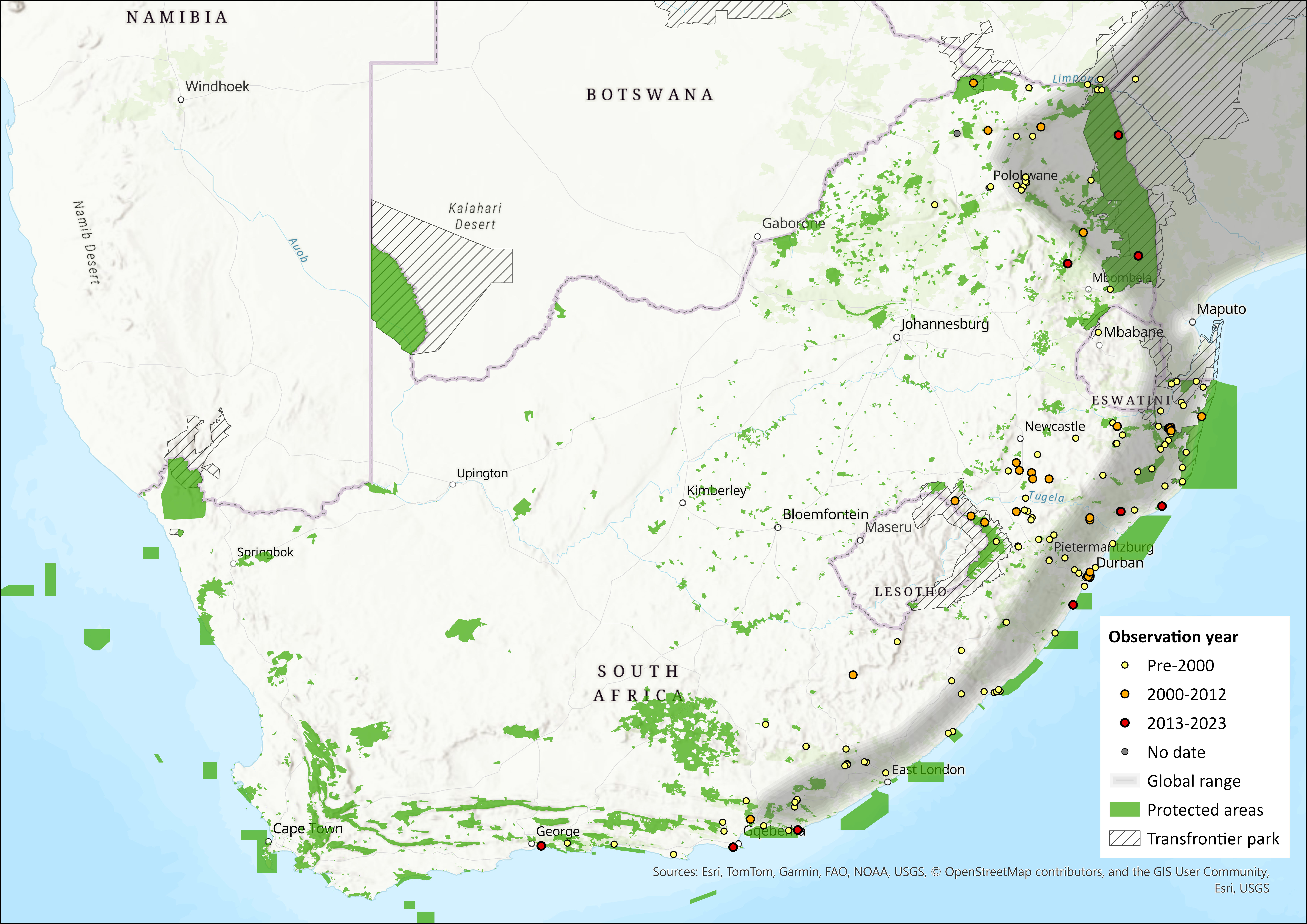
Figure 1. Distribution records for Woodland Mouse (Grammomys dolichurus) within the assessment region (South Africa, Eswatini and Lesotho). Note that distribution data is obtained from multiple sources and records have not all been individually verified.
Biogeographic Realms
Biogeographic Realm: Afrotropical
Occurrence
Countries of Occurrence
| Country | Presence | Origin | Formerly Bred | Seasonality |
| Eswatini | Extant | Native | – | – |
| South Africa | Extant | Native | – | – |
Large Marine Ecosystems (LME) Occurrence
Large Marine Ecosystems: (Not specified)
FAO Area Occurrence
FAO Marine Areas: (Not specified)
Climate change
There is no information on this species but given its restricted distribution in fragmented forests in eastern South Africa, niche models should be performed to predict the impact of climate changes on its distribution.
Population
The Woodland Thicket Rat is a common species and has a continuous distribution within the assessment region (Bryja et al. 2025). Furthermore, it can occur in agricultural and urban areas, so we suspect the population is stable or increasing. However, this species often comprises only a small proportion of the small mammals surveyed at sites, for example 3.7% in Afromontane forests in KwaZulu-Natal (Wirminghaus & Perrin 1993) and 1.5% in sand forests in KwaZulu-Natal (Delcros et al. 2015). In Karkloof Forest, annual fluctuations in population abundance of G. dolichurus was lower than for terrestrial rodents, such as Rhabdomys pumilio, Mastomys natalensis and Myosorex varius (Wirminghaus & Perrin 1993). It had a low, but stable mean density of 1.1 animals/ha in an Afromontane forest of South Africa (Wirminghaus & Perrin 1993).
Population Information
Current population trend: Stable or increasing
Continuing decline in mature individuals: No
Number of mature individuals in population: Unknown
Number of mature individuals in largest subpopulation: Unknown
Number of subpopulations: Unknown
Severely fragmented: No
Quantitative Analysis
Probability of extinction in the wild within 3 generations or 10 years, whichever is longer, maximum 100 years: (Not specified)
Probability of extinction in the wild within 5 generations or 20 years, whichever is longer, maximum 100 years: (Not specified)
Probability of extinction in the wild within 100 years: (Not specified)
Population Genetics
To date, no population genetic study has been conducted on the species. However, a recent phylogeographic study conducted on the genus Grammomys has greatly resolved our understanding of G. dolichurus – in particular its extent of occurrence (Bryja et al. 2025; see Distribution).
The species is assumed to exist as a single metapopulation throughout the assessment region given its continuous distribution and its ability to utilise agricultural and urban areas (see Population section). A population genetic study is highly recommended to verify this, especially considering much of its habitat is fragmented.
Based on available density estimates, it is projected that more than 10,000 individuals exist within the assessment region. This estimate can be used to quantify the effective population size (Ne) for the species, by applying a Ne/Nc conversion ratio of 0.1-0.3. This yields an Ne of over 1,000-3,000 individuals, far exceeding the Ne 500 threshold indicative of a stable and healthy population. Given this value is based on several assumptions and estimations, they should be validate using molecular techniques.
Habitats and ecology
This species inhabits forest areas (dry forest and moist lowland forest); dry, moist and high altitude shrubland; woodlands; as well as anthropogenic habitats, such as arable land, pasture land and urban areas. It prefers thick vegetation, but is absent from Africa’s rainforest zone (Monadjem et al. 2015). In Eswatini, this species was found in a boulder-strewn thicket of a steep slope at Maguga Dam (Avenant & Kuyler 2002). They are often found in secondary growth areas with shrubs (Happold 2013).
Woodland Thicket Rats are nocturnal and typically arboreal yet may be terrestrial when trees and bushes are scarce. They are highly agile and have various adaptations for climbing, including a long digit on the hindfoot and a long tail for balance (Happold 2013). They build spherical nests from grasses and leaves with a single entrance up to about 4 m above the ground (Happold 2013). They also nest in axils of banana leaves and pineapple plants, and are occasionally found in abandoned barbet and weaver nests (Happold 2013). They are considered communal, and several individuals or family groups have been found within the same nest (Roberts 1951).
In Karkloof Forest (KwaZulu-Natal), a study revealed that 47% of the stomach contents from 11 individuals was made up of fruit, 46% of leaves and stems and 6% of invertebrates (Wirminghaus & Perrin 1992). From limited information pertaining to the reproductive ecology of this species, it appears that it has a prolonged breeding season, which peaks in the warm, wet summer months from October to February (Skinner & Chimimba 2005).
Ecosystem and cultural services: No specific ecosystem services have been identified for this species, but this may simply reflect the paucity of information available for this poorly known species.
IUCN Habitats Classification Scheme
| Habitat | Season | Suitability | Major Importance? |
| 1.5. Forest -> Forest – Subtropical/Tropical Dry | – | Suitable | – |
| 1.6. Forest -> Forest – Subtropical/Tropical Moist Lowland | – | Suitable | – |
| 3.5. Shrubland -> Shrubland – Subtropical/Tropical Dry | – | Suitable | – |
| 3.6. Shrubland -> Shrubland – Subtropical/Tropical Moist | – | Suitable | – |
| 3.7. Shrubland -> Shrubland – Subtropical/Tropical High Altitude | – | Suitable | – |
| 4.5. Grassland -> Grassland – Subtropical/Tropical Dry | – | Suitable | – |
| 14.1. Artificial/Terrestrial -> Artificial/Terrestrial – Arable Land | – | Suitable | – |
| 14.2. Artificial/Terrestrial -> Artificial/Terrestrial – Pastureland | – | Suitable | – |
| 14.5. Artificial/Terrestrial -> Artificial/Terrestrial – Urban Areas | – | Suitable | – |
Life History
Generation Length: (Not specified)
Age at Maturity: Female or unspecified: (Not specified)
Age at Maturity: Male: (Not specified)
Size at Maturity (in cms): Female: (Not specified)
Size at Maturity (in cms): Male: (Not specified)
Longevity: (Not specified)
Average Reproductive Age: (Not specified)
Maximum Size (in cms): (Not specified)
Size at Birth (in cms): (Not specified)
Gestation Time: (Not specified)
Reproductive Periodicity: (Not specified)
Average Annual Fecundity or Litter Size: (Not specified)
Natural Mortality: (Not specified)
Does the species lay eggs? (Not specified)
Does the species give birth to live young: (Not specified)
Does the species exhibit parthenogenesis: (Not specified)
Does the species have a free-living larval stage? (Not specified)
Does the species require water for breeding? (Not specified)
Movement Patterns
Movement Patterns: (Not specified)
Congregatory: (Not specified)
Systems
System: Terrestrial
General Use and Trade Information
This species is not known to be traded or utilised in any form.
Local Livelihood: (Not specified)
National Commercial Value: (Not specified)
International Commercial Value: (Not specified)
End Use: (Not specified)
Is there harvest from captive/cultivated sources of this species? (Not specified)
Harvest Trend Comments: (Not specified)
Threats
In view of the species adaptability, there are presumably no major threats. However, domestic cats may prey on this species in urban and agricultural areas.
Conservation
This species occurs in several protected areas within the assessment region, for example, Ndumo Game Reserve, Mkhuze Game Reserve and Kruger National Park. There are no specific conservation interventions necessary at present.
Recommendations for land managers and practitioners:
- No specific management recommendations have been identified.
Research priorities:
- Taxonomic resolution is necessary as this may comprise a species complex. Studies should aim to confirm the status of the northern population and whether that group represents the distinct species G. surdaster.
Encouraged citizen actions:
- Landowners and city planners should conserve corridors of forest on their properties and/or in public spaces.
- Report sightings on virtual museum platforms (for example, iNaturalist and MammalMAP), especially outside protected areas. However, due to morphological similarity and sympatric distributions in some parts, misidentification of this species with G. cometes is common.
Bibliography
Avenant NL, Kuyler P. 2002. Small mammal diversity in the Maguga Dam inundatio n area, Swaziland. South African Journal of Wildlife Research 32: 101-108.
Bryja J, Šumbera R, Kerbis Peterhans JC et al. 2017. Evolutionary history of the thicket rats (genus Grammomys) mirrors the evolution of African forests since late Miocene. Journal of Biogeography. 44:182–94. https://doi.org/10.1111/jbi.12890
Bryja, J., Kerbis Peterhans, J. C.. Lavrenchenko, L. A., Nicolas, V., Denys, C., Bryjová, A., Šumbera, R., Mikula, O., 2025. Integrative taxonomic revision of the African thicket rats (Murinae: Grammomys): how genomics decreases the number of currently recognized species, Zoological Journal of the Linnean Society, Volume 203, Issue 2, zlae057, https://doi.org/10.1093/zoolinnean/zlae057
Delcros G, Taylor PJ, Schoeman MC. 2005. Environmental correlates of small mammal assemblage structure at different spatial scales in the savannah biome of South Africa. Mammalia 79: 1–14.
Happold DCD. 2013. Grammomys dolichurusWoodland Thicket Rat (Common Grammomys). In: Happold DCD (ed.), Mammals of Africa, Volume III: Rodents, Hares and Rabbits, Bloomsbury Publishing, London, UK.
Kryštufek B, Baxter RM, Haberl W, Zima J, Bužan EV. 2008. Systematics and biogeography of the Mozambique thicket rat, Grammomys cometes, in Eastern Cape province, South Africa. Journal of Mammalogy 89: 325–335.
Monadjem, A., Taylor, P.J., Denys, C. and Cotterill, F.P.D. 2015. Rodents of Sub-Saharan Africa: A Biogeographic and Taxonomic Synthesis. . De Gruyter, Berlin, Germany.
Musser, G.G. and Carleton, M.D. 1993. Family Muridae. In: D.E. Wilson and D.A. Reeder (eds), Mammal species of the world: A taxonomic and geographic reference, pp. 501-736. Smithsonian Institution Press, Washington, DC, USA.
Roberts, A. 1951. The Mammals of South Africa. Central New Agency, Johannesburg, South Africa.
Skinner, J.D. and Chimimba, C.T. (eds). 2005. The Mammals of the Southern African Subregion. Cambridge University Press, United Kingdom, Cambridge.
Taylor, P. 1998. The smaller mammals of KwaZulu-Natal. University of Natal Press, Pietermaritzburg, South Africa.
Wirminghaus JO, Perrin MR. 1993. Seasonal changes in density, demography and body fat composition of small mammals in a southern temperate forest. Journal of Zoology 229: 303–318.
Wirminghaus, J.O. and Perrin, M.R. 1992. Diets of small mammals in a southern African temperate forest. Israel Journal of Zoology 38: 353–361.