
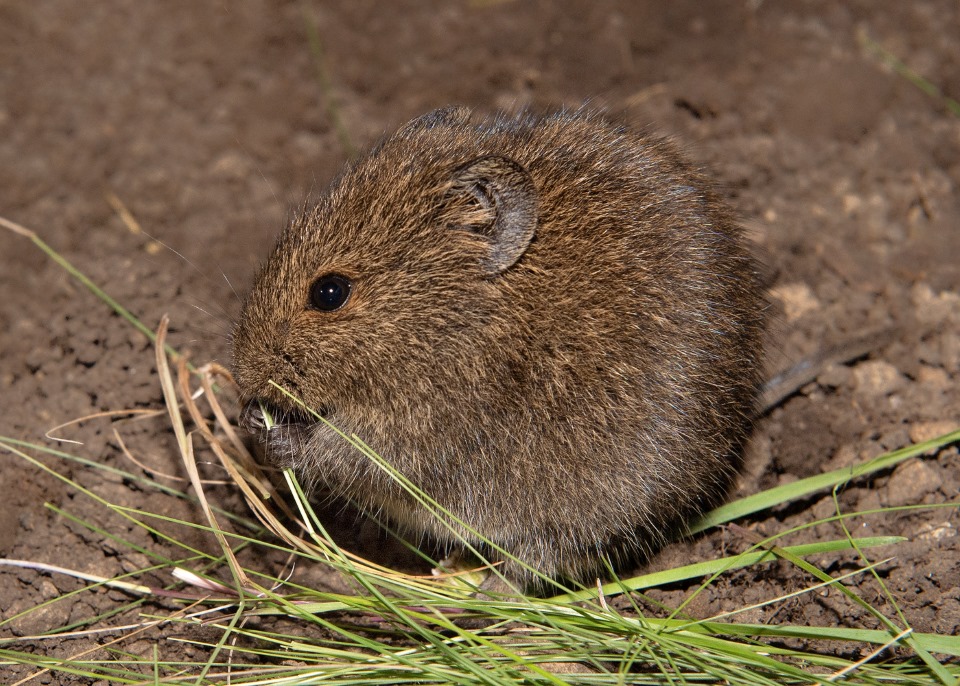
Willan’s Vlei Rat
Otomys willani

2025 Red list status
Least Concern

Regional Population Trend
Unknown

Change compared
to 2016
New Assessment
Overview
Otomys willani – Taylor et al. 2020
ANIMALIA – CHORDATA – MAMMALIA – RODENTIA – MURIDAE – Otomys – willani
Common Names: Willan’s Vlei Rat (English)
Synonyms: None
Taxonomic Note: Formerly part of O saundersiae (which is a synonym of O. irroratus) and then O. karoensis, but Taylor et al. (2020 showed that Eastern Cape specimens of O. karoensis s.l. were phylogenetically and morphologically highly distinct from O. karoensis s.s. from the Western Cape (of which the sister species is O. laminatus).Three very small-sized specimens from the Free State, noted as O. cf. karoensis sp. 2 by Taylor et al. (2020) seem to represent a genetically distinct, undescribed species that is probably more widespread in the Free State, including Golden Gate Highlands National Park where two similar-sized and genetically unique individuals were captured and released in 2019 (Ramoejane, unpublished data).
Red List Status: LC – Least Concern
Assessment Information
Assessors: Taylor, P.1 & da Silva, J.M.2
Reviewer: Oosthuizen, M.3
Institutions: 1University of the Free State,2South African National Biodiversity Institute, 3University of Pretoria
Assessment Rationale
This species is listed as Least Concern as it probably does not reach any EOO or AOO thresholds.
Reasons for Change
Reason(s) for Change in Red List Category from the Previous Assessment: No change, new assessment
Red List Index
Red List Index: New assessment
Recommended Citation: Taylor P & da Silva JM. 2025. A conservation assessment of Otomys willani. In Patel T, Smith C, Roxburgh L, da Silva JM & Raimondo D, editors. The Red List of Mammals of South Africa, Eswatini and Lesotho. South African National Biodiversity Institute and Endangered Wildlife Trust, South Africa.
Regional Distribution and occurrence
Geographic Range
The species occurs along the Southern Great Escarpment from the Sneeuberg to the southern Drakensberg at elevations > 2000 m a.s.l., from the Karoo National Park in the west to Giant’s Castle in KwaZulu-Natal Province in the east (Taylor et al. 2020).
Elevation / Depth / Depth Zones
Elevation Lower Limit (in metres above sea level): 2000 m
Elevation Upper Limit (in metres above sea level): 2700 m
Depth Lower Limit (in metres below sea level): N/A
Depth Upper Limit (in metres below sea level): N/A
Depth Zone: N/A
Map
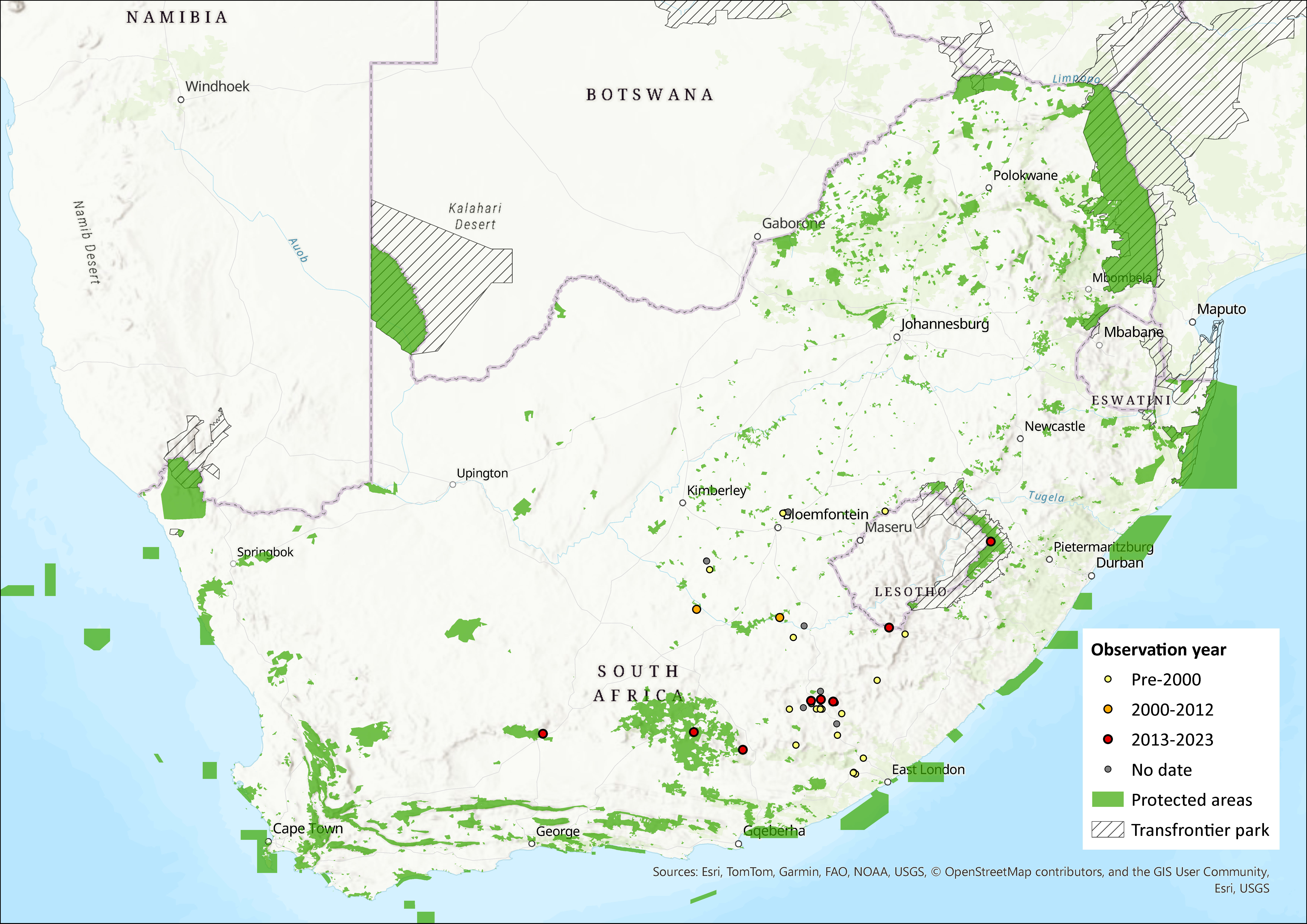
Figure 1. Distribution records for Willan’s Vlei Rat (Otomys willani) within the assessment region (South Africa, Eswatini and Lesotho). Note that distribution data is obtained from multiple sources and records have not all been individually verified.
Biogeographic Realms
Biogeographic Realm: Afrotropical
Occurrence
Countries of Occurrence
| Country | Presence | Origin | Formerly Bred | Seasonality |
| South Africa | Extant | Native | – | Resident |
Large Marine Ecosystems (LME) Occurrence
Large Marine Ecosystems: (Not specified)
FAO Area Occurrence
FAO Marine Areas: (Not specified)
Climate change
Like O. auratus, O. willani is a grassland montane species that is projected to decline in range with climate change by 2050 (Taylor et al. 2016).
Population Information
There is currently no information available for the population size or densities of this species.
Population Information
Continuing decline in mature individuals? (Not specified)
Extreme fluctuations in the number of subpopulations: (Not specified)
Continuing decline in number of subpopulations: (Not specified)
All individuals in one subpopulation: (Not specified)
Number of mature individuals in largest subpopulation: (Not specified)
Number of Subpopulations: (Not specified)
Quantitative Analysis
Probability of extinction in the wild within 3 generations or 10 years, whichever is longer, maximum 100 years: (Not specified)
Probability of extinction in the wild within 5 generations or 20 years, whichever is longer, maximum 100 years: (Not specified)
Probability of extinction in the wild within 100 years: (Not specified)
Population Genetics
A recent phylogenetic study revealed the existence of a unique lineage of Otomys previously attributed to O. karoensis (currently O. willani; Taylor et al. 2020). No evidence of separate subpopulations, or genetic structure was detected within the species (Taylor et al. 2020). Consequently, the species is thought to exist as a single metapopulation within the assessment region. Because no information exists related to population sizes or densities, estimates of effective population size (Ne) cannot be quantified at this time.
Habitats and ecology
This species occupies open grasslands between about 2000 m and 2700 m (Taylor et al. 2020). At higher elevations, they co-occur with Otomys sloggetti.
Ecosystem and cultural services: Vlei rats are an important food source for a number of mammalian predators such as Serval (Leptailurus serval), Marsh Owls (Asio capensis) and Barn Owls (Tyto alba) (Skinner and Chimimba 2005, Monadjem et al. 2015).
IUCN Habitats Classification Scheme
| Habitat | Season | Suitability | Major Importance? |
| 4.7. Grassland -> Grassland – Subtropical/Tropical High Altitude | – | Suitable | – |
| 5.4. Wetlands (inland) -> Wetlands (inland) – Bogs, Marshes, Swamps, Fens, Peatlands | – | Suitable | – |
| – |
Life History
Generation Length: (Not specified)
Age at Maturity: Female or unspecified: (Not specified)
Age at Maturity: Male: (Not specified)
Size at Maturity (in cms): Female: (Not specified)
Size at Maturity (in cms): Male: (Not specified)
Longevity: (Not specified)
Average Reproductive Age: (Not specified)
Maximum Size (in cms): (Not specified)
Size at Birth (in cms): (Not specified)
Gestation Time: Likely around 40 days as in other Otomys species
Reproductive Periodicity: (Not specified)
Average Annual Fecundity or Litter Size: (Not specified)
Natural Mortality: (Not specified)
Does the species lay eggs? no
Does the species give birth to live young: yes
Does the species exhibit parthenogenesis: no
Does the species have a free-living larval stage? no
Does the species require water for breeding? no
Movement Patterns
Movement Patterns: (Not specified)
Congregatory: (Not specified)
Systems
System: Terrestrial
General Use and Trade Information
This species is not known to be utilised or traded.
Local Livelihood: (Not specified)
National Commercial Value: (Not specified)
International Commercial Value: (Not specified)
End Use: (Not specified)
Is there harvest from captive/cultivated sources of this species? (Not specified)
Harvest Trend Comments: (Not specified)
Threats
There are no major threats known, although habitat loss and degradation from wetland drainage, grassland loss and exotic vegetation, are all suspected to be minor threats. Additionally, climate change may represent an emerging threat to the montane grassland habitats that this species predominantly occupies. Climate modelling for similarly mesic-adapted Otomys species reveals significant reductions in area of occupancy by 2050 (Taylor et al. 2016). More research is needed to determine specific effects of climate change on O. willani.
Wetlands are the most threatened ecosystem in South Africa (Driver et al. 2012). The South African National Land-Cover change report found a 32.8% decline in natural wetlands nationally from 1990-2013/14, which is a combination of both genuine wetland loss through anthropogenic activities and the generally drier conditions currently that in 1990 (GeoTerraImage 2015).
Conservation
This species occurs within at least five protected areas within the Western Cape (Karoo National Park), Eastern Cape (Asante Sana Nature Reserve, Mountain Zebra National Park, Grassland National Park) and KwaZulu-Natal (uKhahlamba-Drakensberg National Park). Ongoing degradation of wetlands, over-grazing and soil erosion are likely to severely negatively impact habitat quality. Although no specific interventions are necessary at present, the conservation and restoration of wetlands and grasslands would benefit this species. The following interventions are thus encouraged:
- Using previously cultivated areas for development instead of remaining natural areas.
- Land managers should maintain a vegetation buffer around wetlands to reduce impacts of land-use practices (Driver et al. 2012).
Bibliography
Bowland, A.E. and Perrin, M.R. 1989. The effect of overgrazing on the small mammals in Umfolozi Game Reserve. Zeitschrift für Säugetierkunde 54: 251–260.
Bowland, J.M. 1990. Diet, home range and movement patterns of serval on farmland in Natal. Department of Zoology and Entomology, University of Natal.
Driver, A., Sink, K.J., Nel, J.N., Holness, S., Van Niekerk, L., Daniels, F., Jonas, Z., Majiedt, P.A., Harris, L. and Maze, K. 2012. National Biodiversity Assessment 2011: An assessment of South Africa’s biodiversity and ecosystems. Synthesis Report. South African National Biodiversity Institute and Department of Environmental Affairs, Pretoria, South Africa.
GeoTerraImage. 2015. 1990-2013/14 South African National Land-Cover Change. DEA/CARDNO SCPF002: Implementation of Land-Use Maps for South Africa. Project Specific Data Report.
IUCN. 2017. The IUCN Red List of Threatened Species. Version 2017-2. Available at: www.iucnredlist.org. (Accessed: 14 September 2017).
Meester, J.A.J., Rautenbach, I.L., Dippenaar, N.J. and Baker, C.M. 1986. Classification of Southern African Mammals. Monograph number 5. Transvaal Museum , Pretoria, South Africa.
Monadjem, A., Taylor, P.J., Denys, C. and Cotterill, F.P.D. 2015. Rodents of Sub-Saharan Africa – a biogeographic and taxonomic synthesis. De Gruyter, Berlin/Munich/Boston.
Pence, G.Q.K. 2012. Contribution of C.A.P.E. Business and Biodiversity Initiatives to conservation of critical biodiversity, landscape connectivity and ecological support areas: Post-baseline assessment (2010). A Green Choice Alliance project report. Conservation South Africa, Kirstenbosch, South Africa.
Skinner, J.D. and Chimimba, C.T. (eds). 2005. The Mammals of the Southern African Subregion. Cambridge University Press, United Kingdom, Cambridge.
Taylor, P.J., Nengovhela, A., Linden, J. and Baxter, R.M. 2016. Past, present, and future distribution of Afromontane rodents (Muridae: Otomys) reflect climate-change predicted biome changes. Mammalia 80: 359–375.
Taylor, P. J., Kearney, K., Dalton, D., Mataruse, G., Kelly, C. M. R. and Barker, N. P. 2020. Biomes, geology and past climate drive speciation of laminate-toothed rats on South African mountains (Murinae: Otomys). Zoological Journal of the Linnean Society 189: 1046–1066, https://doi.org/10.1093/zoolinnean/zlz134.