
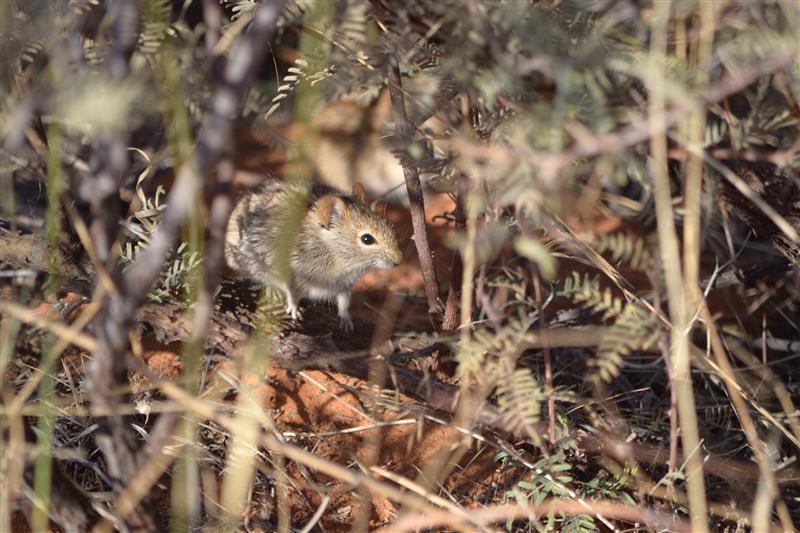
West-Central Four-striped Grass Rat
Rhabdomys bechuanae

2025 Red list status
Least Concern

Regional Population Trend
Unknown

Change compared
to 2016
No Change
Overview
Rhabdomys bechuanae – (Thomas, 1893)
ANIMALIA – CHORDATA – MAMMALIA – RODENTIA – MURIDAE – Rhabdomys – bechuanae
Common Names: West-Central Four-striped Grass Rat (English)
Synonyms: No Synonyms
Previously included under R. pumilio (Rambau et al. 2003; Du Toit et al. 2012) provided molecular evidence for the presence of three distinct paraphyletic taxa within R. pumilio; R. pumilio sensu stricto is more closely related to the R. dilectus group than to the other two taxa (R. bechuanae and R. intermedius) (Du Toit et al. 2012). R. bechuanae is the most distant from the R. dilectus group.
Taxonomic Note: South Africa: Reproductive isolation due to pre- and post-mating barriers have been found among several populations of the former R. pumilio group (Pillay 2000, Pillay et al. 2006). Based on deep mitochondrial genetic divergence, paraphyly of R. pumilio with respect to R. dilectus and different ecological preferences of the three genetic lineages within R. pumilio, the recognition of four species (R. dilectus, R. pumilio, R. bechuanae, and R. intermedius) was suggested (du Toit et al. 2012), confirmed by ongoing studies involving nuclear genomics (Ganem G pers comm). Further molecular research (particularly including more nuclear data) and cranial morphometric analyses would be useful to fully resolve the taxonomy of the genus. Until such time, it is recommended that Rhabdomys be treated as a species complex.
Red List Status: LC – Least Concern
Assessment Information
Assessors: Ganem, G.1 & da Silva, J.M.2
Reviewer: Pillay, N.3
Contributor: Patel, T.4
Institutions:1Montpellier University,2South African National Biodiversity Institute,3University of the Witwatersrand,4Endangered Wildlife Trust
Previous Assessors and Reviewers: Du Toit, N., Pillay, N., Ganem, G. & Relton, C.
Previous Contributors: Child, M.F., Avenant, N., Avery, M., Baxter, R., MacFadyen, D., Mondajem, A., Palmer, G., Taylor, P. & Wilson, B.
Assessment Rationale
Rhabdomys bechuanae is listed as Least Concern and has a wide distribution across the interior of South Africa as well as Namibia and probably Botswana (not confirmed by genotyping). It is found in arid and semi-arid habitats that are currently transformed to some extent, as observed enhanced average dry conditions and frequency of droughts, may be challenging the species considering that it is not a desert specialist (see Keilani et al. 2024). The species occur in many protected areas which should limit the impact of direct human activity. Within the assessment region, R. bechuanae occurs in the Free State Province and northern reaches of the North West and Northern Cape Province.
The species does not rely on ground cover, and nest in bushes (Dufur et al. 2015, 2019), thus should not be adversely affected by overgrazing. Recent research has focused on delimiting the geographical extent of R. bechuanae and investigated their ecological and physiological specificities (Dufour et al. 2015, 2019; Ganem et al. 2020; Keilani et al. 2024). Evidence indicates even mild, seasonal increase in dry conditions can have negative impacts on R. bechuanae individuals thriving in semi-arid environments (Keilani et al. 2024).
Regional population effects: Dispersal between regions is possible for R. bechuanae as this species has a continuous distribution and occur in a relatively wide array of habitats.
Red List Index
Red List Index: No change
Recommended Citation: Ganem G & da Silva JM. 2025. A conservation assessment of Rhabdomys bechuanae. In Patel T, Smith C, Roxburgh L, da Silva JM & Raimondo D, editors. The Red List of Mammals of South Africa, Eswatini and Lesotho. South African National Biodiversity Institute and Endangered Wildlife Trust, South Africa.
Regional Distribution and occurrence
Geographic Range
The distribution of R. bechuanae ranges from Namibia to the Northern Cape, the North West and the Free State Provinces of South Africa. At the limits of its eastern range (Free State Province) it occurs in sympatry with R. dilectus dilectus and R. dilectus chakae (Ganem et al. 2020) with no signs of hybridisations (unpublished data personal communication Ganem G.). R. bechuanae populations thrive in summer rainfall regions (Schulze 1997) in the Desert and Savannah biomes of Namibia as well as the Nama Karoo, Savannah and Grassland biomes of South Africa. All contact zones involving R. bechuanae are also located in an area still considered to be part of the Grassland biome, at the eastern margin of the species distribution, still, at a microenvironmental scale, it resembles a semi-arid habitat (Dufour et al. 2015).
Elevation / Depth / Depth Zones
Elevation Lower Limit (in metres above sea level): 30
Elevation Upper Limit (in metres above sea level): 1300
Depth Lower Limit (in metres below sea level): (Not specified)
Depth Upper Limit (in metres below sea level): (Not specified)
Depth Zone: (Not specified)
Map
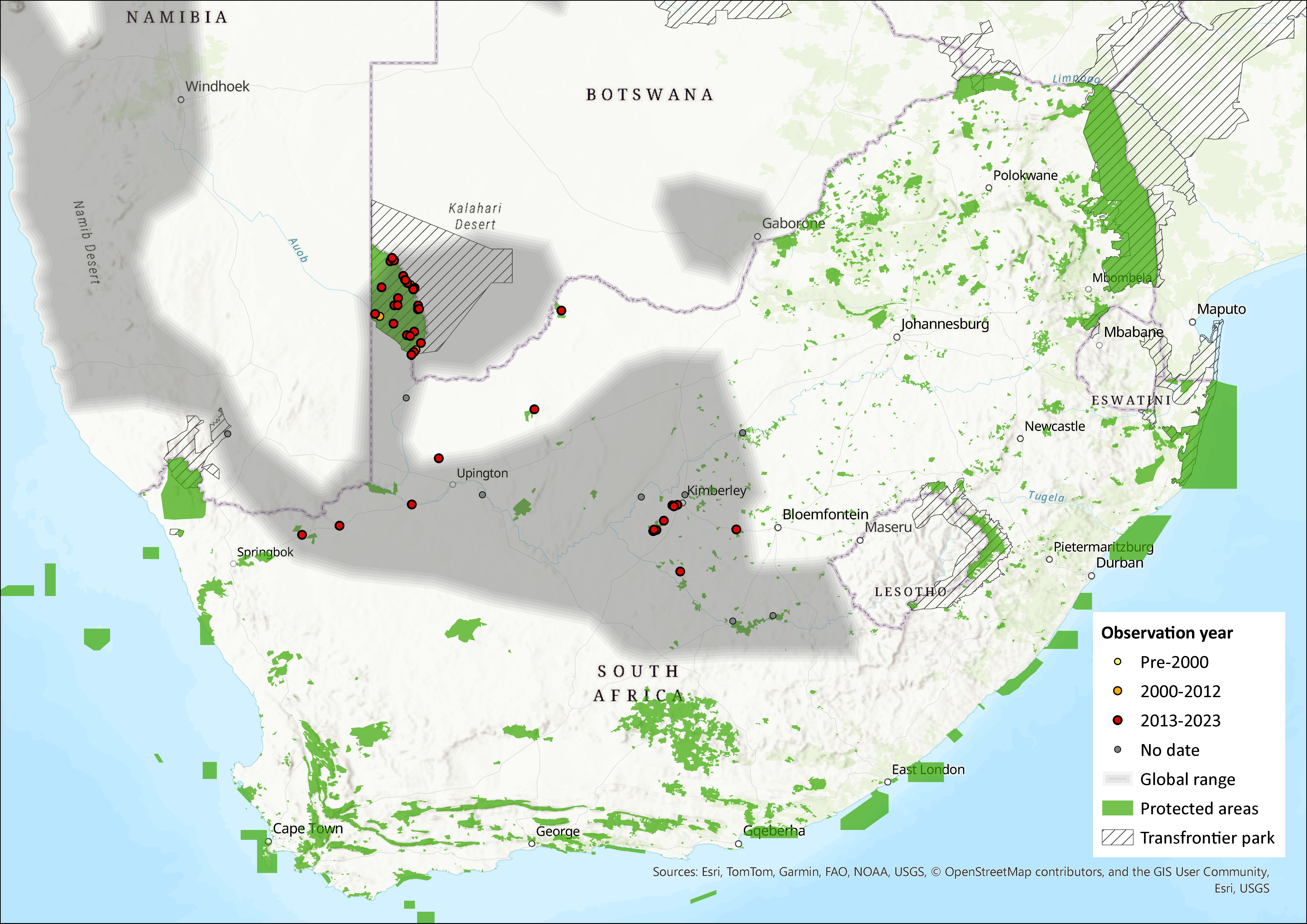
Figure 1. Distribution records for West-Central Four-striped Grass Rat (Rhabdomys bechuanae) within the assessment region (South Africa, Eswatini and Lesotho). Note that distribution data is obtained from multiple sources and records have not all been individually verified.
Biogeographic Realms
Biogeographic Realm: (Not specified)
Occurrence
Countries of Occurrence
| Country | Presence | Origin | Formerly Bred | Seasonality |
| Botswana | Not confirmed by genotyping | Native | – | – |
| Namibia | Extant | Native | – | – |
| South Africa | Extant | Native | – | – |
Large Marine Ecosystems (LME) Occurrence
Large Marine Ecosystems: (Not specified)
FAO Area Occurrence
FAO Marine Areas: (Not specified)
Climate change
Although the species thrives in semi-arid and arid habitats, it is not a desert specialist. Investigations of the physiological responses of semi-arid populations of the species to seasonal variations in dry conditions, even mild, indicate negative impact on an individuals condition. Across its desert range, populations of the species are found in relatively humid areas (around dams). Hence human activity may have a positive effect on maintenance of R. bechuanae populations in arid areas.
Population Information
No national abundance information is available for this species and, although they can be locally and temporally abundant, their densities are known to fluctuate (Happold 2013). Fast growth, followed by population crashes possibly related to dry conditions (Ganem et al. 2020), occur frequently. The species commonly occurs in high numbers, sometimes significantly higher than all other co-occurring small mammal species (Happold 2013).
Population Information
Current population trend: Unknown
Continuing decline in mature individuals? No
Extreme fluctuations in the number of subpopulations: Yes
Continuing decline in number of subpopulations: No
All individuals in one subpopulation: No
Number of mature individuals in population: Unknown
Number of mature individuals in largest subpopulation: Unknown
Number of Subpopulations: Unknown
Severely fragmented: No
Quantitative Analysis
Probability of extinction in the wild within 3 generations or 10 years, whichever is longer, maximum 100 years: no
Probability of extinction in the wild within 5 generations or 20 years, whichever is longer, maximum 100 years: no
Probability of extinction in the wild within 100 years: (Not specified)
Population Genetics
Phylogenetic analyses have provided great insights into the distribution and genetic diversification of species within the Rhabdomys pumilio complex (du Toit et al. 2012; Ganem et al. 2020).
Ongoing research based on nuclear genomic data should improve our knowledge on the population genetics of the species in the near future. With regard to R. bechuanae, evidence from one mitochondrial marker indicates that there could be relatively high genetic diversity within the species, with patterns consistent with a recent expansion (Ganem et al. 2020); however, more fine scale molecular work incorporated nuclear markers is needed to unravel the extent of this diversity and structure. Research based on nuclear genomic data is currently underway and should improve our knowledge on the population genetics of the species in the future.
Based on the available information, it is currently not possible to quantify the two population’s genetic indicators in the Convention on Biological Diversity’s Global Biodiversity Framework’s (GBF); The complementary genetic indicator – proportion of populations maintained (PM), or the headline indicator – proportion of species with an effective population size (Ne) greater than 500.
Habitats and ecology
Rhabdomys is diurnal and crepuscular omnivores with a diet of seeds, fruits, green plant material, Acacia pods, Protea flower bracts, Pinus bark and arthropods (Fuller and Perrin 2001, Skinner and Chimimba 2005, Monadjem et al. 2015). They are primarily granivorous, but depending on the season, are known to be opportunistically omnivorous, occasionally consuming insects (Perrin and Curtis 1980). Research suggests that the mesic-adapted R. dilectus is mostly solitary whereas the more arid-adapted species appear to be more communal (Schradin and Pillay 2005). The genus as a whole has been frequently described as a niche generalist. The four proposed species, however, appear to present different niche requirements, some of them appearing as specialists (du Toit et al. 2012, Meynard et al. 2012). Ecological niche modelling supports the separation of the xeric and the mesic species along a precipitation and temperature gradient from east to west (du Toit et al. 2012, Meynard et al. 2012).
Ecosystem and cultural services: Rhabdomys species is particularly important forage species for diurnal raptors, snakes and small mammals, including Caracal (Caracal caracal), Black-backed Jackal (Lupulella mesomelas), African Wildcat (Felis silvestris) and several species of mongoose (De Graaff 1997), as they are one of the few diurnal rodent species. Since different species of the complex have different ecological requirements, they may be used as bio-indicators of changes in aridity.
Life History
Generation Length: (Not specified)
Age at maturity: female or unspecified: (Not specified)
Age at Maturity: Male: (Not specified)
Size at Maturity (in cms): Female: (Not specified)
Size at Maturity (in cms): Male: (Not specified)
Longevity: (Not specified)
Average Reproductive Age: (Not specified)
Maximum Size (in cms): (Not specified)
Size at Birth (in cms): (Not specified)
Gestation Time: (Not specified)
Reproductive Periodicity: (Not specified)
Average Annual Fecundity or Litter Size: (Not specified)
Natural Mortality: (Not specified)
Does the species lay eggs? (Not specified)
Does the species give birth to live young: (Not specified)
Does the species exhibit parthenogenesis: (Not specified)
Does the species have a free-living larval stage? (Not specified)
Does the species require water for breeding? (Not specified)
Movement Patterns
Movement Patterns: solitary foraging during the day, communal nesting during nights.
Congregatory: (Not specified)
Systems
System: Terrestrial
General Use and Trade Information
Rhabdomys is currently only being utilised for research and museum collections. It is an important research model to assess social evolution, adaptation to arid conditions and ecological diversification.
Local Livelihood: (Not specified)
National Commercial Value: (Not specified)
International Commercial Value: (Not specified)
End Use: (Not specified)
Is there harvest from captive/cultivated sources of this species? (Not specified)
Harvest Trend Comments: (Not specified)
Threats
As mentioned above, despite its relatively arid distribution, populations of R. bechuanae are often found in bushland close to water sources. Moreover, although R. bechuanae individuals seem to cope better with dry conditions than R. dilectus dilectus, recent investigations of semi-arid populations of the species indicate that even mild dry conditions induce a physiological challenge that could impact the individuals’ reproduction and survival.
Conservation
This species is located in many protected areas throughout its range. It is present within Kgalagadi Transfrontier Park, Richtersveld National Park, Tussen-die-Riviere Nature Reserve and Sandveld Nature Reserve (Ganem et al. 2020). No conservation interventions are deemed necessary for this species.
Research priorities:
- Species geographical distribution, morphometrics, genotyping of populations and taxonomic assessment. This includes vetting of existing museum specimens.
- Species social and general biology.
- Ecology and mechanisms of coexistence with other Rhabdomys species.
The species has been the object of collaborative research since 2011, its distribution and ecological requirements are fairly known, and genomic studies should be finalised by 2025. (Guila Ganem (Institute of Evolutionary Sciences), Neville Pillay (University of the Witwatersrand), Nico Avenant (The National Museum Bloemfontein).
Encouraged citizen actions:
- Report sightings on virtual museum platforms (e.g., iNaturalist and MammalMAP), especially outside protected areas. However, due to their morphological similarities, identification to species level may prove difficult, especially in zones of sympatry.
Bibliography
De Graaf, G. 1997. Striped mouse Rhabdomys pumilio. In: G. Mills and L. Hes (eds), The Complete Book of Southern African Mammals, Struik Publishers, Cape Town, South Africa.
Dufour, C.M., Meynard, C., Watson, J., Rioux, C., Benhamou, S., Perez, J., Du Plessis, J.J., Avenant, N., Pillay, N. and Ganem, G. 2015. Space use variation in co-occurring sister species: response to environmental variation or competition? PloS One 10(2): e0117750. DOI: 10.1371/journal.pone.0117750.
Dufour, C.M.S., Pillay, N., Avenant, N., Watson, J., Loire, E. and Ganem, G. 2019. Habitat characteristics and species interference influence space use and nest-site occupancy: implications for social variation in two sister species. Oikos 128: 503-515. 10.1111/oik.05357
du Toit, N., Jansen van Vuuren , B., Matthee, S. and Matthee, C.A. 2012. Biome specificity of distinct genetic lineages within the four-striped mouse, Rhabdomys pumilio (Rodentia: Muridae) from southern Africa with implications for taxonomy. Molecular Phylogenetics and Evolution 65: 75–86.
Fuller, J.A. and Perrin, M.R. 2001. Habitat assessment of small mammals in the Umvoti Vlei Conservancy, KwaZulu-Natal, South Africa. South African Journal of Wildlife Research 31: 1-12.
Ganem, G., Dufour, C.M.S., Avenant, N.L., Caminade, P., Eiseb, S.J., Tougard, C. and Pillay, N. 2020. An update on the distribution and diversification of Rhabdomys sp. (Muridae, Rodentia). Journal of Vertebrate Biology 69(2): 20013.1–17. https://doi.org/10.25225/jvb.20013
Happold, D.C.D. 2013. Rhabdomys pumilio Four-striped Grass Mouse. In: D.C.D. Happold (ed.), Mammals of Africa vol. III: Rodents, Hares and Rabbits, pp. 545–547. Bloomsbury, London.
Keilani, H., Avenant, N., Caminade, P., Pillay, N. and Ganem, G. 2024. Do sister species respond similarly to dry conditions? An ecophysiological approach in natura, BioRxiv. https://doi.org/10.1101/2024.03.11.583554
Meynard, C.N., Pillay, N., Perrigault, M., Caminade, P. and Ganem, G. 2012. Evidence of environmental niche differentiation in the striped mouse (Rhabdomys sp.): inference from its current distribution in southern Africa. Ecology and Evolution 2: 1008–1023.
Monadjem, A., Taylor, P.J., Denys, C. and Cotterill, F.P.D. 2015. Rodents of Sub-Saharan Africa: A Biogeographic and Taxonomic Synthesis. De Gruyter, Berlin, Germany.
Perrin MR, Curtis BA. 1980. Comparative morphology of the digestive system of 19 species of Southern African myomorph rodents in relation to diet and evolution. South African Journal of Zoology 15: 22–33.
Pillay, N. 2000. Reproductive isolation in three populations of the striped mouse Rhabdomys pumilio (Rodentia, Muridae): interpopulation breeding studies. Mammalia 64: 461–470.
Pillay, N., Eborall, J. and Ganem, G. 2006. Divergence of mate recognition in the African striped mouse (Rhabdomys). Behavioral Ecology 17: 757–764.
Rambau, R.V., Robinson, T.J. and Stanyon, R. 2003. Molecular genetics of Rhabdomys pumilio subspecies boundaries: mtDNA phylogeography and karyotypic analysis by fluorescence in situ hybridization. Molecular Phylogenetics and Evolution 28: 564–575.
Schradin, C. and Pillay N. 2005. Demography of the striped mouse (Rhabdomys pumilio) in the succulent karoo. Mammalian Biology 70: 84–92.
Schulze, R.E. 1997. South African Atlas of Agrohydrology and –Climatology. Report to the Water Research Commission, Report No. TT82/96, Pretoria.
Skinner, J.D. and Chimimba, C.T. (eds). 2005. The Mammals of the Southern African Subregion. Cambridge University Press, United Kingdom, Cambridge.