

Visagies’s Golden Mole
Chrysochloris visagiei

2025 Red list status
Data Deficient

Regional Population Trend
Unknown

Change compared
to 2016
No Change
Overview
Chrysochloris visagiei – Broom, 1950
ANIMALIA – CHORDATA – MAMMALIA – AFROSORICIDA – CHRYSOCHLORIDAE – Chrysochloris – visagiei
Common Names: Visagie’s Golden Mole (English), Visagie se Gouemol (Afrikaans), Visagie-Goldmull (German)
Synonyms: No Synonyms
Taxonomic Note:
Subgenus Chrysochloris. Possibly an aberrant asiatica; see Meester (1974). Simonetta (1968:31) listed it as a subspecies of asiatica. Its taxonomic status should thus be considered incertae sedis.
|
Red List Status |
|
|
DD – Data Deficient, (IUCN version 3.1) |
|
|
|
|
|
Data Deficient reason: |
[1, 2] |
Assessment Information
Assessors: Patel, T.1 & Asher, R.2
Reviewer: Mynhardt, S.1
Institutions: 1Endangered Wildlife Trust, 2University of Cambridge
Previous Assessor: Bronner, G.
Previous Reviewer: Taylor, A.
Previous Contributors: Child, M.F. & Relton, C.
Assessment Rationale
Agriculture has dramatically transformed habitat at the type locality, but impact thereof cannot be assessed given uncertainty about the provenance of the type specimen and/or the habitat requirements of the species. No specimens have been seen or collected since its description, despite two expeditions to the type locality during which not even local farmers ever recalled having seen a golden mole in the district. Further research may show this species to qualify for Critically Endangered if indeed a population still survives at the type location.
Reasons for Change
Reason(s) for Change in Red List Category from the Previous Assessment: No change
Red List Index
Red List Index: No change
Recommended citation: Patel T & Asher R. 2025. A conservation assessment of Chrysochloris visagiei. In Patel T, Smith C, Roxburgh L, da Silva JM & Raimondo D, editors. The Red List of Mammals of South Africa, Eswatini and Lesotho. South African National Biodiversity Institute and Endangered Wildlife Trust, South Africa.
Regional Distribution and occurrence
Geographic Range
This species is known from a single specimen collected from the type locality at Gouna farm, near Calvinia in the Northern Cape, South Africa. Broom (1950:fig. 2A) figured the malleus of the type specimen (KM 12720) of C. visagiei and, in that figure caption, gives its locality as “Rhenoster Riv., Calvinia”. “KM” refers to a collection that is now part of the Amathole Museum in Qonce (formerly King William’s Town), Eastern Cape Province. The entry in the Amathole museum catalogue for this specimen shows a skull and skin under the accession number KM 12720, identified as a female C. visagiei, collected by G.C. Shortridge from “Calvinia, Northern Cape” on “29/10/1945” at an elevation of “3600f” (= 1096m). This elevation corresponds to several areas near the town Calvinia, approaching the adjacent highlands. Broom’s description states “captured by Captain Shortridge at Gouna, 54 miles east of Calvinia”, also roughly corresponding to the distance from Calvinia to the Renosterrivier in Northern Cape. The locality thus appears to correspond with Broom’s “Gouna”. Meester et al. (1986:19) stated “86km east of Calvinia, western Cape province”, although Meester’s reference to “western” and not “Northern” Cape Province is presumably a mistake. There is potential ambiguity about a different “Gouna” in Eastern Cape, not Northern, although the references to Calvinia in both Broom’s description and in the Amathole museum catalogue would indicate that Broom correctly recorded the type specimen’s provenance. A close examination of this specimen, in the context of chrysochlorid diversity across western South Africa, would be an important step towards resolving the long-enigmatic status of this species.
Several field trips to ground-truth the occurrence of this species have yielded no specimens, or even signs of golden moles. It has been suggested that the original specimen was transported there by anthropogenic means (Bronner 2013) or even perhaps by floodwaters of the Renoster River, flowing from the Roggeveld mountains further south where several other species of golden moles occur.
Extent of occurrence (EOO): Unknown
Area of occupancy (AOO): Unknown
Number of locations: One. Species only known from one specimen.
Elevation / Depth / Depth Zones
Elevation Lower Limit (in metres above sea level): (Not specified)
Elevation Upper Limit (in metres above sea level): (Not specified)
Depth Lower Limit (in metres below sea level): (Not specified)
Depth Upper Limit (in metres below sea level): (Not specified)
Depth Zone: (Not specified)
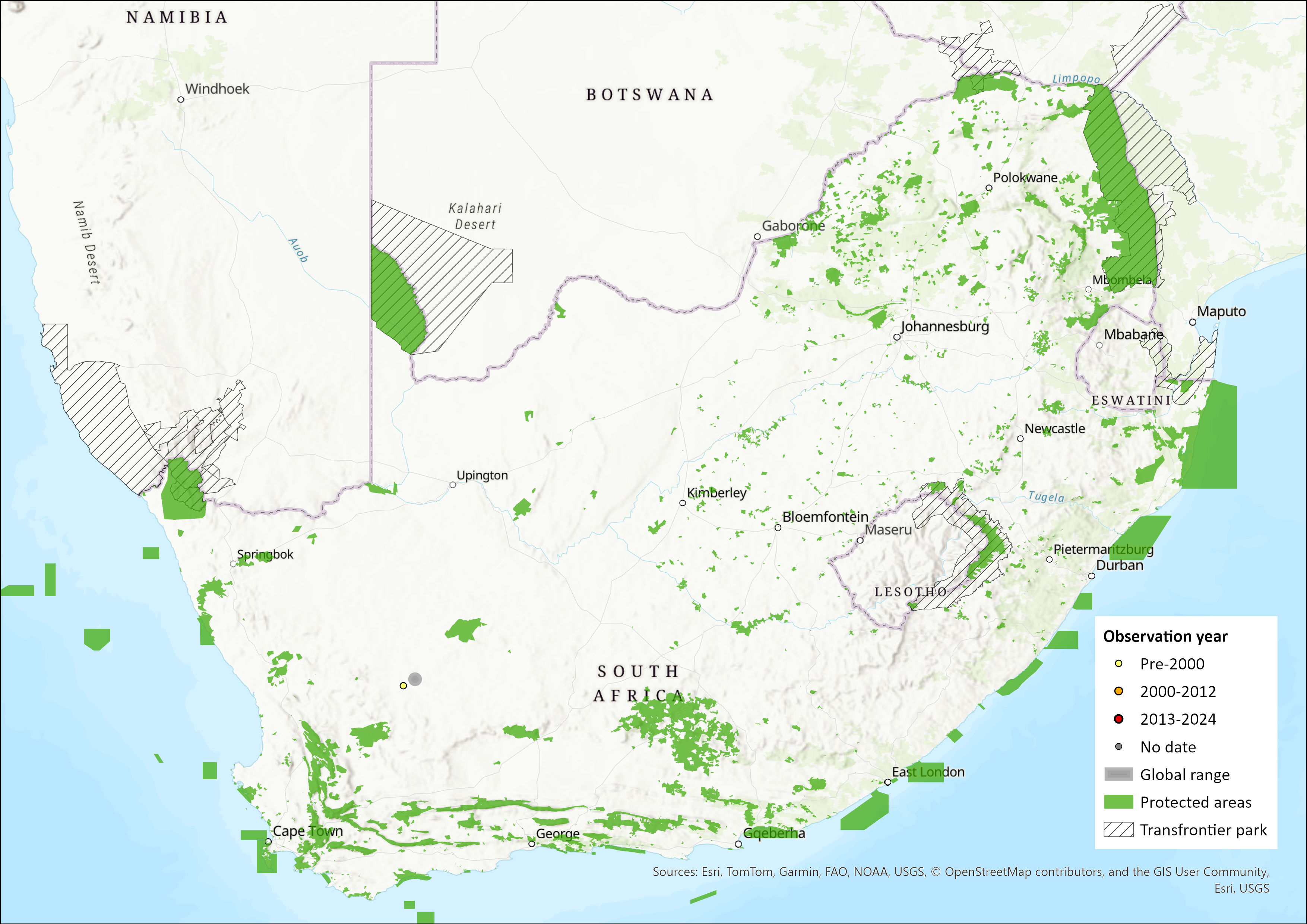
Figure 1. Distribution records for Visagie’s Golden Mole (Chrysochloris visagiei) within the assessment region (South Africa, Eswatini and Lesotho). Note that distribution data is obtained from multiple sources and records have not all been individually verified.
Biogeographic Realms
Biogeographic Realm: Afrotropical
Occurrence
Countries of Occurrence
| Country | Presence | Origin | Formerly Bred | Seasonality |
| South Africa | Extant | Native | – | Resident |
Large Marine Ecosystems (LME) Occurrence
Large Marine Ecosystems: (Not specified)
FAO Area Occurrence
FAO Marine Areas: (Not specified)
Climate change
Although the potential impacts of climate change on this species have not been directly assessed, climate change is expected to impact most golden mole species. Since these subterranean animals are restricted to soft soils for burrowing, and have very low vagility, their ability to migrate or shift their distribution ranges in response to climate change is very limited. Climate change is likely to impact golden moles through changes in vegetation type, soil moisture and prey availability.
Population information
No signs of this species have been found at the type location during two independent expeditions in the last 20 years.
Current population trend: Unknown
Severely fragmented: No
Continuing decline in mature individuals? Unknown
Extreme fluctuations in the number of subpopulations: (Not specified)
Continuing decline in number of subpopulations: (Not specified)
All individuals in one subpopulation: (Not specified)
Number of mature individuals in largest subpopulation: (Not specified)
Number of Subpopulations: (Not specified)
Quantitative Analysis
Probability of extinction in the wild within 3 generations or 10 years, whichever is longer, maximum 100 years: (Not specified)
Probability of extinction in the wild within 5 generations or 20 years, whichever is longer, maximum 100 years: (Not specified)
Probability of extinction in the wild within 100 years: (Not specified)
Population genetics
No molecular information exists for this species. While the species has not been seen since it was described, the uncertainties around its taxonomy make it difficult to assign as locally extinct. As such, no genetic status or indicators can be quantified for this species.
Habitats and ecology
The type locality is situated in Bushmanland Nama-Karoo, with extensive agriculture on the alluvial sand floodplains of the Vis and Renoster Rivers. Adjacent natural habitats are gravel plains and small hills, which appear unsuitable habitats for chrysochlorids. There is currently no information pertaining to the ecology of this species.
IUCN Habitats Classification Scheme
| Habitat | Season | Suitability | Major Importance? |
| 3.5. Shrubland -> Shrubland – Subtropical/Tropical Dry | Resident | Suitable | Yes |
Life History
Generation Length: (Not specified)
Age at Maturity: Female or unspecified: (Not specified)
Age at Maturity: Male: (Not specified)
Size at Maturity (in cms): Female: (Not specified)
Size at Maturity (in cms): Male: (Not specified)
Longevity: (Not specified)
Average Reproductive Age: (Not specified)
Maximum Size (in cms): (Not specified)
Size at Birth (in cms): (Not specified)
Gestation Time: (Not specified)
Reproductive Periodicity: (Not specified)
Average Annual Fecundity or Litter Size: (Not specified)
Natural Mortality: (Not specified)
Breeding Strategy
Does the species lay eggs? No
Does the species give birth to live young? Yes
Does the species exhibit parthenogenesis? No
Does the species have a free-living larval stage? No
Does the species require water for breeding? No
Movement Patterns
Movement Patterns: (Not specified)
Congregatory: (Not specified)
Systems
System: Terrestrial
General Use and Trade Information
General notes regarding trade and use of this species: This species is not known to be traded or utilised in any form.
Local Livelihood: (Not specified)
National Commercial Value: (Not specified)
International Commercial Value: (Not specified)
End Use: (Not specified)
Is there harvest from captive/cultivated sources of this species? (Not specified)
Harvest Trend Comments: (Not specified)
Threats
Extensive agriculture has dramatically transformed habitat at the type locality, but impact thereof cannot be assessed given uncertainty about provenance of the type specimen and/or the habitat requirements of the species.
Continuing decline in area, extent and/or quality of habitat: Unknown. The provenance of the type locality is uncertain.
Conservation
Research is still needed to ground-truth the existence of this species in the Gouna areas of both Northern and Eastern Cape, and/or to trace the locality from which the type specimen was collected. Study of more specimens is required to clarify the systematic status of this taxon. This species has not been identified in any protected areas within the assessment regions. At present no specific conservation interventions can be identified, without additional research and monitoring into the threats, distribution and habitat of this species.
Recommendations for land managers and practitioners: None
Research priorities:
- Field surveys at Gouna Forest, Northern Cape are necessary to assess the possibility of the existence of this species.
- Research on population size, distribution and threats.
Encouraged citizen actions:
- Report sightings on virtual museum platforms (for example, iNaturalist and MammalMAP), especially outside protected areas.
- Deposit any dead specimens found in a state or provincial museum, together with information on the date and site where found.
- Create native vegetation gardens.
Bibliography
Afrotheria Specialist Group. 2014. Specialist Group website. Available at: http://www.afrotheria.net/index.php.
Bronner, G.N. 2013. Chrysochloris visagiei. In: J. Kingdon, D. Happold, T. Butynski, M. Hoffmann, M. Happold and J. Kalina (eds), Mammals of Africa, Volume I: Introductory Chapters and Afrotheria, pp. 246. Bloomsbury Publishing, London.
Bronner, G.N. and Jenkins, P.D. 2005. Order Afrosoricida. In: D.E. Wilson and D.M. Reeder (eds), Mammal Species of the World, pp. 70-81. The Johns Hopkins University Press, Baltimore, MD, USA.
Broom, R. 1950. Some further advances in our knowledge of the Cape golden moles. Annals of the Transvaal Museum 21: 234-241.
IUCN. 2015. The IUCN Red List of Threatened Species. Version 2015.2. Available at: www.iucnredlist.org. (Accessed: 23 June 2015).
Meester, J. 1974. Family Chrysochloridae. Smithsonian Institution Press, Washington, DC, USA.
Meester, J.A.J., Rautenbach, I.L., Dippenaar, N.J. and Baker, C.M. 1986. Classification of Southern African Mammals. Monograph number 5. Transvaal Museum, Pretoria, South Africa.
Nicoll, M.E. and Rathbun, G.B. 1990. African Insectivora and elephant-shrews: An action plan for their conservation. IUCN/SSC Insectivore, Tree-Shrew and Elephant-Shrew Specialist Group. IUCN, Gland, Switzerland.
Simonetta, A.M. 1968. A new golden mole from Somalia with an appendix on the taxonomy of the family Chrysochloridae (Mammalia, Insectivora). Monitore zoologici Italiano, Supplement 2: 27–55.
Skinner, J.D. and Chimimba, C.T. (eds). 2005. The Mammals of the Southern African Subregion. Third edition. Cambridge University Press, United Kingdom, Cambridge.