
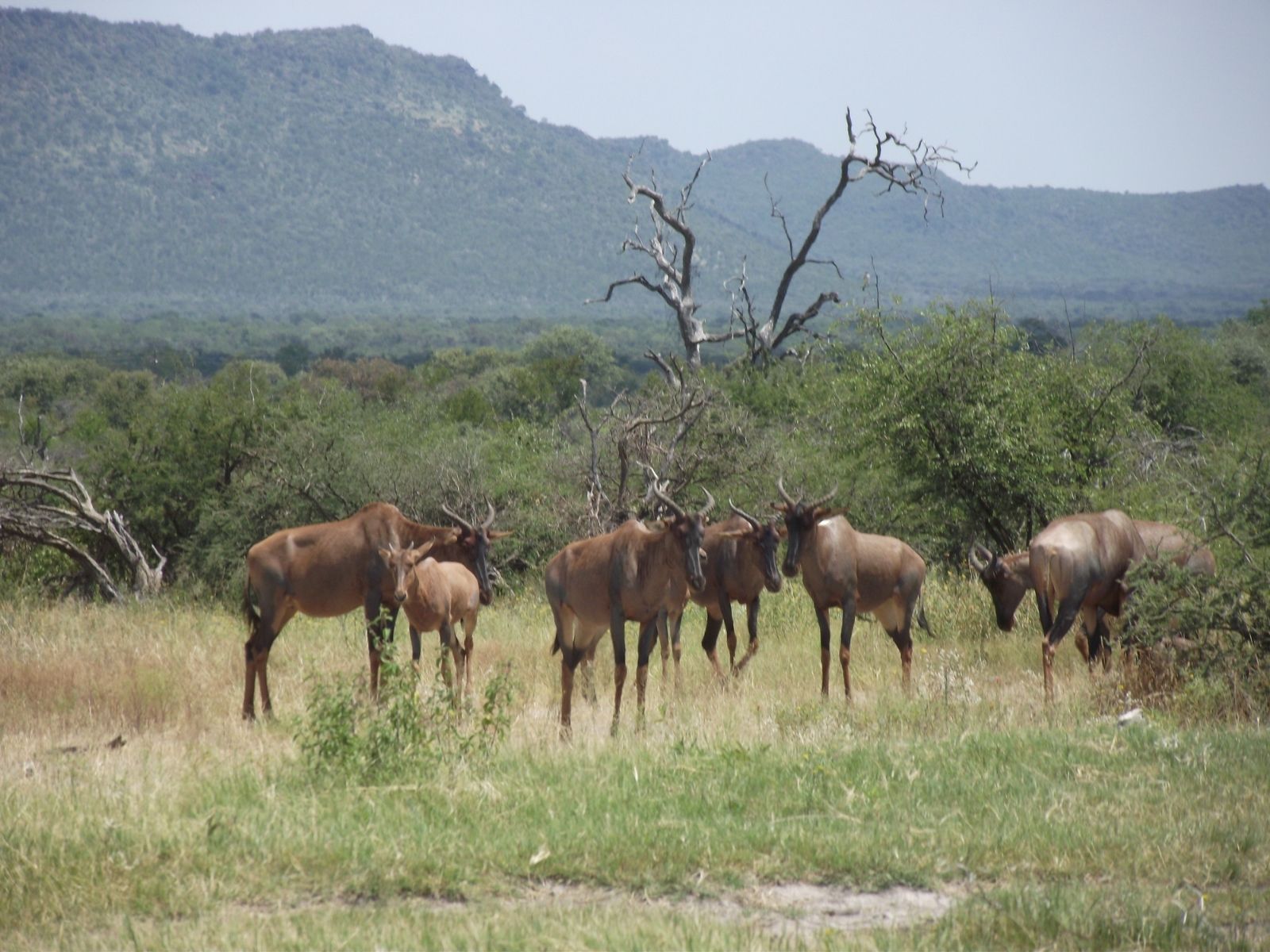
Tsessebe
Damaliscus lunatus lunatus

2025 Red list status
Vulnerable

Regional Population Trend
Declining

Change compared
to 2016
No Change
Overview
ANIMALIA – CHORDATA – MAMMALIA – ARTIODACTYLA – BOVIDAE – Damaliscus – lunatus
Common Names: Tsessebe, (English), Basterhartbees (Afrikaans), Inkolome, Inkomozane (Ndebele), Tshêntshêbê (Sepedi), Kabolê (Setswana), Mzanxi, Inyamatane (Swati), Ndzandzi (Xitsonga) Damalisque, Sassaby, Korrigum (French), Leierantilope (German)
Synonyms: No Synonyms
Taxonomic Status: Subspecies
Taxonomic Note:
Five subspecies are usually recognised: Korrigum (D. lunatus korrigum), Tiang (D. l. tiang), Coastal Topi (D. l. topi), Topi (D. l. jimela) and Tsessebe (D. l. lunatus). The last named form exhibits obvious differences from the other subspecies, with the result that this species is sometimes split into two, most recently by Grubb (2005). Cotterill (2003) recognised Tsessebes in the southern Bangweulu Flats of northeastern Zambia as a new species, Damaliscus superstes based on differences in cranial morphology and pelage, and proposed considering animals from south-central Africa (south of, and including, Angola, Zambia and southern Democratic Republic of the Congo) as D. lunatus (with the exception of D. superstes), and all other populations from East Africa and the remainder of the range provisionally as D. korrigum (followed by Grubb 2005).
Red List Status: VU – Vulnerable, D1 (IUCN version 3.1)
Assessment Information
Assessor: Patel, T.1 & da Silva, J. M.2
Reviewer: Anderson, J.3,4
Institutions: 1Endangered Wildlife Trust; 2South African National Biodiversity Institute; 3International Conservation Services, 4IUCN SSC Antelope Specialist Group
Previous Assessors: Nel, P., Schulze, E. & Goodman, P.
Previous Reviewers: Child, M.F. & Mallon, D.P.
Assessment Rationale
While there was a historical population reduction of c. 77% in Kruger National Park (KNP) between 1986 and 1999, the population has since stabilised. The 2016 assessment used a sample of formally protected areas (N = 12) with adequate long-term data across the natural range of the subspecies, to determine that the national population on protected areas had exhibited a net increase over the past three generations (1996–2014). However, five protected areas in Limpopo and North West provinces were still experiencing significant declines and/or local extinctions (estimated to be 21% reduction over three generations) at the time. The causes of such declines should be investigated and mitigated and further long-term data, especially from the private sector, are needed to more accurately estimate national population trends over three generations.
As there is no net continuing decline, and the historical reduction is outside the three-generation window, the only criterion applicable is D. Between 2013–2015, the formally protected population inside the natural distribution range was 1,642 individuals in 15 reserves (985–1,149 mature individuals, assuming a 60–70% mature population structure). Additionally, a preliminary analysis of 23 wildlife ranches containing Tsessebe subpopulations from around the country indicated that 46–87% of privately owned individuals can be considered wild and free-roaming, which brought the total minimum mature population size to 1,353–1,962 individuals. The mature population size in 2009 was at least 542–633 on formally protected areas, although this may be an underestimate as not all long-term data are available (for both formally and privately protected subpopulations).
This assessment is largely based on data and information from the previous assessment as recent data received was not robust enough to estimate population sizes based on three generations of the species. However, based on population count data from 15 protected areas across the country between 2017 and 2023, it was estimated that the minimum current population is 1,511 individuals. Assuming a 60-70% mature population structure, together with the previously estimated continuing decline in several protected areas across its range, we continue to list this species as Vulnerable D1.
The intensifying threat of poaching around protected area edges, woody plant encroachment as a consequence of overstocking and the potential emerging threat of increased drought frequency from climate change should be monitored as it may counteract the positive trends reported in this assessment. Key interventions include the establishment of a metapopulation plan to guide future translocations and reintroductions and protected area management for landscape heterogeneity and connectivity.
Regional population effects: Populations in neighbouring countries have been declining (Dunham et al. 2003), and hence we assume no rescue effects are possible. Additionally, most subpopulations within the assessment region are isolated by fencing. The only dispersal routes that might exist are between the KNP, Zimbabwe and Mozambique (the Great Limpopo Transfrontier Park). However, based on the small remaining subpopulation in KNP, immigration appears to be negligible and there is no confirmation that it actually takes place.
Reasons for Change
Reason(s) for Change in Red List Category from the Previous Assessment: No change
Red List Index
Red List Index: No change
Recomended citations: Patel T & da Silva JM. 2025. A conservation assessment of Damaliscus lunatus lunatus. In Patel T, Smith C, Roxburgh L, da Silva JM & Raimondo D, editors. The Red List of Mammals of South Africa, Eswatini and Lesotho. South African National Biodiversity Institute and Endangered Wildlife Trust, South Africa.
Distribution
Geographic Range
This species formerly occurred widely on floodplains and other grasslands in sub-Saharan Africa. It was one of the most numerous large antelope species in Africa, but has been eliminated from much of its former range (IUCN SSC Antelope Specialist Group 2008). Five subspecies occur throughout sub-Saharan Africa: Korrigum, Tiang, Coastal Topi, Topi, Bangweulu Tsessebe and Common Tsessebe (hereafter, Tsessebe). Tsessebe remain present in a number of populations in southern Africa, but became extinct in Mozambique around the late 1970s or early 1980s (IUCN SSC Antelope Specialist Group 2008). Similarly, they have been reintroduced in Eswatini after the indigenous population was hunted to extinction by the 1930s (Monadjem 1998). The current distribution of Tsessebe comprises South Africa, the eastern sector of Botswana, northeastern parts of Namibia (limited mainly to the Caprivi), northwestern and central parts of Zimbabwe and into western Zambia.
Within the assessment region, its natural distribution extends to western and eastern Limpopo, northwestern and eastern Mpumalanga, northern and western North West Province, eastern Northern Cape, western Free State and the extreme north of KwaZulu-Natal. It has been widely reintroduced across this range, especially on private land. Additionally, it has been widely introduced into areas of KwaZulu-Natal, Free State, Mpumalanga and Northern Cape provinces.
Elevation / Depth / Depth Zones
Elevation Lower Limit (in metres above sea level): (Not specified)
Elevation Upper Limit (in metres above sea level): (Not specified)
Depth Lower Limit (in metres below sea level): (Not specified)
Depth Upper Limit (in metres below sea level): (Not specified)
Depth Zone: (Not specified)
Map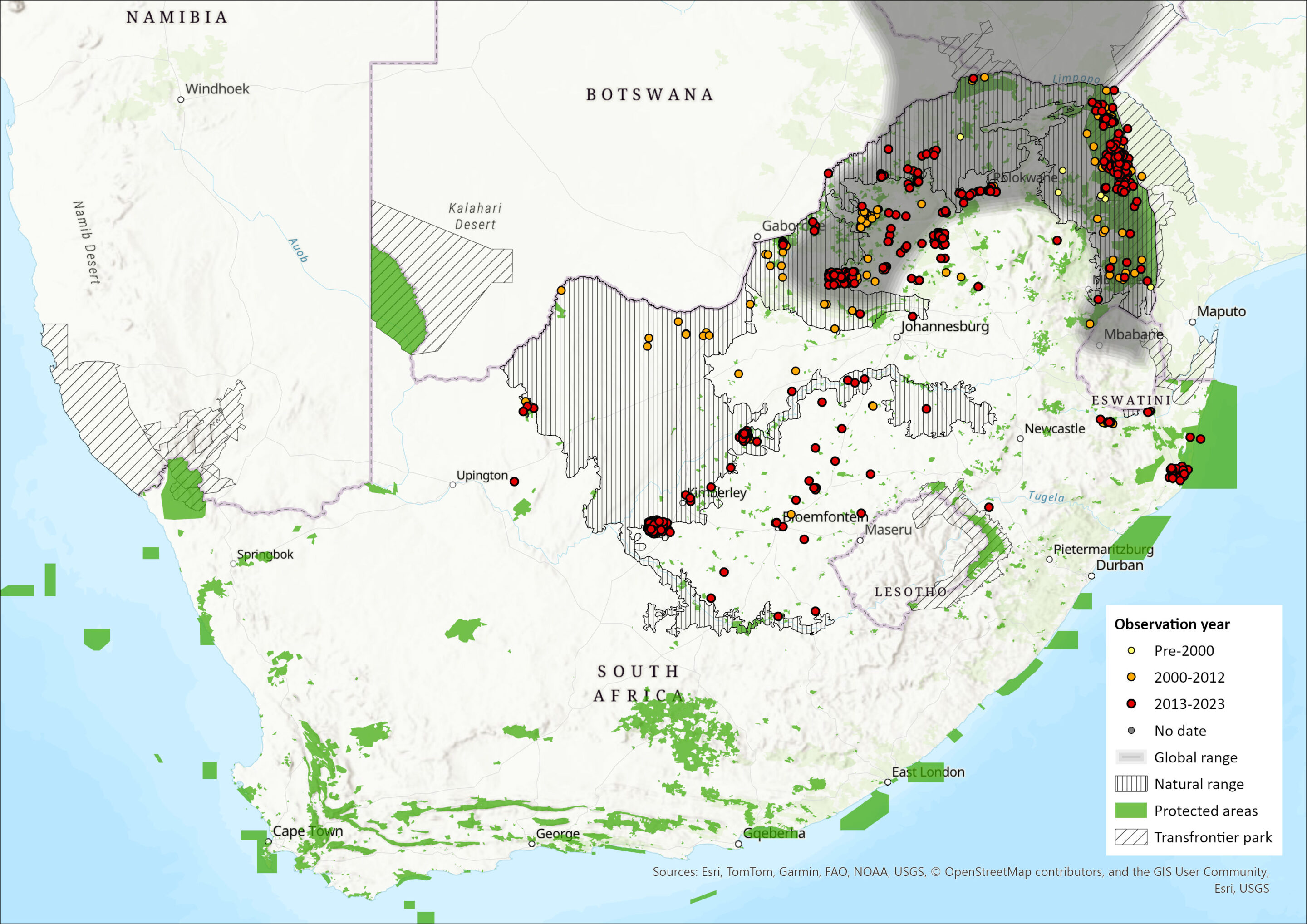
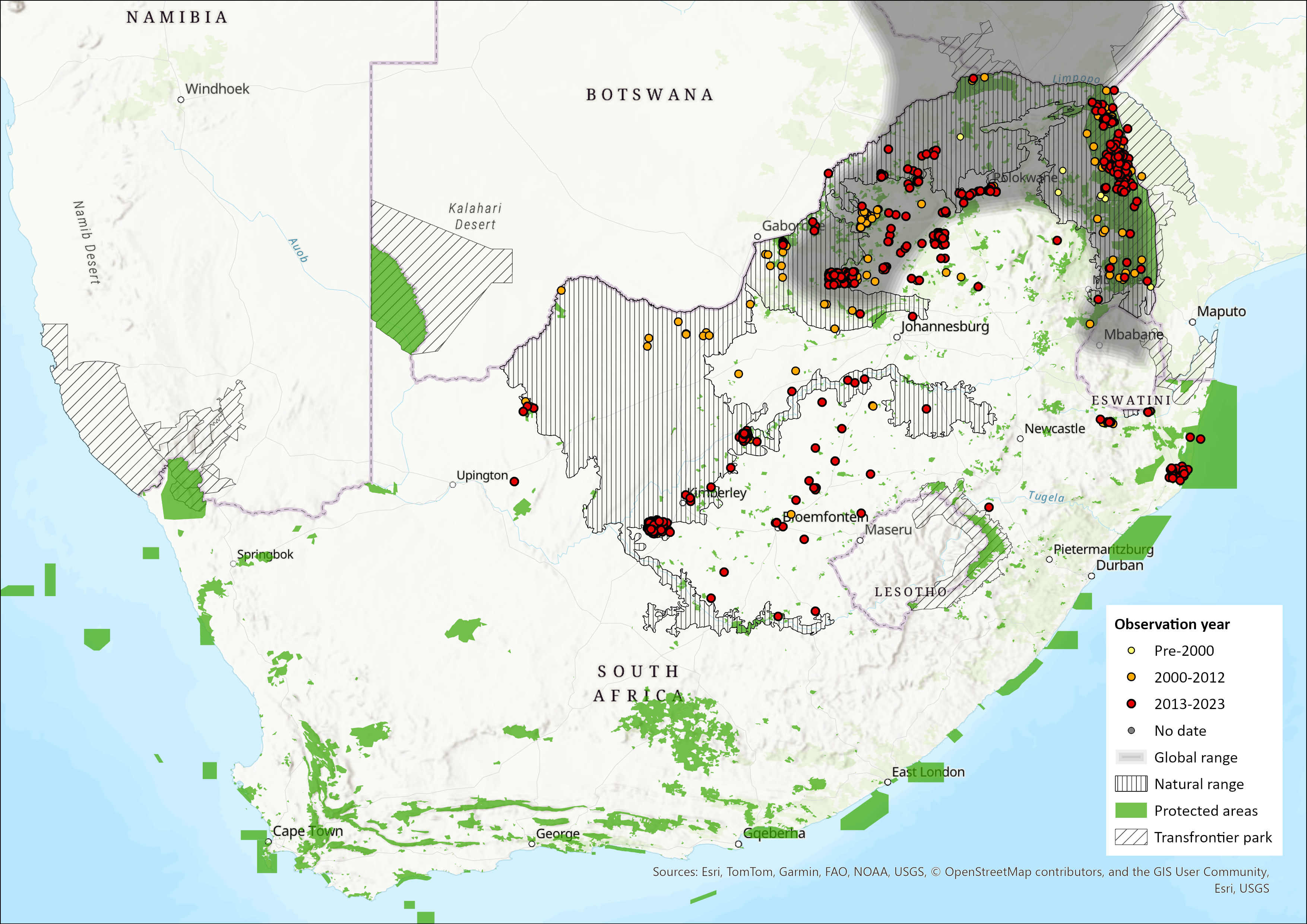
Figure 1. Distribution records for Tsessebe (Damaliscus lunatus lunatus) within the assessment region (South Africa, Eswatini and Lesotho). Note that distribution data is obtained from multiple sources and records have not all been individually verified.
Biogeographic Realms
Biogeographic Realm: Afrotropical
Occurrence
Countries of Occurrence
| Country | Presence | Origin | Formerly Bred | Seasonality |
| Angola | Extant | Native | – | – |
| Benin | Extant | Native | – | – |
| Botswana | Extant | Native | – | – |
| Burkina Faso | Extant | Native | – | – |
| Burundi | Extinct Post-1500 | Native | – | – |
| Cameroon | Extant | Native | – | – |
| Central African Republic | Extant | Native | – | – |
| Chad | Extant | Native | – | – |
| Congo, The Democratic Republic of the | Extant | Native | – | – |
| Eswatini | Extant | Reintroduced | – | – |
| Ethiopia | Extant | Native | – | – |
| Gambia | Extinct Post-1500 | Native | – | – |
| Ghana | Extant | Native | – | – |
| Kenya | Extant | Native | – | – |
| Mali | Extinct Post-1500 | Native | – | – |
| Mauritania | Extinct Post-1500 | Native | – | – |
| Mozambique | Extinct Post-1500 | Native | – | – |
| Namibia | Extant | Native | – | – |
| Niger | Extant | Native | – | – |
| Nigeria | Extant | Native | – | – |
| Rwanda | Extant | Native | – | – |
| Senegal | Extinct Post-1500 | Native | – | – |
| Somalia | Extant | Native | – | – |
| South Africa | Extant | Native | – | – |
| Sudan | Extant | Native | – | – |
| Tanzania, United Republic of | Extant | Native | – | – |
| Togo | Possibly Extinct | Native | – | – |
| Uganda | Extant | Native | – | – |
| Zambia | Extant | Native | – | – |
| Zimbabwe | Extant | Native | – | – |
Large Marine Ecosystems (LME) Occurrence
Large Marine Ecosystems: (Not specified)
FAO Area Occurrence
FAO Marine Areas: (Not specified)
Climate change
The implications of climate change will result in less suitable habitat for this species in the future. It has already been shown in the Kruger National Park that declines in adult survival followed a period of below-average dry season rainfall Dunham et al. (2004).
Population information
In KNP, Tsessebe declined from 1,163 individuals in 1986 to 419 in 1993 and declined again by 62% until 1999 (Grant & van der Walt 2000). However, the subpopulation has since stabilised at c. 200–250 individuals (Ferreira et al. 2013). Generation length for this species has been estimated at six years (Pacifici et al. 2013), making the three generation period approximately 18 years (1996–2014). Based on data from 12 protected areas across the country, the national population was estimated to have increased over three generations by 47–71% in the previous assessment. However, further long-term data from both formally and privately protected areas are needed to more accurately estimate the national population trend as these estimates may be inflated due to the extrapolation of available data to cover the three generation period. Worryingly, however, many protected areas, especially in North West and Limpopo provinces, continue to decline (estimated 21% population reduction at six sites). Overall, five out of 12 sampled sites (protected areas) are declining or locally extinct within the natural distribution. Similarly, in KwaZulu-Natal Province (which is not included in this assessment as it falls significantly outside the natural distribution), there has been a significant crash in population numbers at Ithala Nature Reserve from 160 in 2000 to 60 in 2010 and 19 in 2013 (Barichievy 2013). The cause of the decline is unknown, but is correlated to an accumulative deficit in rainfall. Furthermore, the reintroduced population at Phongolo Nature Reserve has, due to natural causes, gone extinct and must now be considered a failed translocation and establishment attempt (P. Goodman unpubl. data). The same has happened in Madikwe where the decline is probably due to competition with other herbivores (J. Anderson pers. comm). Conversely, the population size at Loskop Dam Nature Reserve, Mpumalanga Province (which is also precluded for falling outside the natural distribution range) has significantly increased from 18 individuals in 2005 to 66 in 2013 (J. Eksteen unpubl. data). No recent population numbers from KwaZulu-Nata were available for this assessment.
The national total population size between 2013 and 2015 was estimated to be at least 3,700 in the assessment region, compared to an estimated 1,100 in 2004 (Friedmann & Daly 2004). This is an underestimate as not all data from privately protected sites were available at the time of the assessment. Of these, the minimum population size of formally and privately protected areas occurring within the natural distribution range (IUCN Standards and Petitions Subcommittee 2014) is 1,642 individuals and 1,334 broadly occurring on wildlife ranches (a more detailed spatial analysis is required to determine exactly which ranches fall within the natural range). A preliminary analysis of 23 wildlife ranches containing Tsessebe from around the country (A. Taylor unpubl. data) indicate that 46–87% of animals on wildlife ranches can be considered wild and free-roaming (not intensively managed; IUCN Standards and Petitions Subcommittee 2014). This brings the total number of estimated eligible individuals to 2,256–2,803 individuals, of which the total minimum mature population size is 1,353–1,962 individuals, assuming a 60–70% mature population structure. Further data collection from the private sector is needed to more accurately estimate national population size.
At least two sites outside of KNP (Mokala National Park and Sandveld Nature Reserve) are larger than 500 individuals (compared to none in 2004); Sandveld Nature Reserve: 537 individuals counted in 2018. This is based on information from ecologists/park managers from all the formal conservation agencies within the assessment region. 280 individuals also exist on a South African National Defence Force (SANDF) property (Roodewal) in Limpopo Province (P. Nel unpubl. data; 2016 estimate).
Currently, according to data from 15 protected areas, the population is estimated to be 1,511 individuals (recent count data from these reserves between 2017-2023). This represents a minimum population estimate of Tsessbe in the country at present, as we are aware that not all data were accounted for in this assessment.
The reproductive rate for Tsessebe can be high in good quality habitat and in the absence of predators. For example, Mokala (SANParks), Sandveld (Free State) and Roodewal Bombing Range (SANDF – Limpopo) reported subpopulation growth rates in excess of 20% over the past decade. In poor quality habitats however, both adult and calf survival is very poor, which can be exacerbated during below average rainfall cycles. Inter-species competition also appears to influence subpopulation performance.
Population Information
| Continuing decline in mature individuals? | Qualifier | Justification |
| Yes | Estimated | In some areas due to poaching, declining habitat quality and interspecific competition. |
Extreme fluctuations in the number of subpopulations: (Not specified)
All individuals in one subpopulation: (Not specified)
Severely fragmented: Found on isolated and fenced protected areas and private land. Its habitat is also fragmented within KNP (Dunham et al. 2004).
Quantitative Analysis
Probability of extinction in the wild within 3 generations or 10 years, whichever is longer, maximum 100 years: (Not specified)
Probability of extinction in the wild within 5 generations or 20 years, whichever is longer, maximum 100 years: (Not specified)
Probability of extinction in the wild within 100 years: (Not specified)
Population genetics
To date no population genetic study incorporating samples from the assessment region has been undertaken. The species has been highly translocated throughout the assessment region and is therefore considered a single metapopulation; however, a genetic study is needed to validate this.
While outdated, the estimated number of Tsessebe within the assessment region is estimated at 3,700 individuals. Based on an Ne/Nc (effective population size/census size) conversion ratio of 0.1-0.3, Ne for this species is estimated between 370-1,110 – cradling the Ne 500 threshold. More up-to-date census counts and/or Ne quantification from a population genetic study will help improve the confidence in these estimates. However, because of declining numbers in neighbouring countries (Dunham et al. 2003), it is assumed that no rescue effect is possible for South Africa. Consequently, we do not expect an elevated Ne based on gene flow from outside the assessment region.
Habitats and ecology
Generally, an inhabitant of floodplains, edaphic grasslands, or dambos and other grasslands in sub-Saharan Africa (IUCN SSC Antelope Specialist Group 2008). In South Africa, the Tsessebe formerly occurred in the bushveld and lowveld, often at the ecotone between grassland and woodland. Their preferred habitats are Kimberley Thornveld and Mopane Bushveld. They do not occur in forests, arid or montane habitats (above 1,500 m) (Duncan 2013). Currently, the Tsessebe occurs mainly on the basalt plains of northern KNP because they feed in broad, grass-covered drainage lines within Colophospermum mopane shrubland on basaltic soils (Dunham et al. 2004). In Borakalalo Nature Reserve (North West) Tsessebe preferred less dense woody areas and areas that had medium height grass species, and home ranges for Tsessebe herds averaged approximately 248±49 hectares (Göpper 2012). Nearly exclusively grazers, they can go for months without drinking in the dry season if they are feeding on growing grass (Duncan 2013). They are averse to using artificial water points unless the points resemble natural pools (Skinner & Chimimba 2005).
IUCN Habitats Classification Scheme
| Habitat | Season | Suitability | Major Importance? |
| 2.1. Savanna -> Savanna – Dry | – | Suitable | – |
| 3.5. Shrubland -> Shrubland – Subtropical/Tropical Dry | – | Suitable | – |
| 3.6. Shrubland -> Shrubland – Subtropical/Tropical Moist | – | Suitable | – |
| 4.5. Grassland -> Grassland – Subtropical/Tropical Dry | – | Suitable | – |
| 4.6. Grassland -> Grassland – Subtropical/Tropical Seasonally Wet/Flooded | – | Suitable | – |
Life History
Generation length: 4
Justification: Females calf for the 1st time at age 36 months. Weaning age of calf ~ 120-150 days.
Data quality: Good
Age at Maturity: Female or unspecified: first calf by three years of age
Age at Maturity: Male: physiologically by 2 years of age but only breed at about 4
Size at Maturity (in cms): Female: shoulder height 125 cms and 120 kg
Size at Maturity (in cms): Male: shoulder height 126 cms and 137 kg
Longevity: 15 years
Average Reproductive Age: most females calve at three years of age
Size at Birth: 10-12 Kg Skinner & Chimimba 2005
Gestation Time: 238 days
Reproductive Periodicity: annually, birth peak late summer
Average Annual Fecundity or Litter Size: one
Natural Mortality: (Not specified)
Does the species lay eggs? No
Does the species give birth to live young: Yes
Does the species exhibit parthenogenesis: No
Does the species have a free-living larval stage? No
Does the species require water for breeding? No
Movement Patterns
Movement Patterns: Not a Migrant
Congregatory: (Not specified)
Systems
System: Terrestrial
General Use and Trade Information
This species is hunted for food and sport. Within the assessment region, Tsessebe are also sold live at auctions. They are managed for their tourist value, as well as trophy hunting. Although their value as trophy animals is unknown, it is not highly sought after. Private ranching and intensive breeding is increasing for this species, along with its commercial value.
Wildlife ranching has the potential to contribute positively to the conservation of the species if the reintroduction of Tsessebe into suitable areas is promoted. Habitat quality and conservative stocking rates are key factors for success with regards to keeping and breeding Tsessebe and it is unlikely that they will perform well in captive breeding systems. Wildlife ranchers should be made aware of the risk of hybridisation with Red Hartebeest (Alcelaphus buselaphus caama) and this threat should be monitored and regulated.
| Subsistence: | Rationale: | Local Commercial: | Further detail including information on economic value if available: |
| Yes | They are poached for bushmeat. | Yes | Sold alive at game auctions and hunted. |
National Commercial Value: Yes
International Commercial Value: Yes
| End Use | Subsistence | National | International | Other (please specify) |
| 1. Food – human | true | true | – | – |
| 15. Sport hunting/specimen collecting | – | true | true | – |
Is there harvest from captive/cultivated sources of this species? Yes
Harvest Trend Comments: Trophy hunting and live animal sales.
Threats
Within the assessment region, being a selective grazer with a preference for edaphic grasslands, the main threats are deteriorating habitat quality, unnaturally high competition from other grazers due to high stocking rates, and increasing poaching in some areas. Deliberate or unintentional hybridisation with other Tsessebe subspecies and/or Red Hartebeest (Alcelaphus buselaphus caama) on wildlife ranches may be an increasing threat as hybrids are fertile (Schulze 2016). There are indications that they are a finicky herbivore species, that can be affected by competition from other grazers (Skinner & Chimimba 2005, Power 2014) and the consequences of over-grazing. The provision of artificial water points, specifically in KNP, is suspected to have resulted in increased grazing competition and predation pressure and thus a decline in Tsessebe numbers (Grant et al. 2002). Drought conditions are thought to exacerbate the more proximal threats, as Dunham et al. (2004) showed that the decline in KNP was likely precipitated by declining adult survival during a period of below-average dry season rainfall. The implication is that climate change, which is projected to decrease rainfall along the east–west aridity gradient in South Africa (Erasmus et al. 2002), will make habitat less suitable in the western parts of the country in the future. Similarly, drought and competition with livestock have been identified as major causes for population decline in Zimbabwe (Dunham et al. 2003). The Marakele National Park subpopulation has been fluctuating at low levels since 2009 and it is speculated that they are impacted by high predator densities. Similarly, the subpopulation at Madikwe Game Reserve declined and this is likely due to declining habitat quality, interspecific competition and high predator densities (P. Nel unpubl. data).
Poaching is an increasing problem in some protected areas, especially as human settlements and density increase along protected area edges (Wittemyer et al. 2008). For example, only one individual is left on Borakalalo Nature Reserve, North West Province, from suspected high poaching rates (Nel 2015). It was also found that this subpopulation had low genetic diversity (Göpper 2012).
It has also been proven that Tsessebe can hybridise with Red Hartebeest and that the hybrid offspring are fertile. Although the F1 hybrid offspring are clearly distinguishable from both pure Tsessebe and pure Red Hartebeest, it is a concern that the hybrid offspring are fertile and it is not known at this stage what further generations of hybrids would look like. Recent data reveal that it is very difficult to distinguish between Red Hartebeest/Tsessebe hybrid offspring from pure offspring (Schulze 2016). The threat can at this stage be considered minor, but it has the potential of becoming a more serious threat as more Tsessebe are being kept in small camps or in intensive breeding systems where Red Hartebeest also occur.
Current habitat trend: Stable in area but decreasing in quality, mainly due to overutilisation (over-stocking) and bush encroachment. Subpopulations are mostly secure in fenced areas, and the area of occupancy may be expanding along with the expansion of privately protected areas and wildlife ranches.
Conservation
Tsessebe are well represented in both protected areas and on private land within the assessment region, with strongholds in KNP (Limpopo), Pilanesberg National Park (North West), Mokala National Park (Northern Cape) and Sandveld Nature Reserve (Free State). Thus, although the decline of subpopulations on state land in North West, Limpopo and Mpumalanga provinces is concerning, all provinces have at least one protected area in which Tsessebe are flourishing and which could potentially re-stock other reserves when off-takes are necessary for subpopulation management. Similarly, captive breeding could possibly be undertaken inside the KNP in similar enclosures as has been undertaken with Roan Antelope (Hippotragus equinus) to stabilise the population declines. However, no ex situ breeding is recommended at this time. Translocation out of the KNP is problematic due to veterinary restrictions.
The most urgent intervention is habitat management to ensure excessive grazing competition and predation pressure is reduced by sustaining ecological stocking densities and closing water points to increase habitat heterogeneity (for example, Smit & Grant 2009; Macandza et al. 2012), thereby enabling the coexistence of rare antelopes, such as Tsessebe, on relatively protected areas and landscapes. Studies testing the effectiveness of this intervention should be initiated.
Reintroductions into new sites within the natural distribution should also be encouraged under a metapopulation framework. Tsessebe subpopulations are also performing very well in areas with good quality habitat and free-roaming wild subpopulations of Tsessebe in these areas should be encouraged. Animals from growing subpopulations can be used to seed new subpopulations. For example, in the North West Province, reintroductions onto SA Lombard, Bloemhof Dam, Mafikeng and Botsalano Game Reserves are endorsed (Power 2014). Similarly, wildlife ranchers should be encouraged to continue establishing the native subspecies in areas of their natural range. However, due to the risk of hybridisation, Tsessebe subpopulations should preferably not be established on properties with Red Hartebeest and if Tsessebe are sourced from populations that occur with Red Hartebeest, genetic testing will have to be conducted to ensure that only genetically pure Tsessebe are translocated.
Protected area expansion, especially transfrontier expansion, should be encouraged, especially in the western parts of its range, to allow adaptation to climate change, dispersal and limit interaction with competing grazers and/or predators. To reduce poaching rates, the establishment of alternative livelihood schemes should be investigated, such as developing game meat markets from sustainable wildlife production areas, thereby also increasing the social and economic relevance of reserves in rural areas. However, the steady decline in management capacity in provincial conservation agencies (Patel et al. 2023) is a concern for the future of the species on state-owned land.
Recommendations for land managers and practitioners:
- A Biodiversity Management Plan is needed to inform a national translocation policy. All provinces have at least one protected area that is flourishing and which could potentially re-stock other reserves when off-takes are necessary for subpopulation management.
- A systematic monitoring scheme should be established as there is no coordinated monitoring at national or provincial scales.
- Landowners should be incentivised to maintain ecological stocking rates and create habitat heterogeneity through seasonal water-points or water-point closure to sustain the resources and prevent excessive grazing competition with Tsessebe.
- Landowners and protected area managers should also be encouraged to create conservancies and extensive areas for free-roaming Tsessebe herds.
- Where the management capacity of state-owned protected areas is declining, more effective models for stewardship such as Public-Private Sector Partnerships should be considered.
Research priorities:
- Long term datasets for protected areas should be collated to more accurately estimate national population trends, and this should be updated annually.
- Evidence for hybridisation with alien subspecies and/or with Red Hartebeest (Alcelaphus buselaphus caama) within the private sector or on formally protected areas should be collated to assess the extent and severity of this threat. This includes developing genetic markers for testing. Hybridisation potential with related species (Blesbok and Red Hartebeest) has been determined in a research project conducted on three provincial nature reserves in the Free State Province by the Free State Department of Small Business, Economic Development, Tourism and Environmental Affairs. The fertility of hybrid offspring as well as the physical characteristics of F2 hybrid offspring are currently being monitored.
- Investigating the causes of current subpopulation decline and testing potential interventions to reverse such declines.
- Investigate the involvement of the private sector in improving management of state-owned Protected Areas.
Encouraged citizen actions:
- Report sightings on virtual museum platforms (for example, iNaturalist and MammalMAP), especially in KNP and on private lands outside protected areas.
- Private landowners can also drop fences to form conservancies and create the conditions to establish wild and free-roaming herds of Tsessebe.
- An increase in trophy value will help to increase the demand by landowners.
Bibliography
Barichievy C. 2013. Ezemvelo KZN Wildlife Monitoring Plan: Damaliscus lunatus lunatus (Tsessebe). Unpublished document, Ezemvelo KZN Wildlife, Pietermaritzburg, South Africa.
Cotterill, F.P.D. 2003. Insights into the taxonomy of the tsessebe antelopes Damaliscus lunatus (Bovidae: Alcelaphini) with the description of a new evolutionary species in south-central Africa. Durban Museum Novitates 28: 11-30.
Duncan, P. 2013. Damaliscus lunatus Topi/Tsessebe/Tiang/Korrigum. In: J.. Kingdon and M. Hoffmann (eds), Mammals of Africa. VI. Pigs, Hippopotamuses, Chevrotain, Giraffes, Deer, and Bovids, pp. 502-510. Bloomsbury Publishing, London, UK.
Dunham KM, Robertson EF, Grant CC. 2004. Rainfall and the decline of a rare antelope, the tsessebe (Damaliscus lunatus lunatus), in Kruger National Park, South Africa. Biological Conservation 117: 83-94.
Dunham KM, Robertson EF, Swanepoel CM. 2003. Population decline of tsessebe antelope (Damaliscus lunatus lunatus) on a mixed cattle and wildlife ranch in Zimbabwe. Biological Conservation 113: 111-124.
Erasmus, B.F.N., van Jaarsveld, A.S., Chown, S.L., Kshatriya, M. and Wessels, K.J. 2002. Vulnerability of South African animal taxa to climate change. Global Change Biology 8: 679-693.
Ferreira S, Gaylard, A, Greaver, C, Hayes, J, Cowell C, Ellis G. 2013. Summary Report: Animal abundances in Parks 2012/2013. Scientific Services, SANParks, Skukuza, South Africa.
Friedmann, Y. and Daly, B. 2004. Red Data Book of the Mammals of South Africa: A Conservation Assessment. Conservation Breeding Specialist Group (SSC/IUCN) and Endangered Wildlife Trust, Parkview, South Africa.
Göpper BM. 2012. The ecology of the Tsessebe, Damaliscus lunatus lunatus, in Borakalalo National Park, North West Province. M.Sc. Thesis. University of Limpopo, Polokwane, South Africa.
Grant CC, Van der Walt JL. 2000. Towards an adaptive management approach for the conservation of rare antelope in the Kruger National Park-outcome of a workshop held in May 2000. Koedoe 43: 103-112.
Grant, C. C., Davidson, T., Funston, P. J. and Pienaar, D. J. 2002. Challenges faced in the conservation of rare antelope: a case study on the northern basalt plains of the Kruger National Park. Koedoe 45: 45–66.
Grubb, P. 2005. Artiodactyla. In: D.E. Wilson and D.M. Reeder (eds), Mammal Species of the World. A Taxonomic and Geographic Reference (3rd ed), pp. 637–722. Johns Hopkins University Press, Baltimore, USA.
IUCN SSC Antelope Specialist Group. 2008. Damaliscus lunatus.
IUCN Standards and Petitions Subcommittee. 2014. Guidelines for Using the IUCN Red List Categories and Criteria. Version 11.
Macandza VA, Owen-Smith N, Cain JW. 2012. Habitat and resource partitioning between abundant and relatively rare grazing ungulates. Journal of Zoology 287: 175-185.
Monadjem, A. 1998. Mammals of Swaziland. The Conservation Trust of Swaziland and Big Game Parks.
Nel, P. 2015. Population estimates for large herbivores and predators in protected areas in the North West Parks Board November 2015. North West Parks Board.
Pacifici, M., Santini, L., Di Marco, M., Baisero, D., Francucci, L., Grottolo Marasini, G., Visconti, P. and Rondinini, C. 2013. Generation length for mammals. Nature Conservation 5: 87–94.
Patel, T , O. Cowan, I. Little, Y. Friedmann, A. Blackmore. 2023. The State of Provincial Reserves in South Africa, Challenges and Recommendations. https://ewt.org.za/resources/cpsu-programme/
Power, R.J. 2014. The distribution and status of mammals in the North West Province. Department of Economic Development, Environment, Conservation & Tourism, North West Provincial Government, Mahikeng.
Schulze E. 2016. Investigating the potential for hybridisation between Tsessebe and Red Hartebeest and Tsessebe and Blesbok. Department of Economic, Small Business Development, Tourism & Environmental Affairs, Free State, South Africa.
Skinner, J.D. and Chimimba, C.T. (eds). 2005. The Mammals of the Southern African Subregion. Cambridge University Press, United Kingdom, Cambridge.
Smit IPJ, Grant CC. 2009. Managing surface-water in a large semi-arid savanna park: effects on grazer distribution patterns. Journal for Nature Conservation 17: 61-71.
Wittemyer, G., Elsen, P., Bean, W.T., Burton, A.C.O. and Brashares, J.S. 2008. Accelerated human population growth at protected area edges. Science 321: 123-126.