

Thomas’s Pygmy Mouse
Mus neavei

2025 Red list status
Data Deficient

Regional Population Trend
Unknown

Change compared
to 2016
No Change
Overview
Mus neavei – (Thomas, 1910)
ANIMALIA – CHORDATA – MAMMALIA – RODENTIA – MURIDAE – Mus – neavei
Common Names: Thomas’s Pygmy Mouse, Neaves’s Pygmy Mouse (English), Thomas se Dwergmuis (Afrikaans)
Synonyms: No Synonyms
Taxonomic Note: Although originally described as a species; Mus neavei was later regarded as a subspecies of M. sorella (Ansell 1978; Meester et al. 1986; Skinner & Smithers 1990). More recently, however, Petter (1981) suggested that M. neavei should be reclassified to species status, as it differs from M. sorella in its fur colour, body size, and its cranial and molar structure. This recommendation was corroborated and accepted by Musser and Carleton (1993) and Bronner et al. (2003). Although commonly confused with M. indutus (the Desert Pygmy Mouse) and M. minutoides (the Pygmy Mouse), this species can be distinguished by its lower three-rooted second molar and pro-odont incisors (Meester et al. 1986).
Red List Status: DD– Data Deficient
Assessment Information
Assessors: Patel, T.1 & da Silva, J.M.2
Reviewer: Roxburgh, L.1
Institutions:1Endangered Wildlife Trust,2South African National Biodiversity Institute
Previous Assessors and Reviewers: Relton, C., Taylor, P. & Monadjem, A.
Previous Contributors: Child, M.F., Avenant, N., Avery, M., Baxter, R., MacFadyen, D., Palmer, G. & Wilson, B.
Assessment Rationale
This species is listed as Data Deficient in view of continuing uncertainty as to its extent of occurrence, natural history, threats and population size. Within the assessment region there are only a handful of records from Mkhuze Game Reserve and Wolkberg Nature Reserve. The species appears to be naturally uncommon, and its conservation status and taxonomy are unclear. Further vetting of museum records and field surveys are required to resolve the uncertainty around this species. It should be reassessed when additional data become available.
Regional population effects: Isolated and disjunct subpopulations of this species have been recorded in South Africa and Zimbabwe/Zambia, thus no rescue effect is possible.
Reasons for Change
Reason(s) for Change in Red List Category from the Previous Assessment: No change
Red List Index
Red List Index: No change
Recommended citation: Patel T & da Silva JM. 2025. A conservation assessment of Mus neavei. In Patel T, Smith C, Roxburgh L, da Silva JM & Raimondo D, editors. The Red List of Mammals of South Africa, Eswatini and Lesotho. South African National Biodiversity Institute and Endangered Wildlife Trust, South Africa.
Regional Distribution and occurrence
Geographic Range
Thomas’s Pygmy Mouse has a largely unresolved distribution, as it is commonly misidentified as M. minutoides, but is thought to range patchily from northern South Africa northwards to Tanzania (Monadjem et al. 2015). Although further investigation and confirmation is necessary, this species has been reported from north-eastern South Africa, southern Zimbabwe, western and southern Mozambique, Zambia, southern Tanzania and the Democratic Republic of Congo (Skinner & Chimimba 2005).
Within the assessment region, it is only known from two localities at present: Wolkberg Wilderness Area in Limpopo Province, where Newbery and Bronner (2002) first confirmed the presence of the species within the assessment region, and Mkhuze Game Reserve in KwaZulu-Natal (Figure 1), which was identified both morphologically and genetically (Lamb et al. 2014). There is a MammalMap record of the species from Pretoriuskop in Kruger National Park in 2016, but this record requires verification. Newbery and Bronner (2002) suggest that the species may be more widespread in Limpopo, but additional surveying is needed to determine the extent of its distribution in the assessment region.
Elevation / Depth / Depth Zones
Elevation Lower Limit (in metres above sea level): (Not specified)
Elevation Upper Limit (in metres above sea level): (Not specified)
Depth Lower Limit (in metres below sea level): (Not specified)
Depth Upper Limit (in metres below sea level): (Not specified)
Depth Zone: (Not specified)
Map
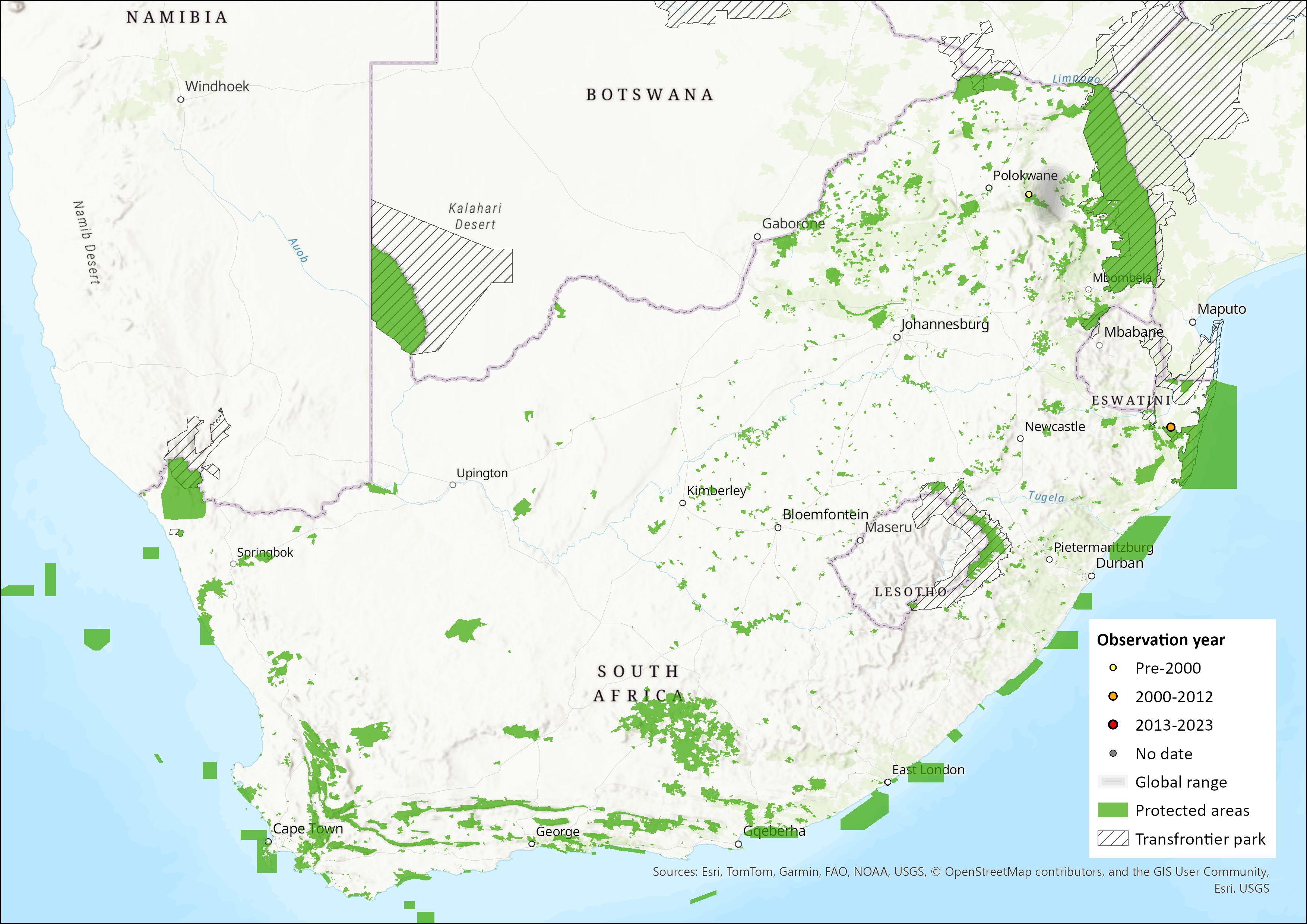
Figure 1. Distribution records for Thomas’s Pygmy Mouse (Mus neavei) within the assessment region (South Africa, Eswatini and Lesotho). Note that distribution data is obtained from multiple sources and records have not all been individually verified.
Biogeographic Realms
Biogeographic Realm: Afrotropical
Occurrence
Countries of Occurrence
| Country | Presence | Origin | Formerly Bred | Seasonality |
| Congo, The Democratic Republic of the | Presence Uncertain | Native | – | – |
| Mozambique | Extant | Native | – | – |
| South Africa | Extant | Native | – | – |
| Tanzania, United Republic of | Presence Uncertain | Native | – | – |
| Zambia | Extant | Native | – | – |
| Zimbabwe | Extant | Native | – | – |
Large Marine Ecosystems (LME) Occurrence
Large Marine Ecosystems: (Not specified)
FAO Area Occurrence
FAO Marine Areas: (Not specified)
Climate change
Known from only two localities in South Africa, there is a possibility that this species might be affected by the 1.5-4°C increase in temperature predicted under various climate change scenarios (Engelbrecht et al. 2024). Rainfall is predicted to decrease in its range, which will result in a more arid and drought-prone habitat possibly affecting resource availability to the species. However, as we know nothing of the biology of this species, this is speculative.
Population information
The current population abundance of M. neavei is unknown, partly because it is frequently mistaken for M. minutoides and M. indutus. These species are extremely difficult to distinguish from one another without thorough analysis of their teeth. Thomas’s Pygmy Mouse has three-roots on its second lower molars, whereas the Desert Pygmy Mouse and the Pygmy Mouse have only two roots on these teeth. Additionally, Thomas’s Pygmy Mouse has pro-odont incisors, rather than opisthodont incisors, as seen in the other two species (Meester et al. 1986; Lamb et al. 2014).
Only a handful of records exist for this species within the assessment region and the Mkhuze record was collected over intensive pitfall trapping. This specimen was identified as M. neavei based on its distinct tawny fur colour and pro-odont incisors, but was extremely alike in cytochrome b sequence divergence to M. minutoides (Lamb et al. 2014).
Population Information
Current population trend: Unknown
Continuing decline in mature individuals: Unknown
Number of mature individuals in population: Unknown
Number of mature individuals in largest subpopulation: Unknown
Number of subpopulations: Unknown
Severely fragmented: Unknown
Quantitative Analysis
Probability of extinction in the wild within 3 generations or 10 years, whichever is longer, maximum 100 years: (Not specified)
Probability of extinction in the wild within 5 generations or 20 years, whichever is longer, maximum 100 years: (Not specified)
Probability of extinction in the wild within 100 years: (Not specified)
Population genetics
While this species has been investigated in a phylogenetic context (Bryja et al. 2014), no population genetic studies have been undertaken. Given the few records known for this species and limited information known about its dispersal capabilities and overall abundance or densities, it is not possible to make any inferences about its possible genetic diversity and structure within the assessment region.
Habitats and ecology
The specimens collected from Wolkberg Wilderness Area in the Limpopo Province were found on sandy loam soil in a rocky (quartzite) montane grassland habitat (Newbery & Bronner 2002). The surrounding habitat consisted of Bracken Fern (Pteridium aquilinum) along the drainage line, and a Protea woodland (Newbery & Bronner 2002). It is unknown whether this species is a habitat specialist, and very little information is available regarding its life history.
Ecosystem and cultural services: Aside from the prospect of small-scale seed dispersal, no specific ecosystem services have been identified for this species. However, this may simply reflect the paucity of information available for this poorly-known species.
IUCN Habitats Classification Scheme
|
Habitat |
Season |
Suitability |
Major Importance? |
|
2.1. Savanna -> Savanna – Dry |
– |
Suitable |
– |
|
4.7. Grassland -> Grassland – Subtropical/Tropical High Altitude |
– |
Suitable |
– |
|
6. Rocky areas (e.g., inland cliffs, mountain peaks) |
– |
Suitable |
– |
Life History
Generation Length: (Not specified)
Age at maturity: female or unspecified: (Not specified)
Age at Maturity: Male: (Not specified)
Size at Maturity (in cms): Female: (Not specified)
Size at Maturity (in cms): Male: (Not specified)
Longevity: (Not specified)
Average Reproductive Age: (Not specified)
Maximum Size (in cms): (Not specified)
Size at Birth (in cms): (Not specified)
Gestation Time: (Not specified)
Reproductive Periodicity: (Not specified)
Average Annual Fecundity or Litter Size: (Not specified)
Natural Mortality: (Not specified)
Does the species lay eggs? (Not specified)
Does the species give birth to live young: (Not specified)
Does the species exhibit parthenogenesis: (Not specified)
Does the species have a free-living larval stage? (Not specified)
Does the species require water for breeding? (Not specified)
Movement Patterns
Movement Patterns: (Not specified)
Congregatory: (Not specified)
Systems
System: Terrestrial
General Use and Trade Information
This species does not appear to be utilised or traded in any form.
Local Livelihood: (Not specified)
National Commercial Value: (Not specified)
International Commercial Value: (Not specified)
End Use: (Not specified)
Is there harvest from captive/cultivated sources of this species? (Not specified)
Harvest Trend Comments: (Not specified)
Threats
As this species has only been confirmed from two localities in South Africa, the extent of its distribution is unknown, and thus the major threats to this species cannot be distinguished.
Current habitat trend: Unknown
Conservation
It is possible that this species is located within more protected areas within Limpopo and KwaZulu-Natal provinces, but this cannot be established until the range of this species has been more thoroughly investigated. Additional research into the population abundance, distribution, general ecology and threats faced by this species is necessary for a more accurate investigation of its conservation status.
Recommendations for land managers and practitioners:
- Fieldwork to survey for subpopulations and assess its distributional limits and the extent of anthropogenic threats is urgently needed.
Research priorities:
- Research is needed to establish the geographic range limits and to gather basic data on natural history of this species, including taxonomy, ecology, and population size, distribution and trends.
- Vetting of museum records to identify previously unidentified localities.
- Studies into specific threats to this species, and corresponding conservation actions are needed.
Encouraged citizen actions: None
Bibliography
Ansell, W.F.H. 1978. The Mammals of Zambia. pp. 73-74. The National Parks and Wildlife Service, Chilanga, Zambia.
Bronner, G.N., Hoffman, M., Taylor, P.J., Chimimba, C.T., Best, P.B., Matthee, C.A. and Robinson, T.J. 2003. A revised systematic checklist of the extant mammals of the southern African subregion. Durban Museum Novitates 28: 56-106.
Lamb, J., Downs, S., Eiseb, S. and Taylor, P.J. 2014. Increased geographic sampling reveals considerable new genetic diversity in the morphologically conservative African Pygmy Mice (Genus Mus; Subgenus Nannomys). Mammalian Biology 79: 24-35.
Meester, J.A.J., Rautenbach, I.L., Dippenaar, N.J. and Baker, C.M. 1986. Classification of Southern African Mammals. Monograph number 5. Transvaal Museum, Pretoria, South Africa.
Monadjem, A., Taylor, P.J., Denys, C. and Cotterill, F.P.D. 2015. Rodents of Sub-Saharan Africa: A Biogeographic and Taxonomic Synthesis. De Gruyter, Berlin, Germany.
Musser, G.G. and Carleton, M.D. 1993. Family Muridae. In: D.E. Wilson and D.A. Reeder (eds), Mammal species of the world: A taxonomic and geographic reference, pp. 501-736. Smithsonian Institution Press, Washington, DC, USA.
Newberry, C. H. and Bronner, G. N. 2002. Confirmation of the occurrence of Mus neavei in South Africa. Koedoe 45: 127-128.
Petter, F. 1981. Les souris africaines de groupe Sorella (Rongeurs, Murids). Mammalia 45(3): 313-320.
Skinner, J.D. and Chimimba, C.T. (eds). 2005. The Mammals of the Southern African Subregion. Cambridge University Press, United Kingdom, Cambridge.
Skinner, J.D. and Smithers, R.H.N. 1990. The mammals of the southern African subregion. 2nd edition. University of Pretoria, Pretoria, South Africa.