
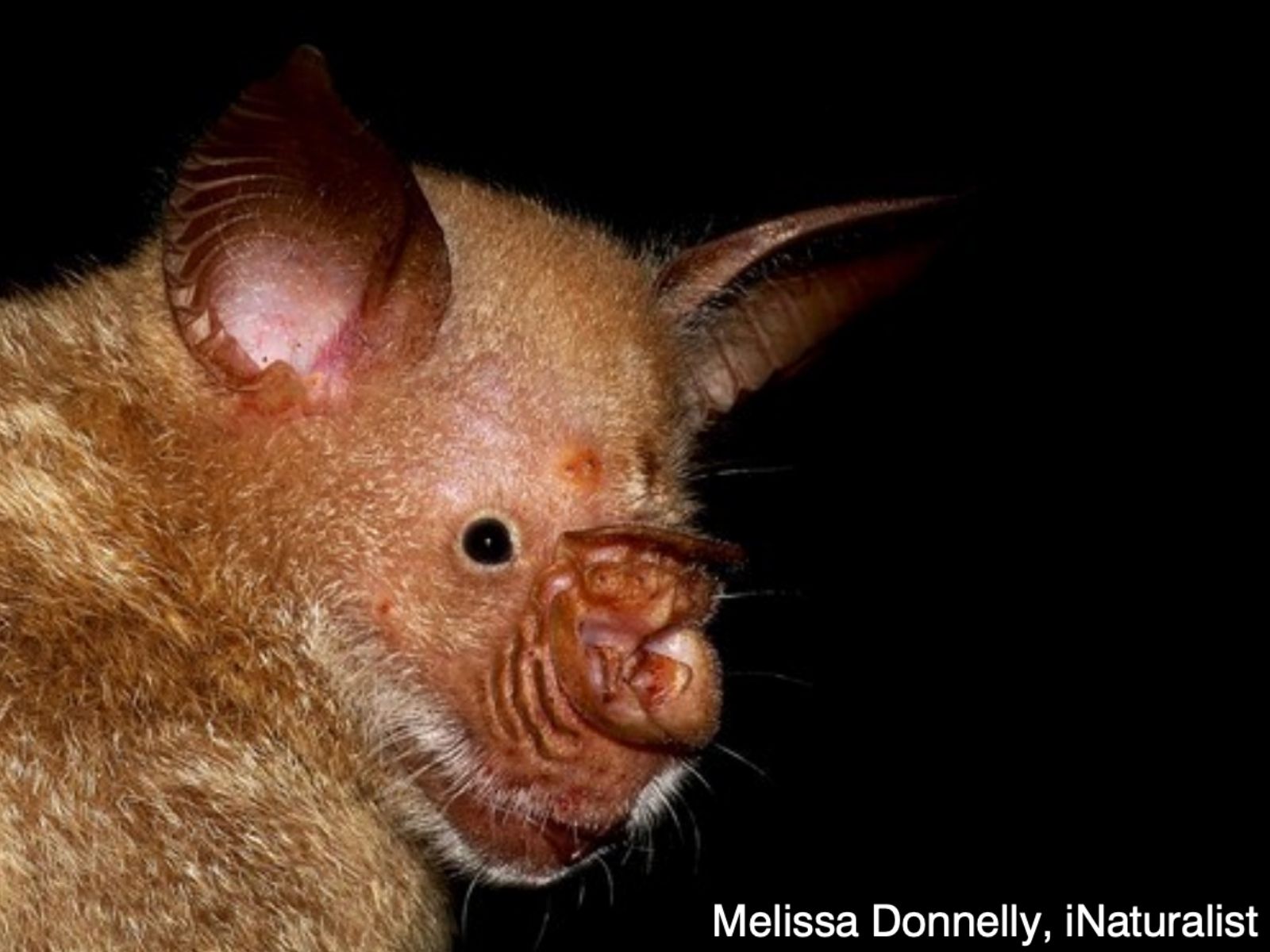
Striped Leaf-nosed Bat
Macronycteris vittata

2025 Red list status
Near Threatened

Regional Population Trend
Unknown

Change compared
to 2016
Uplisted
Overview
Macronycteris vittata – Peters, 1852
ANIMALIA – CHORDATA – MAMMALIA – CHIROPTERA – HIPPOSIDERIDAE – Macronycteris – vittata
Common Names: Striped Leaf-nosed Bat, Commerson’s Leafnosed Bat, Commerson’s Rhinolph, Commerson’s Roundleaf Bat, Giant Leaf-nosed Bat (English)
Synonyms: Hipposideros marungensis Noack, 1887; Hipposideros vittatus (Peters, 1852), Phyllorhina vittata, Phyllorhina commersoni, Hipposideros thomensis
Taxonomic Note:
This species was previously included under Hipposideros commersoni, that is now considered endemic to Madagascar (Monadjem et al. 2020). Historically, these large hipposiderids were grouped together and later divided into H. gigas and H. vittatus (Monadjem et al. 2020, Rakotoarivelo et al. 2015). In 2017 the commersoni species group was placed in a separate genus, Macronytceris based on nuclear and mitochondrial DNA sequence data (Foley et al. 2017). There is still confusion over the taxonomy of this group on mainland Africa with the potential presence of undescribed cryptic diversity.
Red List Status: NT– Near Threatened D2, (IUCN version 3.1)
Assessment Information
Assessors: Richards, L.R.1, Balono, J.2 & da Silva, J.M.3
Reviewer: Smith, C.4
Institutions: 1Durban Natural Science Museum, 2Gauteng and Northern Regions Bat Interest Group, 3South African National Biodiversity Institute, 4Endangered Wildlife Trust
Previous Assessors and Reviewers: Monadjem, A., Jacobs, D., Cohen, L., Richards, L.R., Schoeman, C., Sethusa, T. & Taylor, P.
Previous Contributors: Roxburgh, L., Raimondo, D., Nicholson, S.K., Relton, C. & Child, M.F.
Assessment Rationale
The species is only known from the northern part of the assessment region (extent of occurrence (EOO) estimated at 16,075 km2 and area of occupancy (AOO) estimated at 24 km2), where it occurs in Pafuri (Rautenbach et al. 1984) and Thornybush Game Reserve (Abott 2023), within the Greater Kruger National Park region. Although it qualifies for Vulnerable D2 based on limited number of locations, there are no known threats. While no information exists on population size in the assessment region, it is numerous outside South Africa. In the absence of known, stable colonies, and limited occurrence records the species is regarded as Near Threatened.
Regional population effects: The subpopulation that occurs in northern Kruger National Park is likely to part of a population that is continuous across the border occurring throughout most of Zimbabwe and Mozambique. The species overall is widespread in the rest of Africa. Striped Leaf-nosed Bats have a high wing-loading (Norberg & Rayner 1987), and presumably good dispersal potential, and thus rescue effects are possible.
Reasons for Change
Reason(s) for Change in Red List Category from the Previous Assessment: This edge-of-range species has been uplisted to Near Threatened (previously Least Concern) due to the limited number of known location records and the absence of information on population persistence within these areas. Furthermore, very few new records have been documented. Although no specific threats have been reported, there is a general lack of data on population size within the assessment region. In the absence of confirmed stable colonies and given the restricted occurrence records, the species is assessed as Near Threatened.
Red List Index
Red List Index: Uplisted
Recommended citation: Richards LR, Balono J & da Silva JM. 2025. A conservation assessment of Macronycteris vittata. In Patel T, Smith C, Roxburgh L, da Silva JM & Raimondo D, editors. The Red List of Mammals of South Africa, Eswatini and Lesotho. South African National Biodiversity Institute and Endangered Wildlife Trust, South Africa.
Regional Distribution and occurrence
Geographic Range
Although fairly sparse within its distribution, this species ranges through much of southern, Central and East Africa. The northeastern extent of its range extends from Ethiopia and Somalia to Kenya, Tanzania, Malawi, Zambia and Mozambique. It has a patchy distribution through Central Africa in the Democratic Republic of Congo, Central African Republic, Angola, and spreads westwards to Nigeria and Guinea. The southern portion of its distribution includes Zimbabwe, Botswana, Namibia and the extreme northeastern regions of South Africa. Within the assessment area, the species is limited to the Limpopo Province of South Africa, occurring in Pafuri and Thorny Bush in the northern Kruger National Park (Monadjem et al. 2020). It is absent from Lesotho, Eswatini and most parts of South Africa.
Elevation / Depth / Depth Zones
Elevation Lower Limit (in metres above sea level): 6 m asl (Monadjem et al. 2024)
Elevation Upper Limit (in metres above sea level): 2,211 m asl (Monadjem et al. 2024)
Depth Lower Limit (in metres below sea level): N/A
Depth Upper Limit (in metres below sea level): N/A
Depth Zone: N/A
Map
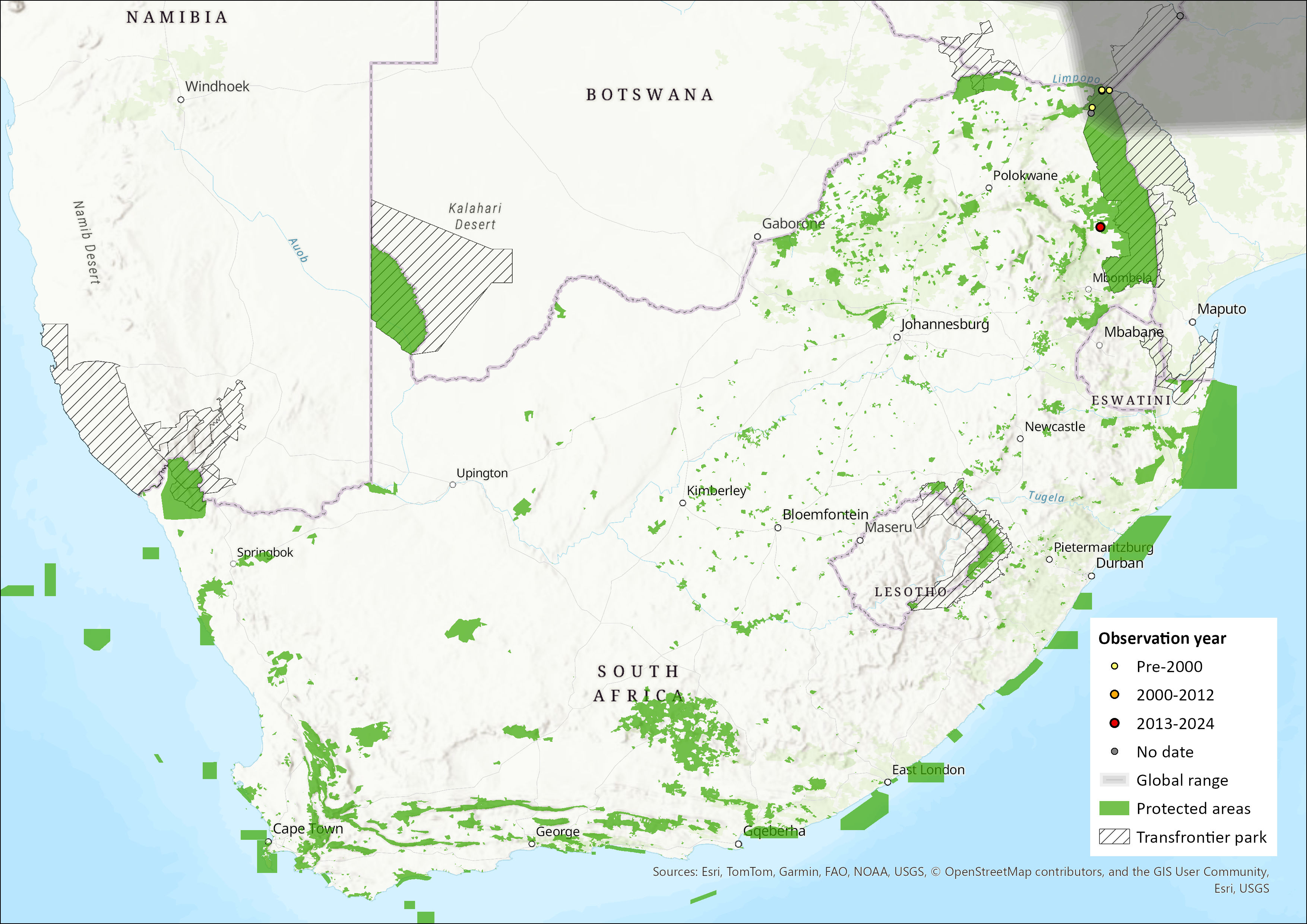 Figure 1. Distribution records for Striped Leaf-nosed Bat (Macronycteris vittata) within the assessment region (South Africa, Eswatini and Lesotho). Note that distribution data is obtained from multiple sources and records have not all been individually verified.
Biogeographic Realms
Biogeographic Realm: Afrotropical
Occurrence
Countries of Occurrence
| Country | Presence | Origin | Formerly Bred | Seasonality |
| Angola | Extant | Native | – | – |
| Botswana | Extant | Native | – | – |
| Central African Republic | Extant | Native | – | – |
| Congo, The Democratic Republic of the | Extant | Native | – | – |
| Ethiopia | Extant | Native | – | – |
| Guinea | Extant | Native | – | – |
| Kenya | Extant | Native | – | – |
| Malawi | Extant | Native | – | – |
| Mozambique | Extant | Native | – | – |
| Namibia | Extant | Native | – | – |
| Nigeria | Extant | Native | – | – |
| Somalia | Extant | Native | – | – |
| South Africa | Extant | Native | – | – |
| Tanzania, United Republic of | Extant | Native | – | – |
| Zambia | Extant | Native | – | – |
| Zimbabwe | Extant | Native | – | – |
Large Marine Ecosystems (LME) Occurrence
Large Marine Ecosystems: N/A
FAO Area Occurrence
FAO Marine Areas: (Not specified)
Climate change
Cotterill and Ferguson (1999) suggest that reduced prey availability during the dry season may negatively impact this large-sized species’ metabolic and reproductive processes. Prolonged dry seasons, increased precipitation seasonality, and an overall reduction in annual precipitation may affect the regional subpopulation.
Reher et al. (2022) reported variability in the thermal tolerance of the sister species Macronycteris commersoni occupying cave- and foliage roosts. Overall, cave-roosting and foliage-roosting bats became hyperthermic and entered heat-induced torpor when exposed to temperatures greater than their thermoneutral zone (Reher et al. 2022). More importantly, bats from both roosting niches appeared restricted in their ability to maintain euthermia outside their typical microclimate roosting conditions. Cave-roosting individuals are likely buffered from acute microclimatic fluctuations whilst in the roost. However, extreme or prolonged fluctuations in the local microclimate are likely to affect individuals adversely. While it is unclear whether South African M. vittata individuals utilise caves as their primary roosting sites, there is some evidence to suggest that they are able to utilise foliage roosts (Abott, 2023). Nonetheless, substantial increases in ambient temperature throughout their range (see Archer et al., 2018) may impose physiological constraints, as demonstrated in M. commersoni, leading to an altered distribution in the assessment region.
Population information
There is no information on the number of individuals occurring within the assessment region, as occurrence records are mostly based on single individual occurrence records (Rautenbach et al 1984). In other parts of its range, it has been documented in large ancestral roosts, consisting of tens of thousands of individuals, which are known to exhibit extensive migrations (Mickleburgh et al. 2008).
Current population trend: Unknown
Continuing decline in mature individuals? Unknown
Extreme fluctuations in the number of subpopulations: Unknown
Continuing decline in number of subpopulations: Unknown
All individuals in one subpopulation: Presumed
Number of mature individuals in largest subpopulation: Unknown, likely 10-50
Number of Subpopulations: 1
Quantitative Analysis
Probability of extinction in the wild within 3 generations or 10 years, whichever is longer, maximum 100 years: (Not specified)
Probability of extinction in the wild within 5 generations or 20 years, whichever is longer, maximum 100 years: (Not specified)
Probability of extinction in the wild within 100 years: (Not specified)
Population genetics
No population genetic studies have been conducted on this species within the assessment region, but seems localised to the northern part of South Africa. As such, it is expected that the species occurs as a single population/metapopulation connected to colonies in neighbouring countries. A phylogenetic/population genomic study would be needed to confirm this.
Habitats and ecology
The Striped Leaf-nosed Bat occupies a variety of savannah and woodland habitats, ranging from arid scrubby savannah in Namibia to moist Miombo Woodland in Zimbabwe and Mozambique (Cotterill 2001). In southern Africa it is recorded from the Mopane Bioregion. The species is a clutter-edge forager with a diet consisting mostly of Coleoptera, only occasionally consuming Isoptera (Monadjem et al. 2010). It is entirely dependent on large caves for breeding, where large colonies numbering hundreds of thousands of individuals may aggregate (Monadjem et al. 2010). When suitable caves are available for roosting, extremely large colonies can occur, but smaller groups do also roost in dense vegetation, hollow trees and tree canopies (Happold 1987; Skinner & Chimimba 2005). It is frequently seen flying between and within buildings, and occasionally roosts under the eaves of buildings (Skinner & Chimimba 2005). Males exhibit territorial behaviour between February and July but will roost together during the rest of the year (Monadjem et al. 2020). Generally mating commences in June/July, and pregnant females leave the breeding roost for about two months before returning in late October to give birth (Cotterill & Fergusson 1999).
Ecosystem and cultural services: The species’ feeding ecology makes them important regulators of insect populations (Boyles et al. 2011; Kunz et al. 2011). Bats particularly feed on species that damage crops, and agricultural areas with bats require less pesticides (Kunz et al. 2011).
IUCN Habitats Classification Scheme
| Habitat | Season | Suitability | Major Importance? |
| 1.6. Forest -> Forest – Subtropical/Tropical Moist Lowland | – | Suitable | – |
| 2.1. Savanna -> Savanna – Dry | – | Suitable | – |
| 2.2. Savanna -> Savanna – Moist | – | Unknown | – |
| 7.1. Caves and Subterranean Habitats (non-aquatic) -> Caves and Subterranean Habitats (non-aquatic) – Caves | – | Suitable | – |
| 7.2. Caves and Subterranean Habitats (non-aquatic) -> Caves and Subterranean Habitats (non-aquatic) – Other Subterranean Habitats | – | Suitable | – |
| 14.4. Artificial/Terrestrial -> Artificial/Terrestrial – Rural Gardens | – | Unknown | – |
Life History
Generation Length: (Not specified)
Age at Maturity: Female or unspecified: (Not specified)
Age at Maturity: Male: (Not specified)
Size at Maturity (in cms): Female: Forearm length = 9.59 cm ±0.23 (Cotterill & Ferguson, 1999)
Size at Maturity (in cms): Male: Forearm length = 10.25 cm ±0.25 Cotterill & Ferguson, 1999)
Longevity: Unknown
Average Reproductive Age: (Not specified)
Maximum Size (in cms): (Not specified)
Size at Birth (in cms): (Not specified)
Gestation Time: (Not specified)
Reproductive Periodicity: (Not specified)
Average Annual Fecundity or Litter Size: (Not specified)
Natural Mortality: (Not specified)
Does the species lay eggs? No
Does the species give birth to live young: Yes
Does the species exhibit parthenogenesis: N/A
Does the species have a free-living larval stage? No
Does the species require water for breeding? No
Movement Patterns
Movement Patterns: Full Migrant
Congregatory: Congregatory (and dispersive)
Systems
System: Terrestrial
General Use and Trade Information
There is no evidence to suggest that the species is traded or harvested within the assessment area, but the literature suggests that the species is targeted in some areas of its distribution for bushmeat (Monadjem et al. 2010). Additionally, in parts of Africa the fat of this species is utilised in the manufacture of candles (Mickleburgh et al. 2008).
|
Subsistence: |
Rationale: |
Local Commercial: |
Further detail including information on economic value if available: |
|
Yes |
– |
– |
– |
National Commercial Value: No
International Commercial Value: No
|
End Use |
Subsistence |
National |
International |
Other (please specify) |
|
11. Other household goods |
true |
– |
– |
– |
Is there harvest from captive/cultivated sources of this species? Yes, international within the sub-Saharan African region.
Harvest Trend Comments: (Not specified)
Threats
There are no major threats to this species in the assessment region as it is predominantly restricted to the Kruger National Park protected area. However, in other parts of its range, this large insectivorous species is sensitive to disturbance of its cavernicolous roosts (especially by guano mining). The loss of roosts in the form of old mine tunnels outside the presently known distribution within the assessment region from i) recommissioning of old mines that have been colonised by this species (pers. comm. C. Lötter) or ii) closure (sealing) of old mine tunnels, inter alia, to prevent their exploitation by illegal miners, (Government Notice 446, 21 May 2021), is considered a potential risk. It is also a popular target of bushmeat hunters within its distribution (Monadjem et al. 2020), and in some parts of its range, people have been known to utilise its fat for making candles, as it stores relatively large proportions of fat in its body (Mickleburgh et al. 2008).
Conservation
This species occurs within the Kruger National Park in the Limpopo Province, thus no species-specific conservation measures are deemed necessary as roost sites are likely to be safe from disturbance within this protected area. Any potential roosts occurring outside of this region may be subject to the threats listed above and may require conservation intervention.
Research priorities:
- Taxonomic revision is required to clarify the relationship between M. vittata and H. curtus/H. gigas.
- Field surveys are needed to generate population size and trend data.
- Targeted surveys for potential cave or crevice roosts within the greater Kruger National Park area and adjacent areas.
- A phylogenetic/population genomic study is needed to confirm population structure.
Encouraged citizen actions:
- Citizens can assist the conservation of the species by reporting sightings on virtual museum platforms (for example, iNaturalist and MammalMAP) and therefore contribute to an understanding of the species distribution.
Bibliography
Abott, L. 2023. iNaturalist observation: https://www.inaturalist.org/observations/152915814. Accessed on 16/10/2024.
Archer, E., Engelbrecht, F., Hänsler, A., Landman, W., Tadross, M. & Helmschrot, J. (2018) Seasonal prediction and regional climate projections for southern Africa. In: Climate change and adaptive land management in southern Africa – assessments, changes, challenges, and solutions (ed. by Revermann, R., Krewenka, K.M., Schmiedel, U., Olwoch, J.M., Helmschrot, J. & Jürgens, N.), pp. 14-21, Biodiversity & Ecology, 6, Klaus Hess Publishers, Göttingen & Windhoek. doi:10.7809/b-e.00296
Boyles JG, Cryan PM, McCracken GF, Kunz TH. 2011. Economic importance of bats in agriculture. Science 332: 41–42.
Cotterill FPD, Fergusson RA. 1999. Reproductive ecology of Commerson’s leaf-nosed bats Hipposideros commersoni (Chiroptera: Hipposideridae) in south-central Africa: interactions between seasonality and large body size; and implications for conservation. South African Journal of Zoology 34: 53–63.
Cotterill, F. P. D. 2001. New distribution records of leaf-nosed bats (Microchiroptera: Hipposideridae) in Zimbabwe. Arnoldia (Zim.) 10(17): 189–198.
Foley NM, Goodman SM, Whelan CV, Puechmaille SJ, Teeling E (2017) Towards navigating the Minotaur’s labyrinth: cryptic diversity and taxonomic revision within the speciose genus Hipposideros (Hipposideridae). Acta Chiropterologica 30;19(1):1-8.
Happold, D.C.D. 1987. The Mammals of Nigeria. Oxford University Press, London, UK.
Kunz TH, Braun de Torrez E, Bauer D, Lobova T, Fleming TH. 2011. Ecosystem services provided by bats. Annals of the New York Academy of Sciences 1223: 1–38.
Mickleburgh, S., Hutson, A.M., Bergmans, W., Cotterill, F.P.D. & Cooper-Bohannon, R. 2020. Macronycteris vittatus. The IUCN Red List of Threatened Species 2020: e.T135485A22050985. https://dx.doi.org/10.2305/IUCN.UK.2020-2.RLTS.T135485A22050985.en
Monadjem, A., Taylor, P.J., Cotterill, F.P.D. and Schoeman, M.C. 2020. Bats of Southern and Central Africa: A Biogeographic and Taxonomic Synthesis, Second Edition. University of the Witwatersrand Press, Johannesburg, South Africa.
Monadjem, A., Montauban, C., Webala, P.W., Laverty, T.M., Bakwo-Fils, E.M., Torrent, L., Tanshi, I., Kane, A., Rutrough, A.L., Waldien, D.L. and Taylor, P.J. 2024. African bat database: curated data of occurrences, distributions and conservation metrics for sub-Saharan bats. Scientific Data, 11(1), p.1309.
Norberg, U.M. and Rayner, J.M. 1987. Ecological morphology and flight in bats (Mammalia; Chiroptera): wing adaptations, flight performance, foraging strategy and echolocation. Philosophical Transactions of the Royal Society B: Biological Sciences 316: 335–427.
Reher S, Rabarison H, Nowack J, Dausmann KH. 2022. Limited Physiological Compensation in Response to an Acute Microclimate Change in a Malagasy Bat. Frontiers in Ecology and Evolution 10: 779381.
Skinner, J.D. and Chimimba, C.T. (eds). 2005. The Mammals of the Southern African Subregion. Cambridge University Press, United Kingdom, Cambridge.