

Stone Dormouse
Graphiurus rupicola

2025 Red list status
Near threatened

Regional Population Trend
Unknown

Change compared
to 2016
No Change
Overview
Graphiurus rupicola – (Thomas & Hinton, 1925)
ANIMALIA – CHORDATA – MAMMALIA – RODENTIA – GLIRIDAE – Graphiurus – rupicola
Common Names: Stone Dormouse, Rupicolous African Dormouse (English)
Synonyms: australis, kaokoensis, montosus (Holden 2013)
Taxonomic Note: Although originally listed as a species by Roberts (1951), this taxon was later reclassified as a subspecies of G. platyops by Genest-Villard (1978). However, more recently, this group was reassessed and is currently recognised as a valid species once again (Holden 2005, 2013).
Due to its flattened skull and rupiculous habits (features shared with the allopatric G. platyops), this species is unlikely to be confused with any other Graphiurus within its range, except G. angolensis which is smaller, does not have a flattened skull and occurs in woodlands (Monadjem et al. 2015). Similarly, Graphiurus microtis is significantly smaller and does not have a flattened skull (Monadjem et al. 2015).
Red List Status: NT – Near Threatened
Assessment Information
Assessors: Smith, C.1 & da Silva, J.M.2
Reviewer: Patel, T.1
Institutions: 1Endangered Wildlife Trust,2South African National Biodiversity Institute
Previous Assessors & Reviewers: MacFadyen, D., Schlitter, D. & Child, M.F.
Previous Contributors: Relton, C., Roxburgh, L., Avenant, N., Avery, M., Baxter, R., Monadjem, A., Palmer, G., Taylor, P. & Wilson, B.
Assessment Rationale
The Stone Dormouse is listed as Near Threatened B1ab(iii) due to its restricted range within the assessment region (estimated 13,723 km2 extent of occurrence using available museum records). Although the species occurs in inaccessible habitat, climate change and development in the region, particularly diamond mining and water pipelines, may have caused habitat loss or a decline in habitat quality. Similarly, the geographic range of this species may be naturally fragmented, and these interconnecting locations are further threatened by development. Additionally, no rescue effect is possible as the Orange River is a barrier to immigration from Namibia. Thus, this is a precautionary listing for this species, and we strongly recommend field surveys to accurately determine occupied localities and subpopulation trends for this species. New data will require reassessment as the species is most likely Least Concern.
Regional population effects: Isolated and disjunct subpopulations in South Africa and Namibia. No rescue effect is possible because the Orange River is a major barrier to dispersal.
Reasons for Change
Reason(s) for Change in Red List Category from the Previous Assessment: No change
Red List Index
Red List Index: No change
Recommended Citation: Smith C & da Silva JM. 2025. A conservation assessment of Graphiurus rupicola. In Patel T, Smith C, Roxburgh L, da Silva JM & Raimondo D, editors. The Red List of Mammals of South Africa, Eswatini and Lesotho. South African National Biodiversity Institute and Endangered Wildlife Trust, South Africa.
Regional Distribution and occurrence
Geographic Range
This species occurs in a narrow belt predominantly along the escarpment of Namibia and marginally into northwestern South Africa (Monadjem et al. 2015). While the northernmost limit was previously thought to be Kamanjab and Mount Brukaros in Namibia, specimens from Mt. Soque, Angola, are considered to represent this species (Holden 2013). It thus occurs on central mountains and plateaux from Mt. Soque, Angola, south to Port Nolloth, Kleinzee, Alexander Bay and Eenriet in Namaqualand, South Africa (Holden 2005). The population is fragmented and subpopulations between South Africa and Namibia are separated by the Orange River. The estimated extent of occurrence within South Africa is 13,723 km². There is assumed to be no overlap with the closely related G. platyops. Additional field research is needed to establish the specific extent of its distribution.
Elevation / Depth / Depth Zones
Elevation Lower Limit (in metres above sea level): (Not specified)
Elevation Upper Limit (in metres above sea level): (Not specified)
Depth Lower Limit (in metres below sea level): (Not specified)
Depth Upper Limit (in metres below sea level): (Not specified)
Depth Zone: (Not specified)
Map
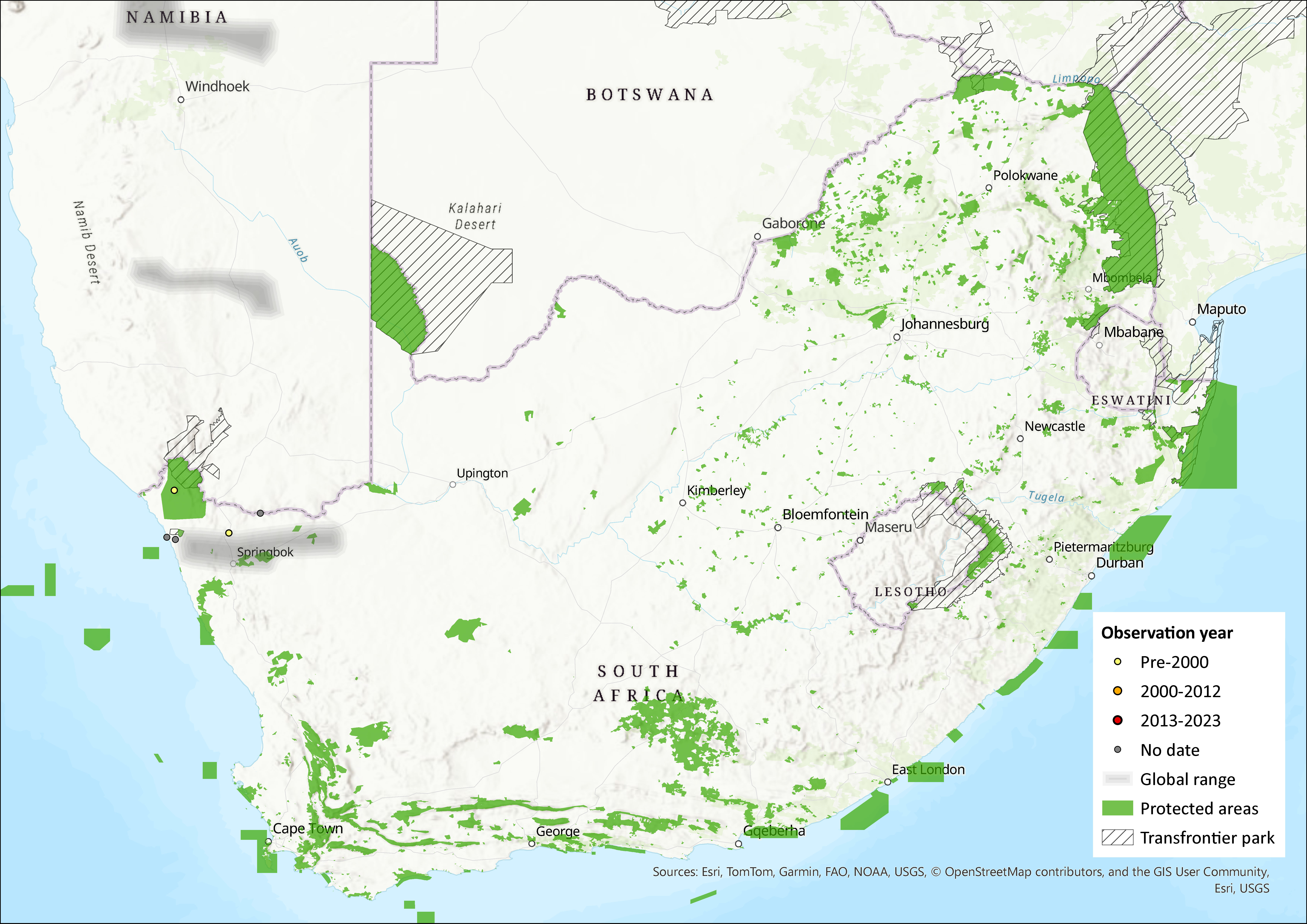
Figure 1. Distribution records for Stone Dormouse (Graphiurus rupicola) within the assessment region (South Africa, Eswatini and Lesotho). Note that distribution data is obtained from multiple sources and records have not all been individually verified.
Biogeographic Realms
Biogeographic Realm: Afrotropical
Occurrence
Countries of Occurrence
| Country | Presence | Origin | Formerly Bred | Seasonality |
| Angola | Presence Uncertain | Native | – | – |
| Namibia | Extant | Native | – | – |
| South Africa | Extant | Native | – | – |
Large Marine Ecosystems (LME) Occurrence
Large Marine Ecosystems: (Not specified)
FAO Area Occurrence
FAO Marine Areas: (Not specified)
Climate change
In the assessment region, this species only occurs in the northwestern area of the Northern Cape province, South Africa. There is a possibility that it might be affected by the 1.5-4°C increase in temperature predicted under various climate change scenarios (Engelbrecht et al. 2024). Rainfall is predicted to decrease in its range. These decreases will result in a more arid and drought-prone habitat which could affect food availability in the species distribution range and possibly leading to exacerbated habitat degradation and range contraction or shifts (sensu Foden et al. 2007).
Population information
Little information on population size or trends is available. This species was once thought plentiful within the rocky habitats around Karibib, Namibia (Shortridge 1934). Roberts (1951) considered it to be rare, which is supported by the relatively few specimens (c. 20) available in museum collections (Holden 2013). Information relating to its population within its marginal distribution along the northwest coast of the assessment region is extremely limited. Similar to other species of this group, the Stone Dormouse is considered difficult to trap and is rarely collected. Its habitat is, however, thought to be fairly continuous.
Population Information
Continuing decline in mature individuals? (Not specified)
Extreme fluctuations in the number of subpopulations: (Not specified)
Continuing decline in number of subpopulations: (Not specified)
All individuals in one subpopulation: (Not specified)
Number of mature individuals in largest subpopulation: (Not specified)
Number of Subpopulations: (Not specified)
Quantitative Analysis
Probability of extinction in the wild within 3 generations or 10 years, whichever is longer, maximum 100 years: (Not specified)
Probability of extinction in the wild within 5 generations or 20 years, whichever is longer, maximum 100 years: (Not specified)
Probability of extinction in the wild within 100 years: (Not specified)
Population genetics
While this genus has been investigated in a phylogenetic context (Montgelard et al. 2003), no population genetic assessment has been undertaken on the species. It has a fairly limited range within the assessment region, and the species is presumed to act as a single metapopulation given its fairly continuous habitat; however, genetic isolation likely exists between animals in the assessment region and those in Namibia due to Orang River acting as a natural barrier to dispersal. Consequently, the Convention on Biological Diversity’s Global Biodiversity Framework’s complementary genetic indicator – proportion of populations maintained (PM) – would receive a value of 1.0 (all populations remaining).
While the species was initially thought to be abundant, information is scarce, and potential threats within its distribution are prominent, making it ill-advised to make any inferences. Consequently, estimates of effective population size are not possible, thereby preventing the calculation of the Ne 500 genetic indicator.
It is highly recommended that a population genetic study be undertaken to better understand the population genetic structure and diversity within the species and to quantify the estimated indicator values.
Habitats and ecology
This species is predominantly limited to rocky areas along escarpments from altitudes of 400 m to at least 1,586 m (Holden 2013) but is known to utilise open areas to disperse to new suitable rocky habitats. It probably nests exclusively in rock crevices (Holden 2013). Shortridge (1934) described the Stone Dormouse as a nocturnal species, confined to mountainous and treeless habitats.
Most specimens have been caught in bushy Karoo-Namib shrubland or Karoo transition vegetation zones (Holden 2013). Its flattened cranium allows it to move through narrow rock crevices (Holden 2013). There is limited research pertaining to its diet, reproduction and behaviour.
Ecosystem and cultural services: This species is not known to provide any ecosystem services, but this may simply reflect the paucity of information available.
IUCN Habitats Classification Scheme
|
Habitat |
Season |
Suitability |
Major Importance? |
|
6. Rocky areas (eg. inland cliffs, mountain peaks) |
– |
Suitable |
– |
Life History
Generation Length: (Not specified)
Age at maturity: female or unspecified: (Not specified)
Age at Maturity: Male: (Not specified)
Size at Maturity (in cms): Female: (Not specified)
Size at Maturity (in cms): Male: (Not specified)
Longevity: (Not specified)
Average Reproductive Age: (Not specified)
Maximum Size (in cms): (Not specified)
Size at Birth (in cms): (Not specified)
Gestation Time: (Not specified)
Reproductive Periodicity: (Not specified)
Average Annual Fecundity or Litter Size: (Not specified)
Natural Mortality: (Not specified)
Does the species lay eggs? (Not specified)
Does the species give birth to live young: (Not specified)
Does the species exhibit parthenogenesis: (Not specified)
Does the species have a free-living larval stage? (Not specified)
Does the species require water for breeding? (Not specified)
Movement Patterns
Movement Patterns: (Not specified)
Congregatory: (Not specified)
Systems
System: Terrestrial
General Use and Trade Information
This species is not known to be traded or utilised in any form. Its limited distributional range and low population numbers would make it unsuitable for the pet trade.
Local Livelihood: (Not specified)
National Commercial Value: (Not specified)
International Commercial Value: (Not specified)
End Use: (Not specified)
Is there harvest from captive/cultivated sources of this species? (Not specified)
Harvest Trend Comments: (Not specified)
Threats
Although no major threats are suspected to cause substantial population decline, as their rocky habitats are largely unsuitable for agriculture, diamond mining and the resulting environmental transformation along the West Coast of South Africa could result in significant habitat degradation. Small-scale mining companies in the area often do not engage in environmental rehabilitation practices, thus further aggravating the problem.
Expanding anthropogenic development, including the construction of a large-scale water pipeline, threatens to affect the movements of this species, as well as the suitability of habitat across its range. Finally, climate change is predicted to have a severe impact on the arid and semi-arid regions of southern Africa through increased frequency and duration of drought (Boko et al. 2007), possibly leading to exacerbated habitat degradation and range contraction or shifts (sensu Foden et al. 2007).
Conservation
The Stone Dormouse occurs within the protected areas of Namaqua National Park and Kleinzee Conservation Area, although its current occupancy in protected areas remains to be verified. This species would be expected to benefit from the effective rehabilitation of mining areas, as well as the implementation and regulation of environmental policies relating to the mining industry. Additional research into the distribution, abundance, general ecology and threats relating to this cryptic species is urgently necessary before species-specific conservation initiatives can be designed.
Recommendations for land managers and practitioners:
- Rehabilitation of areas of suitable habitat (such as rocky areas), as well as corridors between suitable habitats that this species may utilise for dispersal.
Research priorities:
- Field surveys to determine the distributional range of this species.
- Genetic studies to determine range boundaries or overlaps and possibly hybridization with G. platyops.
- Quantifying the severity of threats facing this species.
- Continued research into the general ecology, habitat preferences and population dynamics of this species.
Encouraged citizen actions:
- Report sightings on virtual museum platforms (for example, iNaturalist and MammalMAP), especially outside protected areas.
- Stronger laws and public pressure to enforce rehabilitation of areas mined and those to be mined.
- Development or protection of corridors of suitable habitat to allow for dispersal and gene flow between populations.
Bibliography
Boko M, Niang I, Nyong A, Vogel C, Githeko A, Medany M, Osman-Elasha B, Tabo R, Yanda P. 2007. Africa. Climate Change 2007: Impacts, Adaptation and Vulnerability. Contribution of Working Group II to the Fourth Assessment Report of the Intergovernmental Panel on Climate Change. Pages 433–467. Intergovernmental Panel on Climate Change. Cambridge University Press, Cambridge, UK.
Engelbrecht, FA., Steinkopf, J., Padavatan, J. & Midgley, GF. 2024. Projections of future climate change in southern Africa and the potential for regional tipping points. In: von Maltitz, G.P., et al. Sustainability of Southern African Ecosystems under Global Change. Ecological Studies, vol 248. Springer, Cham. https://doi.org/10.1007/978-3-031-10948-5_7
Foden W, Midgley GF, Hughes G, Bond WJ, Thuiller W, Hoffman MT, Kaleme P, Underhill LG, Rebelo A, Hannah L. 2007. A changing climate is eroding the geographical range of the Namib Desert tree Aloe through population declines and dispersal lags. Diversity and Distributions 13:645–653.
Genest-Villard H. 1978. Révision systématique du genre Graphiurus (Rongeurs, Gliridae). Mammalia 42:391–426.
Holden, M.E. 2005. Family Gliridae. In: D.E. Wilson and D.M. Reeder (eds), Mammal Species of the World, pp. 819-841. Johns Hopkins University Press, Baltimore, Maryland, USA.
Holden ME. 2013. Graphiurus rupicola Rupicolous African Dormouse. Pages 131–132 in Happold DCD, editor. Mammals of Africa. Volume III: Rodents, Hares and Rabbits. Bloomsbury Publishing, London, UK.
Monadjem A, Taylor PJ, Denys C, Cotterill FPD. 2015. Rodents of Sub-Saharan Africa: A Biogeographic and Taxonomic Synthesis. De Gruyter, Berlin, Germany.
Rathbun, G.B. (subeditor). 2005. Macroscelidea. In: J.D. Skinner and C.T. Chimimba (eds), The Mammals of the Southern African Subregion, 3rd edition, pp. 22-34. Cambridge University Press, Cambridge, UK.
Roberts A. 1951. The Mammals of South Africa. The Trustees of the Mammals of South Africa, Central News Agency, Johannesburg, South Africa.
Shortridge, G.C. 1934. The mammals of South West Africa: a biological account of the forms occurring in that region. Heinemann, London, UK.