

Southern Right Whale Dolphin
Lissodelphis peronii

2025 Red list status
Least Concern

Regional Population Trend
Unknown

Change compared
to 2016
No Change
Overview
Lissodelphis peronii – (Lacépède, 1804)
ANIMALIA – CHORDATA – MAMMALIA – ARTIODACTYLA – DELPHINIDAE – Lissodelphis – peronii
Common Names: Southern Right Whale Dolphin, Southern Right Whale Porpoise, Mealy-mouthed Porpoise (English), Suidelike Noordkaperdolfyn (Afrikaans), Dauphin Aptère Austral (French), Delfín Liso Austral, Tunina Sinaleta (Spanish; Castilian)
Synonyms: No Synonyms
Red List Status: LC – Least Concern, (IUCN version 3.1)
Assessment Information
Assessors: Probert, R1. & da Silva, J.M.2
Reviewer: Smith, C.3
Institutions: 1Department of Botany and Zoology, Stellenbosch University, 2South African National Biodiversity Institute, 3Endangered Wildlife Trust
Previous Assessor: Plön, S.,
Previous Reviewer: Child, M.F.
Previous Contributors: Preston-Whyte, F., Relton, C., Atkins, S., Findlay, K., Meyer, M., Oosthuizen, H. & Elwen, S.
Assessment Rationale
To date, there are no abundance estimates for Southern Right Whale Dolphins in the study region or anywhere within their habitat range. The very low sighting rate is probably due to a lack of sampling effort. It is suspected that the population is robust and there is no reason to believe there is any decline. The offshore distribution of this species suggests no major threats. Thus, this species is listed as Least Concern within the assessment region. However, the possible disturbing effect of seismic activity is a minor threat. This species may require re-assessment if new data emerge, but it is not currently a conservation priority.
Regional population effects: Southern Right Whale Dolphins are widely distributed across the temperate regions of the southern hemisphere, and although their movement patterns are largely undocumented, no barriers to dispersal have been recognised, thus rescue effects are possible.
Reasons for Change
Reason(s) for Change in Red List Category from the Previous Assessment: No change
Red List Index
Red List Index: No change
Recommended citations: Probert R & da Silva JM. 2025. A conservation assessment of Lissodelphis peronii. In Patel T, Smith C, Roxburgh L, da Silva JM & Raimondo D, editors. The Red List of Mammals of South Africa, Eswatini and Lesotho. South African National Biodiversity Institute and Endangered Wildlife Trust, South Africa.
Regional Distribution and occurrence
Geographic Range
Southern Right Whale Dolphins have a circumpolar distribution across the southern hemisphere, restricted to regions north of the Antarctic Convergence (Rose & Payne 1991) and south of the Subtropical Convergence (Skinner & Chimimba 2005). There are, however, infrequent records of this species extending beyond these limits, for example 58–61°S (Jefferson et al. 1994) and to 12.5°S off the coast of Peru (Van Waerebeek et al. 1991). Strandings have been documented in southern Argentina (Goodall 1978), New Zealand and Australia (Baker 1981), with a live shallow water entanglement recently documented in coastal Brazil (Arrial et al. 2024).
Presumably this species follows cold-water currents, such as the Benguela and Humbodt (Watson 1985). In southern Africa, this species is known from the west coast, ranging northwards as far as about 23°S, due to the cold counterclockwise Benguela Current, occurring primarily in the region of upwelling off Lüderitz (Rose & Payne 1991). There is just one confirmed record of Southern Right Whale Dolphins off South Africa’s coast, just south of the Orange River (Rose & Payne 1991), though there are at least two skulls from the 19th century which are thought to have been collected from South African beaches (Cruickshank & Brown 1981). This species has also been documented in the waters around Marion Island (Cruickshank & Brown 1981). They are predominantly found offshore and there are no documented inshore sightings off Namibia, however rare inshore sightings from Chile (Aguayo 1975; Pinto-Torres et al. 2019) and Brazil (Arrial et al. 2024) have been recorded. Since this species tends to be localised off Lüderitz (Namibia), it is suspected that this group may infrequently extend marginally into South Africa (Rose & Payne 1991). Thus, sightings are expected to occur further south in the Benguela Current, but the lack thereof is likely to be due to a paucity of sampling effort.
Elevation / Depth / Depth Zones
Elevation Lower Limit (in metres above sea level): (Not specified)
Elevation Upper Limit (in metres above sea level): (Not specified)
Depth Lower Limit (in metres below sea level): (Not specified)
Depth Upper Limit (in metres below sea level): (Not specified)
Depth Zone: (Not specified)
Map
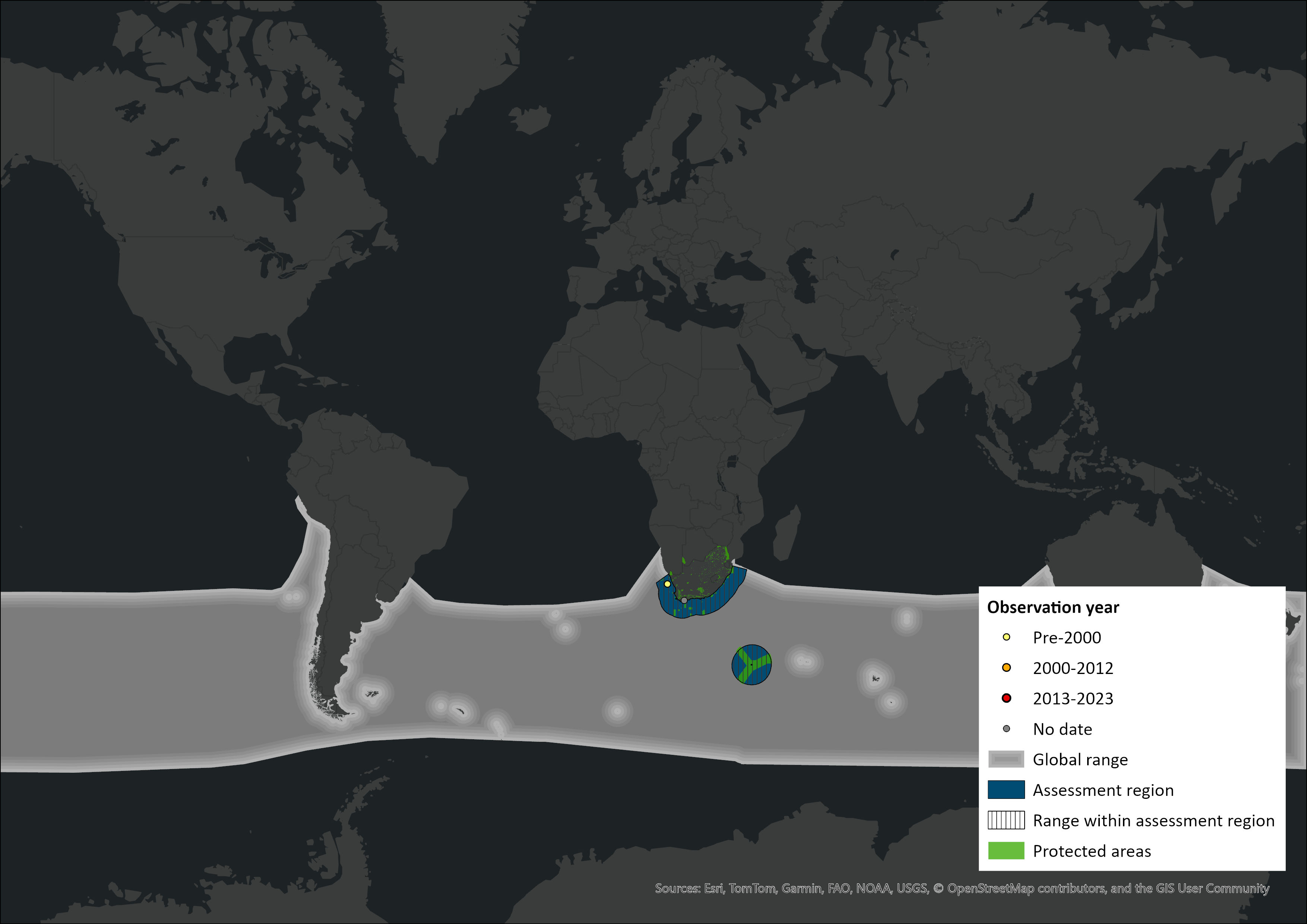 Figure 1. Distribution records for Southern Right Whale Dolphin (Lissodelphis peronii) within the assessment region (South Africa, Eswatini and Lesotho). Note that distribution data is obtained from multiple sources and records have not all been individually verified.
Biogeographic Realms
Biogeographic Realm: Afrotropical, Antarctic, Australasian, Neotropical, Oceanian
Occurrence
Countries of Occurrence
| Country | Presence | Origin | Formerly Bred | Seasonality |
| Argentina | Extant | Native | – | Resident |
| Australia | Extant | Native | – | Resident |
| Bouvet Island | Extant | Native | – | Resident |
| Brazil | Extant | Native | – | Resident |
| Chile | Extant | Native | – | Resident |
| Falkland Islands (Malvinas) | Extant | Native | – | Resident |
| French Southern Territories | Extant | Native | – | Resident |
| Mozambique | Extant | Native | – | Resident |
| Namibia | Extant | Native | – | Resident |
| New Zealand | Extant | Native | – | Resident |
| Peru | Extant | Native | – | Resident |
| Saint Helena, Ascension and Tristan da Cunha | Extant | Native | – | Resident |
| Saint Helena, Ascension and Tristan da Cunha -> Tristan da Cunha | Extant | Native | – | Resident |
| South Africa | Extant | Native | – | Resident |
| South Georgia and the South Sandwich Islands | Extant | Native | – | Resident |
| Uruguay | Extant | Native | – | Resident |
Large Marine Ecosystems (LME) Occurrence
Large Marine Ecosystems: (Not specified)
FAO Area Occurrence
| Presence | Origin | Formerly Bred | Seasonality | |
| 41. Atlantic – southwest | Extant | Native | – | Resident |
| 47. Atlantic – southeast | Extant | Native | – | Resident |
| 48. Atlantic – Antarctic | Extant | Native | – | Resident |
| 51. Indian Ocean – western | Extant | Native | – | Resident |
| 57. Indian Ocean – eastern | Extant | Native | – | Resident |
| 58. Indian Ocean – Antarctic | Extant | Native | – | Resident |
| 81. Pacific – southwest | Extant | Native | – | Resident |
| 87. Pacific – southeast | Extant | Native | – | Resident |
| 88. Pacific – Antarctic | Extant | Native | – | Resident |
Climate change
Over the years, significant shifts in the Benguela Current System Large Marine Ecosystem have been documented, including changes in wind patterns, air and sea temperatures, and upwelling regimes (Hutchings et al. 2009; Moloney et al. 2013; Jarre et al. 2015). Such changes can have direct and indirect effects on Southern Right Whale Dolphins. This species typically prefers cooler water temperatures between 9 and 16°C (Gaskin 1968; Cruickshank & Brown 1981), however they are not restricted to this range (Rose & Payne 1991). Currently, the Benguela Current provides an optimal thermal range for Southern Right Whale Dolphins. However, global temperatures are increasing as a result of climate change. The Benguela Current is considered slow warming (Hampton & Willemse 2012), with an increase 0.28°C over a 25-year period spanning 1982-2006. More recent estimates predict a 0.5°C increase by 2032 and a 1°C increase by 2041, relative to the previous estimate from 1995-2014 (Varela et al. 2023). Such shifts in sea temperatures can directly impact Southern Right Whale Dolphins through displacement and movement boundaries, or indirectly through impacting prey availability.
It is speculated that Southern Right Whale Dolphins feed on lanternfish (Lampanyctodes hectoris), krill (Nyctiphanes capensis), and small squid (Lolinguncula sp.) in Namibian waters, although no stomach contents from individuals in this region have been obtained and assessed (Cruickshank & Brown 1981). Ocean warming is known to influence krill in the Antarctic, negatively impacting its life cycle and recruitment and, thus, its abundance and distribution (Flores et al. 2012). On the other hand, Namibian squid (specifically chokka squid – Loligo reynaudii – and Angolan flying squid – Todarodes angolensis) are considered resilient to the effects of climate change, with an overall moderate to low sensitivity to environmental change (Ortega-Cisneros et al. 2018; Engelhard et al. 2024). Many Namibian fish species are highly sensitive to climate change (see Ortega-Cisneros et al. 2018); however, the diet composition of Southern Right Whale Dolphins is poorly understood. To fully understand the effects on climate change on food availability for Southern Right Whale Dolphins, stomach contents need to be evaluated to determine the extent to which they are feeding on these prey items and to determine whether they are generalist or specialist feeders within this region.
Population
No global or regional estimates or trends are available for Southern Right Whale Dolphins, and generally, this species seems to avoid contact with oceanic vessels, and their fast-swimming behaviour renders them difficult to spot at sea (Rose & Payne 1991). This species is known from only one confirmed record off South Africa’s northwestern coast, as well as around Marion Island, and there are no population estimates for the assessment region. In general, this species is considered to have a robust population and to be fairly common within its range (Jefferson et al. 1994; Lipsky et al. 2002). Additionally, Rose and Payne (1991) suggest that they may be considerably more common in southern African waters than previously believed (Rose & Payne 1991). However, this is only likely to be the case for Namibia, as they are thought to extend only marginally into the waters off South Africa’s west coast, thus they are not considered abundant within the waters off northwestern South Africa (Branch et al. 2007). Taylor et al. (2007) estimated a generation period of 18.3 years for this species.
| Continuing decline in mature individuals? | Qualifier | Justification |
| Unknown | – | – |
Current population trend: Unknown
Continuing decline in mature individuals: Unknown
Number of mature individuals in population: Unknown
Number of mature individuals in largest subpopulation: Unknown
Number of subpopulations: Unknown
Severely fragmented: No
Extreme fluctuations in the number of subpopulations: (Not specified)
Continuing decline in number of subpopulations: (Not specified)
All individuals in one subpopulation: (Not specified)
Quantitative Analysis
Probability of extinction in the wild within 3 generations or 10 years, whichever is longer, maximum 100 years: (Not specified)
Probability of extinction in the wild within 5 generations or 20 years, whichever is longer, maximum 100 years: (Not specified)
Probability of extinction in the wild within 100 years: (Not specified)
Population Genetics
Very little population genetic research has been conducted on the Southern right whale dolphins, and what has been done has generally been localised to South America (e.g., Carroll et al. 2020, Frainer 2024). The occurrence of hybrids with the dusky dolphin (Lagenorhynchus obscurus) along Argentinian waters (Yadzi, 2002). While very little is known about this species in the assessment region, knowledge that they are widely distributed across the temperate regions of the southern hemisphere and there appears to be no barriers to dispersal, it is possible the species (at least around the region) exists as a single population. Based on this assumption, the Convention on Biological Diversity’s Global Biodiversity Framework’s (GBF’s) complementary genetic indicator – proportion of populations maintained (PM) – would receive a value of 1.0 (all populations remaining).
While the species has a wide distribution and has been thought to be fairly common within its range, the general lack of population size data, makes it difficult to estimate the Convention on Biological Diversity’s Global Biodiversity Framework’s (GBF’s) headline genetic indicator – proportion of populations with an Ne > 500.
Habitats and ecology
Gaskin (1968) suggested that this species typically prefers cooler temperate waters between the Subtropical and Antarctic Convergences, at water temperatures of 9–16°C, thus the lack of sightings in the warmer regions off the southern Indian Ocean is not unexpected (Rose & Payne 1991). However, all of Cruickshank and Brown’s (1981) sightings were recorded in waters more than 15.7°C, though subsurface temperatures are likely to have been substantially lower. Thus, it is expected that although this species may be more common in cooler waters (9–16°C), they are certainly not restricted to this temperature range (Rose & Payne 1991). Although generally preferring deep waters, this species does occur in nearshore regions with steep coastal gradients.
Although the feeding ecology of the Southern Right Whale Dolphin is poorly documented, they are believed to feed nocturnally (Torres & Aguayo 1979), predominantly on squid and fish (Jefferson et al. 1994). Lanternfish (mostly Hygophum hanseni) and squid (primarily Gonatus antarcticus) remains were found in the stomach of an individual captured off Chile (Torres & Aguayo 1979). Additionally, the stomach of two individuals stranded in New Zealand contained the fish species Macruronus novaezelandiae and the squid Nototodarus sloanii (Baker 1981). Although stomach contents have not been analysed for individuals inhabiting the Benguela Current, their diet, consisting of small squid, krill, and lanternfish, has been inferred from net samples and acoustic recordings during Southern Right Whale Dolphin encounters (Cruickshank & Brown 1981). This corresponds to the diet of this species in other regions. Rose and Payne (1991) conclude that Southern Right Whale Dolphins are highly gregarious and specialised feeders that, due to their high levels of activity, may be reliant on strong upwelling regions of high productivity in order to meet their energetic demands.
This species has been documented in groups ranging from 4 to 1,000 individuals (Gaskin 1968). Groups of L. peronii have been observed traveling at rapid speeds (estimated at about 20 knots, Rose & Payne 1991) usually just below the surface, surfacing only briefly (Cruickshank & Brown 1981). Southern Right Whale Dolphins occasionally associate with other cetacean species, such as Dusky Dolphins (Lagenorhynchus obscurus), Bottlenose Dolphins (Tursiops truncatus), and pilot whales (presumably Long-finned Pilot Whales, Globicephala melas, due to their west coast distribution) (Cruickshank & Brown 1981). Very little information is known about the reproductive ecology of these species, though they have been recorded as sexually mature at length of 2.18 m and 2.51 m for females and males, respectively (Van Waerebeek et al. 1991).
Ecosystem and cultural services: Marine mammals integrate and reflect ecological variation across large spatial and long temporal scales, and therefore they are prime sentinels of marine ecosystem change; polar cetaceans are useful for assessing the effects of rapid changes in sea ice conditions on food webs in these strongly seasonal ecosystems (Moore 2008).
IUCN Habitats Classification Scheme
| Habitat | Season | Suitability | Major Importance? |
| 9.1. Marine Neritic -> Marine Neritic – Pelagic | – | Marginal | – |
| 10.1. Marine Oceanic -> Marine Oceanic – Epipelagic (0-200m) | – | Suitable | Yes |
Life History
Generation Length: (Not specified)
Age at Maturity: Female or unspecified: (Not specified)
Age at Maturity: Male: (Not specified)
Size at Maturity (in cms): Female: 2.81
Size at Maturity (in cms): Male: 2.51
Longevity: (Not specified)
Average Reproductive Age: (Not specified)
Maximum Size (in cms): (Not specified)
Size at Birth (in cms): (Not specified)
Gestation Time: (Not specified)
Reproductive Periodicity: (Not specified)
Average Annual Fecundity or Litter Size: (Not specified)
Natural Mortality: (Not specified)
Breeding Strategy
Does the species lay eggs? No
Does the species give birth to live young: Yes
Does the species exhibit parthenogenesis: No
Does the species have a free-living larval stage? No
Does the species require water for breeding? Yes
Movement Patterns
Movement Patterns: (Not specified)
Congregatory: (Not specified)
Systems
System: Marine
General Use and Trade Information
There is no trade or use of this species in the assessment region.
|
Subsistence: |
Rationale: |
Local Commercial: |
Further detail including information on economic value if available: |
|
Yes |
– |
– |
– |
National Commercial Value: Yes
International Commercial Value: No
|
End Use |
Subsistence |
National |
International |
Other (please specify) |
|
1. Food – human |
true |
true |
– |
– |
|
2. Food – animal |
true |
true |
– |
– |
Is there harvest from captive/cultivated sources of this species? (Not specified)
Harvest Trend Comments: (Not specified)
Threats
Seismic activity, for oil and gas, might be a minor threat, due to possible disturbance of Southern Right Whale Dolphins. They have been directly taken in gillnets elsewhere in the world but there is no evidence that it occurs in South African waters. Considering the squid-based diet of the Southern Right Whale Dolphin and its distribution in pelagic waters off the west coast of southern Africa, there may be some threat of competition for forage resources with pelagic trawl fisheries.
The impact of global climate change, and the associated effects of increased water temperature and CO2 concentration, on Southern Right Whale Dolphins is largely unknown, however, is likely to have cascading effects on the movements and feeding ecology of these species (Learmonth et al. 2006).
A live shallow water entanglement of a single Southern Right Whale Dolphin was documented in Brazil (Arrial et al. 2024), which was successfully released. Although this is the only entanglement documented to date, both in-use and discarded fishing gear is a threat, albeit likely a minor threat, to this species.
Conservation
Southern Right Whale Dolphins are listed in Appendix II of the Convention on International Trade in Endangered Species of Wild Fauna and Flora (CITES) and are protected by the Marine Living Resources Act (No. 18 of 1998) of the national legislation. Although no specific conservation measures have been identified for this species, it would benefit from continued research into their population dynamics and distribution patterns. Additionally, the impacts of direct threats, such as noise pollution and bycatch in pelagic fisheries, as well as the indirect effects of climate change and competition on food resources should be investigated.
Recommendations for managers and practitioners:
- Sightings, strandings and bycatch data should be recorded, especially during ship-based surveys aimed at other cetacean species, as well as commercial fisheries and marine tour operators.
Research priorities:
- Data pertaining to the species’ distribution patterns and the severity of potential threats that could affect the listing of this species.
- Estimates of population size and trends, as well as the distribution of this species within the assessment region, are urgently needed.
Encouraged citizen actions:
- Use information dispensed by the South African Sustainable Seafood Initiative (SASSI) to make good choices when buying fish in shops and restaurants, e.g. wwfsa.mobi, FishMS 0794998795.
- Save electricity and fuel to mitigate CO2 emissions and hence, the rate of climate change.
- Buy local products that have not been shipped.
- Report sightings on virtual museum platforms (for example, iNaturalist and MammalMAP) to help with mapping geographical distribution.
- Avoid using plastic bags.
Bibliography
Aguayo-L., A. 1975. Progress report on small cetacean research in Chile. Journal of the Fisheries Research Board of Canada 32: 1123-1143.
Arrial, L. G. R., Correa, T. D. P., de Castilho, P. V., & Machado, R. (2024). New record of the southern right whale dolphin, Lissodelphis peronii (Lacépède, 1804), in the coastal waters of Brazil. Polar Biology 47(11): 1169-1173.
Baker SG. 1981. The Southern Right Whale Dolphin Lissodelphis peronii (Lacépède) in Australasian waters. Records of the National Museum of New Zealand 2: 17-34.
Branch G, Griffiths C, Branch M, Beckley L. 2007. Two Oceans. A Guide to the Marine Life of Southern Africa. Struik Publishers, Cape Town, South Africa.
Cruickshank RA, Brown SG. 1981. Recent observations and some historical records of Southern Right-Whale Dolphins Lissodelphis peronii. Fisheries Bulletin South Africa 15: 109-121.
Engelhard, G. H., Bova, C., Gusha, M. N. C., Harrod, O. L., Kadhila, T., Kanyimba, A., … & Hyder, K. (2024). Climate risk assessment of the fisheries in Namibia. Reviews in Fish Biology and Fisheries, 34(4), 1231-1260.
Flores, H., Atkinson, A., Kawaguchi, S., Krafft, B. A., Milinevsky, G., Nicol, S., … & Werner, T. (2012). Impact of climate change on Antarctic krill. Marine Ecology Progress Series, 458, 1-19.
Frainer, G., 2024. Southern Right Whale Dolphin Lissodelphis peronii (Lacépède, 1804). In Mammals of Middle and South America: Cetacea and Sirenia (pp. 1-13). Cham: Springer Nature Switzerland.
Gaskin, D.E. 1968. Distribution of Delphinidae (Cetacea) in relation to sea surface temperatures off eastern and southern New Zealand. New Zealand Journal of Marine and Freshwater Research 2: 527-534.
Goodall RNP. 1978. Report on the small cetaceans stranded on the coasts of Tierra del Fuego. Scientific Reports of the Whales Research Institute 30: 197-230.
Hampton, I., & Willemse, N. E. (2012). Potential effects of climate change and environmental variability on the resources of the Benguela Current Large Marine Ecosystem. Frontline Observations on Climate Change and Sustainability of Large Marine Ecosystems. GEF, New York, 16-50.
Hutchings L, Van der Lingen CD, Shannon LJ, Crawford RJ, Verheye HM, Bartholomae CH, Van der Plas AK, Louw D, Kreiner A, Ostrowski M, Fidel Q. 2009. The Benguela Current: An ecosystem of four components. Progress in Oceanography 83(1-4):15-32.
IUCN (International Union for Conservation of Nature). 2008. Lissodelphis peronii. The IUCN Red List of Threatened Species. Version 3.1. Available at: http://www.iucnredlist.org. Downloaded on 21 February 2016.
Jarre A, Hutchings L, Kirkman SP, Kreiner A, Tchipalanga PC, Kainge P, Uanivi U, van der Plas AK, Blamey LK, Coetzee JC, Lamont T. 2015. Synthesis: climate effects on biodiversity, abundance and distribution of marine organisms in the Benguela. Fisheries Oceanography 24:122-49.
Jefferson, T. A., Newcomer, M. W., Leatherwood, S. and Van Waerebeek, K. 1994. Right whale dolphins Lissodelphis borealis (Peale, 1848) and Lissodelphis peronii (Lacepede, 1804). In: S. H. Ridgway and R. Harrison (eds), Handbook of marine mammals, pp. 335-362. Academic Press.
Learmonth, J.A., Macleod, C.D., Santos, M.B., Pierce, G.J., Crick, H.Q.P. and Robinson, R.A. 2006. Potential effects of climate change on marine mammals. Oceanography and Marine Biology: An Annual Review 44: 431-464.
Lipsky, J. D. 2002. Right whale dolphins Lissodelphis borealis and L. peronii. In: W. F. Perrin, B. Wursig and J. G. M. Thewissen (eds), Encyclopedia of Marine Mammals, pp. 1030-1033. Academic Press.
Mead JG, Brownell RL. 1993. Order Cetacea. In: Wilson DE, Reeder DM (ed.), Mammal Species of the World: A taxonomic and geographic reference, pp. 349-364. Smithsonian Institution Press, Washington, DC, USA.
Moloney, C.L., Fennessey, S.T., Gibbons, M.J., Roychoudhury, A., Shillington, F.A. von der Heyden, B.P. and Watermeyer, K. 2013. Reviewing evidence of marine ecosystem change off South Africa. African Journal of Marine Science 35(3): 427-448.
Moore SE. 2008. Marine mammals as ecosystem sentinels. Journal of Mammalogy 89: 534-540.
Ortega-Cisneros K, Yokwana S, Sauer W, Cochrane K, Cockcroft A, James NC, Potts WM, Singh L, Smale M, Wood A, Pecl G. 2018b. Assessment of the likely sensitivity to climate change for the key marine species in the southern Benguela system. African Journal of Marine Science 40(3):279-92.
Pinto-Torres, M., Acevedo, J., Mora, C., Iglesias, E., Bravo, D., & Martínez, F. (2019). Sighting of southern right whale dolphin (Lissodelphis peronii) in the Magellan Strait, Chile. Polar Biology 42: 633-638.
Rose, B. and Payne, A. I. L. 1991. Occurrence and behavior of the southern right whale dolphin Lissodelphis peronii off Namibia. Marine Mammal Science 7: 25-34.
Skinner, J.D. and Chimimba, C.T. (eds). 2005. The Mammals of the Southern African Subregion. Cambridge University Press, United Kingdom, Cambridge.
Taylor, B.L., Chivers, S.J., Larese, J. and Perrin, W.F. 2007. Generation length and percent mature estimates for IUCN assessments of cetaceans. NOAA, Southwest Fisheries Science Center Administrative Report LJ-07-01. La Jolla, California.
Torres ND, Aguayo LA. 1979. Feeding habits of Lissodelphis peronii (Lacépède 1804) in central Chile (Cetacea; Delphinidae). Revista Biologia Marina Departamento Oceanologia Universidad Chile 16: 221-224.
Van Waerebeek, K., Canto, J., Gonzales, J., Oporto, J. and Brito, J. L. 1991. Southern right whale dolphins, Lissodelphis peronii off the Pacific coast of South America. Zeitschrift für Säugetierkunde 56: 284-295.
Varela, R., de Castro, M., Dias, J. M., & Gómez-Gesteira, M. (2023). Coastal warming under climate change: Global, faster and heterogeneous. Science of the Total Environment, 886, 164029.
Watson L. 1985. Whales of the world. A complete guide to the world’s living whales, dolphins and porpoises. Hutchinson, London, UK.
Yadzi, P., 2002. A possible hybrid between the dusky dolphin (Lagenorhynchus obscurus) and the southern right whale dolphin (Lissodelphis peronii). Aquatic Mammals, 28(2), pp.211-217.