
Southern Bushbuck
Tragelaphus scriptus

2025 Red list status

Regional Population Trend
Stable

Change compared
to 2016
No Change
Overview
Tragelaphus scriptus – (Pallas, 1766)
ANIMALIA – CHORDATA – MAMMALIA – ARTIODACTYLA – BOVIDAE – Tragelaphus – scriptus
Common Names: Southern Bushbuck (English), Bosbok (Afrikaans), Serôlô, Pabala, T’shô’sô (Sepedi), Pabala, Tshoso (Sesotho), Serôlôbotlhoko, Thamma (Setswana), Imbabala (Swati, Xhosa, Zulu), Mbavhala, Xoxwe, Hodzolume (Tsonga), Tshishosho, Luvhengammbwe (Venda), Ungece, Unkonka (Xhosa), Unkonka, Omdaka (Zulu)
Synonyms: No Synonyms
Taxonomic Note:
South Africa
Over 40 subspecies of Tragelaphus scriptus have been described but systematic studies indicate that between 24 (Lydekker 1913; Allen 1939) and six (Grubb 1985) distinct forms may exist. Twenty-three bushbuck (T. scriptus) haplogroups in relation to topology and habitat heterogeneity were identified, whereby the molecular variation is partitioned into two divergent super lineages, Scriptus and Sylvaticus, each inhabiting the northern and western, and the southern and eastern parts of sub-Saharan Africa, respectively. (Moodley & Bruford 2007). These lineages were treated as distinct species following Moodley et al. (2009). However, Hassanin et al. 2012 stated that this specific distinction needed to be confirmed with both morphological and nuclear data. A subsequent analysis comparing mitochondrial and nuclear genes highlighted that Scriptus and Sylvaticus are reciprocally monophyletic at nuclear DNA loci, comprising a single species, where Scriptus and Sylvaticus can be considered chromosomal races (Rakotoarivelo et al. 2019a).
Red List Index: LC – Least Concern, (IUCN version 3.1)
Assessment Information
Assessors: Ehlers Smith, Y.1, Russo, I.M.2, Swanepoel, H.3, Jansen van Vuuren, A.3 & da Silva, J. M.4
Reviewer: Anderson, J.5,6
Contributor: Patel, T7
Institutions: 1Ezemvelo KZN Wildlife, 2Cardiff University, 3Nelson Mandela University, South Africa, 4South African National Biodiversity Institute, 5IUCN SSC Antelope Specialist Group, 6International Conservation Services, 7Endangered Wildlife Trust
Previous Assessors & Reviewers: Downs, C., Coates, G. & Child, M.F.
Previous Contributors: Selier, J., Relton, C. & IUCN SSC Antelope Specialist Group
Assessment Rationale
This species remains Least Concern within the assessment region, as it is widespread (and has been widely reintroduced) and well-represented in protected areas across its range with no evidence for net population decline. However, localised declines may be occurring due to poaching, habitat loss and degradation, and competition with introduced Nyala (T. angasii). Such threats should be quantified to assess their severity on the overall population. While no specific interventions are necessary at present, translocations that mix ecotypes should be avoided, and land managers should conserve thicket habitats on which this species depends. Further research on ecotypes may split the population into management units for conservation.
Regional population effects: This species occurs in many habitat types and its range is connected with neighbouring countries; for example, along the northern border of South Africa between Botswana, Zimbabwe and Mozambique through the Mapungubwe and Great Limpopo Transfrontier Park and northeast KwaZulu-Natal (KZN). There is evidence that males can disperse long distances (Apio et al. 2010), and thus we assume that rescue effects are possible.
Reasons for Change
Reason(s) for Change in Red List Category from the Previous Assessment: No change
Red List Index
Red List Index: No change
Recommended citation: Ehlers Smith Y, Russo IM, Swanepoel H, Jansen van Vuuren A & da Silva JM. 2025. A conservation assessment of Tragelaphus scriptus. In Patel T, Smith C, Roxburgh L, da Silva JM & Raimondo D, editors. The Red List of Mammals of South Africa, Eswatini and Lesotho. South African National Biodiversity Institute and Endangered Wildlife Trust, South Africa.
Regional Distribution and occurrence
Geographic Range
Bushbuck are one of the most widely distributed antelope species on the African continent (Skinner and Chimimba 2005), occurring on c. 72% of Africa’s landmass in 40 countries (East 1999, Moodley et al. 2009). The only sub-Saharan country from which they have not recently been recorded, and where they may formerly have occurred, is Lesotho (Lynch 1994). The Rift Valley broadly separates T. scriptus, occurring in North and West Africa, from T. sylvaticus, occurring in East and southern Africa (Moodley and Bruford 2007). They occur widely in Zimbabwe, Mozambique, Eswatini and the eastern parts of South Africa, as well as northern Botswana (Skinner and Chimimba 2005). They naturally occur throughout much of South Africa and are widely distributed in the highly fragmented forest and thicket biomes. Their current distribution within the assessment region is mostly the same as their historical distribution, occurring in the Limpopo, North West, Mpumalanga, Gauteng and KwaZulu-Natal Provinces, and along the coast in both the Eastern and Western Cape Provinces, about as far west as Bredasdorp (Skinner and Chimimba 2005). However, they have also been widely introduced into unsuitable areas. For example, while Southern Bushbuck naturally occur in the northern bushveld areas of the North West Province (Power 2014), they are locally exotic in the southern parts of the province (Rautenbach 1982). Additionally, there seems to have been a natural range expansion into the riparian habitats of the Maretsaane area in the northwestern part of the North West Province (Power 2014).
Elevation / Depth / Depth Zones
Elevation Lower Limit (in metres above sea level): 0
Elevation Upper Limit (in metres above sea level): 4000
Depth Lower Limit (in metres below sea level): (Not specified)
Depth Upper Limit (in metres below sea level): (Not specified)
Depth Zone: (Not specified)
Map
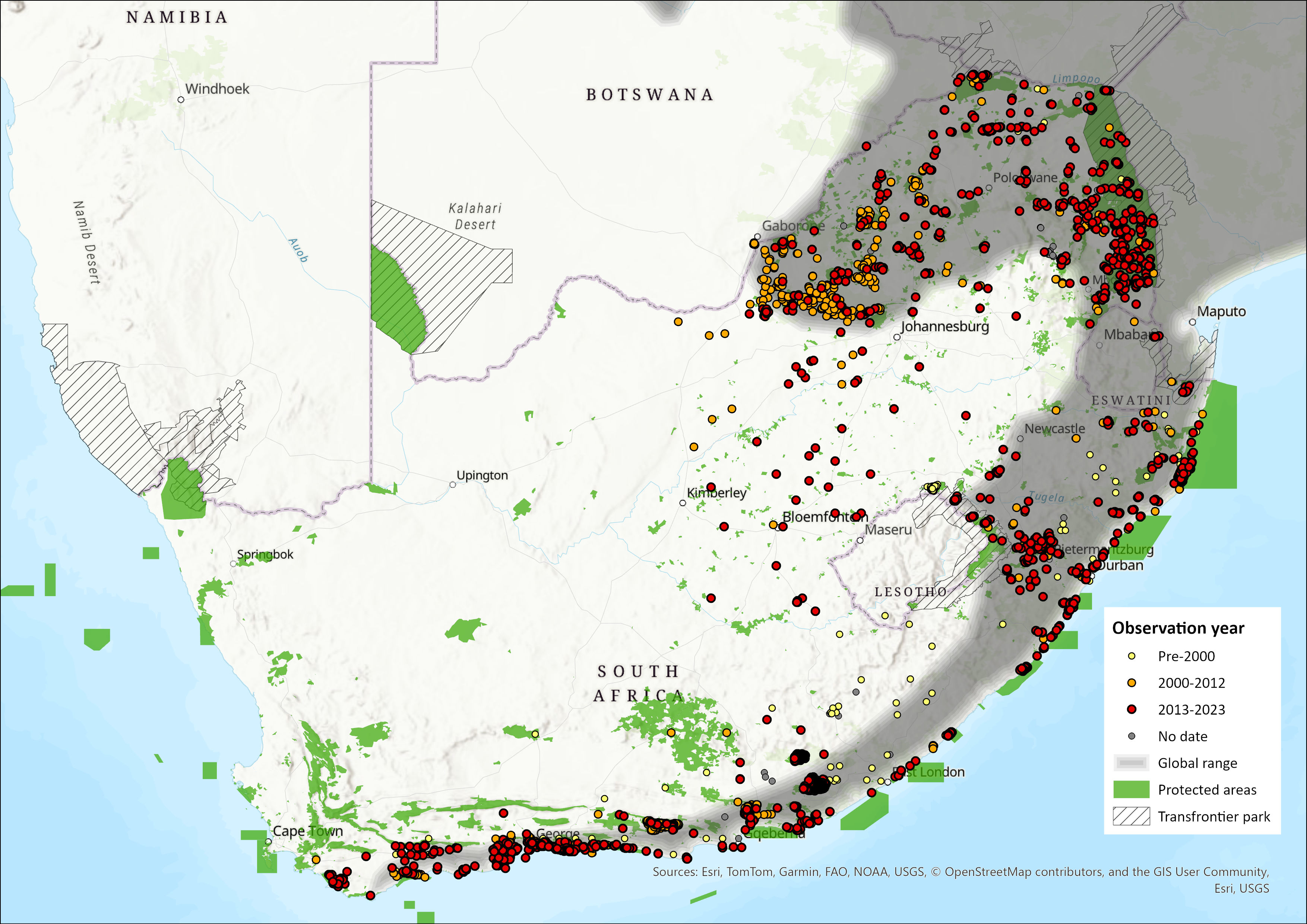
Figure 1. Distribution records for Southern Bushbuck (Tragelaphus scriptus) within the assessment region (South Africa, Eswatini and Lesotho). Note that distribution data is obtained from multiple sources and records have not all been individually verified.
Biogeographic Realms
Biogeographic Realm: Afrotropical
Occurrence
Countries of Occurrence
| Country | Presence | Origin | Formerly Bred | Seasonality |
| Angola | Extant | Native | – | – |
| Benin | Extant | Native | – | – |
| Botswana | Extant | Native | – | – |
| Burkina Faso | Extant | Native | – | – |
| Burundi | Extant | Native | – | – |
| Cameroon | Extant | Native | – | – |
| Central African Republic | Extant | Native | – | – |
| Chad | Extant | Native | – | – |
| Congo | Extant | Native | – | – |
| Congo, The Democratic Republic of the | Extant | Native | – | – |
| Côte d’Ivoire | Extant | Native | – | – |
| Equatorial Guinea | Extant | Native | – | – |
| Eswatini | Extant | Native | – | – |
| Ethiopia | Extant | Native | – | – |
| Gabon | Extant | Native | – | – |
| Gambia | Extant | Native | – | – |
| Ghana | Extant | Native | – | – |
| Guinea | Extant | Native | – | – |
| Guinea-Bissau | Extant | Native | – | – |
| Kenya | Extant | Native | – | – |
| Lesotho | Possibly Extinct | Native | – | – |
| Liberia | Extant | Native | – | – |
| Malawi | Extant | Native | – | – |
| Mali | Extant | Native | – | – |
| Mauritania | Extant | Native | – | – |
| Mozambique | Extant | Native | – | – |
| Niger | Extant | Native | – | – |
| Nigeria | Extant | Native | – | – |
| Rwanda | Extant | Native | – | – |
| Senegal | Extant | Native | – | – |
| Sierra Leone | Extant | Native | – | – |
| Somalia | Extant | Native | – | – |
| South Africa | Extant | Native | – | – |
| Sudan | Extant | Native | – | – |
| Tanzania, United Republic of | Extant | Native | – | – |
| Togo | Extant | Native | – | – |
| Uganda | Extant | Native | – | – |
| Zambia | Extant | Native | – | – |
| Zimbabwe | Extant | Native | – | – |
Large Marine Ecosystems (LME) Occurrence
Large Marine Ecosystems: (Not specified)
FAO Area Occurrence
FAO Marine Areas: (Not specified)
Climate change
The effects of climate change are often intertwined with additional anthropogenic effects which can make it difficult to separate (Trouwborst & Blackmore 2020). However, changes in species richness and ecological structure are significant indicators of the effects of climate change on mammalian browsers (Badgley 2008). Bushbuck populations that inhabit ecosystems of conservation concern and highly fragmented ecosystems face habitat loss which may be exacerbated by the effects of climate change and other anthropogenic effects (Curtis 2013, Guo et al. 2017, Powell et al. 2007, Pote et al. 2006). Climate change additionally is also expected to increase the suitability of marginal habitats for agriculture, which further increases the risk of habitat loss (Hannah et al. 2013). A small fraction of ecosystems of conservation concern occurs within formally protected areas, making the conservation of these ecosystems reliant on cooperation from private landowners (Curtis 2013, Guo et al. 2017, Pote et al. 2006). Climate change will affect fauna through the changes in ecosystems which will result in changes in distribution (Boone 2019). Aridification has resulted in the disappearance of bushbuck from areas their previous distribution on a global scale (East 1999). The effects of climate change will however be dependent on the sensitivity, resilience, adaptability and level of exposure of a species (Boone 2019). Besides these long-term effects there are also short-term effects, such as changes in body condition (Parker et al. 2009), reproductive rates and population sizes (Ellis & Swift 1998). Although not much information is available on the effects of climate change on Bushbuck, we can use the aforementioned information to determine the potential effects on Bushbuck.
Population
The Southern Bushbuck reaches high densities in localised areas of favourable habitat. Aerial and ground surveys undoubtedly underestimate population density. It is difficult to estimate Southern Bushbuck density with accuracy and precision as they are usually nocturnal, solitary, secretive and inhabit thick bush (Jacobsen 1974, von Gadow 1978, Schmidt 1983, Allen-Rowlandson 1986, Seydack et al. 1998). For example, in the Shongweni Dam and Game Reserve, KwaZulu-Natal Province, a variety of count methods (conducted between 2002 and 2003) revealed density estimates ranging from 2.9 ± 0.2 to 21.2 ± 1.3 animals / ha (Coates and Downs 2007), where mark-recapture underestimated density and the high costs involved in capturing and marking animals rendered this method inadequate. Therefore, mark-recapture and drive counts were not considered to be appropriate for monitoring the subpopulation, whereas distance sampling is more promising if the assumptions are met (Coates and Downs 2007). Similarly, sampling has generally been conducted during winter using sighting efforts as visibility at this time of the year is best (Schmidt 1983, Allen-Rowlandson 1986, Marchant 1991). However, Southern Bushbuck may be more likely to be uniformly dispersed during spring, and thus this may be a more appropriate season for sampling (sensu Lannoy et al. 2003).
East (1999) estimated the total African population of bushbuck at 1,340,000, which is likely an underestimation. Their numbers are considered stable over considerable parts of the range but are decreasing in densely settled regions. Within the assessment region, there are at least 5,422 Southern Bushbuck occurring on 257 protected properties and wildlife ranches across the country (2013–2014 counts; Endangered Wildlife Trust unpubl. data). However, this is likely to be an undercount for the reasons listed above. The largest population exists in Kruger National Park (KNP) estimated at c. 500 individuals (2009 count) (Ferreira et al. 2013). Numbers differed from 15 and 10 (2010 count) in Marakele and Mapungubwe National Parks, respectively (Ferreira et al. 2013). The numbers in Marakele subsequently increased to 57 (2020 count; SANParks data). In Garden Route National Park, Western Cape Province, density was estimated (from pellet counts) to be 1.6 ± 1.1 animals / km2 (2011 count), but no individuals were recorded in Agulhas or Bontebok National Parks in 2013 (Ferreira et al. 2013). There are c. 30 animals in Addo Elephant National Park, Eastern Cape Province (Ferreira et al. 2013). They occur at low densities in several protected areas in the North West Province (Nel 2015). Southern Bushbuck occur extensively outside protected areas too. For example, Power (2014) estimated that at least 2,447 animals existed on private lands in the North West Province in 2010. In KwaZulu-Natal the species is present in all the protected areas within the known range, except for Ndumo Game Reserve where recent camera trap surveys failed to detect the species (Ehlers Smith et al. 2020). It should be noted that bushbuck were present in Ndumo in the 1970s (J. Anderson pers. Comm.).
Overall, we assume the population probably is stable as there is no evidence for decline and its extensive reintroduction onto game farms will presumably be increasing the overall population. However, further field surveys and monitoring should attempt to quantify subpopulation trends over three generations, which is calculated to be 15.7 years (Pacifici et al. 2013). Additionally, some of the eco-estates in KwaZulu-Natal have increasing numbers and so a need has arisen to move animals out as the fencing prevents natural dispersal (Y. Ehlers Smith pers. Comm.).
Population Information
Current population trend: Stable
Continuing decline in mature individuals? Locally, due to snaring.
Severely fragmented: Yes. Most subpopulations occur in fenced reserves.
Extreme fluctuations in the number of subpopulations: (Not specified)
Continuing decline in number of subpopulations: (Not specified)
All individuals in one subpopulation: (Not specified)
Number of mature individuals in largest subpopulation: (Not specified)
Number of Subpopulations: (Not specified)
Quantitative Analysis
Probability of extinction in the wild within 3 generations or 10 years, whichever is longer, maximum 100 years: Not likely
Probability of extinction in the wild within 5 generations or 20 years, whichever is longer, maximum 100 years: (Not specified)
Probability of extinction in the wild within 100 years: (Not specified)
Population genetics
A recent study by Baird et al. (2024) that used mitochondrial genomes supported previous findings, confirming the presence of two divergent lineages and geographically distinct subclades (scriptus and sylvaticus lineages) within the species.
Moodley and Bruford (2007) found 23 phylogenetically distinct groups (ecotypes) across the species’ range, the distribution of which was found to correlate strongly with ecology, suggesting that ecological heterogeneity on the African mainland acted as a driving force for local adaptation within both the T. t. scriptus and the T. t. sylvaticus lineages. Of these ecotypes, 15 were further confirmed by Rakatoarivelo et al. (2019b), two or three of which occur within the assessment region. Additional ecotypes (~4) may exist within the assessment region, but sampling from the different regions would be needed to confirm this It is assumed these ecotypes/distinct haplotypes represent unique subpopulations; however, these will need to be confirmed through a fine-scale population genomic study incorporating animals across the assessment region. Until then, translocations should avoid mixing individuals from different ecotypes.
The population size of the Southern Bushbuck has been estimated to be at least 5,422 individuals (Nc). Using the Nc:Ne (effective population size) ratio of 0.1-0.3, the Ne of Southern Bushbuck is at least 542-1,626 (average of 1,084). This is higher that the recommended Ne of 500.
Habitats and ecology
Bushbuck occur widely in sub-Saharan Africa wherever there is adequate cover. The species is naturally absent from arid and semi-arid regions and from extensive areas of closed-canopy forest. They can also exist in agricultural areas where they eat crops. Their strong dependence on thick vegetation for shelter largely influences their habitat preference and thus range (Rowe-Rowe 1994). For example, in Shongweni Dam and Game Reserve, KwaZulu-Natal Province, Southern Bushbuck preferred short thicket habitats (Coates and Downs 2006), especially Protorhus longifolia, Panicum maximum , Ehretia rigidaand E. spirostachys Africana thickets, which provided favourable canopy and understory cover and favourable vegetation for foraging such as Capparis tomentosa, Ziziphus mucronata, Grewia occidentalis, Combretum spp., Rhoicissus spp. and Euclea spp. (Patrick 1998). They avoided low, closed grasslands but were found to feed on dicotyledonous material on the fringes between thick vegetation and grasslands (Coates and Downs 2006), and sometimes venture into these open grasslands at night to feed on forbs (Jacobsen 1974, Smits 1986, MacLeod et al. 1996, Patrick 1998). While they are predominantly browsers and selective feeders, they can adapt their feeding habitats in adverse environments (Skinner and Chimimba 2005).
Home ranges in valley bushveld habitat have been estimated to be 32–34 ha for males and 12–14 ha for females (Coates and Downs 2005a). Similarly, Allen-Rowlandson (1986) gave mean home ranges for males as 120 ha and for females as 60 ha. In the Knysna Forest, density was estimated at < 5 animals / km2 and home range size ranged from 14.6 to 174.3 ha (Odendaal and Bigalke 1979). Other studies state home ranges from 2.5 to 35 ha (Skinner and Chimimba 2005), and a negative correlation may exist between size of home range and population density (Odendaal and Bigalke 1979). They are generally considered to be solitary, but also occur in small groups of two to three. Their movements are very restricted during the dry season, but they move more widely in the warm, wet months (Skinner and Chimimba 2005).
The species is well represented throughout the protected areas and privately owned habitat patches nestled in farmland and residential areas of coastal KwaZulu-Natal. A systematic camera trap survey of 250 camera trap sites, revealed an overall naive site occupancy of 0.8 within the Indian Ocean Coastal Belt of southern KwaZulu-Natal (Ehlers Smith et al. 2018). Occupancy modelling indicated that the Southern Bushbuck appears to have a tolerance threshold linked to human disturbance as reflected in differences in occupancy rates within different land-use types, where protected areas had higher occupancy rates compared to agricultural or residential areas. Forest patches surveyed in the mist-belt of KwaZulu-Natal and the Eastern Cape Provinces showed a lower comparative occupancy: 0.25 in Umtata Forest complex, 0.45 in Creighton Forest complex and 0.55 in Ingeli forest complex (Sosibo et al. 2022a). Sosibo et al. (2022b) showed that 124 out of 303 respondents from the three areas surveyed claimed that bushbuck were hunted for consumptive use. Unregulated hunting in the mist-belt forests and surrounding communal areas are likely to be the cause for the difference in occupancy.
Ecosystem and cultural services: The browsing habits of Southern Bushbuck can potentially contribute to control of bush encroachment, especially on private properties where they have been introduced (Power 2014).
IUCN Habitats Classification Scheme
| Habitat | Season | Suitability | Major Importance? |
| 1.5. Forest -> Forest – Subtropical/Tropical Dry | – | Suitable | – |
| 1.6. Forest -> Forest – Subtropical/Tropical Moist Lowland | – | Suitable | – |
| 1.9. Forest -> Forest – Subtropical/Tropical Moist Montane | – | Suitable | – |
| 2.1. Savanna -> Savanna – Dry | – | Suitable | – |
| 3.5. Shrubland -> Shrubland – Subtropical/Tropical Dry | – | Suitable | – |
| 3.6. Shrubland -> Shrubland – Subtropical/Tropical Moist | – | Suitable | – |
| 3.7. Shrubland -> Shrubland – Subtropical/Tropical High Altitude | – | Suitable | – |
| 4.4. Grassland -> Grassland – Temperate | – | Marginal | – |
| 4.5. Grassland -> Grassland – Subtropical/Tropical Dry | – | Marginal | – |
| 4.6. Grassland -> Grassland – Subtropical/Tropical Seasonally Wet/Flooded | – | Marginal | – |
| 4.7. Grassland -> Grassland – Subtropical/Tropical High Altitude | – | Marginal | – |
| 14.1. Artificial/Terrestrial -> Artificial/Terrestrial – Arable Land | – | Marginal | – |
| 14.2. Artificial/Terrestrial -> Artificial/Terrestrial – Pastureland | – | Marginal | – |
| 14.3. Artificial/Terrestrial -> Artificial/Terrestrial – Plantations | – | Marginal | – |
| 14.6. Artificial/Terrestrial -> Artificial/Terrestrial – Subtropical/Tropical Heavily Degraded Former Forest | – | Marginal | – |
Life History
Generation Length: (Not specified)
Age at Maturity: Female or unspecified: (Not specified)
Age at Maturity: Male: (Not specified)
Size at Maturity (in cms): Female: (Not specified)
Size at Maturity (in cms): Male: (Not specified)
Longevity: (Not specified)
Average Reproductive Age: (Not specified)
Maximum Size (in cms): (Not specified)
Size at Birth (in cms): (Not specified)
Gestation Time: (Not specified)
Reproductive Periodicity: (Not specified)
Average Annual Fecundity or Litter Size: (Not specified)
Natural Mortality: (Not specified)
Breeding Strategy
Does the species lay eggs? No
Does the species give birth to live young? No
Does the species exhibit parthenogenesis? No
Does the species have a free-living larval stage? No
Does the species require water for breeding? No
Movement patterns
Movement Patterns: (Not specified)
Congregatory: (Not specified)
Systems
System: Terrestrial
General Use and Trade Information
The Southern Bushbuck is hunted for food (Sosibo et al. 2022b) and for sport within the assessment region. They are also sold at live game auctions. Use and trade is not suspected to negatively impact the population as it is well regulated, but this should be quantified. Southern Bushbuck is considered a valuable resident on many game reserves and private farms in the KwaZulu-Natal Province (Rowe-Rowe 1994) as they provide both ecological and economic benefits (Coates and Downs 2006). The latter includes game hunting and biltong production in smaller reserves that cannot depend on ecotourism (Humavindu and Barnes 2003, Reilly et al. 2003). In the KwaZulu-Natal Province the species is protected according to the KZN Ordinance (Natal Nature Conservation Ordinamce No 15 of 1974). Females of the species are not to be hunted and hunting of males in KwaZulu-Natal require a TOPS (Threatened or Protected Species) permit.
While wildlife ranching may generally conserve land that would otherwise be overgrazed by livestock and thus expanding the area of occupancy of this species, the introduction and co-occurrence of Nyala is suspected to have negative consequences on small properties. In the KwaZulu-Natal Province, it has been shown that Southern Bushbuck is negatively impacted by sympatric Nyala populations (Coates and Downs 2005b), probably via competition where the Nyala, being a generalist browser-mixed feeder, outcompetes the more specialised browsing-only Southern Bushbuck. This is evidenced in Hluhluwe -Imfolozi Park, where the bushbuck population declined from 479 in 1982 to 42 by 2014 (Cromsigt et al 2017). Through co-occurrence modelling Ehlers Smith et al. (2020) showed that there is a threshold at which Southern Bushbuck can tolerate the presence of Nyala. Co-occurrence is moderated by the presence of native predators such as Leopard (Panthera pardus). However, the presence of African Elephants (Loxodonta africana) as ecosystem engineers favour Nyala by opening thicket habitats. The presence of Nyala also influenced the activity patters of the Southern Bushbuck, where the latter become more nocturnal. In southern KwaZulu-Natal where Nyala is naturally absent, bushbuck is least active at night (Ehlers Smith et al. 2019). Competition between the two species of spiral horned antelope is corroborated by Power (2014), where higher Southern Bushbuck densities are attained on game farms where Nyala are absent in the North West Province, and there is co-existence at low densities. It is suggested that farmers wanting to stock Nyala make allowance for protecting Southern Bushbuck by, for example, setting aside Nyala-free habitat (Power 2014). To avoid competitive exclusion the introduction of Nyala outside of their natural range in northern KwaZulu-Natal is managed on a case-by-case basis via the provincial permitting system managed by Ezemvelo KZN Wildlife.
| Subsistence: | Rationale: | Local Commercial: | Further detail including information on economic value if available: |
| Yes | Often caught in bushmeat snares | Yes | Used for biltong hunting, trophy hunting and live animal sales. |
National Commercial Value: Yes
International Commercial Value: Yes
| End Use | Subsistence | National | International | Other (please specify) |
| 1. Food – human | true | true | – | – |
| 15. Sport hunting/specimen collecting | – | true | true | – |
Is there harvest from captive/cultivated sources of this species? No
Harvest Trend Comments: Possibly increasing with human settlement expansion.
Threats
Globally, bushbuck have disappeared from some areas in the drier parts of its former range because of habitat destruction and increasing aridity. While there do not seem to be any major threats to its long-term conservation, numbers may be gradually decreasing locally as hunting pressures increase in parts of its range (East 1999). Within the assessment region, deforestation and fragmentation is the major threat to this species, while cultural sport hunting with dogs, snaring and high Nyala densities are localised threats. Although no specific evidence documents decline from bushmeat hunting and incidental snaring, bushmeat hunting is an intensifying threat in southern Africa (Lindsey et al. 2013), and presumably Southern Bushbuck are impacted, especially on the edges of protected areas (Wittemyer et al. 2008). For example, they have been poached in Borakalalo Nature Reserve, North West Province (Nel 2015). Cultural sport hunting with dogs is also inferred to be a major contributor to local declines, especially in the KwaZulu-Natal Province (sensu Grey-Ross et al. 2010).
The Nyala is a mixed feeder showing preference for browsing (Anderson 1978, Seymour 2002). It is suggested to outcompete other species by having access to forage at a higher feeding level, potentially creating browse lines, thereby excluding the smaller species (Rowe-Rowe 1994, Haschick and Kerley 1996). Based on landowner surveys in the KwaZulu-Natal Province, Southern Bushbuck subpopulations are declining where Nyala populations are increasing (Coates and Downs 2005b). As the Nyala is a highly prized trophy animal, it has been introduced into many areas beyond its historical range (Rowe-Rowe 1994, Spear and Chown 2009), thereby potentially causing local declines in many Southern Bushbuck populations. However, accurate baseline measurements of density and abundance are necessary to assess impacts of these introductions (Coates and Downs 2007, Power 2014). In the Mpumalanga Lowveld, Nyala populations are increasing in both distribution and density and this could impact negatively on bushbuck populations (J. Anderson pers comm). Uncontrolled reintroductions and translocations are a concern for the genetic integrity of local populations as mixing ecotypes could lead to outbreeding depression. Moodley and Bruford (2007) found 23 phylogenetically distinct groups (ecotypes), the distribution of which was found to correlate strongly with ecology, suggesting that ecological heterogeneity on the African mainland acted as a driving force for local adaptation within both the T. t. scriptus and the T. t. sylvaticus lineages.
Current habitat trend: Declining in area and quality. Human settlement and agricultural land use have decreased habitat for this species. General disturbance of forest structure (particularly understorey) from harvesting for fuel-woods also causes habitat disturbance and decrease in habitat quality. This is likely to continue given increasing human populations. For example, in KZN, there was an average loss of natural habitat of 1.2% per annum from 1994 to 2011, due primarily to agriculture but also plantations, built environments and settlements, mines and dams (Jewitt et al. 2015). Management plans for this species have almost exclusively been based on habitat management (Allen-Rowlandson 1986; Marchant 1991; Rowe-Rowe 1994).
.
Conservation
The Southern Bushbuck is present in numerous protected areas across the assessment region. Its ability to survive widely in settled areas and successfully utilise habitats modified by human activities should ensure that it survives in substantial numbers outside protected areas for the foreseeable future (East 1999). However, landowners should be encouraged to form conservancies to provide greater habitat for this species and decrease competition with Nyala. As Southern Bushbuck are a favoured game farm species, their area of occupancy should continue to expand. However, care should be taken to discourage introduction into unsuitable areas and to prevent mixing Southern Bushbuck ecotypes to prevent outbreeding depression. As such, regulation of translocation, for both Southern Bushbuck and Nyala, is required.
Recommendations for land managers and practitioners:
- Reduce Nyala density or set aside habitat for Southern Bushbuck. Landowners who already have Bushbuck should consider carefully before introducing Nyala. Those who do so must be prepared to control Nyala densities in order to retain Bushbuck.
- Develop this species as a keystone within the sustainable, wildlife-based rural economy.
- Landowners should document and report population declines to their provincial conservation agency or the University of KwaZulu-Natal.
Research priorities:
- Determine national population size and regional population trends.
- Delimit ecotypes as management units for conservation, as a baseline for a Biodiversity Management Plan and translocation policy.
- Quantify the severity of threats facing local subpopulations.
- Determine the feasibility of a reintroduction to Ndumo Game Reserve.
Encouraged citizen actions:
- Landowners should create conservancies for this species and engage local stakeholders to create sustainable, wildlife-based rural economies.
- Report sightings on virtual museum platforms (e.g., iNaturalist and MammalMAP), especially outside protected areas.
Bibliography
Allen, G.M. 1939. A checklist of African mammals. Bulletin of the Museum of Comparative Zoology 83: 1-763.
Allen-Rowlandson T.S. 1986. An autecological study of bushbuck and common duiker in relation to forest management. University of KwaZulu-Natal, South Africa.
Anderson J.L. 1978.. Aspects of the ecology of the nyala (Tragelaphus angasii Gray, 1849) in Zululand. London University.
Apio A, Kabasa JD, Ketmaier V, Schröder C, Plath M, Tiedemann R. 2010. Female philopatry and male dispersal in a cryptic, bush-dwelling antelope: a combined molecular and behavioural approach. Journal of Zoology 280: 213–220.
Badgley, C., Barry, J.C., Morgan, M.E., Nelson, S.V., Behrensmeyer, A.K., Cerling, T.E. and Pilbeam, D., 2008. Ecological changes in Miocene mammalian record show impact of prolonged climatic forcing. Proceedings of the National Academy of Sciences, 105(34), pp.12145-12149.
Baird CN, Ernst M, Waurick I, Blom MPK, Bibi Faysal. 2024. Integrative taxonomy using historical specimens provides evidence for a single species of bushbuck, Tragelaphus scriptus (Mammalia: Bovidae). Zoological Journal of the Linnean Society 200, 532-546.
Boone, R.B., 2019. Weather and climate impacts on browsing and grazing ungulates. The ecology of browsing and grazing II, pp.197-213.
Coates GD, Downs C.T. 2007. Population estimates of bushbuck (Tragelaphus scriptus) in valley thicket and coastal bushveld-grassland habitat. South African Journal of Wildlife Research 37: 91–95.
Coates GD, Downs CT. 2005. A telemetry-based study of bushbuck (Tragelaphus scriptus) home range in Valley
Bushveld. African Journal of Ecology 43: 376–384.
Coates GD, Downs CT. 2005. Survey of the status and management of sympatric bushbuck and nyala in KwaZulu-Natal, South Africa. South African Journal of Wildlife Research 35: 179.
Coates GD, Downs CT. 2006. A preliminary study of valley thicket and coastal bushveld-grassland habitat use during summer by bushbuck (Tragelaphus scriptus): a telemetry based study. South African Journal of Wildlife Research 36: 167-172.
Cromsigt, J.P.G.H, S. Archibald, N. Owen-Smith. 2017. Conserving Africa’s Mega-Diversity in the Anthropocene. The Hluluwe-Imfoloz Story. ( 2017). Cambridge University Press. 406pp.
Curtis, O. E. (2013). Management of Critically Endangered renosterveld fragments in the Overberg, South Africa. Department of biological sciences, University of Cape Town. Doctor of Philosophy.
East, R. (compiler). 1999. African Antelope Database 1998. IUCN, Gland, Switzerland and Cambridge, UK.
Ferreira S., Gaylard, A., Greaver C., Hayes J, Cowell C., Ellis G. 2013. Summary Report: Animal abundances in Parks 2012/2013. Scientific Services, SANParks, Skukuza, South Africa.
Grey-Ross R, Downs CT, Kirkman K. 2010. An assessment of illegal hunting on farmland in KwaZulu-Natal, South Africa: implications for oribi (Ourebia ourebi) conservation. South African Journal of Wildlife Research 40: 43-52.
Grubb, P. 1985.. Geographical variation in the bushbuck of eastern Africa (Tragelaphus scriptus; Bovidae). Proceedings of the International Symposium on African Vertebrates: 11–26.
Guo, D., et al. (2017). “Impact of the Future Changing Climate on the Southern Africa Biomes, and the Importance of Geology.” Journal of Geoscience and Environment Protection 05(07): 1-9.
Haschick S.L., Kerley G.I.H. 1996. Experimentally determined foraging heights of bushbuck Tragelaphus scriptus and boergoats Capra hircus. outh African Journal of Wildlife Research 26: 64–65.
Hassanin, A. 2012. Pattern and timing of diversification of Cetartiodactyla (Mammalia, Laurasiatheria), as revealed by a comprehensive analysis of mitochondrial genomes. Comptes Rendus Biologies 335: 32–50.
Hassanin A, Houck ML, Tshikung D et al. Multi-locus phylogeny of the tribe Tragelaphini (Mammalia, Bovidae) and species delimita- tion in bushbuck: evidence for chromosomal speciation mediated by interspecific hybridization. Molecular Phylogenetics and Evolution 2018;129:96–105. https://doi.org/10.1016/j.ympev.2018.08.006
Humavindu M.N., Barnes, J.I. 2003.. Trophy hunting in the Namibian economy: an assessment. South African Journal of Wildlife Research 33: 65–70.
Jacobsen N.H.G. 1974. Distribution, home range and behaviour patterns of bushbuck in the Lutope and Sengwa Valleys, Rhodesia. Journal of South African Wildlife Management Association 4: 75–93.
Jewitt D., Goodman, P.S., Erasmus, B.F.N., O’Connor, T.G. and Witkowski, E.T.F. 2015. Systematic land-cover change in KwaZulu-Natal, South Africa: Implications for biodiversity. South African Journal of Science 111: 1–9.
Lannoy L., Gaidet N., Chardonnet P., Fanguinoveny M. 2003.. Abundance estimates of duikers through direct counts in a rain forest, Gabon. African Journal of Ecology 41: 108–110.
Lindsey, P.A., Balme, G., Becker, M., Begg, C., Bento, C., Bocchino, C., Dickman, A., Diggle, R.W., Eves, H., Henschel, P., Lewis, D., Marnewick, K., Mattheus, J., McNutt, J.W., McRobb, R., Midlane, N., Milanzi, J., Morley, R., Murphree, M., Opyene, V., Phadima, J., Purchase, G., Rentsch, D., Roche, C., Shaw, J., Van der Westhuizen, H.,Van Vliet, N. and Zisadza-Gandiwa, P. 2013. The bushmeat trade in African savannas: Impacts, drivers, and possible solutions. Biological Conservation 160: 80-96.
Lydekker, R. 1915. Catalogue of the Ungulate Mammals in the British Museum (Natural History), volume 4. Trustees of the British Museum, London, UK.
Lynch, C.D. 1994. The mammals of Lesotho. Navorsinge van die Nasionale Museum Bloemfontein 10(4): 177-241.
MacLeod S.B., Kerley G.I.H., Gaylard A. 1996. Habitat and diet of bushbuck Tragelaphus scriptus in the woody Cape Nature Reserve: observations from faecal analysis. South African Journal of Wildlife Research 26: 19–25.
Marchant, A.N. 1991. An evaluation of the wildlife extension service in Natal. M.Sc. Thesis. University of KwaZulu-Natal, Pietermaritzburg.
Moodley Y., Bruford M.W. 2007. Molecular biogeography: towards an integrated framework for conserving pan-African biodiversity. PLoS One 2: e454.
Moodley Y., Bruford M.W., Bleidorn C., Wronski T, Apio A., Plath M. 2009. Analysis of mitochondrial DNA data reveals non-monophyly in the bushbuck (Tragelaphus scriptus) complex. Mammalian Biology 74: 418–422.
Nel, P. 2015. Population estimates for large herbivores and predators in protected areas in the North West Parks Board November 2015. North West Parks Board.
Odendaal P.B., Bigalke R.C. 1979. Home range and groupings of bushbuck in the southern Cape. South African Journal of Wildlife Research 9: 96-101.
Pacifici, M., Santini, L., Di Marco, M., Baisero, D., Francucci, L., Grottolo Marasini, G., Visconti, P. and Rondinini, C. 2013. Generation length for mammals. Nature Conservation 5: 87–94.
Patrick B.G. 1998. Open space planning: integrating Shongweni Resources Reserve with the Umlaas River park and parts of the lower Mlazi catchmment. University of KwaZulu-Natal.
Pote, J.M., Shackleton, C.M., Cocks, M.L., & Lubke, R.A. (2006). Fuelwood harvesting and selection in Valley Thicket, South Africa. Journal of Arid Environments, 67, 270-287.
Powell, M.B., Mills, A.J., & Marais, C. (2007). CARBON SEQUESTRATION AND RESTORATION : CHALLENGES AND OPPORTUNITIES IN SUBTROPICAL THICKET.
Rakotoarivelo, A.R., O’Donoghue, P., Bruford, M.W. & Moodley, Y. 2019a. An ancient hybridization event reconciles mito-nuclear discordance among spiral-horned antelopes. Journal of Mammalogy, 100(4), pp.1144-1155.
Rakotoarivelo AR, O’Donoghue P, Bruford MW. & Moodley, Y. 2019b. Rapid ecological specialization despite constant population sizes. PeerJ; 7:e6476. https://doi.org/10.7717/peerj.6476
Power, R.J. 2014. The distribution and status of mammals in the North West Province. Department of Economic Development, Environment, Conservation & Tourism, North West Provincial Government, Mahikeng.
Rautenbach, I. L. 1982. Mammals of the Transvaal. Ecoplan monograph, N.S. Supplemento 1: 111-211.
Reilly B.K., Sutherland E.A., Harley V. 2003. The nature and extent of wildlife ranching in Gauteng province, South Africa. South African Journal of Wildlife Research 33: 141–144.
Rowe-Rowe, D. T. 1994. The ungulates of Natal. Natal Parks Board, Pietermaritzburg, South Africa.
Schmidt J.L. 1983.. A comparison of census techniques of common duiker and bushbuck in timber plantations. South African Forestry Journal 126: 15-19.
Seydack AH, Huisamen J, Kok R. 1998. Long-term antelope population monitoring in Southern Cape Forests. Southern African Forestry Journal 182: 9-19.
Seymour G. 2002. Ecological separation of greater kudu, nyala and bushbuck at Londolozi. CC Africa Ecological Journal 4: 137–146.
Skinner, J.D. and Chimimba, C.T. (eds). 2005. The Mammals of the Southern African Subregion. Cambridge University Press, United Kingdom, Cambridge.
Smits C.N.M. 1986. Diet composition and habitat use of the West African bushbuck Tragelaphus scriptus scriptus (Pallas, 1776) during the first half of the dry season. South African Journal of Zoology 21: 89–94.
Sosibo, M.T., Ehlers Smith, D.A., Ehlers Smith, Y.C., Gumede, S.T., Ngcobo, S.P. & Downs, C.T., 2022a. Mammalian assemblages in Southern Mistbelt Forests of the northern Eastern Cape, and southern KwaZulu-Natal Provinces, South Africa, and their response to bordering land-use. Mammalian Biology, 102(2), pp.429-440.
Sosibo, M.T., Ehlers Smith, Y.C., Ehlers Smith, D.A. & Downs, C.T., 2022b. Some perspectives on the use and value of Southern Mistbelt Forests to surrounding rural communities in northern Eastern Cape, and southern KwaZulu-Natal, South Africa. African Journal of Wildlife Research, 52(1), pp.103-121.
Spear D., Chown S.L. 2009. The extent and impacts of ungulate translocations: South Africa in a global context. Biological Conservation 142: 353–363.
Trouwborst, A. and Blackmore, A., 2020. Hot dogs, hungry bears, and wolves running out of mountain—international wildlife law and the effects of climate change on large carnivores. Journal of International Wildlife Law & Policy, 23(3), pp.212-238.
Wittemyer, G., Elsen, P., Bean, W.T., Burton, A.C.O. and Brashares, J.S. 2008. Accelerated human population growth at protected area edges. Science 321: 123-126.
von Gadow K. 1978. A pellet count of blue duiker and bushbuck in the Knysna forests. South African Forestry Journal 107: 77–81.