

Small-eared Dormouse
Graphiurus microtis

2025 Red list status
Least Concern

Regional Population Trend
Unknown

Change compared
to 2016
No Change
Overview
Graphiurus microtis – (Noack, 1887)
ANIMALIA – CHORDATA – MAMMALIA – RODENTIA – GLIRIDAE – Graphiurus – microtis
Common Names: Small-eared Dormouse, Large Savannah African Dormouse, Noack’s African Dormouse (English)
Synonyms: albolineata, butleri, etoschae, griselda, littoralis, marrensis, smithii, streethii, streeteri, sudanensis, tzaneenensis, vandami
Taxonomic Note: The phylogenetic relationships of this genus require urgent clarification (Monadjem et al. 2015). Graphiurus microtis was previously included as a synonym or valid subspecies of G. murinus (Skinner & Chimimba 2005; Holden 2013), but based on morphological and ecological differences, Holden (1993, 2005) classified this as a distinct species. Although these species are not easily distinguished, the dorsal and ventral pelage of G. murinus is not noticeably defined and G. murinus typically occurs in montane or temperate grassland habitats (Monadjem et al. 2015), while G. microtis favours savannah regions (Holden 2013).
Red List Status: LC – Least Concern
Assessment Information
Assessors: Smith, C.1 & da Silva, J.M.2
Reviewer: Patel, T.1
Institutions:1Endangered Wildlife Trust,2South African National Biodiversity Institute
Previous Assessors & Reviewers: MacFadyen, D., Baxter, R. & Child, M.F.
Previous Contributors: Relton, C., Roxburgh, L., Avenant, N., Avery, M., Monadjem, A., Palmer, G., Taylor, P. & Wilson, B.
Assessment Rationale
This species was previously listed as Least Concern because of its wide extent of occurrence (> 60,000 km2), presumed large population, and because it is unlikely to be declining fast enough to qualify for listing in a more threatened category. The Least Concern status is retained due to no new information since the last assessment in 2016. It occurs in several protected areas within the assessment region and can tolerate minor habitat modification. Furthermore, because its habitat with the rest of its African range is largely contiguous, dispersal is possible. Although there are no current (post-2000) records for this species, this is due to lack of sampling effort and specimen confusion (with G. murinus) rather than genuine scarcity. Many museum records for this species need vetting and processing through molecular techniques.
Regional population effects: Its distribution is continuous, so a rescue effect is possible where continuous woodland occurs across provincial boundaries.
Reasons for Change
Reason(s) for Change in Red List Category from the Previous Assessment: No change
Red List Index
Red List Index: No change
Recommended citations: Smith C & da Silva JM. 2025. A conservation assessment of Graphiurus microtis. In Patel T, Smith C, Roxburgh L, da Silva JM & Raimondo D, editors. The Red List of Mammals of South Africa, Eswatini and Lesotho. South African National Biodiversity Institute and Endangered Wildlife Trust, South Africa.
Regional Distribution and occurrence
Geographic Range
This species is widely distributed in sub-Saharan Africa, from southern Sudan, Eritrea and Ethiopia, through East Africa and parts of eastern Central Africa, to Angola and northeastern South Africa. It is apparently absent from West Africa (Monadjem et al. 2015). There are no recent (post-2000) records for this species in the assessment region, thus further field surveys are urgently required. Additionally, DNA studies on museum specimens are essential, as there is a possibility that records of this species have been confused as G. murinus (sensu Monadjem et al. 2015).
Elevation / Depth / Depth Zones
Elevation Lower Limit (in metres above sea level): (Not specified)
Elevation Upper Limit (in metres above sea level): (Not specified)
Depth Lower Limit (in metres below sea level): (Not specified)
Depth Upper Limit (in metres below sea level): (Not specified)
Depth Zone: (Not specified)
Map
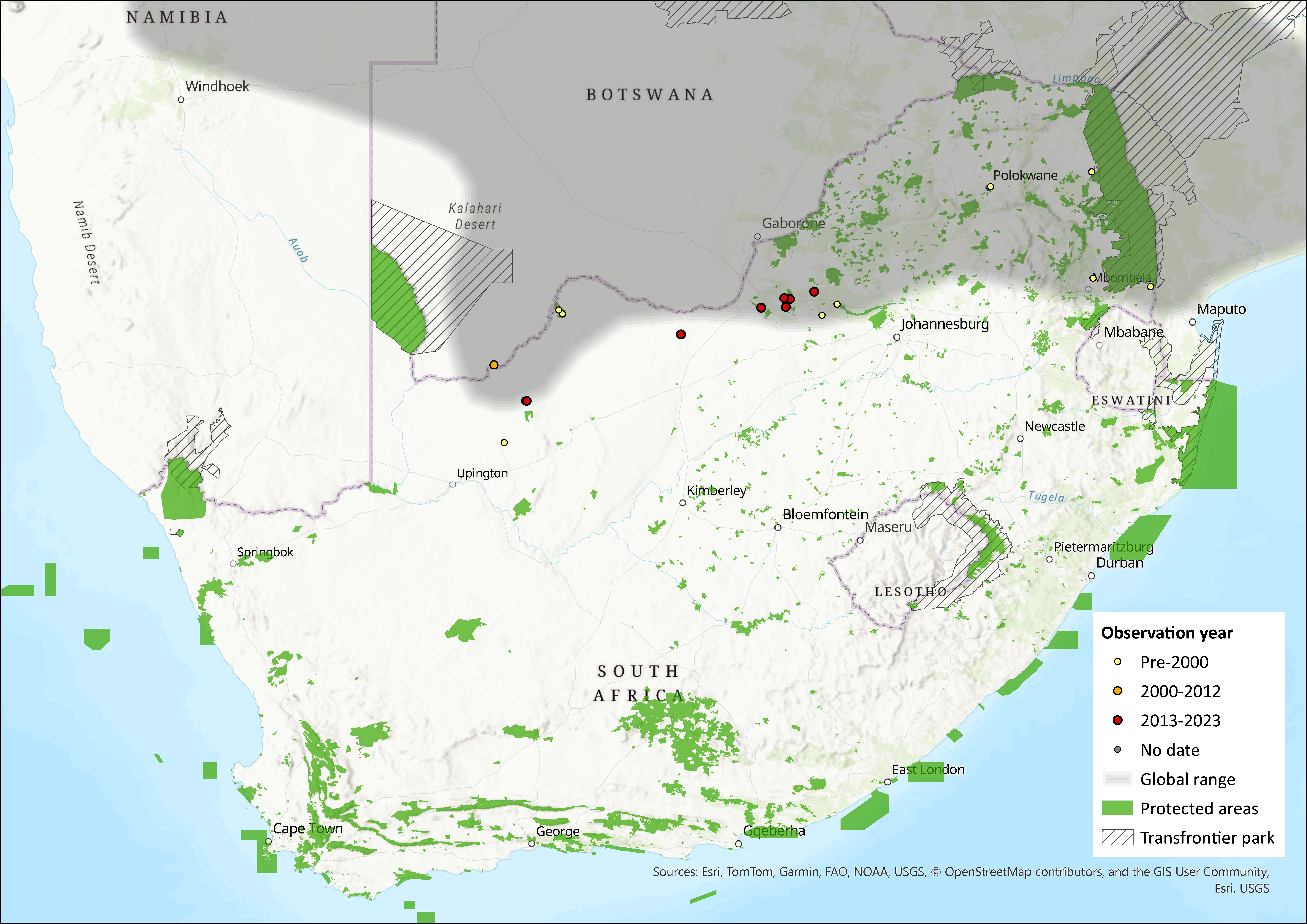
Figure 1. Distribution records for Small-eared Dormouse (Graphiurus microtis) within the assessment region (South Africa, Eswatini and Lesotho). Note that distribution data is obtained from multiple sources and records have not all been individually verified.
Biogeographic Realms
Biogeographic Realm: Afrotropical
Occurrence
Countries of Occurrence
| Country | Presence | Origin | Formerly Bred | Seasonality |
| Angola | Extant | Native | – | – |
| Botswana | Extant | Native | – | – |
| Burundi | Presence Uncertain | Native | – | – |
| Eritrea | Extant | Native | – | – |
| Eswatini | Extant | Native | – | – |
| Ethiopia | Extant | Native | – | – |
| Kenya | Extant | Native | – | – |
| Malawi | Extant | Native | – | – |
| Mozambique | Extant | Native | – | – |
| Namibia | Extant | Native | – | – |
| Rwanda | Presence Uncertain | Native | – | – |
| South Africa | Extant | Native | – | – |
| Sudan | Extant | Native | – | – |
| Tanzania, United Republic of | Extant | Native | – | – |
| Uganda | Extant | Native | – | – |
| Zambia | Extant | Native | – | – |
| Zimbabwe | Extant | Native | – | – |
Large Marine Ecosystems (LME) Occurrence
Large Marine Ecosystems: (Not specified)
FAO Area Occurrence
FAO Marine Areas: (Not specified)
Climate change
This species only occurs in the Limpopo province, South Africa. There is a possibility that it might be affected by the 1.5-4°C increase in temperature predicted under various climate change scenarios (Engelbrecht et al. 2024). Rainfall is predicted to decrease in its range. These decreases will result in a more arid and drought-prone habitat which could affect food availability in the species distribution range.
Population
It is considered a common species throughout Africa due to the large number of museum specimens throughout its range (Holden 2013). Within the assessment region, the species appears to have a limited area of occupancy, but this is due to a lack of current sampling effort rather than a genuine rarity. Although it has been recorded in low numbers in Mpumalanga, Limpopo and North West provinces, it may be a fairly common species in the northern parts of South Africa, particularly within the Soutpansberg area. There are many records in museum collections that are waiting to be identified, and there are expected to be a number of museum records that have been incorrectly identified as G. murinus.
Population Information
Continuing decline in mature individuals? (Not specified)
Extreme fluctuations in the number of subpopulations: (Not specified)
Continuing decline in number of subpopulations: (Not specified)
All individuals in one subpopulation: (Not specified)
Number of mature individuals in largest subpopulation: (Not specified)
Number of Subpopulations: (Not specified)
Quantitative Analysis
Probability of extinction in the wild within 3 generations or 10 years, whichever is longer, maximum 100 years: (Not specified)
Probability of extinction in the wild within 5 generations or 20 years, whichever is longer, maximum 100 years: (Not specified)
Probability of extinction in the wild within 100 years: (Not specified)
Population Genetics
While this genus has been investigated in a phylogenetic context (Montgelard et al. 2003), no population genetic assessment has been undertaken on the species. It is assumed to be common, yet little is known about its abundance and range due to limited sampling effort. There does not appear to be any restrictions to their movement; therefore, they are assumed to exist as a single metapopulation. There is no knowledge of subpopulation extinctions, therefore the Convention on Biological Diversity’s Global Biodiversity Framework’s complementary genetic indicator – proportion of populations maintained (PM) – would receive a value of 1.0 (1/1 populations remaining).
While no population estimates are known, it is thought that at least 5 000 mature individuals exist within the assessment region, and hence the species is thought to exceed the Ne 500 threshold (assuming a 0.1-0.3 conversion ratio of effective population size [Ne] to census size [Nc]). While the 5 000 value is not an actual census count, the quantity can still be used as a proxy for quantifying the proportion of populations with an Ne > 500 indicator, which is valued at 1.0 (1/1 subpopulation with Ne > 500).
A population genomic study investigating the population genetic structure and diversity within this species is recommended to verify these indicator values.
Habitats and ecology
This species is widespread across a range of savannah and woodland habitats, as well as within rocky areas, caves and disturbed areas (Holden 2013). They are arboreal and can seek shelter in trees (Hofmann 2021). It is commensal with people and occurs in human dwellings in the north of South Africa where it is considered a widespread species. This species split from G. murinus is based on geographical and biome differences. Aside from some overlap in certain areas, G. murinus generally favours grassland habitats, while G. microtis prefers savannah regions (Holden 2013).
Ecosystem and cultural services: Similar to other small mammals, this species is likely prey for small carnivores and aerial predators. Additionally, this species may be consumed opportunistically by humans in rural communities.
IUCN Habitats Classification Scheme
|
Habitat |
Season |
Suitability |
Major Importance? |
|
1.5. Forest -> Forest – Subtropical/Tropical Dry |
– |
Suitable |
– |
|
1.6. Forest -> Forest – Subtropical/Tropical Moist Lowland |
– |
Unknown |
– |
|
1.9. Forest -> Forest – Subtropical/Tropical Moist Montane |
– |
Unknown |
– |
|
2.1. Savanna -> Savanna – Dry |
– |
Suitable |
– |
|
2.2. Savanna -> Savanna – Moist |
– |
Suitable |
– |
|
3.5. Shrubland -> Shrubland – Subtropical/Tropical Dry |
– |
Unknown |
– |
|
3.6. Shrubland -> Shrubland – Subtropical/Tropical Moist |
– |
Unknown |
– |
|
14.3. Artificial/Terrestrial -> Artificial/Terrestrial – Plantations |
– |
Unknown |
– |
|
14.4. Artificial/Terrestrial -> Artificial/Terrestrial – Rural Gardens |
– |
Marginal |
– |
|
14.5. Artificial/Terrestrial -> Artificial/Terrestrial – Urban Areas |
– |
Marginal |
– |
Life History
Generation Length: (Not specified)
Age at maturity: female or unspecified: (Not specified)
Age at Maturity: Male: (Not specified)
Size at Maturity (in cms): Female: (Not specified)
Size at Maturity (in cms): Male: (Not specified)
Longevity: (Not specified)
Average Reproductive Age: (Not specified)
Maximum Size (in cms): (Not specified)
Size at Birth (in cms): (Not specified)
Gestation Time: (Not specified)
Reproductive Periodicity: (Not specified)
Average Annual Fecundity or Litter Size: (Not specified)
Natural Mortality: (Not specified)
Does the species lay eggs? (Not specified)
Does the species give birth to live young: (Not specified)
Does the species exhibit parthenogenesis: (Not specified)
Does the species have a free-living larval stage? (Not specified)
Does the species require water for breeding? (Not specified)
Movement Patterns
Movement Patterns: (Not specified)
Congregatory: (Not specified)
Systems
System: Terrestrial
General Use and Trade Information
Although there are no reports of this species being traded or utilised in any form, it has the potential to be utilised in the pet trade. Additionally, this species may be opportunistically eaten in rural communities.
Local Livelihood: (Not specified)
National Commercial Value: (Not specified)
International Commercial Value: (Not specified)
End Use: (Not specified)
Is there harvest from captive/cultivated sources of this species? (Not specified)
Harvest Trend Comments: (Not specified)
Threats
There are no identified major threats. However, it is potentially locally threatened by disturbance and habitat loss in woodland areas through agriculture and mining.
Conservation
This species occurs in several protected areas within the assessment region, including Kruger National Park (KNP). In addition to KNP, Venetia Limpopo Nature Reserve and the Greater Mapungubwe Transfrontier Conservation Area contain suitable habitat for this species, but its presence within these protected areas requires confirmation. DNA testing is required for all museum specimens currently labelled as G. murinus. This species would benefit from the expansion of protected areas to connect isolated savannah woodland habitats. However, no direct interventions are necessary.
Recommendations for land managers and practitioners:
- Protect areas with sufficient woodland, maintaining corridors between areas of suitable habitat.
Research priorities:
- Continued research is required to investigate the taxonomy of G. murinus and G. microtis.
- Distribution range and connectivity of the species.
- Museum records of G. microtis and G. murinus require clarification across the country.
Encouraged citizen actions:
- Report sightings on virtual museum platforms (for example, iNaturalist and MammalMAP), especially outside protected areas.
- Maintain corridors of woodland between natural areas.
Bibliography
Driver, A., Sink, K.J., Nel, J.N., Holness, S., Van Niekerk, L., Daniels, F., Jonas, Z., Majiedt, P.A., Harris, L. and Maze, K. 2012. National Biodiversity Assessment 2011: An assessment of South Africa’s biodiversity and ecosystems. Synthesis Report. South African National Biodiversity Institute and Department of Environmental Affairs, Pretoria, South Africa.
Engelbrecht, FA., Steinkopf, J., Padavatan, J. & Midgley, GF. 2024. Projections of future climate change in southern Africa and the potential for regional tipping points. In: von Maltitz, G.P., et al. Sustainability of Southern African Ecosystems under Global Change. Ecological Studies, vol 248. Springer, Cham. https://doi.org/10.1007/978-3-031-10948-5_7
Hofmann, R., Lehmann, T., Warren, D.L. and Ruf, I., 2021. The squirrel is in the detail: Anatomy and morphometry of the tail in Sciuromorpha (Rodentia, Mammalia). Journal of Morphology, 282(11), pp.1659-1682.
Holden ME. 1993. Family Myoxidae. In: Wilson DE, Reeder DM (ed.), Mammal Species of the World: A Taxonomic and Geographical Reference, pp. 763–770. Smithsonian Institution Press, Washington, DC, USA.
Holden ME. 2013. Graphiurus microtis Noack’s African Dormouse. Mammals of Africa. Volume III: Rodents, Hares and Rabbits., pp. 120–124 . Bloomsbury Publishing, London, UK.
Holden, M.E. 2005. Family Gliridae. In: D.E. Wilson and D.M. Reeder (eds), Mammal Species of the World, pp. 819-841. Johns Hopkins University Press, Baltimore, Maryland, USA.
Monadjem, A., Taylor, P.J., Denys, C. and Cotterill, F.P.D. 2015. Rodents of Sub-Saharan Africa: A Biogeographic and Taxonomic Synthesis. . De Gruyter, Berlin, Germany.
Skinner, J.D. and Chimimba, C.T. (eds). 2005. The Mammals of the Southern African Subregion. Cambridge University Press, United Kingdom, Cambridge.
Swynnerton, G.H. and Hayman, R.W. 1951. A Checklist of the Land Mammals of the Tanganyika Territory and the Zanzibar Protectorate. Journal of the East Africa Natural History Society 20(6): 274-392.