
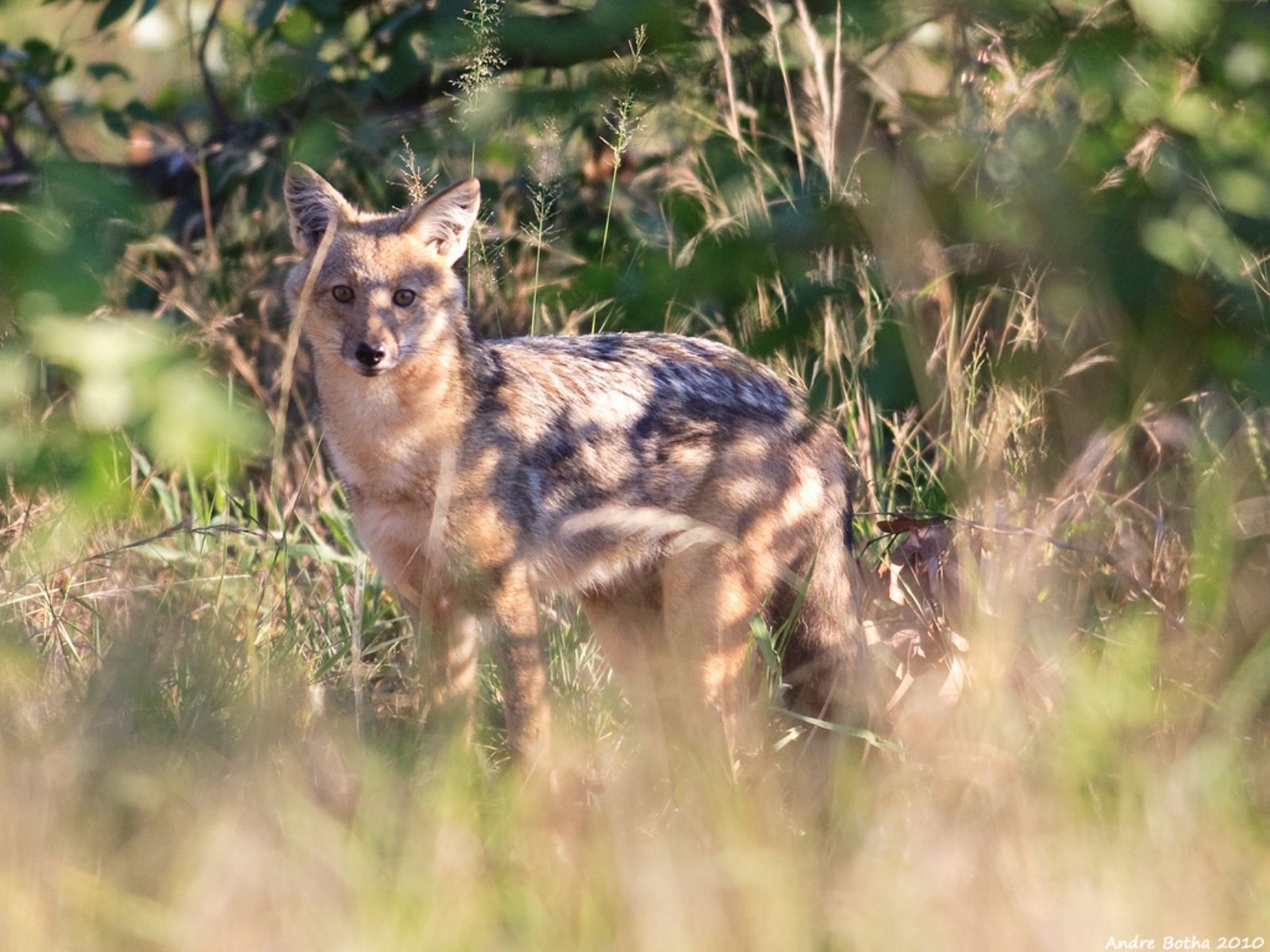
Side–striped Jackal
Lupulella adustus

2025 Red list status
Least Concern

Regional Population Trend
Stable

Change compared
to 2016
No Change
Overview
Lupulella adustus – Sundevall, 1847
ANIMALIA – CHORDATA – MAMMALIA – CARNIVORA – CANIDAE – Lupulella – adustus
Common Names: Side-striped Jackal (English), Grysjakkals, Witwasjakkals (Afrikaans), Ikhanka, Igowa, Ipungutjha, Enemida (Ndebele), Pukubje (Sepedi), Phokojwe (Sesotho), Rantalajê, Rantalajwê, Swatê (Setswana), Imphungushe, Inkalwane, Jakalasi (Swati), Hlathi, Mhungubye (Tsonga), Dabe (Venda), Udyakalashe (Xhosa), Impungushe (Zulu)
Synonyms: Canis adjustus (Sundevall, 1847)
Taxonomic Note:
Coetzee (1977) initially listed seven subspecies of Lupulella adustus on the African continent. However, only one of these subspecies occurs in the assessment regions: Lupulella. a. adustus. Due to recent taxonomic revision, African jackals have been found to fall outside of the African Wolf Clade, and have been assigned a new taxonomic genus, Lupulella (Geraads 2011; Dinets 2015; Viranta et al. 2017; Atickem et al. 2018).
Red List Status: LC – Least Concern, (IUCN version 3.1)
Assessment Information
Assessor: Adams, E.C.1
Reviewers: Power, R.J.2 & Do Linh San, E. 3
Contributors: Roxburgh, L.1, Nicholson, S.1 & da Silva, J.M.4
Institutions:1Endangered Wildlife Trust, 2North West Provincial Government, 3Sol Plaatjie University, 4South African Biodiversity Institute
Previous Assessors & Reviewers: Camacho, G., Page-Nicholson, S., Child, M.F. & Do Linh San, E.
Assessment Rationale
The Side-striped Jackal is listed as Least Concern as it appears to be expanding westwards from the Lowveld of South Africa and thus we infer that the population is increasing or at a minimum stable. The species has been observed in areas where Black-backed Jackals (Lupulella mesomelas) have either been extirpated or have declined in Mpumalanga. Furthermore, this species’ dietary breadth and ability to co-exist with humans in modified landscapes suggests that subpopulations are only threatened in extremely modified habitats or with disease epidemics.
The mature population size has been estimated as 1,627 to 9,382 individuals, based on a density of 1 breeding pair / 25 km² across the extent of occurrence (EOO) (117,273 km² compared to 111,335 km² in the previous assessment). The area of occupancy (AOO) is 580 km2. Further density estimates from within the assessment region are necessary to refine this estimate. Additionally, the majority of the population exists within Kruger National Park and there are no systemic threats that could cause rapid population decline: Side-striped Jackals are not perceived by landowners to be as much of a threat as Black-backed Jackals, and thus we suspect persecution rates are lower; they have high reproductive rates which facilitates rapid recovery following crashes; and the expansion of game farms may be increasing natural prey for this species.
Regional population effects: The Side-striped Jackal is an edge of range species, therefore it is expected that there is continuous distribution with the rest of its range. Immigration into the assessment region is possible, as are rescue effects.
Reasons for Change
Reason(s) for Change in Red List Category from the Previous Assessment: No change
Red List Index
Red List Index: No change
Recommended citation: Adams EC. 2025. A conservation assessment of Lupulella adustus. In Patel T, Smith C, Roxburgh L, da Silva JM & Raimondo D, editors. The Red List of Mammals of South Africa, Eswatini and Lesotho. South African National Biodiversity Institute and Endangered Wildlife Trust, South Africa.
Regional Distribution and occurrence
Geographic Range
The Side-striped Jackal is present over much of sub-Saharan Africa. It occurs from Gambia and Senegal through the Sahelian regions of West Africa to the Horn of Africa, and then southwards into southern Africa and the assessment region (Loveridge & Macdonald 2003). In the arid southwest and northeast of the continent, the species is generally replaced by the Black-backed Jackal (Lupulella mesomelas) and in North Africa by the African Golden Wolf (Canis anthus or lupaster) [previously believed to be the Golden Jackal (Canis aureus)].
Within the assessment region, it occurs in eastern Limpopo, Mpumalanga and northern KwaZulu-Natal and has an assumed area of occupancy across the whole of Kruger National Park and its adjoining private conservation areas (Limpopo and Mpumalanga). It is sparsely spread in the more western areas of the lowveld towards the escarpment and appears now to be present above the escarpment on the eastern Highveld and adjoining Bushveld areas (see Map). The most southerly area (of Mpumalanga) where this species is most commonly seen is Chrissiesmeer, and the most eastern record is Lapalala Game Reserve in the Waterberg (Swanepoel et al. 2023). Northeastern KwaZulu-Natal marks the species most southerly occurrence (Rowe-Rowe 1992), which is still prevalent (see Pretorius 2019, Map), though with some slight expansion there too, in the hinterland of that province (see Swanepoel et al. 2023). Side-striped Jackals are also found in the eastern regions of Eswatini (A. Monadjem pers. comm. 2016), but do not occur in Lesotho.
In the North West, no records have been found so it was concluded that they are absent from the province (Power 2014). In the 1970’s one individual was observed as far west as the north of Pretoria (Rautenbach, 1978), however, no further sightings has been reported. The period in which this individual was observed was during a wet cycle, so it could be that this species ventures into the province from the east during sufficiently wet years (Power 2014).
Over the past two decades the species seems to have been expanding its range westwards from the Lowveld, especially in areas where Black-backed Jackal numbers are suppressed, both by persecution, as well as bush encroachment which is better favoured by the Side-striped jackal (Swanepoel et al. 2023). For example, there are records of the species on the edge of the town of Lydenburg in the western side of the escarpment, well above the Lowveld, and records from the Soutpansberg (Limpopo Province). The observed westward range expansion may also be attributed to increased bush encroachment within previous Savanna areas (Swanepoel et al. 2023). The current extent of occurrence (EOO) is estimated to be 117,273, which is a 5% increase in the EOO compared to 2012 (111,335 km2) and a 61% increase in EOO compared to 2004 (EOO estimated at 43,525 km2; Friedmann & Daly 2004). The extent of range expansion is probably over-estimated due to insufficient data in the previous assessment but may indicate a genuine range increase too.
Elevation / Depth / Depth Zones
Elevation Lower Limit (in metres above sea level): (Not specified)
Elevation Upper Limit (in metres above sea level): (Not specified)
Depth Lower Limit (in metres below sea level): (Not specified)
Depth Upper Limit (in metres below sea level): (Not specified)
Depth Zone: (Not specified)
Map
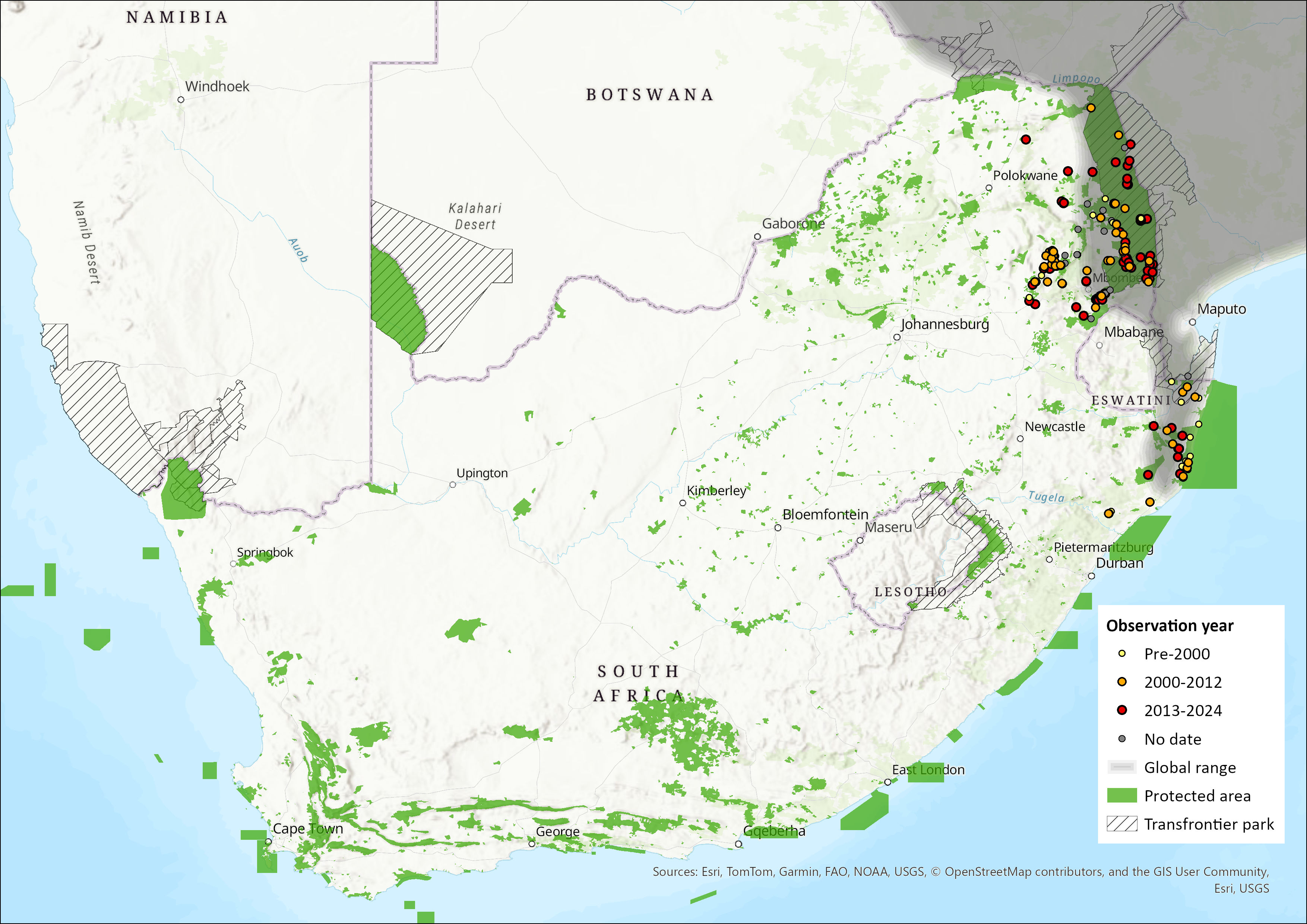
Figure 1. Distribution records for Side-striped Jackal (Lupulella adustus) within the assessment region (South Africa, Eswatini and Lesotho). Note that distribution data is obtained from multiple sources and records have not all been individually verified.
Biogeographic Realms
Biogeographic Realm: Afrotropical
Occurrence
Countries of Occurrence
| Country | Presence | Origin | Formerly Bred | Seasonality |
| Angola | Extant | Native | – | Resident |
| Benin | Extant | Native | – | Resident |
| Botswana | Extant | Native | – | Resident |
| Burkina Faso | Extant | Native | – | Resident |
| Burundi | Extant | Native | – | Resident |
| Cameroon | Extant | Native | – | Resident |
| Central African Republic | Extant | Native | – | Resident |
| Chad | Extant | Native | – | Resident |
| Congo | Extant | Native | – | Resident |
| Congo, The Democratic Republic of the | Extant | Native | – | Resident |
| Côte d’Ivoire | Extant | Native | – | Resident |
| Eswatini | Extant | Native | – | Resident |
| Ethiopia | Extant | Native | – | Resident |
| Gabon | Extant | Native | – | Resident |
| Gambia | Extant | Native | – | Resident |
| Ghana | Extant | Native | – | Resident |
| Guinea | Extant | Native | – | Resident |
| Guinea-Bissau | Extant | Native | – | Resident |
| Kenya | Extant | Native | – | Resident |
| Malawi | Extant | Native | – | Resident |
| Mali | Extant | Native | – | Resident |
| Mauritania | Extant | Native | – | Resident |
| Mozambique | Extant | Native | – | Resident |
| Namibia | Extant | Native | – | Resident |
| Niger | Extant | Native | – | Resident |
| Nigeria | Extant | Native | – | Resident |
| Rwanda | Extant | Native | – | Resident |
| Senegal | Extant | Native | – | Resident |
| Sierra Leone | Extant | Native | – | Resident |
| Somalia | Extant | Native | – | Resident |
| South Africa | Extant | Native | – | Resident |
| Sudan | Extant | Native | – | Resident |
| South Sudan | Extant | Native | – | Resident |
| Tanzania, United Republic of | Extant | Native | – | Resident |
| Togo | Extant | Native | – | Resident |
| Uganda | Extant | Native | – | Resident |
| Zambia | Extant | Native | – | Resident |
| Zimbabwe | Extant | Native | – | Resident |
Large Marine Ecosystems (LME) Occurrence
Large Marine Ecosystems: (Not specified)
FAO Area Occurrence
FAO Marine Areas: (Not specified)
Climate change
No recent research or literature has focused on how climate change might affect this species in the future. However, the observed westward range expansion in South Africa, which is partly attributed to increased bush encroachment within previous Savanna areas by Swanepoel et al. (2023), which is suspected to be linked to climate change, suggests that this species may benefit from climate change, at least in this part of its range.
Population
Throughout their range Side-striped Jackals are naturally uncommon. In Mpumalanga they are widely distributed to the central and eastern parts of the province.In certain parts of the lowveld (for example, Sabie Sands Private Nature Reserve) there has been a decline whereas, in Manyeleti Game Reserve, their numbers appear stable (G. Camacho unpubl. data). However, a recent carnivore survey of this same reserve, and Andover Provincial Reserve, indicated only the Side-striped Jackal, though they generically refer to jackals too (Wentzel et al. 2021). ).
In Zimbabwe, Side-striped Jackals were observed to start breeding in their first year, whereas Black-backed Jackals only started breeding once they were older (Bingham & Purchase 2003). This gives Side-striped Jackals a competitive edge, with a high population turnover, allowing them to recover quickly from population crashes (Bingham & Purchase 2003).
South African estimates of abundance are not available, but, from work undertaken in two diverse habitats in Zimbabwe, densities were estimated at around 1 individual / km² in highveld commercial farmland (Rhodes et al. 1998), where rural density is probably highest, and estimates from western Zimbabwe were between 0.5–0.8 individual / km² (Macdonald et al. 2004). In Niokolo-Koba National Park (Senegal), however, Side-striped Jackal density was found to be much lower, with only 0.07 individual / km² (Sillero-Zubiri et al. 1997).
Seeing that the Lowveld of South Africa possesses similar habitat types to the Zimbabwean studies, both being within the Savannah Biome, it may be reasonable to assume similar density estimates. In the previous assessments, these yielded between 8,475 and 16,950 individuals (using the upper and lower density estimates for all occupied quarter degree grid cells: 678 km2 / grid cell x 25 occupied grids; hence 16,950 km2 x 0.5–1.0 individual / km2). Using a similar methodology in this assessment, we have 30 occupied grid cells (using data from 2013 onwards), which yields estimates between 10,170 and 20,340 individuals. Of course, not all habitats are suitable and so true density is most likely significantly lower. Based on the Red List assessment in the early 2000s, Friedmann and Daly (2004) estimated a density of 1 breeding pair / 25 km2 (i.e. 0.08 individual / km²). Using this density estimate across the entire EOO yields 4,690 breeding pairs and a minimum of 814 breeding pairs for the occupied grid cells. Thus, a more realistic mature population estimate ranges from 1,627 to 9,382 individuals. Representing an increase from the population estimate presented in the previous assessment (1,356 to 8,907 individuals) (Camacho et al. 2016). Additionally, as Side-striped Jackals appear to be expanding westwards into South Africa, we infer that the population is increasing or at least stable. However, it is likely that the population is at least stable and may even be increasing as evidenced by recent range expansions.
Population Information
Current population trend: Stable, possibly increasing.
Continuing decline in mature individuals: No
Number of mature individuals in population: 1,627 to 9,382
Number of mature individuals in largest subpopulation: Unknown
Number of subpopulations: Unknown
Severely fragmented: No
Quantitative Analysis
Probability of extinction in the wild within 3 generations or 10 years, whichever is longer, maximum 100 years: (Not specified)
Probability of extinction in the wild within 5 generations or 20 years, whichever is longer, maximum 100 years: (Not specified)
Probability of extinction in the wild within 100 years: (Not specified)
Population Genetics
Apart from phylogenetic analyses supporting the placement of Side-striped Jackal (L. adustus) and Black-backed Jackal (L. mesomelas) as a monophyletic lineage outside all other Lupulella species (e.g., Atickem et al. 2017; Zrzavý et al. 2018), no further genetic work has been conducted on L. adustus. Population genetic analyses are needed to understand the genetic structure and health of this species.
It does seem the population is contiguous given its distribution (see Map), suggesting one population, though there could easily be more, though likely not more than two.
Habitats and ecology
Side-striped Jackals are found in a range of mostly wooded habitats. These include habitats in game areas through farmland to towns within the broad-leaved savannah zones, including wooded habitats, scrub, abandoned cultivation, marshes and montane habitats up to 2,700 m asl (Ginsberg et al. 1990). Side-striped Jackals favour thickly wooded country and tend to avoid open savannah grasslands (Skinner & Chimimba 2005), however there has been increasingly more evidence of them using grassland habitats, mostly of a montane association (Swanepoel et al. 2023). They frequently occur near rural dwellings and farm buildings and penetrate peri-urban and urban areas (Skinner & Chimimba 2005). Throughout their distributional range they are closely associated with well-watered habitats (Skinner & Chimimba 2005). In a recent study, Side-striped Jackal presence has also been documented in four different grassland vegetation types, as well as in various forest biome vegetation types including the Northern Mistbelt Forest vegetation type within the Soutpansberg Mountains (Swanepoel et al. 2023), indicating the importance of forested regions in Side-striped Jackal habitat. The most favoured vegetation type (based on camera trapping frequency) was Legogote Sour Bushveld (Swanepoel et al. 2023). They have also been recorded in drier associations such as in the Mopane bioregion (see Mack 2022).
Where Side-striped Jackals occur sympatrically with other canid species, they may avoid competition by ecological segregation (Fuller et al. 1989). In such areas of sympatry, Side-striped Jackals usually occupy areas of denser vegetation, while Black-backed Jackals and African Golden Wolves (previously thought to be Golden Jackals) dominate in the more open areas (Loveridge 1999; Loveridge & Macdonald 2003). Recent information has come to the light that as a mesopredator, they may be locally suppressed on fenced reserves with large predators (Pretorius 2019).
As with other jackal species, Side-striped Jackals are omnivorous and opportunistically change their diet based on local and seasonal food availability (Atkinson et al. 2002; Skinner & Chimimba 2005). For example, on commercial farmland in the Zimbabwean highveld, it eats mainly wild fruit (30%) and small (< 1 kg) to medium-sized (> 1 kg) mammals (27% and 23%, respectively), with the remainder of its diet comprising birds, invertebrates, grass and carrion (Atkinson et al. 2002). Skinner and Chimimba (2005) concur that these jackals consume a relatively high proportion of plant materials and that they will also feed on carrion when it is available. In fact, the success of the Side-striped Jackal can be largely attributed to its ability to feed on a variety of food sources (Atkinson 1997). Side-striped Jackals also have a more generalized dentition compared to Black-backed Jackals and thus, a broader dietary niche (Skinner & Chimimba 2005).
Side-striped Jackals can occur solitarily, in pairs or in family groups of up to seven individuals (Loveridge & Macdonald 2003). Larger groups are generally made up of a mated, monogamous pair and their young (Skinner & Chimimba 2005). Mating is most commonly observed between June and July. Gestation is approximately 60 days and litters can range between four and six pups which are born between August and November (Skinner & Chimimba 2005). The pair will assist in the rearing of the young pups and will return every 2–3 intervals through the night to feed the pups regurgitated food (Loveridge & Macdonald 2003).
Ecosystem and cultural services: As is the case with other jackal species, these animals play an important role in cleaning up their environment through scavenging and the consumption of carrion (Ćirović et al. 2016; Hayward et al. 2017). Similarly, as jackals are known to consume fruits, they have been shown to play an important role in the dispersal of seeds (Kamler et al. 2020; Favaretto et al. 2024).Favaretto et al. 2024).
IUCN Habitats Classification Scheme
| Habitat | Season | Suitability | Major Importance? |
| 1.5. Forest -> Forest – Subtropical/Tropical Dry | – | Suitable | – |
| 2.1. Savanna -> Savanna – Dry | – | Suitable | – |
| 3.5. Shrubland -> Shrubland – Subtropical/Tropical Dry | – | Suitable | – |
| 3.7. Shrubland -> Shrubland – Subtropical/Tropical High Altitude | – | Suitable | – |
| 5.4. Wetlands (inland) -> Wetlands (inland) – Bogs, Marshes, Swamps, Fens, Peatlands | – | Suitable | – |
| 14.1. Artificial/Terrestrial -> Artificial/Terrestrial – Arable Land | – | Suitable | – |
| 14.5. Artificial/Terrestrial -> Artificial/Terrestrial – Urban Areas | – | Suitable | – |
Life History
Generation Length: (Not specified)
Age at Maturity: Female or unspecified: (Not specified)
Age at Maturity: Male: (Not specified)
Size at Maturity (in cms): Female: (Not specified)
Size at Maturity (in cms): Male: (Not specified)
Longevity: 3 – 4 years in the wild
Average Reproductive Age: (Not specified)
Maximum Size (in cms): (Not specified)
Size at Birth (in cms): (Not specified)
Gestation Time: 57 – 60 days
Reproductive Periodicity: August – January
Average Annual Fecundity or Litter Size: 5.4 pups per litter
Natural Mortality: (Not specified)
Does the species lay eggs? No
Does the species give birth to live young: Yes
Does the species exhibit parthenogenesis: No
Does the species have a free-living larval stage? No
Does the species require water for breeding? No
Movement Patterns
Movement Patterns: (Not specified)
Congregatory: (Not specified)
Systems
System: Terrestrial
General Use and Trade Information
It can be expected that there may be some body parts usage of the species, as some unidentified jackal species were recorded at the Johannesburg’s Faraday Market (Whiting et al. 2013).
Although not large, and charismatic, the species is intriguing to see for naturalists and photographers, especially in the private game reserve complexes of the greater Kruger National Park and Zululand reserves.
Local Livelihood: (Not specified)
National Commercial Value: (Not specified)
International Commercial Value: (Not specified)
End Use: (Not specified)
Is there harvest from captive/cultivated sources of this species? (Not specified)
Harvest Trend Comments: (Not specified)
Threats
Like other jackal species, the Side-striped Jackal is sometimes persecuted on private land by landowners in an effort to protect their livestock. However, there is very little evidence for extensive predation on domestic stock (Rowe-Rowe 1992; Loveridge & Macdonald 2003; Sillero-Zubiri et al. 2004), or game larger than antelope calves (Loveridge & Macdonald 2003). It is unlikely that persecution has an effect on the overall population, but persecution and snaring could affect local populations (Hoffman 2014). In towns and suburbs, jackals may be run over by vehicles. They are vulnerable to diseases such as canine distemper, mange and rabies (Bingham et al. 1995; Loveridge 1999), for all of which they are known or suspected reservoirs and vectors for domestic dog infection (Rhodes et al. 2008) and therefore are also locally persecuted for this reason. Based on mesopredator suppression on fenced-in large carnivore reserves (Pretorius 2019), it is possible that artificially inflated large carnivore densities can influence them negatively.
Disease may thus be the main threat to the species.
Conservation
Side-striped Jackals occur in several conservation areas, including Kruger National Park and adjoining private game reserves. The species is not listed on the Convention on International Trade in Endangered Species of Wild Fauna and Flora (CITES) appendices, and it has no legal protection outside protected areas. Currently, there are no specific conservation actions that target this species.
Recommendations for land managers and practitioners:
- Currently, there is no management plan for this species, and it does not require one at this stage. We, however, encourage managers and landowners to use a holistic approach when controlling damage-causing animals.
- On managed reserves with large carnivores, managers may want to manage for conservative densities of large carnivores.
Research priorities:
- Population size and trends (can be promoted by citizen science, especially in areas where densities are low or where very specific research questions are asked).
- Predatory impact of the Side-striped Jackals on game ranches.
- At a national scale, number of Side-striped Jackals killed during predator-control operations.
- Spatial ecology of the species with size of home range in relation to prey density and human activity, and estimates of density in the assessment region
- Effects of sympatric apex predators on the population size, survival and behaviour of Side-striped Jackals.
- Further evidence for range expansion
- The effect of climate change on this species.
The following broad research projects or predation management programmes are currently ongoing/in place:
- Predation Management Information Centre (PMIC): collating and analysing reliable information on predation and predation management methods, which will be made available continuously to a management information system (MIS). This may be more important for Black-backed, than Side-striped Jackal. A team of dedicated staff members handles calls and enquiries. Experts in the team are available to provide advice to farmers. The centre is also responsible for the management of information and resources. Aim: to generate information that can be used to reduce the widespread impact of predation on the livestock industry. A collaborative initiative between the UFS and the PMF. Contact details: Email: PredationMC@ufs.ac.za. Telephone: 051 401 2210 (on weekdays from 08:00–16:00).
- Scientific Assessment on the issue of predation on small livestock in South Africa (PredSA): a collaborative initiative between the NMMU and the PMF. Contact details: Prof. Graham Kerley, Centre for African Conservation Ecology (ACE), PO Box 77000, Nelson Mandela Metropolitan University, Port Elizabeth, 6031, South Africa. Email: graham.kerley@nmmu.ac.za.
Encouraged citizen actions:
- Report sightings on virtual museum/social media platforms (for example, iNaturalist and MammalMAP), especially outside protected areas. Jackal sightings are not common, so the use of camera-traps by citizen scientists is encouraged as more data can accrue this way than through direct observations.
- For the farmers and hunters controlling the species, it is crucial that they report all the dead animals (trapped, shot or poisoned), as well as their possible livestock losses due to the species, with photographs and GPS coordinates, to the national Predation Management Information Centre (PMIC; email: PredationMC@ufs.ac.za).
Bibliography
Atickem, A., Stenseth, N.C., Drouilly, M., Bock, S., Roos, C., and Zinner, D. 2018. Deep divergence among mitochondrial lineages in African jackals. Zoologica Scripta 47:1-8.
Atkinson, R. 1997. Side-striped jackal Canis adustus. In Mills G, Hes L. 1997. The Complete Book of Southern African Mammals. Struik, Cape Town, South Africa. Page 197.
Atkinson R.P.D., Macdonald D.W., and Kamizola R. 2002. Dietary opportunism in side-striped jackals Canis adustus. Journal of Zoology 257(129–139).
Bingham, J., Kappeler, A., Hill, F.W., King, A.A., Perry, B.D. and Foggin, C.M. 1995. Efficacy of SAD (Berne) rabies vaccine given by the oral route in two species of jackal (Canis mesomelas and Canis adustus). Journal of Wildlife Diseases 31: 416-419.
Bingham, J., Purchase, G. K. 2003. Age determination in jackals (Canis adustus Sundevall, 1846, and Canis mesomelas Schreber, 1778; Carnivora: Canidae) with reference to the age structure and breeding patterns of jackal populations in Zimbabwe. African Zoology, 38(1), 153-160.
Camacho G., Page-Nicholson S., Child M.F., Do Linh San E. 2016. A conservation assessment of Canis adustus. In Child MF, Roxburgh L, Do Linh San E, Raimondo D, Davies-Mostert HT, editors. The Red List of Mammals of South Africa, Swaziland and Lesotho. South African National Biodiversity Institute and Endangered Wildlife Trust, South Africa
Ćirović, D., Penezić, A., & Krofel, M. 2016. Jackals as cleaners: Ecosystem services provided by a mesocarnivore in human-dominated landscapes. Biological Conservation, 199, 51-55.
Coetzee, C.G. 1977. Order Carnivora. Part 8. In: J. Meester and H.W. Setzer (eds), The Mammals of Africa: An Identification Manual, pp. 1-42. Smithsonian Institution Press, Washington, DC, USA.
Dinets, V. 2015. The Canis tangle: a systematics overview and taxonomic recommendations. Vavilov Journal of Genetics and Breeding, 19(3), 286-291.
Favaretto, B. S., Tambling, C. J., & Kerley, G. I. 2024. The black-backed jackal as a seed disperser. Journal of Arid Environments, 220, 105099.
Friedmann, Y. and Daly, B. 2004. Red Data Book of the Mammals of South Africa: A Conservation Assessment. Conservation Breeding Specialist Group (SSC/IUCN) and Endangered Wildlife Trust, Parkview, South Africa.
Fuller, T. K., Biknevicius, A. R., Kat, P. W., Van Valkenburgh, B. and Wayne, R. K. 1989. The ecology of three sympatric jackal species in the Rift Valley of Kenya. African Journal of Ecology 27: 313-323.
Ginsberg, J.R. and Macdonald, D.W. 1990. Foxes, Wolves, Jackals, and Dogs: An Action Plan for the Conservation of Canids. IUCN/SSC Canid Specialist Group, IUCN, Gland, Switzerland.
Geraads, D. 2011. A revision of the fossil Canidae (Mammalia) of north‐western Africa. Palaeontology, 54(2), 429-446.
Hayward, M. W., Porter, L., Lanszki, J., Kamler, J. F., Beck, J. M., Kerley, G. I., MacDonald, D. W., Montgomery, R. A., Parker, D. M., Scott, D. S., Yarnell, R. W. 2017. Factors affecting the prey preferences of jackals (Canidae). Mammalian Biology, 85(1), 70-82.
Hoffmann M. 2014. Canis adustus. The IUCN Red List of Threatened Species 2014.
Kamler, J. F., Klare, U., & Macdonald, D. W. 2020. Seed dispersal potential of jackals and foxes in semi-arid habitats of South Africa. Journal of Arid Environments, 183, 104284.
Loveridge, A. J. 1999. Behavioural-ecology and rabies transmission in sympatric Southern African jackals. Wildlife Conservation Research Unit, University of Oxford.
Loveridge, A. J. and Macdonald, D. W. 2003. Niche separation in sympatric jackals (Canis mesomelas and Canis adustus). Journal of Zoology (London) 259: 143-153.
Macdonald DW, Loveridge AJ, Atkinson RPD. 2004. A comparative study of side-striped jackals in Zimbabwe: the influence of habitat and congeners. In: Macdonald DW, Sillero-Zubiri C. (ed.), Biology and Conservation of Wild Canids., pp. 255–270. Oxford University Press, New York, USA.
Mack II, I. A. 2022. Habitat Use and Spatiotemporal Partitioning by Black-Backed and Side-Striped Jackals in the Mopaneveld of South Africa. Master’s thesis. Tarleton State University.
Power, R. 2014. The distribution and status of mammals in the North West Province. North West Provincial Government, Mahikeng: Department of Economic Development, Environment, Conservation & Tourism.
Pretorius, M. 2019. Mesocarnivores in Protected Areas: ecological and anthropogenic determinants of habitat use in northern Kwa-Zulu Natal, South Africa. MSc thesis. University of Cape Town, Cape Town, South Africa.
Rhodes, C. J., Atkinson, R. P. D., Anderson R. M. and Macdonald, D. W. 1998. Rabies in Zimbabwe: Reservoir dogs and the implications for disease control. Philosophical Transactions of the Royal Society of London, Series B, Biological Sciences 353: 999-1010.
Rowe-Rowe, D.T. 1992. The Carnivores of Natal. Natal Parks Board, Pietermaritzburg, South Africa.
Rautenbach, I.L. 1978. The mammals of the Transvaal. PHd thesis, University of Natal, Pietermaritzbur, South Africa.
Sillero-Zubiri, C., Di Silvestre, I., Marino, J. Massaly, S. and Novelli, O. 1997. La distribution et l’état des carnivores dans le Niokolo-Badiar. Rapport No 17, Projet Niokolo Badiar. Communaute Europeene, Dakkar, Senegal.
Sillero-Zubiri, C., Hoffmann, M. and Macdonald, D.W. (eds). 2004. Canids: Foxes, Wolves, Jackals and Dogs. Status Survey and Conservation Action Plan. IUCN/SSC Canid Specialist Group, IUCN, Gland, Switzerland and Cambridge, UK.
Skinner, J.D. and Chimimba, C.T. (eds). 2005. The Mammals of the Southern African Subregion. Cambridge University Press, United Kingdom, Cambridge.
Swanepoel, L.H., Faure, J.P.B., Foden, L., and Emslie, K.W. 2023. Extending the geographical distribution of Side-striped Jackal, Lupulella adusta (Sundevall, 1847) (Carnivora, Canidae), in South Africa. Check List, 19(4), 509-520.
Viranta, S., Atickem, A., Werdelin, L., and Stenseth, N.C. 2017. Rediscovering a forgotten canid species. BMC Zoology, 2, 1-9.
Wentzel, J., Gall, C., Bourn, M., De Beer, J., Du Plessis, F. and Fosgate, G.T., 2021. Carnivore detection at the domestic/wildlife interface within Mpumalanga Province, South Africa. Animals, 11(9), p.2535
Whiting, M.J., Williams, V.L. and Hibbitts, T.J., 2013. Animals traded for traditional medicine at the Faraday market in South Africa: species diversity and conservation implications in R. R. N. Alves & I. L. Rosa (eds) 2013. Animals in traditional folk medicine: implications for conservation, pp.421-473. Springer-Verlag Berlin Heidelberg.
Zrzavý, J., Duda, P., Robovský, J., Okřinová, I., Pavelková Řičánková, V. 2018. Phylogeny of the Caninae (Carnivora): Combining morphology, behaviour, genes and fossils. Zoologica Scripta 47(4): 373-389.