
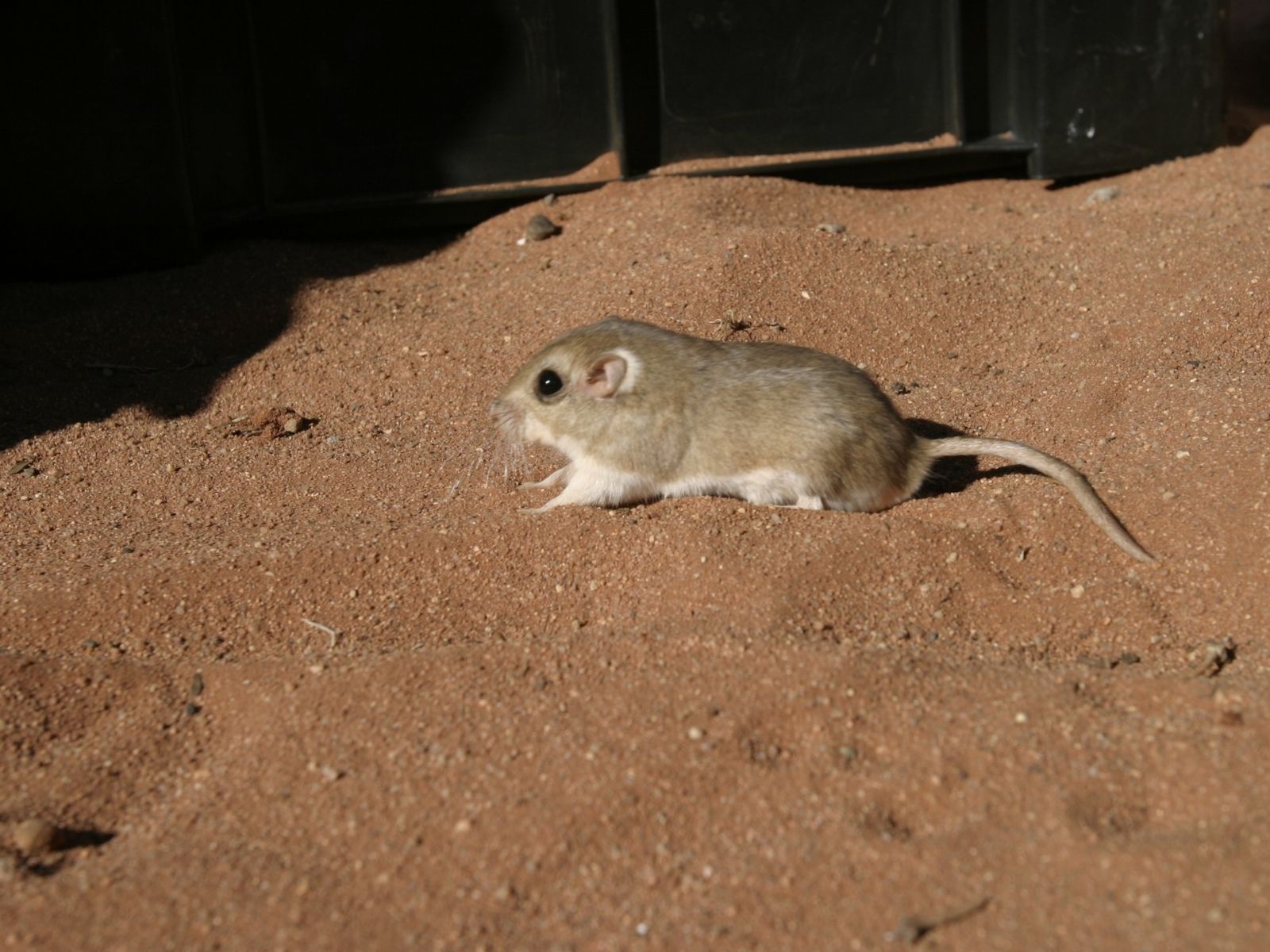
Short-tailed Gerbil
Desmodillus auricularis

2025 Red list status
Least Concern

Regional Population Trend
Stable

Change compared
to 2016
No Change
Overview
Desmodillus auricularis – (Smith, 1834)
ANIMALIA – CHORDATA – MAMMALIA – RODENTIA – MURIDAE – Desmodillus – auricularis
Common Names: Cape Short-eared Gerbil, Short-tailed Gerbil, Namaqua Gerbil, Namaqua Gerbille (English), Kortstertnagmuis, Namakwalandse Nagmuis (Afrikaans)
Synonyms: No Synonyms
Taxonomic Note: Desmodillus is a monotypic genus, restricted to southern Africa, with no recognised subspecies (Nel 2013).
Red List Status: LC – Least Concern
Assessment Information
Assessors: Smith, C.1 & da Silva, J.M.2
Reviewer: Taylor, P.3
Institutions: 1Endangered Wildlife Trust,2South African National Biodiversity Institute, 3University of the Free State, South Africa
Previous Assessors and Reviewers: Wilson, B., Palmer, G. & Relton, C.
Previous Contributors: Child, M.F., Avenant, N., Avery, M., Baxter, R., MacFadyen, D., Monadjem, A., Palmer, G., Taylor, P. & Wilson, B.
Assessment Rationale
Listed as Least Concern in view of its wide distribution within the assessment region, its common frequency in traps and thus presumed large population, and because there are no major threats that could cause population decline. Additionally, climate change may benefit this species by expanding the arid habitats in which it thrives.
Regional population effects: There is likely to be some dispersal across regional borders of Botswana and Namibia as the range is continuous across the western parts of southern Africa. However, the dispersal capability of this species is likely to be limited by the species’ small size and areas of unsuitable habitat. A rescue effect is possible but will be limited in effect.
Reasons for Change
Reason(s) for Change in Red List Category from the Previous Assessment: No change
Red List Index
Red List Index: No change
Recommended Citation: Smith C & da Silva JM. 2025. A conservation assessment of Desmodillus auricularis. In Patel T, Smith C, Roxburgh L, da Silva JM & Raimondo D, editors. The Red List of Mammals of South Africa, Eswatini and Lesotho. South African National Biodiversity Institute and Endangered Wildlife Trust, South Africa.
Regional Distribution and occurrence
Geographic Range
The Cape Short-eared Gerbil is widely distributed across drier western and central southern Africa, ranging from South Africa northwards through Botswana, Namibia and into southwestern Angola. It may also extend marginally into southwestern Zimbabwe (Skinner & Chimimba 2005).
Within the assessment region, this species is restricted to the arid savannah and desert regions of central, western and northeastern South Africa (Monadjem et al. 2015). They are specialist arid-adapted species (Nengovhela et al 2019). Current literature (Nel 2013) suggests that the range is slightly further east than previously described by Skinner and Chimimba (2005). In the North West Province, Power (2014) found that the species was only found on Molopo Nature Reserve, where they prefer sparse open shrubland, such as that along the Molopo riverbed and pan edges. Power (2014), however, notes that they are probably more widespread, as they occur on degraded landscapes (Skinner & Chimimba 2005), which are becoming increasingly more prevalent in the province (DACE 2008; DACERD 2009). There are no records from the southern Cape coastal belt or from any of the Cape Fold Mountains. The recent records from the Saldanha area may indicate a southern movement down the West Coast. A possible range contraction or local extinction may have occurred in the Tussen-die-Riviere Nature Reserve area in Free State Province where Lynch (1983) recorded this species close to the reserve, as they have not been recorded in this area in more recent years (Watson 2006). Extralimital occurrence is possible as they are sometimes kept as pets and escapees can establish local subpopulations.
Elevation / Depth / Depth Zones
Elevation Lower Limit (in metres above sea level): (Not specified)
Elevation Upper Limit (in metres above sea level): (Not specified)
Depth Lower Limit (in metres below sea level): (Not specified)
Depth Upper Limit (in metres below sea level): (Not specified)
Depth Zone: (Not specified)
Map
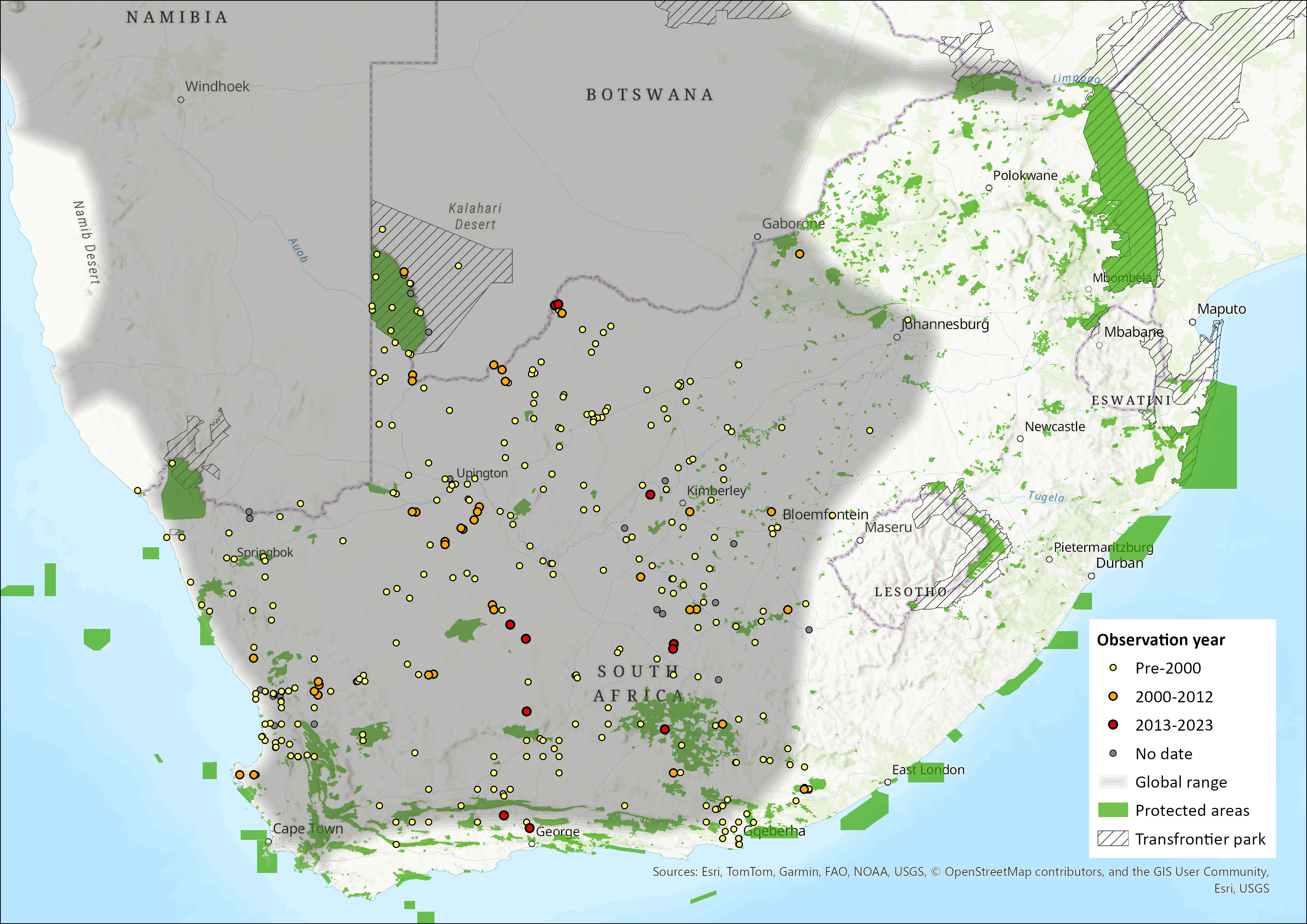
Figure 1. Distribution records for Short-tailed Gerbil (Desmodillus auricularis) within the assessment region (South Africa, Eswatini and Lesotho). Note that distribution data is obtained from multiple sources and records have not all been individually verified.
Biogeographic Realms
Biogeographic Realm: Afrotropical
Occurrence
Countries of Occurrence
| Country | Presence | Origin | Formerly Bred | Seasonality |
| Angola | Extant | Native | – | – |
| Botswana | Extant | Native | – | – |
| Namibia | Extant | Native | – | – |
| South Africa | Extant | Native | – | – |
| Zimbabwe | Presence Uncertain | Native | – | – |
Large Marine Ecosystems (LME) Occurrence
Large Marine Ecosystems: (Not specified)
FAO Area Occurrence
FAO Marine Areas: (Not specified)
Climate change
No recent research or literature has focused on how climate change might affect this species in the future.
Population Information
This is a common species in suitable habitat and is frequently caught in traps. While it is a seasonally abundant species, large fluctuations in numbers rarely occur (Nel 2013). It is assumed that more than 10,000 individuals exist within the assessment region.
Population Information
Current population trend: Stable
Continuing decline in mature individuals: Unknown
Number of mature individuals in population: Unknown
Number of mature individuals in largest subpopulation: Unknown
Number of subpopulations: Unknown
Severely fragmented: No
Extreme fluctuations in the number of subpopulations: (Not specified)
Continuing decline in number of subpopulations: (Not specified)
All individuals in one subpopulation: (Not specified)
Quantitative Analysis
Probability of extinction in the wild within 3 generations or 10 years, whichever is longer, maximum 100 years: (Not specified)
Probability of extinction in the wild within 5 generations or 20 years, whichever is longer, maximum 100 years: (Not specified)
Probability of extinction in the wild within 100 years: (Not specified)
Population Genetics
While broad phylogenetic studies have been undertaken on the genus, no population genetic research has been conducted on D. auricularis. Based on the knowledge that the species is common (likely exceeding 10,000 individuals) and widespread throughout the assessment region, and is able to tolerate degraded and modified landscapes, it may exist as a single metapopulation; however, the possibility of genetic substructure is possible and should be investigated. Based on it being abundant, the estimated population size of > 10,000 individuals translates to an effective population size (Ne) of > 1,000 (based on an effective to census conversion ratio of 0.1). While the 10,000 value is not an actual census count, the quantity can still be used as a proxy for quantifying the proportion of populations with an Ne > 500 indicator, which is valued at 1.0 (1/1 subpopulation with Ne > 500).
Habitats and ecology
Typically restricted to the hard soils of arid plains and pans, with a sparse cover of grass or low karroid shrubs, this species occurs throughout the Namib Desert, but is absent from soft, shifting dune sand (Skinner & Chimimba 2005). It is one of the few species that may be able to cope with degraded and modified landscapes. In Rolfontein Nature Reserve (Northern Cape Province) three specimens were caught in areas of short grass cover (Eragrostis truncate community) with hard calcareous soils (Jooste & Palmer 1982). To avoid the extreme temperatures in the region in which it occurs, these gerbils live in burrows and are nocturnal. The burrow systems are complicated and extensive with well-defined pathways between the burrow entrances (Rautenbach 1982). Despite this, they tend to be asocial and solitary (Nel 2013).
This species is physiologically well-adapted to life in hot, arid conditions, as they produce highly concentrated urine to avoid water loss (Buffenstein et al. 1985; Grobler 1993), and have excellent thermoregulatory capabilities. For example, Grobler (1993) reported that at ambient temperatures of between 34°C and -5°C, they are able to sustain a normal body temperature of about 36°C. They are independent of free water and also store fat in their tails when conditions are good, resulting in some adults becoming very large (Nel 2013). Although mostly granivorous, on occasion they will also eat insects. Gerbils generally forage and feed up to 30 m from their burrows. Both sexes will hoard seeds (Skinner & Chimimba 2005). Food will be stored in burrows (larder-hoarding) and also at other locations within the home range (scatter-hoarding) (Nel 2013).
Unlike other rodents found in the same environment they breed year-round under favourable conditions, with a prolonged breeding period from March to September, probably due to the fact they are not dependent on water (Lovegrove 2004). Litters average 2–4 young after a gestation of about 21 days, and are weaned at about 33 days (Nel 2013).
Ecosystem and cultural services: Rodents are both predators and dispersers of plant seeds in the environment. Since these gerbils are hoarders, they may serve in a limited capacity as seed dispersers. Seeds taken into the burrows are likely to be consumed, but some of the seeds scatter-hoarded in caches or buried are often forgotten or abandoned, and if these escape other seed predators, they may germinate and establish seedlings (Nyiramana et al. 2011; Wang et al. 2012). This species is recognised as a major reservoir and vector of the bubonic plague, and resultantly plays a significant role in plague epidemiology in southern Africa (NICD 2005).
IUCN Habitats Classification Scheme
|
Habitat |
Season |
Suitability |
Major Importance? |
|
8.1. Desert -> Desert – Hot |
– |
Suitable |
– |
|
8.2. Desert -> Desert – Temperate |
– |
Suitable |
– |
Life History
Generation Length: (Not specified)
Age at maturity: female or unspecified: (Not specified)
Age at Maturity: Male: (Not specified)
Size at Maturity (in cms): Female: (Not specified)
Size at Maturity (in cms): Male: (Not specified)
Longevity: (Not specified)
Average Reproductive Age: (Not specified)
Maximum Size (in cms): (Not specified)
Size at Birth (in cms): (Not specified)
Gestation Time: (Not specified)
Reproductive Periodicity: (Not specified)
Average Annual Fecundity or Litter Size: (Not specified)
Natural Mortality: (Not specified)
Does the species lay eggs? (Not specified)
Does the species give birth to live young: (Not specified)
Does the species exhibit parthenogenesis: (Not specified)
Does the species have a free-living larval stage? (Not specified)
Does the species require water for breeding? (Not specified)
Movement Patterns
Movement Patterns: (Not specified)
Congregatory: (Not specified)
Systems
System: Terrestrial
General Use and Trade Information
This species is not known to be traded or utilised in any form.
Local Livelihood: (Not specified)
National Commercial Value: (Not specified)
International Commercial Value: (Not specified)
End Use: (Not specified)
Is there harvest from captive/cultivated sources of this species? (Not specified)
Harvest Trend Comments: (Not specified)
Threats
No major threats have been identified for D. auricularis. In fact, climate change may benefit this species to a limited extent, as it is capable of breeding in adverse conditions that may result in a reduction of more sensitive rodent species. This species can also exist on degraded land (Power 2014).
Current habitat trend: Stable
Conservation
This species is found within a large number of protected areas, including Kgalagadi Transfrontier National Park, |Ai-|Ais/Richtersveld Transfrontier Park, Goegap Nature Reserve, Namaqua National Park, Tankwa National Park, Mountain Zebra National Park, Camdeboo National Park, Augrabies National Park, Addo Elephant National Park, Karoo National Park, Doornkloof Nature Reserve and Molopo Nature Reserve. Resultantly, no conservation interventions are deemed necessary at this stage.
Recommendations for land managers and practitioners:
- No conservation actions are currently needed for this species.
Research priorities:
- No species-specific research priorities have been recognised, but the adaptations to changing climate and habitat conditions could be investigated under the auspices of a regional investigation.
Encouraged citizen actions:
- Report sightings on virtual museum platforms (for example, iNaturalist and MammalMAP), especially outside protected areas.
Bibliography
Buffenstein R, Campbell WE, Jarvis JUM. 1985. Identification of crystalline allantoin in the urine of African Cricetidae (Rodentia) and its role in their water economy. Journal of Comparative Physiology B 155: 493–499.
DACE. 2008. North West Province: Environment Outlook. North West Department of Agriculture, Conservation & Environment, Mmabatho, South Africa.
DACERD. 2009. North West Provincial Biodiversity Conservation Assessment Technical Report, Version 1.2. North West Department of Agriculture, Conservation, Environment and Rural Developmen, Mmbatho, South Africa.
Grobler CAF. 1993. Energy and water metabolism in the Namaqua gerbil, Desmodillus auricularis. M.Sc. Thesis. University of Pretoria, Pretoria.
Jooste JF, Palmer NG. 1982. The distribution and habitat preference of some small mammals in the Rolfontein Nature Reserve. South African Journal of Wildlife Research 12: 26-35.
Lovegrove BG. 2004. Animal form and function. Pages 145–162 in Dean WRJ, Milton SJ, editors. The Karoo: patterns and ecological processes. Cambridge University Press, Cambridge, UK.
Lynch, C.D. 1983. The mammals of the Orange Free State, South Africa. Navorsinge van die Nasionale Museum Bloemfontein 18: 1-218.
Monadjem, A., Taylor, P.J., Denys, C. and Cotterill, F.P.D. 2015. Rodents of Sub-Saharan Africa: A Biogeographic and Taxonomic Synthesis. . De Gruyter, Berlin, Germany.
Nengovhela, A., Braga, J., Denys, C., de Beer, F., Tenailleau, C. and Taylor, P.J., 2019. Associated tympanic bullar and cochlear hypertrophy define adaptations to true deserts in African gerbils and laminate‐toothed rats (Muridae: Gerbillinae and Murinae). Journal of Anatomy, 234(2), pp.179-192.
NICD. 2005. Plague control guidelines for South Africa. National Institute for Communicable Diseases, Department of Health, South Africa.
Nel JAJ. 2013. Desmodillus auricularis, Cape short-eared Gerbil. Pages 266–268 in Happold DCD, editor. Mammals of Africa, Volume III: Rodents, Hares and Rabbits. Bloomsbury Publishing, London, UK.
Nyiramana N, Mendoza I, Kaplin BA, Forget P. 2011. Evidence for Seed Dispersal by Rodents in Tropical Montane Forest in Africa. Biotropica 43: 654–657.
Power RJ. 2014. The Distribution and Status of Mammals in the North West Province. Department of Economic Development, Environment, Conservation & Tourism, North West Provincial Government, Mahikeng, South Africa.
Rautenbach IL. 1982. Mammals of the Transvaal. No. 1, Ecoplan Monograph, Pretoria, South Africa.
Skinner J.D. and Chimimba C.T. 2005. The Mammals of the Southern African Subregion. Cambridge University Press, Cambridge, UK.
Wang B, Wang G, Chen J. 2012. Scatter-hoarding rodents use different foraging strategies for seeds from different plant species. Plant Ecology 213: 1329–1336.
Watson JP. 2006. Check list of the mammals of Tussen-die-Riviere Provincial Nature Reserve, Free State Province, South Africa. Koedoe 49: 111-117.