
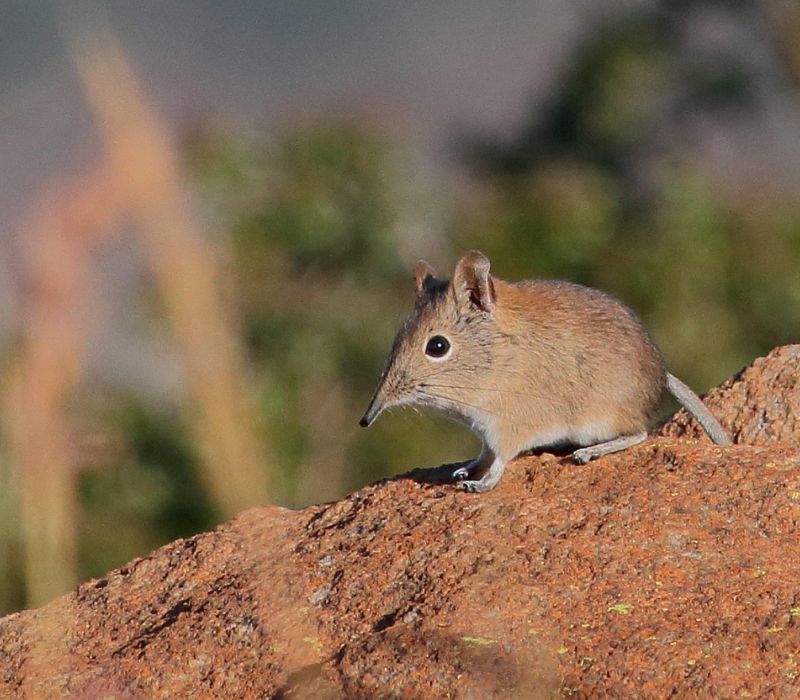
Short-snouted Sengi
Elephantulus brachyrhynchus

2025 Red list status
Least Concern

Regional Population Trend
Stable

Change compared
to 2016
No Change
Overview
Elephantulus brachyrhynchus – (A. Smith, 1836)
ANIMALIA – CHORDATA – MAMMALIA – MACROSCELIDEA – MACROSCELIDIDAE – Elephantulus – brachyrhynchus
Common Names: Short-snouted Sengi, Short-snouted Elephant-shrew (English), Kortneus Klaasneus (Afrikaans)
Synonyms: Macroscelides brachyrhynchus A. Smith, 1836
For general biological information on all sengi species, consult: Species accounts: Order Macroscelidea, in: Perrin, M. & Rathbun, G. B. 2013. Mammals of Africa, Volume I (Ed. by Kingdon, J., Happold, D., Hoffmann, M., Butynski, T., Happold, M. & Kalina, J.), pp. 261-278. London: Bloombury; Order Macroscelidea, in: Rathbun, G. B., (subeditor). 2005. The Mammals of the Southern African Subregion, 3rd edition (Ed. by Skinner, J. D. & Chimimba, C. T.), pp. 22-34. Cape Town, South Africa: Cambridge University Press; Species accounts, in: Rathbun, G. B. 2013. Mammals of Africa, Volume I (Ed. by Kingdon, J., Happold, D., Hoffmann, M., Butynski, T., Happold, M. & Kalina, J.), pp. 279-287. London: Bloomsbury. Order MACROSCELIDEA, in: Heritage, S. 2018. Handbook of the Mammals of the World, Volume 8. Insectivores, Sloths and Colugos (D.E. Wilson and R.A. Mittermeier, eds), Lynx Edicions, Barcelona, Spain. For current and more more technical information, search the on-line bibliography at www.sengis.org.
Taxonomic Note:
In the past, the single family was included in the order Insectivora, but now the family is in the monophyletic order Macroscelidea and the superorder Afrotheria. Currently, there are 20 living species recognised in six genera. The soft-furred sengis or elephant-shrews include five genera: Petrodromus and Petrosaltator are monospecific, Macroscelides has three species, Galegeeska has two species and Elephantulus contains 8 species. The five species of giant sengis belong to the genus Rhynchocyon. The common name “sengi” is being used in place of elephant-shrew by many biologists to try and disassociate the Macroscelidea from the true shrews (family Soricidae) in the order Eulipotyphla.
See the IUCN SSC Afrotheria Specialist Group web site and www.sengis.org for additional information.
| Red List Status |
| LC – Least Concern, (IUCN version 3.1) |
Assessment Information
Assessor: Roxburgh, L.1 & da Silva, J. M.2
Reviewer: Schradin, C.3
Institutions: 1Endangered Wildlife Trust, 2South African National Biodiversity Institute, 3Institut pluridisciplinaire Hubert Curien,
Previous Assessors: Rathbun, G.B. & Smit-Robinson, H.
Reviewer: Taylor, A.
Previous Contributors: Page-Nicholson, S., Child, M.F. & Power, J.
Assessment Rationale
The species is listed as Least Concern. Although this species is not abundant, it is widespread in suitable habitats across the north–eastern reaches of South Africa. Similar to other species in the genera Elephantulus and Macroscelides, it occupies habitats that are arid and will not support many types of human development. There are no known major threats to this species or its habitats. Although habitat loss through agriculture and mining developments in the assessment region may cause local declines, this is not expected to be threatening to the population overall. Although there are no specific data available on population trends, there is no reason to believe that numbers are increasing or decreasing significantly due to any factors other than natural variation in environmental conditions in the relatively arid habitats that this species occupies. In how far desertification and bush encroachment due to various anthropogenic factors and climate change will impact this species is unknown due to missing field surveys.
Regional population effects: The habitats this species occupies are largely intact and connected across regions, so dispersal is possible.
Reasons for Change
Reason(s) for Change in Red List Category from the Previous Assessment: No change
Red List Index
Red List Index: No change
Recommended citation: Roxburgh L & da Silva JM. 2025. A conservation assessment of Elephantulus brachyrhynchus. In Patel T, Smith C, Roxburgh L, da Silva JM & Raimondo D, editors. The Red List of Mammals of South Africa, Eswatini and Lesotho. South African National Biodiversity Institute and Endangered Wildlife Trust, South Africa.
Regional Distribution and occurrence
Geographic Range
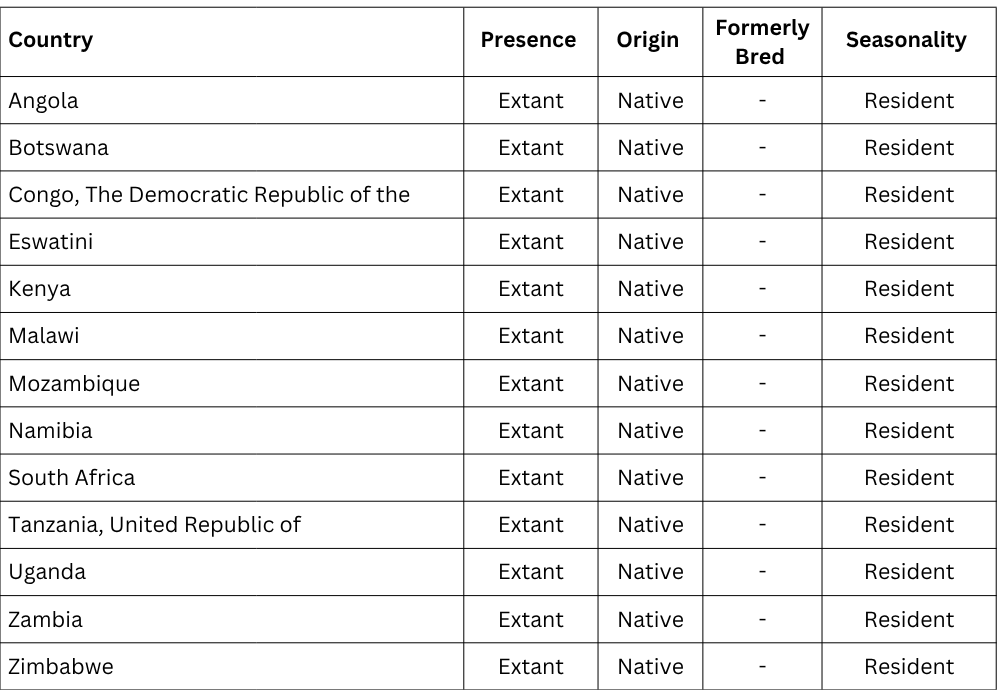
This is the most widespread species of Sengi, but it is among the most localised in South Africa (Rathbun 2005). The species is found from northern South Africa through northeast Namibia (where they are confined to the north-east), east and central Botswana, Angola, Zimbabwe, Malawi, Zambia, Mozambique north to Democratic Republic of Congo. In East Africa, it is found in Tanzania, Kenya and Uganda. Within the assessment region, it occurs mostly in Limpopo Province, but also in North West, Gauteng, and Mpumalanga provinces. It is also recorded from Eswatini (Monadjem 1998). There are no range shifts recorded.
Elevation / Depth / Depth Zones
Elevation Lower Limit (in metres above sea level): (Not specified)
Elevation Upper Limit (in metres above sea level): (Not specified)
Depth Lower Limit (in metres below sea level): (Not specified)
Depth Upper Limit (in metres below sea level): (Not specified)
Depth Zone: (Not specified)
Biogeographic Realms
Biogeographic Realm: Afrotropical
Map
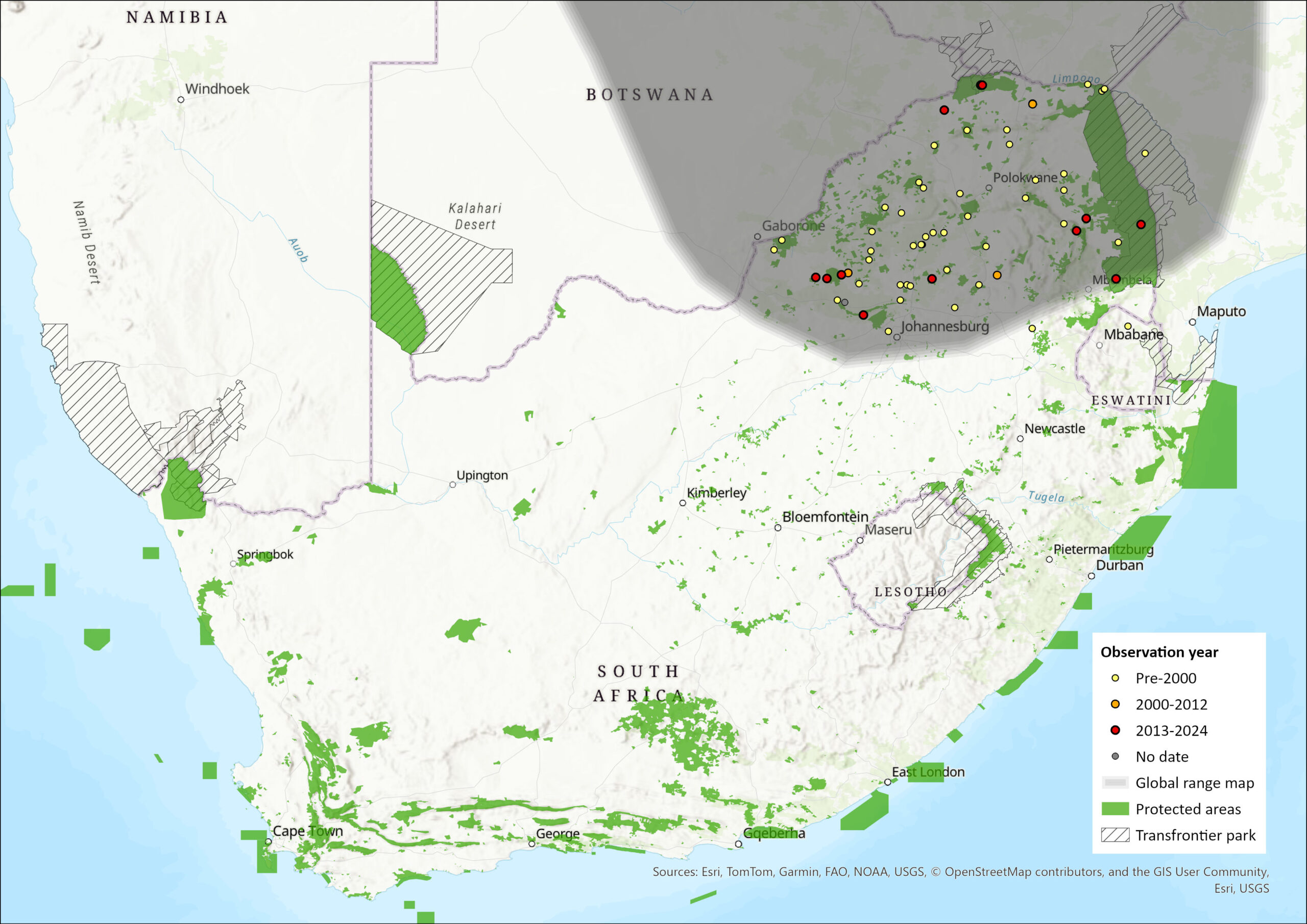
Figure 1. Distribution records for Short-snouted Sengi (Elephantulus brachyrhynchus) within the assessment region (South Africa, Eswatini and Lesotho). Note that distribution data is obtained from multiple sources and records have not all been individually verified.
Countries of Occurrence
Large Marine Ecosystems (LME) Occurrence
Large Marine Ecosystems: (Not specified)
FAO Area Occurrence
FAO Marine Areas: (Not specified
Climate change
This species is widespread in sub-Saharan Africa, reaching as far north as Uganda and Kenya. Climate change is thus not likely to be a significant threat to this species and might allow it to expand its range southward. Its preference for dense grass, scrub and underbrush might allow it to benefit from bush encroachment. It is not associated with rocky outcrops.
Population information
This species, although widespread, is only locally common. It also occurs in fallow agricultural lands and grazed lands. No national population estimates are available, but the population is expected to be stable.
| Continuing decline in mature individuals | No |
| Qualifier | – |
| Justification | – |
Extreme fluctuations in the number of subpopulations: (Not specified)
Continuing decline in number of subpopulations: (Not specified)
All individuals in one subpopulation: (Not specified)
Number of mature individuals in largest subpopulation: (Not specified)
Number of Subpopulations: (Not specified)
Quantitative Analysis
Probability of extinction in the wild within 3 generations or 10 years, whichever is longer, maximum 100 years: (Not specified)
Probability of extinction in the wild within 5 generations or 20 years, whichever is longer, maximum 100 years: (Not specified)
Probability of extinction in the wild within 100 years: (Not specified)
Population genetics
While the karotype of this species has been investigated (Tolliver et al. 1989) and individuals from the assessment region have been incorporated into phylogenetic studies (e.g., Krásová et al. 2021), to date, no fine–scale population genetic studies have been conducted on the species. Reflecting on the genetic structure of other conspecifics (e.g., E. myurus) where northern subpopulations were identified, it is possible the animals in the assessment region form a single metapopulation localised to the north. Due to the lack of density information, population size estimates and, consequently, effective population size (Ne) estimates cannot be quantified.
Habitats and ecology
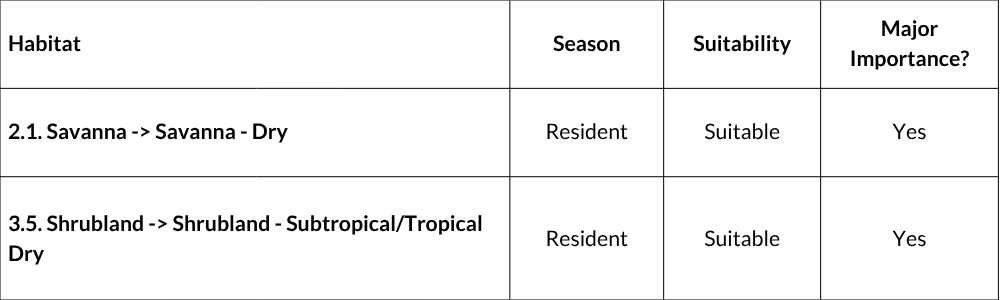
It occurs in Steppe and savannah woodlands within the Savanna Biome. The species prefers a habitat of dense grass cover, with scrub bush and scattered trees, which is denser than areas where the Bushveld Sengi (Elephantulus intufi) is found. In some parts of its distribution, the Short-snouted Sengi is found on rocky hillsides (Rathbun 2005). In the North West Province, they were sampled in the Mabeskraal area and the southwestern parts of Pilanesberg National Park all within Zeerust Thornveld (Mucina & Rutherford 2006), where the specific habitat was mixed Olea spp. woodland on a pediment (Power 2014). Interestingly, they were not sampled in the Borakalalo area where one would expect to capture them based on historical occurrence (Rautenbach 1982; Power 2014). In Eswatini, it was sampled in moist savannah in an acacia thicket on an overgrazed field with compacted soil (Monadjem 1998). Generally, the nature of the ground/soil does not seem to be a factor that limits its distribution. For example, this species occurs on sandy ground or sandy alluvium or, in stark contrast, on the hard substrate of Mopane scrub (Rathbun 2005). The species has home ranges up to 0.25 ha, and it uses termitaria to escape fire (Yarnell et al. 2008), which is uncommon in most Elephantulus spp. (Rathbun 2005) and may be an adaptation to fire. Although it is sympatric with E. myurus and E. intufi, it is segregated by its habitat requirements as it prefers denser vegetation than other species (Rathbun 2005). It is omnivorous, but mostly consumes insects with a small amount of fruit and seeds (Leirs et al. 1995).
Ecosystem and cultural services: Sengi species are thought to be included in San art and are therefore subject to local folklore.
IUCN Habitats Classification Scheme
Life History
Generation Length: (Not specified)
Age at maturity: Female or unspecified: (Not specified)
Age at Maturity: Male: (Not specified)
Size at Maturity (in cms): Female: 21
Size at Maturity (in cms): Male: 21
Longevity: 4.2 years (Weigl 2005)
Average Reproductive Age: (Not specified)
Maximum Size (in cms): (Not specified)
Size at Birth (in cms): (Not specified)
Gestation Time: 61 days
Reproductive Periodicity: (Not specified)
Average Annual Fecundity or Litter Size: 2 (litter size)
Natural Mortality: (Not specified)
Breeding Strategy
Does the species lay eggs? No
Does the species give birth to live young? Yes
Does the species exhibit parthenogenesis? No
Does the species have a free-living larval stage? No
Does the species require water for breeding? No
Movement Patterns
Movement Patterns: Not Migrant
Congregatory: (Not specified)
Systems
System: Terrestrial
General Use and Trade Information
There is no evidence that this Sengi species is used for local or international trade.
Local Livelihood: (Not specified)
National Commercial Value: (Not specified)
International Commercial Value: (Not specified)
End Use: (Not specified)
Is there harvest from captive/cultivated sources of this species? (Not specified)
Harvest Trend Comments: (Not specified)
Threats
There are no major identified threats to the species within the assessment region. However, expansion of crop agriculture, overgrazing on cattle and game farms and mining activity – particularly in North West and Limpopo provinces – may lead to local declines. As this species needs dense ground cover, imprudent fire regimes and overgrazing may be detrimental, which is corroborated by results that demonstrate they significantly prefer unburnt areas following fires (Yarnell et al. 2008).
Current habitat trend: The savannah ecosystem is well protected within the assessment region. Additionally, the conversion of livestock to wildlife ranches may be creating additional habitat, as long as such areas are well managed.
Conservation
The species is expected to occur in protected areas within the assessment region (for example, Pilanesberg National Park, North West Province), but these records must be more formally documented and confirmed. Although no specific interventions are necessary at present, this species is suspected to benefit from protected area expansion and mine rehabilitation or biodiversity offsets. Yarnell et al. (2008) studied this species by radio-tracking 11 individuals on the Mankwe Wildlife Reserve, east of Pilanesberg National Park and recording their response to fire. All individuals were found immediately sheltering in termite mounds after fires, which suggests that landowners should protect such microhabitats as a key refuge area for this species and other small mammals. As individuals were restricted to patches of unburned vegetation following fire, an important intervention is to design fire management strategies that leave sufficient patches of unburned vegetation (Yarnell et al. 2008).
Recommendations for land managers and practitioners:
- Land managers should stock cattle or wildlife at ecological levels, employ natural fire regimes and protect termite mounds as refugia for small mammals during fire.
Research priorities:
- Further field surveys to refine distribution mapping within the assessment region and determine occupancy across different land uses.
- Determine the impact of anthropogenic land modifications and climate change on sengi populations.
Encouraged citizen actions:
- Citizens are encouraged to report sightings on virtual museum platforms (for example, iNaturalist and MammalMAP), preferably with photographic confirmation.
Bibliography
Krásová, J., Mikula, O., Šumbera, R., Horáková, S., Robovský, J., Kostin, D.S., Martynov, A.A., Lavrenchenko, L.A. and Bryja, J. 2021. The Rufous Sengi is not Elephantulus—Multilocus reconstruction of evolutionary history of sengis from the subfamily Macroscelidinae. J. Zool. Syst. Evol. Res., 59: 918-932. https://doi.org/10.1111/jzs.12460
Leirs H, Verhagen R, Verheyen W, Perrin MR. 1995. The biology of Elephantulus brachyrhynchus in natural miombo woodland in Tanzania. Mammal Review 25: 45-49.
Monadjem, A. 1998. Distributional patterns and conservation status of mammals of Swaziland, southern Africa. Koedoe 41: 45-59.
Mucina, L. and Rutherford, M.C. 2006. The Vegetation of South Africa, Lesotho and Swaziland. Strelitzia 19. South African National Biodiversity Institute, Pretoria, South Africa.
Perrin M, Rathbun GB. 2013. Species accounts: Order Macroscelidea, Family Macroscelididae, Genus Elephantulus, E. edwardii, E. intufi, E. myurus, E. rozeti, E. rufescens; Genus Macroscelides; M. proboscideus. In: in Kingdon J, Happold D, Hoffmann M, Butynski T, Happold M, Kalina J (ed.), Mammals of Africa, Volume I, pp. 261-278. Bloomsbury Publishing, London, UK.
Power, RJ. 2014. The distribution and status of mammals in the North West Province. Department of Economic Development, Environment, Conservation & Tourism, North West Provincial Government, Mahikeng.
Rathbun GB. 2013. Species accounts: Genus Petrodromus, P. tetradactylus, Genus Rhynchocyon, R. cirnei, R. chrysopygus, R. petersi. In: Kingdon J, Happold D, Hoffmann M, Butynski T, Happold M, Kalina J (ed.), Mammals of Africa, Volume I, pp. 279-287. Bloomsbury Publishing, London, UK.
Rathbun GB. (subeditor). 2005. Order Macroscelidea. In: J.D. Skinner and C.T. Chimimba (eds), The Mammals of the Southern African Subregion, 3rd edition, pp. 22-34. Cambridge University Press, Cape Town, South Africa.
Rautenbach IL. 1982. Mammals of the Transvaal. No. 1, Ecoplan Monograph, Pretoria, South Africa.
Tolliver, D., Robbins, L., Rautenbach, I.L., Schlitter, D. & Coetzee, C.G. 1989. Biochemical systematics of elephant shrews from Southern Africa. Biochemical Systematics and Ecology. 17. 345-355. 10.1016/0305-1978(89)90016-1.
Yarnell RW, Metcalfe DJ, Dunstone N, Burnside N, Scott DM. 2008. The impact of fire on habitat use by the short-snouted elephant shrew (Elephantulus brachyrhynchus) in North West Province, South Africa. African Zoology 43: 45-52.
Weigl R 2005. Longevity of Mammals in Captivity; from the Living Collections of the World. Kleine Senckenberg-Reihe 48: Stuttgart.