
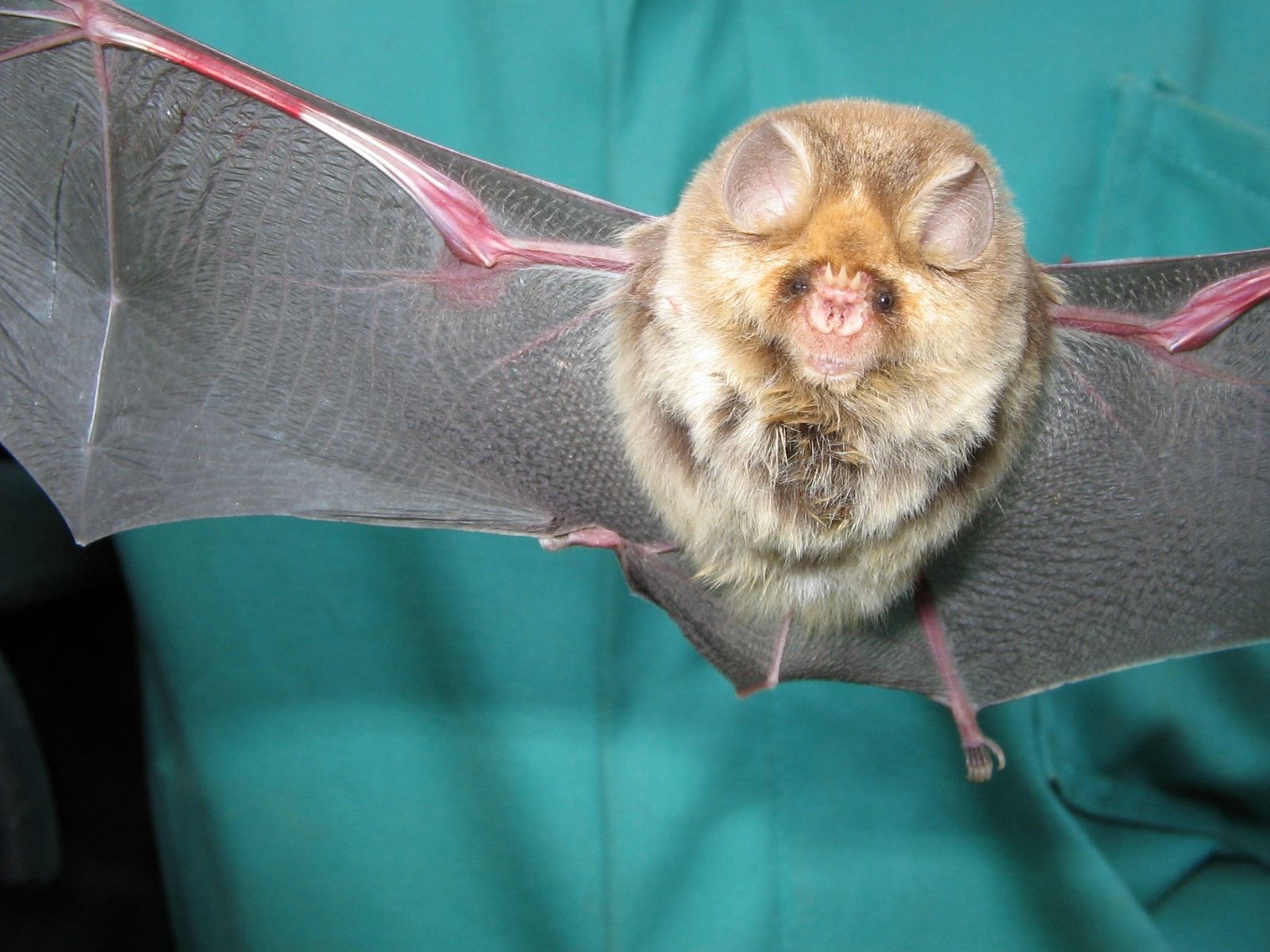
Short-eared Trident Bat
Cloeotis percivali

2025 Red list status
Endangered

Regional Population Trend
Declining

Change compared
to 2016
No Change
Overview
Cloeotis percivali – Thomas, 1901
ANIMALIA – CHORDATA – MAMMALIA – CHIROPTERA – RHINONYCTERIDAE – Cloeotis – percivali
Common Names: Percival’s Short-eared Trident Bat, Percival’s Trident Bat, Short-eared Trident Bat, African Trident Bat, East African Trident Bat (English), Drietandbladneusvlermuis (Afrikaans), Lilulwane (siSwati)
Synonyms: No Synonyms
Taxonomic Note:
Meester et al. (1986) listed two subspecies, of which only Cloeotis p. australis occurs in the assessment region, while the other, C. p. percivali occurs in East Africa.
Red List Status: EN – Endangered C1 (IUCN version 3.1)
Assessment Information
Assessors: Balona, J.1 & da Silva, J.M.2
Reviewer: Richards, L.3
Institutions: 1Gauteng and Northern Regions Bat Interest Group, 2South African National Biodiversity Institute, 3Durban Natural Science Museum
Previous Assessors and Reviewers: Balona, J., Cohen, L., White, W., Jacobs, D., MacEwan, K., Monadjem, A., Richards, L.R., Schoeman, C., Sethusa, T. & Taylor, P.
Previous Contributors: Roxburgh, L., Raimondo, D. & Child, M.F.
Assessment Rationale
Known from only twelve colonies in South Africa, with the five surveyed estimated to have fewer than 100 mature individuals (surveyed between 2009 and 2012). There is also one colony known from Eswatini, believed to number around 100 mature individuals. The overall population for the region is suspected to be less than 2,400 mature individuals, with no colony having more than 250 individuals present. There have been recorded declines in numbers at two locations, presumed to be due to roost disturbance. However, further long-term monitoring is required to estimate overall population decline. The species has an EOO of 169,393 km2, and an AOO of 652 km2 (using a 2 by 2 km grid cell size, or 16,300 km2 using a 10 by 10 km grid cell size). The species is listed as Endangered C1 on account of the number of mature individuals in the population and the observed and projected population declines.
Regional population effects: Although it occurs outside of the assessment region, Cloeotis percivali has short, rounded wings with low wing loading (Monadjem et al. 2010). It is thus not suspected that individuals from subpopulations outside of the assessment region are able to readily disperse into and influence population dynamics of the subpopulations within the assessment region.
Reasons for Change
Reason(s) for Change in Red List Category from the Previous Assessment: No change
Red List Index
Red List Index: No change
Recommended citation: Balona J & da Silva JM. 2025. A conservation assessment of Cloeotis percivali. In Patel T, Smith C, Roxburgh L, da Silva JM & Raimondo D, editors. The Red List of Mammals of South Africa, Eswatini and Lesotho. South African National Biodiversity Institute and Endangered Wildlife Trust, South Africa.
Regional Distribution and occurrence
Geographic Range
The Short-eared Trident Bat is largely confined to southern Africa, with records from South Africa, Eswatini, south-east Botswana, southern Zambia and Zimbabwe (the core of the distribution), while records also exist from southern Democratic Republic of Congo, Malawi, northwestern Mozambique, coastal Kenya and Mafia Island – Tanzani (Taylor 2000; Mickleburgh et al. 2008; ACR 2024). Its elevational range is from 14 to to 1,553 m asl (Monadjem et al. 2024). In the assessment region, the species occurs in Limpopo, Mpumalanga, Gauteng, North West and KwaZulu-Natal provinces of South Africa, as well as in Eswatini (localities reviewed in Balona 2015). While ecological niche models predict suitable climatic conditions exist through much of KwaZulu-Natal and the northern parts of the Eastern Cape, this species has not been recorded further south than northern KwaZulu-Natal (Monadjem et al. 2010). Six new distribution records were generated between 2008 and 2013 for both Limpopo and Gauteng provinces.
Subsequent to this, the bat has been recorded at three sites on three separate occasions (2013, 2018 and 2023) in the Soutpansberg Mountain range in Limpopo Province (P. Taylor, D. Cory-Toussaint and the Gauteng and Northern Regions Bat Interest Group pers. comm.).
Elevation / Depth / Depth Zones
Elevation Lower Limit (in metres above sea level): 14 m asl (Monadjem et al. 2024)
Elevation Upper Limit (in metres above sea level): 1553 m asl (Monadjem et al. 2024)
Depth Lower Limit (in metres below sea level): N/A
Depth Upper Limit (in metres below sea level): N/A
Depth Zone: (Not specified)
Map
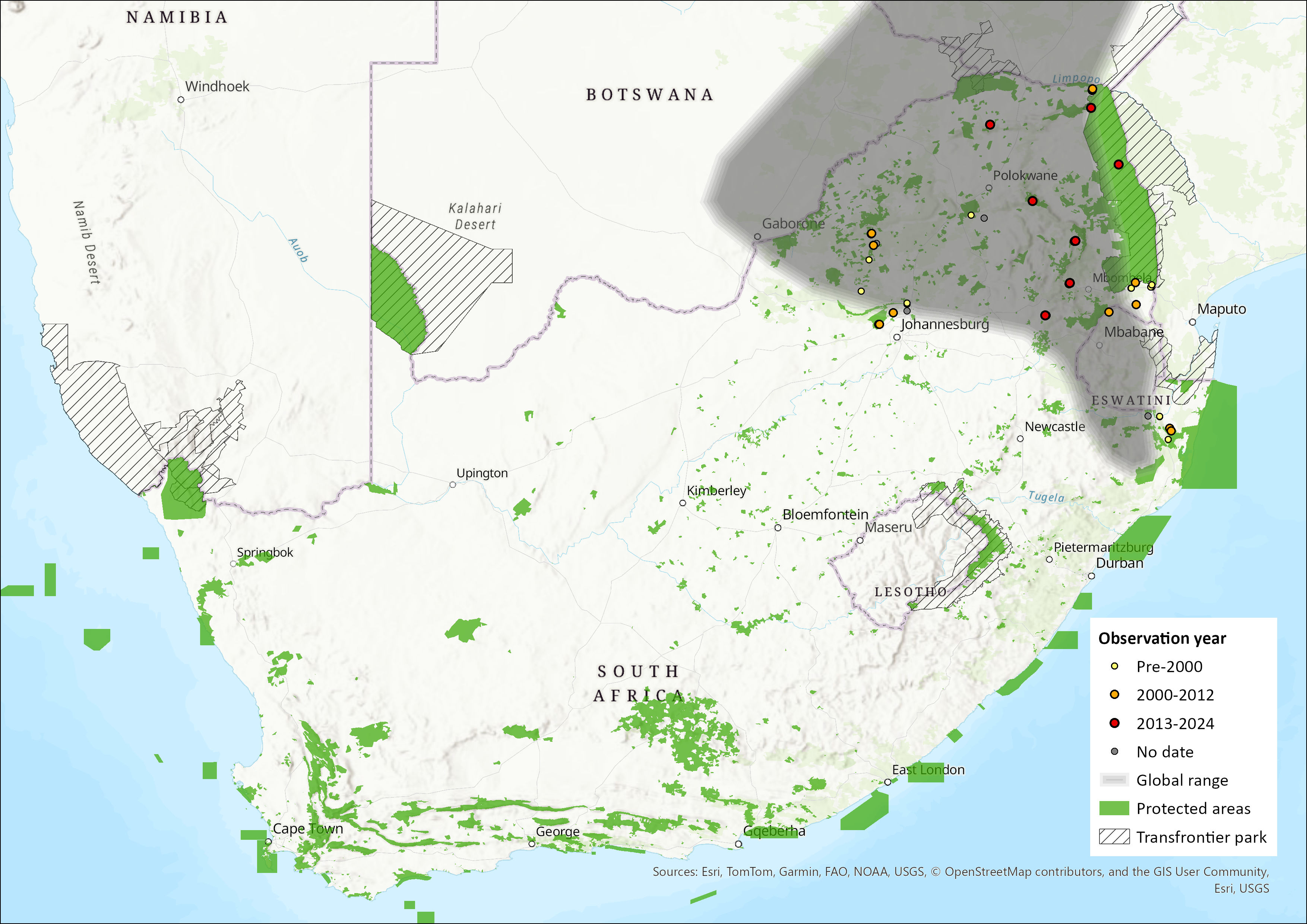 Figure 1. Distribution records for Percival’s Short-eared Trident Bat (Cloeotis percivali) within the assessment region (South Africa, Eswatini and Lesotho). Note that distribution data is obtained from multiple sources and records have not all been individually verified.
Biogeographic Realms
Biogeographic Realm: (Not specified)
Occurrence
Countries of Occurrence
| Country | Presence | Origin | Formerly Bred | Seasonality |
| Botswana | Extant | Native | – | – |
| Congo, The Democratic Republic of the | Extant | Native | – | – |
| Eswatini | Extant | Native | – | – |
| Kenya | Extant | Native | – | – |
| Malawi | Extant | Native | – | Resident |
| Mozambique | Extant | Native | – | – |
| South Africa | Extant | Native | – | – |
| Tanzania, United Republic of | Extant | Native | – | – |
| Zambia | Extant | Native | – | – |
| Zimbabwe | Extant | Native | – | – |
Large Marine Ecosystems (LME) Occurrence
Large Marine Ecosystems: N/A
FAO Area Occurrence
FAO Marine Areas: (Not specified)
Climate change
There are no studies on the impacts of climate change on this species. Overall, it is predicted that within the species range in the assessment region, there will be an increase in intense rainfall events, while temperatures are predicted to increase in line with global averages, with drought indexes also increasing. Currently there is not enough information to predict the impacts of climate change on this species.
Population information
Cloeotis percivali is not abundant within the assessment region with numbers ranging from 20–200 individuals per roost (Monadjem et al. 2020). Large fluctuations in population numbers are known, and the species is prone to local extinctions (Mickleburgh et al. 2008). A serious decline has been reported from the Jozini Dam colony, where about 200 observed individuals in April 2001 decreased to only three in 2012. Of concern, no individuals were detected during the 2018 roost inspection (L. Richards, pers. comm.). In other parts of South Africa five of the twelve recorded locations have population estimates available, all of which have fewer than 100 mature individuals. If we were to assume that all known sites sheltered a full complement of 200 bats, the total population of C. percivali in South Africa is possibly as small as 2,400 individuals (Balona 2015). There are no population estimates from elsewhere in its range, although the largest might be in Zimbabwe (ACR 2024).
Although it is known that some C. percivali colonies have declined, or have even become locally extinct, the lack of comprehensive long-term monitoring of all known roosts prevents a confident assessment of the South African population trend (Balona 2015).
Current population trend: Suspected to be decreasing (recorded declines at two locations)
Continuing decline in mature individuals? Yes
Extreme fluctuations in the number of subpopulations: (Not specified)
All individuals in one subpopulation: Presumed, however population genetic studies are required to confirm this.
Number of mature individuals in population: <2,400 mature individuals
Number of mature individuals in largest subpopulation: Unknown
Quantitative Analysis
Probability of extinction in the wild within 3 generations or 10 years, whichever is longer, maximum 100 years: (Not specified)
Probability of extinction in the wild within 5 generations or 20 years, whichever is longer, maximum 100 years: (Not specified)
Probability of extinction in the wild within 100 years: Possible, if observed declines continue throughout
Population genetics
No population genetic studies have been conducted on this species; however, given high fluctuations in population numbers and the occasional local extinction at some sites, it is assumed that individuals are capable of dispersing to neighbouring colonies to repopulate them. As such, they are presumed to exist as a single metapopulation, possibly also connected to colonies in adjacent countries. A population genetic study would be informative at identifying source and sink populations and quantifying the overall genetic health of this species.
With the population size in the assessment region estimated at 2400 mature individuals, it can be noted that the effective population size (Ne) is greater than 240-720 (based on conversion ratios 0.1-0.3) considering the metapopulation likely involves neighbouring countries and likely exceeds the 500 threshold.
Habitats and ecology
Occurs in savannah and woodland areas where there is sufficient cover in the form of caves and mine tunnels for day roosting (Taylor 2000). It feeds exclusively on moths (Taylor 2000; Skinner & Chimimba 2005), and appears to be very sensitive to disturbance. Its elevation range is from 14 to 1,553 masl (Monadjem et al. 2024). In the assessment region, the species is recorded from Central Bushveld, Lowveld and Mesic Highveld Grassland. This is mainly a woodland species (Balona 2015). It may be more common than indicated by museum specimens as it is not easy to capture with mist-nets and may roost in narrow crevices (Seamark 2005), thus leading to an underestimation of roosts, which is corroborated by the discovery of several new roost sites (Balona 2015) in the last decade. However, it remains relatively rare and occurs in low densities, considering the infrequent captures even in suitable habitat (savannah or woodland) near suitable roosts.
Ecosystem and cultural services: None specifically documented.
IUCN Habitats Classification Scheme
| Habitat | Season | Suitability | Major Importance? |
| 1.5. Forest -> Forest – Subtropical/Tropical Dry | – | Marginal | – |
| 2.1. Savanna -> Savanna – Dry | – | Suitable | – |
| 2.2. Savanna -> Savanna – Moist | – | Suitable | – |
| 4.4. Grassland -> Grassland – Temperate | – | Marginal | – |
| 7.1. Caves and Subterranean Habitats (non-aquatic) -> Caves and Subterranean Habitats (non-aquatic) – Caves | – | Suitable | – |
Life History
Generation Length: Unknown
Age at Maturity: Female or unspecified: Unknown
Age at Maturity: Male: Unknown
Size at Maturity (in cms): Female: Mean forearm length = 3.44 ± 0.10 cm (Monadjem et al. 2020)
Size at Maturity (in cms): Male: Mean forearm length = 3.40 ± 0.09 cm (Monadjem et al. 2020)
Longevity: Unknown
Average Reproductive Age: Unknown
Maximum Size (in cms): Female forearm length = 3.60 cm; Male forearm length = 3.60 cm
Size at Birth (in cms): Unknown
Gestation Time: Females with pups were observed in late November at Jozini, suggesting that birthing is timed with the onset of the austral summer (Taylor 1998)
Reproductive Periodicity: Uncertain
Average Annual Fecundity or Litter Size: unknown
Natural Mortality: None reported
Does the species lay eggs? No
Does the species give birth to live young: Yes
Does the species exhibit parthenogenesis: No
Does the species have a free-living larval stage? N/A
Does the species require water for breeding? N/A
Movement Patterns
Movement Patterns: Unknown
Congregatory: Yes, found roosting in colonies of between 2-200 individuals (Monadjem et al. 2020)
Systems
System: Terrestrial
General Use and Trade Information
Not known to be utilised or traded in any form.
Local Livelihood: (Not specified)
National Commercial Value: Although not reported from agroecosystem, the species may play a role in suppressing pest moth species.
International Commercial Value: Although not reported from agroecosystem, the species may play a role in suppressing pest moth species.
End Use: (Not specified)
Is there harvest from captive/cultivated sources of this species? (Not specified)
Harvest Trend Comments: (Not specified)
Threats
Mining (both legal and illegal) is the primary threat to this species, with three of the ten known subpopulations (Wylesdale, Pilgrim’s Rest and Sudwala) threatened by mining directly, and one threatened indirectly (Gatkop Cave 1 & 2). For example, in 2005, a colony of 50–100 individuals was re-discovered in an abandoned gold mine, in Eswatini, near the South African border (Monadjem et al. 2005). At the time recommissioning of the mine was being considered, threatening the continued existence of the colony. It is not known if the mine was in fact brought back into operation (Balona 2015).
Short-eared Trident Bats are highly sensitive to roost disturbance and regular roost disturbance may lead to abandonment or dissuade breeding. This could explain why the Jozini Dam and population has disappeared completely (L. Richards pers. comm.), as well as the colony from Wonderboom Cave near Pretoria (Balona 2015). In South Africa, religious ceremonies by local people are carried out in caves. These rituals and other forms of disturbance may be impacting some subpopulations. The use of pesticides that affect moths, the main diet of this species, is also postulated to be causing a decline in the population.
Conservation
In South Africa, this species is formally protected in Kruger National Park, Mkhuze Game Reserve and Lekgalametse; and is also found in Monate Private Game Reserve. Most colony sites are located outside formal protected areas (Wylesdale, Sudwala, Pafuri River Camp, Pilgrim’s Rest Machadodorp, Gatkop Caves and Lajuma). In order for this species to be better protected, as many of these locations as possible need to be included in protected areas. For example, both Mamelodi Cave (Gauteng Province) and Gatkop caves (Limpopo Province) host important subpopulations of this species, as well as other important bat species, and should be targeted by local conservation authorities to mitigate the effects of human disturbance (Balona 2015).
Recommendations for land managers and practitioners: The setting of harp traps is the preferred capture method when surveying for this species since it cannot be caught in mist-nets and is typically difficult to locate in roosts (Balona 2015).
Research priorities: Long-term monitoring, inclusive of acoustic monitoring, of all known sites must be initiated in order to establish whether populations are stable and/or need intervention at any time. Re-surveying of the sites that appear to have low or no longer extant populations is required (Kromdraai mine and Mamelodi Cave).
Encouraged citizen actions: Limit disturbance to roost sites.
Bibliography
ACR. 2024. African Chiroptera Report. 2024. AfricanBats NPC, Pretoria. i – xv; 1 – 1397.
Balona J. 2015. New distribution records of the Short-eared Trident Bat, Cloeotis percivali Thomas, 1901 (Chiroptera: Rhinonycteridae) in South Africa. African Bat Conservation News 41: 3–9.
Chege HN, Schepers C, Wolfaardt GJJ. 2015. Documenting the bat species assemblages of the Meletse Bat Research and Conservation Training Centre in Limpopo Province, Thabazimbi, South Africa. African Bat Conservation News 38: 5–8.
GeoTerraImage. 2015. 1990-2013/14 South African National Land-Cover Change. DEA/CARDNO SCPF002: Implementation of Land-Use Maps for South Africa. Project Specific Data Report.
Jubber W. 2012. Observation #22: First observation of the Trident Leaf-nosed Bat (Cloeotis percivali) from Kruger National Park, South Africa. African Bat Conservation News 27: 2.
Meester, J.A.J., Rautenbach, I.L., Dippenaar, N.J. and Baker, C.M. 1986. Classification of Southern African Mammals. Monograph number 5. Transvaal Museum, Pretoria, South Africa.
Mickleburgh, S., Hutson, A.M., Bergmans, W., Taylor, P.J., Aulagnier, S. & Fahr, J. 2008. Cloeotis percivali. The IUCN Red List of Threatened Species 2008. E.T4983A11106463. http://dx.doi.org/10.2305/IUCN.UK.2008.RLTS.T4983A11106463.en. Downloaded on 28 January 2016.
Monadjem A, Cohen L, De Wet K. 2005. Rediscovery of the Short-eared Trident Bat (Cloeotis percivali Thomas 1901) in Swaziland. African Bat Conservation News 6: 2–3.
Monadjem, A., Taylor, P.J., Cotterill, F.P.D. and Schoeman M.C. 2010. Bats of Southern and Central Africa: a biogeographic and taxonomic synthesis. University of Witwatersrand Press, Johannesburg.
Monadjem, A., Taylor, P.J., Cotterill, F.P.D. and Schoeman M.C. 2020. Bats of Southern and Central Africa: a biogeographic and taxonomic synthesis, Second Edition. University of Witwatersrand Press, Johannesburg.
Monadjem, A., Montauban, C., Webala, P.W., Laverty, T.M., Bakwo-Fils, E.M., Torrent, L., Tanshi, I., Kane, A., Rutrough, A.L., Waldien, D.L. and Taylor, P.J., 2024. African bat database: curated data of occurrences, distributions and conservation metrics for sub-Saharan bats. Scientific Data, 11(1), p.1309.
Rautenbach IL. 1997. Insectivorous bats – Suborder Microchiroptera. In: Mills MGL, Hes L (ed.), he Complete Book of Southern African Mammals, pp. 72–103. Struik Publishers, Cape Town, South Africa.
Seamark E. 2005. Correction and update of distribution data for Cloeotis percivali Thomas, 1901 (Chiroptera: Rhinolophidae: Hipposiderinae) in southern Africa. African Bat Conservation News 4: 3–5.
Skinner, J.D. and Chimimba, C.T. (eds). 2005. The Mammals of the Southern African Subregion. Cambridge University Press, United Kingdom, Cambridge.
Taylor, P.J. 1998. Regional patterns of small mammal abundance and community composition in protected areas in KwaZulu-Natal. Durban Museum Novitates, 23(1), pp.42-51.
Taylor, P.J. 2000. Bats of Southern Africa: Guide to Biology, Identification, and Conservation. University of Natal Press, Pietermaritzburg, South Africa.