
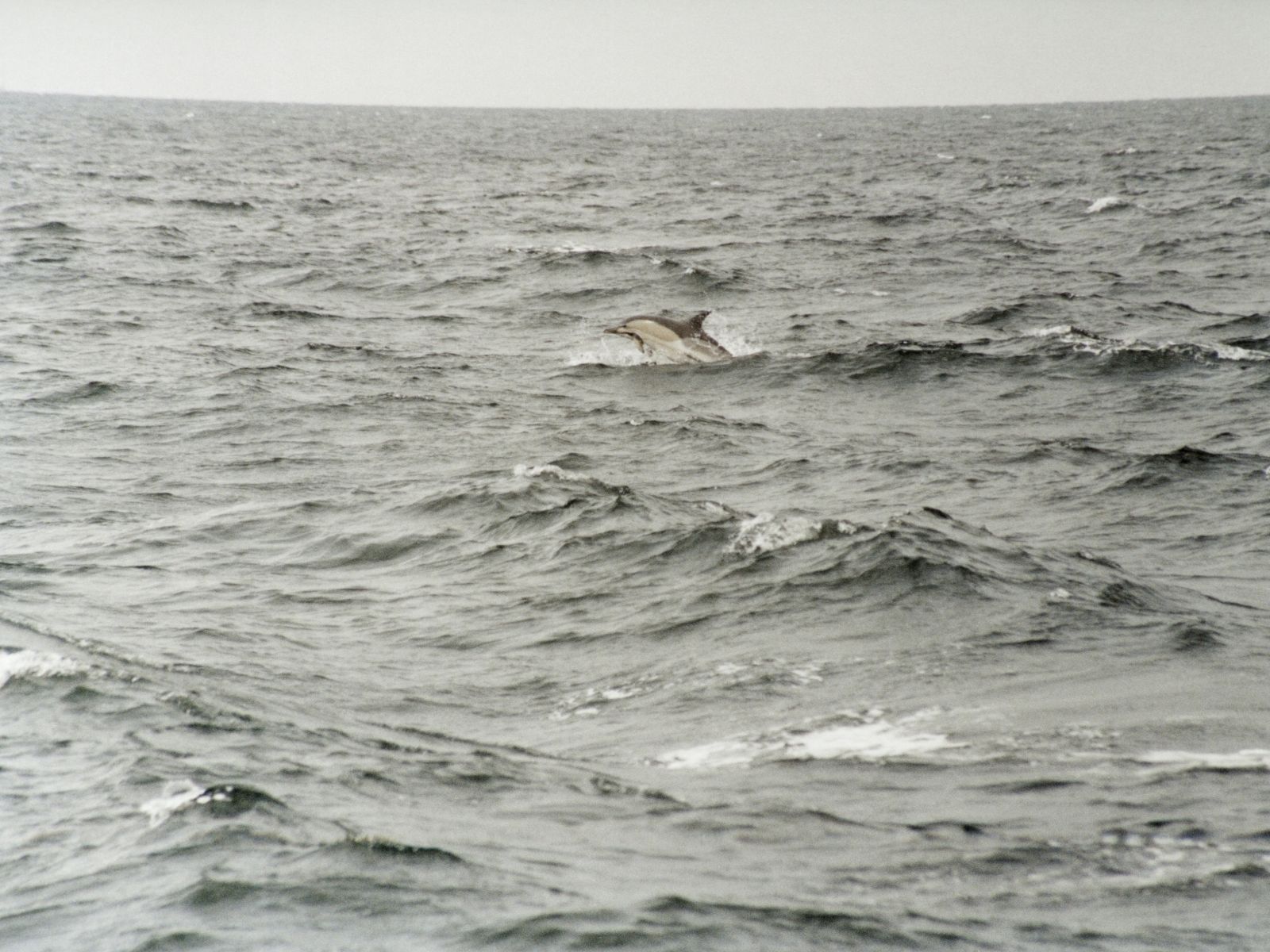
Short-beaked Common Dolphin
Delphinus delphis

2025 Red list status
Least Concern

Regional Population Trend
Unknown

Change compared
to 2016
No Change
Overview
Delphinus delphis – Linnaeus, 1758
ANIMALIA – CHORDATA – MAMMALIA – ARTIODACTYLA – DELPHINIDAE – Delphinus – delphis
Common Names: Common Dolphin (English), Gewone Dolfyn (Afrikaans)
Taxonomic Note:
Until recently, two globally distributed species in the genus were recognised: the Short-beaked Common Dolphin (Delphinus delphis) and the Long- beaked Common Dolphin (D. capensis) as described by Heyning and Perrin (1994). The morphological differences described between D. delphis and D. capensis in the North Pacific (Heyning & Perrin 1994) were supported by molecular evidence from both mitochondrial and nuclear markers (Rosel et al. 1994). However, the genus appears to exhibit much morphological variation globally and the criteria used to distinguish between the two species in the North Pacific may not necessarily apply elsewhere (Best 2007). Samaai et al. (2005) examined a number of morphometric characteristics for a sample of 72 Delphinus specimens from South Africa and found the majority of specimens belonging to D. capensis. However, two specimens, stranded along the West Coast, showed cranial characteristics that fell within the range of D. delphis from the North Pacific, suggesting that this species also occurs in South African waters. The results for a third specimen fell between the ranges for D. delphis and D. capensis, although closer to D. capensis (Samaai et al. 2005). Unfortunately, the same molecular markers as used for the two sympatric species in the North Pacific failed to reveal any genetic distinction between these described morphotypes in South Africa (Best 2007).
Cunha et al. (2015) in a global analysis of Delphinus, which included nine specimens from the West Coast (Southwestern Atlantic) of South Africa, concluded that all specimens analysed from the Atlantic Ocean belong to Delphinus delphis and that D. capensis is genetically an invalid species. However, no specimens from South Africa’s eastern coast were included in that analysis, and previous morphological evidence from South Africa’s east and south coast did support the existence of D. capensis in these regions (Jefferson & van Waerebeek 2002; Samaai et al. 2005). In another study, 296 skulls of Delphinus spp. were examined to investigate whether there were two species of this genus in South African waters. Both geometric morphometrics and the rostral index were used for this, and the majority of the specimens analysed exhibited characteristics of the long-beaked common dolphin (Ngqulana et al. 2019).
The non-concordance of morphological and genetic data for Common Dolphins results in much confusion and a more rigorous global revision is needed.
Red List Status: LC – Least Concern, (IUCN version 3.1)
Assessment Information
Assessors: Ngqulana, S.G.,1 Patel, T.2 & da Silva, J.M.3
Reviewer: Plön, S.4
Institutions: 1Port Elizabeth Museum at Bayworld, 2Endangered Wildlife Trust; 3South African National Biodiversity Institute, 4University of Cape Town
Previous Assessors: Plön, S. & Cockcroft, V.
Previous Reviewer: Child, M.F.
Previous Contributors: Relton, C. & Atkins, S.
Assessment Rationale
D. delphis lives offshore and exhibits naturally low sightings. However, there are no known major threats and thus the Least Concern listing remains. There are no estimates of population size for the species in the subregion. The assumed large population size, large extent of occurrence and area of occupancy, the minimal threats, plus the global status of Least Concern suggest this species is probably of Least Concern within South African waters. Ongoing molecular research should help to resolve its taxonomic status, and this species should be reassessed once further data are available.
Regional population effects: This is a wide-ranging and common species globally (Hammond et al. 2008), and thus rescue effects are possible.
Reasons for Change
Reason(s) for Change in Red List Category from the Previous Assessment: No change
Red List Index
Red List Index: No change
Recommended citations: Ngqulana SG, Patel T & da Silva JM. 2025. A conservation assessment of Delphinus delphis. In Patel T, Smith C, Roxburgh L, da Silva JM & Raimondo D, editors. The Red List of Mammals of South Africa, Eswatini and Lesotho. South African National Biodiversity Institute and Endangered Wildlife Trust, South Africa.
Regional Distribution and occurrence
Geographic Range
This is an oceanic species that is widely distributed in tropical to warm-temperate waters of all the major oceans (Perrin 2002), from nearshore waters to thousands of kilometres offshore.
Elevation / Depth / Depth Zones
Elevation Lower Limit (in metres above sea level): (Not specified)
Elevation Upper Limit (in metres above sea level): (Not specified)
Depth Lower Limit (in metres below sea level): (Not specified)
Depth Upper Limit (in metres below sea level): (Not specified)
Depth Zone: (Not specified)
Map
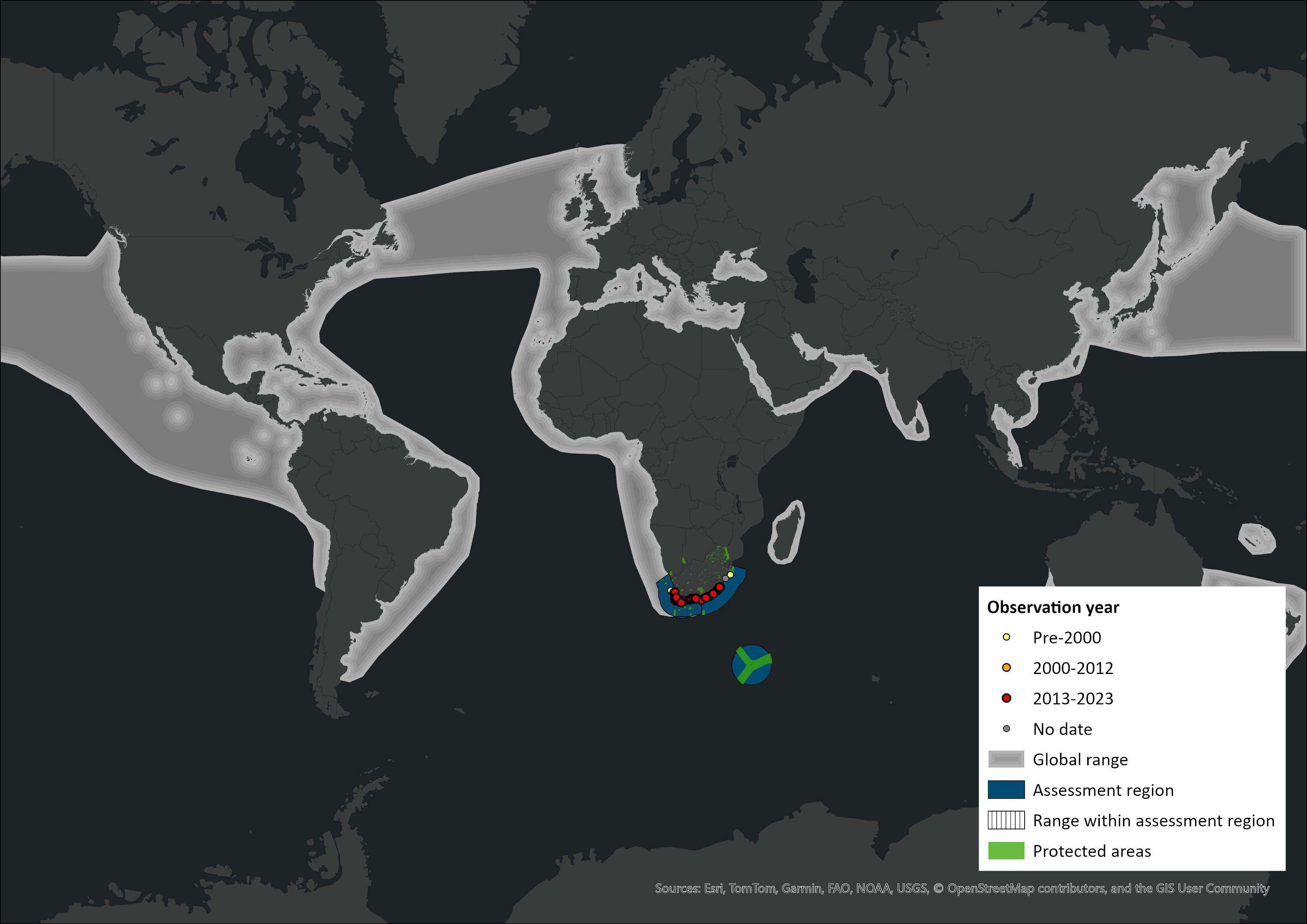 Figure 1. Distribution records for Common Dolphin (Delphinus delphis) within the assessment region (South Africa, Eswatini and Lesotho). Note that distribution data is obtained from multiple sources and records have not all been individually verified.
Biogeographic Realms
Biogeographic Realm: Afrotropical, Australasian, Indomalayan, Nearctic, Neotropical, Palearctic
Occurrence
Large Marine Ecosystems (LME) Occurrence
Large Marine Ecosystems: (Not specified)
Climate change
Climate change might exacerbate a loss or shift in prey base, especially because of its clumped distribution pattern globally. This in turn, will affect the distribution and feeding of Common Dolphins. If their habitat requirements are very specific with respect to water temperature (for example, thermocline and water temperature range), climate change effects may impact this species in the future.
Population
Globally, this is a very abundant species, with many available estimates for various areas where it occurs. However, no abundance estimates appear to exist for the assessment region, as very few records are available. Model-based estimates of generation time are 14.8 years (Taylor et al. 2007).
|
Continuing decline in mature individuals? |
Qualifier |
Justification |
|
Unknown |
– |
– |
Current population trend: Unknown
Extreme fluctuations in the number of subpopulations: (Not specified)
Continuing decline in number of subpopulations: (Not specified)
All individuals in one subpopulation: (Not specified)
Number of mature individuals in population: Unknown
Number of mature individuals in largest subpopulation: Unknown
Number of Subpopulations: Unknown
Severely fragmented: No
Quantitative Analysis
Probability of extinction in the wild within 3 generations or 10 years, whichever is longer, maximum 100 years: (Not specified)
Probability of extinction in the wild within 5 generations or 20 years, whichever is longer, maximum 100 years: (Not specified)
Probability of extinction in the wild within 100 years: (Not specified)
Population Genetics
While phylogenetic studies have been conducted with this species (e.g., Cunha et al. 2015, Ngqulana 2020), no population genetic studies have been undertaken. The phylogenetic studies support the collapse of D. capensis into D, delphis due to the lack of any genetic differentiation.
However, the different morphological forms likely suggest different subpopulations (a short-beaked and long-beaked form). Given that no subpopulations are thought to have gone extinct, the Convention on Biological Diversity’s Global Biodiversity Framework’s (GBF’s) complementary genetic indicator – proportion of populations maintained (PM). All populations remaining, would result in a PM indicator value of 1.0.
Similarly, the GBF’s headline genetic indicator – proportion of populations with an effective population size (Ne) > 500 – can be estimated to some degree based on the available information. Since the animals are considered very abundant, this can be interpreted as there being at least 10,000 individuals within the assessment region for the short-beaked form. If D. capensis is also collapsed into D. delphis, then the long-beaked form would exceed 15,000–20,000 individuals. Applying an Ne/Nc conversion ratio of 0.1-0.3 to both subpopulations would equate to an Ne between 1,000-3,000 for the short-beaked form and 1500- 6000 for the long-beaked form; both well above the Ne 500 threshold. The Ne 500 indicator value would then be 1.0 (2/2 subpopulations with Ne > 500). Just to note that this value would remain even if the long-beak form remains a separate species. The calculation would simply involve 1/1 populations with Ne> 500.
It is highly recommended that a population genetic study be conducted across the species range, incorporating D. capensis samples, to more accurately estimate the genetic indicators and better understand the overall genetic health and diversity in this species.
Habitats and ecology
Common Dolphins appear to have a preference for upwelling-modified waters, areas with steep sea floor relief, and extensive shelf areas, but they are widespread in warm temperate and tropical waters (Evans 1994). In the eastern tropical Pacific, they prefer equatorial and subtropical waters with a shallow thermocline, relatively large seasonal changes in surface temperature, and seasonal upwelling (Reilly 1990; Fiedler & Reily 1994).
Associations with other marine mammal species are common. Schools in the Eastern Tropical Pacific (ETP) are sometimes associated with Yellowfin Tuna (Thunnus albacares) and have thus been involved in tuna purse- seine fishing operations (Gerrodette 2002). Mixed-species groups of D. delphis, Stenella coeruleoalba (Striped Dolphins) and Grampus griseus (Risso’s Dolphins) have been observed frequently in the pelagic waters of the Gulf of Corinth, Greece (Frantzis & Herzing 2002). The prey of D. delphis consists largely of small schooling fishes and squids (Perrin 2002) and stomachs of two individuals from South Africa confirmed that, as mainly myctophids (97.1% by number) and squid (Loligo spp., 2.3% by number) were found (Best 2007). Chub mackerel (Scomber japonicus) was the dominant prey in 95 Common Dolphins sampled in KwaZulu-Natal, South Africa between 2000 and 2009, suggesting that Common Dolphins prey on locally abundant fish species which changes with the availability of the most abundant prey species (Ambrose et al. 2013).
Life History
Generation Length: (Not specified)
Age at Maturity: Female or unspecified: (Not specified)
Age at Maturity: Male: (Not specified)
Size at Maturity (in cms): Female: (Not specified)
Size at Maturity (in cms): Male: (Not specified)
Longevity: (Not specified)
Average Reproductive Age: (Not specified)
Maximum Size (in cms): (Not specified)
Size at Birth (in cms): (Not specified)
Gestation Time: (Not specified)
Reproductive Periodicity: (Not specified)
Average Annual Fecundity or Litter Size: (Not specified)
Natural Mortality: (Not specified)
Does the species lay eggs? (Not specified)
Does the species give birth to live young: (Not specified)
Does the species exhibit parthenogenesis: (Not specified)
Does the species have a free-living larval stage? (Not specified)
Does the species require water for breeding? (Not specified)
Movement Patterns
Movement Patterns: (Not specified)
Congregatory: (Not specified)
Systems
System: Marine
General Use and Trade Information
There is local opportunistic medicinal and food use of stranded animals.
|
Subsistence: |
Rationale: |
Local Commercial: |
Further detail including information on economic value if available: |
|
Yes |
– |
– |
– |
National Commercial Value: Yes
International Commercial Value: No
|
End Use |
Subsistence |
National |
International |
Other (please specify) |
|
1. Food – human |
true |
true |
– |
– |
|
2. Food – animal |
true |
true |
– |
– |
Is there harvest from captive/cultivated sources of this species? Yes
Harvest Trend Comments: (Not specified)
Threats
The Common Dolphin is one of the most prominent species in by-catch in fisheries around the world. Takes have been recorded in other purse-seine fisheries in the Indian Ocean and off the west coast of Africa (Simmons 1968). Best (2007) points out that there is potential for bycatch of the species in the midwater trawl fishery off South Africa and Namibia, so this threat should be investigated. Their offshore distribution within the region suggests that habitat loss from industrial activity along the coastline is not a major threat.
Conservation
The species is listed in Appendix II of the Convention on International Trade in Endangered Species of Wild Fauna and Flora (CITES) and Marine Living Resources Act (No. 18 of 1998). No conservation interventions are required for the assessment region at present.
Research priorities: The lack of knowledge regarding the abundance, distribution and seasonality of this species suggests that survey studies should be undertaken to determine the actual distribution of the species in local waters. Current research conducted by Port Elizabeth Museum and Nelson Mandela Metropolitan University is investigating the taxonomy of the species along the South African coast using material from stranded and incidentally bycaught animals. Once the taxonomy is resolved, life history studies (age, growth reproduction, diet) as well as research on habitat/niche requirements should be investigated to understand the potential impact of climate change. Threat assessments should be carried out.
Encouraged citizen actions:
- Use information dispensed by the South African Sustainable Seafood Initiative (SASSI) to make good choices when buying fish in shops and restaurants (for example, wwfsa.mobi), FishMS 0794998795.
- Save electricity and fuel to mitigate CO2 emissions and hence rate of climate change.
- Buy fresh produce that has been grown in pesticide-free environments.
- Buy local products that have not been shipped.
- Reduce boat speed in coastal environments and do not approach or chase dolphins in boats or skis.
- When participating in whale/dolphin watching tours, use only official tour operators and ensure regulations are upheld.
Bibliography
Ambrose, S.T., Froneman, P.W., Smale, M.J., Cliff, G. & Plön, S. 2013. Winter diet shift of long-beaked common dolphins (Dephinus capensis) feeding in the sardine run off KwaZulu-Natal, South Africa. Mar Biol, 160: 1543-1561.
Best PB. 2007. Whales and Dolphins of the Southern African Subregion. Cambridge University Press, Cape Town, South Africa.
Branch G, Griffiths C, Branch M, Beckley L. 2007. Two Oceans. A Guide to the Marine Life of Southern Africa. Struik Publishers, Cape Town, South Africa.
Cunha HA, de Castro RL, Secchi ER, Crespo EA, Lailson-Brito J, Azevedo AF, Lazoski C, Solé-Cava AM. 2015. Molecular and morphological differentiation of common dolphins (Delphinus spp.) in the southwestern Atlantic: testing the two species hypothesis in sympatry. PloS One 10:e0140251.
Evans W. 1994. Common dolphin, white-bellied porpoise Delphinus delphis Linneaus, 1758. Pages 191–224 in Ridgway SH, Harrison R, editors. Handbook of Marine Mammals. Volume 5: The First Book of Dolphins. Academic Press. New York, New York, USA.
Fiedler P., Reily S. 1994. Interannual variability of dolphin habitats in the eastern tropical Pacific. I: Research vessel surveys, 1986– 1990. Fishery Bulletin 92:460–489.
Frantzis A, Herzing DL. 2002. Mixed-species associations of striped dolphins (Stenella coeruleoalba), short-beaked common dolphins (Delphinus delphis), and Risso’s dolphins (Grampus griseus) in the Gulf of Corinth (Greece, Mediterranean Sea).
Aquatic Mammals 28:188–197.
Gerrodette T. 2002. Tuna-dolphin issue. Pages 1269–1273 in Perrin WF, Wursig B, Thewissen JGM, editors. Encyclopedia of Marine Mammals. Academic Press, San Diego, California, USA.
Hammond PS, et al. 2008. Delphinus delphis. The IUCN Red List of Threatened Species 2008: e.T6336A12649851.
Heyning JE, Perrin WF. 1994. Evidence for two species of common dolphins (genus Delphinus) from the eastern North Pacific. Natural History Museum of Los Angeles County, Contributions in Science 442:1–35.
IUCN (International Union for Conservation of Nature). 2012. Delphinus delphis. The IUCN Red List of Threatened Species. Version 3.1. http://www.iucnredlist.org. Downloaded on 21 February 2016.
Jefferson TA, van Waerebeek K. 2002. The taxonomic status of the nominal dolphin species Delphinus tropicalis van Bree, 1971. Marine Mammal Science 18:787–818.
Ngqulana, SG., Plön, S., Galatius, A., Pistorius, P. & Hofmeyr, GJG. 2019. Cranial variation in common dolphins Delphinus spp. off South Africa, with the inclusion of information from the holotype of Delphinus capensis. African Journal of Marine Science 41(3): 247-260. https://doi.org/10.2989/1814232X.2019.1648318.
Perrin WF. 2002. Common dolphins Delphinus delphis, D. capensis, and D. tropicalis. Pages 245–248 in Perrin WF, Würsig B, Thewissen JGM, editors. Encyclopedia of Marine Mammals. Academic Press, San Diego, California, USA.
Reilly SB. 1990. Seasonal changes in distribution and habitat differences among dolphins in the eastern tropical Pacific. Marine Ecology Progress Series 66:1–11.
Rosel PE, Dizon AE, Heyning JE. 1994. Genetic analysis of sympatric morphotypes of common dolphins (genus Delphinus). Marine Biology 119:159–167.
Samaai T, Best PB, Gibbons MJ. 2005. The taxonomic status of common dolphins Delphinus spp. in South African waters. African Journal of Marine Science 27:449–458.
Simmons DC. 1968. Purse seining off Africa’s west coast. Commercial Fisheries Review 30:21–22.
Taylor BL, Chivers SJ, Larese J, Perrin WF. 2007. Generation length and percent mature estimates for IUCN assessments of cetaceans. Administrative Report LJ-07-01. Southwest Fisheries Science Center, USA.