

Shepherd’s Beaked Whale
Tasmacetus shepherdi

2025 Red list status
Data Deficient

Regional Population Trend
Unknown

Change compared
to 2016
Not previously evaluated
Overview
Tasmacetus shepherdi – Oliver, 1937
ANIMALIA – CHORDATA – MAMMALIA – ARTIODACTYLA – ZIPHIIDAE – Tasmacetus – shepherdi
Common Names: Shepherd’s Beaked Whale (English), Ballena Picuda De Shepherd (Spanish; Castilian), Tasmacète (French), Tasman Beaked Whale (English), Tasman Whale (English)
Synonyms: No Synonyms
Red List Status: DD – Data Deficient, (IUCN version 3.1)
Assessment Information
Assessor: Purdon, J.1,2
Reviewer: Smith, C.3
Institutions: 1TUT Nature Conservation, 2Whale Unit, University of Pretoria, 3Endangered Wildlife Trust
Previous Assessors: Taylor, B.L., Baird, R., Barlow, J., Dawson, S.M., Ford, J., Mead, J.G., Notarbartolo di Sciara, G., Wade, P. & Pitman, R.L.
Previous Reviewers: Hammond, P.S. & Perrin, W.
Assessment Rationale
There is no information on abundance and no information on trends in global abundance for this species. As a relatively uncommon species it is potentially vulnerable to low-level threats and a 30% global reduction over three generations cannot be ruled out (criterion A). However, this species is currently listed as Data Deficient and should be reassessed once more information becomes available.
Reasons for Change
Reason(s) for Change in Red List Category from the Previous Assessment: Previously Not Evaluated
Red List Index
Red List Index: (Not specified)
Recommended citation: Purdon J. 2025. A conservation assessment of Tasmacetus shepherdi. In Patel T, Smith C, Roxburgh L, da Silva JM & Raimondo D, editors. The Red List of Mammals of South Africa, Eswatini and Lesotho. South African National Biodiversity Institute and Endangered Wildlife Trust, South Africa.
Regional Distribution and occurrence
Geographic Range
Shepherd’s Beaked Whales are primarily known from a few dozen strandings, all south of 30°S, around New Zealand, southern Australia, southern South America, the Juan Fernandez Islands, and Tristan de Cunha (Mead 1989). There have been 24 confirmed live sightings in the circumpolar region (Towers & Tixia 2022), with many of them from southeast Australia, New Zealan and Tristan da Cunha. The majority of strandings have occurred in New Zealand. It is presumed that they have a circumpolar distribution in cold temperate waters of the Southern Hemisphere (MacLeod et al. 2006). It is possible that the species may be somewhat more widespread than the records suggest, since it was not likely to be accurately identified at sea until its recent re-description (Pitman et al. 2006).
Elevation / Depth / Depth Zones
Elevation Lower Limit (in metres above sea level): (Not specified)
Elevation Upper Limit (in metres above sea level): (Not specified)
Depth Lower Limit (in metres below sea level): (Not specified)
Depth Upper Limit (in metres below sea level): (Not specified)
Depth Zone: (Not specified)
Map
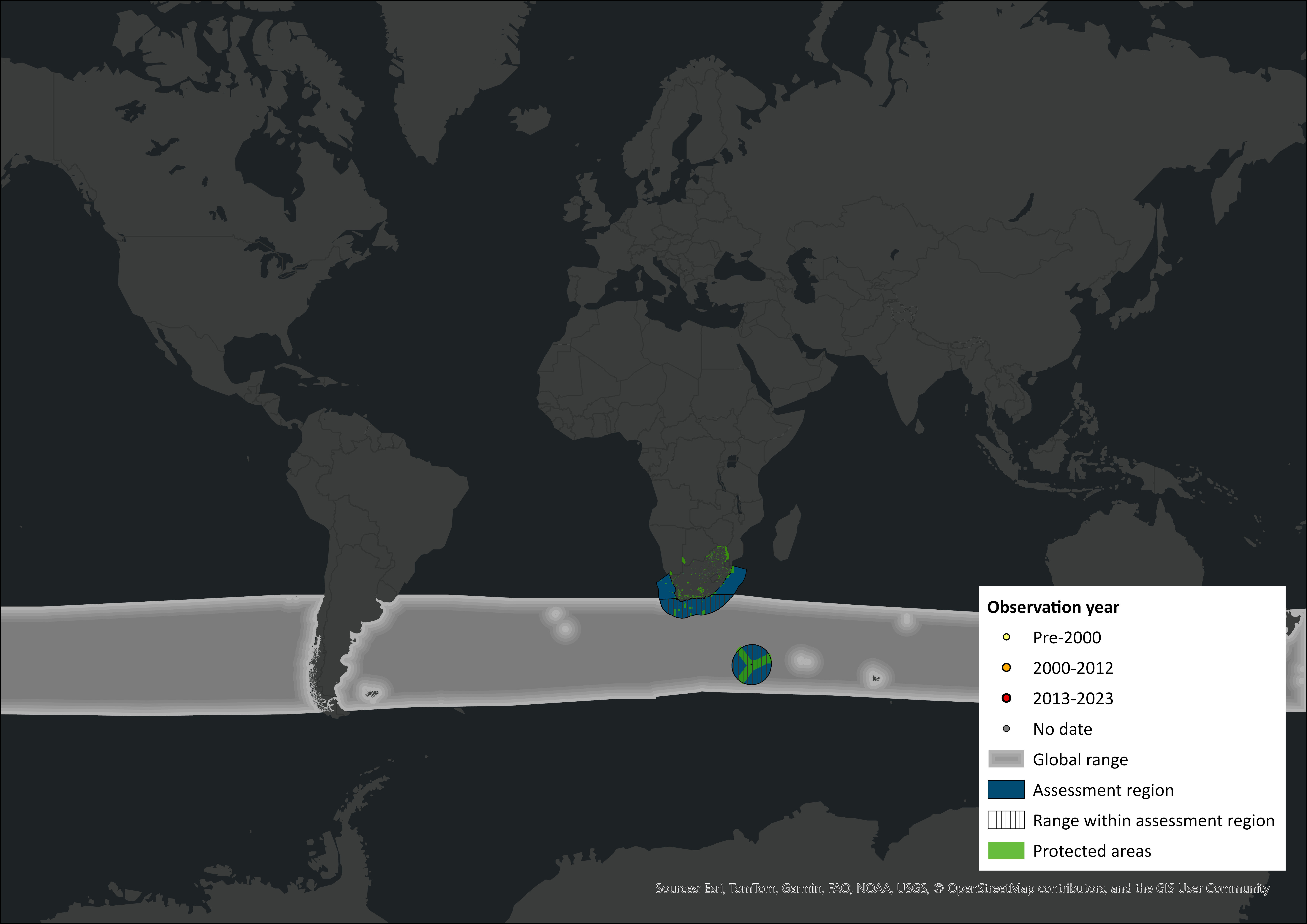 Figure 1. Distribution records for Shepherd’s Beaked Whale (Tasmacetus shepherdi) within the assessment region (South Africa, Eswatini and Lesotho). Note that distribution data is obtained from multiple sources and records have not all been individually verified.
Biogeographic Realms
Biogeographic Realm: Afrotropical, Australasian, Neotropical
Occurrence
Countries of Occurrence
| Country | Presence | Origin | Formerly Bred | Seasonality |
| Argentina | Extant | Native | – | – |
| Australia | Extant | Native | – | – |
| Chile | Extant | Native | – | – |
| Chile -> Juan Fernández Is. | Extant | Native | – | – |
| New Zealand | Extant | Native | – | – |
| New Zealand -> Chatham Is. | Extant | Native | – | – |
| New Zealand -> North Is. | Extant | Native | – | – |
| New Zealand -> South Is. | Extant | Native | – | – |
| Saint Helena, Ascension and Tristan da Cunha | Extant | Native | – | – |
| Saint Helena, Ascension and Tristan da Cunha -> Tristan da Cunha | Extant | Native | – | – |
| South Africa | Extant | Native | – | – |
| Uruguay | Presence Uncertain | Native | – | – |
Large Marine Ecosystems (LME) Occurrence
Large Marine Ecosystems: (Not specified)
FAO Area Occurrence
| Presence | Origin | Formerly Bred | Seasonality | |
| 41. Atlantic – southwest | Extant | Native | – | – |
| 57. Indian Ocean – eastern | Extant | Native | – | – |
| 81. Pacific – southwest | Extant | Native | – | – |
| 87. Pacific – southeast | Extant | Native | – | – |
Climate change
Since there is little to no information regarding the distribution, feeding ecology and reproductive behaviour of Shepard’s Beaked Whales (Best 2007), it is hard to determine the effect of climate change on this species. However, there are a few generalisations for these circumpolar species that can be made from the literature. Prey availability will almost certainly decrease which will lead to habitat loss forcing cetaceans to move to potentially better feeding grounds. Shepard’s Beaked Whales’ habitat will probably move further poleward to where water temperatures are cooler, ultimately reducing their preferred habitat area. The melting of ice in the poles will also increase land-based runoff leading to higher levels of contaminates in the marine ecosystem. This will ultimately have an impact on the species overall health (Kebke et al. 2022). Cumulatively these impacts could have a dire impact on Shepard’s Beaked Whale population. With the paucity of data on these species the true effect of climate change will be difficult to determine.
Population information
Shepherd’s Beaked Whale appears to be relatively rare, but there are no estimates of abundance available. The external appearance of the species was not well-known until it was re-described from several fresh specimens and at-sea sightings; this could lead to further refinement about its distribution and abundance (Pitman et al. 2006).
| Continuing decline in mature individuals? | Qualifier | Justification |
| – | Suspected | – |
Extreme fluctuations in the number of subpopulations: (Not specified)
| Continuing decline in number of subpopulations | Qualifier | Justification |
| – | Suspected | – |
All individuals in one subpopulation: (Not specified)
Number of mature individuals in largest subpopulation: (Not specified)
Number of Subpopulations: (Not specified)
Quantitative Analysis
Probability of extinction in the wild within 3 generations or 10 years, whichever is longer, maximum 100 years: (Not specified)
Probability of extinction in the wild within 5 generations or 20 years, whichever is longer, maximum 100 years: (Not specified)
Probability of extinction in the wild within 100 years: (Not specified)
Population genetics
A database of mitochondrial DNA sequences has been compiled for all known species of beaked whale, making it possible to reliably assign individual animals to a particular species. However, this or other data have not been used to study the population genetic structure within the species. While little information exists on its distribution, it is likely the species exists as a single population within the assessment region, most likely genetically connected to other populations in the southern hemisphere. Unfortunately, no information is available on its effective population size (Ne), nor can Ne be inferred from population estimates given the lack of this information.
Habitats and ecology
This species generally lives mainly far offshore, well away from coasts; however, where there is a narrow continental shelf, T. shepherdi may sometimes occur in deep water close to shore.
Shepherd’s Beaked Whales are known to feed on several species of fish (primarily eelpouts), as well as squid and crabs, possibly near the bottom in deep waters. This seems somewhat unusual, as most beaked whales appear to feed almost exclusively on cephalopods (Best 2007, Best et al. 2012). Identification of stomach contents of a beaked whale on Tristan da Cunha Island revealed that there were at least 13 cephalopod species, and 8 fish species identified.
IUCN Habitats Classification Scheme
| Habitat | Season | Suitability | Major Importance? |
| 10.1. Marine Oceanic -> Marine Oceanic – Epipelagic (0-200m) | – | Marginal | – |
| 10.2. Marine Oceanic -> Marine Oceanic – Mesopelagic (200-1000m) | – | Suitable | Yes |
| 10.3. Marine Oceanic -> Marine Oceanic – Bathypelagic (1000-4000m) | – | Suitable | Yes |
Life History
Generation Length: (Not specified)
Age at Maturity: Female or unspecified: (Not specified)
Age at Maturity: Male: (Not specified)
Size at Maturity (in cms): Female: (Not specified)
Size at Maturity (in cms): Male: (Not specified)
Longevity: (Not specified)
Average Reproductive Age: (Not specified)
Maximum Size (in cms): (Not specified)
Size at Birth (in cms): (Not specified)
Gestation Time: (Not specified)
Reproductive Periodicity: (Not specified)
Average Annual Fecundity or Litter Size: (Not specified)
Natural Mortality: (Not specified)
Breeding Strategy
Does the species lay eggs? No
Does the species give birth to live young: Yes
Does the species exhibit parthenogenesis: No
Does the species have a free-living larval stage? No
Does the species require water for breeding? Yes
Movement Patterns
Movement Patterns: (Not specified)
Congregatory: (Not specified)
Systems
System: Marine
General Use and Trade Information
General notes regarding trade and use of this species: (Not specified)
Local Livelihood: (Not specified)
National Commercial Value: (Not specified)
International Commercial Value: (Not specified)
End Use: (Not specified)
Is there harvest from captive/cultivated sources of this species? (Not specified)
Harvest Trend Comments: (Not specified)
Threats
No major threats are known for this species. As is true for most of the beaked whales, this species has never been hunted and fisheries interactions are not known. Evidence from stranded individuals of T. shepherdi indicated that they had swallowed discarded plastic items, which may eventually lead to death (e.g. Scott et al. 2001). This species, like other beaked whales, is likely to be vulnerable to loud anthropogenic sounds, such as those generated by navy sonar and seismic exploration (Cox et al. 2006). Predicted impacts of global climate change on the marine environment may affect this species of whale, although the nature of impacts is unclear (Learmonth et al. 2006).
Conservation
The species is listed on Appendix II of CITES. Research is needed to assess the impacts of potential threats on this species.
Bibliography
Balcomb, K.C. and Claridge, D.E. 2001. A mass stranding of cetaceans caused by naval sonar in the Bahamas. Bahamas Journal of Science 8(2): 2-12.
Cox, T.M., Ragen, T.J., Read, A.J., Vos, E., Baird, R.W., Balcomb, K., Barlow, J., Caldwell, J., Cranford, T., Crum, L., D’Amico, A., D’Spain, A., Fernández, J., Finneran, J., Gentry, R., Gerth, W., Gulland, F., Hildebrand, J., Houser, D., Hullar, T., Jepson, P.D., Ketten, D., Macleod, C.D., Miller, P., Moore, S., Mountain, D., Palka, D., Ponganis, P., Rommel, S., Rowles, T., Taylor, B., Tyack, P., Wartzok, D., Gisiner, R., Mead, J. and Benner, L. 2006. Understanding the impacts of anthropogenic sound on beaked whales. Journal of Cetacean Research and Management 7(3): 177-187.
Kebke, A., Samarra, F. and Derous, D., 2022. Climate change and cetacean health: impacts and future directions. Philosophical Transactions of the Royal Society B, 377(1854), p.20210249.
Fernández, A., Edwards, J. F., Rodriguez, F., Espinosa, A., De Los Monteros, Herraez, P., Castro, P., Jaber, J. R., Martin, V. and Arebelo, M. 2005. “Gas and fat embolic syndrome” involving a mass stranding of beaked whales (family Ziphiidae) exposed to anthropogenic sonar signals. Veterinary Pathology 42: 446-457.
Gomercic, H., Gomercic, M. D., Gomericic, T., Lucic, H., Dalebout, M., Galov, A., Skrtic, D., Curkovic, S., Vukovic, S. and Huber, D. 2006. Biological aspects of Cuvier’s beaked whale (Ziphius cavirostris) recorded in the Croatian part of the Adriatic Sea. European Journal of Wildlife Research 52(3): 182-187.
Jepson, P.D., Arebelo, M., Deaville, R., Patterson, I.A.P., Castro, P., Baker, J.R., Degollada, E., Ross, H.M., Herraez, P., Pocknell, A.M., Rodriguez, F., Howie, F.E., Espinosa, A., Reid, R.J., Jaber, J.R., Martin, V., Cunningham, A.A. and Fernandez, A. 2003. Gas-bubble lesions in stranded cetaceans. Nature 425: 575-576.
Learmonth, J.A., Macleod, C.D., Santos, M.B., Pierce, G.J., Crick, H.Q.P. and Robinson, R.A. 2006. Potential effects of climate change on marine mammals. Oceanography and Marine Biology: An Annual Review 44: 431-464.
Macleod, C. D., Perrin, W. F., Pitman, R. L., Barlow, J., Balance, L., D’amico, A., Gerrodette, T., Joyce, G., Mullin, K. D., Palka, D. L. and Waring, G. T. 2006. Known and inferred distributions of beaked whale species (Ziphiidae: Cetacea). Journal of Cetacean Research and Management 7(3): 271-286.
Malakoff, D. 2002. Suit ties whale deaths to research cruise. Science 298: 722-723.
Mead, J. G. 1989. Shepherd’s beaked whale Tasmacetus shepherdi Olivier, 1937. In: S. H. Ridgway and R. Harrison (eds), Handbook of marine mammals, Vol. 4: River dolphins and the larger toothed whales, pp. 309-320. Academic Press.
Pitman, R. L., Van Helden, A. L., Best, P. B. and Pym, A. 2006. Shepherd’s beaked whale (Tasmacetus shepherdi): Information on appearance and biology based on strandings and at-sea observations. Marine Mammal Science 22(3): 744-755.
Scott, M. D., Hohn, A. A., Westgate, A. J., Nicolas, J. R., Whitaker, B. R. and Campbell, W. B. 2001. A note on the release and tracking of a rehabilitated pygmy sperm whale (Kogia breviceps). Journal of Cetacean Research and Management 3(1): 87-94.
Towers, J.R. and Tixier, P., 2022. Indian Ocean sighting of Shepherd’s beaked whale (Tasmacetus shepherdi) helps confirm circumpolar distribution in Southern Hemisphere. Aquatic Mammals, 48(5), pp.462-467.
Wang, J.Y. and Yang, S.C. 2006. Unusual cetacean stranding events of Taiwan in 2004 and 2005. Journal of Cetacean Research and Management 8: 283-292.