
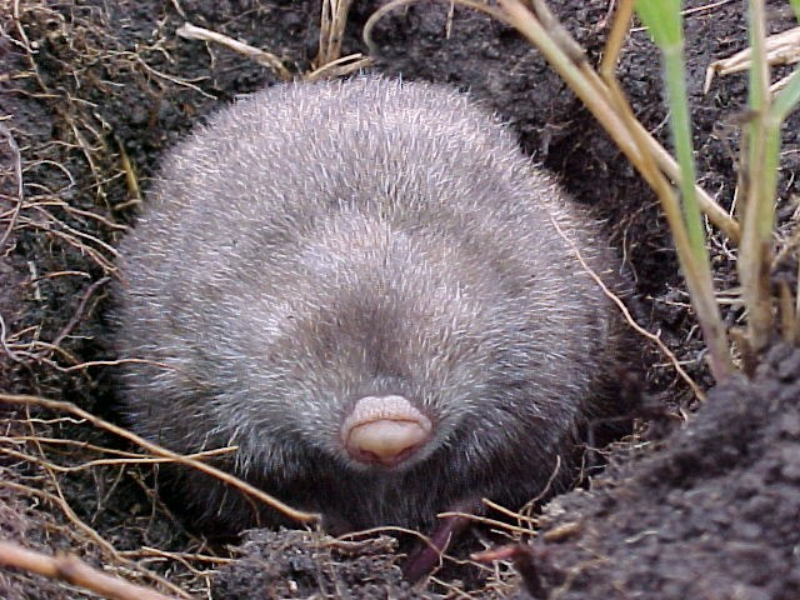
Rough-haired Golden Mole
Chrysospalax villosus

2025 Red list status
Vulnerable

Regional Population Trend
Unknown

Change compared
to 2016
No Change
Overview
Chrysospalax villosus – (A. Smith, 1833)
ANIMALIA – CHORDATA – MAMMALIA – AFROSORICIDA – CHRYSOCHLORIDAE – Chrysospalax – villosus
Common Names: Rough-haired Golden Mole (English), Grasveldgouemol, Grofhaarkruipmol (Afrikaans)
Synonyms: No Synonyms
Taxonomic Note:
Meester (1974) listed six subspecies distinguished mainly by subtle differences in pelage colour: villosus, transvaalensis, leschae, dobsoni, rufopallidus and rufus. The validity of these subspecies is uncertain (Bronner and Jenkins 2005, Bronner 2013).
Red List Status: VU – Vulnerable, B2ab(ii,iii,iv) (IUCN version 3.1)
Assessment Information
Assessors: Patel, T.1 & da Silva, J.2
Reviewer: Mynhardt, S.1
Institutions: 1Endangered Wildlife Trust, 2South African Biodiversity Institute
Previous Assessors & Reviewers: Bronner, G. & Asher, R.
Previous Contributors: Taylor, A., Relton, C. & Child, M.F.
Assessment Rationale
While the extent of occurrence of this species appears large (> 20,000 km2), it has very specific habitat requirements and has been recorded from only 11 locations. Based on recent field surveys it no longer occurs at three of these, as its preferred natural grassland habitats have vanished under urban sprawl (especially in Gauteng around Pretoria, and KwaZulu-Natal around Pietermaritzburg). Known locations are scattered far apart suggesting possible fragmentation into numerous subpopulations with little gene flow. Even at sites where this species occurs it is uncommon, suggesting that population densities are low. Its total area of occupancy is estimated at 128 km2. Many of the sites at which this species was collected historically have been transformed by agricultural practices and other anthropogenic activities. The widespread practice of ranchers allowing livestock to graze in wetlands and grasslands near waterbodies during the dry winter months leads to trampling of vegetation and a loss of cover, which undoubtedly impacts this species negatively as these are its preferred habitats and it is known to spend at least some time foraging above ground. Likewise, overgrazing and the frequent (often annual) burning of pasturelands in areas where this species occurs surely reduce resources (cover and invertebrates) that local populations rely on (Bronner 2013). In Mpumalanga the Highveld grasslands favoured by this species have been severely impacted by open-cast coal mining to fuel the South African power station hub; this, together with associated industrial activities, rapid spread of local towns, and increasing human population pressures are likely threats at many locations. Other threats include the widespread use of pesticides during agro-industrial farming and the loss of habitat to agro-industrial plantations (diminishing but historically acute).
Due to uncertain levels of fragmentation, the status of this species potentially ranges between Vulnerable and Endangered. An AOO of 128 km² meets the requirement for endangered status, but only one of the three necessary criteria is clearly met (B2bii, iii). Criteria B2a can only be met if severe fragmentation occurs (number of locations is > 5), and this is not known. Taking a slightly evidentiary approach, this species is listed as Vulnerable under criteria B2a + B2b(ii,iii) (given its restricted area of occupancy, probable decline in number of locations and area/extent/quality of suitable habitat with only six locations where its presence is still certain, and the persistent, varied threats to the population across its entire range). Should the number of known locations decline further or if evidence arises of severe fragmentation, it will clearly qualify for Endangered status. Further field surveys are thus urgently required.
Reasons for Change
Reason(s) for Change in Red List Category from the Previous Assessment: No change
Red List Index
Red List Index: No change
Recommended citation: Patel T & da Silva JM. 2025. A conservation assessment of Chrysospalax villosus. In Patel T, Smith C, Roxburgh L, da Silva JM & Raimondo D, editors. The Red List of Mammals of South Africa, Eswatini and Lesotho. South African National Biodiversity Institute and Endangered Wildlife Trust, South Africa.
Regional Distribution and occurrence
Geographic Range
This species has a disjunct distribution in South Africa, being recorded historically only from scattered localities in Eastern Cape, KwaZulu-Natal, Gauteng and Mpumalanga; and recently in Gauteng (Gauteng Department of Agricultural and Rural Development, unpubl. data) and Mpumalanga (L. Cohen, Mpumalanga Parks and Tourism Agency unpubl. data) (Figure 1). The species is possibly now locally extinct at some localities, such as Tsolo, Eastern Cape (type locality, never subsequently found there), and urban areas around Pretoria (Pretoria West, Lynwood Glen) and Scottsville (Pietermaritzburg) where intensive urbanization has destroyed all natural habitat.
Area of Occupancy (AOO)
| Estimated area of occupancy (AOO) – in km2 | Justification |
| 128 | Based on a grid cell area of 16km2 |
| Continuing decline in area of occupancy (AOO) | Qualifier | Justification |
| Yes | Inferred | Suspected |
Extent of Occurrence (EOO)
| Estimated extent of occurrence (EOO)- in km2 | EOO estimate calculated from Minimum Convex Polygon | Justification |
| 20000 | – | MCP estimate |
Locations Information
| Number of Locations | Justification |
| 6-8 | 6 currently confirmed but possibly 8 based on historical records, excluding 3 where radical habitat alteration has clearly extirpated this species. |
| Continuing decline in number of locations | Qualifier | Justification |
| Yes | Inferred | Suspected |
Very restricted AOO or number of locations (triggers VU D2)
| Very restricted in area of occupancy (AOO) and/or # of locations | Justification |
| No | – |
Elevation / Depth / Depth Zones
Elevation Lower Limit (in metres above sea level): (Not specified)
Elevation Upper Limit (in metres above sea level): (Not specified)
Depth Lower Limit (in metres below sea level): (Not specified)
Depth Upper Limit (in metres below sea level): (Not specified)
Depth Zone: (Not specified)
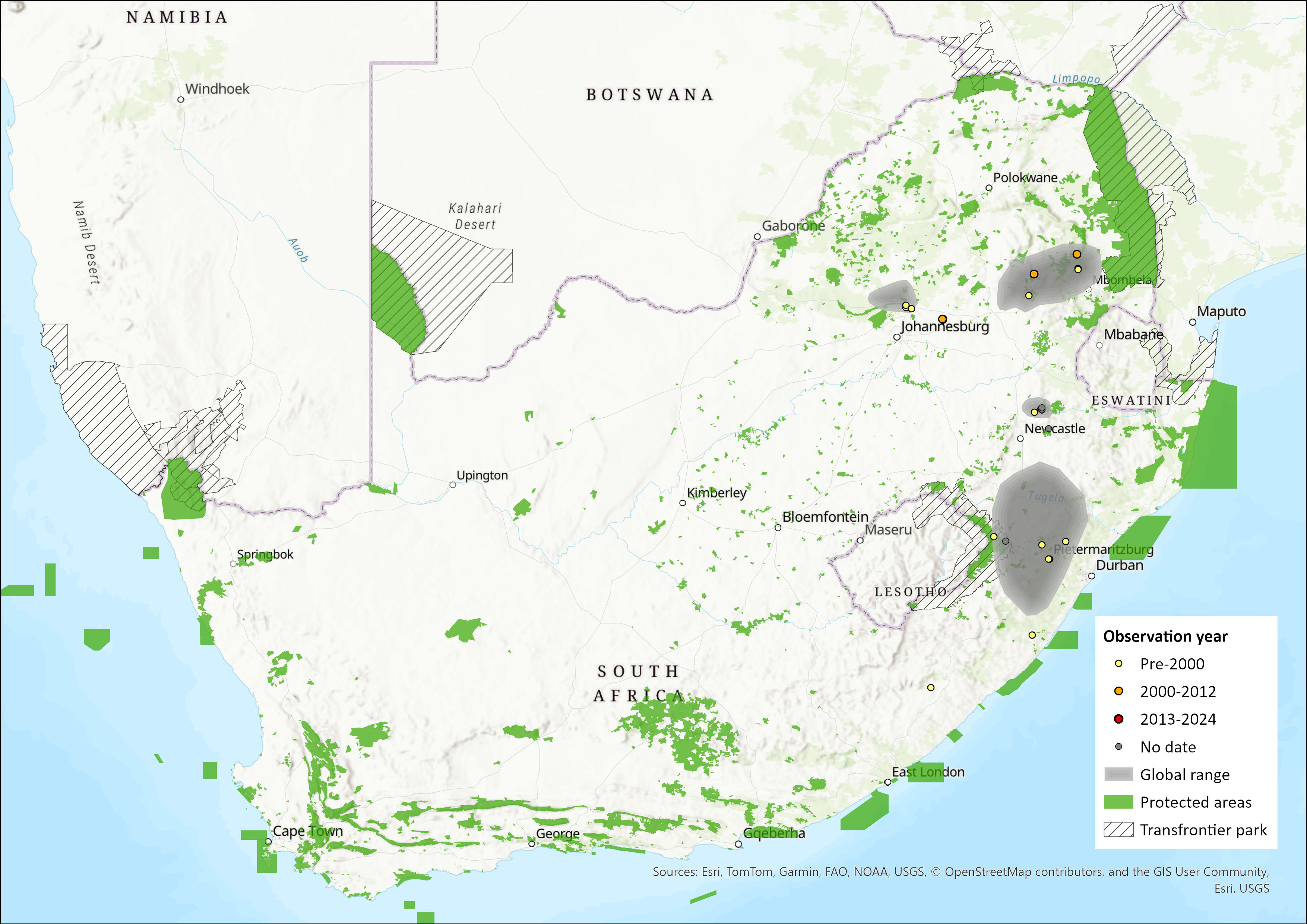
Figure 1. Distribution records for Rough-haired Golden Mole (Chrysospalax villosus) within the assessment region (South Africa, Eswatini and Lesotho). Note that distribution data is obtained from multiple sources and records have not all been individually verified.
Biogeographic Realms
Biogeographic Realm: Afrotropical
Occurrence
Countries of Occurrence
| Country | Presence | Origin | Formerly Bred | Seasonality |
| South Africa | Extant | Native | – | Resident |
| South Africa -> Eastern Cape Province | Extant | Native | – | Resident |
| South Africa -> Gauteng | Extant | Native | – | Resident |
| South Africa -> KwaZulu-Natal | Extant | Native | – | Resident |
| South Africa -> Mpumalanga | Extant | Native | – | Resident |
Large Marine Ecosystems (LME) Occurrence
Large Marine Ecosystems: (Not specified)
FAO Area Occurrence
FAO Marine Areas: (Not specified)
Climate change
Although the potential impacts of climate change on this species have not been directly assessed, climate change is expected to impact most golden mole species. Since these subterranean animals are restricted to soft soils for burrowing, and have very low vagility, their ability to migrate or shift their distribution ranges in response to climate change is very limited. Climate change is likely to impact golden moles through changes in vegetation type, soil moisture and prey availability.
Population information
This species is extremely rare and secretive. Only three specimens have been collected since 1980 (Bronner 2013). They are difficult to detect owing to their preference for areas with sandy soils and dense vegetation cover.
Current population trend: Unknown, but probably declining.
Continuing decline in mature individuals: Unknown
Number of mature individuals in population: Unknown
Number of mature individuals in largest subpopulation: Unknown
Number of subpopulations: Unknown, but continuing decline in number of subpopulations is inferred based on ongoing habitat loss in grasslands.
Severely fragmented: Unknown but suspected based on existing information where more than half of the individuals (or, more than half of the occupied habitat area) are in isolated patches.
| Continuing decline in number of subpopulations | Qualifier | Justification |
| Yes | Inferred | Suspected |
Quantitative Analysis
Probability of extinction in the wild within 3 generations or 10 years, whichever is longer, maximum 100 years: (Not specified)
Probability of extinction in the wild within 5 generations or 20 years, whichever is longer, maximum 100 years: (Not specified)
Probability of extinction in the wild within 100 years: (Not specified)
Population genetics
No population genomic study has been conducted on this species to clearly understand the population structure and diversity within it; however, based on the known distribution at present, the species is believed to exist as six (possibly eight) geographically isolated, and likely genetically distinct subpopulations. Three subpopulations where they formerly occurred (e.g., Tshwane (Pretoria) West) have been completely transformed by urbanisation and industrialisation, and hence the species is thought to be extirpated from these areas. Recent surveys confirmed signs of their presence only at three sites in KZN Midlands, and three in Mpumalanga, therefore it is possible that the northwestern (Pretoria) subpopulation may already be lost. A molecular study is needed to verify this, and would be instrumental in assessing the validity of the proposed subspecies.
Based on the available information, one of the two population genetic indicators in the Convention on Biological Diversity’s Global Biodiversity Framework can be quantified – the proportion of populations maintained within species. With at least six populations known and three extinct, this indicator receives a value of 0.67 (six of nine population remaining).
Due to the lack of data on population size or density, an estimate of effective population size is not possible.
Habitats and ecology
The Rough-haired Golden Mole occurs in sandy soils in grasslands, meadows and along edges of marshes in Savannah and Grassland biomes of South Africa. Some specimens have been recorded from gardens and parklands, and also in dense stands of Kikuyu Grass (Pennisetum clandestinum) and marginally on golf courses adjoining natural grasslands. Unlike other golden mole species, C. villosus presumably does not make subsurface runs, but rather excavates burrows and lives in chambers, emerging most commonly after rainfall events (Roberts 1951; G.N. Bronner unpubl. data). They feed on insects and earthworms.
IUCN Habitats Classification Scheme
| Habitat | Season | Suitability | Major Importance? |
| 3.4. Shrubland -> Shrubland – Temperate | Resident | Marginal | – |
| 4.4. Grassland -> Grassland – Temperate | Resident | Suitable | Yes |
| 14.1. Artificial/Terrestrial -> Artificial/Terrestrial – Arable Land | Resident | Marginal | – |
| 14.2. Artificial/Terrestrial -> Artificial/Terrestrial – Pastureland | Resident | Marginal | – |
| 14.4. Artificial/Terrestrial -> Artificial/Terrestrial – Rural Gardens | Resident | Marginal | – |
Life History
Generation Length: (Not specified)
Age at Maturity: Female or unspecified: (Not specified)
Age at Maturity: Male: (Not specified)
Size at Maturity (in cms): Female: 13-16
Size at Maturity (in cms): Male: 15-18
Longevity: (Not specified)
Average Reproductive Age: (Not specified)
Maximum Size (in cms): (Not specified)
Size at Birth (in cms): (Not specified)
Gestation Time: (Not specified)
Reproductive Periodicity: (Not specified)
Average Annual Fecundity or Litter Size: Litter size = 2
Natural Mortality: (Not specified)
Breeding Strategy
Does the species lay eggs? No
Does the species give birth to live young? Yes
Does the species exhibit parthenogenesis? No
Does the species have a free-living larval stage? No
Does the species require water for breeding? No
Movement Patterns
Movement Patterns: (Not specified)
Congregatory: (Not specified)
Systems
System: Terrestrial
General Use and Trade Information
General notes regarding trade and use of this species: This species is not known to be traded or utilised in any form.
Local Livelihood: (Not specified)
National Commercial Value: (Not specified)
International Commercial Value: (Not specified)
End Use: (Not specified)
Is there harvest from captive/cultivated sources of this species? (Not specified)
Harvest Trend Comments: (Not specified)
Threats
The major threats are habitat alteration as a result of mining and power generation, ecologically poor agricultural practices and urbanisation, and habitat degradation associated with mining for shallow coal deposits to fuel numerous power stations that occur in the high-altitude grassland habitats in the northern parts of this species’ range. Rehabilitation attempts at these sites have proved largely ineffective. These power stations form the backbone of South Africa’s electricity network, and disturbance is likely to increase as human populations grow and the demand for power increases. The widespread practice of allowing cattle to graze in marshes and dense grasslands near water during dry winter months leads to trampling and a loss of cover, and this undoubtedly impacts severely on this species; likewise, ranchers often burn such areas to provide fresh graze at the end of the dry winter, which must adversely affect through predation and resource loss given the tendency of this species to forage above-ground under dense vegetative cover. Some areas in which they formerly occurred (e.g., Tshwane (Pretoria) West) have been completely transformed by urbanisation and industrialisation. There are only a handful of sites (three in KZN Midlands, three in Mpumalanga) where there are conclusive signs of their presence but given its cryptic nature and lack of sustained surveying effort, this species may prove to be more resilient and widespread than current data indicate.
Habitat trend: Declining in area and quality. Widespread transformation and loss of Highveld grassland habitats favoured by this species continue to occur. In Mpumalanga, 40% of the grassland vegetation types are listed as threatened and only 51% of the grasslands are still natural and previously not ploughed (Lötter et al. 2014). The Mpumalanga Tourism and Parks Agency (MTPA) mapped all development applications received at a cadastral scale over a 14-year period (2000-2014) and showed that greatest pressure for land-use change has come from prospecting applications (54.2% of the land surface area of Mpumalanga) and mining (24.5% of land surface area). The province can anticipate much greater expansion in the mining sector than ever before (Lötter et al. 2014). In KwaZulu-Natal, between 2005 and 2011 there was a loss of 7.6% of the natural habitat of the province with an average loss of 1.2% per year since 1994, where the drivers of this loss were agriculture, plantations, built environments and settlements, mines and dams (Jewitt et al. 2015). Additionally, in Gauteng, there has been a 13% loss of natural habitat between 1995 and 2009 (Driver et al. 2012). Finally, rural settlement expansion has increased by 38%, 7% and 1% in Gauteng, Mpumalanga and KwaZulu-Natal, respectively (GeoTerraImage 2015).
Conservation
It possibly occurs in the Blyde River Canyon Nature Reserve and Verloren-Vallei Nature Reserve (Mpumalanga), and Mgeni Vlei Nature Reserve (KwaZulu-Natal). Critical research is needed to assess the status of these populations and the threats they face, at all known localities. In particular, the conservation areas in the Drakensberg foothills and Mpumalanga are in need of urgent surveying.
A possible intervention for this species is to prioritise the old lands or previously ploughed areas now left fallow (which make up 8.9% of the Grassland Biome in Mpumalanga; Lötter et al. 2014) for future development, instead of pristine grasslands. Additionally, it is expected that this species would benefit from protected area expansion and biodiversity stewardship schemes in these grassland habitats.
Recommendations for land managers and practitioners:
- Field surveys to assess the status of existing subpopulations at all known localities and to discover additional subpopulations.
- Land managers should be incentivised to de-stock ranchlands to conserve grassland habitats, especially vlei areas, and to follow ecologically sensitive veld burning practices (using a mosaic spatial scheme so that refugia remain, from which re-colonisation of burned areas can take place).
Research priorities:
- Urgent research and surveys to determine subpopulation sizes, trends and distributions.
- The identification of key protection sites, and connectivity possibilities.
- Research into the severity of threats at known localities.
- Effectiveness of conservation interventions, particularly de-stocking ranchlands to improve subpopulation status.
- Surveying to identify the species’ distributional extent.
- Research on life history traits and ecological tolerances.
Encouraged citizen actions:
- Report sightings on virtual museum platforms (for example, iNaturalist and MammalMAP), especially outside protected areas.
- Deposit any dead specimens found in a state or provincial museum, together with information on the date and site where found.
- Create indigenous vegetation gardens.
Bibliography
Afrotheria Specialist Group. 2014. Specialist Group website. Available at: http://www.afrotheria.net/index.php.
Bronner, G.N. 2013. Chrysospalax villosus. In: J. Kingdon, D. Happold, T. Butynski, M. Hoffmann, M. Happold and J. Kalina (eds), Mammals of Africa, Volume I: Introductory Chapters and Afrotheria, pp. 248-250. Bloomsbury Publishing, London.
Bronner, G.N. and Jenkins, P.D. 2005. Order Afrosoricida. In: D.E. Wilson and D.M. Reeder (eds), Mammal Species of the World, pp. 70-81. The Johns Hopkins University Press, Baltimore, MD, USA.
IUCN. 2015. The IUCN Red List of Threatened Species. Version 2015.2. Available at: www.iucnredlist.org. (Accessed: 23 June 2015).
Driver A, Sink KJ, Nel JN, Holness S, Van Niekerk L, Daniels F, Jonas Z, Majiedt PA, Harris L, Maze K. 2012. National Biodiversity Assessment 2011: An assessment of South Africa’s biodiversity and ecosystems. Synthesis Report. South African National Biodiversity Institute and Department of Environmental Affairs, Pretoria, South Africa.
GeoTerraImage. 2015. Quantifying settlement and built-up land use change in South Africa.
Jewitt D, Goodman PS, Erasmus BFN, O’Connor TG, Witkowski ETF. 2015. Systematic land-cover change in KwaZulu-Natal, South Africa: Implications for biodiversity. South African Journal of Science 111:1–9.
Meester, J. 1974. Family Chrysochloridae. Smithsonian Institution Press, Washington, DC, USA.
Lötter MC, Cadman MJ, Lechmere-Oertel RG. 2014. Mpumalanga Biodiversity Sector Plan Handbook. Mpumalanga Tourism & Parks Agency, Mbombela (Nelspruit), South Africa.
Roberts A. 1951. The Mammals of South Africa. The Trustees of the Mammals of South Africa, Central News Agency, Johannesburg, South Africa.