

Rock Dormouse
Graphiurus platyops

2025 Red list status
Least Concern

Regional Population Trend
Unknown

Change compared
to 2016
No Change
Overview
Graphiurus platyops – Thomas, 1897
ANIMALIA – CHORDATA – MAMMALIA – RODENTIA – GLIRIDAE – Graphiurus – platyops
Common Names: Rock Dormouse, Rock Dormouse, Flat-headed African Dormouse (English), Klipwaaierstertmuis (Afrikaans), Tsititsiki (Sepedi), Mmanthuhê (Tswana), Tshitema-namana, Tshitema-phulu (Venda)
Synonyms: No Synonyms
Taxonomic Note: Two subspecies in southern Africa were recognised by Meester et al. (1986), including the nominate Graphiurus platyops platyops occurring across northern South Africa (including the Limpopo, North West, Gauteng and Mpumalanga provinces), into Zimbabwe and marginally into central Mozambique and eastern Botswana; and the isolated G. p. rupicola (Thomas & Hinton 1925), which is found along the central plateau of Namibia, and extending, at the edge of its range, into the Northern Cape Province. However, more recently these subspecies have been reclassified as the distinct species: G. platyops and G. rupicola (Holden 2005).
Red List Status: LC – Least Concern
Assessment Information
Assessors: Smith, C.1 & da Silva, J.M.2
Reviewer: Patel, T.1
Institutions: 1Endangered Wildlife Trust,2South African National Biodiversity Institute
Previous Assessors & Reviewers: MacFadyen, D., Baxter, R. & Child, M.F.
Previous Contributors: Relton, C., Roxburgh, L., Avenant, N., Avery, M., Monadjem, A., Palmer, G., Taylor, P. & Wilson, B.
Assessment Rationale
Listed as Least Concern as the species is widespread, and, although no field surveys have been conducted recently in most areas of its range, it is thought to be fairly common in suitable habitat (especially in the northern parts of its range). Recently It was previously recorded from Tswalu Kalahari Reserve in the Northern Cape Province, significantly extending its known range westwards. There are not suspected to be any major threats as the species occupies inaccessible habitats not prone to transformation and there seems to be no reason to believe that the population is declining. More work is necessary to discern its distribution from other Graphiurus spp. and to vet museum specimens pertaining to both this species and Graphiurus rupicola.
Regional population effects: Possible immigration from areas where habitat is continuous into South Africa from Zimbabwe and Botswana, but the Eswatini subpopulation is isolated.
Reasons for Change
Reason(s) for Change in Red List Category from the Previous Assessment: No change
Red List Index
Red List Index: No change
Recommended Citation: Smith C & da Silva JM. 2025. A conservation assessment of Graphiurus platyops. In Patel T, Smith C, Roxburgh L, da Silva JM & Raimondo D, editors. The Red List of Mammals of South Africa, Eswatini and Lesotho. South African National Biodiversity Institute and Endangered Wildlife Trust, South Africa.
Regional Distribution and occurrence
Geographic Range
This species is patchily distributed in the northeastern savannahs of southern Africa (Monadjem et al. 2015), and has been recorded from Zambia, southern Malawi, much of Zimbabwe, central Mozambique, eastern Botswana, northeastern South Africa and the highveld of Eswatini. It was previously thought to occur in central Botswana (de Graaff 1981), but the museum specimen was found to be G. microtis (Holden 2005).
Within the assessment region, the species has been recorded at Tswalu Kalahari Reserve, Northern Cape Province on two occasions in 2007 and 2014 (D. MacFadyen unpubl. data), which extends its range west. Similarly, in Limpopo Province, D. MacFadyen (unpubl. data) trapped two individuals at Musina Nature Reserve in the reserve accommodation. In the North West Province, although museum records exist for the Magaliesberg and Witwatersberg regions, it was not recorded in a recent field survey despite much sampling effort in rocky habitats (Power 2014). They are suspected to occur in the Pilanesberg hills as the Norite Koppies Bushveld offers suitable habitat. It was not recorded from the Rocky Highveld Grasslands of Telperion Nature Reserve (Mpumalanga Province) or Ezemvelo Nature Reserve (Gauteng Province) (MacFadyen 2014).
Elevation / Depth / Depth Zones
Elevation Lower Limit (in metres above sea level): (Not specified)
Elevation Upper Limit (in metres above sea level): (Not specified)
Depth Lower Limit (in metres below sea level): (Not specified)
Depth Upper Limit (in metres below sea level): (Not specified)
Depth Zone: (Not specified)
Map
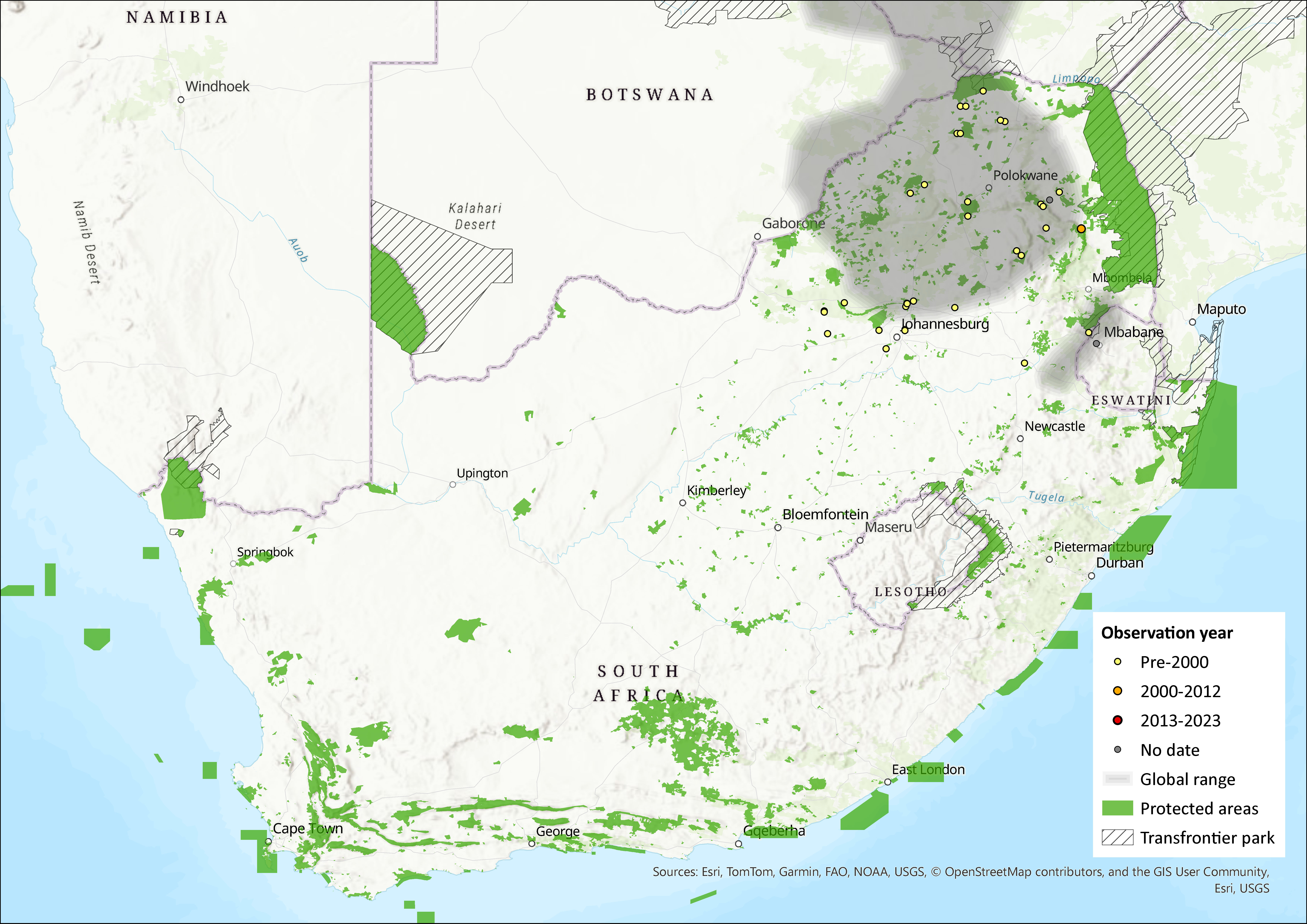
Figure 1. Distribution records for Rock Dormouse (Graphiurus platyops) within the assessment region (South Africa, Eswatini and Lesotho). Note that distribution data is obtained from multiple sources and records have not all been individually verified.
Biogeographic Realms
Biogeographic Realm: Afrotropical
Occurrence
Countries of Occurrence
| Country | Presence | Origin | Formerly Bred | Seasonality |
| Botswana | Extant | Native | – | – |
| Eswatini | Extant | Native | – | – |
| Mozambique | Extant | Native | – | – |
| South Africa | Extant | Native | – | – |
| Zambia | Extant | Native | – | – |
| Zimbabwe | Extant | Native | – | – |
Large Marine Ecosystems (LME) Occurrence
Large Marine Ecosystems: (Not specified)
FAO Area Occurrence
FAO Marine Areas: (Not specified)
Climate change
This species occurs in the Northern Cape, Limpopo, and Gauteng provinces of South Africa. There is a possibility that it might be affected by the 1.5-4°C increase in temperature predicted under various climate change scenarios (Engelbrecht et al. 2024). Rainfall is predicted to decrease in its range. These decreases will result in a more arid and drought-prone habitat which could affect food availability in the species distribution range.
Population
There is little information on population size and there are only c. 50 museum specimens for the species with usually only one or two specimens trapped at each locality suggesting that densities are not high even in suitable habitat (Holden 2013). However, it is probably more abundant in the northern part of its range than what current data reveal. For example, they are relatively common in Musina Nature Reserve, Limpopo Province (D. MacFadyen unpubl. data). It is apparently trap shy and difficult to capture (Rautenbach 1978).
Population Information
Continuing decline in mature individuals? (Not specified)
Extreme fluctuations in the number of subpopulations: (Not specified)
Continuing decline in number of subpopulations: (Not specified)
All individuals in one subpopulation: (Not specified)
Number of mature individuals in largest subpopulation: (Not specified)
Number of Subpopulations: (Not specified)
Quantitative Analysis
Probability of extinction in the wild within 3 generations or 10 years, whichever is longer, maximum 100 years: (Not specified)
Probability of extinction in the wild within 5 generations or 20 years, whichever is longer, maximum 100 years: (Not specified)
Probability of extinction in the wild within 100 years: (Not specified)
Population Genetics
While this genus has been investigated in a phylogenetic context (Montgelard et al. 2003), no population genetic assessment has been undertaken on the species.
Little is known about this species, with sparse observations recorded, but it is likely more abundant than museum and trap records would suggest. It is possible the species exists as a single metapopulation, with connections to neighbouring countries. It is assumed that no extinctions have occurred within the species; hence, the Convention on Biological Diversity’s Global Biodiversity Framework’s complementary genetic indicator – proportion of populations maintained (PM) – would receive a value of 1.0 (1/1 population remaining).
Despite limited data, the knowledge that the species likely forms a metapopulation with neighbouring countries greatly increases its effective population size (Ne), which is presumed to exceed 500. Assuming a Ne/Nc conversion ratio between 0.1-0.3, the population size is expected to exceed 5000 mature individuals.
It is highly recommended that a population genetic study be undertaken to increase the available knowledge on the species and verify the estimated indicator values reported here.
Habitats and ecology
The Rock Dormouse generally occurs in rocky terrain, especially granite outcrops, living in rock crevices and in piles of boulders. In parts of their distributional range, where rocky habitats are unavailable, they live in trees (Ansell 1960; Smithers & Lobao-Tello 1976). They are sometimes found in association with dassies (Heterohyrax and Procavia spp.) and three individuals were trapped in caves in South Africa (Holden 2013). Its flattened cranium allows the species to move through narrow rock crevices where they are most commonly found (Holden 2013). D. MacFadyen (unpubl. data) collected them in the research accommodation at Musina Nature Reserve, confirming the fact that they may be found in buildings.
They are solitary and omnivorous (Holden 2013). In Botswana and Zimbabwe, specimens were found to have consumed seeds, vegetable matter and insects, such as moths (Skinner & Chimimba 2005). Although nocturnal, they may be crepuscular in habit, especially on overcast days. Little information is available for their reproductive ecology in the assessment region. However, in Zambia, Ansell (1960) documented a female carrying six foetuses in January, and juveniles have been recorded in November and December. They possibly use scent trails and are aggressive, whipping their tails as a visual signal (Holden 2013).
Ecosystem and cultural services: No specific ecosystem services have been identified for this species. However, this may simply reflect the paucity of information available for this poorly-known species (Holden 2013).
IUCN Habitats Classification Scheme
|
Habitat |
Season |
Suitability |
Major Importance? |
|
1.5. Forest -> Forest – Subtropical/Tropical Dry |
– |
Suitable |
– |
|
6. Rocky areas (eg. inland cliffs, mountain peaks) |
– |
Suitable |
– |
Life History
Generation Length: (Not specified)
Age at maturity: female or unspecified: (Not specified)
Age at Maturity: Male: (Not specified)
Size at Maturity (in cms): Female: (Not specified)
Size at Maturity (in cms): Male: (Not specified)
Longevity: (Not specified)
Average Reproductive Age: (Not specified)
Maximum Size (in cms): (Not specified)
Size at Birth (in cms): (Not specified)
Gestation Time: (Not specified)
Reproductive Periodicity: (Not specified)
Average Annual Fecundity or Litter Size: (Not specified)
Natural Mortality: (Not specified)
Does the species lay eggs? (Not specified)
Does the species give birth to live young: (Not specified)
Does the species exhibit parthenogenesis: (Not specified)
Does the species have a free-living larval stage? (Not specified)
Does the species require water for breeding? (Not specified)
Movement Patterns
Movement Patterns: (Not specified)
Congregatory: (Not specified)
Systems
System: Terrestrial
General Use and Trade Information
This species is not known to be traded or utilised in any form. It has potential to be trafficked for the pet trade, but this is unconfirmed.
Local Livelihood: (Not specified)
National Commercial Value: (Not specified)
International Commercial Value: (Not specified)
End Use: (Not specified)
Is there harvest from captive/cultivated sources of this species? (Not specified)
Harvest Trend Comments: (Not specified)
Threats
There are unlikely to be any major threats to this species. They generally occur in rocky habitat unsuitable for agriculture and thus habitat is unlikely to decline. Increased mining of granite and the crushing of rock within its distribution range potentially has a negative impact on local subpopulations.
Conservation
This species has been recorded from several protected areas, including Musina Nature Reserve and Tswalu Kalahari Reserve (D. MacFadyen unpubl. data). No specific conservation measures are currently necessary, but additional studies and surveys are needed to better determine the taxonomy, distribution, natural history and possible threats to this species. Furthermore, it is important to investigate how sensitive this species is to change in habitat: there are records of them living in buildings, thus this species could be a generalist. This species would benefit from the expansion of protected areas in the Limpopo Province, and continued regulation of mining practices throughout the northern regions of South Africa, ensuring that areas of suitable habitat are protected through provincial stewardship programmes.
Recommendations for land managers and practitioners:
- Areas zoned for mining rock should include mining-free zones as corridors of suitable habitat to connect adjacent areas.
Research priorities:
- Research into the impacts of the mining of granite and the crushing of rock on the population.
- Field surveys to determine distribution range and area of occupancy.
- Studies to determine the population densities across this species distribution range.
- A population genetics study to be undertaken to increase the available knowledge on the species.
- Determine the taxonomy, distribution, natural history and possible threats to this species.
- Populations should be referenced to distinguish distribution maps and to discern genetic markers, and isolated subpopulations need to be assessed taxonomically.
Encouraged citizen actions:
- Report sightings on virtual museum platforms (for example, iNaturalist and MammalMAP), especially outside protected areas.
- Public pressure to curb granite mining and rock crushing within this species distribution range.
Bibliography
Ansell, W. F. H. 1960. Mammals of Northern Rhodesia. The Government Printer, Lusaka, Northern Rhodesia.
De Graaff, G. 1981. The Rodents of Southern Africa. Butterworths, Durban, South Africa.
Engelbrecht, FA., Steinkopf, J., Padavatan, J. & Midgley, GF. 2024. Projections of future climate change in southern Africa and the potential for regional tipping points. In: von Maltitz, G.P., et al. Sustainability of Southern African Ecosystems under Global Change. Ecological Studies, vol 248. Springer, Cham. https://doi.org/10.1007/978-3-031-10948-5_7
Holden ME. 2013. Graphiurus platyopsFlat-headed African Dormouse. In: Happold DCD (ed.), Mammals of Africa. Volume III: Rodents, Hares and Rabbits., pp. 130–131. Bloomsbury Publishing, London, UK.
Holden, M.E. 2005. Family Gliridae. In: D.E. Wilson and D.M. Reeder (eds), Mammal Species of the World, pp. 819-841. Johns Hopkins University Press, Baltimore, Maryland, USA.
MacFadyen DN. 2014. The dynamics of small mammal populations in Rocky Highveld Grassland, Telperion, South Africa. Ph.D. Thesis. University of Pretoria, Pretoria, South Africa.
Meester, J.A.J., Rautenbach, I.L., Dippenaar, N.J. and Baker, C.M. 1986. Classification of Southern African Mammals. Monograph number 5. Transvaal Museum, Pretoria, South Africa.
Monadjem, A., Taylor, P.J., Denys, C. and Cotterill, F.P.D. 2015. Rodents of sub-Saharan Africa: a biogeographic and taxonomic synthesis. De Gruyter, Berlin, Germany.
Power, R.J. 2014. The distribution and status of mammals in the North West Province. Department of Economic Development, Environment, Conservation & Tourism, North West Provincial Government, Mahikeng.
Rautenbach, I.L. 1978. The mammals of the Transvaal. Ph.D. Thesis, University of Natal.
Skinner, J.D. and Chimimba, C.T. (eds). 2005. The Mammals of the Southern African Subregion. Cambridge University Press, United Kingdom, Cambridge.
Smithers, R.H.N. and Lobao-Tello, J.L.P. 1976. Check list and atlas of the mammals of Mozambique. Trustees of the National Museums and Monuments of Rhodesia, Salisbury, Rhodesia.