

Roberts’ Vlei Rat
Otomys karoensis

2025 Red list status
Least Concern

Regional Population Trend
Stable

Change compared
to 2016
No Change
Overview
Otomys karoensis – Roberts, 1931
ANIMALIA – CHORDATA – MAMMALIA – RODENTIA – MURIDAE – Otomys – karoensis
Common Names: Roberts’ Vlei Rat (English)
Synonyms: Cytogenetic, DNA sequence and geometric morphometric data demonstrate the synonymy of O. saundersiae from Grahamstown (Eastern Cape, South Africa) under O. irroratus, and the validity of Otomys karoensis from the Fynbos Biome of the Western Cape (Taylor et al. 2009).
Taxonomic Note: Otomys karoensis previously was included as a synonym or subspecies of O. saundersiae (Meester et al. 1986) but chromosomal and molecular evidence show that O. saundersiae from the Eastern Cape is a synonym of O. irroratus and that O. karoensis is the correct name for the species (Taylor et al. 2009).
Red List Status: LC – Least Concern
Assessment Information
Assessors: Taylor, P.1 & da Silva, J.M.2
Reviewer: Oosthuizen, M.3
Institutions: 1University of the Free State,2South African National Biodiversity Institute,3University of Pretoria
Previous Assessors and Reviewers: Baxter, R., Child, M.F. & Taylor, P.
Previous Contributors: Roxburgh, L., Avenant, N., MacFadyen, D., Monadjem, A., Avery, M., Palmer, G. & Wilson, B.
Assessment Rationale
This mountain fynbos, endemic species is listed as Least Concern because it has a relatively wide distribution within the assessment region in the Western Cape and occupies habitats that are largely inaccessible and unlikely to be transformed on a significant scale. It is very common in high mountain fynbos, predominantly on rocky slopes and dense fynbos patches, and this habitat is not prone to being overgrazed. However, the effects of climate change on this species should be monitored and, should molecular research reveal a species complex, it will necessitate a reassessment.
Reasons for Change
Reason(s) for Change in Red List Category from the Previous Assessment: No change
Red List Index
Red List Index: No change
Recommended Citation: Taylor P & da Silva JM. 2025. A conservation assessment of Otomys karoensis. In Patel T, Smith C, Roxburgh L, da Silva JM & Raimondo D, editors. The Red List of Mammals of South Africa, Eswatini and Lesotho. South African National Biodiversity Institute and Endangered Wildlife Trust, South Africa.
Regional Distribution and occurrence
Geographic Range
The species is endemic to South Africa and occurs in the Fynbos of the Cape Fold Belt Mountains of the Western Cape. Populations previously referred to this species from the grasslands of southern Drakensberg in northern Eastern Cape and the central plateau grasslands of the southern Free State have shown to be a distinct species, O. willani (Taylor et al. 2020).
Elevation / Depth / Depth Zones
Elevation Lower Limit (in metres above sea level): (Not specified)
Elevation Upper Limit (in metres above sea level): (Not specified)
Depth Lower Limit (in metres below sea level): (Not specified)
Depth Upper Limit (in metres below sea level): (Not specified)
Depth Zone: (Not specified)
Map
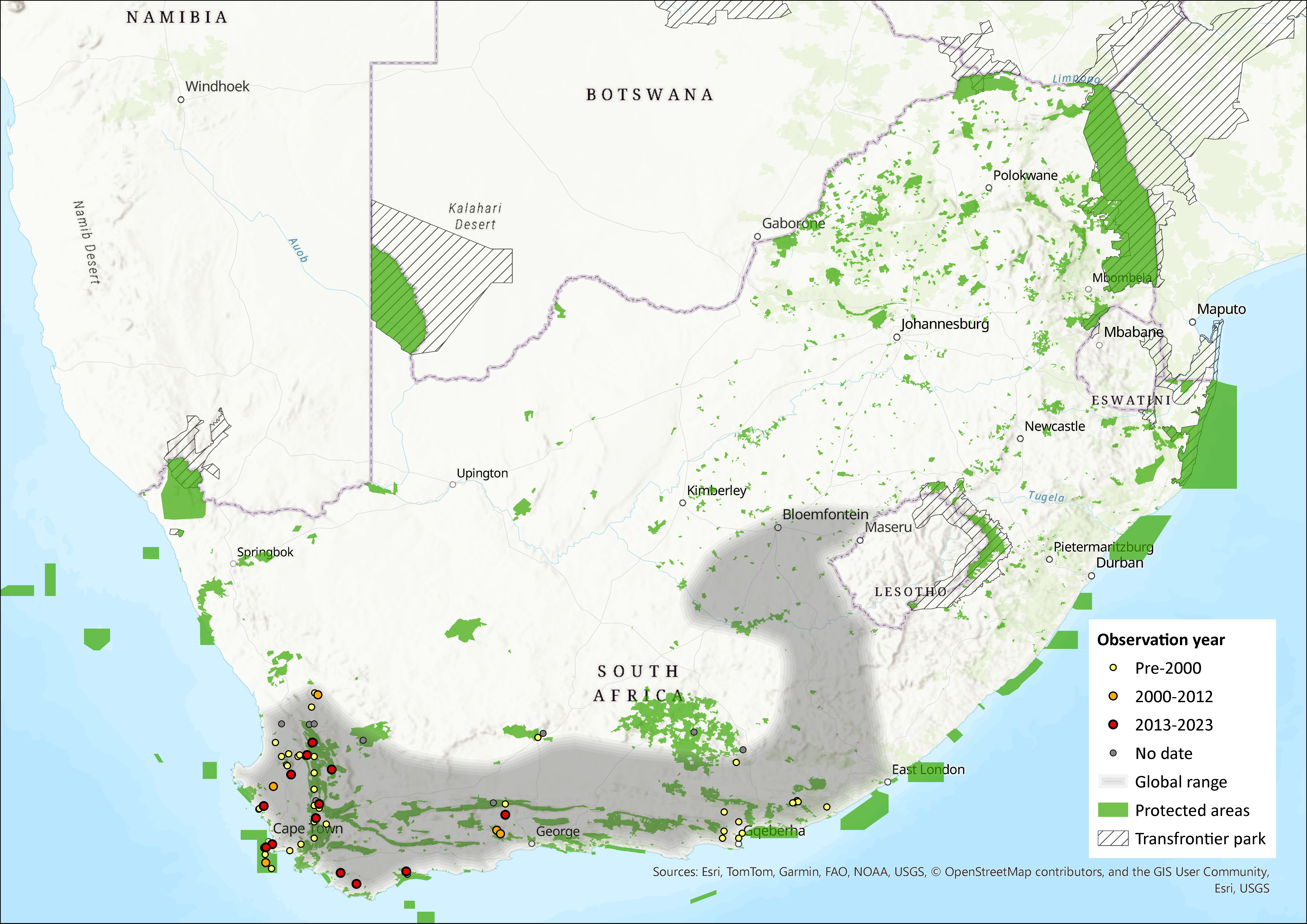
Figure 1. Distribution records for Roberts’ Vlei Rat (Otomys karoensis) within the assessment region (South Africa, Eswatini and Lesotho). Note that distribution data is obtained from multiple sources and records have not all been individually verified.
Biogeographic Realms
Biogeographic Realm: Afrotropical
Occurrence
Countries of Occurrence
| Country | Presence | Origin | Formerly Bred | Seasonality |
| South Africa | Extant | Native | – | Resident |
Large Marine Ecosystems (LME) Occurrence
Large Marine Ecosystems: (Not specified)
FAO Area Occurrence
FAO Marine Areas: (Not specified)
Climate change
The species co-occurs with O. irroratus in the Western Cape, occurring on rocky slopes rather than valleys, and it will also be similarly affected by climate change, with projected range declines by 2050 (Taylor et al. 2016).
Population
The population size or density is unknown. Its presence seems to be closely tied to Mountain Fynbos habitat where it can be trapped in fair numbers of about 1 capture per 100 trap nights (P.J. Taylor, personal observation). Given that Otomys are trap-shy and based on their high representation in owl pellet remains, it is probably abundant in suitable habitat.
Population Information
Current population trend: Stable
Continuing decline in mature individuals: No
Number of mature individuals in population: Unknown
Number of mature individuals in largest subpopulation: Unknown
Number of subpopulations: Unknown
Severely fragmented: No
Quantitative Analysis
Probability of extinction in the wild within 3 generations or 10 years, whichever is longer, maximum 100 years: (Not specified)
Probability of extinction in the wild within 5 generations or 20 years, whichever is longer, maximum 100 years: (Not specified)
Probability of extinction in the wild within 100 years: (Not specified)
Population Genetics
A recent phylogenetic study revealed the existence of a unique lineage of Otomys previously attributed to O. karoensis (currently O. willani; Taylor et al. 2020). Consequently, the distribution of O. karoensis has been revised. While no finescale population genetic study has been undertaken on this species, its close association with Montane Fynbos could suggest the presence of several genetically distinct subpopulations along the Cape Fold Mountains, as has been found with other montane specialists. While the exact number is unknown, it is assumed that all distinct subpopulations have remained intact (none have gone extinct) due to the limited threats assumed to impact the species. Based on this understanding, it is possible to quantify one of the two population genetic indicators in the Convention on Biological Diversity’s Global Biodiversity Framework’s (GBF). The complementary genetic indicator – proportion of populations maintained (PM), would receive a value of 1.0 (all populations maintained).
Because no population size or density information is available for this species, it is not possible to estimate the GBF’s headline indicator – proportion of populations within a species with an effective population size (Ne) greater than 500. This can be informed through a fine scale molecular study across the species distribution.
Habitats and ecology
This species occupies open grassland and shrubland habitats on the upper slopes of hilly terrain and Restio-dominated rocky mountain fynbos (Taylor 2013). While some Otomys species can occupy disturbed habitats such as lush overgrown lawns and gardens, young pine plantations, and rank vegetation along drainage lines and roads (Taylor 1998), it is not known if the species can persist in modified habitats. Taylor et al. (1993) provide morphometric data that completely separates O. karoensis from O. irroratus.
Ecosystem and cultural services: Vlei rats are important food for a number of mammalian predators, as well as raptors such as Marsh Owls (Asio capensis) and Common Barn Owls (Tyto alba) (Skinner and Chimimba 2005, Monadjem et al. 2015). For example, Vlei rats are favoured food by the Serval (Leptailurus serval) (Bowland 1990), so their range expansion could be interrelated (Power 2014).
IUCN Habitats Classification Scheme
|
Habitat |
Season |
Suitability |
Major Importance? |
|
4.7. Grassland -> Grassland – Subtropical/Tropical High Altitude |
– |
Suitable |
– |
|
5.4. Wetlands (inland) -> Wetlands (inland) – Bogs, Marshes, Swamps, Fens, Peatlands |
– |
Suitable |
– |
|
14.3. Artificial/Terrestrial -> Artificial/Terrestrial – Plantations |
– |
Suitable |
– |
Life History
Generation Length: (Not specified)
Age at maturity: female or unspecified: (Not specified)
Age at Maturity: Male: (Not specified)
Size at Maturity (in cms): Female: (Not specified)
Size at Maturity (in cms): Male: (Not specified)
Longevity: (Not specified)
Average Reproductive Age: (Not specified)
Maximum Size (in cms): (Not specified)
Size at Birth (in cms): (Not specified)
Gestation Time: (Not specified)
Reproductive Periodicity: (Not specified)
Average Annual Fecundity or Litter Size: (Not specified)
Natural Mortality: (Not specified)
Does the species lay eggs? (Not specified)
Does the species give birth to live young: (Not specified)
Does the species exhibit parthenogenesis: (Not specified)
Does the species have a free-living larval stage? (Not specified)
Does the species require water for breeding? (Not specified)
Movement Patterns
Movement Patterns: (Not specified)
Congregatory: (Not specified)
Systems
System: Terrestrial
General Use and Trade Information
This species is not known to be utilised or traded.
Local Livelihood: (Not specified)
National Commercial Value: (Not specified)
International Commercial Value: (Not specified)
End Use: (Not specified)
Is there harvest from captive/cultivated sources of this species? (Not specified)
Harvest Trend Comments: (Not specified)
Threats
There are no major threats known, although habitat loss and degradation from wetland drainage, grassland loss and exotic vegetation, are all suspected to be minor threats. Additionally, climate change may represent an emerging threat to the montane grassland habitats that this species predominantly occupies. Climate modelling for similarly mesic-adapted Otomys species reveals significant reductions in area of occupancy by 2050, particularly in the Western Cape region (Taylor et al. 2016). More research is needed to determine specific effects of climate change on O. karoensis.
Habitat trend: Declining. Wetlands are the most threatened ecosystem in South Africa (Driver et al. 2012). The South African National Land-Cover change report found a 32.8% decline in natural wetlands nationally from 1990-2013/14, which is a combination of both genuine wetland loss through anthropogenic activities and the generally drier conditions currently that in 1990 (GeoTerraImage 2015). In the Western Cape, specifically, 31% of all wetlands (plus a 32m buffer) and riparian areas have been transformed/lost to agricultural land use (Pence 2012).
Conservation
This species occurs within several protected areas within the Western Cape, although these are yet to be comprehensively documented. Although no specific interventions are necessary at present, the conservation and restoration of wetlands and grasslands would benefit this species. The following interventions are thus encouraged:
- Using previously cultivated areas for development instead of remaining natural areas.
- Land managers should maintain a vegetation buffer around wetlands to reduce impacts of land-use practices (Driver et al. 2012).
Recommendations for land managers and practitioners:
- Long-term, systematic monitoring is needed to establish subpopulation trends and threat levels.
- Land managers should maintain vegetation around wetlands.
- Prioritise old fields for development in systematic conservation planning.
Research priorities:
- Effects of climate change on distribution.
- Genetic and taxonomic research is recommended to refine distribution.
Encouraged citizen actions:
- Report vlei rat sightings on MammalMAP: The feeding signs of this species are easy to detect by short chopped lengths of grass and green moist faecal pellets (Skinner & Chimimba 2005).
Bibliography
Bowland, A.E. and Perrin, M.R. 1989. The effect of overgrazing on the small mammals in Umfolozi Game Reserve. Zeitschrift für Säugetierkunde 54: 251–260.
Bowland, J.M. 1990. Diet, home range and movement patterns of serval on farmland in Natal. Department of Zoology and Entomology, University of Natal.
Driver, A., Sink, K.J., Nel, J.N., Holness, S., Van Niekerk, L., Daniels, F., Jonas, Z., Majiedt, P.A., Harris, L. and Maze, K. 2012. National Biodiversity Assessment 2011: An assessment of South Africa’s biodiversity and ecosystems. Synthesis Report. South African National Biodiversity Institute and Department of Environmental Affairs, Pretoria, South Africa.
GeoTerraImage. 2015. 1990-2013/14 South African National Land-Cover Change. DEA/CARDNO SCPF002: Implementation of Land-Use Maps for South Africa. Project Specific Data Report.
IUCN. 2017. The IUCN Red List of Threatened Species. Version 2017-2. Available at: www.iucnredlist.org. (Accessed: 14 September 2017).
Meester, J.A.J., Rautenbach, I.L., Dippenaar, N.J. and Baker, C.M. 1986. Classification of Southern African Mammals. Monograph number 5. Transvaal Museum , Pretoria, South Africa.
Monadjem, A., Taylor, P.J., Denys, C. and Cotterill, F.P.D. 2015. Rodents of Sub-Saharan Africa – a biogeographic and taxonomic synthesis. De Gruyter, Berlin/Munich/Boston.
Pence, G.Q.K. 2012. Contribution of C.A.P.E. Business and Biodiversity Initiatives to conservation of critical biodiversity, landscape connectivity and ecological support areas: Post-baseline assessment (2010). A Green Choice Alliance project report. Conservation South Africa, Kirstenbosch, South Africa.
Power, R.J. 2014. The distribution and status of mammals in the North West Province. Department of Economic Development, Environment, Conservation & Tourism, North West Provincial Government, Mahikeng.
Skinner, J.D. and Chimimba, C.T. (eds). 2005. The Mammals of the Southern African Subregion. Cambridge University Press, United Kingdom, Cambridge.
Taylor, P.J. 1998. The Smaller Mammals of KwaZulu-Natal. University of Natal Press, Pietermaritzburg, South Africa.
Taylor, P.J. 2013. Otomys saundersiae Saunder’s Vlei Rat. In: D.C.D. Happold (ed.), Mammals of Africa. Volume III: Rodents, Hares and Rabbits, pp. 588–589. Bloomsbury Publishing, London, UK.
Taylor, P.J., Kumirai, A. and Contrafatto, G. 2005. Species with fuzzy borders: the taxonomic status and species limits of Saunders vlei rat, Otomys saundersiae Roberts (Rodentia: Muridae: Otomyini). Mammalia 69: 297–322.
Taylor, P.J., Maree, S., Van Sandwyk, J., Baxter, R. and Rambau, R.V. 2009. When is a species not a species? Uncoupled phenotypic, karyotypic and genotypic divergence in two species of South African laminate-toothed rats (Murinae: Otomyini). Journal of Zoology 277: 317–332.
Taylor, P.J., Maree, S., van Sandwyk, J., Baxter, R. and Rambau, R.V. 2009. When is a species not a species? Uncoupled phenotypic, karyotypic and genotypic divergence in two species of South African laminate-toothed rats (Murinae: Otomyini). Journal of Zoology 277: 317–332.
Taylor, P.J., Meester, J. and Kearney, T. 1993. The taxonomic status of Saunders’ vlei rat, Otomys saundersiae Roberts (Rodentia: Muridae: Otomyinae). Journal of African Zoology 107: 1–26.
Taylor, P.J., Nengovhela, A., Linden, J. and Baxter, R.M. 2016. Past, present, and future distribution of Afromontane rodents (Muridae: Otomys) reflect climate-change predicted biome changes. Mammalia 80: 359–375.
Taylor, P. J., Kearney, K., Dalton, D., Mataruse, G., Kelly, C. M. R. and Barker, N. P. 2020. Biomes, geology and past climate drive speciation of laminate-toothed rats on South African mountains (Murinae: Otomys). Zoological Journal of the Linnean Society 189: 1046–1066, https://doi.org/10.1093/zoolinnean/zlz134.