
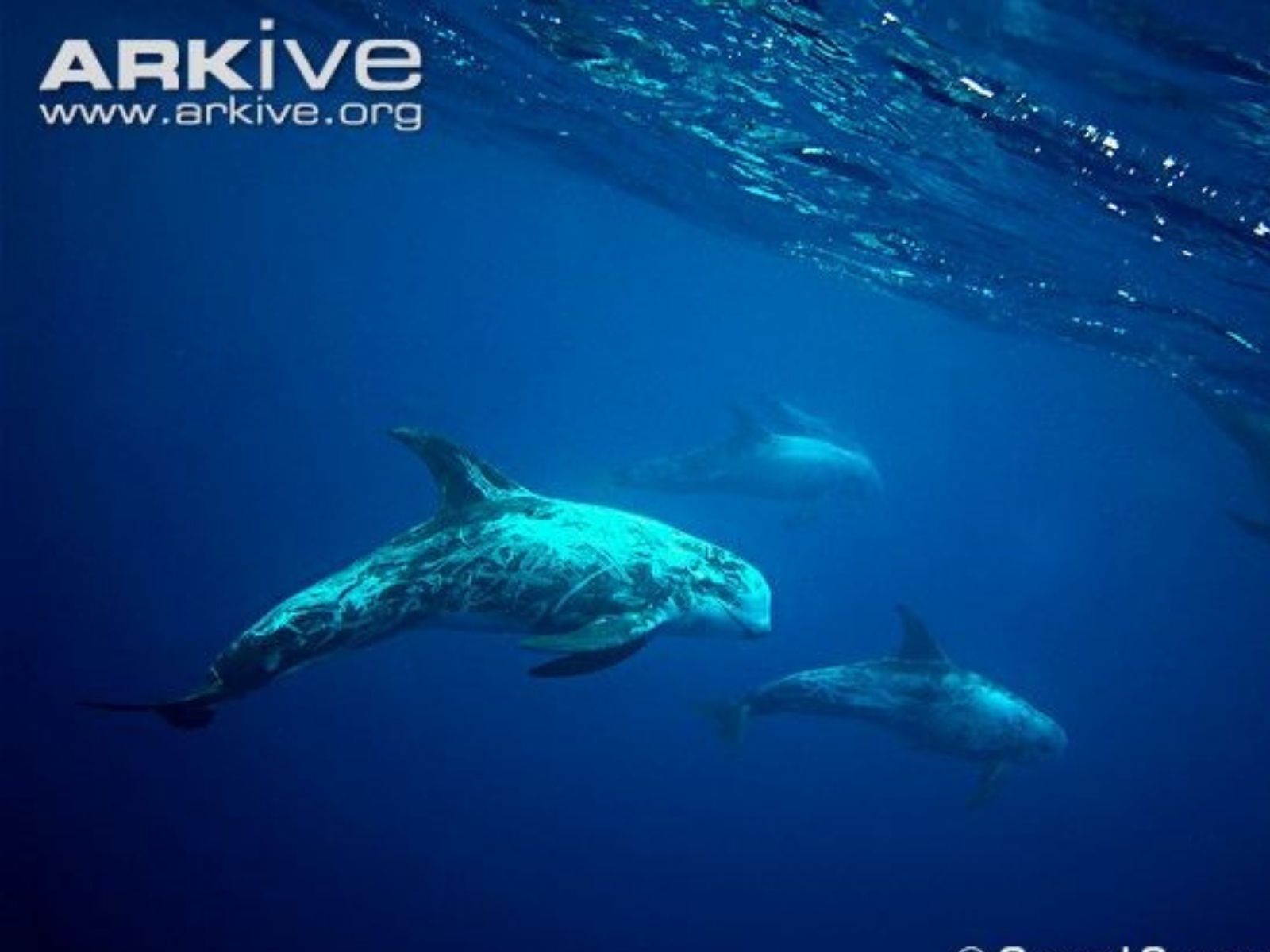
Risso’s Dolphin
Grampus griseus

2025 Red list status
Least Concern

Regional Population Trend
Unknown

Change compared
to 2016
No Change
Overview
Grampus griseus – (G. Cuvier, 1812)
ANIMALIA – CHORDATA – MAMMALIA – ARTIODACTYLA – DELPHINIDAE – Grampus – griseus
Common Names: Risso’s Dolphin, Grey Dolphin (English), Risso se Dolfyn (Afrikaans), Calderón gris, Delfín de Risso (Spanish; Castilian), Dauphin de Risso (French), Delfin griú (Maltese), Glavati dupin (Croatian), Grampo (Italian), Grampus (Turkish), Okrogloglavi delfin (Slovenian), Rundkopfdelfin (German), σταχτοδέλφινο (stachtodélfino) (Greek, Modern (1453-))
Synonyms: Delphinus griseus G. Cuvier, 1812; Grampus rissoanus (Gray 1850)
Taxonomic Note:
The genus Grampus contains a single species, the Risso’s Dolphin (Grampus griseus). No subspecies are recognised (Committee on Taxonomy 2021).
A skull belonging a South African specimen, previously ascribed to G. richardsonii (Gray 1865) from the South African Museum was later found to belong to the North Atlantic species G. griseus by True (1889). This species is now recognised throughout the tropical and temperate regions of all major oceans. Though there is evidence of morphological and genetic variation between and within oceans, these population divisions remain unclear, and no subspecies are currently recognised (Baird 2002). Much geographic variation in body size has been documented, for example, North Atlantic specimens reach lengths of approximately 4.0 m, while individuals from South Africa are recorded to average 3.41 m (Ross 1984).
Red List Status: LC – Least Concern, (IUCN version 3.1)
Assessment Information
Assessors: Penry, G.1,2, Plön, S.3 & da Silva, J.4
Reviewer: Purdon, J.2,5
Contributor: Hofmeyr, G.6
Institutions: 1Nelson Mandela University, 2The Whale Unit, University of Pretoria, 3University of Cape Town, 4South African National Biodiversity Institute,5TUT Nature Conservation, 6Port Elizabeth Museum at Bayworld
Previous Assessors: Plön, S. & Cockcroft, V.
Previous Reviewer: Child, M.F.
Previous Contributors: Relton, C. & Atkins, S.
Assessment Rationale
Although no data on population dynamics are available for Risso’s Dolphins, there are no known threats that could cause a range-wide decline, and this species is not a conservation priority. The biggest threat within the assessment region, the Chokka/Cape Hope squid (Loligo reynaudii) fishery, is localised. However, a recent collapse of the fishery may be responsible for a lack of strandings off the south-eastern coast of South Africa. This may have caused the animals to move offshore to feed on other prey species, thus being less likely to strand (Plön et al. 2020). Thus, this threat should be monitored. Currently, the species is listed as Least Concern, in line with the global assessment.
Regional population effects: The Risso’s Dolphin is a wide-ranging, pelagic species, and although its movements and seasonality are largely unknown, no barriers to dispersal have been recognised, thus rescue effects are possible.
Reasons for Change
Reason(s) for Change in Red List Category from the Previous Assessment: No change
Red List Index
Red List Index: No change
Recommended citations: Penry G, Plön S & da Silva JM. 2025. A conservation assessment of Grampus griseus. In Patel T, Smith C, Roxburgh L, da Silva JM & Raimondo D, editors. The Red List of Mammals of South Africa, Eswatini and Lesotho. South African National Biodiversity Institute and Endangered Wildlife Trust, South Africa.
Regional Distribution and occurrence
Geographic Range
Risso’s Dolphins are located extensively throughout tropical and temperate regions of both the southern and northern hemisphere, predominantly in waters more than 1,000 m deep on the continental slope but also have an apparent preference for the steep continental shelf edges between 400–1,000 m deep (Kruse et al. 1999; Baird 2009). Within the assessment region, this species has been recorded along the shelf edge, between 31°S on South Africa’s west coast, and 29°S on the east coast (Skinner & Chimimba 2005; Best 2007). Along the west coast, sightings have been reported from Saldanha Bay, and strandings between 23°S and 21°S have been recorded from Namibia (Findlay et al. 1992). On the east coast, Risso’s Dolphins have been documented well offshore, along the 1,000 m isobath (Ross 1984) and strandings occur along the entire coastlines of the Eastern Cape and KwaZulu-Natal (Plön et al., 2020).
Elevation / Depth / Depth Zones
Elevation Lower Limit (in metres above sea level): (Not specified)
Elevation Upper Limit (in metres above sea level): (Not specified)
Depth Lower Limit (in metres below sea level): (Not specified)
Depth Upper Limit (in metres below sea level): (Not specified)
Depth Zone: (Not specified)
Map
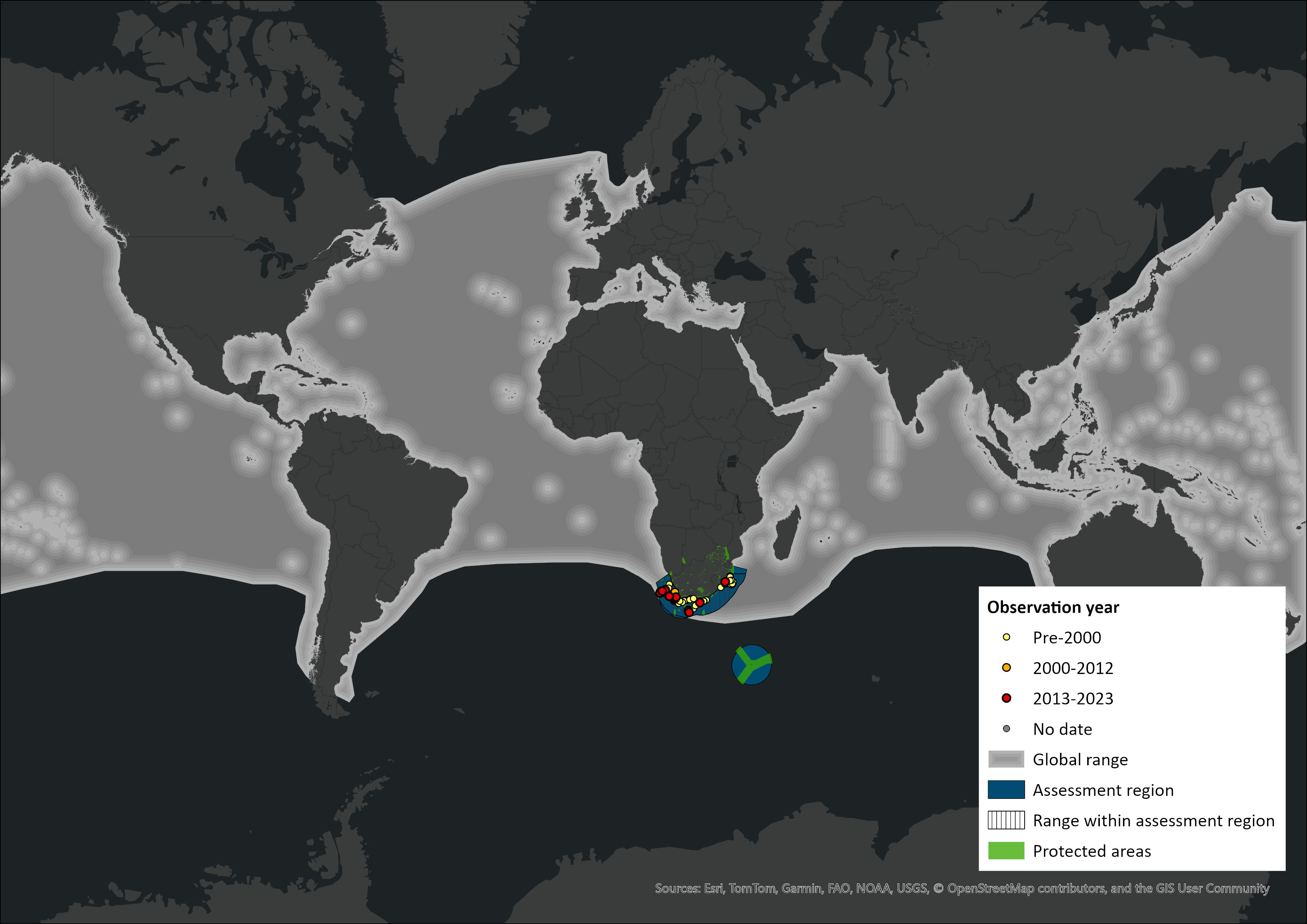 Figure 1. Distribution records for Risso’s Dolphin (Grampus griseus) within the assessment region (South Africa, Eswatini and Lesotho). Note that distribution data is obtained from multiple sources and records have not all been individually verified.
Biogeographic Realms
Biogeographic Realm: Afrotropical, Australasian, Indomalayan, Nearctic, Neotropical, Palearctic
Occurrence
Countries of Occurrence
| Country | Presence | Origin | Formerly Bred | Seasonality |
| Albania | Presence Uncertain | Native | – | Seasonal Occurrence Uncertain |
| Algeria | Extant | Native | – | Resident |
| American Samoa | Presence Uncertain | Native | – | Seasonal Occurrence Uncertain |
| Angola | Extant | Native | – | Resident |
| Anguilla | Extant | Native | – | Resident |
| Antigua and Barbuda | Extant | Native | – | Resident |
| Argentina | Extant | Native | – | Resident |
| Aruba | Extant | Native | – | Resident |
| Australia | Extant | Native | – | Resident |
| Bahamas | Extant | Native | – | Resident |
| Bahrain | Presence Uncertain | Native | – | Seasonal Occurrence Uncertain |
| Bangladesh | Presence Uncertain | Native | – | Seasonal Occurrence Uncertain |
| Barbados | Extant | Native | – | Resident |
| Belgium | Presence Uncertain | Native | – | Seasonal Occurrence Uncertain |
| Belize | Presence Uncertain | Native | – | Seasonal Occurrence Uncertain |
| Benin | Presence Uncertain | Native | – | Seasonal Occurrence Uncertain |
| Bermuda | Extant | Native | – | Resident |
| Bonaire, Sint Eustatius and Saba | Extant | Native | – | Resident |
| Bosnia and Herzegovina | Presence Uncertain | Native | – | Seasonal Occurrence Uncertain |
| Brazil | Extant | Native | – | Resident |
| British Indian Ocean Territory | Presence Uncertain | Native | – | Seasonal Occurrence Uncertain |
| Brunei Darussalam | Presence Uncertain | Native | – | Seasonal Occurrence Uncertain |
| Cabo Verde | Presence Uncertain | Native | – | Seasonal Occurrence Uncertain |
| Cambodia | Presence Uncertain | Native | – | Seasonal Occurrence Uncertain |
| Cameroon | Presence Uncertain | Native | – | Seasonal Occurrence Uncertain |
| Canada | Extant | Native | – | Resident |
| Cayman Islands | Extant | Native | – | Resident |
| Chile | Extant | Native | – | Resident |
| China | Extant | Native | – | Resident |
| Christmas Island | Presence Uncertain | Native | – | Seasonal Occurrence Uncertain |
| Cocos (Keeling) Islands | Presence Uncertain | Native | – | Seasonal Occurrence Uncertain |
| Colombia | Extant | Native | – | Resident |
| Comoros | Extant | Native | – | Resident |
| Congo | Presence Uncertain | Native | – | Seasonal Occurrence Uncertain |
| Congo, The Democratic Republic of the | Presence Uncertain | Native | – | Seasonal Occurrence Uncertain |
| Cook Islands | Extant | Native | – | Resident |
| Costa Rica | Extant | Native | – | Resident |
| Croatia | Extant | Native | – | Resident |
| Cuba | Extant | Native | – | Resident |
| Curaçao | Extant | Native | – | Resident |
| Cyprus | Presence Uncertain | Native | – | Seasonal Occurrence Uncertain |
| Côte d’Ivoire | Extant | Native | – | Resident |
| Denmark | Extant | Native | – | Resident |
| Djibouti | Presence Uncertain | Native | – | Seasonal Occurrence Uncertain |
| Dominica | Extant | Native | – | Resident |
| Dominican Republic | Presence Uncertain | Native | – | Seasonal Occurrence Uncertain |
| Ecuador | Extant | Native | – | Resident |
| Egypt | Presence Uncertain | Native | – | Seasonal Occurrence Uncertain |
| El Salvador | Presence Uncertain | Native | – | Seasonal Occurrence Uncertain |
| Equatorial Guinea | Presence Uncertain | Native | – | Seasonal Occurrence Uncertain |
| Eritrea | Presence Uncertain | Native | – | Seasonal Occurrence Uncertain |
| Fiji | Presence Uncertain | Native | – | Seasonal Occurrence Uncertain |
| France | Extant | Native | – | Resident |
| French Guiana | Presence Uncertain | Native | – | Seasonal Occurrence Uncertain |
| French Polynesia | Extant | Native | – | Resident |
| French Southern Territories | Extant | Native | – | Resident |
| French Southern Territories -> Mozambique Channel Is. | Extant | Native | – | Resident |
| Gabon | Extant | Native | – | Resident |
| Gambia | Extant | Native | – | Resident |
| Germany | Extant | Native | – | Resident |
| Ghana | Extant | Native | – | Resident |
| Gibraltar | Extant | Native | – | Resident |
| Greece | Extant | Native | – | Resident |
| Grenada | Extant | Native | – | Resident |
| Guadeloupe | Extant | Native | – | Resident |
| Guam | Extant | Native | – | Resident |
| Guatemala | Extant | Native | – | Resident |
| Guernsey | Extant | Native | – | Resident |
| Guinea | Presence Uncertain | Native | – | Seasonal Occurrence Uncertain |
| Guinea-Bissau | Extant | Native | – | Resident |
| Guyana | Presence Uncertain | Native | – | Seasonal Occurrence Uncertain |
| Haiti | Extant | Native | – | Resident |
| Honduras | Presence Uncertain | Native | – | Seasonal Occurrence Uncertain |
| Hong Kong | Presence Uncertain | Native | – | Seasonal Occurrence Uncertain |
| India | Extant | Native | – | Resident |
| Indonesia | Extant | Native | – | Resident |
| Iran, Islamic Republic of | Extant | Native | – | Resident |
| Ireland | Extant | Native | – | Resident |
| Isle of Man | Presence Uncertain | Native | – | Seasonal Occurrence Uncertain |
| Israel | Extant | Native | – | Resident |
| Italy | Extant | Native | – | Resident |
| Jamaica | Extant | Native | – | Resident |
| Japan | Extant | Native | – | Resident |
| Jersey | Extant | Native | – | Resident |
| Jordan | Presence Uncertain | Native | – | Seasonal Occurrence Uncertain |
| Kenya | Presence Uncertain | Native | – | Seasonal Occurrence Uncertain |
| Kiribati | Presence Uncertain | Native | – | Seasonal Occurrence Uncertain |
| Korea, Republic of | Extant | Native | – | Resident |
| Lebanon | Extant | Native | – | Resident |
| Liberia | Presence Uncertain | Native | – | Seasonal Occurrence Uncertain |
| Madagascar | Extant | Native | – | Resident |
| Malaysia | Presence Uncertain | Native | – | Seasonal Occurrence Uncertain |
| Maldives | Extant | Native | – | Resident |
| Malta | Extant | Native | – | Resident |
| Marshall Islands | Presence Uncertain | Native | – | Seasonal Occurrence Uncertain |
| Martinique | Presence Uncertain | Native | – | Seasonal Occurrence Uncertain |
| Mauritania | Presence Uncertain | Native | – | Seasonal Occurrence Uncertain |
| Mauritius | Extant | Native | – | Resident |
| Mayotte | Extant | Native | – | Resident |
| Mexico | Extant | Native | – | Resident |
| Micronesia, Federated States of | Presence Uncertain | Native | – | Seasonal Occurrence Uncertain |
| Monaco | Presence Uncertain | Native | – | Seasonal Occurrence Uncertain |
| Montenegro | Presence Uncertain | Native | – | Seasonal Occurrence Uncertain |
| Montserrat | Presence Uncertain | Native | – | Seasonal Occurrence Uncertain |
| Morocco | Extant | Native | – | Resident |
| Mozambique | Presence Uncertain | Native | – | Seasonal Occurrence Uncertain |
| Myanmar | Presence Uncertain | Native | – | Seasonal Occurrence Uncertain |
| Namibia | Presence Uncertain | Native | – | Seasonal Occurrence Uncertain |
| Nauru | Presence Uncertain | Native | – | Seasonal Occurrence Uncertain |
| Netherlands | Presence Uncertain | Native | – | Seasonal Occurrence Uncertain |
| New Caledonia | Extant | Native | – | Resident |
| New Zealand | Extant | Native | – | Resident |
| Nicaragua | Presence Uncertain | Native | – | Seasonal Occurrence Uncertain |
| Nigeria | Presence Uncertain | Native | – | Seasonal Occurrence Uncertain |
| Niue | Presence Uncertain | Native | – | Seasonal Occurrence Uncertain |
| Northern Mariana Islands | Presence Uncertain | Native | – | Seasonal Occurrence Uncertain |
| Norway | Presence Uncertain | Native | – | Seasonal Occurrence Uncertain |
| Oman | Extant | Native | – | Resident |
| Pakistan | Presence Uncertain | Native | – | Seasonal Occurrence Uncertain |
| Palau | Presence Uncertain | Native | – | Seasonal Occurrence Uncertain |
| Panama | Extant | Native | – | Resident |
| Papua New Guinea | Extant | Native | – | Resident |
| Peru | Extant | Native | – | Resident |
| Philippines | Extant | Native | – | Resident |
| Pitcairn | Presence Uncertain | Native | – | Seasonal Occurrence Uncertain |
| Portugal | Presence Uncertain | Native | – | Seasonal Occurrence Uncertain |
| Puerto Rico | Presence Uncertain | Native | – | Seasonal Occurrence Uncertain |
| Qatar | Presence Uncertain | Native | – | Seasonal Occurrence Uncertain |
| Russian Federation | Extant | Native | – | Resident |
| Saint Barthélemy | Extant | Native | – | Resident |
| Saint Kitts and Nevis | Presence Uncertain | Native | – | Seasonal Occurrence Uncertain |
| Saint Lucia | Presence Uncertain | Native | – | Seasonal Occurrence Uncertain |
| Saint Martin (French part) | Extant | Native | – | Resident |
| Saint Pierre and Miquelon | Presence Uncertain | Native | – | Seasonal Occurrence Uncertain |
| Saint Vincent and the Grenadines | Presence Uncertain | Native | – | Seasonal Occurrence Uncertain |
| Samoa | Extant | Native | – | Resident |
| Sao Tome and Principe | Presence Uncertain | Native | – | Seasonal Occurrence Uncertain |
| Saudi Arabia | Presence Uncertain | Native | – | Seasonal Occurrence Uncertain |
| Senegal | Presence Uncertain | Native | – | Seasonal Occurrence Uncertain |
| Seychelles | Extant | Native | – | Resident |
| Sierra Leone | Presence Uncertain | Native | – | Seasonal Occurrence Uncertain |
| Singapore | Presence Uncertain | Native | – | Seasonal Occurrence Uncertain |
| Sint Maarten (Dutch part) | Extant | Native | – | Resident |
| Slovenia | Extant | Native | – | Resident |
| Solomon Islands | Extant | Native | – | Resident |
| Somalia | Extant | Native | – | Resident |
| South Africa | Extant | Native | – | Resident |
| Spain | Extant | Native | – | Resident |
| Sri Lanka | Extant | Native | – | Resident |
| Sudan | Presence Uncertain | Native | – | Seasonal Occurrence Uncertain |
| Suriname | Presence Uncertain | Native | – | Seasonal Occurrence Uncertain |
| Sweden | Extant | Native | – | Resident |
| Syrian Arab Republic | Extant | Native | – | Resident |
| Taiwan, Province of China | Extant | Native | – | Resident |
| Tanzania, United Republic of | Extant | Native | – | Resident |
| Thailand | Presence Uncertain | Native | – | Seasonal Occurrence Uncertain |
| Timor-Leste | Presence Uncertain | Native | – | Seasonal Occurrence Uncertain |
| Togo | Presence Uncertain | Native | – | Seasonal Occurrence Uncertain |
| Tonga | Extant | Native | – | Resident |
| Trinidad and Tobago | Extant | Native | – | Resident |
| Tunisia | Extant | Native | – | Resident |
| Turks and Caicos Islands | Presence Uncertain | Native | – | Seasonal Occurrence Uncertain |
| Tuvalu | Presence Uncertain | Native | – | Seasonal Occurrence Uncertain |
| Türkiye | Extant | Native | – | Resident |
| United Arab Emirates | Extant | Native | – | Resident |
| United Kingdom of Great Britain and Northern Ireland | Extant | Native | – | Resident |
| United States Minor Outlying Islands | Extant | Native | – | Resident |
| United States Minor Outlying Islands -> Midway Is. | Extant | Native | – | Resident |
| United States of America | Extant | Native | – | Resident |
| Uruguay | Extant | Native | – | Resident |
| Vanuatu | Presence Uncertain | Native | – | Seasonal Occurrence Uncertain |
| Venezuela, Bolivarian Republic of | Extant | Native | – | Resident |
| Viet Nam | Extant | Native | – | Resident |
| Virgin Islands, British | Presence Uncertain | Native | – | Seasonal Occurrence Uncertain |
| Virgin Islands, U.S. | Presence Uncertain | Native | – | Seasonal Occurrence Uncertain |
| Wallis and Futuna | Presence Uncertain | Native | – | Seasonal Occurrence Uncertain |
| Western Sahara | Presence Uncertain | Native | – | Seasonal Occurrence Uncertain |
| Yemen | Extant | Native | – | Resident |
Large Marine Ecosystems (LME) Occurrence
Large Marine Ecosystems: (Not specified)
FAO Area Occurrence
| Presence | Origin | Formerly Bred | Seasonality | |
| 21. Atlantic – northwest | Extant | Native | – | Resident |
| 27. Atlantic – northeast | Extant | Native | – | Resident |
| 31. Atlantic – western central | Extant | Native | – | Resident |
| 34. Atlantic – eastern central | Extant | Native | – | Resident |
| 37. Mediterranean and Black Sea | Extant | Native | – | Resident |
| 41. Atlantic – southwest | Extant | Native | – | Resident |
| 47. Atlantic – southeast | Extant | Native | – | Resident |
| 51. Indian Ocean – western | Extant | Native | – | Resident |
| 57. Indian Ocean – eastern | Extant | Native | – | Resident |
| 61. Pacific – northwest | Extant | Native | – | Resident |
| 67. Pacific – northeast | Extant | Native | – | Resident |
| 71. Pacific – western central | Extant | Native | – | Resident |
| 77. Pacific – eastern central | Extant | Native | – | Resident |
| 81. Pacific – southwest | Extant | Native | – | Resident |
| 87. Pacific – southeast | Extant | Native | – | Resident |
Climate change
Climate change affects cetaceans through a reduction in prey availability and a shift in the distribution of prey species (Kebke et al. 2022). This in turn results in a change in distribution range of cetaceans. In addition to affecting distribution range and abundance, climate change can also impact migration timing and behaviour (Kebke et al. 2022). With the reduction in food availability comes a change in body condition, leading to a decline in reproductive success. However, these impacts are all species-specific. Specific research needs to be carried on the impact and severity of climate change on Risso’s Dolphin.
Population
No global population estimates or trends are available for Risso’s Dolphins, and although some regional estimates exist for other areas (Baird 2009), these are lacking for the assessment region. Differences in length at birth and maximum body length between individuals from the Western and Eastern Cape may indicate different populations being present in the southeast Atlantic vs. the western Indian Ocean (Plön et al. 2020). The decline of reported strandings off the south-eastern coastline of South Africa since the 1980’s may be indicative of a population decline or of animals moving out of the area (Plön et al. 2020). However, based on the frequency of strandings (approximately 8 per year on South Africa’s east coast), a relatively high population abundance is expected in South African waters. Generally, in regions where their ranges overlap, Risso’s Dolphins are more abundant than other closely related cetaceans, including pilot whales (Globicephala spp.), False Killer Whales (Pseudorca crassidens), Melon-headed Whales (Peponocephala electra) and Pygmy Killer Whales (Feresa attenuata; Baird 2009). Taylor et al. (2007) estimated a generation period of 19.6 years for this species.
Current population trend: Unknown
Continuing decline in mature individuals: Unknown
Number of mature individuals in population: Unknown
Number of mature individuals in largest subpopulation: Unknown
Number of subpopulations: Unknown
Severely fragmented: No
Extreme fluctuations in the number of subpopulations: (Not specified)
Continuing decline in number of subpopulations: (Not specified)
All individuals in one subpopulation: (Not specified)
Quantitative Analysis
Probability of extinction in the wild within 3 generations or 10 years, whichever is longer, maximum 100 years: (Not specified)
Probability of extinction in the wild within 5 generations or 20 years, whichever is longer, maximum 100 years: (Not specified)
Probability of extinction in the wild within 100 years: (Not specified)
Population Genetics
Little is known about the population genetics of Risso’s dolphins, because they live in small, isolated coastal populations, making it difficult to determine biologically meaningful separation distances between populations. However, a doctoral study using mitochondrial DNA (mtDNA) showed that G. griseus in the North Pacific Ocean was divided into three distinct genetic subpopulations that generally corresponded to existing biogeographic provinces (Chen 2016). The study also reported the direction of gene flow to follow mainstream currents. Additionally, the data showed these Pacific populations to be genetically distinct from the subpopulations in the eastern North Atlantic Ocean and the Mediterranean Sea. No population genetic study has been undertaken on the species within the Southern Hemisphere, making it difficult to clearly state the number of populations within the assessment region. However, it is possible that two subpopulations exist associated with the Agulhas and Benguela currents. While little information is known, it is assumed these subpopulations are intact and no other subpopulations within the assessment region have been lost. Based on this, the proportion of populations maintained (PM) indicator is 2/2 =1.0. Due to no information on population size or density, the Ne 500 indicator (proportion of population within a species with an effective population size > 500) cannot be quantified.
It is highly recommended that available tissue samples be genotyped, and genetic diversity metrics quantified to get a better idea of the genetic health of the species surrounding South Africa.
Habitats and ecology
Generally inhabiting deep pelagic waters, Risso’s Dolphins are often associated with regions along, and seaward from, the continental slope (Baird 2009). Although, some geographic shifts in abundance have been documented off North America’s west coast, seasonal movements in the assessment region are unknown (Best 2007) and sightings and stranding records still occur throughout the year (Findlay 1989; Ross 1984). Stranding data between 1958 and 2017 from the south-east coast of South Africa indicated a decline in the number of reported strandings since the 1980’s: while a mean of 5.6 ± 4.7 animals were reported stranded per annum during that decade, subsequent decades showed a decline and only 0.4± 0.7 animals/year were reported stranded between 2000 and 2017; no strandings were documented in that area between 2013 and 2017 (Plön et al. 220).The range of Risso’s dolphins appears to be somewhat restricted by water temperature, with populations most commonly occurring in waters between 15°C and 20°C, and very infrequently inhabiting waters below 10°C (Baird 2009).
This species is thought to feed almost exclusively on cephalopods (Baird 2009). In fact, the stomach contents of individuals stranded in the Eastern Cape between 1958 and 2017 were comprised entirely of cephalopod remains (Plön et al. 2020; Best 2007; Cockcroft et al. 1993). Of the 19 prey species identified, the most important cephalopod species, constituting 81% of the prey mass, was the Cape Hope/Chokka squid Loligo reynaudii (previously considered a subspecies of Loligo vulgaris, i.e. L.v. reynaudii; Cockcroft et al. 1993). This analysis suggested that these individuals fed within the Agulhas Current and along the narrow regions of the continental shelf (Cockcroft et al. 1993). The diversity of the consumed prey differed between males and females as well as between dolphin size classes (Plön et al. 2020; Cockcroft et al. 1993). Fish species, such as anchovy (Engraulis capensis) and Cape Horse Mackerel (Trachurus trachurus capensis) represented a minor proportion of the diet of individuals from the Western Cape, with 14 species of cephalopods making up the remaining proportion, mostly Octopus spp. (Sekiguchi et al. 1992). Based on limited data, this species is thought to feed predominantly at night (Baird 2009).
This gregarious species characteristically travels in groups of between 10 and 50 individuals and is frequently associated with other cetaceans (Baird 2009). Ross (1984) suggested that Risso’s Dolphins exhibit seasonal reproduction, giving birth in the austral late spring and summer (December–April) following a gestation period of 10-11 months (Best 2007). Length at birth is approximately 1.3 m and calves are estimated to grow at a rate of 0.46 cm/day (Best 2007).
Ecosystem and cultural services: Marine mammals integrate and reflect ecological variation across large spatial and long temporal scales, and therefore they are prime sentinels of marine ecosystem change (Moore 2008). Thus the decline in reported strandings for the species off the south-eastern coastline of South Africa may reflect a lack of reporting associated with a ban on driving on beaches or may be related to the collapse of the local “chokka” squid (Loligo reynaudii) fishery in 2014–2015 (Githaiga-Mwicigi and van der Westhuizen, 2017), likely resulting in animals moving out of the area (Plön et al. 2020).
IUCN Habitats Classification Scheme
| Habitat | Season | Suitability | Major Importance? |
| 10.1. Marine Oceanic -> Marine Oceanic – Epipelagic (0-200m) | – | Marginal | – |
| 10.2. Marine Oceanic -> Marine Oceanic – Mesopelagic (200-1000m) | – | Suitable | Yes |
| 10.3. Marine Oceanic -> Marine Oceanic – Bathypelagic (1000-4000m) | – | Marginal | – |
Life History
Generation Length: (Not specified)
Age at Maturity: Female or unspecified: 7.7 yrs (Plön et al. 2020)
Age at Maturity: Male: 7.1 yrs (Plön et al. 2020)
Size at Maturity (in cms): Female: 282 cm (Plön et al. 2020)
Size at Maturity (in cms): Male: 280 cm (Plön et al. 2020)
Longevity: Maximum age estimates are 17 yrs for females and 13 yrs for males from south-eastern South Africa; however, the oldest age estimate was obtained for a 300-cm-long animal of unknown sex, which had 19 cemental growth-layer-groups (GLGs; Plön et al. 2020). However, previous age estimates for the species were 34.5 years for females (Amano and Miyazaki, 2004) and 30 years for males (Kruse et al. 1999).
Average Reproductive Age: Age at female maturity 8-10 yrs and approximately 10-12 years in males (Best 2007)
Maximum Size (in cms): 313cm for females, 325cm for males from south-eastern South Africa (Plön et al. 2020), although Best (2007) reports 318 cm for females and 341 cm for males.
Size at Birth (in cms): smallest female: 124 cm, smallest male: 135 cm; but average length at birth based on data from nine neonates was calculated to be 146.9 cm (Plön et al. 2020).
Gestation Time: 10-11 months
Reproductive Periodicity: (Not specified)
Average Annual Fecundity or Litter Size: a single calf may be born on average at intervals of at least 2.4 years (Best 2007).
Natural Mortality: (Not specified)
Breeding Strategy
Does the species lay eggs? No
Does the species give birth to live young: Yes
Does the species exhibit parthenogenesis: No
Does the species have a free-living larval stage? No
Does the species require water for breeding? Yes
Movement Patterns
Movement Patterns: (Not specified)
Congregatory: (Not specified)
Systems
System: Marine
General Use and Trade Information
Although historical exploitation of this species has been documented in Japanese waters (Mitchell 1975b), there is no trade or use of this species within the assessment region.
|
Subsistence: |
Rationale: |
Local Commercial: |
Further detail including information on economic value if available: |
|
Yes |
– |
– |
– |
National Commercial Value: Yes
International Commercial Value: No
|
End Use |
Subsistence |
National |
International |
Other (please specify) |
|
1. Food – human |
true |
true |
– |
– |
|
5. Manufacturing chemicals |
– |
true |
– |
– |
Is there harvest from captive/cultivated sources of this species? No
Harvest Trend Comments: N/a
Threats
The Chokka Squid (Loligo vulgaris reynaudii) is the second most important prey species, in terms of numbers and frequency, and the most important species in terms of mass (Plön et al. 2020). Thus, competition with the Chokka fishery could pose a real threat to this species, however, currently this has not been documented, and no direct observations have been made. Linked to this, Risso’s Dolphins sometimes remove bait from longline fisheries, thus they are occasionally deliberately shot by aggravated fishermen. The inshore area utilised by the Chokka fishery is only a small part of this species’ range, thus it is suspected to be a minor threat. In other parts of its range, this species has been recorded as accidental bycatch in gillnet and seine-net fisheries (Baird 2009).
Similar to beaked whales, this species may be vulnerable to marine noise pollution produced by, for example, navy sonar and seismic exploration (Cox et al. 2006), and future oil and gas drilling and extraction. Additionally, the increasing risk of plastic pollution (Baird 2002) and global climate change (Learmonth et al. 2006) should also be recognised as minor threats to this species, although the severity of these impacts requires confirmation.
Conservation
Risso’s Dolphin is listed in Appendix II of the Convention on International Trade in Endangered Species of Wild Fauna and Flora (CITES) and this species is protected by the Marine Living Resources Act (No. 18 of 1998) of the national legislation. No species-specific conservation measures have been recognised. However, based on the likelihood of depredation on longline and Chokka fisheries, and the resulting persecution of this species by local fishermen, systematic monitoring of this species is required, specifically in view of a decline in reported strandings of the species, possibly in association with a collapse of the local “chokka” squid fishery (Plön et al. 2020). Additionally, continued research into the general ecology and severity of threats to this species, specifically from various anthropogenic impacts, would be beneficial.
Recommendations for managers and practitioners:
- Systematic monitoring of this species in the assessment region, particularly with regards to their interactions with long-line and Chokka fisheries.
Research priorities:
- The severity and potential impacts of threats, specifically the impacts of competition, bycatch and persecution with fisheries.
- Population status and trends in abundance.
- The general ecology of Risso’s Dolphins off South Africa.
- Genetic analyses and comparison with specimens outside of the assessment region to identify subpopulations and conservation management units.
- Improved collaboration with platforms of opportunity for sightings contributions (e.g., NeMMO initiative under IndoCet) and submission to OCIMs (ocims.environment.gov.za) for monitoring.
Encouraged citizen actions:
- Use information dispensed by the South African Sustainable Seafood Initiative (SASSI) to make good choices when buying fish in shops and restaurants, e.g. wwfsa.mobi, FishMS 0794998795.
- Save electricity and fuel to mitigate CO2 emissions and hence, the rate of climate change.
- Buy local products that have not been shipped.
- Report sightings on virtual museum platforms (for example, iNaturalist and MammalMAP) to help with mapping geographical distribution. Sightings data from pelagic commercial tourism operators may be particularly valuable (see NeMMO initiative of IndoCet).
- Report any strandings to the relevant local authorities.
Bibliography
Baird, R. W. 2002. Risso’s dolphin Grampus griseus. In: W. F. Perrin, B. Wursig and J. G. M. Thewissen (eds), Encyclopedia of Marine Mammals, pp. 1037-1039. Academic Press.
Amano, M. and Miyazaki, N. 2004. Composition of a school of Risso’s dolphins, Grampus griseus. Marine Mammal Science 20(1): 152-160.
Baird, R. W. 2009. Risso’s dolphin Grampus griseus. In W. F. Perrin, B. Würsig, & J. G. M. Thewissen (Eds.), Encyclopedia of marine mammals (2nd ed., pp. 975–976). New York, NY: Academic Press.
Best, P. B. B. 2007. Whales and Dolphins of the Southern African Subregion. Cambridge University Press, Cape Town. 338pp.
Cockcroft VG, Haschick SL, Klages NTW. 1993. The diet of Risso’s dolphin, Grampus griseus (Cuvier, 1812), from the east coast of South Africa. Zeitschrift für Säugetierkunde 58: 286-293.
Cox, T.M., Ragen, T.J., Read, A.J., Vos, E., Baird, R.W., Balcomb, K., Barlow, J., Caldwell, J., Cranford, T., Crum, L., D’Amico, A., D’Spain, A., Fernández, J., Finneran, J., Gentry, R., Gerth, W., Gulland, F., Hildebrand, J., Houser, D., Hullar, T., Jepson, P.D., Ketten, D., Macleod, C.D., Miller, P., Moore, S., Mountain, D., Palka, D., Ponganis, P., Rommel, S., Rowles, T., Taylor, B., Tyack, P., Wartzok, D., Gisiner, R., Mead, J. and Benner, L. 2006. Understanding the impacts of anthropogenic sound on beaked whales. Journal of Cetacean Research and Management 7(3): 177-187.
Findlay KP, Best PB, Ross GJB, Cockcroft VG. 1992. The distribution of small odontocete cetaceans off the coasts of South Africa and Namibia. South African Journal of Marine Science 12: 237-270.
Findlay KP. 1989. The distribution of cetaceans off the coast of South Africa and South West Africa/Namibia. M.Sc. Thesis. University of Pretoria, Pretoria, South Africa.
IUCN (International Union for Conservation of Nature). 2012. Grampus griseus. The IUCN Red List of Threatened Species. Version 3.1. Available at: http://www.iucnredlist.org.
Kebke A, Samarra F, Derous D. 2022 Climate change and cetacean health: impacts and future directions. Phil. Trans. R. Soc. B 377: 20210249. https://doi.org/10.1098/rstb.2021.0249
Kruse, S., Caldwell, D. K. and Caldwell, M. C. 1999. Risso’s dolphin Grampus griseus (G. Cuvier, 1812). In: S. H. Ridgway and R. Harrison (eds), Handbook of marine mammals, pp. 183-212. Academic Press, San Diego, California, USA.
Learmonth, J.A., Macleod, C.D., Santos, M.B., Pierce, G.J., Crick, H.Q.P. and Robinson, R.A. 2006. Potential effects of climate change on marine mammals. Oceanography and Marine Biology: An Annual Review 44: 431-464.
Mitchell E. 1975a. Review of biology and fisheries for smaller cetaceans: report and papers from a meeting on smaller cetaceans, Montreal, April 1–11, 1974. Journal of the Fisheries Research Board of Canada 32: 889-983.
Mitchell, E. 1975b. Porpoise, dolphin and small whale fisheries of the world. IUCN Monograph 3: 1-129.
Moore SE. 2008. Marine mammals as ecosystem sentinels. Journal of Mammalogy 89: 534-540.Plön, S., Heyns-Veale, E., Smale M. J. and Froneman, P. W. 2020. Life history parameters and diet of Risso’s dolphins (Grampus griseus, Cuvier, 1812) from southeastern South Africa. Marine Mammal Science 36 (3): 786-801.
Ross GJ. 1984. Smaller cetaceans of the south-east coast of southern Africa. Annals of the Cape Provincial Museums. Natural History 16: 309-319.
Sekiguchi, K., Klages, N.T.W. and Best, P.B. 1992. Comparative analysis of the diets of smaller odontocete cetaceans along the coast of southern Africa. South African Journal of Marine Science 12: 843-861.
Skinner, J.D. and Chimimba, C.T. (eds). 2005. The Mammals of the Southern African Subregion. Cambridge University Press, United Kingdom, Cambridge.
Taylor, B.L., Chivers, S.J., Larese, J. and Perrin, W.F. 2007. Generation length and percent mature estimates for IUCN assessments of cetaceans. NOAA, Southwest Fisheries Science Center Administrative Report LJ-07-01. La Jolla, California.
True FW. 1889. Contributions to the natural history of the cetaceans. A review of the family Delphinidae. Bulletin of the United States National Museum 36: 191.