

Ramari’s Beaked Whale
Mesoplodon eueu

2025 Red list status
Data Deficient

Regional Population Trend
Unknown

Change compared
to 2016
No Change
Overview
Mesoplodon eueu – Carroll et al. 2021
ANIMALIA – CHORDATA – MAMMALIA – ARTIODACTYLA – ZIPHIIDAE – Mesoplodon – mirus
Common Names: Ramari’s Beaked Whale (English)
Synonyms: Mesoplodon mirus True, 1913
Taxonomic Note:
Ramari’s beaked whale was once accepted as conspecific with True’s Beaked Whale M. mirus and included under that name. However, in 2021, Southern Hemisphere specimens were split from those in the North Atlantic and a new species described as M. eueu (Carroll et al. 2021). The two species differ in terms of genetics (Carroll et al. 2021) and skull morphology (Ross, 1984, Carroll et al. 2021), and to some extent, external colour patterns (Ross 1984).
Red List Status: DD – Data Deficient, (IUCN version 3.1)
Assessment Information
Assessors: Hofmeyr, G.J.G.1, James, B.S.2 & da Silva, J.M.3
Reviewers: Patel, T.4 & Purdon, J.5,6
Institutions: 1Port Elizabeth Museum at Bayworld, 2University of Cape Town, 3South African National Biodiversity Institute, 4Endangered Wildlife Trust, 5TUT Nature Conservation, 6Whale Unit, University of Pretoria
Previous Assessors & Reviewers: Relton, C., Cockcroft, V. & Hofmeyr, G.J.G.
Previous Contributors: Elwen, S., Findlay, K., Meÿer, M., Oosthuizen, H., Plön, S. & Child, M.F.
Assessment Rationale
There is no information on the abundance of Ramari’s beaked whale (Brownell & Pitman 2022), and they may be naturally rare (Pitman 2018). This species is therefore listed as Data Deficient. There appear to be no current major threats to these species, but persistent organic pollutants, toxic metals and plastics have been identified (Feyrer et al. 2024). In addition, marine noise pollution, usually in the form of seismic surveys, navy operations and marine construction (Cox et al. 2006) have been identified as emerging and escalating threats to beaked whales (Pitman 2018). Beaked whales are more vulnerable to marine noise (particularly mid-frequency active sonar) than other cetaceans (Cox et al. 2006, MacLeod & Mitchell 2006). The compounding influences of these threats, in association with other low-level threats, such as anthropogenic climate change, could potentially cause beaked whale population declines, which highlights the need for additional research, specifically on assessments of abundance, changes in abundance, distribution and anthropogenic threats, including marine noise pollution.
Regional population effects: Beaked whales are considered to be wide-ranging and regional differences in populations of Ramari’s beaked whales are unknown.
Reasons for Change
Reason(s) for Change in Red List Category from the Previous Assessment: No change
Red List Index
Red List Index: No change
Recommended citation: Hofmeyr GJG, James BS & da Silva JM. 2025. A conservation assessment of Mesoplodon eueu. In Patel T, Smith C, Roxburgh L, da Silva JM & Raimondo D, editors. The Red List of Mammals of South Africa, Eswatini and Lesotho. South African National Biodiversity Institute and Endangered Wildlife Trust, South Africa.
Regional Distribution and occurrence
Geographic Range
In the region, Ramari’s beaked whale has been recorded from several strandings on coast of South Africa from the Western Cape to Northern KwaZulu-Natal (Best 2007, Hofmeyr et al. 2019, Ross 1984), and on the southern coast of Mozambique (Reeves-Arnold et al. 2020). Further afield, several strandings have been noted from Australia (Dixon & Frigo 1994, Ross 2006, Groom et al. 2014) and single, possibly extralimital strandings from Tristan da Cunha (Best et al. 2009), Brazil (Souza et al. 2005), Uruguay (Valdivia et al. 2024) and New Zealand (Constantine et al. 2014). The only confirmed live sightings are from the south-west Indian Ocean, some 900 km south of Madagascar (MacLeod et al. 2006).
Elevation / Depth / Depth Zones
Elevation Lower Limit (in metres above sea level): 0
Elevation Upper Limit (in metres above sea level): 0
Depth Lower Limit (in metres below sea level): Unknown
Depth Upper Limit (in metres below sea level): 0 Depth Zone: Unknown
Map
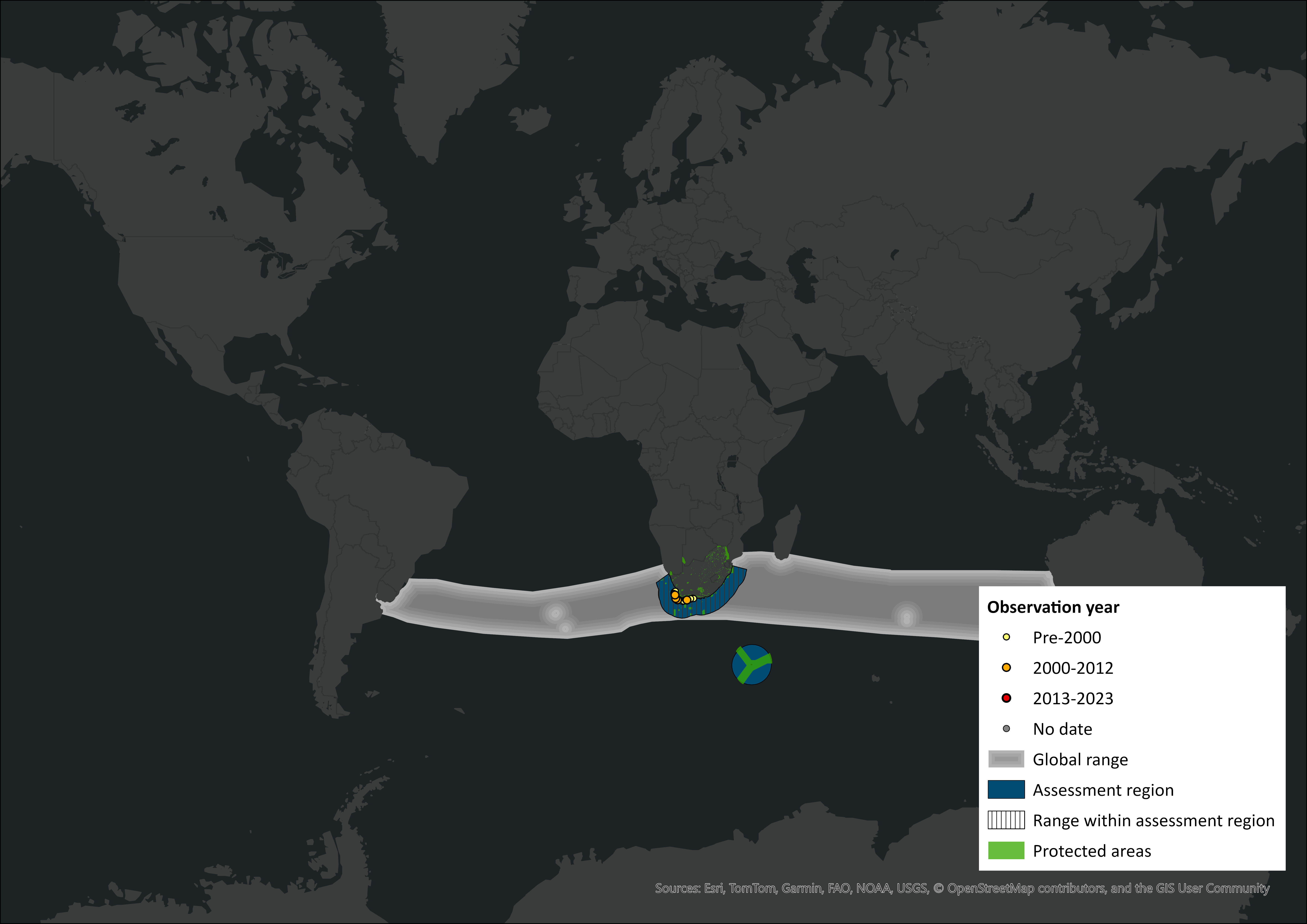 Figure 1. Distribution records for Ramari’s Beaked Whale (Mesoplodon eueu) within the assessment region (South Africa, Eswatini and Lesotho). Note that distribution data is obtained from multiple sources and records have not all been individually verified.
Biogeographic Realms
Biogeographic Realm: Afrotropical, Australasian, Neotropical
Occurrence
Countries of Occurrence
| Country | Presence | Origin | Formerly Bred | Seasonality |
| Australia | Extant | Native | – | – |
| Australia -> Tasmania | Extant | Possible vagrant | – | – |
| Australia -> Victoria | Extant | Possible vagrant | – | – |
| Australia -> Western Australia | Extant | Native | – | – |
| Brazil | Extant | Possible vagrant | – | – |
| Mozambique | Extant | Native | – | – |
| South Africa | Extant | Native | – | – |
| South Africa -> Eastern Cape Province | Extant | Native | – | – |
| South Africa -> KwaZulu-Natal | Extant | Native | – | – |
| South Africa -> Western Cape | Extant | Native | – | – |
| New Zealand | Extant | Possible vagrant | ||
| New Zealand -> South Is. | Extant | Possible vagrant | – | – |
| Saint Helena, Ascension and Tristan da Cunha -> Tristan da Cunha | Extant | Possible vagrant | ||
| Uruguay | Extant | Possible vagrant |
Large Marine Ecosystems (LME) Occurrence
Large Marine Ecosystems: (Not specified)
FAO Area Occurrence
| Presence | Origin | Formerly Bred | Seasonality | |
| 41. Atlantic – southwest | Extant | Possible vagrant | ||
| 47. Atlantic – southeast | Extant | Native | – | – |
| 51. Indian -eastern | Extant | Possible vagrant | ||
| 57. Indian Ocean – eastern | Extant | Native | – | – |
| 81. Pacific – southwest | Extant | Possible vagrant |
Climate change
The specific effects of climate change on Ramari’’s beaked whales is currently unknown however it has been suggested that similar to other cetaceans, beaked whales will likely undergo extensive range shift towards higher latitudes where they may be exposed to additional stressors such as increased noise exposure, interactions with fisheries, incidence of disease outbreaks and risk of ship strikes as well as reduced prey availability (Feyrer et al. 2024). Drastic reductions in suitable habitat and available prey for beaked whales due to climate change may result in future population declines, which would be difficult to quantify give the scarcity of abundance, life history and population level information we currently have for many beaked whale species.
Population information
Due to their wide distribution, assumed preference for deep water habitat, and cryptic behaviour, there are no data on their abundance and population trends in Southern African waters.
Continuing decline in mature individuals? Unknown
Extreme fluctuations in the number of subpopulations: Unknown
Continuing decline in number of subpopulations: Unknown
All individuals in one subpopulation: Unknown
Number of mature individuals in largest subpopulation: Unknown (Not specified)
Number of Subpopulations: Unknown
Quantitative Analysis
Probability of extinction in the wild within 3 generations or 10 years, whichever is longer, maximum 100 years: Unknown
Probability of extinction in the wild within 5 generations or 20 years, whichever is longer, maximum 100 years: Unknown
Probability of extinction in the wild within 100 years: Unknown
Population genetics
Population level genetic studies have been able to inform this species’ status within the genus, however more finescale genomic studies with more comprehensive sampling across the distribution have yet to be undertaken. With that said, it is expected that this species is continuous and connected across its distribution. No substructure is anticipated within the assessment region.
Historical estimates of effective population size (Ne) derived from whole-genome data using PSMC simulated and propose and approximately 17,000 mature individuals are estimated to have existed during the last glacial maximum across the southern hemisphere. While historical effective population size (Ne) estimates are not accurate for informing current Ne, they can inform the relative trend of the population growth or decline. Based on the available data, the population has undergone an expansion during recent evolutionary time.
Habitats and ecology
Little is known about the key behavioural and ecological characteristics of Ramari’s Beaked Whale, but it is possible that their behaviour is similar to the closely related True’s Beaked Whale. Typically, True’s Beaked Whale occurs in deep, offshore waters, and are considered to have long, deep-diving capabilities (MacLeod & Mitchell 2006). Their occurrence is generally associated with topographic features, including slopes, escarpments, canyons and oceanic islands (Macleod et al. 2006). The stomach contents of stranded Ramari’s beaked whales suggest that their primary food source includes deep-water, mesopelagic cephalopods in addition to unidentified species of fish (Ross 1984, Sekiguchi et al. 1992, Constantine et al. 2014). Beaked whales are believed to be suction feeders (Heyning & Mead 1996).
Ecosystem and cultural services: Marine mammals integrate and reflect ecological variation across large spatial and long temporal scales, and therefore they are prime sentinels of marine ecosystem change; migratory whales may be used to investigate broad-scale shifts in ecosystems (Moore 2008).
IUCN Habitats Classification Scheme
| Habitat | Season | Suitability | Major Importance? |
| 10.1. Marine Oceanic -> Marine Oceanic – Epipelagic (0-200m) | – | Unknown | – |
| 10.2. Marine Oceanic -> Marine Oceanic – Mesopelagic (200-1000m) | – | Probably suitable | Yes |
| 10.3. Marine Oceanic -> Marine Oceanic – Bathypelagic (1000-4000m) | – | Probably suitable | Yes |
Life History
Generation Length: Unknown
Age at Maturity: Female or unspecified: Unknown
Age at Maturity: Male: Unknown
Size at Maturity (in cms): Female: 450 cm (Best 2007)
Size at Maturity (in cms): Male: 450 – 460 cm (Best 2007)
Longevity: Unknown
Average Reproductive Age: Unknown
Maximum Size (in cms): 533 cm (Best 2007)
Size at Birth (in cms): 220 cm (Ross 1984)
Gestation Time: Unknown
Reproductive Periodicity: Unknown
Average Annual Fecundity or Litter Size: Probably one
Natural Mortality: Unknown
Does the species lay eggs? No
Does the species give birth to live young: Yes
Does the species exhibit parthenogenesis: No
Does the species have a free-living larval stage? No
Does the species require water for breeding? Yes
Movement Patterns
Movement Patterns: Unknown
Congregatory: Unknown
Systems
System: Marine
General Use and Trade Information
In general, beaked whales in the southern hemisphere are not utilised or traded commercially. In Mozambique however stranded animals (such as the Ramari’s beaked whale which stranded in 2019) may be utilised as marine bushmeat for consumption by local communities (Reeve-Arnold et al. 2020).
Local Livelihood: None
National Commercial Value: None
International Commercial Value: None
End Use: None
Is there harvest from captive/cultivated sources of this species? None
Harvest Trend Comments: Not applicable
Threats
There appear to be no major threats to beaked whales. However, anthropogenic noise pollution has become an increasing and well-known threat to beaked whales, as they appear to be more vulnerable to noise pollution (for example, from seismic exploration and navy sonar) than other cetacean species (Barlow & Gisner 2006, Dalebout et al. 2005). Within the assessment region, marine noise pollution is intensifying due to coastal industrial development, shipping traffic and energy exploration, and thus represents a potential threat. The threats facing this species are persistent organic pollutants, toxic metals and plastics (Feyrer et al. 2024).
Plastic pollution is a large-scale and increasing problem in all marine environments. The ingestion of plastic marine pollution has been documented in other species of beaked whales and may eventually lead to mortality as a result of choking, a reduction in appetite or starvation (e.g. Scott et al. 2001).
Accidental entanglement of beaked whales in general in fisheries is widespread, particularly in deep-water gillnets, although the number of recorded mortalities is not high. (Jefferson et al. 1993, Julian & Beeson 1998).
There is substantial evidence of large-scale reductions in many predatory fish populations (Baum et al. 2005; Polacheck 2006; Sibert et al. 2006), over-fishing and the collapse of several important prey fish stocks world-wide (e.g. Jackson et al. 2001). However, Ramari’s Beaked Whales are thought to feed primarily on squid (Ross 1984, Sekiguchi et al. 1992, Constantine et al. 2014).
The marine-related threats associated with global climate change may pose unquantified and complex threats to all species of beaked whales, particularly within cool temperate habitats (Learmonth et al. 2006). Increasing ocean temperatures may result in range shift or contraction (Learmonth et al. 2006); however, no direct predictions pertaining to the direction or size of these shifts in range are currently known.
Unlike many whale species, beaked whales in general have not experienced large-scale historic or recent exploitation. This may be attributed to their general scarcity and inconspicuous nature, deep-sea distributions and/or deep-diving behaviour.
Conservation
More research into the distribution, abundance, migration patterns, bycatch rate and diet of all species of beaked whales is essential for the effective development of species-specific mitigation measures for these species in South African waters. Mitigation measures associated with anthropogenic marine noise is probably most vital for Ziphiidae species locally and world-wide. Due to their cryptic behaviour, mitigation of noise pollution based on observation is likely to be ineffective for these species. Additionally, avoidance of Ramari’s Beaked Whale habitats in Southern African waters is currently challenging due to their wide distribution, and the lack of data on habitat preferences and range in this region.
Passive acoustic monitoring is a valuable technique used to detect marine mammals in order to modify marine activities so as to avoid the animals, decrease the amplitude or temporarily stop the source of sound when animals are within a critical distance (Barlow & Gisiner 2005). Although beaked whales are acoustically difficult to detect, all species are assumed to give off echolocation clicks, some may also produce whistles (MacLeod & D’Amico 2006). Generally, the clicks of Ziphiidae species have narrower bands than those of other marine mammals of a similar frequency, thus electronic filtering methods may be more effective than other methods (Barlow & Gisiner 2005).
Maintaining sightings records of Ramari’s Beaked Whales, during ship-based surveys directed at other species, will be a valuable means with which to monitor the distribution and abundance of this cryptic and unknown species in South African waters.
Ramari’s Beaked Whale is listed either on Appendix I or II of the Convention on International Trade in Endangered Species of Wild Fauna and Flora (CITES).
Recommendations for managers and practitioners:
- Critical habitats, and areas where the species concentrates should be identified to more effectively mitigate noise pollution.
- Continued work by, and more support of, stranding response networks and museums.
Research priorities:
- Abundance and population trends.
- Effects of marine noise pollution and plastic pollution.
- The identification of areas of high concentration in Southern African waters, including distributional limits, seasonal movements and diving behaviour.
- Diet, reproduction and general biology.
Encouraged citizen actions:
- Report strandings to stranding networks.
- Report sightings at sea on virtual museum platforms (for example, iNaturalist and MammalMAP) to help with mapping geographical distribution.
- Proper disposal of plastic and other waste items.
- Mitigate CO2 emissions and hence the rate of climate change.
Bibliography
Barlow, J. and Gisiner, R. 2006. Mitigating, monitoring and assessing the effects of anthropogenic sound on beaked whales. Journal of Cetacean Research and Management 7(3): 239-250.
Baum, J.K., Kehler, D.G. and Myers, R.A. 2005. Robust estimates of decline for pelagic shark populations in the northwest Atlantic and Gulf of Mexico. Fisheries 2005: 27-29.
Best, P.B. 2007. Whales and Dolphins of the Southern African Subregion. Cambridge University Press, Cape Town, South Africa.
Best, P.B. 2007. Whales and Dolphins of the Southern African Subregion. Cambridge University Press, Cape Town, South Africa. 338 pp.
Best, P.B., Glass, J.P., Ryan, P.G., and Dalebout, M,L, 2009. Cetacean records from Tristan da Cunha, South Atlantic. Journal of the Marine Biological Association or the United Kingdom 89: 1023-1032.
Carroll E, McGowen M, McCarthy ML, Marx FG, Aguilar N, Dalebout M, Gaggiotti OE, Hansen SS, van Helden A, Nielsen SD, Onoufriou A, Baker CS, Berrow S, Cholewiak D, Constantine R, Ferreira M, Gatesy J, Hofmeyr GJG, Martín V, Mead J, Mignucci A, Morin P, Reyes C, Rogan E, Rosso M, Silva M, Springer M, Steel D, Tange Olsen M (2021) Speciation in the abyss: genomics and morphology reveal a new species of beaked whale – Mesoplodon eueu. Proceedings of the Royal Society Series B 288: 20211213.
Constantine R, Carroll EL, Stewart R, Neale D, Van Helden A 2014. First record of True’s beaked whale Mesoplodon mirus in New Zealand. Marine Biodiversity Record 7, e1
Cox, T.M., Ragen, T.J., Read, A.J., Vos, E., Baird, R.W., Balcomb, K., Barlow, J., Caldwell, J., Cranford, T., Crum, L., D’Amico, A., D’Spain, A., Fernández, J., Finneran, J., Gentry, R., Gerth, W., Gulland, F., Hildebrand, J., Houser, D., Hullar, T., Jepson, P.D., Ketten, D., Macleod, C.D., Miller, P., Moore, S., Mountain, D., Palka, D., Ponganis, P., Rommel, S., Rowles, T., Taylor, B., Tyack, P., Wartzok, D., Gisiner, R., Mead, J. and Benner, L. 2006. Understanding the impacts of anthropogenic sound on beaked whales. Journal of Cetacean Research and Management 7(3): 177-187.
Dixon, J.M. and Frigo, L. 1994. The cetacean collection of the Museum of Victoria. An annotated catalogue. Australian Deer Foundation, Croyden, Australia. 44pp.
Feyrer, L.J., Stanistreet, J.E. and H.B. Moors-Murphy. 2024-Navigating the unknown: assessing anthropogenic threats to beaked whales, family Ziphiidae. Royal Society Open Science 11: 240058.
Groom CJ, Coughran DK and Smith HC 2014. Records of beaked whales (family Ziphiidae) in Western Australian waters. Marine Biodiversity Records 7: e50
Heyning, J. E. and Mead, J. G. 1996. Suction feeding in beaked whales: morphological and observational evidence. Natural History Museum of Los Angeles County, Contributions in Science 464: 12.
Jackson, J. B. C., Kirby, M. X., Berger, W. H., Bjorndal, K. A., Botsford, L. W., Bourque, B. J., Bradbury, R. H., Cooke, R., Erlandson, J., Estes, J. A., Hughes, T. P., Kidwell, S., Lange, C. B., Lenihan, H. S., Pandolfi, J. M., Peterson, C. H., Steneck, R. S., Tegner, M. J. and Warner, R. R. 2001. Historical overfishing and the recent collapse of coastal ecosystems. Science 293: 629-637.
Jefferson, T. A., Leatherwood, S. and Webber, M. A. 1993. Marine Mammals of the World: FAO Species Identification Guide. United Nation Environment Programme and Food and Agricultural Organization of the UN.
Julian, F. and Beeson, M. 1998. Estimates of marine mammal, turtle, and seabird mortality for two California gillnet fisheries: 1990-95. Fishery Bulletin 96: 271-284.
Learmonth, J.A., Macleod, C.D., Santos, M.B., Pierce, G.J., Crick, H.Q.P. and Robinson, R.A. 2006. Potential effects of climate change on marine mammals. Oceanography and Marine Biology: An Annual Review 44: 431-464.
MacLeod, C. D., W. F. Perrin, R. L. Pitman, J. Barlow, L. Balance, A. D’Amico, T. Gerrodette, G. Joyce, K. D. Mullin, D. L. Palka, G. T. Waring. 2006. Known and inferred distributions of beaked whale species (Ziphiidae: Cetacea). Journal of Cetacean Research and Management 7(3): 271-286.
MacLeod, C. D., and D’Amico, A. 2006. A review of beaked whale behaviour and ecology in relation to assessing and mitigating impacts of anthropogenic noise. Journal of Cetacean Research and Management 7: 211-221.
MacLeod CD and Mitchell G 2006. Key areas for beaked whales worldwide. Journal of Cetacean management and Research 7: 309-322
Moore SE. 2008. Marine mammals as ecosystem sentinels. Journal of Mammalogy 89: 534-540.
Moritz, C. 1994. Defining ‘Evolutionarily Significant Units’ for conservation. Trends in Ecology and Evolution 9: 373–375.
Pitman R 2018. Mesoplodon beaked whales In: W. F. Perrin, B. Wursig and J. G. M. Thewissen (eds), Encyclopedia of Marine Mammals, pp. ???-??? Academic Press, San Diego, USA.
Polacheck, T. 2006. Tuna longline catch rates in the Indian Ocean: did industrial fishing result in a 90% rapid decline in the abundance of large predatory species? Marine Policy 30: 470-482.
Reeve-Arnold KE, Keeping JA, Cockcroft VG, Guissamulo A 2020. New strandings of True’s beaked whale, Mesoplodon mirus, in Mozambique and their destiny as marine bushmeat. WIO Journal of Marine Science. 19: 167-173
Ross, G. J. B. 1984. The smaller cetaceans of the south east coast of southern Africa. Annals of the Cape Provincial Museums (Natural History) 15: 173-410.
Ross, G.J.B. 2006. Review of the conservation status of Australia’s smaller whales and dolphins. Report to the Australian Department of the Environment and Heritage, Canberra. 124pp.Scott, M. D., Hohn, A. A., Westgate, A. J., Nicolas, J. R., Whitaker, B. R. and Campbell, W. B. 2001. A note on the release and tracking of a rehabilitated pygmy sperm whale (Kogia breviceps). Journal of Cetacean Research and Management 3(1): 87-94.
Sekiguchi, K., Klages, N.T.W. and Best, P.B. 1992. Comparative analysis of the diets of smaller odontocete cetaceans along the coast of southern Africa. South African Journal of Marine Science 12: 843-861.
Sibert, J., Hampton, J., Kleiber, P. and Maunder, M. 2006. Biomass, size, and trophic status of top predators in the Pacific Ocean. Science 314: 1773-1776.
Souza SP, Siciliano S, Cuenca S, Sanctis B 2005. A True’s beaked whale (Mesoplodon mirus) on the coast of Brazil: adding a new beaked whale species to the Western Tropical Atlantic and South America. Latin American Journal of Aquatic Mammals. 4: 129-136.
Valdivia, M., Frones, L., Rossini, E., Laporta, P., Carroll, E.L., McGowen, M.R., Marx, F.G. and N. Ríos. 2024. First record of Ramari’s beaked whale Mesoplodon eueu (Cetacea: Ziphiidae) for Uruguay. Journal of the Marine Biological Association of the United Kingdom 104: e7.