
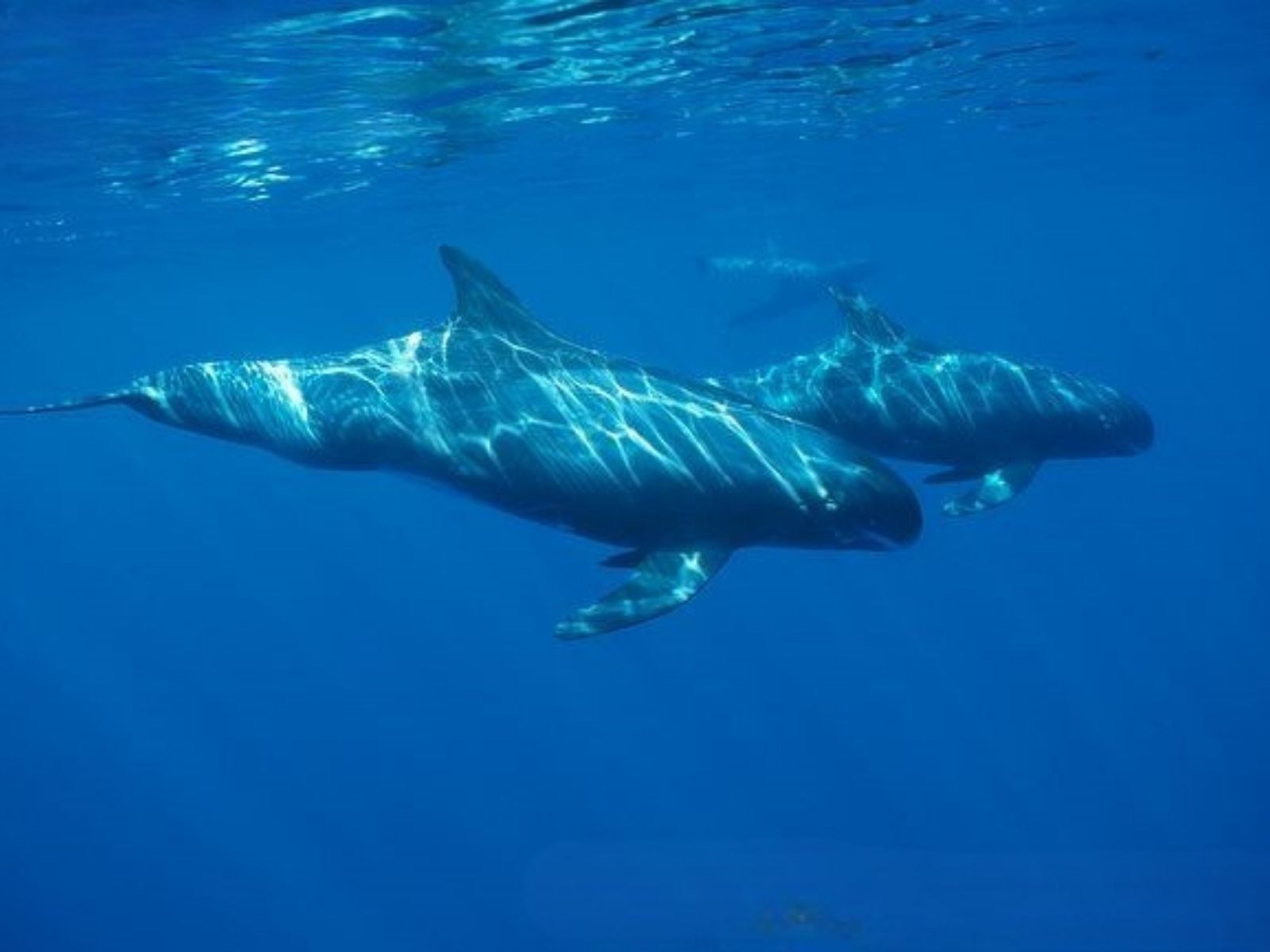
Pygmy Killer Whale
Feresa attenuata

2025 Red list status
Least Concern

Regional Population Trend
Unknown

Change compared
to 2016
No Change
Overview
Feresa attenuata – Gray, 1875
ANIMALIA – CHORDATA – MAMMALIA – ARTIODACTYLA – DELPHINIDAE – Feresa – attenuata
Common Names: Pygmy Killer Whale, Slender Blackfish, Slender Pilot Whale (English), Dwergmoordvis (Afrikaans), Orca Pigmeo (Spanish; Castilian), Orque pygmée (French)
Synonyms: Feresa attenuata Gray, 1875
Taxonomic Note:
Pygmy Killer Whales (Feresa attenuata) are easily confused with Melon-Headed Whales (Peponocephala electra) in the field because of their similar external morphology (Jefferson et al. 2015). Before 1952 this species was identified from only two skulls, which had each been described as type specimens of two separate species, namely intermedius (J. E. Gray 1827), and attenuata (J. E. Gray 1874), although Gray (1975) is inaccurately cited by most authors as the original description of this species (Caldwell & Caldwell 1971; Jeyabaskaran et al. 2011). However, these skulls have now both been recognised as specimens of F. attenuata, and in 1952, an individual was caught in the seas off Japan, providing the first evidence of the Pygmy Killer Whale’s physical appearance (Yamada 1954). Subsequently, this species has been reported from the Pacific, Atlantic and Indian Oceans, thus it is now known to have a circumglobal distribution (Caldwell & Caldwell 1971).
Red List Status: LC – Least Concern, (IUCN version 3.1)
Assessment Information
Assessor: Purdon, J.1,2
Reviewer: Smith, C.3
Contributor: da Silva, J.4
Institutions: 1TUT Nature Conservation, 2The Whale Unit, University of Pretoria, 3Endangered Wildlife Trust, 4South African National Biodiversity Institute
Previous Assessors: Plön, S. & Cockcroft, V.
Previous Reviewer: Child, M.F.
Previous Contributors: Preston-Whyte, F., Relton, C., Atkins, S., Findlay, K., Meyer, M., Oosthuizen, H. & Elwen, S.
Assessment Rationale
This species is listed as Least Concern, due to the suspected distribution pattern of the species as far offshore, its rarity in the assessment region, and the perceived lack of major threats that could cause rapid decline. The cost-benefit ratio makes research unlikely and places the Pygmy Killer Whale low on the list of conservation priorities. Despite this classification, the potential pressures that threaten most cetacean species, such as high intensity sound pollution and bycatch in fisheries, are likely to be increasing in South African waters. Such threats should be monitored for their impacts on this species.
Regional population effects: Pygmy Killer Whales are thought to occur seasonally in South African waters (Findlay 1989), and although their movement patterns are largely unknown, no barriers to dispersal are recognised, thus rescue effects are possible.
Reasons for Change
Reason(s) for Change in Red List Category from the Previous Assessment: No change
Red List Index
Red List Index: No change
Recommended citations: Purdon J. 2025. A conservation assessment of Feresa attenuata. In Patel T, Smith C, Roxburgh L, da Silva JM & Raimondo D, editors. The Red List of Mammals of South Africa, Eswatini and Lesotho. South African National Biodiversity Institute and Endangered Wildlife Trust, South Africa.
Regional Distribution and occurrence
Geographic Range
This is a tropical, subtropical, and possibly warm-temperate species that inhabits the pelagic waters, of all major oceans, found mainly off the continental shelf. Pygmy Killer Whales are known to migrate into warmer waters due to physiological requirements (Caldwell & Caldwell 1971). The distribution of this species has been mapped mainly from strandings and skulls, sited internationally around Japan, the Hawaiin Islands, the Caribbean Sea and Senegal. The Southern African distribution is known from Kosi Bay to the Orange River with sightings around Richards Bay (Bass 1968; Best 1970), Durban, Cape Town and Lüderitz (Best 1970; Caldwell & Caldwell 1971).
Elevation / Depth / Depth Zones
Elevation Lower Limit (in metres above sea level): (Not specified)
Elevation Upper Limit (in metres above sea level): (Not specified)
Depth Lower Limit (in metres below sea level): (Not specified)
Depth Upper Limit (in metres below sea level): (Not specified)
Depth Zone: (Not specified)
Map
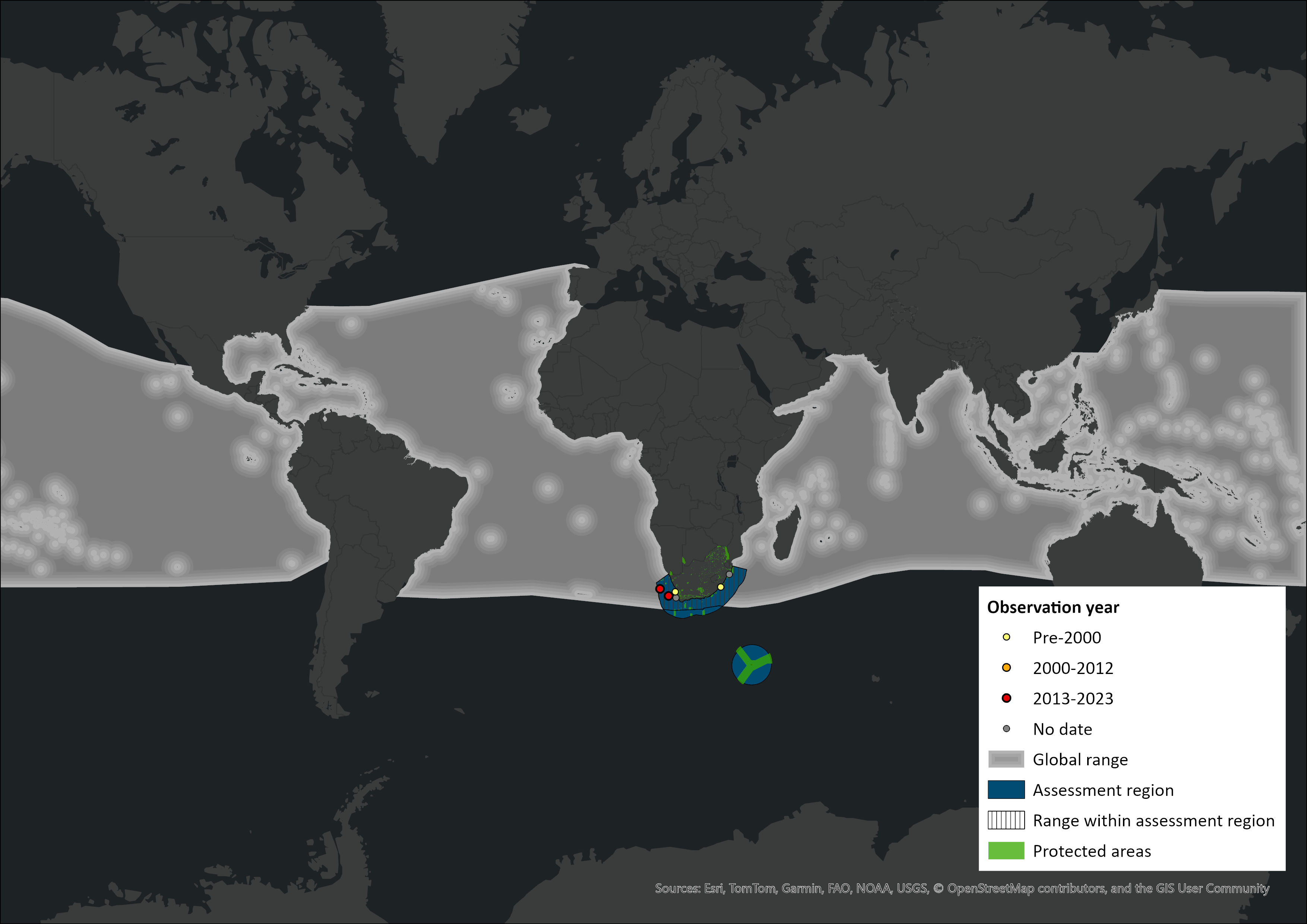 Figure 1. Distribution records for Pygmy Killer Whale (Feresa attenuata) within the assessment region (South Africa, Eswatini and Lesotho). Note that distribution data is obtained from multiple sources and records have not all been individually verified.
Biogeographic Realms
Biogeographic Realm: Afrotropical, Australasian, Indomalayan, Nearctic, Neotropical, Oceanian, Palearctic
Occurrence
Countries of Occurrence
| Country | Presence | Origin | Formerly Bred | Seasonality |
| Algeria | Extant | Native | – | – |
| Angola | Presence Uncertain | Native | – | – |
| Anguilla | Extant | Native | – | – |
| Antigua and Barbuda | Extant | Native | – | – |
| Aruba | Extant | Native | – | – |
| Australia | Extant | Native | – | – |
| Bahamas | Extant | Native | – | – |
| Bangladesh | Extant | Native | – | – |
| Barbados | Extant | Native | – | – |
| Belize | Extant | Native | – | – |
| Benin | Extant | Native | – | – |
| Bonaire, Sint Eustatius and Saba | Extant | Native | – | – |
| Brazil | Extant | Native | – | – |
| Brunei Darussalam | Extant | Native | – | – |
| Cambodia | Extant | Native | – | – |
| Cameroon | Extant | Native | – | – |
| Cayman Islands | Extant | Native | – | – |
| China | Extant | Native | – | – |
| Cocos (Keeling) Islands | Extant | Native | – | – |
| Colombia | Extant | Native | – | – |
| Comoros | Extant | Native | – | – |
| Congo | Extant | Native | – | – |
| Congo, The Democratic Republic of the | Extant | Native | – | – |
| Cook Islands | Extant | Native | – | – |
| Costa Rica | Extant | Native | – | – |
| Cuba | Extant | Native | – | – |
| Curaçao | Extant | Native | – | – |
| Côte d’Ivoire | Extant | Native | – | – |
| Djibouti | Extant | Native | – | – |
| Dominica | Extant | Native | – | – |
| Dominican Republic | Extant | Native | – | – |
| Ecuador | Extant | Native | – | – |
| El Salvador | Extant | Native | – | – |
| Equatorial Guinea | Extant | Native | – | – |
| Fiji | Extant | Native | – | – |
| France | Extant | Native | – | – |
| French Guiana | Extant | Native | – | – |
| French Polynesia | Extant | Native | – | – |
| Gabon | Extant | Native | – | – |
| Gambia | Extant | Native | – | – |
| Ghana | Extant | Native | – | – |
| Grenada | Extant | Native | – | – |
| Guam | Extant | Native | – | – |
| Guatemala | Extant | Native | – | – |
| Guinea | Extant | Native | – | – |
| Guinea-Bissau | Extant | Native | – | – |
| Guyana | Extant | Native | – | – |
| Haiti | Extant | Native | – | – |
| Honduras | Extant | Native | – | – |
| India | Extant | Native | – | – |
| Indonesia | Extant | Native | – | – |
| Iran, Islamic Republic of | Extant | Native | – | – |
| Italy | Extant | Native | – | – |
| Jamaica | Extant | Native | – | – |
| Japan | Extant | Native | – | – |
| Kenya | Extant | Native | – | – |
| Kiribati | Extant | Native | – | – |
| Korea, Republic of | Extant | Native | – | – |
| Liberia | Extant | Native | – | – |
| Madagascar | Extant | Native | – | – |
| Malaysia | Extant | Native | – | – |
| Malaysia -> Peninsular Malaysia | Extant | Native | – | – |
| Malaysia -> Sabah | Extant | Native | – | – |
| Malaysia -> Sarawak | Extant | Native | – | – |
| Maldives | Extant | Native | – | – |
| Marshall Islands | Extant | Native | – | – |
| Mauritania | Extant | Native | – | – |
| Mayotte | Extant | Native | – | – |
| Mexico | Extant | Native | – | – |
| Micronesia, Federated States of | Extant | Native | – | – |
| Morocco | Extant | Native | – | – |
| Mozambique | Extant | Native | – | – |
| Myanmar | Extant | Native | – | – |
| Namibia | Presence Uncertain | Native | – | – |
| Nauru | Extant | Native | – | – |
| New Caledonia | Extant | Native | – | – |
| Nicaragua | Extant | Native | – | – |
| Nigeria | Extant | Native | – | – |
| Niue | Extant | Native | – | – |
| Northern Mariana Islands | Extant | Native | – | – |
| Oman | Extant | Native | – | – |
| Pakistan | Extant | Native | – | – |
| Palau | Extant | Native | – | – |
| Panama | Extant | Native | – | – |
| Papua New Guinea | Extant | Native | – | – |
| Peru | Extant | Native | – | – |
| Philippines | Extant | Native | – | – |
| Pitcairn | Extant | Native | – | – |
| Portugal | Extant | Native | – | – |
| Puerto Rico | Extant | Native | – | – |
| Saint Barthélemy | Extant | Native | – | – |
| Saint Kitts and Nevis | Extant | Native | – | – |
| Saint Martin (French part) | Extant | Native | – | – |
| Saint Vincent and the Grenadines | Extant | Native | – | – |
| Samoa | Extant | Native | – | – |
| Senegal | Extant | Native | – | – |
| Seychelles | Presence Uncertain | Native | – | – |
| Sierra Leone | Extant | Native | – | – |
| Singapore | Extant | Native | – | – |
| Sint Maarten (Dutch part) | Extant | Native | – | – |
| Solomon Islands | Extant | Native | – | – |
| Somalia | Extant | Native | – | – |
| South Africa | Extant | Native | – | – |
| Spain | Extant | Native | – | – |
| Sri Lanka | Extant | Native | – | – |
| Suriname | Extant | Native | – | – |
| Taiwan, Province of China | Extant | Native | – | – |
| Tanzania, United Republic of | Extant | Native | – | – |
| Thailand | Extant | Native | – | – |
| Timor-Leste | Extant | Native | – | – |
| Togo | Extant | Native | – | – |
| Tokelau | Extant | Native | – | – |
| Tonga | Extant | Native | – | – |
| Trinidad and Tobago | Extant | Native | – | – |
| Tuvalu | Presence Uncertain | Native | – | – |
| United States of America | Extant | Native | – | – |
| Uruguay | Presence Uncertain | Native | – | – |
| Vanuatu | Presence Uncertain | Native | – | – |
| Venezuela, Bolivarian Republic of | Extant | Native | – | – |
| Viet Nam | Extant | Native | – | – |
| Virgin Islands, British | Extant | Native | – | – |
| Virgin Islands, U.S. | Extant | Native | – | – |
| Wallis and Futuna | Extant | Native | – | – |
| Western Sahara | Extant | Native | – | – |
| Yemen | Extant | Native | – | – |
Large Marine Ecosystems (LME) Occurrence
Large Marine Ecosystems: (Not specified)
FAO Area Occurrence
| Presence | Origin | Formerly Bred | Seasonality | |
| 31. Atlantic – western central | Extant | Native | – | – |
| 34. Atlantic – eastern central | Extant | Native | – | – |
| 41. Atlantic – southwest | Extant | Native | – | – |
| 47. Atlantic – southeast | Extant | Native | – | – |
| 51. Indian Ocean – western | Extant | Native | – | – |
| 57. Indian Ocean – eastern | Extant | Native | – | – |
| 61. Pacific – northwest | Extant | Native | – | – |
| 71. Pacific – western central | Extant | Native | – | – |
| 77. Pacific – eastern central | Extant | Native | – | – |
| 81. Pacific – southwest | Extant | Native | – | – |
| 87. Pacific – southeast | Extant | Native | – | – |
Climate change
Pygmy Killer Whales are found in tropical and subtropical waters. With temperatures expected to rise, it is possible that their habitat range will shift further south where water temperatures will be within their preferred range (Kebke et al. 2021). Pygmy Killer Whales distribution will ultimately be reliant on their prey species. In the assessment area stomach contents of stranded Pygmy Killer Whales have indicated that prey may consist of squid, hake (Merluccius sp.) and goby (Sufflogobius bibarbatus) (Best 2007). Through models, climate change has been shown to affect prey species by both a reduction in prey species and a shift in their distribution (Kebke et al. 2021). A recent paper by Currie et al. (2021) highlighted that without food Pygmy Killer Whales can lose 2% of their body weight per day. With reduced prey availability this will have consequences for the population as a whole. Climate change will also increase the concentration of contaminants in the marine environment. The full consequences of these contaminants are unknown but will ultimately have an effect on fecundity and population (Derville et al. 2019, Kebke et al. 2021).
Population
This species is considered naturally rare and, based on the few existing datasets, occurs at much lower densities compared to other cetaceans (Jeyabaskaran et al. 2011). The IUCN estimates the eastern tropical Pacific population to be around 38,900 individuals (Yajing et al. 2018, Wade & Gerrodette 1993). This estimate has a high coefficient of variation, indicating a possible overestimation or an underestimation of individuals. In the assessment area, there have been no estimates of the population size. A very low frequency of Pygmy Killer Whale strandings have been documented in South Africa, and similarly, sightings records are extremely uncommon. In August 1969, 11 individuals were sighted off KwaZulu-Natal in waters between 1,000–2,000 m deep (Findlay et al. 1992). Between 1970 and 2023 there have been 11 strandings of Pygmy Killer Whales, of which two occurred along the Namibian coastline (unpublished whale unit data). The majority of strandings occurred on the south coast close to Qheberha, with only two close to Cape point.
| Continuing decline in mature individuals? | Qualifier | Justification |
| Unknown | – | – |
Current population trend: Unknown
Number of mature individuals in population: Unknown
Number of mature individuals in largest subpopulation: Unknown
Number of subpopulations: Unknown
Severely fragmented: No
Extreme fluctuations in the number of subpopulations: (Not specified)
Continuing decline in number of subpopulations: (Not specified)
All individuals in one subpopulation: (Not specified)
Number of Subpopulations: (Not specified)
Quantitative Analysis
Probability of extinction in the wild within 3 generations or 10 years, whichever is longer, maximum 100 years: (Not specified)
Probability of extinction in the wild within 5 generations or 20 years, whichever is longer, maximum 100 years: (Not specified)
Probability of extinction in the wild within 100 years: (Not specified)
Population Genetics
There has been no genetic worked conducted on Pygmy Killer Whales in the assessment area. There has however been some genetic analysis on pygmy whales using samples from the Philippines (n=3), Taiwan (n=4), Maldives (n=1), Guam (n=3), Hawaii Pelagic (n=4), Hawaiian Islands (n=21), California (n=2), New Caledonia (n=6), Fiji (n=1), US Atlantic Coast (n=9), Gulf of Mexico (n=3), Puerto Rico (n=2), Eastern Tropical Pacific (ETP) (n=12). This study by Hancock-Hanser et al (2015) showed that the nucleotide divergence between other regions of the world and the Philippines is higher than many other cetacean species that are recognised. They recommended that the taxonomy of the Pygmy Killer Whale be revised. The lack of genetic information on Pygmy Killer Whales in South Africa is worrisome as information about this species is sparse and their conservation status unknown. This highlights the importance of genetic testing of stranded pygmy whale specimens in South Africa.
While genetic evidence is non-existent in the region, it is expected that the species exists as a single population. With this assumption we can quantify the proportion of populations maintained as 1.0 (i.e., it is still present).
Habitats and ecology
This species presumably occurs in deep, tropical waters, but has occasionally been documented entering temperate regions. Their distribution is generally restricted to regions far offshore, beyond the edge of the continental shelf, in waters between 120–1,000 m deep (Jeyabaskaran et al. 2011). However, in warmer regions, they are known to occur along the coastline, especially around some oceanic islands, for example Hawaii (Wade & Gerrodette 1993).
Although only limited records of this species in South African waters are available, they are generally assumed to form small pods of less than 15 individuals (Ross & Leatherwood 1994), and Findlay (1989) suggests that they may have a summer–autumn seasonality in the assessment region. However, in the eastern Pacific, as many as 70 individuals have been recorded simultaneously. Association analyses of Pygmy Killer Whales observed off Hawaii revealed that this species forms mixed-sex groups with stable, long-term bonds between individuals (McSweeney et al. 2009).
Although, little information is available on the diet of Pygmy Killer Whales, they are thought to feed predominantly on fish and squid. The stomach contents of a specimen stranded in the Eastern Cape was found to have fed on unidentified cephalopods (Ross 1984). Sekiguchi et al. (1992) documented that the stomach of one individual contained goby (Sufflogobius bibarbatus) and hake (Merluccius spp.).
Pygmy Killer Whales are considered aggressive, especially in captivity where they will kill and savage other dolphins. For example, an individual caught in South Africa and contained in a tank with four Dusky Dolphins (Lagenorhynchus obscurus), killed one of the Dusky Dolphins and brutally attacked another (Best 1970). Furthermore, Pygmy Killer Whales have been witnessed attacking dolphins (Stenella spp.) around purse-seine tuna fisheries in the eastern Pacific (Perryman & Foster 1980).
Ecosystem and cultural services: Marine mammals integrate and reflect ecological variation across large spatial and long temporal scales, and therefore they are prime sentinels of marine ecosystem change (Moore 2008).
IUCN Habitats Classification Scheme
| Habitat | Season | Suitability | Major Importance? |
| 10.1. Marine Oceanic -> Marine Oceanic – Epipelagic (0-200m) | – | Marginal | – |
| 10.2. Marine Oceanic -> Marine Oceanic – Mesopelagic (200-1000m) | – | Suitable | Yes |
| 10.3. Marine Oceanic -> Marine Oceanic – Bathypelagic (1000-4000m) | – | Suitable | Yes |
Life History
Generation Length: (Not specified)
Age at Maturity: Female or unspecified: (Not specified)
Age at Maturity: Male: (Not specified)
Size at Maturity (in cms): Female: (Not specified)
Size at Maturity (in cms): Male: (Not specified)
Longevity: (Not specified)
Average Reproductive Age: (Not specified)
Maximum Size (in cms): (Not specified)
Size at Birth (in cms): (Not specified)
Gestation Time: (Not specified)
Reproductive Periodicity: (Not specified)
Average Annual Fecundity or Litter Size: (Not specified)
Natural Mortality: (Not specified)
Does the species lay eggs? (Not specified)
Does the species give birth to live young: (Not specified)
Does the species exhibit parthenogenesis: (Not specified)
Does the species have a free-living larval stage? (Not specified)
Does the species require water for breeding? (Not specified)
Movement Patterns
Movement Patterns: (Not specified)
Congregatory: (Not specified)
Systems
System: Marine
General Use and Trade Information
This species is not utilised or traded within the assessment region.
| Subsistence: | Rationale: | Local Commercial: | Further detail including information on economic value if available: |
| Yes | – | – | – |
National Commercial Value: No
International Commercial Value: No
| End Use | Subsistence | National | International | Other (please specify) |
| 1. Food – human | true | – | – | – |
| 17. Other (free text) | true | – | – | – |
Is there harvest from captive/cultivated sources of this species? (Not specified)
Harvest Trend Comments: (Not specified)
Threats
Due to the predicted small population size of Pygmy Killer Whales within the assessment region, it is likely that minor localised threats, could have a substantial influence on population stability. In general, loss of prey base due to anthropogenic overfishing, impacts of climate change, and the subsequent ecosystem changes have the potential to affect Pygmy Killer Whales.
Although this species, like beaked whales, is likely to be vulnerable to loud anthropogenic sounds, such as those generated by navy sonar and seismic exploration, it is not considered more vulnerable than other cetaceans. There are no known reports of Pygmy Killer Whale bycatch in trawls or long-lines in South African fisheries, and hence no significant bycatch is suspected. However, they have been killed incidentally in various types of fishing gear in many other areas of the species’ range (Jeyabaskaran et al. 2011).
Climate change is expected to have both direct and indirect effects on prey species, which will indirectly affect the distribution, migration, population structure and reproductive success of cetacean species, and additionally may enhance their vulnerability to disease, anthropogenic marine pollution and contaminants (Learmonth et al. 2006).
Current habitat trend: Stable
Conservation
The Pygmy Killer Whale is listed in Appendix II of Convention on International Trade in Endangered Species of Wild Fauna and Flora (CITES) and is protected by the Marine Living Resources Act (No. 18 of 1998) of the national legislation. Due to the predicted small population size of this species, additional research into the abundance and potential threats facing Pygmy Killer Whales would benefit the conservation of this species in the assessment region. Although species-specific monitoring may be unnecessary, considering the rarity of this species in South African waters, sightings and strandings data should be recorded during systematic monitoring of other cetacean species.
Recommendations for managers and practitioners:
- The severity of threats, as well as the potential synergistic effects of those threats on this species requires investigation.
- Sightings, strandings and bycatch data should be recorded, especially during ship-based surveys aimed at other cetacean species, as well as commercial fisheries and marine tour operators.
Research priorities:
- Data pertaining to the species’ distribution patterns and the severity of potential threats that could affect the listing of this species.
- Estimates of population size and trends, as well as the distribution of this species within the assessment region are urgently needed.
- Analysis of genetic material to determine if the South African population is a subspecies.
Encouraged citizen actions:
- Use information dispensed by the South African Sustainable Seafood Initiative (SASSI) to make good choices when buying fish in shops and restaurants, e.g. wwfsa.mobi, FishMS 0794998795.
- Save electricity and fuel to mitigate CO2 emissions and hence, the rate of climate change.
- Buy local products that have not been shipped.
- Report sightings on virtual museum platforms (for example, iNaturalist and MammalMAP) to help with mapping geographical distribution.
- Avoid using plastic bags.
Bibliography
Bass J. 1968. A rare whale stranded in Zululand. South African Association of Marine Biology 7: 36.
Best PB. 1970. Records of the pygmy killer whale, Feresa attenuata, from southern Africa, with notes on behaviour in captivity. Annals of the South African Museum 57: 1-14.
Caldwell DK, Caldwell MC. 1971. The pygmy killer whale, Feresa attenuata, in the western Atlantic, with a summary of world records. Journal of Mammalogy 52: 206-209.
Derville, S., Torres, L.G., Albertson, R., Andrews, O., Baker, C.S., Carzon, P., Constantine, R., Donoghue, M., Dutheil, C., Gannier, A. and Oremus, M., 2019. Whales in warming water: Assessing breeding habitat diversity and adaptability in Oceania’s changing climate. Global Change Biology, 25(4), pp.1466-1481.
Donahue MA, Perryman WL. 2002. Pygmy Killer Whale – Feresa attenuata. In: Perrin WF, Würsig B, Thewissen JGM (ed.), Encyclopedia of Marine Mammals, pp. 1009-1010. Academic Press, San Diego, California, USA.
Findlay KP, Best PB, Ross GJB, Cockcroft VG. 1992. The distribution of small odontocete cetaceans off the coasts of South Africa and Namibia. South African Journal of Marine Science 12: 237-270.
Findlay KP. 1989. The distribution of cetaceans off the coast of South Africa and South West Africa/Namibia. M.Sc. Thesis. University of Pretoria, Pretoria, South Africa.
Hancock-Hanser, B.L., Baird, R.W., Robertson, K.M., Rosel, P.E., Mignucci-Giannoni, A.A. and Martien, K.K., 2015, December. Examining the global phylogeography of a little known species: the pygmy killer whale (Feresa attenuata). In Poster presented at the 21st Biennial Conference on the Biology of Marine Mammals, San Francisco, CA (pp. 14-18).
IUCN (International Union for Conservation of Nature). 2008. Feresa attenuata. The IUCN Red List of Threatened Species. Version 3.1. Available at: http://www.iucnredlist.org.
Jeyabaskaran R, Paul S, Vivekanandan E, Yousuf K. 2011. First record of pygmy killer whale Feresa attenuata
Kebke, A., Samarra, F. and Derous, D., 2022. Climate change and cetacean health: impacts and future directions. Philosophical Transactions of the Royal Society B, 377(1854), p.20210249.
Gray, 1874 from India with a review of their occurrence in the World Oceans. Journal of the Marine Biological Association of India 53: 208-217.
Learmonth, J.A., Macleod, C.D., Santos, M.B., Pierce, G.J., Crick, H.Q.P. and Robinson, R.A. 2006. Potential effects of climate change on marine mammals. Oceanography and Marine Biology: An Annual Review 44: 431-464.
McSweeney, D.J., Baird, R.W., Mahaffy, S.D., Webster, D.L. and Schorr, G.S. 2009. Site fidelity and association patterns of a rare species: pygmy killer whales (Feresa attenuata) in the main Hawaiian Islands. Marine Mammal Science 25: 557-572.
Moore SE. 2008. Marine mammals as ecosystem sentinels. Journal of Mammalogy 89: 534-540.
Perryman WL, Foster TC. 1980. Preliminary report on predation by small whales, mainly the false killer whale Pseudorca crassidens, on dolphins (Stenella spp. and Delphinus delphis) in the Eastern Tropical Pacific. Admin Report LJ-80-05. National Oceanic and Atmospheric Administration.
Ross GJB, Leatherwood S. 1994. Pygmy Killer Whale, Feresa attenuata Gray, 1874. In: Ridgeway SH, Harrison R (ed.), Handbook of Marine Mammals. Volume 5: The First Book of Dolphins, pp. 387-404. Academic Press, New York, New York, USA.
Ross, G. J. B. 1984. The smaller cetaceans of the south east coast of southern Africa. Annals of the Cape Provincial Museums (Natural History) 15: 173-410.
Sekiguchi, K., Klages, N.T.W. and Best, P.B. 1992. Comparative analysis of the diets of smaller odontocete cetaceans along the coast of southern Africa. South African Journal of Marine Science 12: 843-861.
Wade, P.R. and Gerrodette, T. 1993. Estimates of cetacean abundance and distribution in the eastern tropical Pacific. Reports of the International Whaling Commission 43: 477-493.
Yamada M. 1954. An account of a rare porpoise, Feresa Gray from Japan. Scientific Reports of the Whales Research Institute, Tokyo 9: 59-88.