
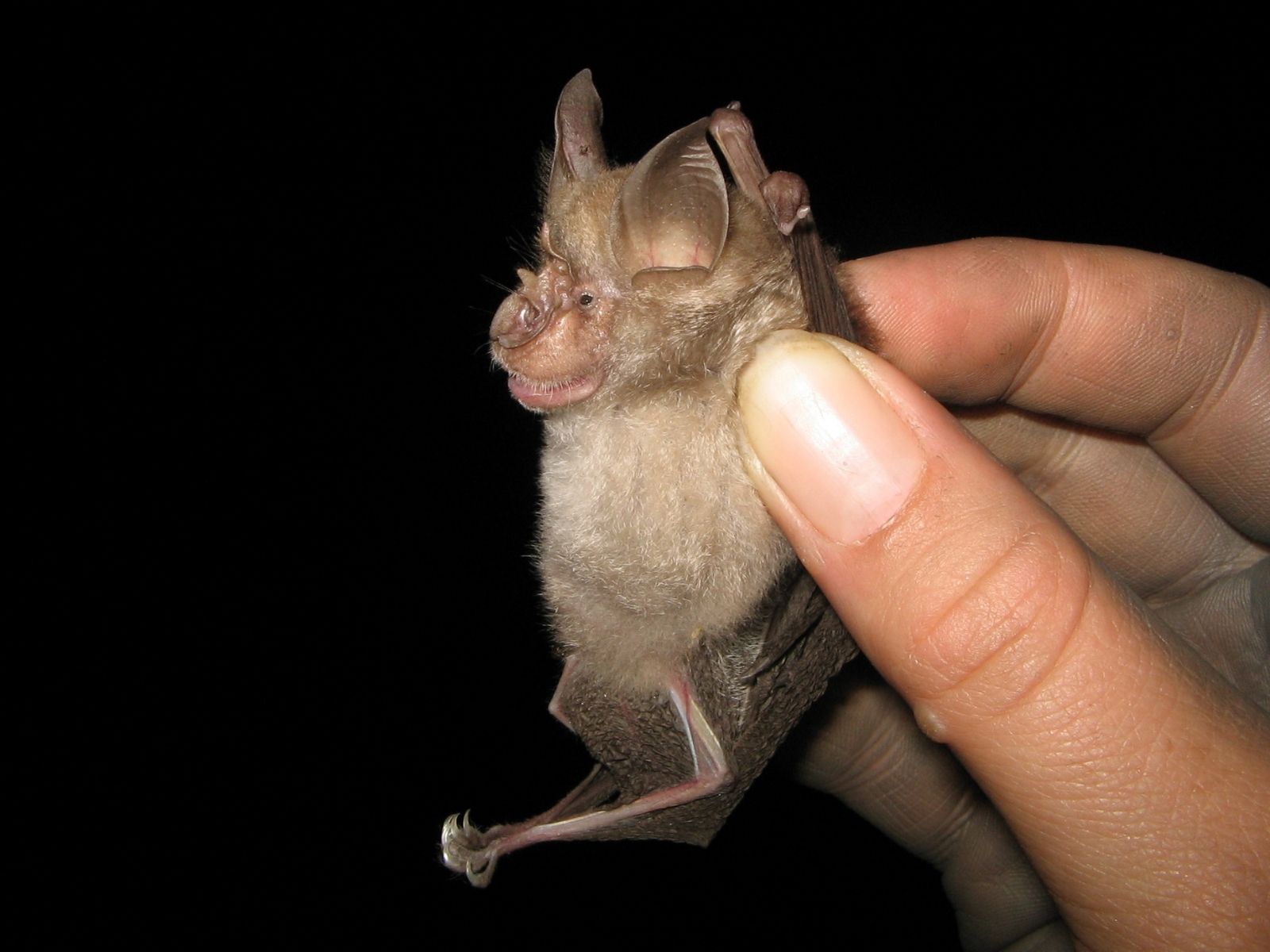
Peter’s Horseshoe Bat
Rhinolophus lobatus

2025 Red list status
Least Concern

Regional Population Trend
Unknown

Change compared
to 2016
No Change
Overview
Rhinolophus lobatus – Peters, 1852
ANIMALIA – CHORDATA – MAMMALIA – CHIROPTERA – RHINOLOPHIDAE – Rhinolophus – lobatus
Common Names: Peter’s Horseshoe Bat (English)
Synonyms: No Synonyms
Taxonomic Note:
Previously considered a south-eastern subspecies of Rhinolophus landeri Martin 1837 which occurs in central and west Africa (Monadjem et. al. 2020), R. l. lobatus Peters 1852 was elevated to full species R. lobatus based on molecular and morphological research (Taylor et al. 2018).
Red List Status: LC – Least Concern (IUCN version 3.1)
Assessment Information
Assessors: Balona, J.1, Taylor, P.2 & da Silva, J.M.3
Reviewers: Howard, A.2
Institutions: 1Gauteng and Northern Regions Bat Interest Group, 2University of the Free State, 3South African National Biodiversity Institute
Previous Assessors and Reviewers: Monadjem, A., Jacobs, D., Cohen, L., MacEwan, K., Richards, L, Schoeman, C., Sethusa, T. & Taylor, P.
Previous Contributors: Relton, C., Child, M.F. & Raimondo, D.
Assessment Rationale
Within the assessment region, the species is recorded from fewer than five localities with an estimated extent of occurrence of 37,205 km². Although it could qualify for Vulnerable based on limited localities, it occurs within the Great Limpopo Transfrontier Park and thus there are no plausible known threats that could cause significant decline. Additionally, it is able to survive in modified habitats and man-made structures, but no population trend data has yet been collected. As habitats are connected across regions, and thus rescue effects are presumed to be possible, and the species is widespread and locally common outside of the assessment region, it qualifies as Least Concern.
Regional population effects: Although it has low wing loading (Norberg & Rayner 1987), its habitat is continuous into Mozambique and Zimbabwe through the Great Limpopo Transfrontier Park thus, we assume dispersal capacity is adequate for rescue effects.
Reasons for Change
Reason(s) for Change in Red List Category from the Previous Assessment: No change
Red List Index
Red List Index: No change
Recommended citation: Balona J, Taylor P & da Silva JM. 2025. A conservation assessment of Rhinolophus lobatus. In Patel T, Smith C, Roxburgh L, da Silva JM & Raimondo D, editors. The Red List of Mammals of South Africa, Eswatini and Lesotho. South African National Biodiversity Institute and Endangered Wildlife Trust, South Africa.
Regional Distribution and occurrence
Geographic Range
The distribution of this species based on voucher specimens is Angola, Burundi, Congo (Democratic Republic of the), Kenya, Malawi, Mozambique, Rwanda, South Africa, Tanzania, Uganda, Zambia, Zimbabwe (ACR 2024), but these records may actually be R. landeri (Monadjem et al. 2020).
Within the assessment region, this species is found in the Great Limpopo Transfrontier Park in the northeastern region of Limpopo Province (Monadjem et al. 2020). Based on known colonies, extent of occurrence in the assessment region is 37,205 km², and area of occupancy is 52 km² (based on occupied grid cells of 2 by 2 km), to 1,300 km2 (based on occupied grid cells of 10 by 10 km). However, these estimates are based on records that are pre-2000. There are no recent records for this species in the assessment region.
Elevation / Depth / Depth Zones
Elevation Lower Limit (in metres above sea level): 0 m asl (Monadjem et al. 2024)
Elevation Upper Limit (in metres above sea level): 1,933 m asl (Monadjem et al. 2024)
Depth Lower Limit (in metres below sea level): (Not specified)
Depth Upper Limit (in metres below sea level): (Not specified)
Depth Zone: (Not specified)
Map
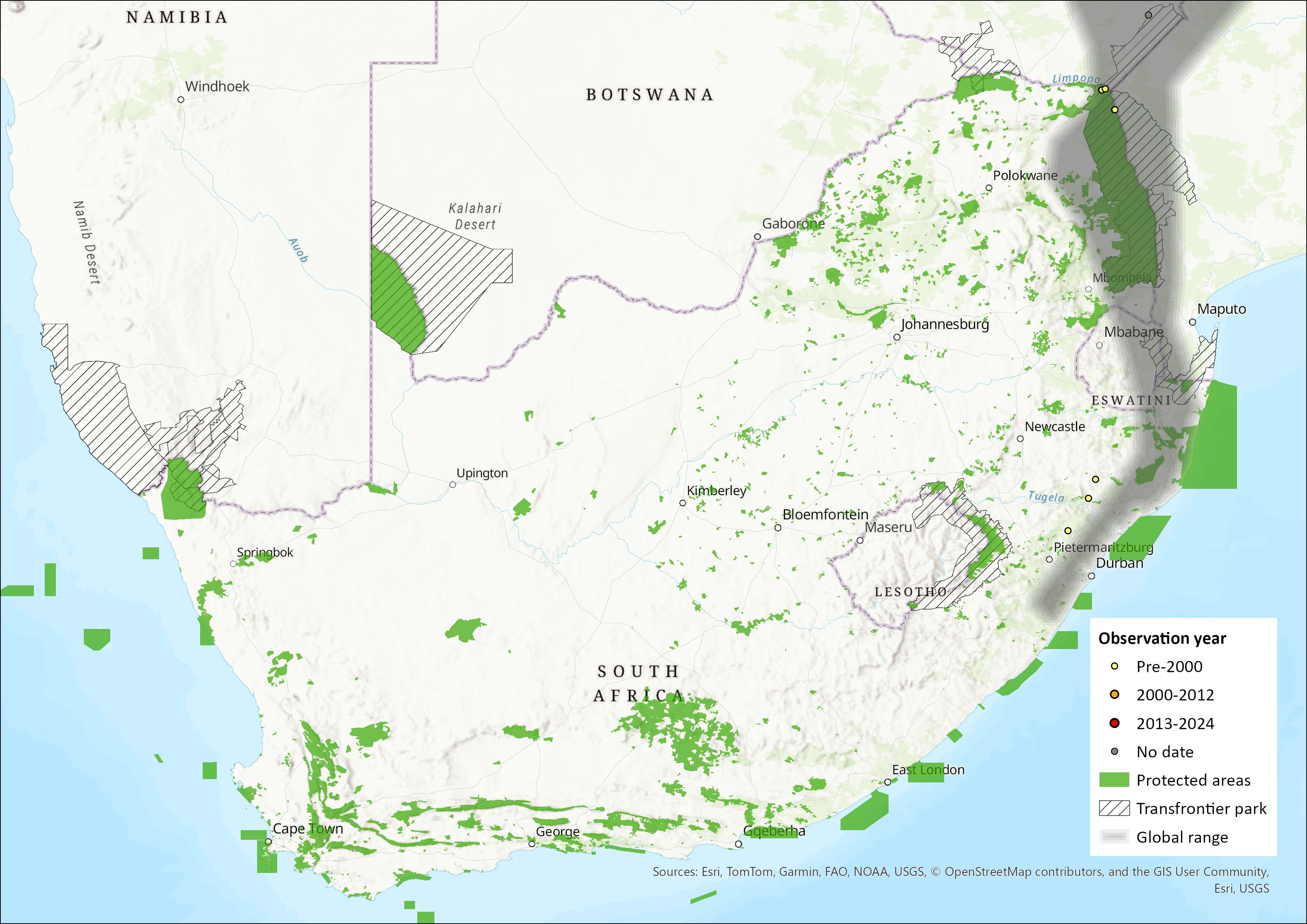 Figure 1. Distribution records for Peter’s Horseshoe Bat (Rhinolophus lobatus) within the assessment region (South Africa, Eswatini and Lesotho). Note that distribution data is obtained from multiple sources and records have not all been individually verified.
Biogeographic Realms
Biogeographic Realm: Afrotropical
Occurrence
Countries of Occurrence
| Country | Presence | Origin | Formerly Bred | Seasonality |
| Angola | Extant | Native | – | – |
| Burundi | Extant | Native | – | – |
| Congo, The Democratic Republic of the | Extant | Native | – | – |
| Eswatini | Possibly Extant | Native | – | |
| Kenya | Extant | Native | – | – |
| Malawi | Extant | Native | – | – |
| Mozambique | Extant | Native | – | – |
| Rwanda | Extant | Native | – | – |
| South Africa | Extant | Native | – | – |
| Tanzania, United Republic of | Extant | Native | – | – |
| Uganda | Extant | Native | – | – |
| Zambia | Extant | Native | – | – |
| Zimbabwe | Extant | Native | – | – |
Large Marine Ecosystems (LME) Occurrence
Large Marine Ecosystems: (Not specified)
FAO Area Occurrence
FAO Marine Areas: (Not specified)
Climate change
There are no studies on the impacts of climate change on this species. Overall, there will be an increase in intense rainfall events within the assessment region, while temperatures are also predicted to increase in line with global averages, with drought indexes also increasing (Engelbrecht et al. 2024). However, as the species is widespread across savanna habitats in the region, it may be tolerant to a relatively wide range of climatic conditions.
Population
Although widespread, it is not common anywhere in southern Africa (Monadjem et al. 2020). Only five localities are currently known from the assessment region, but undiscovered localities are possible. Although this species is gregarious, it only occurs in small numbers in the assessment region, usually only one or two and not more than twelve individuals have been observed (Skinner & Chimimba 2005). Concerningly, Brinkley et al. (2021) did not record this species in the northern Kruger despite two years of acoustic surveys.
Current population trend: Unknown
Continuing decline in mature individuals: No
Number of subpopulations: Likely occurs as a single metapopulation. Five localities are recorded in the assessment region. However, it is likely to be under-collected and more than 10 are suspected.
Extreme fluctuations in the number of subpopulations: (Not specified)
Continuing decline in number of subpopulations: (Not specified)
All individuals in one subpopulation: (Not specified)
Number of mature individuals in largest subpopulation: (Not specified)
Quantitative Analysis
Probability of extinction in the wild within 3 generations or 10 years, whichever is longer, maximum 100 years: (Not specified)
Probability of extinction in the wild within 5 generations or 20 years, whichever is longer, maximum 100 years: (Not specified)
Probability of extinction in the wild within 100 years: (Not specified)
Population Genetics
Based on the current known distribution of the species within the assessment region, it is likely to occur as a single metapopulation, connected to colonies in neighbouring countries. While it is considered rare, occurring in fairly low numbers, it is possible its effective population size is higher than census counts would suggest. The population genetic structure and diversity of this species is needed to confirm its genetic status.
Habitats and ecology
In southern Africa, this species is typically associated with riparian woodland (Smithers & Wilson 1979) and, in the assessment area, is known from the Mopane Bioregion. These bats roost in mine adits, rock crevices and caves, but have also been observed roosting in Baobab Trees (Adansonia digitata), hollow trees, buildings (Rosevear 1965) and water wells (Koopman et al. 1978). When roosting in caves, individuals hang from the ceiling well separated from each other (Skinner & Chimimba 2005).
They are insectivorous, mostly feeding on Lepidoptera, but to a lesser extent, Orthoptera are also taken (Fenton et al. 1977). This species is a clutter forager (Monadjem et al. 2020), and at a feeding site in Zimbabwe, Fenton et al. (1977) found that they were highly selective for certain moth species. There is very little information available on the reproductive ecology of this species.
Ecosystem and cultural services: As this species is insectivorous, it may contribute to controlling insect populations that damage crops (Boyles et al. 2011; Kunz et al. 2011). Ensuring a healthy population of insectivorous bats can thus decrease the need for pesticides.
IUCN Habitats Classification Scheme
| Habitat | Season | Suitability | Major Importance? |
| 1.6. Forest -> Forest – Subtropical/Tropical Moist Lowland | – | Suitable | – |
| 1.9. Forest -> Forest – Subtropical/Tropical Moist Montane | – | Suitable | – |
| 2.1. Savanna -> Savanna – Dry | – | Suitable | Yes |
| 2.2. Savanna -> Savanna – Moist | – | Suitable | – |
| 3.5. Shrubland -> Shrubland – Subtropical/Tropical Dry | – | Suitable | – |
| 7.1. Caves and Subterranean Habitats (non-aquatic) -> Caves and Subterranean Habitats (non-aquatic) – Caves | – | Suitable | Yes |
| 7.2. Caves and Subterranean Habitats (non-aquatic) -> Caves and Subterranean Habitats (non-aquatic) – Other Subterranean Habitats | – | Suitable | – |
Life History
Generation Length: (Not specified)
Age at Maturity: Female or unspecified: (Not specified)
Age at Maturity: Male: (Not specified)
Size at Maturity (in cms): Female: (Not specified)
Size at Maturity (in cms): Male: (Not specified)
Longevity: (Not specified)
Average Reproductive Age: (Not specified)
Maximum Size (in cms): (Not specified)
Size at Birth (in cms): (Not specified)
Gestation Time: (Not specified)
Reproductive Periodicity: (Not specified)
Average Annual Fecundity or Litter Size: (Not specified)
Natural Mortality: (Not specified)
Does the species lay eggs? No
Does the species give birth to live young: Yes
Does the species exhibit parthenogenesis: No
Does the species have a free-living larval stage? No
Does the species require water for breeding? No
Movement Patterns
Movement Patterns: Unknown
Congregatory: (Not specified)
Systems
System: Terrestrial
General Use and Trade Information
There is no known evidence to suggest that this species is traded or utilised in any form.
Local Livelihood: (Not specified)
National Commercial Value: (Not specified)
International Commercial Value: (Not specified)
End Use: (Not specified)
Is there harvest from captive/cultivated sources of this species? (Not specified)
Harvest Trend Comments: (Not specified)
Threats
There are no major threats to this species within the assessment region as it occurs predominantly in a protected area and is able to survive within modified habitats.
Conservation
No specific conservation interventions are currently necessary. This edge of range species occurs within the Great Limpopo Transfrontier Park, and its range is thus continuous with Zimbabwe and Mozambique.
Recommendations for land managers and practitioners:
- Field surveys to discover new roost sites and confirm occupancy of existing roost sites from historic sites.
Research priorities:
- Systematic monitoring to estimate population size and trends.
- It is likely that this species is under collected, thus continued research into its distribution is necessary.
- Taxonomic research is necessary to resolve the species complex.
Encouraged citizen actions:
- Citizens can assist in the conservation of the species by reporting sightings on virtual museum platforms (for example, iNaturalist and MammalMAP) and therefore contribute to an understanding of the species distribution.
Bibliography
ACR. 2024. African Chiroptera Report 2024. Pretoria, South Africa.
Aggundey, I.R. and Schlitter, D.A. 1984. Annotated checklist of the mammals of Kenya. Annals of the Carnegie Museum 53: 119–161.
Aldridge, H.D.J.N. and Rautenbach, I.L. 1987. Morphology, echolocation and resource partitioning in insectivorous bats. The Journal of Animal Ecology 56: 763–778.
Boyles, J.G., Cryan, P.M., McCracken, G.F. and Kunz, T.H. 2011. Economic importance of bats in agriculture. Science 332: 41–42.
Brinkley, E.R., Weier, S.M., Parker, D.M. and Taylor, P.J. 2021. Three decades later in the northern Kruger National Park: multiple acoustic and capture surveys may underestimate the true local richness of bats based on historical collections. Hystrix, the Italian Journal of Mammalogy 32(2), doi:10.4404/hystrix-00319-2020.
Csorba, G.P., Ujhelyi, P. and Thomas, N. 2003. Horseshoe Bats of the World. Alana Books, Shropshire, England.
Driver, A., Sink, K.J., Nel, J.N., Holness, S., van Niekerk, L., Daniels, F., Jonas, Z., Majiedt, P.A., Harris, L. and Maze, K. 2012. National Biodiversity Assessment 2011: An Assessment of South Africa’s Biodiversity and Ecosystems. Synthesis Report. South African National Biodiversity Institute and Department of Environmental Affairs, Pretoria, South Africa.
Engelbrecht, F.A., Steinkopf, J., Padavatan, J. and Midgley, G.F. 2024. Projections of future climate change in southern Africa and the potential for regional tipping points. In: von Maltitz, G.P., et al. Sustainability of Southern African Ecosystems under Global Change. Ecological Studies, vol 248. Springer, Cham. https://doi.org/10.1007/978-3-031-10948-5_7
Fenton, M.B., Boyle, N.G.H., Harrison, T.M. and Oxley, D.J. 1977. Activity patterns, habitat use, and prey selection by some African insectivorous bats. Biotropica 9: 73–85.
Happold, D.C.D. 1987. The Mammals of Nigeria. Oxford University Press, London, UK.
Koopman, K. F., Mumford, R. E. and Heisterberg, J. F. 1978. Bat records from Upper Volta, West Africa. American Museum Novitates 2643: 1-6.
Kunz, T.H., Braun de Torrez, E., Bauer, D., Lobova, T. and Fleming, T.H. 2011. Ecosystem services provided by bats. Annals of the New York Academy of Sciences 1223: 1–38.
Meester, J.A.J., Rautenbach, I.L., Dippenaar, N.J. and Baker, C.M. 1986. Classification of southern African mammals. Transvaal Museum Monographs 5: 1–359.
Menzies, J. I. 1973. A Study of Leaf-Nosed Bats (Hipposideros caffer and Rhinolophus landeri) in a Cave in Northern Nigeria. Journal of Mammalogy 54: 930-945.
Monadjem, A., Taylor, P.J., Cotterill, F.P.D. and Schoeman M.C. 2020. Bats of Southern and Central Africa: a biogeographic and taxonomic synthesis, 2nd Ed. University of Witwatersrand Press, Johannesburg.
Monadjem, A., Montauban, C., Webala, P.W., Laverty, T.M., Bakwo-Fils, E.M., Torrent, L., Tanshi, I., Kane, A., Rutrough, A.L., Waldien, D.L. and Taylor, P.J. 2024. African bat database: curated data of occurrences, distributions and conservation metrics for sub-Saharan bats. Scientific Data, 11(1), p.1309.
Norberg, U.M. and Rayner, J.M. 1987. Ecological morphology and flight in bats (Mammalia; Chiroptera): wing adaptations, flight performance, foraging strategy and echolocation. Philosophical Transactions of the Royal Society B: Biological Sciences 316: 335–427.
Rosevear, D.R. 1965. The Bats of West Africa. British Museum, London, UK.
Schoeman, M.C. and Jacobs, D.S. 2008. The relative influence of competition and prey defenses on the phenotypic structure of insectivorous bat ensembles in southern Africa. PLoS One 3: e3715.
Skinner, J.D. and Chimimba, C.T. 2005. The Mammals of the Southern African Subregion. Cambridge University Press, Cambridge, UK.
Smithers, R.H.N. and Wilson, V.J. 1979. Check list and atlas of the mammals of Zimbabwe Rhodesia. Trustees of the National Museums and Monuments 9: 1–147.
Smithers, R.H.N. 1983. The Mammals of the Southern African Subregion. University of Pretoria, Pretoria, South Africa.
Taylor, P. 1998. The Smaller Mammals of KwaZulu-Natal. University of Natal Press, Pietermaritzburg, South Africa.
Taylor P.J., MacDonald A., Goodman S.M., Kearney T., Cotterill F.P.D., Stoffberg S., Monadjem A., Schoeman M.C., Guyton J., Naskrecki P. and Richards L.R. 2018. Integrative taxonomy resolves three new cryptic species of small southern African horseshoe bats (Rhinolophus). Zoological Journal of the Linnean Society, 184: 1249-1276