
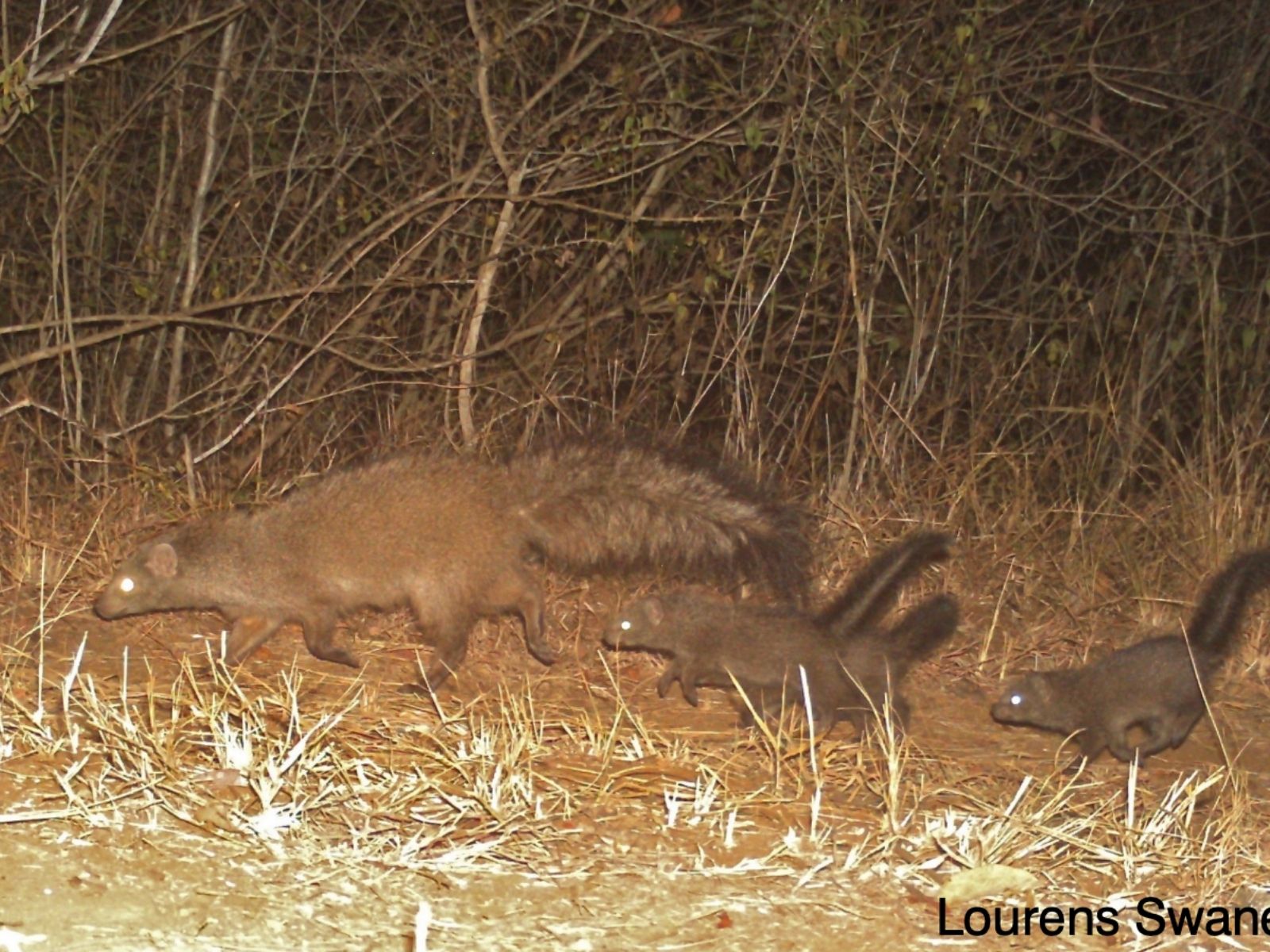
Meller’s Mongoose
Rhynchogale melleri

2025 Red list status
Least Concern

Regional Population Trend
Unknown

Change compared
to 2016
No Change
Overview
Rhynchogale melleri – (Gray, 1865)
ANIMALIA – CHORDATA – MAMMALIA – CARNIVORA – HERPESTIDAE – Rhynchogale – melleri
Common Names: Meller’s Mongoose (English), Meller se Muishond (Afrikaans), Mangouste de Meller (French), Meller-Manguste (German)
Synonyms: No Synonyms
Taxonomic Note:
Meester et al. (1986) listed two subspecies from the southern African subregion: 1) R. m. melleri and 2) R. m. langi. The latter is the only subspecies present in the assessment region, more specifically, from eastern Limpopo and Mpumalanga provinces, and Swaziland (Skinner & Chimimba 2005).
Red List Status: LC – Least Concern, (IUCN version 3.1)
Assessment Information
Assessors: Adams, E.C.1 & da Silva, J.M.2
Reviewers: Do Linh San, E.3
Institutions: 1Endangered Wildlife Trust, 2South African National Biodiversity Institute, 3Sol Plaatje University
Previous Assessors & Reviewers: Do Linh San, E., Camacho, G., Swanepoel, L.H., Page-Nicholson, S., Stuart, C. & Stuart, M.
Previous Contributors: Madikiza, Z.
Assessment Rationale
Meller’s Mongoose is listed as Least Concern since, although it is uncommon and lives at low density across its distribution, the majority of its range encompasses well-protected savannah habitats, such as Kruger National Park. The expansion of wildlife ranching may have created additional suitable habitat, especially bordering Kruger. Although this species may be experiencing local declines from dog hunting and maybe road collisions or untargeted snaring and poisoning, there is no evidence to suggest that this is causing range-wide decline. However, camera-trap monitoring should be used to assess occupancy more comprehensively and to estimate densities. This species’ conservation status should be reassessed when better data become available.
Regional population effects: Although this species is on the edge of its range in the assessment region, dispersal is likely across the northern borders and therefore rescue effects are presumably possible.
Reasons for Change
Reason(s) for Change in Red List Category from the Previous Assessment: No change
Red List Index
Red List Index: No change
Recommended citation: Adams EC & da Silva JM. 2025. A conservation assessment of Rhynchogale melleri. In Patel T, Smith C, Roxburgh L, da Silva JM & Raimondo D, editors. The Red List of Mammals of South Africa, Eswatini and Lesotho. South African National Biodiversity Institute and Endangered Wildlife Trust, South Africa.
Regional Distribution and occurrence
Geographic Range
Meller’s Mongoose is confined to the eastern sections of the African continent and throughout its range it is not considered common (Skinner & Chimimba 2005). It ranges from central Tanzania south through Malawi, Zambia, Zimbabwe and Mozambique, to Eswatini and northeastern South Africa (Stuart & Stuart 2013). A possible record from Chobe National Park in Botswana (Purchase et al. 2007), if substantiated, would be the first record for this country. The presence of Meller’s Mongoose has recently been confirmed in the Lower Zambezi Protected Area Complex (Bird & Mateke 2013) as well as in the North Luangwa Valley where it was one of the two small carnivore species camera-trapped most often (White 2013). This small carnivore has also been recorded in Niassa Game Reserve, Mozambique (C.M. Begg and K.S. Begg pers. comm. 2012) and camera-trapped frequently in recent years in Debshan Ranch, north of Bulawayo, Zimbabwe (C.R. Edwards pers. comm. 2015–2016).
Within the assessment region, Meller’s Mongoose is rare, but it has been recorded in eastern Mpumalanga, southeastern parts of Limpopo, and in the north of Eswatini (Skinner & Chimimba 2005). However, its presence in Eswatini has not been confirmed since 1937, when a type specimen was recorded (Skinner & Chimimba 2005). Camera-trapping studies in the Ka-Ndengeza and Vyeboom villages (Vhembe district, Limpopo Province) and the Greater Lydenburg Area (Mpumalanga Province) in South Africa confirmed this species’ presence (L.H. Swanepoel and G. Camacho pers. obs. 2014). Recent camera-trap studies have also confirmed its presence in the Maputaland Conservation Unit of KwaZulu-Natal Province (Ramesh et al. 2016) and it has been identified from Ithala Game Reserve (C. Stuart & M. Stuart unpubl. data; these data are not reflected in Figure 1 as they were unavailable at the time of the assessment), which extends its known distribution range to the south of Eswatini. In Mpumalanga they have been recorded from 250 m asl to 1,500 m asl; in Tanzania they have been recorded up to 1,850 m asl (De Luca & Mpunga 2005).
Elevation / Depth / Depth Zones
Elevation Lower Limit (in metres above sea level): (Not specified)
Elevation Upper Limit (in metres above sea level): (Not specified)
Depth Lower Limit (in metres below sea level): (Not specified)
Depth Upper Limit (in metres below sea level): (Not specified)
Depth Zone: (Not specified)
Map
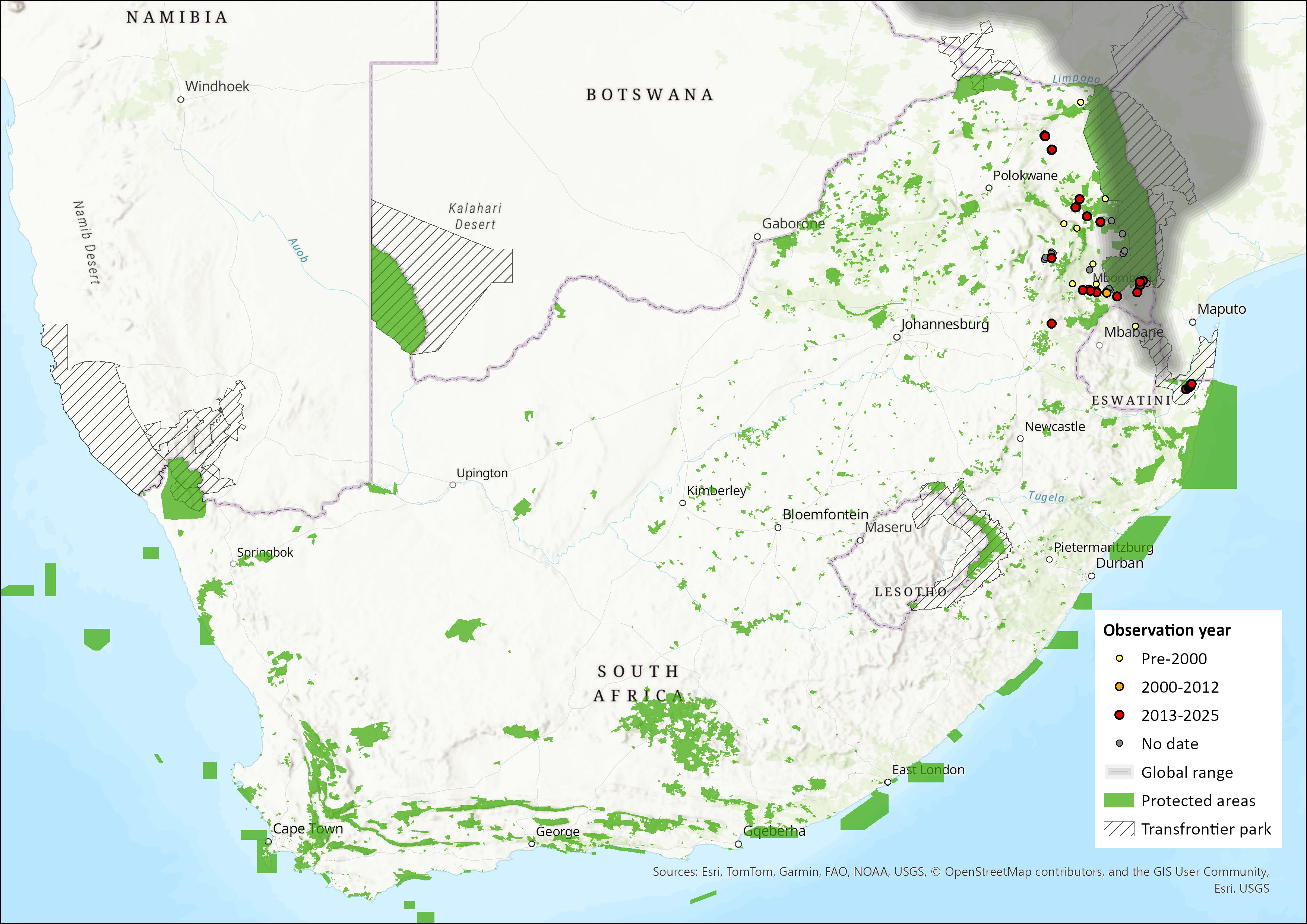
Figure 1. Distribution records for Meller’s Mongoose (Rhynchogale melleri) within the assessment region (South Africa, Eswatini and Lesotho). Note that distribution data is obtained from multiple sources and records have not all been individually verified.
Biogeographic Realms
Biogeographic Realm: Afrotropical
Occurrence
Countries of Occurrence
| Country | Presence | Origin | Formerly Bred | Seasonality |
| Botswana | Presence Uncertain | Native | – | – |
| Congo, The Democratic Republic of the | Extant | Native | – | – |
| Eswatini | Extant | Native | – | – |
| Malawi | Extant | Native | – | – |
| Mozambique | Extant | Native | – | – |
| South Africa | Extant | Native | – | – |
| Tanzania, United Republic of | Extant | Native | – | – |
| Zambia | Extant | Native | – | – |
| Zimbabwe | Extant | Native | – | – |
Large Marine Ecosystems (LME) Occurrence
Large Marine Ecosystems: (Not specified)
FAO Area Occurrence
FAO Marine Areas: (Not specified)
Climate change
No recent research or literature has focused on how climate change might affect this species in the future.
Population Information
Meller’s Mongoose is considered uncommon to rare, but it may be easily overlooked or confused with other mongoose species such as Water Mongoose (Atilax paludinosus), White-tailed Mongoose (Ichneumia albicauda) or Selous’ Mongoose (Paracynictis selousi). Population size is unknown. However, it is an edge of range species and its range is continuous with other regions. As there are no major threats to this species and its stronghold within the assessment region is likely Kruger National Park (KNP), we infer that overall the population is stable.
Current population trend: Unknown, but probably stable.
Continuing decline in mature individuals: Unknown, but probably not.
Number of mature individuals in population: Unknown
Number of mature individuals in largest subpopulation: Unknown, but probably in Kruger National Park.
Number of subpopulations: It is not currently possible to determine the extent or number of subpopulations.
Severely fragmented: No. Favourable habitat is relatively well connected across this species’ range.
Quantitative Analysis
Probability of extinction in the wild within 3 generations or 10 years, whichever is longer, maximum 100 years: (Not specified)
Probability of extinction in the wild within 5 generations or 20 years, whichever is longer, maximum 100 years: (Not specified)
Probability of extinction in the wild within 100 years: (Not specified)
Population Genetics
The complete mitochondrial genome for Meller’s Mongoose has recently been mapped, solidifying their placement within the subfamily Herpestinae (Sosale et al. 2024). To date, no population genetic analyses have been conducted on the species to get a clear idea of its population structure; however, from what is known, this structure may be partly inferred. While it is considered rare or fairly uncommon, possible dispersal between neighbouring countries suggests there is likely gene flow within and outside the assessment region. Consequently, the species is presumed to exist as a metapopulation. From this, the Convention on Biological Diversity’s GBF’s complementary genetic indicator – proportion of populations maintained (PM) – would receive a value of 1.0 (all populations remaining).
Because so little is known about population sizes, inferring effective population size is not possible. Consequently, the GBF’s headline genetic indicator – proportion of populations with an Ne > 500 – cannot be quantified.
Habitats and ecology
Meller’s Mongoose is a savannah species, mainly associated with open woodland and grassland with termitaria (Skinner & Chimimba 2005; Stuart & Stuart 2013). It is found in miombo woodlands in Zambia (White 2013) and montane bamboo forests in Tanzania (De Luca & Mpunga 2005). Within Mpumalanga, more specifically the Manyeleti Game Reserve and Sabi Sands Game Reserve, the species has been found in savannah woodlands, whereas in KNP (Limpopo and Mpumalanga) it has been recorded from the low-lying granitic soils to the mountainous areas (Skinner & Chimimba 2005). Within the Maputaland Conservation Unit, Meller’s Mongoose was recorded to utilise sand forest and woodland vegetation types (Ramesh et al. 2016).
Meller’s Mongoose is solitary and nocturnal (Skinner & Chimimba 2005). Termites – particularly Macrotermes spp. and Hodotermes spp. – seem to make up the majority of its diet, but it will also feed on small vertebrates, invertebrates and occasionally, wild fruit (Skinner & Chimimba 2005). No information is available on the spatial behaviour and detailed activity patterns of this species. Little is known of the reproductive biology, except that females give birth to two to three young during the summer wet season (Stuart & Stuart 2013).
Ecosystem and cultural services: None specifically reported. Although this species may be a valuable predator of agricultural pest species such as termites and other arthropods, its apparently naturally low densities suggest that it would likely not have a substantial control effect in this context.
IUCN Habitats Classification Scheme
| Habitat | Season | Suitability | Major Importance? |
| 2.1. Savanna -> Savanna – Dry | – | Suitable | – |
| 3.5. Shrubland -> Shrubland – Subtropical/Tropical Dry | – | Suitable | – |
Life History
Generation Length: (Not specified)
Age at Maturity: Female or unspecified: (Not specified)
Age at Maturity: Male: (Not specified)
Size at Maturity (in cms): Female: (Not specified)
Size at Maturity (in cms): Male: (Not specified)
Longevity: (Not specified)
Average Reproductive Age: (Not specified)
Maximum Size (in cms): (Not specified)
Size at Birth (in cms): (Not specified)
Gestation Time: (Not specified)
Reproductive Periodicity: (Not specified)
Average Annual Fecundity or Litter Size: (Not specified)
Natural Mortality: (Not specified)
Does the species lay eggs? No
Does the species give birth to live young: Yes
Does the species exhibit parthenogenesis: No
Does the species have a free-living larval stage? No
Does the species require water for breeding? No
Movement Patterns
Movement Patterns: (Not specified)
Congregatory: (Not specified)
Systems
System: Terrestrial
General Use and Trade Information
It is unknown whether Meller’s Mongoose is used as bushmeat. It is assumed that, like several other Carnivora, this species may be utilised in muthi (traditional medicine). However, as the chances of capturing this mongoose are low (owing to its skittish nocturnal and solitary behaviour), it is highly unlikely that it is highly sought after and actively hunted. Instead, it might rather be killed accidentally by dogs when hunting for ungulates or lagomorphs.
The expansion of wildlife ranching may have created additional suitable and preserved habitat, especially bordering KNP. It is possible that Meller’s Mongoose does well in partially degraded grassland – being in some wildlife ranches or well-managed cattle ranches – since some harvester termites (e.g. Hodotermes spp.) are more effective and abundant when grasslands are overgrazed or disturbed (Picker et al. 2004). Highly overgrazed areas, however, are unlikely to be favourable to Meller’s Mongoose. Because this small carnivore seems to naturally live at low density, most landowners would likely not know about its presence on their land.
Local Livelihood: (Not specified)
National Commercial Value: (Not specified)
International Commercial Value: (Not specified)
End Use: (Not specified)
Is there harvest from captive/cultivated sources of this species? (Not specified)
Harvest Trend Comments: (Not specified)
Threats
There are no major threats to the species. Its favoured habitat is extensive, and in some parts overlaps with very low human population densities. However, in some parts of the range (e.g. KwaZulu-Natal) there has been considerable expansion of the human population and their dogs (sensu Grey-Ross et al. 2010), which could represent a significant localised threat (Stuart & Stuart 2013). While the species has been recorded in areas dominated by domestic/feral dogs (Ka-Ndengeza and Vyeboom villages, Vhembe district, Limpopo Province), detection rates were low (L.H. Swanepoel pers. obs. 2014). Meller’s Mongooses are sometime killed by vehicles, but the impact of this threat is probably low. Finally, it is likely that a small number of individuals are killed or poisoned as bycatch in some control operations of damage-causing animals, but we do not have data to confirm this assumption.
Conservation
Meller’s Mongoose have been recorded from several protected areas across its range. It is protected in KNP, the private protected areas on the western boundary of KNP and several protected areas in KwaZulu-Natal.
There are no conservation actions that target this species. More information on the biology and ecology of Meller’s Mongoose, and a better evaluation of the impact of identified and suspected threats, are needed in order to adequately evaluate whether conservation interventions need to be devised and implemented. Meanwhile, some general conservation interventions will certainly benefit the species.
Recommendations for land managers and practitioners:
- Conserve termite mounds where possible.
- Use holistic (selective or non-lethal) control methods for damage-causing animals.
Research priorities:
- Assess occupancy and estimate densities in selected areas of this species’ distribution, possibly by means of camera-trapping.
- Conduct in-depth studies to acquire a better understanding of the biology and ecology of the species, notably regarding population demographics at the local scale.
- The effects of climate change on this species throughout its range.
- Population health and genetics across its range.
Encouraged citizen actions:
- Report sightings on virtual museum platforms (for example, iNaturalist and MammalMAP), especially outside protected areas. As confusion with other mongoose species is possible, a photograph is required for confirmation of identification.
Bibliography
Bird, T.L.F. and Mateke, C.W. 2013. A preliminary survey of the presence and distribution of small carnivores in the Lower Zambezi Protected Area Complex, Zambia. Small Carnivore Conservation 48: 47-59.
De Luca, D.W. and Mpunga, N.E. 2005. Carnivores of the Udzungwa Mountains: Presence, distributions and threats. Wildlife Conservation Society, Mbeya, Tanzania.
Grey-Ross R, Downs CT, Kirkman K. 2010. An assessment of illegal hunting on farmland in KwaZulu-Natal, South Africa: implications for oribi (Ourebia ourebi) conservation. South African Journal of Wildlife Research 40: 43-52.
Meester, J.A.J., Rautenbach, I.L., Dippenaar, N.J. and Baker, C.M. 1986. Classification of Southern African Mammals. Monograph number 5. Transvaal Museum , Pretoria, South Africa.
Picker, M.D., Griffiths, C. & Weaving, A. 2004. Field Guide to the Insects of South Africa . Struik, Cape Town.
Purchase, G.K., Mateke, C. and Purchase, D. 2007. A review of the status and distribution of carnivores, and levels of human–carnivore conflict, in the protected areas and surrounds of the Zambezi Basin. The Zambezi Society, Bulawayo.
Ramesh T, Kalle R, Rosenlund H, Downs CT. 2016. Native habitat and protected area size matters: Preserving mammalian assemblages in the Maputaland Conservation Unit of South Africa. Forest Ecology and Management 360: 20-29.
Skinner, J.D. and Chimimba, C.T. (eds). 2005. The Mammals of the Southern African Subregion. Cambridge University Press, United Kingdom, Cambridge.
Sosale, M.S., Roelke-Parker, M., Machange, G.A., Edwards, C.W., Figueiró, H.V. and Koepfli, K.P. 2024. The complete mitochondrial genome of Meller’s mongoose (Rhynchogale melleri). Mitochondrial DNA Part B, 9(4), 432-436.
Stuart, C. and Stuart, T. 2013. Rhynchogale melleri Meller’s Mongoose. In: J. Kingdon and M. Hoffmann (eds), The Mammals of Africa. Volume V: Carnivores, Pangolins, Equids and Rhinoceroses, Bloomsbury Publishing, London, UK.
White, P.A. 2013. Distribution, habitat use and activity patterns of nocturnal small carnivores in the North Luangwa Valley, Zambia. Small Carnivore Conservation 48: 37-46.