

Meester’s Golden Mole
Amblysomus meesteri

2025 Red list status
Vulnerable

Regional Population Trend
Unknown

Change compared
to 2016
Not Previously Assessed
Overview
Amblysomus meesteri – (G. Bronner, 2000)
ANIMALIA – CHORDATA – MAMMALIA – AFROSORICIDA – CHRYSOCHLORIDAE – Amblysomus – meesteri
Common Names: Meester’s Golden Mole (English)
Synonyms: Amblysomus hottentotus A. Smith, 1829; Amblysomus iris Thomas & Schwann, 1905
Taxonomic Note:
Originally described by Bronner (2000) as a subspecies of Amblysomus hottentotus. Recently elevated to species status, based on cytogenetic (Gilbert et al. 2008) and phylogenetic evidence (Mynhardt et al. 2015, 2020, Bronner et al. 2024).
Red List Status: Vulnerable B1ab(iii)+2ab(iii)
Assessment Information
Assessors: Mynhardt, S.1 & da Silva, J.2
Reviewer: Raimondo, D.2
Institutions: 1Endangered Wildlife Trust, 2South African National Biodiversity Institute
Assessment Rationale
This species has a limited distribution, with an extent of occurrence (EOO) of 1,620km2 and area of occupancy (AOO) of 104km2. It is known from ten locations and is experiencing an ongoing decline in quality of habitat. It therefore qualifies for listing as Vulnerable under criterion B.
Red List Index
Red List Index: Not previously assessed
Recommended citation: Mynhardt S & da Silva JM. 2025. A conservation assessment of Amblysomus meesteri. In Patel T, Smith C, Roxburgh L, da Silva JM & Raimondo D, editors. The Red List of Mammals of South Africa, Eswatini and Lesotho. South African National Biodiversity Institute and Endangered Wildlife Trust, South Africa.
Distribution
Geographic Range
This species is endemic to South Africa and occurs in the Graskop region of Mpumalanga. The current known distribution stretches from Sabie in the west, eastwards to White River and Hazyview, and northwards through Graskop and Pilgrim’s Rest to Mariepskop near Kampersrus.
Elevation / Depth / Depth Zones
Elevation Lower Limit (in metres above sea level): (Not specified)
Elevation Upper Limit (in metres above sea level): (Not specified)
Depth Lower Limit (in metres below sea level): (Not specified)
Depth Upper Limit (in metres below sea level): (Not specified)
Depth Zone: (Not specified)
MAP
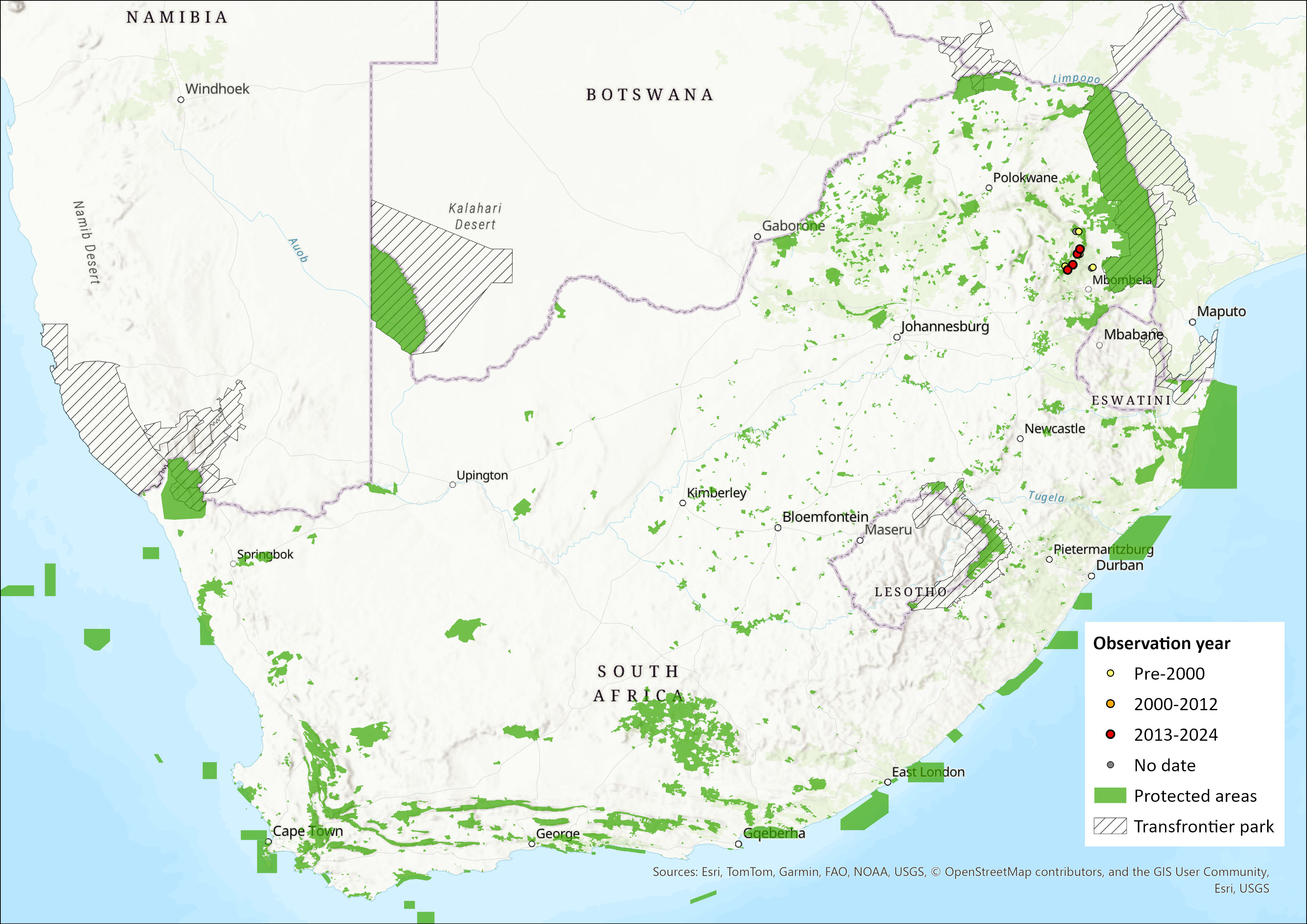
Figure 1. Distribution records for Meester’s Golden Mole (Amblysomus meesteri) within the assessment region (South Africa, Eswatini and Lesotho). Note that distribution data is obtained from multiple sources and records have not all been individually verified.
Biogeographic Realms
Biogeographic Realm: Afrotropical
Occurrence
Countries of Occurrence
| Country | Presence | Origin | Formerly Bred | Seasonality |
| South Africa | Extant | Native | – | Resident |
| South Africa -> Mpumalanga | Extant | Native | – | Resident |
Large Marine Ecosystems (LME) Occurrence
Large Marine Ecosystems: (Not specified)
FAO Area Occurrence
FAO Marine Areas: (Not specified)
Climate change
Although the potential impacts of climate change on this species have not been directly assessed, climate change is expected to impact most golden mole species. Since these subterranean animals are restricted to soft soils for burrowing, and have very low vagility, their ability to migrate or shift their distribution ranges in response to climate change is very limited. Climate change is likely to impact golden moles through changes in vegetation type, soil moisture and prey availability.
Population information
The species is known from ten subpopulations across its range in the Graskop region of Mpumalanga. Much of its range has been transformed to pine plantations and this is suspected to have caused past decline and fragmentation of the population. While there has been no quantitative monitoring of subpopulations and the population trend is unknown, field observations report it to be locally common in the fragmentated locations where it occurs.
Population trend: Unknown
Population Information
Continuing decline in mature individuals? (Not specified)
All individuals in one subpopulation: (Not specified)
Number of mature individuals in largest subpopulation: (Not specified)
Number of Subpopulations: (Not specified)
Quantitative Analysis
Probability of extinction in the wild within 3 generations or 10 years, whichever is longer, maximum 100 years: (Not specified)
Probability of extinction in the wild within 5 generations or 20 years, whichever is longer, maximum 100 years: (Not specified)
Probability of extinction in the wild within 100 years: (Not specified)
Population genetics
Genomic work using RADseq data provided evidence of Amblysomus meesteri as a highly divergent cryptic lineage within the Amblysomus hottentotus species complex (Mynhardt et al. 2020). This metapopulation is geographically isolated and has been elevated to species rank, based on cytogenetic (Gilbert et al. 2008) and phylogenetic evidence (Mynhardt et al. 2015, 2020, Bronner et al. 2024).
RADseq data have been generated for only two A. meesteri specimens, which is not a sufficient sample size for population genetic inference or Ne estimation. Although the effective population size (Ne) for this population has not been quantified, the animals are relatively common throughout their range. Therefore, it is likely that the population is genetically stable and healthy (e.g., Ne > 500).
Habitats and ecology
It occurs across a variety of woodland and grassland habitats in the Savanna biome of South Africa, and also in Afromontane forests. Particularly abundant in moist soils near waterbodies but also found far from surface water provided the substrate is friable and not too rocky, and the soil invertebrate fauna is abundant. Common in gardens, agricultural lands and golf courses; less common in exotic plantations.
IUCN Habitats Classification Scheme
| Habitat | Season | Suitability | Major Importance? |
| 1.5. Forest -> Forest – Subtropical/Tropical Dry | – | Suitable | Yes |
| 1.6. Forest -> Forest – Subtropical/Tropical Moist Lowland | – | Suitable | Yes |
| 1.9. Forest -> Forest – Subtropical/Tropical Moist Montane | – | Suitable | Yes |
| 2.2. Savanna -> Savanna – Moist | – | Suitable | Yes |
| 3.4. Shrubland -> Shrubland – Temperate | – | Suitable | No |
| 3.8. Shrubland -> Shrubland – Mediterranean-type Shrubby Vegetation | – | Marginal | – |
| 4.4. Grassland -> Grassland – Temperate | – | Suitable | Yes |
| 4.5. Grassland -> Grassland – Subtropical/Tropical Dry | – | Suitable | No |
| 14.1. Artificial/Terrestrial -> Artificial/Terrestrial – Arable Land | – | Marginal | – |
| 14.2. Artificial/Terrestrial -> Artificial/Terrestrial – Pastureland | – | Suitable | No |
| 14.3. Artificial/Terrestrial -> Artificial/Terrestrial – Plantations | – | Marginal | – |
| 14.4. Artificial/Terrestrial -> Artificial/Terrestrial – Rural Gardens | – | Suitable | No |
| 14.5. Artificial/Terrestrial -> Artificial/Terrestrial – Urban Areas | – | Marginal | – |
| 16. Introduced vegetation | – | Marginal | – |
Life History
Generation Length: (Not specified)
Age at Maturity: Female or unspecified: (Not specified)
Age at Maturity: Male: (Not specified)
Size at Maturity (in cms): Female: 10-14
Size at Maturity (in cms): Male: 11-14
Longevity: (Not specified)
Average Reproductive Age: (Not specified)
Maximum Size (in cms): (Not specified)
Size at Birth (in cms): 4-5
Gestation Time: (Not specified)
Reproductive Periodicity: Aseasonal with enhanced fecundity in wet summer months
Average Annual Fecundity or Litter Size: Litter size 1-3 (usually 2)
Natural Mortality: (Not specified)
Breeding Strategy
Does the species lay eggs? No
Does the species give birth to live young? Yes
Does the species exhibit parthenogenesis? No
Does the species have a free-living larval stage? No
Does the species require water for breeding? No
Movement Patterns
Movement Patterns: (Not specified)
Congregatory: (Not specified)
Systems
System: Terrestrial
General Use and Trade Information
General notes regarding trade and use of this species: (Not specified)
Local Livelihood: (Not specified)
National Commercial Value: (Not specified)
International Commercial Value: (Not specified)
End Use: (Not specified)
Is there harvest from captive/cultivated sources of this species? (Not specified)
Harvest Trend Comments: (Not specified)
Threats
It is possibly experiencing limited levels of decline as a result of persecution and poisoning by landowners, habitat alteration for rural housing developments and predation by domestic dogs and cats. Field surveys have noted that it is not often found in pine plantations, with this being the predominant land use within its range, the species is suspected to have lost significant habitat between 1940 and 1980. Ongoing infrastructure and housing developments are resulting in continuing slow degradation of its habitat.
Conservation
The species is not recorded in any protected areas, however the possibility exists that it may occur in the Kruger National Park and surrounding protected areas.
Recommendations for land managers and practitioners: None
Research priorities:
- Surveys to better understand distribution and population density.
- Studies on population size, trends and distributions.
- Studies assessing the severity of threats faced by this species.
Encouraged citizen actions:
- Report sightings on virtual museum platforms (for example, iNaturalist and MammalMAP), especially outside protected areas.
- Deposit any dead specimens found in a state or provincial museum, together with information on the date and site where found.
- Create indigenous vegetation gardens.
Bibliography
Afrotheria Specialist Group. 2014. Specialist Group website. Available at: http://www.afrotheria.net/index.php.
Bronner, G.N. 2000. New species and subspecies of golden mole (Chrysochloridae: Amblysomus) from Mpumalanga, South Africa. Mammalia 64: 41–54.
Bronner, G.N., Mynhardt, S., Bennett, N.C., Cohen, L., Crumpton, N., Hofreiter, M., Arnold, P. and Asher, R.J., 2024. Phylogenetic history of golden moles and tenrecs (Mammalia: Afrotheria). Zoological Journal of the Linnean Society, 201(1), pp.184-213.
Gilbert, C., Maree S. and Robinson T.J. 2008. Chromosomal evolution and distribution of telomeric repeats in golden moles (Chrysochloridae, Mammalia). . Cytogenetic and Genome Research 121(2): 110-119.
IUCN. 2015. The IUCN Red List of Threatened Species. Version 2015.2.
Mynhardt, S., Bennett, N.C. and Bloomer, P., 2020. New insights from RADseq data on differentiation in the Hottentot golden mole species complex from South Africa. Molecular phylogenetics and evolution, 143, p.106667.
Mynhardt, S., Maree, S., Pelser, I., Bennett, N.C., Bronner, G.N., Wilson, J.W. and Bloomer, P., 2015. Phylogeography of a morphologically cryptic golden mole assemblage from South-Eastern Africa. PLoS One, 10(12), p.e0144995.
Taylor WA, Mynhardt S, Maree S (2018). Family Chrysochloridae. In: Handbook of the Mammals of the World – Volume 8 Insectivores, Sloths and Colugos. DE Wilson & RA Mittermeier (eds). Lynx Edicions. ISBN-13: 978-84-16728-08-4.