
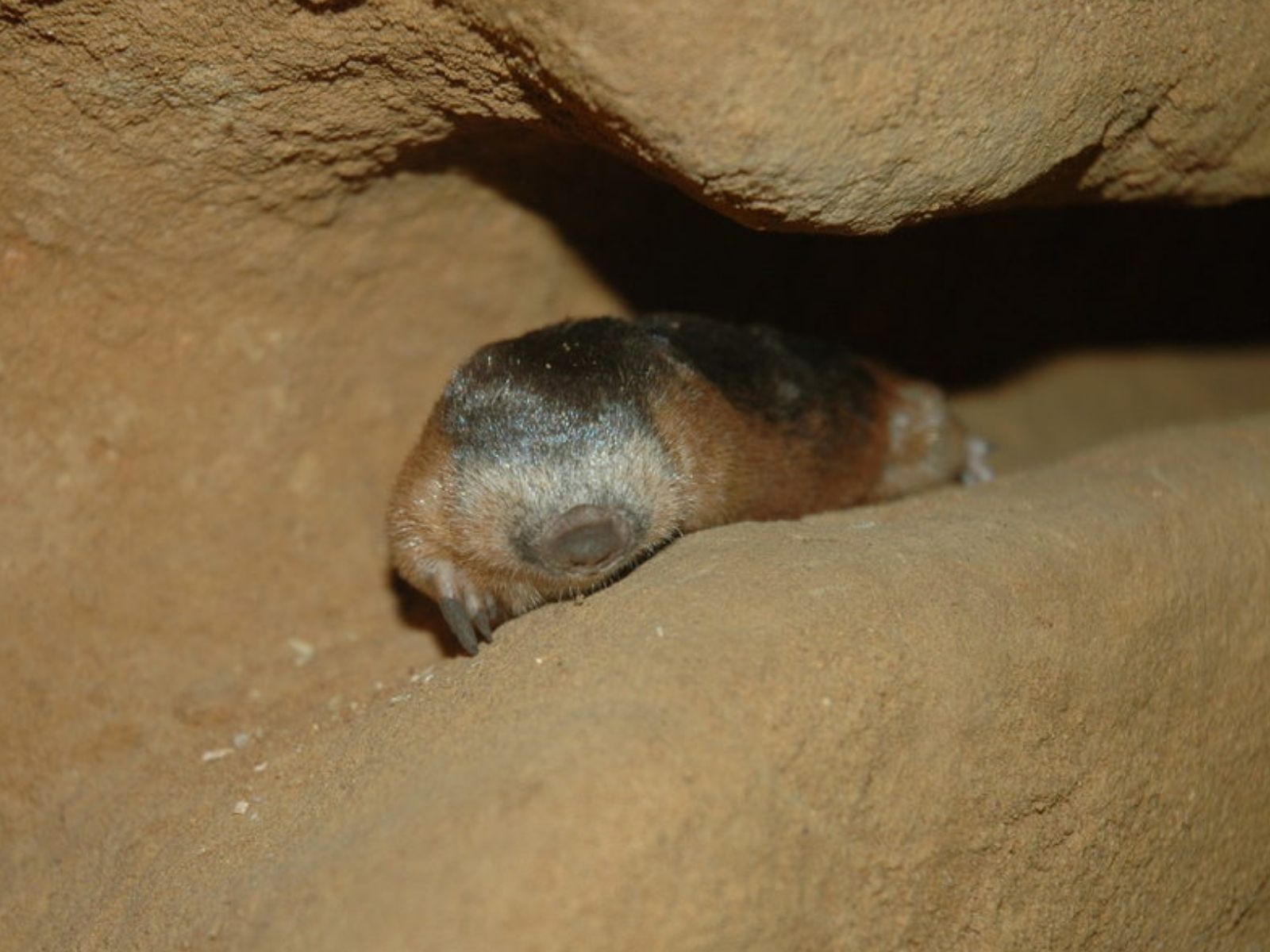
Marley’s Golden Mole
Amblysomus marleyi

2025 Red list status
Endangered

Regional Population Trend
Unknown

Change compared
to 2016
No Change
Overview
Amblysomus marleyi – Roberts, 1931
ANIMALIA – CHORDATA – MAMMALIA – AFROSORICIDA – CHRYSOCHLORIDAE – Amblysomus – marleyi
Common Names: Marley’s Golden Mole (English), Marley se Gouemol (Afrikaans), Marley-Goldmull (German)
Synonyms: No Synonyms
Taxonomic Note:
Traditionally recognised as a subspecies of A. hottentotus, but raised to full species rank by Bronner (1996). Species status for this taxon is corroborated by recent phylogenetic analyses, which showed that A. hottentotus represents a species complex, with A. marleyi and A. meesteri representing the most ancestral species within the complex. A. meesteri (previously A. h. meesteri) has since been elevated to full species rank, sister to A. marleyi.(Mynhardt et al. 2015, 2020, Bronner et al. 2024).
Red List Status: EN – Endangered, B1ab(ii,iii,v)+2ab(ii,iii,v) (IUCN version 3.1)
Assessment Information
Assessor: Mynhardt, S.1 & da Silva, J.2
Reviewer: Patel, T.1
Institutions: 1Endangered Wildlife Trust, 2South African National Biodiversity Institute
Previous Assessor: Bronner, G.
Previous Reviewer: Taylor, A.
Assessment Rationale
The species is listed as Endangered because it is only recorded from two locations 49 km apart. The extent of occurrence is ca. 1,563 km2 and area of occupancy is only 32 km2 (based on a grid cell area of 16 km2). Overgrazing and poor agricultural practices by growing low-income subsistence farming communities has, and continues to, lead to habitat degradation and probable ongoing declines in the area of occupancy, numbers of individuals and quality of suitable habitat. Further field surveys are required to more accurately delimit distribution and occupancy, and this species should be reassessed subsequently.
Reasons for Change
Reason(s) for Change in Red List Category from the Previous Assessment: No change
Red List Index
Red List Index: No change
Recommended citation: Mynhardt S & da Silva JM. 2025. A conservation assessment of Amblysomus marleyi. In Patel T, Smith C, Roxburgh L, da Silva JM & Raimondo D, editors. The Red List of Mammals of South Africa, Eswatini and Lesotho. South African National Biodiversity Institute and Endangered Wildlife Trust, South Africa.
Regional Distribution and occurrence
Geographic Range
This species is endemic to South Africa. Known from only two isolated localities (Ubombo and Ingwavuma) on the eastern slopes of Lebombo Mountains in KwaZulu-Natal. Owl pellet remains from Weenen, about 250 km southwest, appear to represent this species, suggesting that it may be more widespread than currently recognized. Possibly extends into southeastern eSwatini along Lebombo Mountains. There are two locations with an estimated extent of occurrence of 1,563 km2 and an area of occupancy of 32 km2 (based on grid cell area of 16 km2).
Elevation / Depth / Depth Zones
Elevation Lower Limit (in metres above sea level): (Not specified)
Elevation Upper Limit (in metres above sea level): (Not specified)
Depth Lower Limit (in metres below sea level): (Not specified)
Depth Upper Limit (in metres below sea level): (Not specified)
Depth Zone: (Not specified)
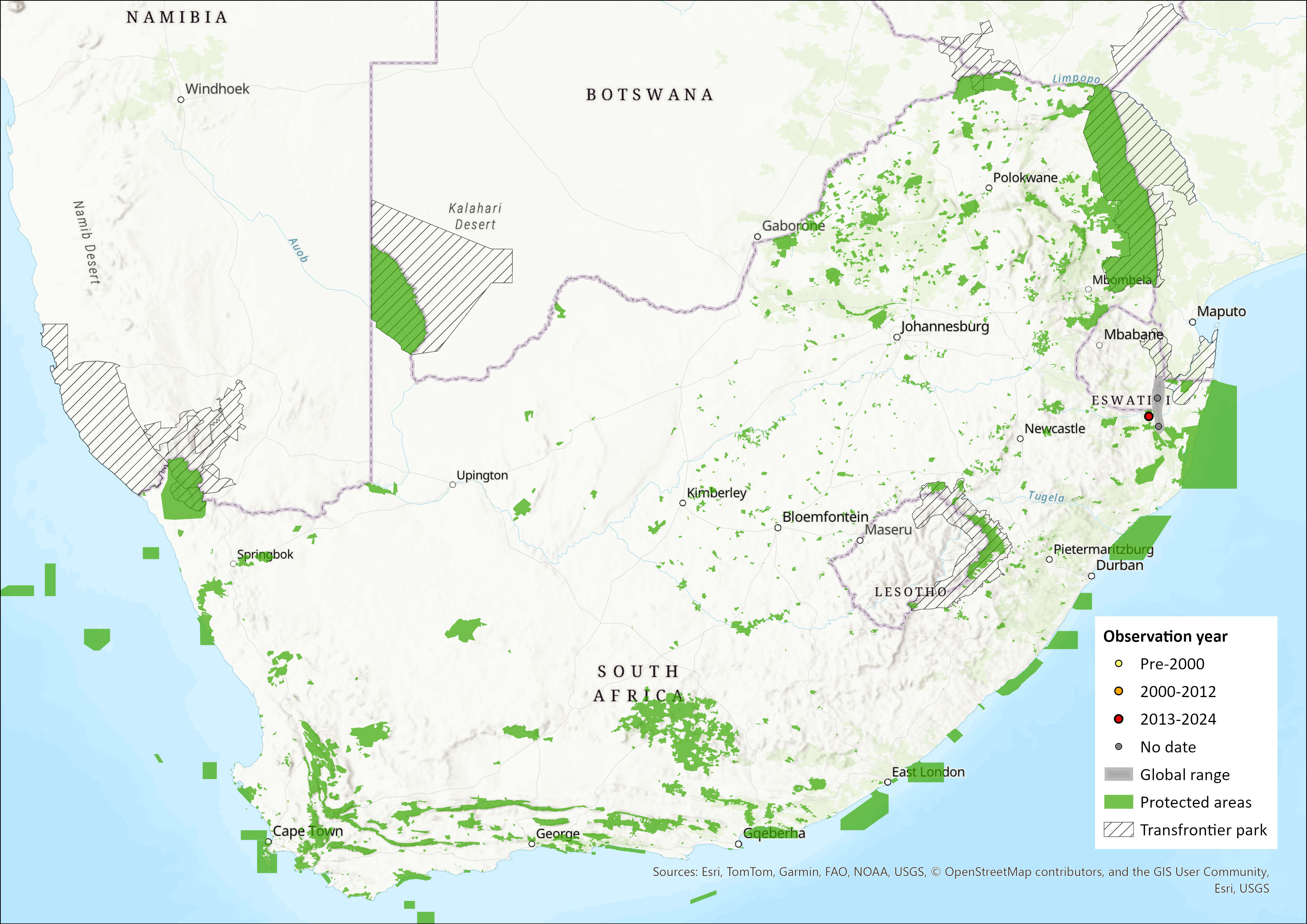
Figure 1. Distribution records for Marley’s Golden Mole (Amblysomus marleyi) within the assessment region (South Africa, Eswatini and Lesotho). Note that distribution data is obtained from multiple sources and records have not all been individually verified.
Biogeographic Realms
Biogeographic Realm: Afrotropical
Occurrence
Countries of Occurrence
| Country | Presence | Origin | Formerly Bred | Seasonality |
| Eswatini | Presence Uncertain | Origin Uncertain | – | – |
| South Africa | Extant | Native | – | Resident |
| South Africa -> KwaZulu-Natal | Extant | Native | – | Resident |
Large Marine Ecosystems (LME) Occurrence
Large Marine Ecosystems: (Not specified)
FAO Area Occurrence
FAO Marine Areas: (Not specified)
Climate change
Although the potential impacts of climate change on this species have not been directly assessed, climate change is expected to impact most golden mole species. Since these subterranean animals are restricted to soft soils for burrowing, and have very low vagility, their ability to migrate or shift their distribution ranges in response to climate change is very limited. Climate change is likely to impact golden moles through changes in vegetation type, soil moisture and prey availability.
Population information
The species is known from only two isolated localities (Ubombo and Ingwavuma) on the eastern slopes of Lebombo Mountains in KwaZulu-Natal. It is locally common, but no quantitative data are available.
|
Continuing decline in mature individuals? |
Qualifier |
Justification |
|
Yes |
Inferred |
– |
Current population trend: Unknown
Severely fragmented: No
Continuing decline in mature individuals: Yes
Extreme fluctuations in the number of subpopulations: (Not specified)
Continuing decline in number of subpopulations: (Not specified)
All individuals in one subpopulation: No
Number of subpopulations: 2
Number of mature individuals in largest subpopulation: (Not specified)
Quantitative Analysis
Probability of extinction in the wild within 3 generations or 10 years, whichever is longer, maximum 100 years: (Not specified)
Probability of extinction in the wild within 5 generations or 20 years, whichever is longer, maximum 100 years: (Not specified)
Probability of extinction in the wild within 100 years: (Not specified)
Population genetics
No population genetic studies have been conducted on this species; however, the two known localities where this species occurs are thought to represent two geographically isolated, genetically distinct subpopulations. Due to limited data, estimates of effective population size cannot be provided for the two subpopulations; however, these would be influential in re-evaluating the conservation status of this species. As would surveys to assess whether the species possesses a wide distribution than currently known.
Habitats and ecology
It is associated with moist grassland and indigenous forest habitats in Natal Lowveld Bushveld and Lebombo Arid-Mountain Bushveld of the Savannah biome in KwaZulu-Natal. It does not range below the mountains on the Mozambique plain, where it is replaced by the Yellow Golden Mole (Calcochloris obtusirostris). It also occurs in gardens (Bronner 2013). Similar to other golden moles, Amblysomus marleyi is insectivorous, predominantly nocturnal and constructs both subsurface foraging tunnels and deeper nesting chambers tunnels, which are usually situated under roots and large rocks (Skinner and Chimimba 2005).
IUCN Habitats Classification Scheme
| Habitat | Season | Suitability | Major Importance? |
| 1.5. Forest -> Forest – Subtropical/Tropical Dry | – | Suitable | Yes |
| 1.6. Forest -> Forest – Subtropical/Tropical Moist Lowland | – | Suitable | Yes |
| 1.9. Forest -> Forest – Subtropical/Tropical Moist Montane | – | Suitable | Yes |
| 2.1. Savanna -> Savanna – Dry | – | Suitable | Yes |
| 2.2. Savanna -> Savanna – Moist | – | Suitable | Yes |
| 3.5. Shrubland -> Shrubland – Subtropical/Tropical Dry | – | Suitable | Yes |
| 4.5. Grassland -> Grassland – Subtropical/Tropical Dry | – | Suitable | No |
| 14.1. Artificial/Terrestrial -> Artificial/Terrestrial – Arable Land | – | Suitable | No |
| 14.2. Artificial/Terrestrial -> Artificial/Terrestrial – Pastureland | – | Suitable | No |
| 14.3. Artificial/Terrestrial -> Artificial/Terrestrial – Plantations | – | Marginal | – |
| 14.4. Artificial/Terrestrial -> Artificial/Terrestrial – Rural Gardens | – | Suitable | No |
| 14.5. Artificial/Terrestrial -> Artificial/Terrestrial – Urban Areas | – | Marginal | – |
| 16. Introduced vegetation | – | Marginal | – |
Life History
Generation Length: (Not specified)
Age at Maturity: Female or unspecified: (Not specified)
Age at Maturity: Male: (Not specified)
Size at Maturity (in cms): Female: 9-12
Size at Maturity (in cms): Male: 9-11
Longevity: (Not specified)
Average Reproductive Age: (Not specified)
Maximum Size (in cms): (Not specified)
Size at Birth (in cms): (Not specified)
Gestation Time: (Not specified)
Reproductive Periodicity: (Not specified)
Average Annual Fecundity or Litter Size: (Not specified)
Natural Mortality: (Not specified)
Breeding Strategy
Does the species lay eggs? No
Does the species give birth to live young? Yes
Does the species exhibit parthenogenesis? No
Does the species have a free-living larval stage? No
Does the species require water for breeding? No
Movement Patterns
Movement Patterns: (Not specified)
Congregatory: (Not specified)
Systems
System: Terrestrial
General Use and Trade Information
General notes regarding trade and use of this species: This species is not known to be traded or utilised in any form.
Local Livelihood: (Not specified)
National Commercial Value: (Not specified)
International Commercial Value: (Not specified)
End Use: (Not specified)
Is there harvest from captive/cultivated sources of this species? (Not specified)
Harvest Trend Comments: (Not specified)
Threats
Habitat degradation is expected to be the most severe threat faced by Marley’s Golden Mole, possibly through overgrazing, urbanisation (in the Ubombo district) or the removal of vegetation for firewood by local communities. Localised threats include predation by domestic cats and dogs, as well as pesticide contamination in habitats adjacent to agricultural areas. Since urban and rural development has increased by 6% and 1% respectively in KwaZulu-Natal between 2000 and 2013 (GeoTerraImage 2015), there is an inferred increase in predation from pets, pesticide and habitat degradation from firewood collection in the region.
Continuing decline in area, extent and/or quality of habitat: Yes. Declining in area and quality. Its core grassland and forest habitats are prone to being modified, and there is an estimated on-going loss of natural habitat in KwaZulu-Natal of 1.2% per year (Jewitt et al. 2015).
Conservation
Marley’s Golden Mole is known to occur within the Pongola Wilderness Area, but additional research into the population trends, distribution and threats associated with this species is necessary in order to ensure the continued persistence of this species. Protected area expansion, reduced overgrazing and reduced logging will presumably benefit this species.
Recommendations for land managers and practitioners:
- Field surveys to discover additional subpopulations.
- Incentivise landowners to de-stock to reduce overgrazing impacts.
Research priorities:
- Field studies to determine life history traits and ecological tolerances of this species.
- Studies on subpopulation sizes, trends and distribution.
- Studies assessing the severity of threats to this species.
Encouraged citizen actions:
- Report sightings on virtual museum platforms (for example, iNaturalist and MammalMAP), especially outside protected areas.
- Deposit any dead specimens found in a state or provincial museum, together with information on the date and site where found.
- Create indigenous vegetation gardens.
Bibliography
Afrotheria Specialist Group. 2014. Specialist Group website. Available at: http://www.afrotheria.net/index.php.
Bronner, G.N. 1995. Systematic revision of the golden mole genera Amblysomus, Chlorotalpa and Calcochloris (Insectivora: Chrysochloromorpha; Chrysochloridae). Ph.D. Thesis, University of Natal.
Bronner, G.N. 1996. Geographic patterns of morphometric variation in the Hottentot golden mole, Amblysomus hottentotus (Insectivora: Chrysochloridae): a multivariate analysis. Mammalia 60: 729–751.
Bronner, G.N. 2013. Amblysomus marleyi. In: J. Kingdon, D. Happold, T. Butynski, M. Hoffmann, M. Happold and J. Kalina (eds), Mammals of Africa, Volume I: Introductory Chapters and Afrotheria, pp. 230-23. Bloomsbury Publishing, London.
Bronner, G.N. and Jenkins, P.D. 2005. Order Afrosoricida. In: D.E. Wilson and D.M. Reeder (eds), Mammal Species of the World, pp. 70-81. The Johns Hopkins University Press, Baltimore, MD, USA.
Bronner, G.N., Mynhardt, S., Bennett, N.C., Cohen, L., Crumpton, N., Hofreiter, M., Arnold, P. and Asher, R.J., 2024. Phylogenetic history of golden moles and tenrecs (Mammalia: Afrotheria). Zoological Journal of the Linnean Society, 201(1), pp.184-213.
GeoTerraImage. 2015. Quantifying settlement and built-up land use change in South Africa. Pretoria.
IUCN. 2015. The IUCN Red List of Threatened Species. Version 2015.2. Available at: www.iucnredlist.org. (Accessed: 23 June 2015).
Jewitt, D., Goodman, P.S., Erasmus, B.F.N., O’Connor, T.G. and Witkowski, E.T.F. 2015. Systematic land-cover change in KwaZulu-Natal, South Africa: Implications for biodiversity. South African Journal of Science 111: 1-9.
Mynhardt, S., Bennett, N.C. and Bloomer, P., 2020. New insights from RADseq data on differentiation in the Hottentot golden mole species complex from South Africa. Molecular phylogenetics and evolution, 143, p.106667.
Mynhardt, S., Maree, S., Pelser, I., Bennett, N.C., Bronner, G.N., Wilson, J.W. and Bloomer, P., 2015. Phylogeography of a morphologically cryptic golden mole assemblage from South-Eastern Africa. PLoS One, 10(12), p.e0144995.
Skinner, J.D. and Chimimba, C.T. (eds). 2005. The Mammals of the Southern African Subregion. Third edition. Cambridge University Press, United Kingdom, Cambridge.