

Maquassie Musk Shrew
Crocidura maquassiensis

2025 Red list status
Vulnerable

Regional Population Trend
Declining
Change compared
to 2016
No Change
Overview
Crocidura maquassiensis – Roberts, 1946
ANIMALIA – CHORDATA – MAMMALIA – EULIPOTYPHLA – SORICIDAE – Crocidura – maquassiensis
Common Names: Maquassie Musk Shrew, Makwassie Musk Shrew (English), Maquassie-skeerbek (Afrikaans)
Synonyms: No Synonyms
Taxonomic Note:
Meester et al. (1986) raised doubts about the validity of the species which has been described as a variant of the Reddish-grey Musk Shrew (C. cyanea) or a form of the Lesser White-toothed Musk Shrew (C. suaveolens). This may represent a species complex based on ecological divergence between the lower lying sand forests of Maputaland and the grassland escarpment subpopulations (P. Taylor unpubl. data) and will need revision to confirm the taxonomy of this species. Until new research proves the relatedness to other musk shrews, C. maquassiensis retain species status.
Red List Status: VU – Vulnerable, B2ab(ii,iii,iv,v) (IUCN version 3.1)
Assessment Information
Assessor: Russo, I.M.1 & da Silva, J.2
Reviewer: Patel, T.3
Institutions: 1Cardiff University, 2South African National Biodiversity Institute,3Endangered Wildlife Trust
Previous Assessors: Taylor, P., Baxter, R., Monadjem, A. & Power, J.,
Previous Reviewer: Child, M.F.
Previous Contributors: Avery, M., MacFadyen, D., Avenant, N., Wilson, B., Palmer, G. & Roxburgh, L.
Assessment Rationale
This is a rare species endemic to South Africa, Eswatini and Zimbabwe which occurs in moist grassland habitats in the Savannah and Grassland Biomes. Although the species has a wide inferred extent of occurrence (284,735 km2), it appears to be patchily distributed. Wetlands were used as a proxy for suitable habitat and the amount of natural habitat remaining within buffer strips around wetlands as the inferred area of occupancy (AOO) was calculated. This yielded a range of 1,790–2,089 km2 using a 32 m buffer strip. Habitat patches for this species are severely fragmented due to the poor dispersal ability of shrews in general. A continuing population decline based on high rates of habitat loss in all provinces, especially the KwaZulu-Natal and North West Provinces (1.2% per year from 1994–2011 and 0.5% per annum from 2006–2010, respectively) was inferred. This species is therefore listed as Vulnerable B2ab(ii,iii,iv,v) because, although the AOO estimate varies widely, not all suitable habitat will be occupied (for example, not a single individual was sampled during a recent survey in North West Province). More field studies should be undertaken to understand the distribution and density of the species. If new data indicate a wider AOO and confirm broad habitat tolerance then a reassessment will be necessary, and the species may be downlisted to Near Threatened or Least Concern. Key interventions include protected area expansion of moist grassland and riverine woodland habitats as well as providing incentives for landowners to sustain natural vegetation around wetlands and keep livestock or wildlife at ecological carrying capacity to avoid overgrazing.
Regional population effects: This species is suspected to have low dispersal capabilities and exists in fragmented habitat. No rescue effects are possible.
Reasons for Change
Reason(s) for Change in Red List Category from the Previous Assessment: No change
Red List Index
Red List Index: No change
Recommended Citation: Russo IM & da Silva JM. 2025. A conservation assessment of Crocidura maquassiensis. In Patel T, Smith C, Roxburgh L, da Silva JM & Raimondo D, editors. The Red List of Mammals of South Africa, Eswatini and Lesotho. South African National Biodiversity Institute and Endangered Wildlife Trust, South Africa.
Regional Distribution and occurrence
Geographic Range
This is a rare species, recorded only from disparate localities in Zimbabwe, Mantenga Falls in the Middleveld region of Eswatini (Monadjem 1998), the Limpopo (Motlateng and Blouberg, and more recently in the Soutpansberg Mountains; P. Taylor unpubl. data), North West (Makwassie), Gauteng (Krugersdorp, Roodeplaat Dam and Heuningklip), KwaZulu-Natal (Kosi Lake, Lake Sibaya, Gaint’s Castle, Royal Natal and Chase Valley Heights) and Mpumalanga Provinces (Loskop Dam; Skinner & Chimimba 2005). The species may be considered near endemic or endemic if molecular work reveals that a species complex exists across regions and biomes. Additionally, the Highveld grassland population may turn out to be taxonomically distinct from the subtropical grassland population (P. Taylor unpubl. data).
Although the type locality for the species is Maquassie (town in the North West Province discovered in 1928 in a house), the species has been infrequently recorded in the province and there have been no post-1999 records despite a recent survey that sampled the Klipspruit region around Maquassie that may form part of a dispersal corridor for the species (Power 2014). Countrywide, post-1999 records for the species pertain only to the Soutpansberg Mountains (Taylor et al. 2015) and the northern part of the KwaZulu-Natal Province (P. Taylor unpubl. data). Similarly, both Friedmann and Daly (2004) and Baxter (2008) indicated a possible occurrence for the species in the southern Free State Province on the Orange River, but this revision does not have a record for this area and the species presence has not been detected in the Free State in recent surveys (N. Avenant pers. comm. 2016).
Based on the scattered records available, the extent of occurrence was estimated at 284,735 km2. However, the species is patchily distributed within the assessment area and the species depends on moist habitats, wetlands were used as a proxy for suitable habitat and the amount of natural habitat remaining within buffer strips around wetlands as the inferred area of occupancy (AOO) was calculated at 40,496–47,246 km2 (using a 500 m buffer strip) or 1,790–2,089 km2 (using a 32 m buffer strip). Although this is still a large area, the lower estimates are more plausible.
Elevation / Depth / Depth Zones
Elevation Lower Limit (in metres above sea level): (Not specified)
Elevation Upper Limit (in metres above sea level): (Not specified)
Depth Lower Limit (in metres below sea level): (Not specified)
Depth Upper Limit (in metres below sea level): (Not specified)
Depth Zone: (Not specified)
Map
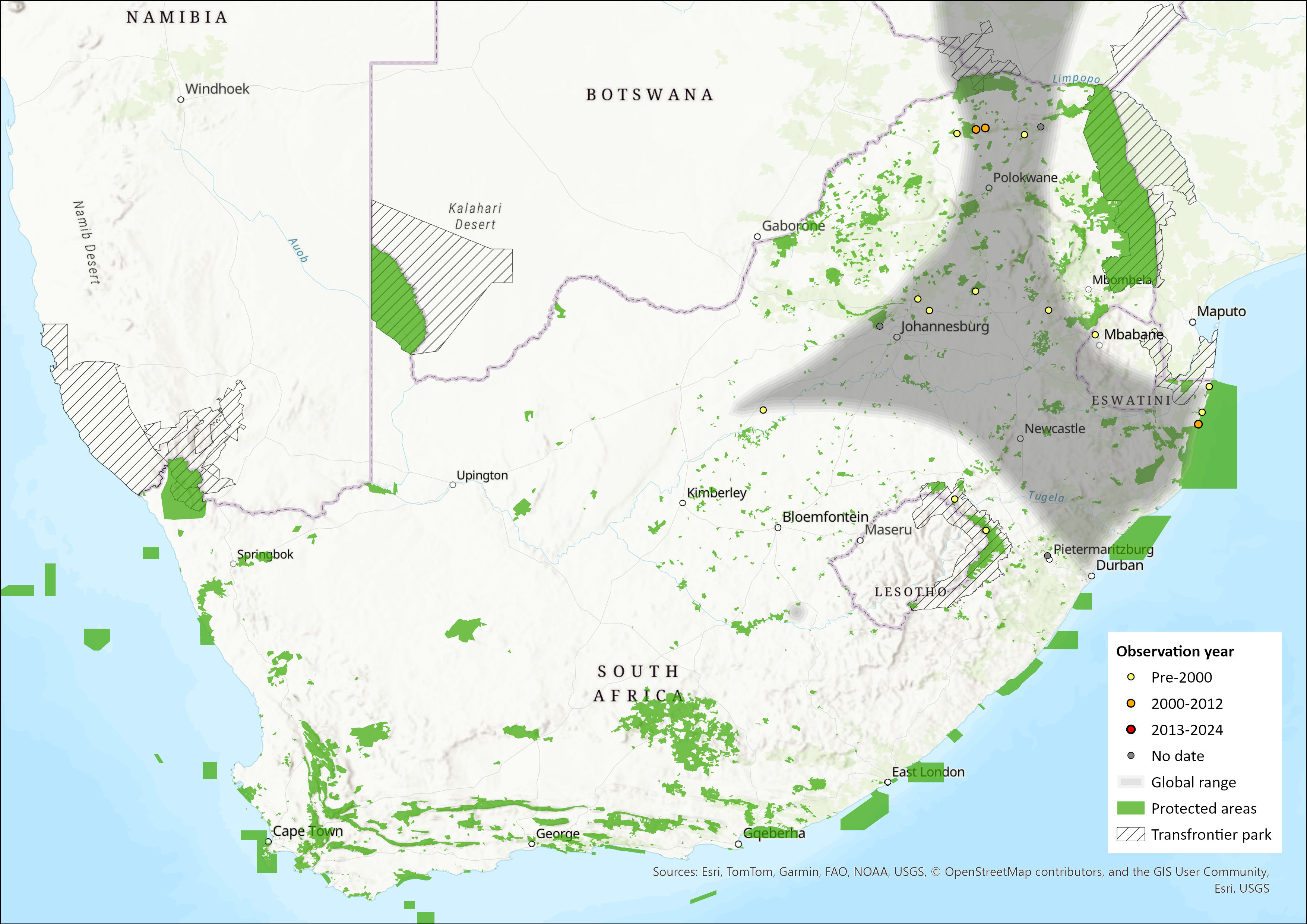
Figure 1. Distribution records for Maquassie Musk Shrew (Crocidura maquassiensis) within the assessment region (South Africa, Eswatini and Lesotho). Note that distribution data is obtained from multiple sources and records have not all been individually verified.
Biogeographic Realms
Biogeographic Realm: Afrotropical
Occurrence
Countries of Occurrence
| Country | Presence | Origin | Formerly Bred | Seasonality |
| Eswatini | Extant | Native | – | – |
| South Africa | Extant | Native | – | – |
| Zimbabwe | Extant | Native | – | – |
Large Marine Ecosystems (LME) Occurrence
Large Marine Ecosystems: (Not specified)
FAO Area Occurrence
FAO Marine Areas: (Not specified)
Climate change
There is no information on how climate change may impact this species at present.
Population information
This species is small, relatively rare and seldom caught in traps during sampling. Research from Luvhondo Nature Reserve in the Soutpansberg Mountains indicated a population at low density where only two individuals were captured over a year-long period (2010–2011) in half-hectare plots (Taylor et al. 2015). This equates to a trap success of 0.005 captures/trap night and an inferred density of around 1 individual/0.01 km2 (P. Taylor unpubl. data). If this density calculation is extrapolated across the lowest estimate of AOO a population size of at least 179,000 individuals is estimated.
Its rarity is also corroborated through recent field studies in Mkhuze and Phinda Game Reserves, the KwaZulu-Natal Province where despite being within the distributional range of the species it was not sampled (Delcros et al. 2014; Rautenbach et al. 2014). This may be a naturally rare species that is difficult to identify and has been overlooked. Although more information and sampling are needed, this species is likely to persist in areas with moist conditions.
Population Information
| Continuing decline in mature individuals? | Qualifier | Justification |
| Unknown | – | – |
Current population trend: Declining. Inferred from natural habitat loss in core provinces.
Number of mature individuals in population: 179,000 – based on extrapolation across AOO of density in the Soutpansberg Mountains.
Number of mature individuals in largest subpopulation: Unknown
Number of subpopulations: Unknown
Severely fragmented: Yes, considering the poor dispersal ability of the species and the fragmented nature of moist grasslands within its EOO.
Extreme fluctuations in the number of subpopulations: (Not specified)
Continuing decline in number of subpopulations: (Not specified)
All individuals in one subpopulation: (Not specified)
Quantitative Analysis
Probability of extinction in the wild within 3 generations or 10 years, whichever is longer, maximum 100 years: (Not specified)
Probability of extinction in the wild within 5 generations or 20 years, whichever is longer, maximum 100 years: (Not specified)
Probability of extinction in the wild within 100 years: (Not specified)
Population genetics
No population genetics study has been conducted for this species; however, given that the species is thought to have low dispersal capabilities and exists in fragmented habitats, it is very likely genetic differentiation exists within the assessment region. Unfortunately, given the limited information available, it would be difficult to guess where and how this structure would be positioned. While an approximate population size based on density and AOO has been provided (179,000 individuals; see Population section), without an idea of the population structure, attempting to quantify effective population size (Ne) would be inaccurate.
Habitats and ecology
Little is known about the habitats and ecology of this species. The type specimen was collected in a house and the Motlateng specimen from a grassy mountainside beneath a rock at 1,580 m asl (Skinner & Chimimba 2005). Other specimens have also been found on rocky or montane grassland (Soutpansberg Mountains; Taylor et al. 2015). The Chase Valley Heights specimen was brought in by a cat from the garden (P. Taylor pers. comm. 2016). The Royal Natal specimen was collected in mixed bracken and grasslands along the Tugela River and from coastal forest (Taylor 1998). Thus, it may tolerate a wide range of habitats including urban and rural landscapes.
Ecosystem and cultural services: This species could be a candidate flagship species in the grassland biodiversity stewardship schemes.
IUCN Habitats Classification Scheme
| Habitat | Season | Suitability | Major Importance? |
| 4.7. Grassland -> Grassland – Subtropical/Tropical High Altitude | – | Marginal | – |
| 6. Rocky areas (eg. inland cliffs, mountain peaks) | – | Suitable | – |
| 14.4. Artificial/Terrestrial -> Artificial/Terrestrial – Rural Gardens | – | Unknown | – |
Life History
Generation Length: (Not specified)
Age at Maturity: Female or unspecified: (Not specified)
Age at Maturity: Male: (Not specified)
Size at Maturity (in cms): Female: (Not specified)
Size at Maturity (in cms): Male: (Not specified)
Longevity: (Not specified)
Average Reproductive Age: (Not specified)
Maximum Size (in cms): (Not specified)
Size at Birth (in cms): (Not specified)
Gestation Time: (Not specified)
Reproductive Periodicity: (Not specified)
Average Annual Fecundity or Litter Size: (Not specified)
Natural Mortality: (Not specified)
Does the species lay eggs? (Not specified)
Does the species give birth to live young: (Not specified)
Does the species exhibit parthenogenesis: (Not specified)
Does the species have a free-living larval stage? (Not specified)
Does the species require water for breeding? (Not specified)
Movement Patterns
Movement Patterns: (Not specified)
Congregatory: (Not specified)
Systems
System: Terrestrial
General Use and Trade Information
There is no known subsistence or commercial use of this species.
Local Livelihood: (Not specified)
National Commercial Value: (Not specified)
International Commercial Value: (Not specified)
End Use: (Not specified)
Is there harvest from captive/cultivated sources of this species? (Not specified)
Harvest Trend Comments: (Not specified)
Threats
The main threats to shrews are the loss or degradation of moist, productive areas such as wetlands and rank grasslands within suitable habitat. The two main drivers behind this are abstraction of surface water and draining of wetlands through industrial and residential expansion, and overgrazing of moist grasslands, which leads to the loss of ground cover and decreases small mammal diversity and abundance (Bowland & Perrin 1989, 1993). Suppression of natural ecosystem processes, such as severe fire can also lead to habitat degradation through bush encroachment or loss of plant diversity through alien invasive infestation and is suspected to be increasing with human settlement expansion. There are also clear overlaps and synergistic effects between these threats. A continuing population decline based on natural habitat loss is inferred.
Wetlands are the country’s most threatened ecosystem, with 65% of wetland ecosystem types threatened (48% of all wetland types are Critically Endangered, 12% are Endangered and 5% are Vulnerable) because they are highly productive and hence become transformed for agriculture (Driver et al. 2012). Overall 45% of our remaining wetland areas exist in a heavily modified condition due primarily to onsite modification from crop cultivation, coal mining, urban development, dam construction, and overgrazing (and thus erosion) and off-site modifications from disruptions to flow regime and deterioration of water quality (Driver et al. 2012).
Current habitat trend: Habitat loss and degradation across the range of the species are caused primarily by agricultural expansion, urban and rural settlement expansion, plantations and mining. Overall, there was a 19.7% loss of natural habitat in KwaZulu-Natal from 1994 to 2008, with an average loss of 1.2% per year (Jewitt et al. 2015). If this rate of loss continues into the future, there will be an estimated 12% loss of habitat over 10 years. In Gauteng, 13% of natural habitat was lost between 1995 and 2009 (Driver et al. 2012). In North West Province, 2% of natural habitat was lost just between 2006 and 2010 (Desmet & Schaller 2015). Similarly, although not formally quantified, there is ongoing habitat loss in both Mpumalanga and Limpopo provinces, especially from settlement expansion and mining. New land cover data from 2000 and 2013 show that Gauteng, Limpopo, Mpumalanga and North West provinces experienced rural expansion of 39%, 9%, 7% and 6.5%, respectively (GeoTerraImage 2015), while urban expansion proceeded at 8%, 15%, 11% and 14% for the same provinces (GeoTerraImage 2015). Such settlement expansion indicates both a loss of habitat and an increase in human encroachment on grassland and wetland resources, which we infer as increasing habitat degradation. The effects of climate change on this species are currently unknown.
Conservation
This species occurs in the Maloti-Drakensberg Transfrontier Park and presumably several other protected areas. The main intervention for this species is the protection and restoration of wetlands and grasslands. Biodiversity stewardship schemes should be promoted if landowners possess wetlands or grasslands close to core protected areas or remaining habitat patches, and the effects on small mammal subpopulations should be monitored. Protecting such habitats may create dispersal corridors between grassland patches that will restore connectivity between habitat patches. Landowners and managers should be educated, encouraged and incentivised to conserve the habitats on which shrews and other small mammals depend. Retaining ground cover is the most important management tool to increase small mammal diversity and abundance. This can be achieved through reducing grazing pressure (Bowland & Perrin 1989), or by maintaining a buffer strip of natural vegetation around wetlands (Driver et al. 2012). Small mammal diversity and abundance is also higher in more complex or heterogeneous landscapes where periodic burning is an important tool to achieve this (Bowland & Perrin 1993). Removing alien vegetation from watersheds, watercourses and wetlands is also an important intervention to improve flow and water quality, and thus habitat quality for shrews. Education and awareness campaigns should be employed to teach landowners and local communities about the importance of conserving wetlands and moist grasslands.
Recommendations for land managers and practitioners:
- Landowners and communities should be incentivised to stock livestock or wildlife at ecological carrying capacity to avoid overgrazing and to maintain a buffer of natural vegetation around wetlands.
- Enforce regulations on developments that could potentially impact on the habitat integrity of grasslands and wetlands.
Research priorities:
- Additional field surveys are needed to clarify and confirm the distribution of this species.
- Molecular research may be needed to disentangle a possible species complex.
Encouraged citizen actions:
- Citizens are requested to submit any shrews killed by cats or drowned in pools to a museum or a provincial conservation authority for identification, thereby enhancing our knowledge of shrew distribution (carcasses can be placed in a ziplock bag and frozen with the locality recorded).
Bibliography
Baxter R. 2008. Crocidura maquassiensis. The IUCN Red List of Threatened Species 2008: e.T5576A11351679.
Bowland, A.E. and Perrin, M.R. 1989. The effect of overgrazing on the small mammals in Umfolozi Game Reserve. Zeitschrift für Säugetierkunde 54: 251–260.
Bowland, J.M. and Perrin, M.E. 1993. Wetlands as reservoirs of small-mammal populations in the Natal Drakensberg. South African Journal of Wildlife Research 23: 39–43.
Delcros, G., Taylor, P.J., and Schoeman, M.C. 2015. Ecological correlates of small mammal assemblage structure at different spatial scales in the savannah biome of South Africa. Mammalia 79(1): 1-14.
Desmet PG, Schaller R. 2015. North West Biodiversity Sector Plan Technical Report. North West Department of Rural, Environment and Agricultural Development, Mahikeng, South Africa.
Driver, A., Sink, K.J., Nel, J.N., Holness, S., Van Niekerk, L., Daniels, F., Jonas, Z., Majiedt, P.A., Harris, L. and Maze, K. 2012. National Biodiversity Assessment 2011: An assessment of South Africa’s biodiversity and ecosystems. Synthesis Report. South African National Biodiversity Institute and Department of Environmental Affairs, Pretoria, South Africa.
Friedmann, Y. and Daly, B. 2004. Red Data Book of the Mammals of South Africa: A Conservation Assessment. Conservation Breeding Specialist Group (SSC/IUCN) and Endangered Wildlife Trust, Parkview, South Africa.
GeoTerraImage. 2015. Quantifying settlement and built-up land use change in South Africa. Pretoria.
Jewitt, D., Goodman, P.S., Erasmus, B.F.N., O’Connor, T.G. and Witkowski, E.T.F. 2015. Systematic land-cover change in KwaZulu-Natal, South Africa: Implications for biodiversity. South African Journal of Science 111: 1-9.
Meester, J.A.J., Rautenbach, I.L., Dippenaar, N.J. and Baker, C.M. 1986. Classification of Southern African Mammals. Monograph number 5. Transvaal Museum , Pretoria, South Africa.
Monadjem A. 1998. The mammals of Swaziland. Conservation Trust of Swaziland and Big Games Parks, Mbabane, Swaziland.
Power, R.J. 2014. The distribution and status of mammals in the North West Province. Department of Economic Development, Environment, Conservation & Tourism, North West Provincial Government, Mahikeng.
Rautenbach A, Dickerson T, Schoeman MC. 2014. Diversity of rodent and shrew assemblages in different vegetation types of the savannah biome in South Africa: no evidence for nested subsets or competition. African Journal of Ecology 52: 30-40.
Skinner, J.D. and Chimimba, C.T. (eds). 2005. The Mammals of the Southern African Subregion. Cambridge University Press, United Kingdom, Cambridge.
Taylor PJ, Munyai A, Gaigher I, Baxter R. 2015. Afromontane small mammals do not follow the hump-shaped rule: altitudinal variation in the Soutpansberg Mountains, South Africa. Journal of Tropical Ecology 31: 37-48.
Taylor, P. 1998. The Smaller Mammals of KwaZulu-Natal. University of Natal Press, Pietermaritzburg, South Africa.