

Lowveld Serotine Bat

2025 Red list status
Least Concern

Regional Population Trend
Unknown

Change compared
to 2016
New Assessment
Overview
Neoromicia hlandzeni – (Taylor et al. 2022)
ANIMALIA – CHORDATA – MAMMALIA – CHIROPTERA – VESPERTILIONIDAE – Neoromicia – hlandzeni
Common Names: Lowveld Serotine Bat (English)
Synonyms
Pipistrellus (Hypsugo) anchietae Hill & Harrison (1987) (In part): Zambia
Pipistrellus (Hypsugo) anchietae Koopman (1993) (In part): South Africa.
Hypsugo anchietae Cotterill (1996): Zimbabwe.
Hypsugo anchietae Kearney et al. (2002): KwaZulu-Natal Province, South Africa.
Hypsugo anchietae Kearney (2005): Zimbabwe, Limpopo, and KwaZulu-Natal provinces, South Africa.
Hypsugo anchietae Simmons (2005) (In part): Zimbabwe, South Africa.
Hypsugo anchietae Monadjem et al. (2010) (In part): Zimbabwe, Mozambique, Eswatini, South Africa.
Neoromicia anchietae Monadjem et al. (2020) (In part): Zimbabwe, Mozambique, Eswatini, South Africa.
Laephotis anchietae Simmons & Cirranello (2022): (In part): Zimbabwe, Mozambique, Eswatini,
Taxonomic Note:
Previously included in N. anchietae but shown by Taylor et al. (2022) to be a “lowveld” species distinguished from N. anchietae (a highland species) on genetic grounds (11% sequence divergence in cytochrome-b), on cranial size (distinctly larger in hlandzeni) and on baculum shape (lateral projections in the tip in anchietae but not hlandzeni).
Reasons for Change
Reason(s) for Change in Red List Category from the Previous Assessment: No Change
Red List Status
Red List Status: LC – Least Concern (IUCN version 3.1)
Assessment Information
Assessors: Taylor, P.J.1, Richards, L.R.2, Howard, A.1 & da Silva, J.M.3
Reviewer: Smith, C.4
Institutions: 1University of the Free State, 2Durban Natural Science Museum, 3South African National Biodiversity Institute, 4Endangered Wildlife Trust
Assessment Rationale
Listed as Least Concern as it has a wide distribution in the assessment region (estimated extent of occurrence is 434,534 km2), and it occurs in the iSimangaliso Wetland Park and Kruger National Park.
Regional population effects: This species occurs widely in the lowveld of Zimbabwe and the Zambezi Valley in Mozambique.
Reasons for Change
Reason(s) for Change in Red List Category from the Previous Assessment: New Assessment
Red List Index
Red List Index: New assessment
Recommended citation: Taylor PJ, Richards LR, Howard A & da Silva JM. 2025. A conservation assessment of Neoromicia hlandzeni. In Patel T, Smith C, Roxburgh L, da Silva JM & Raimondo D, editors. The Red List of Mammals of South Africa, Eswatini and Lesotho. South African National Biodiversity Institute and Endangered Wildlife Trust, South Africa.
Regional Distribution and occurrence
Geographic Range
This species is restricted to southern Africa, occurring from the Durban area of KwaZulu-Natal through to the northern coast of KwaZulu-Natal, the lowveld of Eswatini, the southern Kruger National Park, into the Limpopo Valley, and the Zambezi Valley of Zimbabwe to the lower reaches of the Zambezi River in Mozambique (Taylor et al. 2022).
Elevation / Depth / Depth Zones
Elevation Lower Limit (in metres above sea level): 6 m asl (Monadjem et al. 2024)
Elevation Upper Limit (in metres above sea level): 1,505 m asl (Monadjem et al. 2024)
Depth Lower Limit (in metres below sea level): (Not specified)
Depth Upper Limit (in metres below sea level): (Not specified)
Depth Zone: (Not specified)
Map
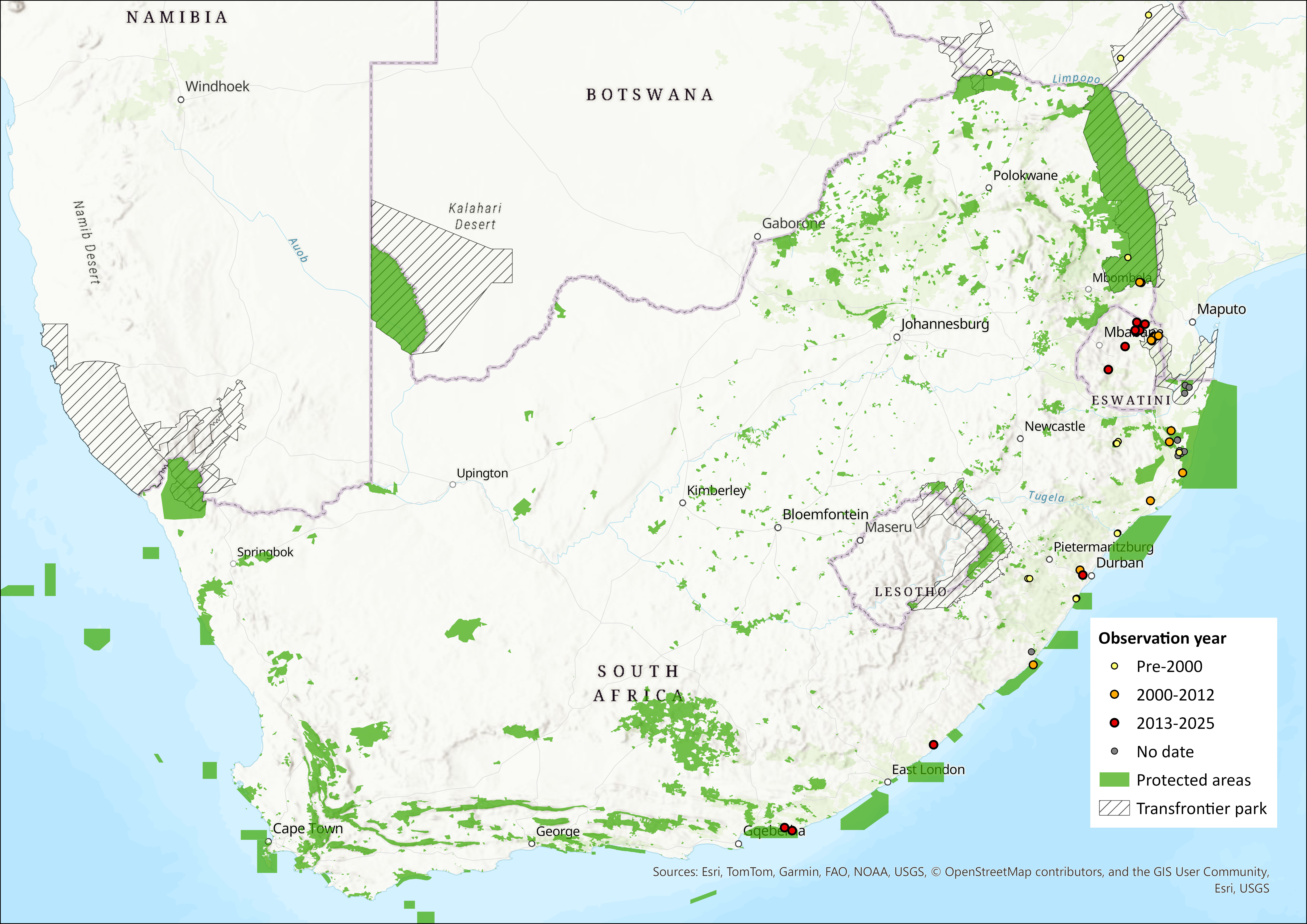 Figure 1. Distribution records for Lowveld Serotine Bat (Neoromicia hlandzeni) within the assessment region (South Africa, Eswatini and Lesotho). Note that distribution data is obtained from multiple sources and records have not all been individually verified.
Biogeographic Realms
Biogeographic Realm: Afrotropical
Occurrence
Countries of Occurrence
| Country | Presence | Origin | Formerly Bred | Seasonality |
| Eswatini | Extant | Native | – | – |
| Mozambique | Extant | Native | – | – |
| South Africa | Extant | Native | – | – |
| Zimbabwe | Extant | Native | – | – |
Large Marine Ecosystems (LME) Occurrence
Large Marine Ecosystems: (Not specified)
FAO Area Occurrence
FAO Marine Areas: (Not specified)
Climate change
No formal study on the direct effects of climate change in this species has yet been conducted. However, due to the increasing temperatures across most of the species’ distribution, the roosting preferences and foraging areas are predicted to shift (Pacifici et al. 2018). Most studies on the effects of climate change on bats are based on predictive species distribution modelling, thus there is a lack of empirical studies measuring behavioural, physiological, phenological or genetic responses to extreme and seasonal climatic changes, especially in the Global South (Festa et al. 2023; Pio et al. 2014). Globally, there have been documented declines in bat populations, species richness and distributions in relation to water availability with increasing global aridity which may become a growing concern as heat waves and maximum temperatures are expected to increase over much of South Africa and Eswatini (Adams & Hayes 2021; Mbokodo et al. 2020; Pacifici et al. 2018).
Population Information
Under the previous name of N. anchietae, it was predominantly collected from only a few localities is the assessment region (Monadjem et al. 2020), yet this species is considered locally common in southern Africa.
Current population trend: Unknown
Continuing decline in mature individuals: Unknown
Extreme fluctuations in the number of subpopulations: (Not specified)
Continuing decline in number of subpopulations: (Not specified)
All individuals in one subpopulation: (Not specified)
Number of mature individuals in largest subpopulation: (Not specified)
Number of Subpopulations: (Not specified)
Quantitative Analysis
Probability of extinction in the wild within 3 generations or 10 years, whichever is longer, maximum 100 years: (Not specified)
Probability of extinction in the wild within 5 generations or 20 years, whichever is longer, maximum 100 years: (Not specified)
Probability of extinction in the wild within 100 years: (Not specified)
Population Genetics
A population genetic study has not been conducted on the species; however, based on morphological evidence, it is believed that individuals from South Africa, Eswatini and Zimbabwe form a metapopulation. While this species is locally common, it can be mistaken with other species. Studies piloting the use of environmental DNA on guano at roosting sites or colonies could prove valuable at identifying additional roost sites for the species.
Habitats and ecology
This species is typically associated with dry savannah and woodland habitats (Monadjem et al. 2020; Taylor et al. 2022). Specimens in KwaZulu-Natal, were collected from woody habitats, such as Afromontane forest, riparian forest coastal forest or bushveld (Taylor 1998). In Durban, the species is found along rivers in the urban landscapes (Naidoo et al. 2011). Very little research is available on the feeding ecology and roosting behaviour of this species (Skinner and Chimimba 2005), but they are often collected when nets and harp traps are placed above water (Kearney and Taylor 1997, Monadjem et al. 2020). They are considered clutter-edge and clutter foragers (Monadjem et al. 2020). At the Sudwala Caves in Mpumalanga, their diet was found to comprise of Hemiptera, Diptera and Coleoptera (Schoeman and Jacobs 2011). Although little is known of their reproductive biology, in KwaZulu-Natal, a female pregnant with two fetuses was recorded in October (Kearney and Taylor 1997).
Ecosystem and cultural services: As this species is insectivorous, it may contribute to controlling insect populations that damage crops (Boyles et al. 2011, Kunz et al. 2011). Ensuring a healthy population of insectivorous bats can thus decrease the need for pesticides which may be detrimental for human health as well as biodiversity (Frank 2024).
IUCN Habitats Classification Scheme
| Habitat | Season | Suitability | Major Importance? |
| 2.1. Savanna -> Savanna – Dry | – | Suitable | – |
Life History
Generation Length: Unknown
Age at Maturity: Female or unspecified: Unknown
Age at Maturity: Male: Unknown
Size at Maturity (in cms): Sexes combined: mean forearm length = 3.11 ± 0.10 cm (Taylor et al. 2022)
Size at Maturity (in cms): Male: Unknown
Longevity: Unknown
Average Reproductive Age: Unknown
Maximum Size (in cms): Unknown
Size at Birth (in cms): (Not specified)
Gestation Time: (Not specified)
Reproductive Periodicity: (Not specified)
Average Annual Fecundity or Litter Size: Two (based on reports of animals examined from KwaZulu-Natal originally identified as Neoromicia anchietae; Kearney and Taylor 1997)
Natural Mortality: (Not specified)
Breeding Strategy
Does the species lay eggs? No
Does the species give birth to live young: Yes
Does the species exhibit parthenogenesis: No
Does the species have a free-living larval stage? No
Does the species require water for breeding? No
Movement Patterns
Movement Patterns: (Not specified)
Congregatory: (Not specified)
Systems
System: Terrestrial
General Use and Trade Information
There is no evidence to suggest that this species is traded or harvested within the assessment region.
|
Subsistence: |
Rationale: |
Local Commercial: |
Further detail including information on economic value if available: |
|
Yes |
– |
– |
– |
National Commercial Value: No
International Commercial Value: No
End Use: (Not specified)
Is there harvest from captive/cultivated sources of this species? Yes
Harvest Trend Comments: (Not specified)
Threats
No major threats have been identified for this species at present, but there is limited research available for this species, thus more comprehensive studies are required to assess possible threats. For example, there are no data available for the types of roosting sites utilised by this species, which undermines our ability to predict which sites may be vulnerable to human disturbance or habitat alteration. Similar to other insectivorous bats, the use of pesticides in agricultural landscapes may diminish its prey base.
Conservation
This species is present within a number of protected areas within the assessment region, including the Kruger National Park (Great Limpopo Transfrontier Park), iSimangaliso Wetland Park, Tembe Elephant Park, Kranzkloof Nature Reserve, as well as the Lubombo Transfrontier Conservation Areas. No specific conservation measures have been identified for this species. However, further investigations into the general ecology, distribution and possible threats to this species are required.
Recommendations for land managers and practitioners:
- Reduce pesticide use in agricultural landscapes.
Research priorities:
- Field surveys and systematic monitoring to determine distribution, population size and trends.
- Natural history, including the roosting, feeding and reproductive ecology of this species.
- Quantifying the possible threats faced by this species.
- Continued molecular and taxonomic research is necessary for this species and the Neoromica/Pipistrellus group.
Encouraged citizen actions:
- Citizens can assist the conservation of the species by reporting sightings on virtual museum platforms (e.g., iNaturalist and MammalMAP) and therefore contribute to an understanding of the species distribution.
Bibliography
Adams, R.A. and Hayes, M.A. 2021. The importance of water availability to bats: climate warming and increasing global aridity. 50 years of bat research: foundations and new frontiers, pp.105-120.
Boyles JG, Cryan PM, McCracken GF, Kunz TH. 2011. Economic importance of bats in agriculture. Science 332: 41–42.
Cotterill, F. P. D. 1996a. New distribution records of insectivorous bats of the families Nycteridae, Rhinolophidae and Vespertilionidae (Microchiroptera: Mammalia) in Zimbabwe. Arnoldia Zimbabwe, 10 (8): 71 – 89
Festa, F., Ancillotto, L., Santini, L., Pacifici, M., Rocha, R., Toshkova, N., Amorim, F., Benítez‐López, A., Domer, A., Hamidović, D. and Kramer‐Schadt, S. 2023. Bat responses to climate change: a systematic review. Biological Reviews, 98(1), pp.19-33.
Frank, E.G. 2024. The economic impacts of ecosystem disruptions: Costs from substituting biological pest control. Science 385,0344.
Hill, J. E. and D. L. Harrison. 1987. The baculum in the Vespertilioninae (Chiroptera: Vespertilionidae) with a systematic review, a synopsis of Pipistrellus and Eptesicus, and the descriptions of a new genus and subgenus. Bulletin of the British Museum (Natural History): Zoology, 52 (7): 225 – 305.
Kearney, T. & Taylor, P. 1997. New distribution records of bats in KwaZulu-Natal. Durban Museum Novitates, 22(1), pp.53-56.
Kearney, T. C., M. Volleth, G. Contrafatto and P. J. Taylor. 2002. Systematic implications of chromosome GTG-band and bacula morphology for Southern African Eptesicus and Pipistrellus and several other species of Vespertilioninae (Chiroptera: Vespertilionidae). Acta Chiropterologica, 4 (1): 55 – 76. doi: 10.3161/001.004.0107
Kearney, T. C. 2005. Systematic revision of Southern African species in the genera Eptesicus, Neoromicia, Hypsugo and Pipistrellus (Chiroptera: Vespertilionidae). PhD thesis, University of KwaZulu-Natal – Durban: i – xxvii; 1 – 580.
Koopman, K. F. 1993a. Order Chiroptera. In: Wilson, D. E. and D. M. Reeder [Eds]: Mammal species of the world: a taxonomic and geographic reference. Second edition. Smithsonian Institution Press – Washington, D.C. & London: 137 – 241.
Kunz TH, Braun de Torrez E, Bauer D, Lobova T, Fleming TH. 2011. Ecosystem services provided by bats. Annals of the New York Academy of Sciences 1223: 1–38.
Mbokodo, I., Bopape, M.J., Chikoore, H., Engelbrecht, F. and Nethengwe, N. 2020. Heatwaves in the future warmer climate of South Africa. Atmosphere, 11(7), p.712.
Monadjem, A., Taylor, P.J., Cotterill, F.P.D. and Schoeman M.C. 2010. Bats of Southern and Central Africa: a biogeographic and taxonomic synthesis. 1st Edition. University of Witwatersrand Press, Johannesburg.
Monadjem, A., Taylor, P.J., Cotterill, F.P.D. and Schoeman M.C. 20210. Bats of Southern and Central Africa: a biogeographic and taxonomic synthesis. 2nd Edition. University of Witwatersrand Press, Johannesburg.
Monadjem, A., T.C. Demos, D.L. Dalton, P.W. Webala, S. Musila, J.C. Kerbis Peterhans, and B.D. Patterson. 2020. A revision of pipistrelle-like bats (Mammalia: Chiroptera: Vespertilionidae) in East Africa with the description of new genera and species. Zoological Journal of the Linnean Society XX: 1-33
Monadjem, A., Montauban, C., Webala, P.W., Laverty, T.M., Bakwo-Fils, E.M., Torrent, L., Tanshi, I., Kane, A., Rutrough, A.L., Waldien, D.L. and Taylor, P.J., 2024. African bat database: curated data of occurrences, distributions and conservation metrics for sub-Saharan bats. Scientific Data, 11(1), p.1309.
Naidoo, S., Mackey, R.L. and Schoeman, M.C. 2011. Foraging ecology of insectivorous bats (Chiroptera) at a polluted and an unpolluted river in an urban landscape. Durban Museum Novitates, 2011, Vol. 34, 21-28 ref. 45
Pacifici, M., Visconti, P. and Rondinini, C. 2018. A framework for the identification of hotspots of climate change risk for mammals. Global Change Biology, 24(4), pp.1626-1636.
Pio, D.V., Engler, R., Linder, H.P., Monadjem, A., Cotterill, F.P., Taylor, P.J., Schoeman, M.C., Price, B.W., Villet, M.H., Eick, G. and Salamin, N. 2014. Climate change effects on animal and plant phylogenetic diversity in southern Africa. Global Change Biology, 20(5), pp.1538-1549.
Schoeman, M.C. and Jacobs, D.S. 2011. The relative influence of competition and prey defences on the trophic structure of animalivorous bat ensembles. Oecologia, 166(2), pp.493-506.
Simmons, N. B. 2005. Order Chiroptera. In: Wilson, D.E. and D. M. Reeder [Eds]: Mammal Species of the World: A taxonomic and geographic reference. The John Hopkins University Press – Baltimore.
Simmons, N. B. and A. L. Cirranello. 2022. Bats of the world. A taxonomic and geographic database. Version 1.3. Zenodo98 pages.
Skinner J.D. and Chimimba C.T. 2005. The Mammals of the Southern African Subregion. Cambridge University Press, Cambridge, UK.
Taylor, P.J. 1998. Th Smaller Mammals of KwaZulu-Natal. University of Natal Press, Pietermaritzburg, South Africa.
Taylor, P. J., Markotter, W., Strydom, E., Kearney, T., Cotterill, F. P. D., Cory Toussaint, D., Weier, S. M., Keith, M., Neef, G., Richards, L., Howard, A., Mamba, M., Magagula, S., Monadjem, A. 2022. Integrative taxonomic analysis of new collections from the central Angolan highlands resolves the taxonomy of African pipistrelloid bats on a continental scale. Zoological Journal of the Linnean Society 196: 1570-1590,