

Long-finned Pilot Whale
Globicephala melas

2025 Red list status
Least Concern

Regional Population
Trend
Unknown

Change compared
to 2016
No Change
Overview
Globicephala melas – (Traill, 1809)
ANIMALIA – CHORDATA – MAMMALIA – ARTIODACTYLA – DELPHINIDAE – Globicephala – melas
Common Names: Long-finned Pilot Whale, Ca’aing Whale, Atlantic Blackfish, Common Pilot Whale, Pilot Whale, Pothead (English), Langvinloodswalvis (Afrikaans)
Synonyms: Delphinus melas Traill, 1809; Globicephala melaena (Traill 1809).
The subspecies for this species have never been assessed; they are attached here to ensure the full cetacean taxonomy is accounted for in SIS, and to make these available to the Cetacean SG if they decide to assess these taxa in future.
Taxonomic Note:
Two subspecies of the Long-finned Pilot Whale are currently recognised: The North Atlantic Long-finned Pilot Whale, Globicephala melas melas and the Southern Long-finned Pilot Whale, G. m. edwardii Committee on Taxonomy 2024); however, these designations are not supported by genetic evidence (Kraft et al. 2020).
Red List Status: LC – Least Concern, (IUCN version 3.1)
Assessment Information
Assessors: Penry, G.,1 James, B.S.2 & da Silva, J.3
Reviewer: Purdon, J.4,5
Institutions: 1Nelson Mandela University, 2The Centre for Statistics in Ecology, the Environment and Conservation, University of Cape Town, 3South African National Biodiversity Institute, 4TUT Nature Conservation, 5The Whale Unit, University of Pretoria
Previous Assessors: Cockcroft, V. & Relton, C.
Previous Reviewer: Plön, S.
Previous Contributors: Atkins, S., Child, M.F., Elwen, S., Findlay, K., Meÿer, M. & Oosthuizen, H.
Assessment Rationale
Long-finned Pilot Whales (Globicephala melas) are a widely distributed species across the globe, where their offshore distribution patterns may overlap with increasing threats such as long-line fishing, shipping lanes, and seismic exploration activities in the assessment region. Although this species is unstudied in the assessment region, based on strandings and opportunistic sightings data, they appear to be relatively common offshore. While the general threats outlined for pelagic species could also apply here, there are no known threats that could cause a range-wide decline. However, there are no population size and trend data for the region of assessment and the taxonomy is uncertain, thus this species will need to be re-assessed as new data emerge. Additionally, as this species is deep-diving, it may be increasingly threatened by the emerging threats of underwater marine noise and plastic pollution, the effects of which should be monitored. Currently, Long-finned Pilot Whales are not conservation priorities within the assessment region as they are globally fairly abundant (for example 750,000 in the North Atlantic). Therefore, they are listed as Least Concern.
Regional population effects: Pilot whales presumably occur seasonally in South African waters, and although continued research into their seasonal distribution and movements is required, no barriers to dispersal are recognised, thus rescue effects are considered possible.
Reasons for Change
Reason(s) for Change in Red List Category from the Previous Assessment: No change
Red List Index
Red List Index: No change
Recommended citations: Penry G, James BS & da Silva JM. 2025. A conservation assessment of Globicephala melas. In Patel T, Smith C, Roxburgh L, da Silva JM & Raimondo D, editors. The Red List of Mammals of South Africa, Eswatini and Lesotho. South African National Biodiversity Institute and Endangered Wildlife Trust, South Africa.
Regional Distribution and occurrence
Geographic Range
Long-finned Pilot Whales are widely distributed with little geographic overlap in their range with Short-finned Pilot Whales (G. macrorhynchus). The Long-finned Pilot Whale is generally restricted to an anti-tropical distribution in temperate and subpolar regions (Olson 2018) however it has been suggested that they likely occur in southern Angola, however this remains to be confirmed (Weir 2019). Southern Hemisphere Long-finned Pilot Whales have a circumpolar distribution from warm temperate regions southwards to approximately 70°S (Skinner & Chimimba 2005). Within the southern African subregion, they are recorded from Namibia, South Africa, Tristan da Cunha, Kerguelen and the Southern Ocean (Best 2007).
Within the assessment region, van Bree et al. (1978) indicated that Long-finned Pilot Whales are primarily confined to the west coast of South Africa. This species typically occurs in waters deeper than 1,000 m, beyond the edge of the continental shelf.
Off southern Africa, the furthest east that a Long-finned Pilot Whale was recorded is a stranded specimen off East London, South Africa, however this is thought to be the extreme easterly limit of its range or even an extralimital specimen (Best 2007). They overlap partially with the Short-finned Pilot Whales in the region of Mossel Bay and East London (Skinner & Chimimba 2005). Long-finned Pilot Whales also occur around the Prince Edward Islands.
Elevation / Depth / Depth Zones
Elevation Lower Limit (in metres above sea level): (Not specified)
Elevation Upper Limit (in metres above sea level): (Not specified)
Depth Lower Limit (in metres below sea level): (Not specified)
Depth Upper Limit (in metres below sea level): (Not specified)
Depth Zone: (Not specified)
Map
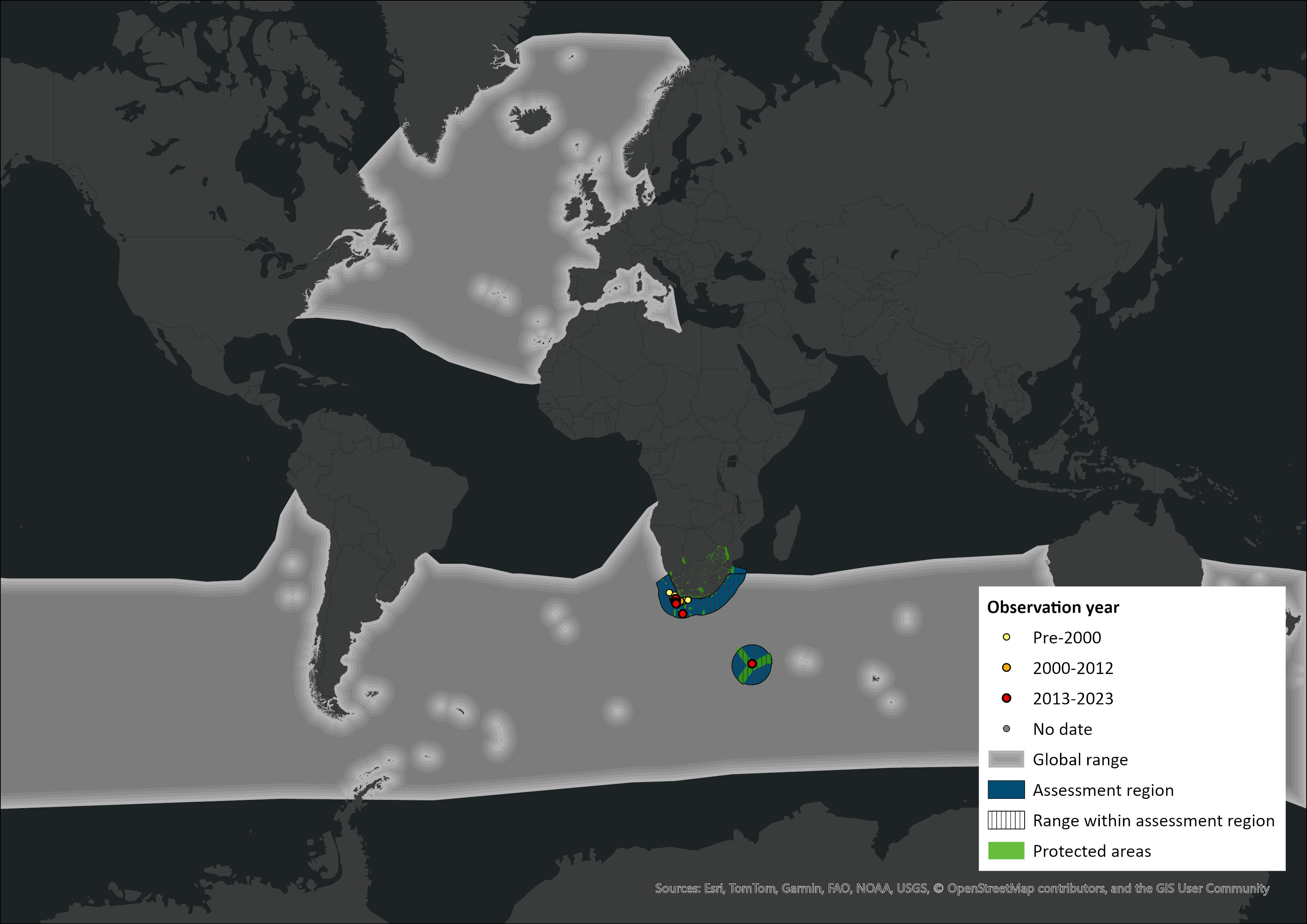 Figure 1. Distribution records for Long-finned Pilot Whale (Globicephala melas) within the assessment region (South Africa, Eswatini and Lesotho). Note that distribution data is obtained from multiple sources and records have not all been individually verified.
Biogeographic Realms
Biogeographic Realm: Afrotropical, Antarctic, Australasian, Nearctic, Neotropical, Oceanian, Palearctic
Occurrence
Countries of Occurrence
| Country | Presence | Origin | Formerly Bred | Seasonality |
| Algeria | Extant | Native | – | Resident |
| Angola | Presence Uncertain | Native | – | Seasonal Occurrence Uncertain |
| Antarctica | Presence Uncertain | Native | – | Seasonal Occurrence Uncertain |
| Argentina | Extant | Native | – | Resident |
| Australia | Extant | Native | – | Resident |
| Belgium | Extant | Native | – | Resident |
| Bouvet Island | Extant | Native | – | Resident |
| Brazil | Extant | Native | – | Resident |
| Canada | Extant | Native | – | Resident |
| Chile | Extant | Native | – | Resident |
| Denmark | Extant | Native | – | Resident |
| Falkland Islands (Malvinas) | Extant | Native | – | Resident |
| Faroe Islands | Extant | Native | – | Resident |
| France | Extant | Native | – | Resident |
| French Southern Territories -> Kerguelen | Extant | Native | – | Resident |
| French Southern Territories -> Crozet Is. | Extant | Native | – | Resident |
| Germany | Extant | Native | – | Resident |
| Gibraltar | Extant | Native | – | Resident |
| Greenland | Extant | Native | – | Resident |
| Guernsey | Presence Uncertain | Native | – | Seasonal Occurrence Uncertain |
| Heard Island and McDonald Islands | Extant | Native | – | Resident |
| Iceland | Extant | Native | – | Resident |
| Ireland | Extant | Native | – | Resident |
| Isle of Man | Extant | Native | – | Resident |
| Italy | Extant | Native | – | Resident |
| Jersey | Presence Uncertain | Native | – | Seasonal Occurrence Uncertain |
| Libya | Extant | Native | – | Resident |
| Malta | Extant | Native | – | Resident |
| Mauritania | Extant | Native | – | Resident |
| Monaco | Presence Uncertain | Native | – | Seasonal Occurrence Uncertain |
| Morocco | Extant | Native | – | Resident |
| Namibia | Extant | Native | – | Resident |
| Netherlands | Extant | Native | – | Resident |
| New Zealand | Extant | Native | – | Resident |
| New Zealand -> Antipodean Is. | Extant | Native | – | Resident |
| New Zealand -> Chatham Is. | Extant | Native | – | Resident |
| New Zealand -> North Is. | Extant | Native | – | Resident |
| New Zealand -> South Is. | Extant | Native | – | Resident |
| Norfolk Island | Presence Uncertain | Native | – | Seasonal Occurrence Uncertain |
| Norway | Extant | Native | – | Resident |
| Peru | Extant | Native | – | Resident |
| Portugal | Extant | Native | – | Resident |
| Portugal -> Azores | Extant | Native | – | Resident |
| Portugal -> Madeira | Extant | Native | – | Resident |
| Saint Pierre and Miquelon | Extant | Native | – | Resident |
| South Africa | Extant | Native | – | Resident |
| South Africa -> Marion-Prince Edward Is. | Extant | Native | – | Resident |
| South Georgia and the South Sandwich Islands | Extant | Native | – | Resident |
| Spain | Extant | Native | – | Resident |
| Sweden | Extant | Native | – | Resident |
| Tunisia | Extant | Native | – | Resident |
| United Kingdom of Great Britain and Northern Ireland | Extant | Native | – | Resident |
| United States of America | Extant | Native | – | Resident |
| United States of America -> North Carolina | Extant | Native | – | Resident |
| Uruguay | Extant | Native | – | Resident |
| Western Sahara | Extant | Native | – | Resident |
Large Marine Ecosystems (LME) Occurrence
Large Marine Ecosystems: (Agulhas Somali Current Large Marine Ecosystem (ASCLME); Benguela Current Large Marine Ecosystem (BCLME))
FAO Area Occurrence
| Presence | Origin | Formerly Bred | Seasonality | |
| 21. Atlantic – northwest | Extant | Native | – | – |
| 27. Atlantic – northeast | Extant | Native | – | – |
| 31. Atlantic – western central | Extant | Native | – | – |
| 34. Atlantic – eastern central | Extant | Native | – | – |
| 37. Mediterranean and Black Sea | Extant | Native | – | – |
| 41. Atlantic – southwest | Extant | Native | – | – |
| 47. Atlantic – southeast | Extant | Native | – | – |
| 48. Atlantic – Antarctic | Extant | Native | – | – |
| 51. Indian Ocean – western | Extant | Native | – | – |
| 57. Indian Ocean – eastern | Extant | Native | – | – |
| 58. Indian Ocean – Antarctic | Extant | Native | – | – |
| 81. Pacific – southwest | Extant | Native | – | – |
| 87. Pacific – southeast | Extant | Native | – | – |
Climate change
Although the impacts of climate change to Pilot Whales are largely unknown, it is likely that changes in water temperature and CO2 concentration will have cascading effects on Pilot Whale movements and feeding ecology. Learmonth et al. (2006) reported that in the Faroe Islands, where Long-finned Pilot Whales have been historically hunted, catch rates were positively correlated with occurrence of a popular prey species, Todarodes sagittatus. This pelagic squid is thought to be either directly influenced by water temperature and CO2 concentration, or possibly indirectly influenced by productivity (Bjørge 2002).
Cetacean morbillivirus was responsible for the deaths of at least 60 Long-finned Pilot Whales in the Mediterranean (Bellière et al. 2011) with surviving individuals often exhibiting decreased long-term survival due to chronic infections and immunosuppression (Pons et al. 2022). Such incidents are likely to become more prevalent as the impacts of climate change, especially increasing sea surface temperatures (Sanderson and Alexander 2020), and ship-avoidance behaviour increase, which may force the species into environments that expose them to new vectors of disease.
Population
No global estimates of abundance exist for this species; however, several regional population estimates indicate that in certain regions these species are relatively abundant. For example, Buckland et al. (1993) reported that there are approximately 778,000 Long-finned Pilot Whales in the Northeast Atlantic. In summer, south of the Antarctic Convergence, Waring et al. (2006) estimated approximately 200,000 Long-finned Pilot Whales, however this may have included some misidentified Short-finned Pilot Whales. No population estimates are available for the assessment region. Model-based estimates of generation time are 24.0 years for Long-finned Pilot Whales (Taylor et al. 2007).
Current population trend: Unknown
Continuing decline in mature individuals: Unknown
Number of mature individuals in population: Unknown
Number of mature individuals in largest subpopulation: Unknown
Number of subpopulations: Unknown
Severely fragmented: No
Quantitative Analysis
Probability of extinction in the wild within 3 generations or 10 years, whichever is longer, maximum 100 years: (Not specified)
Probability of extinction in the wild within 5 generations or 20 years, whichever is longer, maximum 100 years: (Not specified)
Probability of extinction in the wild within 100 years: (Not specified)
Population Genetics
G. melas and G. macrorhyncus are genetically distinct at the species level, yet within each species there are low levels of genetic (mtDNA) diversity (Oremus et al. 2009). Two subspecies are recognised within G. melas: G. melas melas and G. melas edwardii; however, these designations are not supported by recent genetic evidence (Kraft et al. 2020). Indeed, several studies report low levels of diversity within the species overall, in particular for haplotype richness and nucleotide diversity (Oremus et al. 2009; Miralles et al. 2016; Kraft et al. 2020). The current distribution of this species is likely related to dispersal events during the Last Glacial Maximum bringing about incipient divergence between the hemispheres (Kraft et al. 2020). So, while there might not be sufficient data to warrant subspecific status, the species can be considered to have two demographically independent subpopulations.
Based on this information, there is one subpopulation in the assessment region. Consequently, the Convention on Biological Diversity’s Global Biodiversity Framework’s (GBF’s) complementary genetic indicator – proportion of populations maintained (PM) – would receive a value of 1.0 (all populations remaining). This is assuming no distinct subpopulations have gone extinct in the region.
While no global or regional population size estimates exist for Long-finned Pilot Whales, estimates from other regions suggest the species is relatively abundant, numbering in the hundreds of thousands (see Population section). The species would be considered genetically stable if approximately 5,000 individuals or more make up the subpopulation, assuming a conversion ratio of Ne/Nc between 0.1-0.3 (i.e., Ne > 500). In general, this is deemed to be feasible, especially considering it is part of a larger subpopulation with no additional barriers to gene flow likely to exist.
Habitats and ecology
Long-finned Pilot Whales are distributed anti-tropically, with marginal overlap with Short-finned Pilot Whales in temperate waters off South Africa (Olson 2018; Best, 2007). Southern hemisphere populations of Long-finned Pilot Whales are circumpolar, occurring from warm temperate regions southwards to 70°S, and are present within the Benguela System, Humboldt Current and Falkland Current (Skinner & Chimimba 2005). They inhabit cold temperate waters of both the North Atlantic and Southern Ocean. This species tends to follow its prey (squid and mackerel) inshore and into continental shelf waters during the summer and autumn (Reeves et al. 2003). Both species are associated with the shelf edge or in water over 1,000 m deep and sightings within the assessment region occur in summer and winter.
Cephalopods constitute a large proportion of the diet of Globicephala spp., however, fish are also consumed. Three dietary patterns have been identified for Long-finned Pilot whales, diverse (≥10 species) and restricted (≤ 3 species) diets dominated by cephalopods and restricted diets (≤ 3 species) dominated by fish (Beasley et al. 2019). Although primarily squid eaters, Long-finned Pilot Whales in the western North Atlantic were found to also take small to medium-sized fish, such as mackerel, when available (Gannon et al. 1997). Stable isotope analysis of stranded Long-finned Pilot Whales from Argentina also suggest a diet comprised mainly of oceanic squid species with neritic species forming only a small proportion of the diet (Becker et al. 2021). In the assessment region, Sekiguchi et al. (1992) reported that the stomach content remains of Long-finned Pilot Whales from South Africa only contained cephalopods. Of the 23 cephalopod species identified, Lycoteuthis diadema and Todarodes sagittatus dominated, contributing 43.4% and 27.8% of the 551 food items examined, respectively. A single, 1,000 kg Long-finned Pilot Whale was estimated to have a daily food intake requirement of approximately 3.1% of body mass (Best 2007).
Pilot whales are considered extremely gregarious, forming cohesive bonds, and are often reported in pods comprising of several hundred (Oremus et al. 2009). This strong social cohesion may be an influencing factor in the occurrence of mass stranding events (Perrin & Geraci 2002). Globally, Pilot Whales frequently occur in association with other odontocetes including Bottlenose Dolphins (Tursiops spp.) and Rough-toothed Dolphins (Weir 2010), and in the assessment region have also been recorded with Striped, Spinner, Hourglass and Southern Right Whale Dolphins (Best 2007). Groups of positively identified Long-finned Pilot Whales in the southern African region ranged in numbers from 2 to 120, with an average of 56 (Best 2007).
Although little is known about the reproductive biology of this species locally, in the northern hemisphere, the gestation period of Long-finned Pilot Whales has been documented at 15.5–16 months (Skinner & Chimimba 2005). G. melas seems to mature at a younger age and have a shorter lifespan than G. macrorhynchus, with females reaching maturity at a body length of 3.63 m (6–7 years old) and males reaching sexual maturity at 4.6 m (12 years old; Kasuya et al. 1988). Differences in the post-reproductive lifespan of females are also present between the two species with the proportion of female years spent post reproductive (“menopause”) in Long-finned Pilot Whales only 0.002 (equivalent to about 1 year) compared to that of Short-finned Pilot Whales at 0.26 (equivalent to about 14 or 15 years) despite similar social structures and longevities (approximately 60 years) for the two species (Nichols et al. 2020). The average duration of lactation is 3.35 years but is reported to last as long as 9 years in older females (Best 2007; Olson 2018).
Ecosystem and cultural services: Marine mammals integrate and reflect ecological variation across large spatial and long temporal scales, and therefore they are prime sentinels of marine ecosystem change (Moore 2008).
IUCN Habitats Classification Scheme
| Habitat | Season | Suitability | Major Importance? |
| 10.1. Marine Oceanic -> Marine Oceanic – Epipelagic (0-200m) | – | Marginal | – |
| 10.2. Marine Oceanic -> Marine Oceanic – Mesopelagic (200-1000m) | – | Suitable | Yes |
| 10.3. Marine Oceanic -> Marine Oceanic – Bathypelagic (1000-4000m) | – | Suitable | Yes |
Life History
(updated from Olsen 2018 & Best 2007)
Generation Length: 24 years
Age at Maturity: Female or unspecified: 8 years
Age at Maturity: Male: 12 years
Size at Maturity (in cms): Female: 374 cm
Size at Maturity (in cms): Male: 516 cm
Longevity: Females: 60 years; Males 35-45 years
Average Reproductive Age: (Not specified)
Maximum Size (in cms): Female: 475 cm; Male: 556 cm
Size at Birth (in cms): 1.63-1.91 m, 55-85 kg
Gestation Time: 12-16 months
Reproductive Periodicity: average of 5.1 years (2.7-11.8 years)
Average Annual Fecundity or Litter Size: (Not specified)
Natural Mortality: (Not specified)
Does the species lay eggs? No
Does the species give birth to live young: Yes
Does the species exhibit parthenogenesis: No
Does the species have a free-living larval stage? No
Does the species require water for breeding? Yes
Movement Patterns
Movement Patterns: (Not specified)
Congregatory: (Not specified)
Systems
System: Marine
General Use and Trade Information
Pilot whales in the northern hemisphere have been historically exploited for their oil and are still hunted in regions such as Japan. In some years, hundreds of G. melas are killed in the Faroe Islands. There is no legal trade or use of this species within the assessment region.
| Subsistence: | Rationale: | Local Commercial: | Further detail including information on economic value if available: |
| No | – | – | – |
National Commercial Value: No
International Commercial Value: No
| End Use | Subsistence | National | International | Other (please specify) |
| 1. Food – human | – | true | – | – |
Is there harvest from captive/cultivated sources of this species? (Not specified)
Harvest Trend Comments: (Not specified)
Threats
Due to their deep-water distribution, pilot whales within South African waters are not expected to experience any major threats that may severely impact their population status in the assessment region. However, additional research into the population status, taxonomy and seasonal movements of these species is needed, following which a reassessment of their conservation status may be necessary. A number of minor threats have been recognised:
Bycatch, particularly in long-line squid fisheries, is a threat to Short- and Long-finned Pilot Whales. There is also a potential emerging threat posed by a southern shift in the distribution of effort by the tuna purse-seine fisheries. It is also possible that there is direct competition between the Long-finned Pilot Whale and the squid fishery, which has been documented in other parts of its range (Minton et al. 2018a), with both species widely reported to depredate on longline fisheries, removing fish from hooks during operations and losses to fisheries can be substantial (Werner et al. 2015). Pilot whales are particularly susceptible to entanglement in driftnets, but the population-level effect of this mortality is unknown.
Although, there is no local information available, commercial squid fisheries are widespread in the western North Atlantic, and the target species for these fisheries are squids commonly eaten by pilot whales, raising the possibility of prey depletion. Bernard and Reilly (1999) suggest that bycatch of pilot whales is likely to be considerably more common than is currently reported. Similar to beaked whales, both species of pilot whales are thought to be vulnerable to anthropogenic noise pollution, specifically those produced by seismic exploration and navy sonar (Cox et al. 2006; Antunes et al. 2014) but also increasing levels of commercial shipping and marine construction. Long-finned Pilot Whales are documented changing their diving and acoustic behaviour in response to sonar (Isojunno et al., 2017; Northridge 2018). Although, the cause of pilot whale mass stranding events remains controversial in many regions, Short-finned Pilot Whales are thought to be frequently impacted by high levels of anthropogenic marine noise (Hohn et al. 2006). As the intensity of marine noise pollution is thought to be increasing within South African waters (Koper & Plön 2012), this potentially represents an emerging threat. Similar to other deep-diving species, marine plastic pollution may also represent an emerging threat, as it has been known to cause fatalities in sperm whales.
In addition to noise pollution, pilot whales are affected by chemical pollutants which, even at relatively low levels, may impair reproduction and reduce disease resilience. In the north Atlantic Long-finned Pilot Whales were found to have high levels of organochlorine and organobromide contaminants, while in the Mediterranean population levels of organochlorines were between 5 and 10 times higher (DDTs: 224.22 µg/g lipid weight, PCBs: 268.31 µg/g lipid weight; Lauriano et al. 2014; Pons et al. 2022). Being predators at the top of the food chain, they also accumulate heavy metals such as cadmium and mercury (Gajdosechova et al. 2016)
Although the impacts of climate change to pilot whales are largely unknown, it is likely that changes in water temperature and CO2 concentration will have cascading effects on pilot whale movements and feeding ecology. Learmonth et al. (2006) reported that in the Faroe Islands, where Long-finned Pilot Whales have been historically hunted, catch rates were positively correlated with occurrence of a popular prey species, Todarodes sagittatus. This pelagic squid is thought to be either directly influenced by water temperature and CO2 concentration, or possibly indirectly influenced by productivity (Bjørge 2002). Additionally, environmental variation as a result of the 1982–1983 El Niño is likely to have indirectly caused the absence of Short-finned Pilot Whales, and their associated prey-species Loligo opalescens, in some regions.
Disease – Cetacean morbillivirus was responsible for the deaths of at least 60 Long-finned Pilot Whales in the Mediterranean (Bellière et al. 2011) with surviving individuals often exhibiting decreased long-term survival due to chronic infections and immunosuppression (Pons et al. 2022). Such incidents are likely to become more prevalent as the impacts of climate change, especially increasing sea surface temperatures (Sanderson and Alexander, 2020), and ship-avoidance behaviour increase, which may force the species into environments that expose them to new vectors of disease.
Although pilot whales are hunted in some parts of their range (for example, Long-finned Pilot Whales are caught in “drive-kill fisheries” off Japan and the Faroe Islands, Minton et al. 2018a; Olson 2018), these species are not hunted within the assessment region, and the small-scale exploitation in the southern hemisphere is considered to be irregular (Skinner & Chimimba 2005).
Conservation
Both pilot whale species are listed in Appendix II of CITES and are protected in South Africa under the Threatened or Protected Species (TOPS) regulations that fall within the Marine Living Resources Act (Act 18 of 1998). No specific conservation measures can be recommended for these species within the assessment region until more information on population sizes, trends and threats are generated. As such, they would benefit from continued research into their population dynamics, distribution patterns and the impact of competition and bycatch with local squid fisheries. Globally, too, more research is needed to determine the impact of potential threats on pilot whales (Minton et al. 2018a).
Recommendations for managers and practitioners:
- Interactions between pilot whales and long-line fisheries require urgent investigation. The spatial distribution of squid fisheries and pilot whales should be mapped and overlaps identified. The impacts and severity of potential competition between the fisheries and the cetaceans should be quantified.
Research priorities:
- The severity and potential impacts of threats, specifically the impacts of squid fisheries, could affect the listings of pilot whales.
- It is recommended that population census surveys are undertaken in South African waters, and Marion Island could be used as a monitoring base for G. melas.
- Data pertaining to these species’ distribution patterns and taxonomy is required. With limited resources and capacity available in the assessment region, research collaborations and partnerships with platforms of opportunity (for e.g., cruise ship companies) should be developed.
Encouraged citizen actions:
- Use information dispensed by the South African Sustainable Seafood Initiative (SASSI) to make good choices when buying fish in shops and restaurants, e.g. wwfsa.mobi, FishMS 0794998795.
- Save electricity and fuel to mitigate CO2 emissions and hence, the rate of climate change.
- Buy local products that have not been shipped.
- Sightings data from pelagic commercial tourism operators may be particularly valuable; e.g. pelagic birding tours, and cruise companies. These are currently being developed within the IndoCet Consortium’s initiative ‘NeMMO’ (Network for Marine Mammal Observers).
- Report any strandings to the relevant local authorities.
Bibliography
Aguilar de Soto, N., Johnson, M.P., Madsen, P.T., Díaz, F., Domínguez, I., Brito, A., and Tyack, P. 2008. Cheetahs of the deep sea: deep foraging sprints in short-finned pilot whales off Tenerife (Canary Islands). J. Anim. Ecol. 77, 936–947.
Alves, F., Quérouil, S., Dinis, A., Nicolau, C., Ribeiro, C., Freitas, L., Kaufmann, M., and Fortuna, C. 2013. Population structure of short-finned pilot whales in the oceanic archipelago of Madeira based on photo-identification and genetic analyses: implications for conservation. Aquat. Conserv. 23, 758–776.
Antunes, R., Kvadsheim, P.H., Lam, F.P.A., Tyack, P.L., Thomas, L., Wensveen, P.J., and Miller, P.J.O. 2014. High thresholds for avoidance of sonar by free-ranging long-finned pilot whales (Globicephala melas). Mar. Pollut. Bull. 83, 165–180.
Beasley, I., Cherel, Y., Robinson, S., Betty, E., Hagihara, R. and R. Gales. 2019. Stomach contents of long-finned pilot whales, Globicephala melas mass-stranded in Tasmania. PLoS ONE 14(1): e0206747.
Becker, Y.A., Fioramonti, N.E., Dellabianca, N.A. and L. Riccialdelli. 2021. Feeding ecology of the Long finned pilot whale, Globicephala melas edwardii, in the southwestern Atlantic Ocean, determined by stable isotope analysis. Polar Biology 44: 1655-1667.
Bellière, E.N., Esperón, F., Fernández, A., Arbelo, M., Muñoz, M.J., and Sánchez-Vizcaíno, J.M. (2011). Phylogenetic analysis of a new Cetacean morbillivirus from a short-finned pilot whale stranded in the Canary Islands. Res. Vet. Sci. 90, 324–328.
Bernard, H. J. and Reilly, S. B. 1999. Pilot whales Globicephala Lesson, 1828. In: S. H. Ridgway and R. Harrison (eds), Handbook of marine mammals, Vol. 6: The second book of dolphins and the porpoises, pp. 245-279. Academic Press, San Diego, CA, USA.
Best, P.B. 2007. Whales and Dolphins of the Southern African Subregion. Cambridge University Press.
Bjørge A. 2002. How persistent are marine mammal habitats in an ocean of variability? In: Raga JA (ed.), Marine Mammals: Biology and Conservation, pp. 63–91. Kluwer Academic/Plenum Publishers, New York, USA.
Buckland, S., Bloch, D., Cattanach, K., Gunnlaugsson, T., Hoydall, K., Lens, S. and Sigurjónsson, J. 1993. Distribution and abundance of long-finned pilot whales in the North Atlantic, estimated from NASS-87 and NASS-89 data. Reports of the International Whaling Commission Special Issue 14: 33-49.
Committee on Taxonomy. 2024. List of marine mammal species and subspecies. Society for Marine Mammalogy, www.marinemammalscience.org, consulted on 20 February 2025.
Cox, T.M., Ragen, T.J., Read, A.J., Vos, E., Baird, R.W., Balcomb, K., Barlow, J., Caldwell, J., Cranford, T., Crum, L., D’Amico, A., D’Spain, A., Fernández, J., Finneran, J., Gentry, R., Gerth, W., Gulland, F., Hildebrand, J., Houser, D., Hullar, T., Jepson, P.D., Ketten, D., Macleod, C.D., Miller, P., Moore, S., Mountain, D., Palka, D., Ponganis, P., Rommel, S., Rowles, T., Taylor, B., Tyack, P., Wartzok, D., Gisiner, R., Mead, J. and Benner, L. 2006. Understanding the impacts of anthropogenic sound on beaked whales. Journal of Cetacean Research and Management 7(3): 177-187.
Gajdosechova, Z., Brownlow, A., Cottin, N.T., Fernandes, M., Read, F.L., Urgast, D.S., Raab, A., Feldmann, J., and Krupp, E.M. (2016). Possible link between Hg and Cd accumulation in the brain of longfinned pilot whales (Globicephala melas). Sci. Total Environ. 545, 407–413.
Gannon, D. P., Read, A. J., Craddock, J. E., Fristrup, K. M. and Nicolas, J. R. 1997. Feeding ecology of long-finned pilot whales Globicephala melas in the western North Atlantic. Marine Ecology Progress Series 148: 1-10.
Lauriano, G., Di Guardo, G., Marsili, L., Maltese, S. and M.C. Fossi. 2014. Biological threats and environmental pollutants, a lethal mixture for mediterranean cetaceans? Journal of the Marine Biological Association of the United Kingdom 94(6): 1221-1225.
Hohn, A.A., Rotstein, D.S., Harms, C.A. and Southall, B.L. 2006. Multispecies mass stranding of pilot whales (Globicephala macrorhynchus), minke whale (Balaenoptera acutorostrata), and dwarf sperm whales (Kogia sima) in North Carolina on 15-16 January 2005. NOAA Technical Memorandum NMFS-SEFSC-57.
Isojunno, S., Sadykova, D., DeRuiter, S., Cure, C., Visser, F., Thomas, L., Miller, P,J.O. and C.M. Harris. 2017. Individual, ecological, and anthropogenic influences on activity budgets of long-finned pilot whales. Ecosphere 8(12): e02044.
Kasuya, T., Miyashita, T. and Kasamatsu, F. 1988. Segregation of two forms of short-finned pilot whales off the Pacific coast of Japan. Scientific Reports of the Whales Research Institute 39: 77–90.
Koper RP, Plön S. 2012. The potential impacts of anthropogenic noise on marine animals and recommendations for research in South Africa. EWT Research & Technical Paper No. 1. Endangered Wildlife Trust, South Africa.
Kraft, S., Pérez-Álvarez, M., Olavarría, C. et al. Global phylogeography and genetic diversity of the long-finned pilot whale Globicephala melas, with new data from the southeastern Pacific. Sci Rep 10, 1769 (2020). https://doi.org/10.1038/s41598-020-58532-3
Learmonth, J.A., Macleod, C.D., Santos, M.B., Pierce, G.J., Crick, H.Q.P. and Robinson, R.A. 2006. Potential effects of climate change on marine mammals. Oceanography and Marine Biology: An Annual Review 44: 431-464.
Minton, G., Reeves, R., Braulik, G. 2018a. Globicephala melas. IUCN Red List of Threatened Species. 2018. e.T9250A50356171. doidoi:10.2305/IUCN.UK.2018-2.RLTS.T9250A50356171.en9250A50356171.en. Retrieved 20 February 2025
Minton, G., Reeves, R., Braulik, G. 2018b. Globicephala macrorhyncus. IUCN Red List of Threatened Species. 2018. e.T9250A50356171. doi:10.2305/IUCN.UK.2018-2.RLTS.T9250A50356171.en. Retrieved 20 February 2025
Miralles, L., Oremus, M., Silva, M.A., Planes, S. & Garcia-Vazquez, E. 2016. Interspecific Hybridisation in Pilot Whales and Asymmetric Genetic Introgression in Northern Globicephala melas under the Scenario of Global Warming. PLoS ONE 11(8): e0160080. https://doi.org/10.1371/journal.pone.0160080
Moore SE. 2008. Marine mammals as ecosystem sentinels. Journal of Mammalogy 89: 534-540.
Nichols, H.J., Arbuckle, K., Fullard, K. and W. Amos. Why don’t long-finned pilot whales have a widespread post reporductive lifespan? Insights from genetic data. Behavioral Ecology 31(2):508-518.
Northridge, S. 2018. Fisheries Interactions. In: B. Wursig, J.G.M. Thewissen, and K.T Kovacs (eds), Encyclopaedia of Marine Mammals 3rd edition, pp. 375-383. Academic Press.
Olson, P.A. 2018. Pilot whales Globicephala melas and G. macrorhynchus. In: B.Wursig, J.G.M. Thewissen, and K.T Kovacs (eds), Encyclopedia of Marine Mammals 3rd edition, pp. 701-704. Academic Press.
Oremus, M., Gales, R., Dalebout, M.L., Funahashi, N., Endo, T., Kage, T., Steel, D. and Baker, C.S. 2009. Worldwide mitochondrial DNA diversity and phylogeography of pilot whales (Globicephala spp.). Biological Journal of the Linnean Society 98: 729-744.
Perrin, W.F. and Geraci, J.R. 2002. Stranding. In: Perrin WF, Würsig B, Thewissen JGM. (ed.), Encyclopedia of Marine Mammals, pp. 1192–1197. Academic Press, San Diego, California, USA.
Pons, M.,e Stephanis, R., Verborgh, P. and M. Genovart. 2022. Sharp decrease in survival probabilities in long-finned pilot whales in Strait of Gibraltar. Marine Biology 169:44.
Reeves, R.R., Smith, B.D., Crespo, E.A. and Notarbartolo di Sciara, G. 2003. Dolphins, Whales and Porpoises: 2002-2010 Conservation Action Plan for the World’s Cetaceans. IUCN, Gland, Switzerland and Cambridge, UK.
Reilly, S. B. and Shane, S. H. 1986. Pilot whale. In: D. Haley (ed.), Marine mammals of the eastern North Pacific and Arctic waters, pp. 132-139. Pacific Search Press.
Sanderson, C.E. and K.A. Alexander. 2020. Unchartered waters: Climate change likely to intensify infectious disease outbreaks causing mass mortality events in marine mammals. Global Change Biology 26(8): 4284-4301.
Santos, M.B., Monteiro, S.S., Vingada, J.V., Ferreira, M., López, A., Martinez Cedeira, J.A., Reid, R.J., Brownlow, A., and Pierce, G.J. 2014. Patterns and trends in the diet of long-finned pilot whales (Globiphala melas) in the northeast Atlantic. Mar. Mamm. Sci. 30, 1–19.
Sekiguchi, K., Klages, N.T.W. and Best, P.B. 1992. Comparative analysis of the diets of smaller odontocete cetaceans along the coast of southern Africa. South African Journal of Marine Science 12: 843-861.
Skinner, J.D. and Chimimba, C.T. (eds). 2005. The Mammals of the Southern African Subregion. Cambridge University Press, United Kingdom, Cambridge.
Taylor, B.L., Chivers, S.J., Larese, J. and Perrin, W.F. 2007. Generation length and percent mature estimates for IUCN assessments of cetaceans. NOAA, Southwest Fisheries Science Center Administrative Report LJ-07-01. La Jolla, California.
Waring, G.T., Josephson, E., Fairfield, C.P. and Maze-Foley, K. 2006. U.S. Atlantic and Gulf of Mexico marine mammal stock assessments – 2005. NOAA Technical Memorandum NMFS-NE-201. 346 p.
Weir, C.R. 2010. A review of cetacean occurrence in West African waters from the Gulf of Guinea to Angola. Mammal Review 40(1): 2-39.
Weir, C.R. 2019. The cetaceans (whales and dolphins) of Angola. In Biodiversity of Angola: Science & Conservation: A modern Synthesis. Eds B.J. Huntley, V. Russo, F. Lages, and N. Ferrand. Springer Nature, New York, N.Y. pp 445-470.
Werner, T., Northridge, S., McClellan Press, K., and Young, N. (2015). Mitigating bycatch and depredation of marine mammals in longline fisheries. ICES J. Mar. Sci. 72, 1576–1596.
van Bree PJH, Best PB, Ross GJB. 1978. Occurrence of the two species of pilot whales (genus Globicephala) on the coast of South Africa. In: F.A.O. Advisory Committee on the Marine Resources Research (ed.), Scientific consultation on Marine Mammals. Bergen.