
Large-eared Mouse
Malacothrix typica

2025 Red list status
Least Concern

Regional Population Trend
Stable

Change compared
to 2016
No Change
Overview
Malacothrix typica – (A. Smith, 1834)
ANIMALIA – CHORDATA – MAMMALIA – RODENTIA – NESOMYIDAE – Malacothrix – typica
Common Names: Large-eared Mouse, Gerbil Mouse, Large-eared African Desert Mouse, Long-eared Mouse (English), Bakoormuis (Afrikaans)
Synonyms: No Synonyms
Taxonomic Note: Although currently a monotypic genus, this may be a species complex with six possible subspecies proposed. These include Malacothrix typica typica from the Graaff-Reinet region in the Eastern Cape, M. t. fryi Roberts 1917 from the North West Province, M. t. molopensis Roberts 1933 from southeastern Botswana, M. t. kalaharicus Roberts 1932 from southwestern Botswana, M. t. egregia Thomas 1926 from northern Namibia, and M. t. damarensis Roberts 1932 from central Namibia (Meester et al. 1986). Further taxonomic investigation is required to confirm the status of these subspecies (Skinner & Chimimba 2005; Monadjem et al. 2015).
Red List Status: LC – Least Concern
Assessment Information
Assessors: Patel, T.1, da Silva, J.M.2
Reviewer: Kraai, M.3
Institutions: 1Endangered Wildlife Trust,2South African National Biodiversity Institute,3Sol Plaatjie University
Previous Assessors & Reviewers: Wilson, B. & Child, M.F.
Previous Contributors: Relton, C., Avenant, N., Avery, M., Baxter, R., MacFadyen, D., Monadjem, A., Palmer, G. & Taylor, P.
Assessment Rationale
Listed as Least Concern because this species is widespread within the assessment region and occurs in areas of low human density. It is represented in several protected areas within its range. Although the effects of climate change are unknown, there are no obvious major threats, and there is no reason to infer a population decline at this stage, and the population trend is considered stable. However, this possible species complex may necessitate reassessment following taxonomic resolution.
Regional population effects: Rescue effect is possible through Namibia and Botswana across contiguous habitat. However, since dispersal ability is primarily a function of an animal’s body size, tolerance for disturbance and recolonisation capabilities, this small rodent’s rescue effect may be limited.
Reasons for Change
Reason(s) for Change in Red List Category from the Previous Assessment: No change
Red List Index
Red List Index: No change
Recommended Citation: Patel T da Silva JM. 2025. A conservation assessment of Malacothrix typica. In Patel T, Smith C, Roxburgh L, da Silva JM & Raimondo D, editors. The Red List of Mammals of South Africa, Eswatini and Lesotho. South African National Biodiversity Institute and Endangered Wildlife Trust, South Africa.
Regional Distribution and occurrence
Geographic Range
This monotypic species was first described from a locality near Graaff-Reinet in the Eastern Cape. Endemic to southern Africa, its current range includes the central and southwestern regions of South Africa, southwestern Botswana, most of Namibia and into the extreme southwestern portions of Angola (Monadjem et al. 2015). Its range is composed of scattered records within the assessment region, including records from the North West, Gauteng, Free State, Western Cape provinces, the northwestern regions of the Eastern Cape Province and widely across the Northern Cape Province (Figure 1; Skinner & Chimimba 2005). Although, formerly present at Border Cave during the late Pleistocene period (Avery 1991), this species no longer occurs in KwaZulu-Natal. It is known to have occurred across a range of localities in the Northern Cape Province during the Holocene and Pleistocene periods (Avery & Avery 2011) and still does today.
The species was not detected in North West Province during a recent field survey (Power 2014), but it is difficult to trap (Skinner & Chimimba 2005). A pregnant female was trapped 22 km northwest of Vryburg in April 1985 (B. Wilson unpubl. data) indicating that the species was, and may still be, present in the region as suggested by historical records.
Elevation / Depth / Depth Zones
Elevation Lower Limit (in metres above sea level): (Not specified)
Elevation Upper Limit (in metres above sea level): (Not specified)
Depth Lower Limit (in metres below sea level): (Not specified)
Depth Upper Limit (in metres below sea level): (Not specified)
Depth Zone: (Not specified)
Map
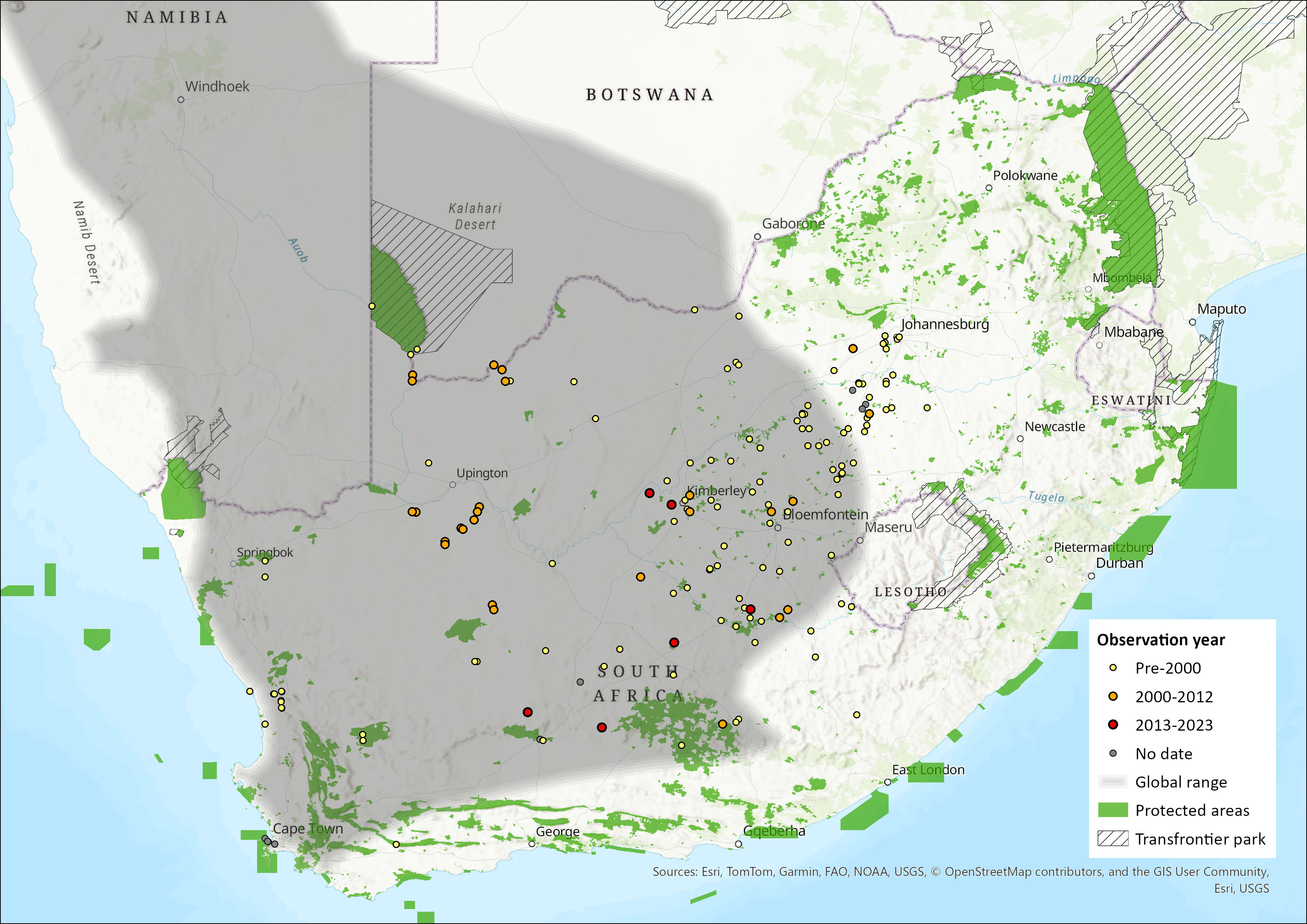
Figure 1. Distribution records for Large-eared Mouse (Malacothrix typica) within the assessment region (South Africa, Eswatini and Lesotho). Note that distribution data is obtained from multiple sources and records have not all been individually verified.
Biogeographic Realms
Biogeographic Realm: Afrotropical
Occurrence
Countries of Occurrence
| Country | Presence | Origin | Formerly Bred | Seasonality |
| Angola | Extant | Native | – | – |
| Botswana | Extant | Native | – | – |
| Lesotho | Presence Uncertain | Native | – | – |
| Namibia | Extant | Native | – | – |
| South Africa | Extant | Native | – | – |
Large Marine Ecosystems (LME) Occurrence
Large Marine Ecosystems: (Not specified)
FAO Area Occurrence
FAO Marine Areas: (Not specified)
Climate change
The effects of climate change on this species are unknown.
Population Information
Although this species is generally considered to be rare (Happold 2013), it can be locally abundant, particularly in areas supporting numerous dry calcrete pans. It is rarely captured using conventional trap methods and is best captured by hand with the aid of a spotlight (Smithers 1971; Rautenbach 1978). It was also caught by hand in Rolfontein Nature Reserve, Northern Cape Province (Jooste & Palmer 1982).
Population Information
Current population trend: Stable
Continuing decline in mature individuals: Unknown
Number of mature individuals in population: Unknown
Number of mature individuals in largest subpopulation: Unknown
Number of subpopulations: Unknown
Severely fragmented: No, naturally fragmented.
Quantitative Analysis
Probability of extinction in the wild within 3 generations or 10 years, whichever is longer, maximum 100 years: (Not specified)
Probability of extinction in the wild within 5 generations or 20 years, whichever is longer, maximum 100 years: (Not specified)
Probability of extinction in the wild within 100 years: (Not specified)
Population Genetics
While a phylogenetic study investigating the divergence of muroid rodents incorporated a single specimen of M. typica (Steppan et al. 2004), no population genetic study has been undertaken on the species. Consequently, patterns of genetic structure and diversity are unknown.
It is possible the species exists as a single metapopulation within the assessment region and connected with neighbouring countries; however, too little is known about its dispersal capabilities and ability to tolerate disturbance. Hence it is possible the species exists as several isolated populations. Given that the species no longer exists in KZN, it is possible that a distinct subpopulation may have been lost. Confirmation of the genetic structure and diversity of this species is needed to validate this, ideally incorporating genetic material from KZN specimens that might be kept at local museums.
Due to the limited records and information on this species, it is not possible to estimate the two population genetic indicators within the Convention of Biological Diversity’s Global Biodiversity Framework – proportion of populations maintained within species (complementary indicator) and the proportion of populations within species within effective population size (nN) greater than 500 (headline indicator).
Habitats and ecology
The species is predominantly found in semi-desert areas with a mean annual rainfall of 150–500 mm (Skinner & Chimimba 2005). It also occurs readily in the Nama and Succulent Karoo, and grassland areas, preferring habitats with short grass on a hard substrate covered with pebbles, and generally lives on panveld fringes where there is a cover of karoo bushes, while avoiding sandy areas in duneveld and Acacia savanna. It is terrestrial and nocturnal, mostly active from 19:00 to 04:00 (Happold 2013; B. Wilson pers. obs.), when it can be seen foraging on green vegetation and seeds at least 100 m from the burrow entrance (Smithers 1971; Monadjem et al. 2015). Occasionally, insects will also form part of its diet. In Rolfontein Nature Reserve, Northern Cape Province, specimens were caught at night among Chloris virgata and they were commonly associated with short stands of Cynodon dactylon (Jooste & Palmer 1982).
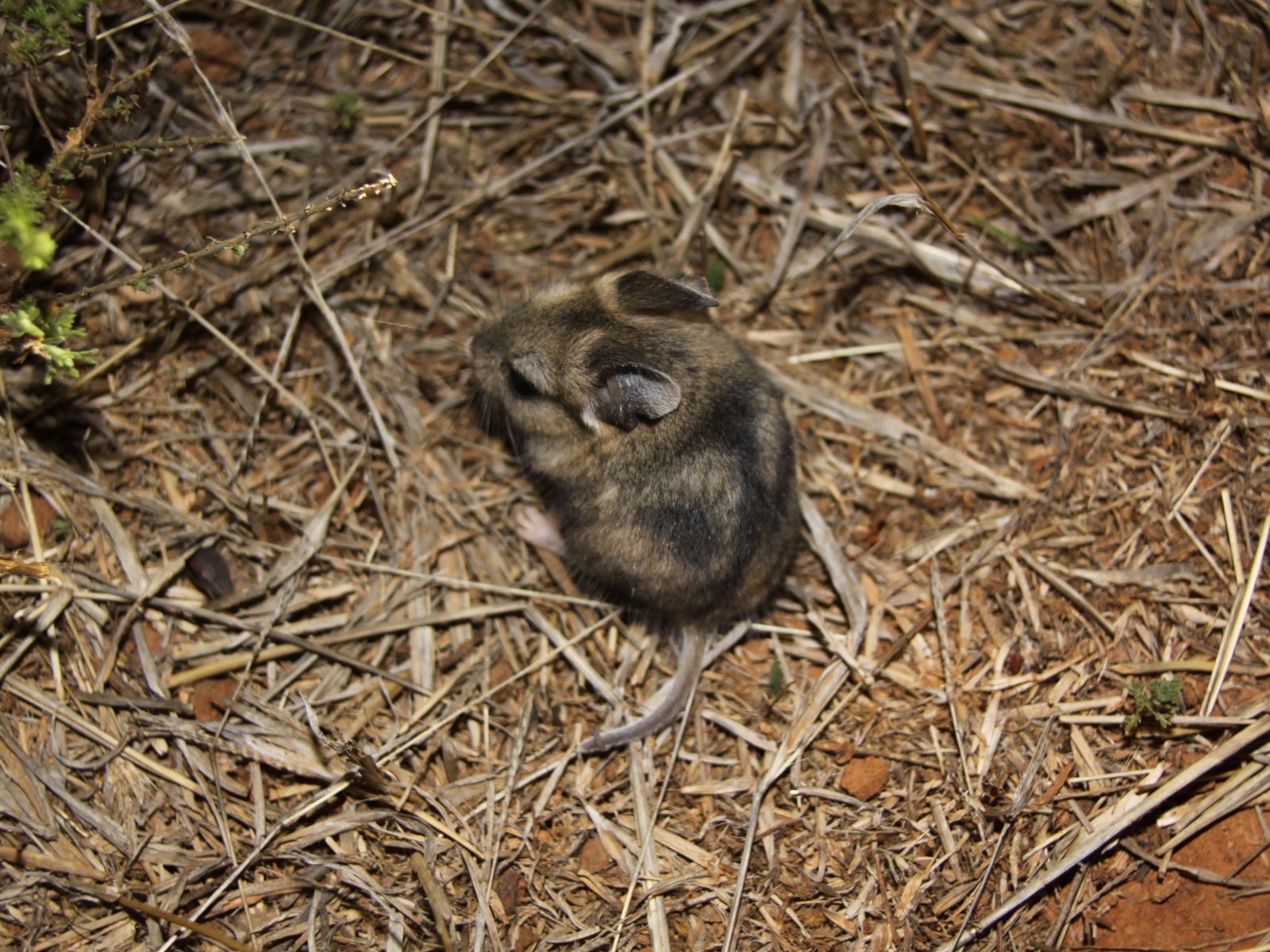
It is relatively slow-moving, preferring to remain motionless when threatened. The patchy markings on the back likely serve as a cryptic camouflage (Knight & Skinner 1981). Its slow-moving behaviour may be a disadvantage as this species is one of the key prey items of Black-footed Cats (Felis nigripes), particularly during their reproductive season when female cats have young (Sliwa 1994). It has also been recorded as prey for Barn Owls (Tyto alba), as well as various other smaller carnivores and snakes (Happold 2013). To combat its slow movements, it has large ears to aid in predator detection, and will often freeze when it senses danger, with its body colouration aiding in concealment (Knight & Skinner 1981).
Large-eared Mice are solitary and believed to be asocial. Smithers (1971) recorded the majority of young being born during warm wet months (August to March), but one female caught in the North West Province in late April was pregnant with five foetuses measuring 1 x 1 mm. With a gestation period of 23–27 days, litter sizes vary from two to eight young and weaning takes place at around 32 days. Males are larger at about 16 g with females averaging only 10.4 g. In captivity Smithers (1971) recorded them surviving up to two and half years. They have an unusual burrow system (Happold 2013): a burrow, 20–25 mm in diameter, is made deep into the ground with a nest chamber lined with grass and feathers at the end. A new burrow is then built vertically from the chamber back to the surface with the soil being pushed back into the original burrow blocking it entirely.
This species has characteristically large ears, which give rise to some of its common names, as well as a short, naked tail. It has patchy, black-tipped hairs on the back resembling grease marks which make it easy to distinguish from the young of other larger species or similar-sized species such as Dendromus. There is some colour variation throughout its range, which may be linked to either habitat or explained by possible sub-speciation. “Malacothrix”, is from the Greek word “malakos” meaning “soft” and “thrix” meaning “hair”, which aptly describes this very small mouse with long and soft hair.
Ecosystem and cultural services: This species is a valuable prey item for Black-footed Cats as well as Barn Owls, other small carnivores and snakes (Happold 2013). Similar to other small mammals, this species likely plays a role in regulating invertebrate numbers, seed predation and nutrient cycling. De Graaf (1981) suggested that this species may be a reservoir of plague, but this was not indicated by the National Institute for Communicable Diseases (National Institute for Communicable Diseases 2005).
IUCN Habitats Classification Scheme
|
Habitat |
Season |
Suitability |
Major Importance? |
|
2.1. Savanna -> Savanna – Dry |
– |
Suitable |
– |
|
3.5. Shrubland -> Shrubland – Subtropical/Tropical Dry |
– |
Suitable |
– |
|
8.1. Desert -> Desert – Hot |
– |
Suitable |
– |
|
8.2. Desert -> Desert – Temperate |
– |
Suitable |
– |
Life History
Generation Length: (Not specified)
Age at maturity: female or unspecified: (Not specified)
Age at Maturity: Male: (Not specified)
Size at Maturity (in cms): Female: (Not specified)
Size at Maturity (in cms): Male: (Not specified)
Longevity: (Not specified)
Average Reproductive Age: (Not specified)
Maximum Size (in cms): (Not specified)
Size at Birth (in cms): (Not specified)
Gestation Time: (Not specified)
Reproductive Periodicity: (Not specified)
Average Annual Fecundity or Litter Size: (Not specified)
Natural Mortality: (Not specified)
Does the species lay eggs? (Not specified)
Does the species give birth to live young: (Not specified)
Does the species exhibit parthenogenesis: (Not specified)
Does the species have a free-living larval stage? (Not specified)
Does the species require water for breeding? (Not specified)
Movement Patterns
Movement Patterns: (Not specified)
Congregatory: (Not specified)
Systems
System: Terrestrial
General Use and Trade Information
The Large-eared Mouse is not traded or utilised in any form. This species has never been considered for the pet trade industry. One reason for this is because their solitary and asocial nature makes them unsuitable pets.
Local Livelihood: (Not specified)
National Commercial Value: (Not specified)
International Commercial Value: (Not specified)
End Use: (Not specified)
Is there harvest from captive/cultivated sources of this species? (Not specified)
Harvest Trend Comments: (Not specified)
Threats
There are no major threats to this species. However, long-term overgrazing by small-holder and nomadic livestock can cause declines in habitat quality for this species in some areas such as the North West Province, most particularly around large panveld areas (B. Wilson pers. obs.). This could potentially result in localised extinctions.
Habitat trend: Stable, the extent of habitat is not expected to decline by expanding human settlements. This species is not generally common in heavily utilised areas, probably due to its preference for green vegetation, which becomes reduced in these circumstances. Wildlife ranching may be positive for this species, as the habitat and water systems for herbivore species tend to be better managed and this may result in key niche panveld fringe areas being less disturbed compared to communal or small-holder livestock farming areas. However, this should be investigated.
Conservation
This species is present within several protected areas of the assessment region, including Kgalagadi Transfrontier Park, Mokala National Park, Karoo National Park, Tankwa Karoo National Park, West Coast National Park, Namaqualand National Park, Tussen-die-Riviere Nature Reserve, Mountain Zebra National Park and Goegap Nature Reserve. No specific conservation interventions are necessary at present.
Recommendations for land managers and practitioners:
- The species would benefit from suitable land management: landowners should leave corridors of grassland between grazed areas and decrease stocking rates.
Research priorities:
- Taxonomic resolution of the six proposed subspecies is required.
- Phylogeographical differences between subspecies need to be determined.
Encouraged citizen actions:
- Report sightings on virtual museum platforms (for example, iNaturalist and MammalMAP), especially outside protected areas.
Bibliography
Avery DM. 1991. Late Quaternary incidence of some micromammalian species in Natal. Durban Museum Novitates 16: 1–11.
Avery, D.M. and Avery, G. 2011. Micromammals in the Northern Cape Province of South Africa, past and present. African Natural History 7: 9-39.
de Graaff, G. 1981. The Rodents of Southern Africa: Notes on their Identification, Distribution, Ecology, and Taxonomy. Butterworths, Durban, Pretoria, South Africa.
Happold DCD. 2013. Malacothrix typica, Large-eared Mouse. In: Happold DCD (ed.), Mammals of Africa.Volume III: Rodents, Hares and Rabbits, pp. 186–188. Bloomsbury Publishing, London, UK.
Jooste JF, Palmer NG. 1982. The distribution and habitat preference of some small mammals in the Rolfontein Nature Reserve. South African Journal of Wildlife Research 12:26–35.
Knight MH, Skinner JD. 1981. Thermoregulatory, reproductive and behavioural adaptations of the big eared desert mouse, Malacothrix typica to its arid environment. Journal of Arid Environments 4:137–145.
Meester JAJ, Rautenbach IL, Dippenaar NJ, Baker CM. 1986. Classification of southern African mammals. Transvaal Museum Monographs 5:1–359.
Monadjem A, Taylor PJ, Denys C, Cotterill FPD. 2015. Rodents of Sub-Saharan Africa: A Biogeographic and Taxonomic Synthesis. De Gruyter, Berlin, Germany.
National Institute for Communicable Diseases. 2005. Plague Control Guidelines for South Africa. Department of Health, South Africa.
Power RJ. 2014. The Distribution and Status of Mammals in the North West Province. Department of Economic Development, Environment, Conservation & Tourism, North West Provincial Government, Mahikeng, South Africa.
Rautenbach IL. 1978. The mammals of the Transvaal. Ph.D. Thesis. University of Natal, Pietermaritzburg, South Africa.
Skinner JD, Chimimba CT. 2005. The Mammals of the Southern African Subregion. Third Edition. Cambridge University Press, Cambridge, UK.
Sliwa A. 1994. Diet and feeding behaviour of the black-footed cat (Felis nigripes Burchell, 1824) in the Kimberley region, South Africa. Der Zoologische Garten 64:83–96.
Smithers RHN. 1971. The mammals of Botswana. Trustees of the National Museum of Rhodesia, Salisbury 4:1–340.
Steppan SJ, Adkins RM, Anderson J. 2004. Phylogeny and divergence-date estimates of rapid radiations in muroid rodents based on multiple nuclear genes. Systematic Biology 53:533–553.