
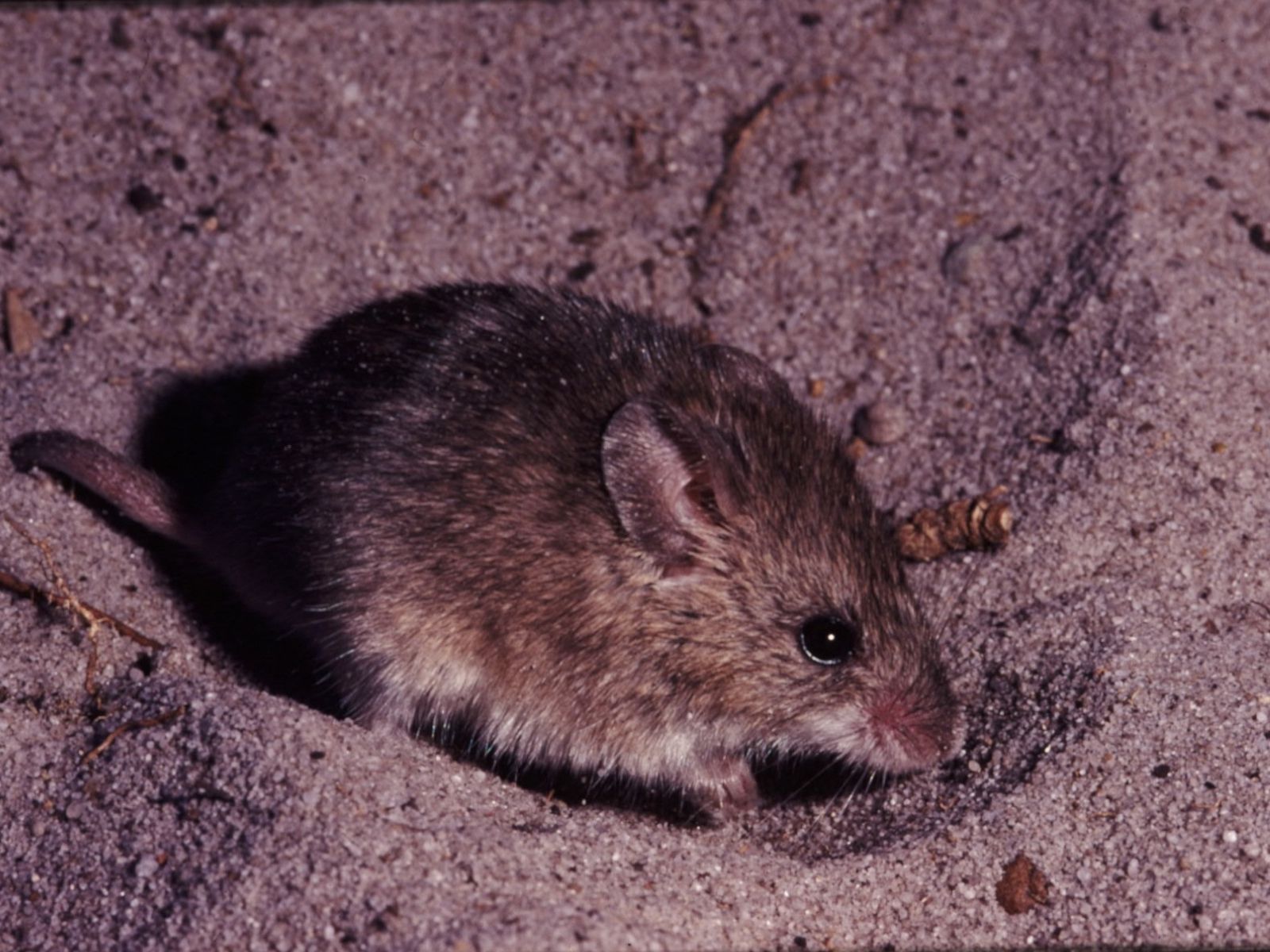
Kreb’s Fat Mouse

2025 Red list status
Least Concern

Regional Population Trend
Stable

Change compared
to 2016
No Change
Overview
Steatomys krebsii – Peters, 1852
ANIMALIA – CHORDATA – MAMMALIA – RODENTIA – NESOMYIDAE – Steatomys – krebsii
Common Names: Kreb’s Fat Mouse (English), Krebs se Vetmuis (Afrikaans)
Synonyms: Steatomys leucorhynchus Hill & Carter, 1937, S. angolensis, bensoni, bradleyi, chiversi, mariae, orangiae, tongensis, transvaalensis
Taxonomic Note: The taxonomic status of the Steatomys genus requires urgent revision, as the phylogenetic relationships between the various species and subspecies are currently unknown (Monadjem et al. 2015). Steatomys krebsii possibly represents a complex of several similar species and further studies are needed to clarify the taxonomic status of disjunct populations currently allocated to this species (Monadjem & Schlitter 2008). Steatomys species are recognised by their small to medium size, small hind feet and short tails, which are usually 35–60% of their head and body length (Monadjem et al. 2015). In parts of its range, S. krebsii overlaps with S. pratensis and these species are not easily distinguished, although S. krebsii has eight nipples, while S. pratensis has 10–14 (Monadjem et al. 2015).
Red List Status: LC – Least Concern
Assessment Information
Assessors: Smith, C.1 & da Silva, J.M.2
Reviewer: Kraai, M.3
Institutions: 1Endangered Wildlife Trust,2South African National Biodiversity Institute, 3Sol Plaatje University
Previous Assessors & Reviewers: Shoeman, C., Relton, C., Harvey, J. & Mondajem, A.
Previous Contributors: Child, M.F., Avenant, N., Avery, M., Baxter, R., MacFadyen, D., Palmer, G., Taylor, P. & Wilson, B.
Assessment Rationale
This species is currently listed as Least Concern due to its wide distribution within the assessment region and its potential ability to survive in modified landscapes, such as fallow fields. However, it is naturally rare and trap-shy and thus population size may be fairly small. Further taxonomic resolution is required as this species, due to its disjunct distribution within the assessment region, may represent several endemic species, some of which may potentially be threatened. For example, S. krebsii was not recorded during a recent survey in North West Province. Reassessment should follow once molecular and additional field data are available. Density and occupancy should also be calculated to facilitate more accurate future revision. It is uncertain whether there are any threats to this species but presumably habitat loss is causing local and regional declines.
Regional population effects: This species has a scattered, disjunct distribution through southern Africa. Limited dispersal may be possible between South Africa and Botswana across the Molopo River, although the species was not recorded in North West Province during a recent survey (Power 2014).
Reasons for Change
Reason(s) for Change in Red List Category from the Previous Assessment: No change
Red List Index
Red List Index: No change
Recommended Citation: Smith C & da Silva JM. 2025. A conservation assessment of Steatomys krebsii. In Patel T, Smith C, Roxburgh L, da Silva JM & Raimondo D, editors. The Red List of Mammals of South Africa, Eswatini and Lesotho. South African National Biodiversity Institute and Endangered Wildlife Trust, South Africa.
Regional Distribution and occurrence
Geographic Range
Kreb’s Fat Mouse has a wide, yet disjunct, distribution across southern Africa, occurring in the southwestern region of South Africa, parts of central South Africa, Lesotho, northern Botswana, the Caprivi Strip and northern regions of Namibia, Angola and Zambia. This species appears to avoid the subtropical eastern regions of southern Africa (Monadjem et al. 2015).
Within the assessment region, it has been identified from the Northern Cape, North West, Gauteng, the Free State, KwaZulu-Natal, as well as the Western Cape and Eastern Cape provinces. Barn Owl (Tyto alba) pellet analysis reveals a wider distribution in the Western Cape Province than previously recorded (Avery et al. 2005). Lynch (1994) recorded the species in Lesotho. Worryingly, the last record from North West Province is from the Molopo Nature Reserve in 1996 (Newbery 1996), but it was not recorded there between 2010 and 2013 despite similar sampling effort (J. Power pers. comm. 2016), and was not recorded elsewhere in North West Province (Power 2014).
Elevation / Depth / Depth Zones
Elevation Lower Limit (in metres above sea level): (Not specified)
Elevation Upper Limit (in metres above sea level): (Not specified)
Depth Lower Limit (in metres below sea level): (Not specified)
Depth Upper Limit (in metres below sea level): (Not specified)
Depth Zone: (Not specified)
Map
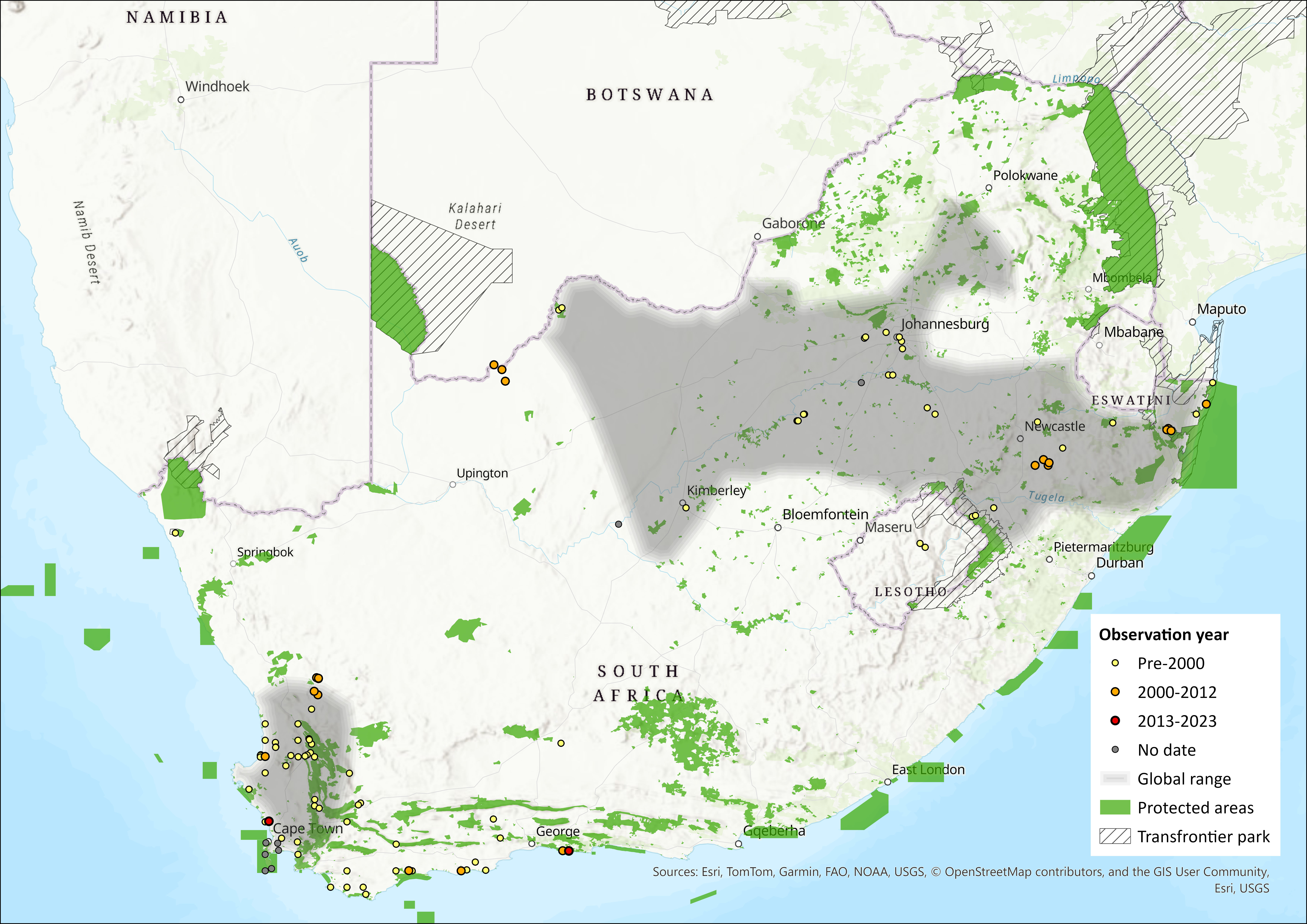
Figure 1. Distribution records for Kreb’s Fat Mouse (Steatomys krebsii) within the assessment region (South Africa, Eswatini and Lesotho). Note that distribution data is obtained from multiple sources and records have not all been individually verified.
Biogeographic Realms
Biogeographic Realm: Afrotropical
Occurrence
Countries of Occurrence
| Country | Presence | Origin | Formerly Bred | Seasonality |
| Angola | Extant | Native | – | – |
| Botswana | Extant | Native | – | – |
| Lesotho | Extant | Native | – | – |
| Namibia | Extant | Native | – | – |
| South Africa | Extant | Native | – | – |
| Zambia | Extant | Native | – | – |
Large Marine Ecosystems (LME) Occurrence
Large Marine Ecosystems: (Not specified)
FAO Area Occurrence
FAO Marine Areas: (Not specified)
Climate change
No recent research or literature has focused on how climate change might affect this species in the future.
Population Information
Although the geographic extent of this species is wide, it appears to occur in low densities, and may be trap shy; thus, no accurate population estimate, or trend is available. For example, of 13 localities sampled in Lesotho, it was only recorded from two by Lynch (1994). Steatomys krebsii was captured for the first time at Blue Hill Nature Reserve, Western Cape, at one of the burnt sites in 2017 (Lee 2020).
Population Information
Current population trend: Stable
Continuing decline in mature individuals: Unknown
Number of mature individuals in population: Unknown
Number of mature individuals in largest subpopulation: Unknown
Number of subpopulations: Unknown
Severely fragmented: Yes, disjunct distribution, and localities widely separated.
Quantitative Analysis
Probability of extinction in the wild within 3 generations or 10 years, whichever is longer, maximum 100 years: (Not specified)
Probability of extinction in the wild within 5 generations or 20 years, whichever is longer, maximum 100 years: (Not specified)
Probability of extinction in the wild within 100 years: (Not specified)
Population Genetics
The species has been investigated broadly within a biogeographic context using molecular techniques (Krásová et al. 2021); however, no population genetic study has been undertaken. Despite this, the species is believed to possibly represent a complex of several similar species. Consequently, further studies are needed to clarify the taxonomic status of disjunct subpopulations currently allocated to this species (Monadjem & Schlitter 2008). Despite this, it is not expected that any potential subpopulations within the species have been lost. Based on this assumption, the Convention on Biological Diversity’s Global Biodiversity Framework’s (GBF’s) complementary genetic indicator – proportion of populations maintained (PM) – would receive a value of 1.0 (all populations remaining).
Estimating the GBF’s headline genetic indicator – proportion of populations with an effective population size (Ne) above 500 – is more difficult to quantify given the lack of population size and trend data., and the knowledge that the species tends to occur at low densities (Lynch 1994). Moreover, the possibility of this species being a species complex further complicates potential estimates.
Habitats and ecology
Inhabiting a wide range of habitat types, this species favours sandy substrates, and is often associated with dry grassland habitats on sandy alluvium and dry savanna (Skinner & Chimimba 2005; Linchamps et al 2021). In the southwestern limits of its range, this species occurs within shrubby vegetation of the Fynbos biome, while further north it is found within high altitude shrub- and grasslands. In Lesotho, specimens were collected from grasslands dominated by Cymbopogon plurinodis, Trichoneura grandiglumis, Enneapogon scoparius, and Aristida spp. in regions of low rainfall and arid vegetation (Lynch 1994). In KwaZulu-Natal Province, this species was recorded in Acacia woodlands (Delcros et al. 2015), and red, loam soils of old agricultural plots (Rautenbach et al. 1981). This species may be more moisture-tolerant than S. pratensis (Coetzee 1977).
The diet and reproductive characteristics of this species are largely unknown, although like other Steatomys species, it is likely that this species feeds on both insects and seeds (Rautenbach & Nel 1980; Skinner & Chimimba 2005).
Ecosystem and cultural services: No specific ecosystem services have been identified for this species, however, it is likely that it contributes somewhat towards seed dispersal, and may be utilised as a prey item for aerial predators, including the Barn Owl (Tyto alba).
IUCN Habitats Classification Scheme
|
Habitat |
Season |
Suitability |
Major Importance? |
|
3.7. Shrubland -> Shrubland – Subtropical/Tropical High Altitude |
– |
Suitable |
– |
|
3.8. Shrubland -> Shrubland – Mediterranean-type Shrubby Vegetation |
– |
Suitable |
– |
|
4.7. Grassland -> Grassland – Subtropical/Tropical High Altitude |
– |
Suitable |
– |
Life History
Generation Length: (Not specified)
Age at maturity: female or unspecified: (Not specified)
Age at Maturity: Male: (Not specified)
Size at Maturity (in cms): Female: (Not specified)
Size at Maturity (in cms): Male: (Not specified)
Longevity: (Not specified)
Average Reproductive Age: (Not specified)
Maximum Size (in cms): (Not specified)
Size at Birth (in cms): (Not specified)
Gestation Time: (Not specified)
Reproductive Periodicity: (Not specified)
Average Annual Fecundity or Litter Size: (Not specified)
Natural Mortality: (Not specified)
Does the species lay eggs? (Not specified)
Does the species give birth to live young: (Not specified)
Does the species exhibit parthenogenesis: (Not specified)
Does the species have a free-living larval stage? (Not specified)
Does the species require water for breeding? (Not specified)
Movement Patterns
Movement Patterns: (Not specified)
Congregatory: (Not specified)
Systems
System: Terrestrial
General Use and Trade Information
This species does not appear to be utilised or traded in any form.
Local Livelihood: (Not specified)
National Commercial Value: (Not specified)
International Commercial Value: (Not specified)
End Use: (Not specified)
Is there harvest from captive/cultivated sources of this species? (Not specified)
Harvest Trend Comments: (Not specified)
Threats
No major threats have been identified for this species. However, habitat loss from agricultural transformation and mining may potentially be causing local declines, especially in North West and KwaZulu-Natal provinces. More research is needed to determine the degree to which it can exist in agricultural landscapes or fallow fields.
Habitat trend: Declining in certain regions. In North West Province, from 1994 to 2010, approximately 12% of remaining natural vegetation was lost (NW READ 2014; Desmet & Schaller 2015); and, in KwaZulu-Natal Province, natural habitat is being lost at a rate of 1.2% per annum, amounting to a 20% loss between 1994 and 2011, primarily due to agriculture (Jewitt et al. 2015).
Conservation
This species is present within a number of protected areas, such as the Cape Peninsula National Park, De Hoop Nature Reserve, Outeniqua Nature Reserve, iSimangaliso Wetland Park and possibly Molopo Nature Reserve (but see Power 2014). No specific conservation initiatives have been identified for this species. More research on its taxonomy, ecology and threat status is necessary.
Recommendations for land managers and practitioners:
- Systematic surveys needed to gather information on population size and trends.
Research priorities:
- Taxonomic resolution of the Steatomys genus. It is likely that this species complex represents two to three endemic species.
- Assessing potential threats to this species.
- Population size, distribution and trend estimates.
- Diet, reproduction and general biology.
Encouraged citizen actions:
- Report sightings on virtual museum platforms (for example, iNaturalist and MammalMAP), especially outside protected areas. However, due to their morphological similarities, misidentification of this species with Steatomys pratensis is common. See taxonomic note for distinguishing characteristics.
Bibliography
Avery, D.M., Avery, G. and Palmer, N.G. 2005. Micromammalian distribution and abundance in the Western Cape Province, South Africa, as evidenced by Barn owls Tyto alba (Scopoli). Journal of Natural History 39: 2047–2071.
Coetzee, C.G. 1977. Genus Steatomys . In: Meester J, Setzer HW (ed.), The Mammals of Africa: An Identification Manual., Smithsonian Institution Press, Washington, DC, USA.
Delcros, G., Taylor, P.J., and Schoeman, M.C. 2015. Ecological correlates of small mammal assemblage structure at different spatial scales in the savannah biome of South Africa. Mammalia 79(1): 1-14.
Desmet PG, Schaller R. 2015. North West Biodiversity Sector Plan Technical Report. North West Department of Rural, Environment and Agricultural Development, Mahikeng, South Africa.
Jewitt, D., Goodman, P.S., Erasmus, B.F.N., O’Connor, T.G. and Witkowski, E.T.F. 2015. Systematic land-cover change in KwaZulu-Natal, South Africa: Implications for biodiversity. South African Journal of Science 111: 1-9.
Krásová, J., Mikula, O., Bryja, J., Baptista, N.L., António, T., Aghová, T. and Šumbera, R., 2021. Biogeography of Angolan rodents: The first glimpse based on phylogenetic evidence. Diversity and Distributions, 27(12): 2571-2583.
Lee, A.T.K., 2020. 3. Mammal mapping at Blue Hill Nature Reserve. EXPEDITION REPORT.
Linchamps, P., Stoetzel, E., Hanon, R. and Denys, C., 2021. Neotaphonomic study of two Tyto alba assemblages from Botswana: Palaeoecological implications. Journal of Archaeological Science: Reports, 38, p.103085.
Lynch, C.D. 1994. The mammals of Lesotho. Navorsinge van die Nasionale Museum Bloemfontein 10(4): 177-241.
Monadjem A, Schlitter D. 2008. Steatomys krebsii.
Monadjem, A., Taylor, P.J., Denys, C. and Cotterill, F.P.D. 2015. Rodents of Sub-Saharan Africa: A Biogeographic and Taxonomic Synthesis. . De Gruyter, Berlin, Germany.
NW READ. 2014. North West Environment Outlook Report 2013. North West Provincial Government, Mahikeng, South Africa.
Newbery CH. 1996. Inventory – report: Small Mammals: Molopo Nature Reserve. Ecological Support Services, North West Parks Board, Mafikeng, South Africa.
Power, R.J. 2014. The distribution and status of mammals in the North West Province. Department of Economic Development, Environment, Conservation & Tourism, North West Provincial Government, Mahikeng.
Rautenbach IL, Nel JAJ, Root GA. 1981. Mammals of the Itala Nature Reserve, Natal. Lammergeyer 31: 21–37.
Rautenbach, I.L. and Nel, J.A.J. 1980. Mammal diversity and ecology in the Cedarberg wilderness area, Cape Province. Annals of the Transvaal Museum 32: 101-124.
Skinner, J.D. and Chimimba, C.T. (eds). 2005. The Mammals of the Southern African Subregion. Cambridge University Press, United Kingdom, Cambridge.