
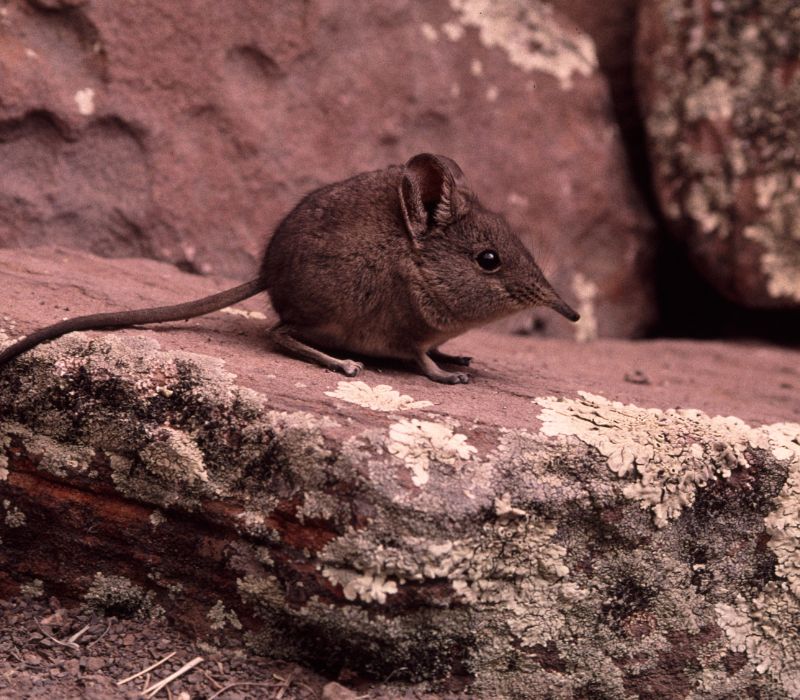
Karoo Rock Sengi
Elephantulus pilicaudus

2025 Red list status
Data Deficient

Regional Population Trend
Unknown

change compared
to 2016
No Change
Overview
Elephantulus pilicaudus – Smit, 2008
ANIMALIA – CHORDATA – MAMMALIA – MACROSCELIDEA – MACROSCELIDIDAE – Elephantulus – pilicaudus
Common Names: Karoo Rock Sengi, Karoo Rock Elephant-shrew (English)
Synonyms: No Synonyms
For general biological information on all sengi species, consult accounts in: Perrin, M. & Rathbun, G. B. 2013. Species accounts: Order Macroscelidea, Family Macroscelididae, Genus Elephantulus, E. edwardii, E. intufi, E. myurus, E. rozeti, E. rufescens; Genus Macroscelides; species account M. proboscideus. In: Mammals of Africa, Volume I (Ed. by Kingdon, J., Happld, D., Hoffmann, M., Butynski, T., Happold, M. & Kalina, J.), pp. 261-278. London: Bloombury. Rathbun, G. B., (subeditor). 2005. Order Macroscelidea. In: The Mammals of the Southern African Subregion, 3rd edition (Ed. by Skinner, J. D. & Chimimba, C. T.), pp. 22-34. Cape Town, South Africa: Cambridge University Press. Rathbun, G. B. 2013. Species accounts: Genus Petrodromus, P. tetradactylus, Genus Rhynchocyon, R. cirnei, R. chrysopygus, R. petersi. In: Mammals of Africa, Volume I (Ed. by Kingdon, J., Happld, D., Hoffmann, M., Butynski, T., Happold, M. & Kalina, J.), pp. 279-287. London: Bloomsbury. Heritage, S. 2018. Order MACROSCELIDEA. In Handbook of the Mammals of the World, Volume 8. Insectivores, Sloths and Colugos (D.E. Wilson and R.A. Mittermeier, eds), Lynx Edicions, Barcelona, Spain. For current and more technical information, search the on-line bibliography at www.sengis.org.
Taxonomic Note:
In the past, the single family was included in the order Insectivora, but now the family is in the monophyletic order Macroscelidea and the superorder Afrotheria. Currently, there are 20 living species recognised in six genera. The soft-furred sengis or elephant-shrews include five genera: Petrodromus and Petrosaltator are monospecific, Macroscelides has three species, Galegeeska (previously included in Elephantulus) has two species and Elephantulus contains eight species. The five species of giant sengis belong to the genus Rhynchocyon. The common name “sengi” is being used in place of elephant shrew by many biologists to try and disassociate the Macroscelidea from the true shrews (family Soricidae) in the order Eulipotyphla.
See www.afrotheria.net and www.sengis.org for additional information.
| Red List Status | |
| DD – Data Deficient, (IUCN version 3.1) |
Assessment Information
Assessor: Roxburgh, L.1
Reviewer: Schradin, C.2
Institutions: 1Endangered Wildlife Trust, 2Institut pluridisciplinaire Hubert Curien
Assessors: Smit-Robinson, H. & Rathbun, G.
Previous Reviewer: Taylor, A.
Assessment Rationale
This species was described in 2008, based almost entirely on molecular genetics, with weak support from external morphology – thus, it is a highly cryptic species. It is considered a sister species of the Cape Rock Sengi, Elephantulus edwardii. Smit et al. 2008 described the species from only five locations (with a total of 17 specimens), with two of these locations based on trapping after the year 2000, the other three are based on older museum specimens. A newer study by Main et al. (2019) found the species in 3 additional localities, including one that is more than 120 km southward of records from the Smit et al. (2008) study. Although previously thought to be a Nama-Karoo endemic, the study extended its distribution into the Roggeveld vegetation type of the Succulent Karoo, and extends the EOO from 23 000 km2 to 32 000 km2. Based on the study of Smit et al. (2008), this species mainly occurs in boulder habitats. All sengi species carefully studied to date occur at low densities, which suggests relatively few animals per unit area. Trapping efforts for this species indicate this may be the case here. Although no threats are known, without actual abundance and density data, more locations, habitat associations, and a proper assessment of habitat condition, there are not enough data to conduct an assessment. Apart from two additional genetic studies (Crowhurst 2022, Main et al. 2019), no known additional ecological information has been collected on this species and thus our assessment remains Data Deficient.
Reasons for Change
Reason(s) for Change in Red List Category from the Previous Assessment: No change
Red List Index
Red List Index: No change
Recommended citation: Roxburgh L. 2025. A conservation assessment of Elephantulus pilicaudus. In Patel T, Smith C, Roxburgh L, da Silva JM & Raimondo D, editors. The Red List of Mammals of South Africa, Eswatini and Lesotho. South African National Biodiversity Institute and Endangered Wildlife Trust, South Africa.
Regional Distribution and occurrence
Geographic Range
The Karoo Rock Sengi is endemic to South Africa occurring in the Northern Cape Province and the northwestern edge of the Western Cape Province. The species therefore appears limited to the Nama-Karoo vegetation biome in the south-central semi-arid Karoo of South Africa. The Nama-Karoo is subdivided into Bushmanland and the Upper and Lower Karoo bioregion vegetational units (Mucina and Rutherford 2006). Based on genetic evidence, E. pilicaudus is divided into two clades (Smit et al. 2008). Specimens from the Upper Karoo bioregion have a different genetic profile than those from the Lower Karoo bioregion. Because there are only eight known locations where the species occurs, the distribution is not well understood, although it appears to be highly restricted. It is possible that the distributions of the Cape Rock Sengi (E. edwardii) and the Western Rock Sengi (E. rupestris) do not overlap with E. pilicaudus. Within the range of this species, it is not likely to be continuously distributed because its boulder and rock habitats are highly fragmented, thus the area encompassed by the known locations is undoubtedly greatly exaggerated. All known locations are >1,300 m asl.
Elevation / Depth / Depth Zones
Elevation Lower Limit (in metres above sea level):1300
Elevation Upper Limit (in metres above sea level): (Not specified)
Depth Lower Limit (in metres below sea level): (Not specified)
Depth Upper Limit (in metres below sea level): (Not specified)
Depth Zone: (Not specified)
Biogeographic Realms
Biogeographic Realm: Afrotropical
Map
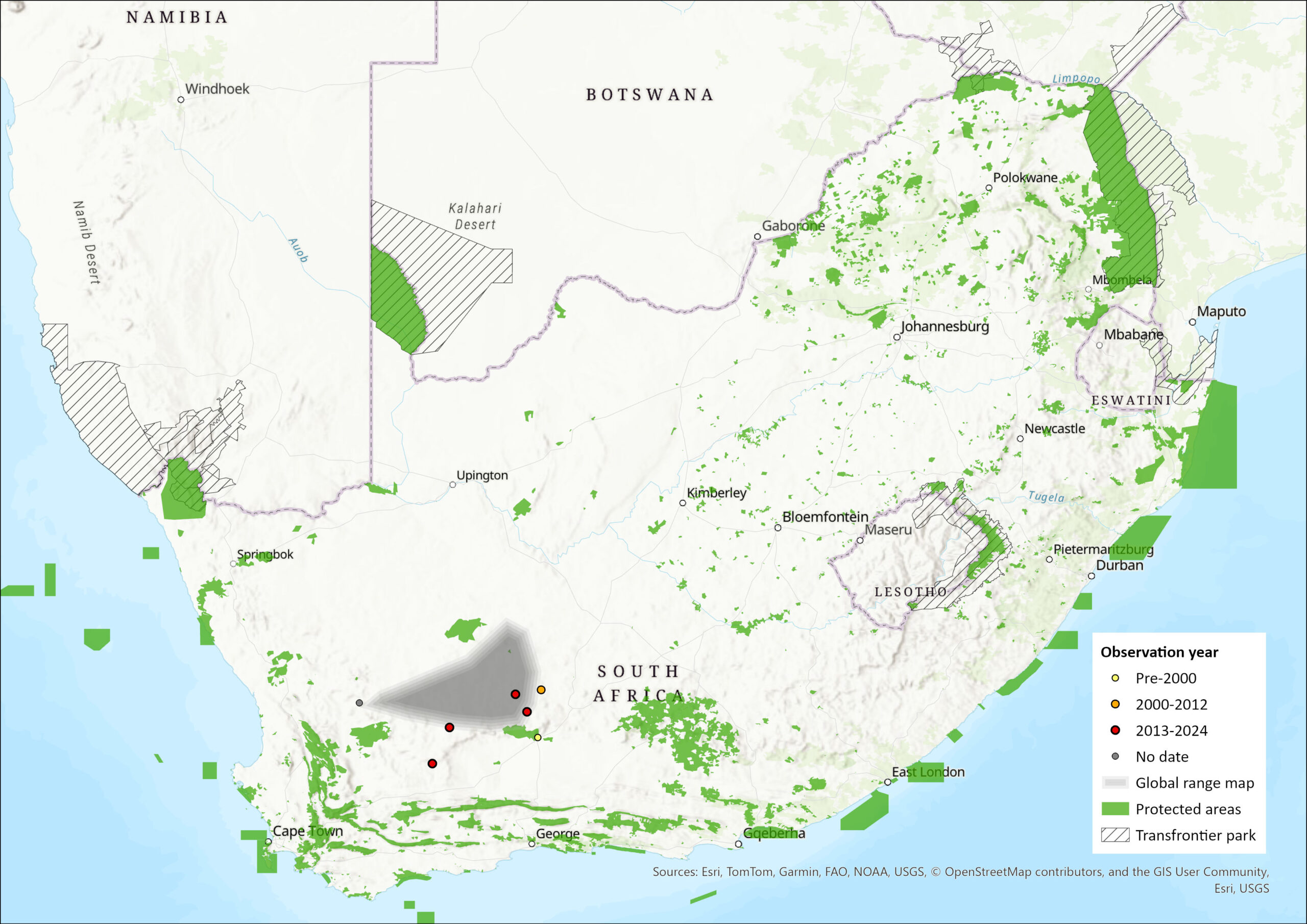
Figure 1. Distribution records for Karoo Rock Sengi (Elephantulus pilicaudus) within the assessment region (South Africa, Eswatini and Lesotho). Note that distribution data is obtained from multiple sources and records have not all been individually verified.
Countries of Occurrence
| Country | Presence | Origin | Formerly Bred | Seasonality |
| South Africa | Extant | Native | – | Resident |
| South Africa -> Northern Cape Province | Extant | Native | – | Resident |
| South Africa -> Western Cape | Extant | Native | – | Resident |
Large Marine Ecosystems (LME) Occurrence
Large Marine Ecosystems: (Not specified)
FAO Area Occurrence
FAO Marine Areas: (Not specified
Climate change
Very little ecological information is available on this species. However, it appears to have the same habits as other habitat specialist Elephantulus species, favouring rocky outcrops, which provide shelter.
Population information
The abundance and population size are unknown. Despite numerous field excursions in the region up to 2006, only 17 specimens of the new species from five locations in the Nama-Karoo are known (three live trapped by Hanneline Smit; two trapped by Galen Rathbun, and 12 museum specimens housed in South African museums). In October 2008, a farm near Calvinia in the Northern Cape Province of South Africa, where three live specimens were trapped in September 2006, was revisited by H. Smit, but an effort to trap additional live specimens was unsuccessful. This reinforces the evidence of a species with a low abundance. However, Main et al. (2022) were able to trap an additional 15 animals in 3 sites in 2016 and 2017 under the Karoo BioGaps Project.
Current population trend: Unknown
Continuing decline in mature individuals? Unknown
Extreme fluctuations in the number of subpopulations: (Not specified)
Continuing decline in number of subpopulations: (Not specified)
All individuals in one subpopulation: (Not specified)
Number of mature individuals in largest subpopulation: (Not specified)
Number of Subpopulations: (Not specified)
Severely fragmented: Unknown
Quantitative Analysis
Probability of extinction in the wild within 3 generations or 10 years, whichever is longer, maximum 100 years: (Not specified)
Probability of extinction in the wild within 5 generations or 20 years, whichever is longer, maximum 100 years: (Not specified)
Probability of extinction in the wild within 100 years: (Not specified)
Population genetics
Based on genetic evidence, E. pilicaudus is divided into two clades (Smit et al. 2008). Specimens from the Upper Karoo bioregion have a different genetic profile than those from the Lower Karoo bioregion. Crowhurst (2022) found that mitochondrial analysis showed a pattern of geographically distinct haplotypes and no main ancestral haplotype, suggesting infraspecific variation. Similarly, Main et al. (2019) found very high intraspecific diversity within E. pilicaudus compared to other species in their study.
Habitats and ecology
This species is confined to rocky or boulder-strewn habitats against mountain slopes or on ridges in karroid vegetation. Based on the five locations where it has been trapped, the species may have similar ecology as its sister species, the Cape Rock Sengi (E. edwardii), and the boulder- and rock-dwelling Western Rock Sengi (E. rupestris) (Corbet and Hanks 1968).
IUCN Habitats Classification Scheme
| Habitat | Season | Suitability | Major Importance? |
| 3.5. Shrubland -> Shrubland – Subtropical/Tropical Dry | Resident | Suitable | Yes |
| 6. Rocky areas (e.g. inland cliffs, mountain peaks) | Resident | Suitable | Yes |
Life History
Generation Length: (Not specified)
Age at maturity: female or unspecified: (Not specified)
Age at Maturity: Male: (Not specified)
Size at Maturity (in cms): Female: (Not specified)
Size at Maturity (in cms): Male: (Not specified)
Longevity: (Not specified)
Average Reproductive Age: (Not specified)
Maximum Size (in cms): (Not specified)
Size at Birth (in cms): (Not specified)
Gestation Time: (Not specified)
Reproductive Periodicity: (Not specified)
Average Annual Fecundity or Litter Size: (Not specified)
Natural Mortality: (Not specified)
Breeding Strategy
Does the species lay eggs? No
Does the species give birth to live young? Yes
Does the species exhibit parthenogenesis? No
Does the species have a free-living larval stage? No
Does the species require water for breeding? No
Movement Patterns
Movement Patterns: (Not specified)
Congregatory: (Not specified)
Systems
System: Terrestrial
General Use and Trade Information
General notes regarding trade and use of this species: This species is not known to be utilised and has no national or international commercial value.
Local Livelihood: (Not specified)
National Commercial Value: (Not specified)
International Commercial Value: (Not specified)
End Use: (Not specified)
Is there harvest from captive/cultivated sources of this species? (Not specified)
Harvest Trend Comments: (Not specified)
Threats
The species occurs in an area of ongoing livestock farming, which poses no direct threat to the species. Because it occupies rocky and boulder habitats that are not suitable for most agricultural or urban development, there are no known threats to the Karoo Rock Sengi. Although landscape change from hydraulic fracturing may occur in the region, this is suspected not to be a threat to species in rocky habitat. Identifying potential threats and monitoring their impacts on this species is required.
Conservation
Concerted efforts should be made to assess the relative abundance of this species, and further document its distribution. It is unknown whether the species occurs in any protected areas other than the Karoo National Park, Beaufort-West. The species is limited to a region of local endemism and shares a distribution with other Karoo endemic mammals, such as the Riverine Rabbit Bunolagus monticularis and Grant’s Rock Mouse Aethomys granti, which may be an important consideration in identifying and establishing additional protected areas in the region. However, no conservation interventions can be recommended until further survey work reveals more accurate range and abundance estimates, as well as identifying threats.
Recommendations for land managers and practitioners:
- Expansion of the protected area network could secure habitat.
Research priorities:
- Field surveys to estimate occupancy, density and population size across its range. This should include confirming the likely lack of sympatry with other rock sengis (Elephantulus edwardii and E. rupestris).
- Studies on the life-history and ecology of the species.
- Research to assess the scale and impact of potential threats.
Encouraged citizen actions:
- Given the difficulty of identifying this sengi, even when in the hand, citizen science reporting is likely to be challenging. Citizens can, however, help in protesting irresponsible mining activities in the region.
Bibliography
Afrotheria Specialist Group. For more information, see the Specialist Group website
Corbet, G.B. and Hanks, J. 1968. A revision of the elephant-shrews, family Macroscelididae. Bulletin of the British Museum of Natural History (Zoology) 16: 1-111.
Crowhurst, E.T. 2022. The spatial genetic structure of Elephantulus rupestris (Master’s Dissertation). Johannesburg: University of Johannesburg.
IUCN. 2015. The IUCN Red List of Threatened Species. Version 2015.2. Available at: www.iucnredlist.org. (Accessed: 23 June 2015).
Main, D., Tensen, L., Gihring, K., Bronner, G., Aboul-Hassan, N., Blanckenberg, M., & van Vuuren, B.J. 2019. Unravelling the taxonomy and distribution of two problematic small mammal genera in the Karoo biome. African Zoology, 54(3), 125–135. https://doi.org/10.1080/15627020.2019.1628661.
Mucina, L. and Rutherford, M.C. 2006. The Vegetation of South Africa, Lesotho and Swaziland. Strelitzia 19. South African National Biodiversity Institute, Pretoria, South Africa.
Perrin, M. and Rathbun, G.B. 2013. Species accounts: Order Macroscelidea, Family Macroscelididae, Genus Elephantulus, E. edwardii, E. intufi, E. myurus, E. rozeti, E. rufescens; Genus Macroscelides; species account M. proboscideus. In: J.S Kingdon, D.C.D. Happold, M. Hoffmann, T.M. Butynski, M. Happold and J. Kalina (eds), Mammals of Africa, Volume I: Introductory Chapters and Afrotheria, pp. 261-278. Bloomsbury Publihing, London.
Rathbun, G.B. (subeditor). 2005. Order Macroscelidea. In: J.D. Skinner and C.T. Chimimba (eds), The Mammals of the Southern African Subregion, 3rd edition, pp. 22-34. Cambridge University Press, Cape Town, South Africa.
Rathbun, G.B. 2013. Species accounts: Genus Petrodromus, P. tetradactylus, Genus Rhynchocyon, R. cirnei, R. chrysopygus, R. petersi. In: J. Kingdon, D. Happold, M. Hoffmann, T. Butynski, M. Happold and J. Kalina (eds), Mammals of Africa, Volume I, pp. 279-287. Bloomsbury Publishing, London, UK.
Smit, H.A., Robinson, T.J. and Van Vuuren, B.J. 2007. Coalescence methods reveal the impact of vicariance on the spatial genetic structure of Elephantulus edwardii (Afrotheria, Macroscelidea). Molecular Ecology 16: 2680-2692.
Smit, H.A., Robinson, T.J., Watson, J. and Jansen Van Vuuren, B. 2008. A new species of elephant-shrew (Afrotheria: Macroscelidea: Elephantulus) from South Africa. Journal of Mammalogy 89: 1257-1269.
Smit, H.A., Watson, J, and Jansen van Vuuren, B. 2009. Relative importance of habitat connectivity in shaping the genetic profiles of two southern African elephant-shrews. Journal of Biogeography 37: 857-864.