

Karoo Four-striped Grass Rat
Rhabdomys intermedius

2025 Red list status
Least Concern

Regional Population Trend
Unknown

Change compared
to 2016
No Change
Overview
Rhabdomys intermedius – (Wroughton, 1905)
ANIMALIA – CHORDATA – MAMMALIA – RODENTIA – MURIDAE – Rhabdomys – intermedius
Common Names: Karoo Four-striped Grass Rat (English)
Synonyms: No Synonyms
Previously included under R. pumilo. Du Toit et al. (2012) provided molecular evidence for the presence of three distinct taxa within this mitochondrial lineage.
Taxonomic Note: Initially the single, monotypic species Rhabdomys pumilio was recognised (Sparrman, 1784). Several subspecies have been proposed based on extensive variation in pelage colour and morphology across the distribution. Within southern Africa, Roberts (1951) proposed 20 subspecies of which Meester et al. (1986) regarded only seven as being valid. Rambau et al. (2003) recommended the recognition of two species based on cytogenetic and mitochondrial sequence data, the xeric R. pumilio and mesic R. dilectus, which was adopted by Musser and Carleton (2005). Reproductive isolation due to pre- and post-mating barriers have been found among R. pumilio and R. dilectus, as well as among the proposed subspecies within the latter taxon (Pillay 2000; Pillay et al. 2006). Subsequently, du Toit et al. (2012) indicated three genetic lineages with distinct distributions related to biome boundaries within the xeric R. pumilio. Based on deep mitochondrial genetic divergence, paraphyly of R. pumilio with respect to R. dilectus and different ecological preferences of the three genetic lineages within R. pumilio, the recognition of four species (R. dilectus, R. pumilio, R. bechuanae, and R. intermedius) was suggested (du Toit et al. 2012). Several cases of sympatry were documented between several of these species (Ganem et al. 2020). Further molecular research (particularly including more nuclear data) and cranial morphometric analyses would be useful to fully resolve the taxonomy of the genus. Until such time, it is recommended that Rhabdomys be treated as a species complex.
Red List Status: LC – Least Concern
Assessment Information
Assessors: Ganem, G.1 & da Silva, J.M.2
Reviewer: Pillay, N.3
Contributor: Patel, T.4
Institutions:1Montpellier University,2South African National Biodiversity Institute,3University of the Witwatersrand,4Endangered Wildlife Trust
Previous Assessors and Reviewers: Du Toit, N., Pillay, N., Ganem, G. & Relton, C.
Previous Contributors: Child, M.F., Avenant, N., Avery, M., Baxter, R., MacFadyen, D., Mondajem, A., Palmer, G., Taylor, P. & Wilson, B.
Assessment Rationale
Rhabdomys intermedius is endemic to South Africa and has a wide distribution across the interior of South Africa in arid habitats that are unlikely to be rapidly transformed on a broad scale, and occurs in many protected areas. It is thus listed as Least Concern. Overgrazing may reduce the ground cover on which R. intermedius depends and thus lead to local declines, but this is not expected to impact the population overall. Managers should be encouraged to retain ground cover by de-stocking livestock.
Among all known Rhabdomys species, R. intermedius may be the one for which we have the less information. Further, ongoing research based on the nuclear genome may suggest that it may not be a distinct species to R. bechuanae (Ganem, personal communication).
Red List Index
Red List Index: No change
Recommended Citation: Ganem G & da Silva JM. 2025. A conservation assessment of Rhabdomys intermedius. In Patel T, Smith C, Roxburgh L, da Silva JM & Raimondo D, editors. The Red List of Mammals of South Africa, Eswatini and Lesotho. South African National Biodiversity Institute and Endangered Wildlife Trust, South Africa.
Regional Distribution and occurrence
R. intermediusis endemic to the southern interior region of South Africa where it occurs in a narrow band through the Karoo, wedged between R. pumilio on the coast and R. bechuanae further north (du Toit et al. 2012, Monadjem et al. 2015 Ganem et al. 2020). It was described from Cradock and Port Elizabeth in the Eastern Cape, as well as Deelfontein in the Northern Cape. This species mostly represents the central clade (du Toit et al. 2012). Further molecular research and vetting of museum specimens is needed to more accurately describe this species.
Elevation / Depth / Depth Zones
Elevation Lower Limit (in metres above sea level): (Not specified)
Elevation Upper Limit (in metres above sea level): (Not specified)
Depth Lower Limit (in metres below sea level): (Not specified)
Depth Upper Limit (in metres below sea level): (Not specified)
Depth Zone: (Not specified)
Map
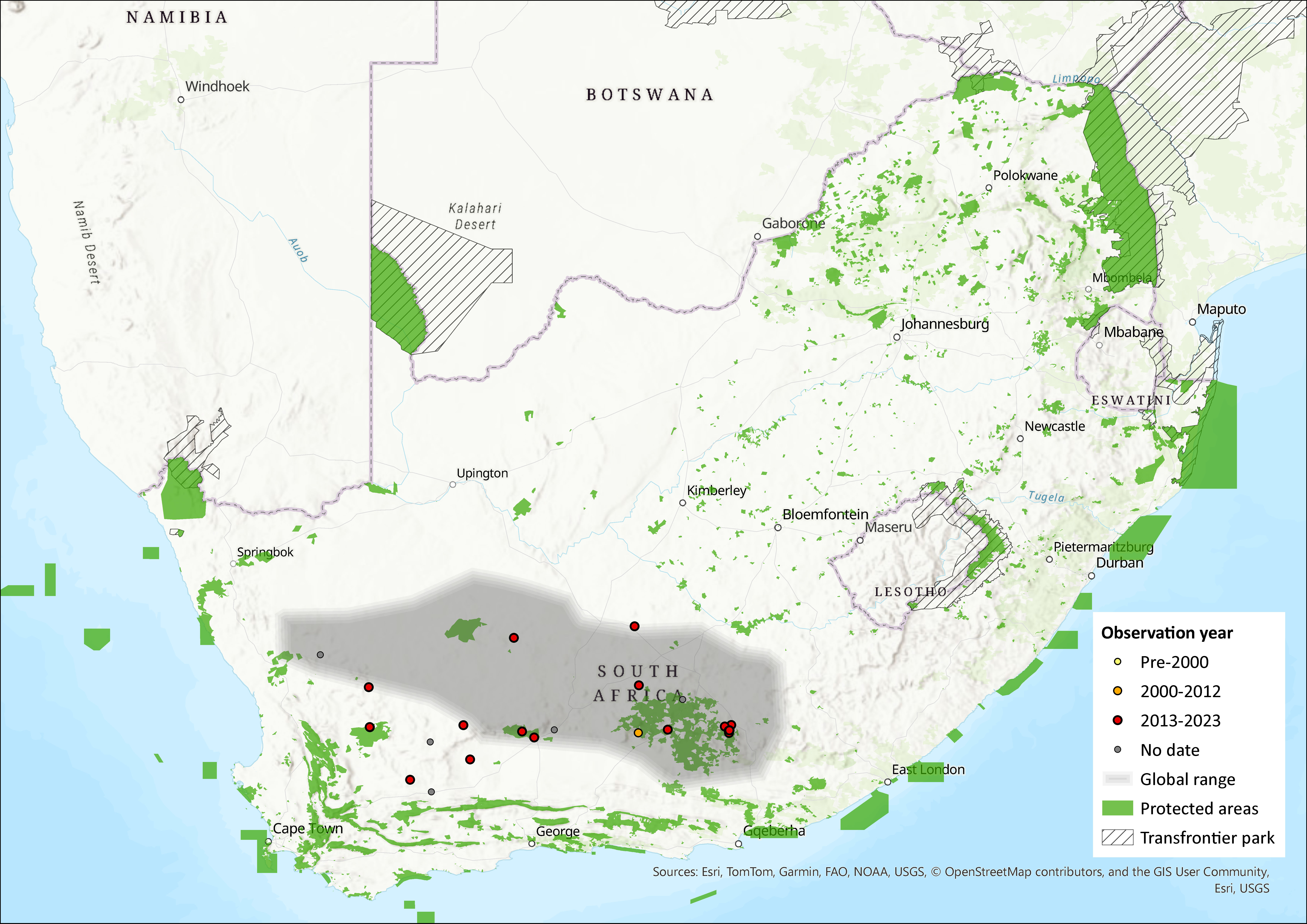
Figure 1. Distribution records for Karoo Four-striped Grass Rat (Rhabdomys intermedius) within the assessment region (South Africa, Eswatini and Lesotho). Note that distribution data is obtained from multiple sources and records have not all been individually verified.
Biogeographic Realms
Biogeographic Realm: Afrotropical
Occurrence
Countries of Occurrence
| Country | Presence | Origin | Formerly Bred | Seasonality |
| South Africa | Extant | Native | – | Resident |
| South Africa -> Eastern Cape Province | Extant | Native | – | Resident |
| South Africa -> Northern Cape Province | Extant | Native | – | Resident |
| South Africa -> Western Cape | Extant | Native | – | Resident |
Large Marine Ecosystems (LME) Occurrence
Large Marine Ecosystems: (Not specified)
FAO Area Occurrence
FAO Marine Areas: (Not specified)
Climate change
Occurring in an arid region that may experience enhanced aridification, further studies may question the response capacity of the species to arid constraints.
Population
The poorest studied species. No national abundance information is available for this species.
Population Information
Current population trend: Unknown
Continuing decline in mature individuals? Unknown
Extreme fluctuations in the number of subpopulations: Unknown
Continuing decline in number of subpopulations: Unknown
All individuals in one subpopulation: Unknown
Number of mature individuals in population: Unknown
Number of mature individuals in largest subpopulation: Unknown
Number of Subpopulations: Unknown
Severely fragmented: Unknown
Quantitative Analysis
Probability of extinction in the wild within 3 generations or 10 years, whichever is longer, maximum 100 years: (Not specified)
Probability of extinction in the wild within 5 generations or 20 years, whichever is longer, maximum 100 years: (Not specified)
Probability of extinction in the wild within 100 years: (Not specified)
Population Genetics
No genetic studies have been published on this species; however. a fine-scale nuclear genomic study is underway. It is anticipated it will provide clarity on the taxonomic status of this species.
Habitats and ecology
Not documented
IUCN Habitats Classification Scheme
|
Habitat |
Season |
Suitability |
Major Importance? |
|
3.5. Shrubland -> Shrubland – Subtropical/Tropical Dry |
– |
Suitable |
– |
|
3.8. Shrubland -> Shrubland – Mediterranean-type Shrubby Vegetation |
– |
Suitable |
– |
|
4.5. Grassland -> Grassland – Subtropical/Tropical Dry |
– |
Suitable |
– |
|
14.1. Artificial/Terrestrial -> Artificial/Terrestrial – Arable Land |
– |
Suitable |
– |
|
14.4. Artificial/Terrestrial -> Artificial/Terrestrial – Rural Gardens |
– |
Suitable |
– |
|
14.5. Artificial/Terrestrial -> Artificial/Terrestrial – Urban Areas |
– |
Suitable |
– |
Life History
Generation Length: (Not specified)
Age at maturity: female or unspecified: (Not specified)
Age at Maturity: Male: (Not specified)
Size at Maturity (in cms): Female: (Not specified)
Size at Maturity (in cms): Male: (Not specified)
Longevity: (Not specified)
Average Reproductive Age: (Not specified)
Maximum Size (in cms): (Not specified)
Size at Birth (in cms): (Not specified)
Gestation Time: (Not specified)
Reproductive Periodicity: (Not specified)
Average Annual Fecundity or Litter Size: (Not specified)
Natural Mortality: (Not specified)
Does the species lay eggs? (Not specified)
Does the species give birth to live young: (Not specified)
Does the species exhibit parthenogenesis: (Not specified)
Does the species have a free-living larval stage? (Not specified)
Does the species require water for breeding? (Not specified)
Movement Patterns
Movement Patterns: (Not specified)
Congregatory: (Not specified)
Systems
System: Terrestrial
General Use and Trade Information
Rhabdomys species are currently only being utilised for research and museum collections. It is an important research model to assess social evolution and ecological diversification.
Local Livelihood: (Not specified)
National Commercial Value: (Not specified)
International Commercial Value: (Not specified)
End Use: (Not specified)
Is there harvest from captive/cultivated sources of this species? (Not specified)
Harvest Trend Comments: (Not specified)
Threats
No major threats have been recognised for this species complex. However, the various proposed species may be susceptible to range declines or shifts due to climate change (Rymer et al. 2013). Considering the lack of information regarding the ecology and distribution of R. intermedius, the extent to which it will be affected by habitat shifts is largely uncertain.
Conservation
The species is located in many protected areas throughout its range. No conservation interventions are deemed necessary.
Research priorities:
- Species geographical distribution, morphometrics, genotyping of populations and taxonomic assessment. This includes vetting of existing museum specimens.
- Species social and general biology.
- Ecology, including adaptation to arid conditions, and mechanisms of coexistence with other Rhabdomys species.
Encouraged citizen actions:
- Report sightings on virtual museum platforms (for example, iNaturalist and MammalMAP), especially outside protected areas. However, due to their morphological similarities, identification to species level may prove difficult, especially in zones of sympatry.
Bibliography
du Toit , N., Jansen van Vuuren , B., Matthee, S. and Matthee, C.A. 2012. Biome specificity of distinct genetic lineages within the four-striped mouse, Rhabdomys pumilio (Rodentia: Muridae) from southern Africa with implications for taxonomy. Molecular Phylogenetics and Evolution 65: 75–86.
Ganem, G., Dufour, C.M.S., Avenant, N.L., Caminade, P., Eiseb, S.J., Tougard, C. and Pillay, N. 2020. An update on the distribution and diversification of Rhabdomys sp. (Muridae, Rodentia). Journal of Vertebrate Biology 69(2): 20013.1–17. https://doi.org/10.25225/jvb.20013
Meester, J.A.J., Rautenbach, I.L., Dippenaar, N.J. and Baker, C.M. 1986. Classification of Southern African Mammals. Monograph number 5. Transvaal Museum , Pretoria, South Africa.
Monadjem, A., Taylor, P.J., Denys, C. and Cotterill, F.P.D. 2015. Rodents of Sub-Saharan Africa: A Biogeographic and Taxonomic Synthesis. De Gruyter, Berlin, Germany.
Musser, G.G. and Carleton, M.D. 2005. Superfamily Muroidea. In: D.E. Wilson and D.A. Reeder (eds), Mammal Species of the World: a geographic and taxonomic reference, pp. 894-1531. The John Hopkins University Press, Baltimore, USA.
Pillay, N. 2000. Reproductive isolation in three populations of the striped mouse Rhabdomys pumilio (Rodentia, Muridae): interpopulation breeding studies. Mammalia 64: 461–470.
Pillay, N., Eborall, J. and Ganem, G. 2006. Divergence of mate recognition in the African striped mouse (Rhabdomys). Behavioral Ecology 17: 757–764.
Rambau, R.V., Robinson, T.J. and Stanyon, R. 2003. Molecular genetics of Rhabdomys pumilio subspecies boundaries: mtDNA phylogeography and karyotypic analysis by fluorescence in situ hybridization. Molecular Phylogenetics and Evolution 28: 564–575.
Roberts, A. 1951. The Mammals of South Africa. Central New Agency, Johannesburg, South Africa.
Rymer ,T.L., Pillay N. and Schradin C. 2013. Extinction or survival? Behavioral flexibility in response to environmental change in the African striped mouse Rhabdomys. Sustainability 5: 163–186.