
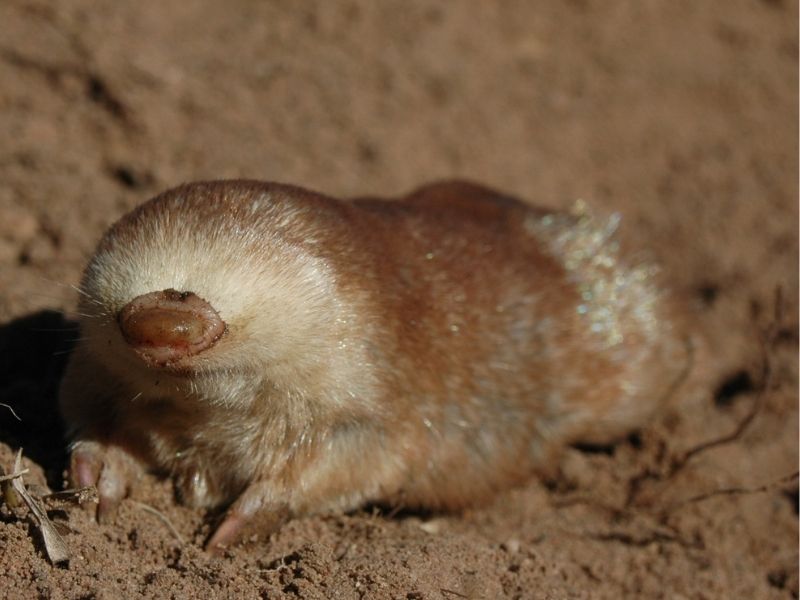
Juliana’s Golden Mole
(Bronberg Ridge subpopulation)
Neamblysomus julianae (Bronberg Ridge subpopulation)

2025 Red list
status
Critically Endangered

Regional Population Trend

Change compared
to 2016
No Change
Overview
Neamblysomus julianae Bronberg Ridge subpopulation- (Meester, 1972)
ANIMALIA – CHORDATA – MAMMALIA – AFROSORICIDA – CHRYSOCHLORIDAE Neamblysomus – julianae – Bronberg Ridge subpopulation
Common Names: Juliana’s Golden Mole (English), Juliana se Gouemol (Afrikaans)
Synonyms: No Synonyms
Taxonomic Note:
Assigned to the genus Neamblysomus by Bronner (1995, 2013). Topotypical population (Bronner and Jenkins 2005). Consistent colour and dental differences exist between two western subpopulations (Bronberg Ridge and Modimolle) and the Kruger National Park subpopulation at the eastern limit of its distribution. Ongoing molecular research suggests pronounced genetic partitioning between the Kruger National Park (KNP) and the other two subpopulations (Maree et al. 2003; Jackson et al. 2007a; unpublished data) and that these are potentially distinct species.
| Red List Status | |
| CR – Critically Endangered, B1ab(ii,iii,iv) (IUCN version 3.1) | |
| Possibly Extinct: | No |
| Possibly Extinct in the Wild: | No |
| Date Last Recorded (in the wild): | |
Assessment Information
Assessor: Patel, T.1 & da Silva, J.2
Reviewer: Mynhardt, S.1
Institution: 1Endangered Wildlife Trust, 2South African National Biodiversity Institute
Previous Assessor: Maree, S.
Previous Reviewers: Bennett, N.C. & Taylor, A.
Previous Contributors: Bronner, G.
Assessment Rationale
Treated as a distinct subpopulation, as there are no intermediate locality records or evidence of gene flow between the Bronberg Ridge population east of Pretoria (Tshwane, Gauteng) and the other two geographically isolated populations documented in South Africa (in and around Nylsvley Nature Reserve and Modimolle, Limpopo Province and Numbi Gate, Pretoriuskop and Matjulwana districts in southwestern Kruger National Park, Mpumalanga Province). Localities documented in the Bronberg area do not fall in any national or provincial protected areas. Much of its natural sandy habitat has been dramatically altered, degraded and fragmented as a result of intense urbanisation and high-density housing developments along nearly the entire length of its very restricted range (48 km2) on the Bronberg Ridge, east of Pretoria (Tshwane), Gauteng. Its entire distributional range has been fragmented into four sections by two major roads and a housing development. Quartzite mining operations pose an additional and severe threat of destroying the sole remaining primary east-west dispersal corridor inside the largest intact section of remaining natural habitat (about 7.5 km x 0.9 km). Such impacts are known to lead to genetic erosion (reduced variability and inbreeding) and reduced population viability (also see Conservation). Therefore, the reassessment confirms the Critically Endangered status of this subpopulation.
Reasons for Change
Reason(s) for Change in Red List Category from the Previous Assessment: No change
Red List Index
Red List Index: No change
Recommended citation: Patel T & da Silva JM. 2025. A conservation assessment of Neamblysomus julianae (Bronberg Ridge subpopulation). In Patel T, Smith C, Roxburgh L, da Silva JM & Raimondo D, editors. The Red List of Mammals of South Africa, Eswatini and Lesotho. South African National Biodiversity Institute and Endangered Wildlife Trust, South Africa.
Regional Distribution and occurrence
Geographic Range
This topotypical population is known from only The Willows (type locality), Wapadrand, Shere Agricultural Holdings and Tierpoort on the northern slopes, and Olympus and Zwavelpoort on the southern slopes, of the Bronberg Ridge in eastern Pretoria (Thswane), Gauteng. However, the very restricted ranges of this and the other subpopulations (Nylsvley area and Kruger National Park) are possibly not sufficient to ensure the long-term persistence of the species (Jackson and Robertson 2011).
Estimated Extent of Occurrence (EOO): 48 km2
Extreme fluctuations in EOO: No
Estimated Area of Occupancy (AOO): 48 km2 (using the IUCN 2 by 2 km grid cells). However, due to extensive development within the AOO, we have refined this by removing unsuitable habitat in the AOO, which includes roads, mines, business and industrial developments, and high density urban development, based on the 2020 South African Landcover layer. However, this was further refined by examining satellite imagery available from Esri, 2023, and removing additional polygons based on whether they had been transformed since 2020, or incorrectly classified as natural. Natural habitat, fields, and large gardens within the AOO were retained. The refined AOO was 36 km2 . However, this still contains some houses, whose gardens might be suitable, and extensive low density smallholdings in the south-eastern part of their range, where there are a few recent records of this species (GDARD, pers. comm. 2025), but which have not been extensively sampled to the best of our knowledge. Selecting only those landcover polygons that intersect with actual observations of this species, and that are not severely transformed (mining, roads, commercial developments and paved areas, dense residential areas) yields an AOO of 12 km2 .
Continuing decline in AOO: Yes. Severe destruction of suitable habitat remaining within its very restricted range due to intense urbanisation, infrastructure development and quartzite mining.
Number of locations: One. There are 6 sites where this species occurs on Bronberg Ridge, but they all face similar, intense threats (habitat loss and alteration) that could lead to rapid and severe reduction or elimination of the entire subpopulation.
Continuing decline in number of locations: Yes
Extreme fluctuations in the number of locations: No
Elevation / Depth / Depth Zones
Elevation Lower Limit (in metres above sea level): (Not specified)
Elevation Upper Limit (in metres above sea level): (Not specified)
Depth Lower Limit (in metres below sea level): (Not specified)
Depth Upper Limit (in metres below sea level): (Not specified)
Depth Zone: (Not specified)
MAP
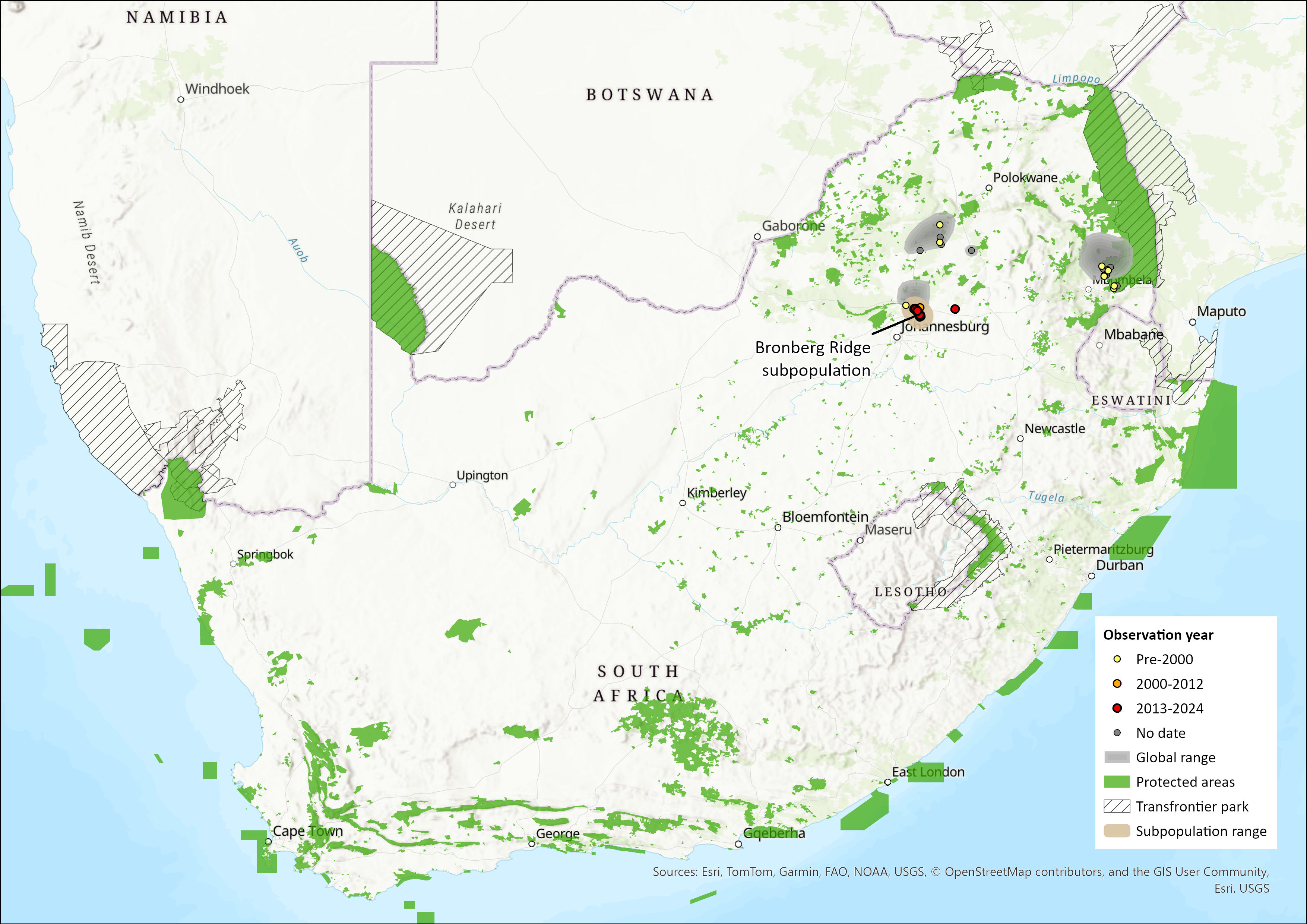 Figure 1. Distribution records for Juliana’s Golden Mole (Neamblysomus julianae Bronberg Ridge subpopulation) within the assessment region (South Africa, Eswatini and Lesotho). Note that distribution data is obtained from multiple sources and records have not all been individually verified.
Biogeographic Realms
Biogeographic Realm: Afrotropical
Occurrence
Countries of Occurrence
| Country | Presence | Origin | Formerly Bred | Seasonality |
| South Africa | Extant | Native | – | Resident |
| South Africa -> Gauteng | Extant | Native | – | Resident |
Large Marine Ecosystems (LME) Occurrence
Large Marine Ecosystems: (Not specified)
FAO Area Occurrence
FAO Marine Areas: (Not specified)
Climate change
Although the potential impacts of climate change on this species have not been directly assessed, climate change is expected to impact most golden mole species. Since these subterranean animals are restricted to soft soils for burrowing, and have very low vagility, their ability to migrate or shift their distribution ranges in response to climate change is very limited. Climate change is likely to impact golden moles through changes in vegetation type, soil moisture and prey availability.
Population information
Locally common, with 2–3 individuals/ha in prime habitat. However, dispersion is patchy and clumped within each subpopulation owing to specialised habitat requirements (e.g. soil characteristics, Jackson et al. 2007b).
Current population trend: Declining
Continuing decline in mature individuals: Yes
All individuals in one subpopulation: Yes
Number of subpopulations: One
Number of mature individuals in subpopulation: Unknown
Extreme fluctuations in the number of mature individuals: Unknown
Severely fragmented: Yes. Continued large-scale intensive urbanisation, infrastructure development and sand mining.
Quantitative Analysis
Probability of extinction in the wild within 3 generations or 10 years, whichever is longer, maximum 100 years: (Not specified)
Probability of extinction in the wild within 5 generations or 20 years, whichever is longer, maximum 100 years: (Not specified)
Probability of extinction in the wild within 100 years: (Not specified)
Population genetics
To date no population genetic studies have been undertaken on this species; however, the three subpopulations are geographically isolated and hence considered genetically distinct.
The Bronberg population’s AOO is estimated at 12 km2 , and given the density estimates, it is projected that this subpopulation contains between 2,400 and 3,600 animals. Assuming a Ne/Nc conversion ratio of 0.1-0.3, the effective population size of the Bronberg subpopulation may be at or under the Ne 500 threshold (240-1,080 individuals). Several assumptions were made to approximate Ne, including uniform density across the subpopulations. Acquiring more accurate metrics are recommended through the use of fine scale nuclear markers.
Habitats and ecology
Confined to sandy soils, often pockets of weathered sandstone associated with rocky ridges within Rocky Highveld Grassland vegetation. Also occurs in well-irrigated residential gardens and small-holdings supporting livestock. The size distribution of sand particles influences soil density and compactability, which are positively correlated with the presence of these golden moles and affect energy expenditure during tunnelling (Jackson et al. 2007b). Subsurface foraging tunnels visible as broken ridges on the soil surface; most foraging activity occur within the upper layer (10 20 mm; Bronner and Bennett 2005), mainly in the late afternoon and early evening.
Much suitable habitat remaining within their very limited range along the Bronberg Ridge is undergoing severe transformation and fragmentation as a result of urbanisation and quartzite mining. The size and connectedness of the remaining patches of suitable habitat mainly defines if they can sustain golden moles (Jackson 2007, Jackson et al. 2007a, Jackson and Robertson 2011).
IUCN Habitats Classification Scheme
| Habitat | Season | Suitability | Major Importance? |
| 4.5. Grassland -> Grassland – Subtropical/Tropical Dry | Resident | Suitable | No |
| 14.4. Artificial/Terrestrial -> Artificial/Terrestrial – Rural Gardens | Resident | Suitable | No |
| 14.5. Artificial/Terrestrial -> Artificial/Terrestrial – Urban Areas | Resident | Marginal | – |
Life History
Generation Length: (Not specified)
Age at Maturity: Female or unspecified: (Not specified)
Age at Maturity: Male: (Not specified)
Size at Maturity (in cms): Female: 9-11
Size at Maturity (in cms): Male: 9-11
Longevity: (Not specified)
Average Reproductive Age: (Not specified)
Maximum Size (in cms): (Not specified)
Size at Birth (in cms): (Not specified)
Gestation Time: (Not specified)
Reproductive Periodicity: Aseasonally polyoestrous
Average Annual Fecundity or Litter Size: Litter size 2
Natural Mortality: (Not specified)
Breeding Strategy
Does the species lay eggs? No
Does the species give birth to live young? Yes
Does the species exhibit parthenogenesis? No
Does the species have a free-living larval stage? No
Does the species require water for breeding? No
Movement Patterns
Movement Patterns: (Not specified)
Congregatory: (Not specified)
Systems
System: Terrestrial
General Use and Trade Information
General notes regarding trade and use of this species: This species is not known to be utilised or traded in any form.
Local Livelihood: (Not specified)
National Commercial Value: (Not specified)
International Commercial Value: (Not specified)
End Use: (Not specified)
Is there harvest from captive/cultivated sources of this species? (Not specified)
Harvest Trend Comments: (Not specified)
Threats
Inferred major threats are habitat alteration, fragmentation and loss. Much of its natural sandy habitat has been dramatically altered, degraded and fragmented as a result of intense urbanization and high-density housing developments along nearly the entire length of its very restricted range on the Bronberg Ridge. The extent of occurrence of this subpopulation has been fragmented into four sections by two major roads and a housing development. Quartzite mining operations pose an additional and severe threat of destroying the sole remaining primary east-west dispersal corridor inside the largest intact patch of remaining natural habitat (about 7.5 km x 0.9 km) (Jackson 2007, Jackson et al. 2007a). Such impacts may lead to genetic erosion (reduced genetic variability via inbreeding) and reduced population viability.
Inferred minor threats are predation by domestic pets, persecution by gardeners and landowners.
Continuing decline in area, extent and/or quality of habitat: Yes
Conservation
Enforcement of existing legislation and political will are urgently needed to conserve the Bronberg Ridge subpopulation. According to the Gauteng Ridge Policy (Pfab 2001), the Bronberg is a Class 2 ridge (5% – 35% have been transformed) and a no-go development policy is applicable, whereby only low impact developments will be considered, but then a full Environmental Impact Assessment (including public participation) is required. GDACEL (Gauteng Department of Agriculture, Conservation and Land Affairs) now GDARD (Gauteng Department of Agriculture and Rural Development) commissioned a Strategic Environmental Assessment to assist in formulating a policy to regulate development and activities in this area (See Pfab 2002). The sensitive nature of the Bronberg ecosystem as a whole was emphasised in the Gauteng Conservation Plan version 2 (C-Plan-2; Pfab 2006) and version 3 (C-Plan-3, Compaan 2011). The authors of this report, based at various departments at the University of Pretoria started researching certain aspects of the ecology and evolutionary relationships of Juliana’s Golden Mole (Neamblysomus julianae) in 2003. GDACE (Gauteng Department of Agriculture, Conservation and Environment) appointed and tasked a specialist research with compiling a conservation assessment of the Bronberg subpopulation of the species, based on ecological and molecular genetic findings that culminated in a conservation management plan, specifying actions to be implemented in an attempt to successfully conserve this critically endangered population (Jackson et al. 2007).
Despite all these actions, and a separate EIA tabled by EcoAssessments C.C. on behalf of local landowners, the Department of Mineral and Energy Affairs in 2003 re-issued a mining permit to allow mining to continue into the foreseeable future. In the last quarter of 2013, the Department of Mineral Resources (DMR) approved an intervention strategy for rehabilitation and stabilising of a slippage area in the quarry that will result in the loss of a substantial portion of the largest continuous sections of suitable habitat for the species remaining on the ridge, and destroy the primary east-west movement corridor in the process. Golden Mole specialist researchers confirmed the presence of and suitable habitat for the species and strongly advised against the planned intervention. Moreover, several residential and commercial developments have also been approved (last 5 – 7 years) in areas where clear signs of fresh activity and suitable habitat for the species were found. Local residents (Shere Residents Association) fiercely opposed the destruction of the Bronberg ecosystem and resident golden moles through legal action appeals via the NEMA process (National Environmental Management Authorities), yet these were all unsuccessful.
Sustained and concerted efforts, including legal interventions, are needed to ensure support GDARD in implementing their policies and to convince relevant provincial and national regulatory bodies of the dire threat faced by this population. Non-governmental conservation and legal organizations have now become involved in actions to oppose such developments.
Public education efforts should be sustained and expanded (especially among residents and local schools). Current research on systematics status of the Pretoria subpopulation should be expanded to incorporate conservation genetics data, and a thorough risk assessment should be done.
Conservation Actions In- Place
| Systematic monitoring scheme | Note |
| No | – |
| Conservation sites identified | Note |
| No | – |
| Occur in at least one PA | Note |
| No | – |
| Percentage of population protected by PAs (0-100) | Note |
| 0 | – |
| Successfully reintroduced or introduced benignly | Note |
| No | – |
| Subject to recent education and awareness programmes | Note |
| Yes | IUCN initiatives; ARKive |
| Included in international legislation | Note |
| No | – |
| Subject to any international management/trade controls | Note |
| No | – |
Important Conservation Actions Needed
| Conservation Actions | Note |
| 1.1. Land/water protection -> Site/area protection | – |
| 2.1. Land/water management -> Site/area management | – |
| 4.3. Education & awareness -> Awareness & communications | – |
| 5.1.2. Law & policy -> Legislation -> National level | – |
| 5.4.3. Law & policy -> Compliance and enforcement -> Sub-national level | – |
Research Needed
| Research | Note |
| 1.1. Research -> Taxonomy | – |
| 1.2. Research -> Population size, distribution & trends | – |
| 1.3. Research -> Life history & ecology | – |
| 1.5. Research -> Threats | – |
| 3.1. Monitoring -> Population trends | – |
Bibliography
Afrotheria Specialist Group. 2014. Specialist Group website. Available at: http://www.afrotheria.net/index.php.
Bronner, G.N. 1995. Systematic revision of the golden mole genera Amblysomus, Chlorotalpa and Calcochloris (Insectivora: Chrysochloromorpha; Chrysochloridae). Ph.D. Thesis, University of Natal.
Bronner, G.N. 2013. Neamblysomus julianae. In: J. Kingdon, D. Happold, T. Butynski, M. Hoffmann, M. Happold and J. Kalina (eds), Mammals of Africa, Volume I: Introductory Chapters and Afrotheria, pp. 253-254. Bloomsbury Publishing, London.
Bronner, G.N. 2013. Neamblysomus julianae. In: J. Kingdon, D. Happold, T. Butynski, M. Hoffmann, M. Happold and J. Kalina (eds), Mammals of Africa, Volume I: Introductory Chapters and Afrotheria, pp. 253-254. Bloomsbury Publishing, London.
Bronner, G.N. and Bennett, N.C. 2005. Order Afrosoricida. In: J.D. Skinner and C.T. Chimimba (eds), The Mammals of the Southern African Subregion, 3rd edn, Cambridge University Press, Cambridge.
Bronner, G.N. and Jenkins, P.D. 2005. Order Afrosoricida. In: D.E. Wilson and D.M. Reeder (eds), Mammal Species of the World, pp. 70-81. The Johns Hopkins University Press, Baltimore, MD, USA.
Compaan, P.C. 2011. Gauteng Conservation Plan version 3.3 (C-plan 3.3). Unpublished Technical Report. Gauteng Nature Conservation, Gauteng. Department of Agriculture and Rural Development, Johannesburg (and subsequent updates).
Freitag, S. and van Jaarsveld, A.S. 1997. Relative occupancy, endemism, taxonomic distinctiveness and vulnerability: prioritising regional conservation actions. Biodiversity and Conservation 6: 211–232.
IUCN. 2015. The IUCN Red List of Threatened Species. Version 2015.2. Available at: www.iucnredlist.org. (Accessed: 23 June 2015).
Jackson, C.R. 2007. The ecology and conservation of Juliana’s golden mole (Neamblysomus julianae). University of Pretoria.
Jackson, C.R. and Robertson, M.P. 2011. Predicting the potential distribution of an endangered cryptic subterranean mammal from few occurrence records. Journal for Nature Conservation 19: 87-94.
Jackson, C.R., Lubbe, N.R., Robertson, M.P., Setsaas, T.H., van der Waals, J. and Bennett, N.C. 2007. Soil properties and the distribution of the endangered Juliana’s golden mole. Journal of Zoology 274: 13-17.
Jackson, C.R., Maree, S., Robertson, M.P., Bloomer, P., Bennett, N.C. and Bronner, G.N. 2007. A Conservation Assessment of Juliana’s Golden Mole (Neamblysomus julianae) on the Bronberg Ridge, Gauteng, South Africa. Technical report compiled for Gauteng Provincial Government, Department of Agriculture, Conservation and Environment.
Jackson, C.R., Setsaas, T. H., Robertson, M.P. and Bennett, N.C. 2008. Ecological variables governing habitat quality and the distribution of the endangered Juliana’s golden mole. African Zoology 43: 245-255.
Maree, S., Bronner, G.N., Jackson, CR. and Bennett, N.C. 2003. The conservation of golden moles (Afrosoricida; Chrysochloridae) with emphasis on the status of Neamblysomus julianae in South Africa. IUCN Afrotheria Specialist Group Newsletter 2: 4-6.
Pfab, M. 2001. Development guidelines for ridges. Internal report, Gauteng Department of Agriculture, Conservation and Environment (GDACE).
Pfab, M. 2002. The quartzite ridges of Gauteng. Veld & Flora: 56–59.