

Jameson’s Red Rock Hare
Pronolagus randensis

2025 Red list status
Least Concern

Regional Population Trend
Unknown
Change compared
to 2016
No Change
Overview
ANIMALIA – CHORDATA – MAMMALIA – LAGOMORPHA – LEPORIDAE – Pronolagus – randensis
Common Names: Jameson’s Red Rock Hare, Jameson’s Red Rockhare, Jameson’s Red Rabbit, Jameson’s Red Rock Rabbit (English), Jamesonse Rooiklipkonyn (Afrikaans)
Synonyms: Pronolagus capricornis Roberts, 1926; Pronolagus caucinus Thomas 1929; Pronolagus ekmani Lundholm, 1955; Pronolagus kaokoensis Roberts, 1946; Pronolagus koboensis Roberts, 1938; Pronolagus maka-pani Roberts, 1924; Pronolagus powelli Roberts, 1924; Pronolagus waterbergensis Hoesch and Von Lehmann, 1956; Pronolagus whitei Roberts, 1938
Taxonomic Note: While three subspecies have previously been recognised: Pronolagus randensis caucinus, P. r. randensis and P. r. whitei (Hoffmann and Smith 2005), currently no subspecies are considered valid in light of mitochondrial DNA analyses revealing insifficient geographical variation (Happold 2013) and that no significant variation has been observed among the previously described forms (Johnston 2018).
| Red List Status |
| LC – Least Concern, (IUCN version 3.1) |
Assessment Information
Assessors: Wilson-Hartmann, B.1, Matthee, C.M.2 & da Silva, J.3
Reviewer: Moodley, S.4
Institutions: 1McGregor Museum, Kimberley, 2Stellenbosch University, 3South African National Biodiversity Institute, 4Private
Previous Assessors and Reviewers: Matthee, C.M., Wilson, B., Robinson, T.J. & Child, M.F.
Previous Contributors: Roxburgh, L. & Smith, A.
Assessment Rationale
Red rock hares are widespread but patchily distributed within the assessment region due to their restriction to areas of rocky habitat. While no estimates of population size or trend are available, we infer a large population, given their extent of occurrence, and retain the Least Concern status. However, whilst their rocky habitats are largely inaccessible and unlikely to be transformed, increasing hunting pressure (inferred from expanding human settlements and subsequent changes in land-use), loss of foraging areas from agricultural expansion, and habitat degradation from overgrazing may be causing local declines and possible extinctions. These species are easily hunted and are thought to be substantially utilised for subsistence or sport hunting. Anecdotal reports from the Northern Cape suggest Smith’s Red Rock Hare have declined over the past 30 years. Similarly, the Natal Red Rock Hare occurs in areas of high human population density and may be becoming increasingly locally threatened from hunting practices. Emerging threats to Smith’s Red Rock Hare include anthropogenic impacts such as land-use transformation from natural grasslands to secondary pastureland, increasing
Although local declines may be occurring due to overhunting for bushmeat in some areas, there was no evidence to suggest a significant widespread population decline during previous assessments. However, with the outbreak of Rabbit Haemorrhagic Disease Virus strain 2 (RHDV-2) in November 2022 in the Northern Cape Province, South Africa that subsequently spread to all the provinces (DALRRD 2024), urgent investigations are needed to ascertain the effect on populations and subpopulations.
Concerted research into population size, densities and trends, as well as quantifying the identified threats, should be conducted before specific interventions are implemented if needed. Specifically, the area of occupancy and population trends of Red Rock Hares should be determined and reassessed once such data are available. Long-term monitoring sites should be established to detect subpopulation trends in different regions.
Regional population effects: Jameson’s Red Rock Hare has a fragmented distribution between the Namibian population and the rest of its range, and it is unlikely that there is any gene flow between the two. However, dispersal between South Africa, Botswana and Zimbabwe is suspected to occur. Thus, rescue effects are possible.
Reasons for Change
Reason(s) for Change in Red List Category from the Previous Assessment: No change
Red List Index
Red List Index: No change
Recommended citation: Wilson-Hartmann B, Matthee CM & da Silva JM. 2025. A conservation assessment of Pronolagus randensis. In Patel T, Smith C, Roxburgh L, da Silva JM & Raimondo D, editors. The Red List of Mammals of South Africa, Eswatini and Lesotho. South African National Biodiversity Institute and Endangered Wildlife Trust, South Africa.
Regional Distribution and occurrence
Geographic Range
The close confinement of all Pronolagus species to rocky areas means their distribution is discontinuous and naturally fragmented with vast areas of land within their extent of occurrence unsuitable for them (Skinner & Chimimba 2005). As these species exist in habitat patches, area of occupancy should be calculated using land-cover data and remote sensing.
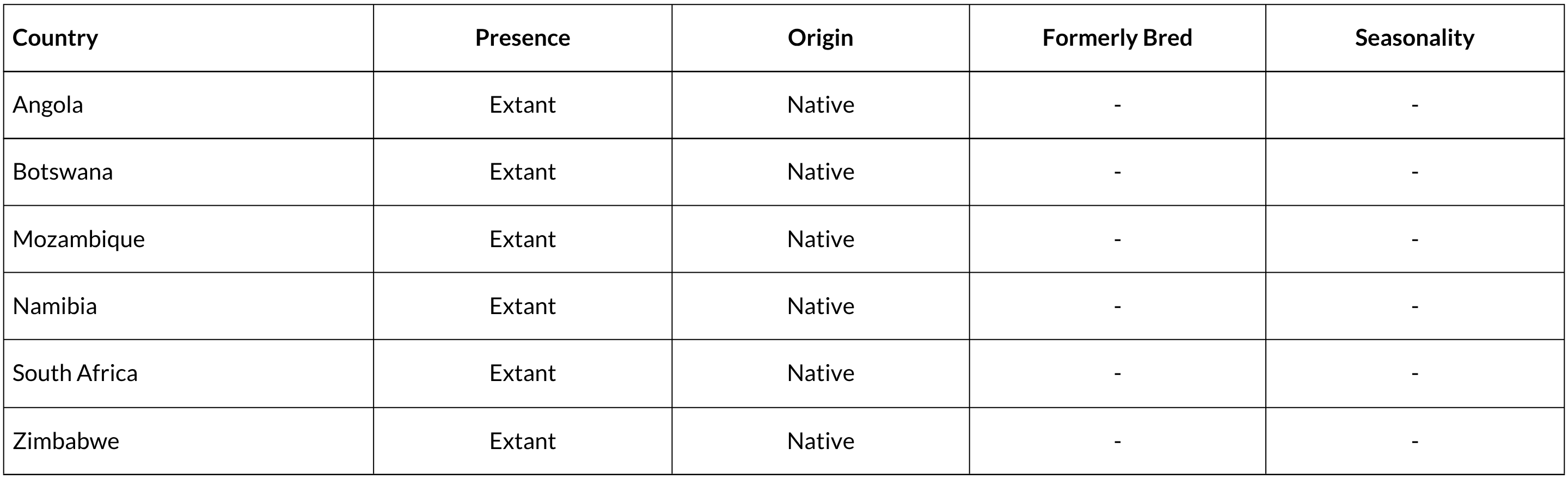
Jameson’s Red Rock Hare occurs in northeastern South Africa, Botswana, Zimbabwe, western Mozambique, and a separate, isolated population exists marginally in western Angola to central Namibia (Duthie & Robinson 1990; Happold 2013). There is no reason to suspect gene flow between the two isolated populations, which are some 900 km apart, and taxonomic resolution is required. Within the assessment region, it occurs in Gauteng, Limpopo, Mpumalanga and North West provinces.
All museum records need vetting following taxonomic resolution of these species to accurately delineate the distribution maps.
Elevation / Depth / Depth Zones
Elevation Lower Limit (in metres above sea level): (Not specified)
Elevation Upper Limit (in metres above sea level): (Not specified)
Depth Lower Limit (in metres below sea level): (Not specified)
Depth Upper Limit (in metres below sea level): (Not specified)
Depth Zone: (Not specified)
Map Status
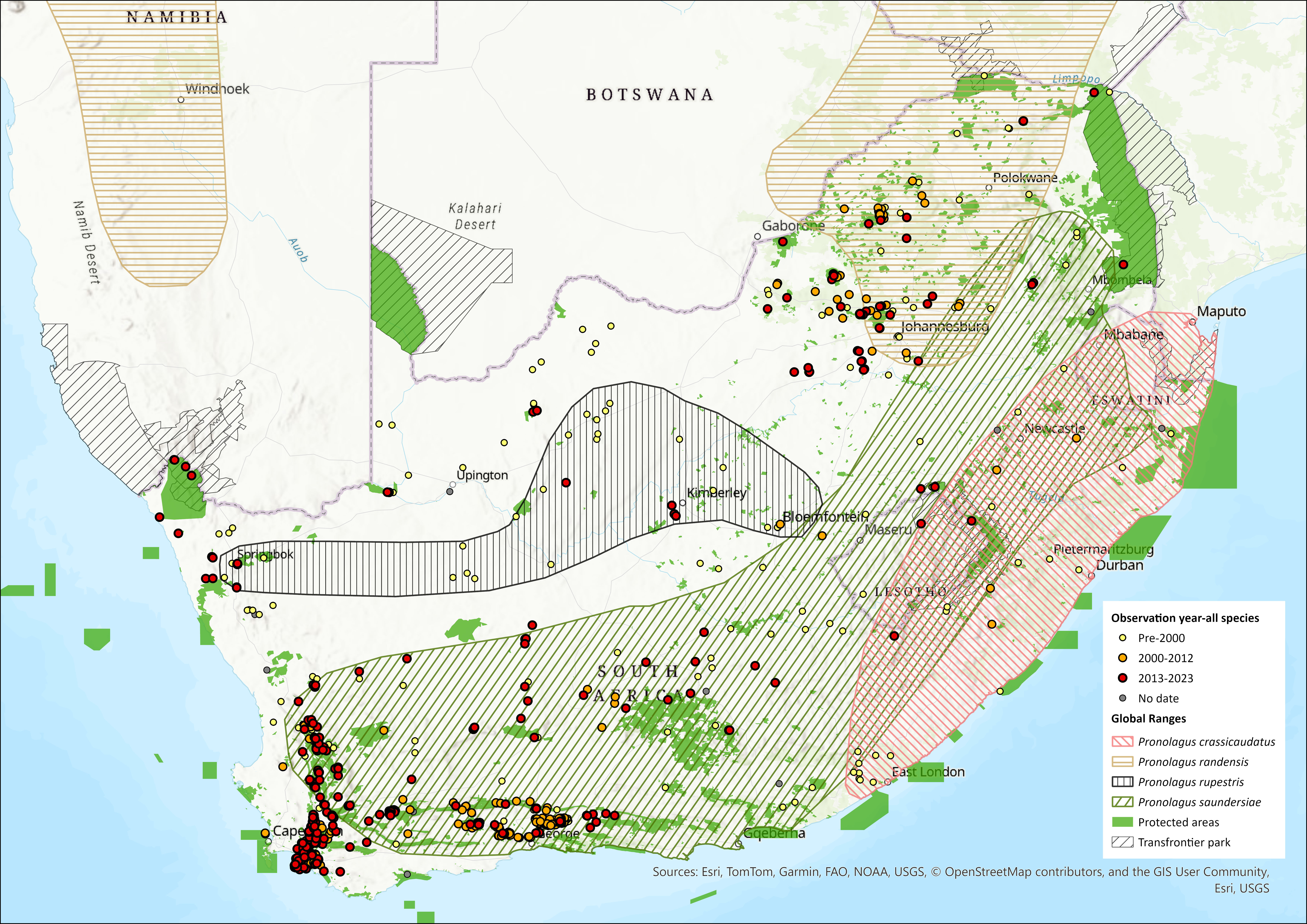
Figure 1. Distribution records for Jameson’s Red Rock Hare (Pronolagus randensis) within the assessment region (South Africa, Eswatini and Lesotho). Note that distribution data is obtained from multiple sources and records have not all been individually verified.
Biogeographic Realms
Biogeographic Realm: Afrotropical
Countries of Occurrence
Large Marine Ecosystems (LME) Occurr ence
Large Marine Ecosystems: (Not specified)
FAO Area Occurrence
FAO Marine Areas: (Not specified)
Climate change
Climate change per se is unlikely to have a dramatic effect on Jameson’s Rock Hare during this assessment period, climate change is already affecting the spread of infectious diseases beyond their typical geographic reach. Whilst this may not be the cause of the outbreak of Rabbit Haemorrhagic Disease Virus strain 2 (RHDV-2) in South Africa at the end of 2022, it can assist in the spread of the virus and increase the susceptibility of hares and rabbits to the effects of droughts and periods of flooding. Often, the cross-border spread of infectious diseases is further exacerbated by the lack of global governance (that led to the introduction of this disease into South Africa and allowed it to spread to neighbouring countries), policies or a consensus to mitigate climate change. As a result, the current and future burden on humans, animals and plants is significant, especially if these infectious diseases cause large scale outbreaks such as RHDV-2.
Population information
There are no population size or trend estimates available for any Pronolagus species. P. randensis is fairly common throughout its distribution (Duthie and Robinson 1990). Greater than 10,000 individuals exist in South Africa (Matthee et al. 2004). Future decline in total population is predicted to be 20% or more over an unspecified length of time (Matthee et al. 2004). It may be experiencing local declines due to encroachment of human settlements and subsequent land-use changes and hunting pressure.
In addition, the recent outbreak of RHDV-2 could lead to significant declines throughout the range. However, long-term studies will be required to substantiate this.
Population Information

Extreme fluctuations in the number of subpopulations: Unknown
Continuing decline in number of subpopulations: Suspected
All individuals in one subpopulation: No
Number of mature individuals in largest subpopulation: Unknown
Number of Subpopulations: 2
Severely fragmented: Yes. Range is naturally fragmented across mountainous and rocky areas.
Quantitative Analysis
Probability of extinction in the wild within 3 generations or 10 years, whichever is longer, maximum 100 years: (Not specified)
Probability of extinction in the wild within 5 generations or 20 years, whichever is longer, maximum 100 years: (Not specified)
Probability of extinction in the wild within 100 years: (Not specified)
Population genetics
The species has been investigated in a phylogenetic context and also partly using mtDNA data (Matthee 1993). No significant geographic structure was evident among the South African sampled populations suggesting one metapopulation (Matthee 1993). The animals within the assessment region belong to the southern population of the species, with no evidence of gene flow with the northern population (Matthee et al. 2004). It is expected that the population within the assessment region exists as a metapopulation, connected to subpopulations in neighbouring countries through at least one migrant per generation. Given that more than 10,000 individuals are thought to exist within the region (Matthee et al. 2004) a proxy measure of the populations effective population size can be quantified. Applying a Ne/Nc conversion ratio between 0.1-0.3, it is estimated that Ne exceeds 1,000-3,000 individuals. It is highly recommended that the genetic structure and diversity within this population be verified for accuracy and to monitor possible shifts in projected population declines.
Habitats and ecology
All species of Pronolagus seem to have similar habitat requirements in that they are confined to rocky areas that provide shelter and occur in krantzes, rocky boulder-strewn hillsides, rocky ravines and amongst rocks in dry riverbeds (Skinner & Chimimba 2005). Such areas must provide palatable grasses (they are grazers) and some cover of scrub bushes. They are predominantly nocturnal, emerging at dusk to feed but never forage far from their shelters, although they forage around the base of hills looking for fresh sprouting grasses (Skinner & Chimimba 2005). Shortridge (1934) remarked on their ability to ‘vanish like shadows behind rocks or down rock crevices on the slightest alarm’. Also characteristic of the genus are their flattened round dung pellets deposited on flat spaces amongst rocks (Lynch 1983). They use latrines established away from their resting sites. Rock hares are unique in their ability to run and jump over rocks and can run up steep rock faces to reach crevices when fleeing. Key vegetation types are those typical of mountainous and rocky terrain, including Afromontane and Afroalpine areas.
Jameson’s Red Rock Hare is much like the other members of the Red Rock Hare family. The second largest of the genus, this species is a medium-sized rabbit-like hare with thick, dense woolly pelage typically cinnamon-rufous in colour. Its cheeks are strikingly light grey, in contrast to the colouring of its back and sides (Robinson 1982). Generally, the feet are darker red with the soles covered in very dense dark brown hair. The tail is reddish-black and typically darker than the other species. Where its range overlaps with that of Hewitt’s Red Rock Hare, it tends to occur in the drier low-lying mountain slopes where there are many jumbled boulders and rock crevices, whereas Hewitt’s is found at higher altitudes with fewer boulders and crevices and higher rainfall (Happold 2013). Generally nocturnal and solitary in nature, they can sometimes be seen in small groups of 3-5 individuals when grazing.
It is believed to be capable of dispersing up to 22km (Johnston 2018). It feeds on the vegetation in and around its habitat including grasses and prefers eating fresh shoots following brush fires. If it cannot find grass within its rocky habitat, it will venture out into flat areas to forage, retreating into rocky outcroppings afterward or if startled. Not much is known about their reproduction, and it is believed they breed year-round. One to two kits are born naked (altricial) following a relatively short 32 to 38-day gestation. Their eyes open about 4 to 10 days following birth. Known predators of P. randensis and red rock hares in general are Verreaux’s eagle, Cape eagle-owls, Caracal, Jackal and leopards (Johnston 2018).
Ecosystem and cultural services:
Hares and rabbits are recognised as important seed dispersal agents, particularly in harsh environments.
IUCN Habitats Classification Scheme

Life History
Generation Length: (Not specified)
Age at maturity: Female: 6 months
Age at Maturity: Male: 6 months
Size at Maturity (in cms): Female: (Not specified)
Size at Maturity (in cms): Male: (Not specified)
Longevity: 2-3 years
Average Reproductive Age: (Not specified)
Maximum Size (in cms): 48-63cm
Size at Birth (in cms): (Not specified)
Gestation Time: 32-38 days
Reproductive Periodicity: year round
Average Annual Fecundity or Litter Size: LS=1-2
Natural Mortality: (Not specified)
Breeding Strategy
Does the species lay eggs? No
Does the species give birth to live young? Yes
Does the species exhibit parthenogenesis? No
Does the species have a free-living larval stage? No
Does the species require water for breeding? No
Movement Patterns
Movement Patterns: (Not specified)
Congregatory: (Not specified)
Systems
System: Terrestrial
General Use and Trade Information
These species are likely to be fairly important in subsistence communities where they are easily obtained. Maliehe (1993) specifically mentioned rock hares as being an important bush meat item in Lesotho and in Zululand, but this is likely to be true throughout their ranges. As a f slow-moving species, they are easily hunted with dogs. At night, they tend to freeze when chanced upon in spotlights and can be easily shot or captured in nets (B. Wilson pers. obs.). During the day, it is also possible to hunt them in their refuges, using a coiled piece of barbed wire that hooks and drags the animal out of its shelter (B. Wilson pers. obs.). Whilst having a particularly warm and thick fur, pelts from these species are prone to hairslip and do not cure well, making them unsuitable for hardwearing fur items.

National Commercial Value: No
International Commercial Value: No

Is there harvest from captive/cultivated sources of this species? (Not specified)
Harvest Trend Comments: (Not specified)
Threats
The main threat to rock hares is hunting, both for bushmeat and for sport. The survival of Hewitt’s Red Rock Hare in Lesotho is threatened due to hunting pressure from herders with packs of dogs (Lynch 1994). While skittish, they can be caught by hand when hiding under rock ledges or boulders (Skinner & Chimimba 2005) and thus may be susceptible to being hunted (see Use and Trade). Hunting pressure is thought to be more severe in areas of high-density human settlements. In the southern part of Jameson’s Red Rock Hare’s eastern range, intensive urbanisation (Johannesburg, Pretoria and surrounds) is likely to be impacting on local subpopulations. Additionally, agricultural and rural settlement expansion may be increasing incidental predation on rock hares by domestic dogs. Hunting is suspected to be causing local declines (and possibly local extinctions) in all red rock hare species, but it is uncertain whether there is a net decline in the populations. Long-term monitoring should be established to quantify subpopulation trends across species.
Eucalyptus and pine plantations may also impact the habitat quality (reducing foraging areas) (Armstrong & Hensbergen 1996) but may provide refugia in areas with no other viable habitat corridors for Jameson’s Red Rock Hare.
Additionally, because of available food resources, many sheep-farming areas also higher than normal rates of predators such as Black-backed Jackals (Lupulella mesomelas) and Caracals (Caracal caracal), which is exacerbated by indiscriminate and non-holistic predator control methods (Minnie et al. 2016). These predators pose a threat to the rock hares when at abnormally high numbers. Another possible reason for a decline in population numbers in some areas (for example, the lower Karoo) may be linked to higher-than-normal numbers of sympatric Hyrax species (Procavia spp.) (B. Wilson pers. obs.). Following recent declines in raptor species in the region (for example, Anderson 2000), some areas have seen population explosions of diurnal hyraxes. The two species now compete directly for food resources. Since rock hare species occur at relatively low densities, it is unlikely that they are considered a significant competitive grazing species and thus are not expected to be persecuted by farmers.
However, a more urgent concern has recently emerged for this restricted population. In October 2022, reports of unusual Lepus deaths were received from the Middelpos, Springbok and Fraserburg areas in the Northern Cape. In November 2022 affected carcasses tested by Onderstepoort Veterinary Research Laboratory, the deaths were confirmed to as the result of the highly contagious and acute fatal hepatitis of Leporids called Rabbit Haemorrhagic Disease Virus 2 strain (RHDV-2). The new variant RHDV-2 affects rabbits, but also causes fatal RHD in various Lepus species, including Sardinian Cape hares (L. capensis mediterraneus), Italian hares (L. corsicanus), and mountain hares (L. timidus) (Rocchi & Dagleish 2018). This disease, which originated in China in 1984, primarily affects all rabbit and hares. Caused by a calicivirus, it was previously absent in South Africa. Infection typically occurs by the oral route. It spreads very easily, normally through direct contact between individuals but is also carried by insects, birds, scavengers feeding on carcasses, contaminated food or urine and faeces, and by humans on clothes, shoes, tools and car tyres. The virus can persist in infected meat (even if frozen) and for long periods in decomposing carcasses (Gleeson & Petritz 2020). Incubation varies from one to three days, and death usually occurs 12-36 hours after the onset of fever. The main clinical manifestations of the acute infection are nervous and respiratory signs, apathy and anorexia. In RHDV-2, clinical signs and mortality are observed even in young animals from 7 to 15 days of age onwards. Indirect control of the disease is easily achieved by vaccination. RHDV has never been reported in humans and other mammals. Outbreaks tend to be seasonal (typically peak breeding seasons) in wild rabbit and hare populations where adults have survived infection and are immune (Kerr & Donnelly 2013). As young kits grow up and stop nursing, they no longer receive the antibodies in their mother’s milk and become susceptible to infection. Mortality rates are high and up to 90% of infected individuals die (WOAH 2025). Not all rabbits exposed to RHDV-2 become overtly ill. A small proportion of infected rabbits clears the virus without developing signs of disease (Kerr & Donnelly 2013). Asymptomatic carriers also occur, and can continue to shed virus for months, thereby infecting other animals. Surviving rabbits develop a strong immunity to the specific viral variant with which they were infected (Gleeson & Petritz 2020).
This outbreak is of concern for indigenous rabbit and hare species due to their historic naivety to the virus and thus susceptibility to the virus. Whilst a vaccine is available for captive situations overseas, there is no specific treatment for RHDV-2, and management is limited to preventing further spread.
Often, the cross-border spread of infectious diseases is further exacerbated by the lack of global governance, a factor that led to the introduction of this disease into South Africa and allowed it to spread to neighbouring countries.
Conservation
Rock hares exist in numerous national and provincial protected areas, as well as, presumably, private protected areas and conservancies. However, these should be collated and confirmed to estimate current occupancy. They are protected by most Provincial Nature Conservation agencies to a certain degree but not in Gauteng or or Eastern Cape provinces. The main intervention at this stage is research to quantify potential threats, area of occupancy, population size and trends. Until such data have been collected, no specific conservation interventions can be proposed. However, the following general interventions will benefit the rock hare species:
- Set aside land under crop and livestock agriculture to conserve foraging areas around rocky areas.
- Enforce legislation restricting residential development in rocky habitat or hilly slopes.
- Employ ecological stocking rates to reduce habitat degradation and grazing pressure.
- Employ holistic management of predators to reduce heightened interspecific predation and competition.
- The continued formation of conservancies should be encouraged to protect rocky habitat and reduce localised grazing pressure.
Recommendations for land managers and practitioners:
- Holistic management of ranchlands through reduction in stocking rates, predator control or areas of set-aside habitat.
Research priorities:
- We need to know whether the disjunct populations of P. randensis are genetically distinct – all inferences about geneflow have not been tested.
- Fine scale distributional studies across the range.
- Studies on changes in density across a spectrum of habitat quality. Quantification of population size and trends.
- Studies into the dispersal abilities and survival of subadult individuals in different habitats.
- Levels of direct persecution by farmers and subsistence hunters, and the efficacy of education and awareness programmes targeted at landowners.
- Long-term monitoring of population and subpopulation trends.
- Vetting of museum records to revise distribution maps.
- Potential of wildlife ranching and the private sector in conserving rock hares.
- Determination of the impact of RHDV-2 on the southern African population, particularly at subpopulation level.
Encouraged citizen actions:
- Refrain from having too many dogs on farms.
- Report sightings, especially outside protected areas, on virtual museum platforms (for example, iNaturalist and MammalMAP). Look out for their disc-shaped pellets as an indication of their presence.
- Balanced farming methods to prevent changes in predation pressures experienced by the hares.
- Report unusual death outbreaks potentially linked to RHDV-2 and prevent the spread of the disease.
Bibliography
Anderson, M.D. 2000. Raptor conservation in the Northern Cape Province, South Africa. Ostrich 71: 25–32.
Armstrong, A.J. and van Hensbergen, H.J. 1996. Impacts of afforestation with pines on assemblages of native biota in South Africa. South African Forestry Journal 175: 35-42.
Boitani, L., Corsi, F., De Biase, A. 1999. A Databank for the Conservation and Management of the African Mammals. Istituto di Ecologia Applicata, Rome, Italy.
Bronner, G.N., Hoffmann, M., Taylor, P.J., Chimimba, C.T., Best, P., Mathee, C.A., Robinson, T.J. 2003. A revised systematic checklist of the extant mammals of the southern African subregion. Durban Museum Novitates 28: 56–106.
Department Agriculture, Land Reform and Rural Development. 2024. Rabbit haemorrhagic disease outbreak update report. Directorate Animal Health, 27 February 2024.
Duthie, A.G. and Robinson, T. J. 1990. The African rabbits. In: J.A. Chapman and J.E.C. Flux (eds), Rabbits, Hares and Pikas: Status Survey and Conservation Action Plan, pp. 121-127. IUCN, Gland, Switzerland.
GeoTerraImage. 2015. 1990-2013/14 South African National Land-Cover Change. DEA/CARDNO SCPF002: Implementation of Land-Use Maps for South Africa. Project Specific Data Report.
Gleeson, M. and Petritz, O.A. 2020. Emerging Infectious Diseases of Rabbits. Veterinary Clinics of North America: Exotic Animal Practice. 23 (2): 249–261.
Happold, D.C.D. 2013. Pronoloagus randensis Jameson’s Red Rock Hare. Pages 714–715 in Happold DCD, editor. Mammals of Africa. Volume III: Rodents, Hares and Rabbits. Bloomsbury Publishing, London, UK.
Hoffmann, R.S. and Smith, A.T. 2005. Order Lagomorpha. In: D.E. Wilson and D.M. Reeder (eds), Mammal Species of the World, pp. 185-211. Johns Hopkins University Press, Baltimore, Maryland, USA.
Jameson, H.L. 1907. On a new hare from the Transvaal. Journal of Natural History. Ser. 7. 20 (119): 404–406.
Kerr, P.J. and Donnelly, T.M. 2013. Viral infections of Rabbits. Veterinary Clinics of North America: Exotic Animal Practice. 16 (2): 437–468.
Johnston, C.H. 2018. Pronolagus randensis Jameson, 1907 Jameson’s Red Rock Hare. In Smith, Andrew T.; Johnston, C.H.; Alves, Paulo C.; Hackländer, Klaus (eds.). Lagomorphs: Pikas, Rabbits, and Hares of the World. Baltimore: Johns Hopkins University Press. pp. 110–111. doidoi:10.1353/book.5719310.1353/book.57193
Lynch, C.D. 1994. The mammals of Lesotho. Navorsinge van die Nasionale Museum, Bloemfontein 10: 177–241.
Maliehe, T.M. 1993. Non-wood forest products in South Africa. Paper prepared for the Regional Expert Consultation on non-wood forest products for English-speaking African countries. Commonwealth Science Council, Arusha, Tanzania.
Matthee, C.A. 1993. Mitochondrial DNA variability and geographic population structure in Pronolagus rupestris and P. randensis (Mammalia: Lagomorpha). MSc thesis, University of Pretoria, South Africa.
Matthee, C., Collins, K. and Keith, M. 2004. Pronolagus randensis. In: Y. Friedman and B. Daly (eds), Red Data Book of the Mammals of South Africa: A Conservation Assessment, pp. 420-421. CBSG Southern Africa, Conservation Breeding Specialist Group (SSC/IUCN), Endangered Wildlife Trust, South Africa.
Meester, J.A.J., Rautenbach, I.L., Dippenaar, N.J. and Baker, C.M. 1986. Classification of southern African mammals. Transvaal Museum Monographs 5: 1–359.
Minnie, L., Gaylard, A., Kerley, G.I. 2016. Compensatory life-history responses of a mesopredator may undermine carnivore management efforts. Journal of Applied Ecology 53: 379-387.
Rautenbach, I.L. 1982. Mammals of the Transvaal. No. 1, Ecoplan Monograph, Pretoria, South Africa.
Robinson, T.J. 1982. Key to the South African Leporidae (Mammalia: Lagomorpha). South African Journal of Zoology 17: 220–222.
Shortridge, G.C. 1934. The Mammals of South West Africa. Heinemann, London, UK.
Skinner, J.D. and Chimimba, C.T. 2005. The Mammals of the Southern African Subregion. Cambridge University Press, Cambridge, UK.
Taylor, P.J. 1998. The Smaller Mammals of KwaZulu-Natal. University of Natal Press, Pietermaritzburg, South Africa.
World Organisation for Animal Health. Rabbit Haemorrhagic Disease.