
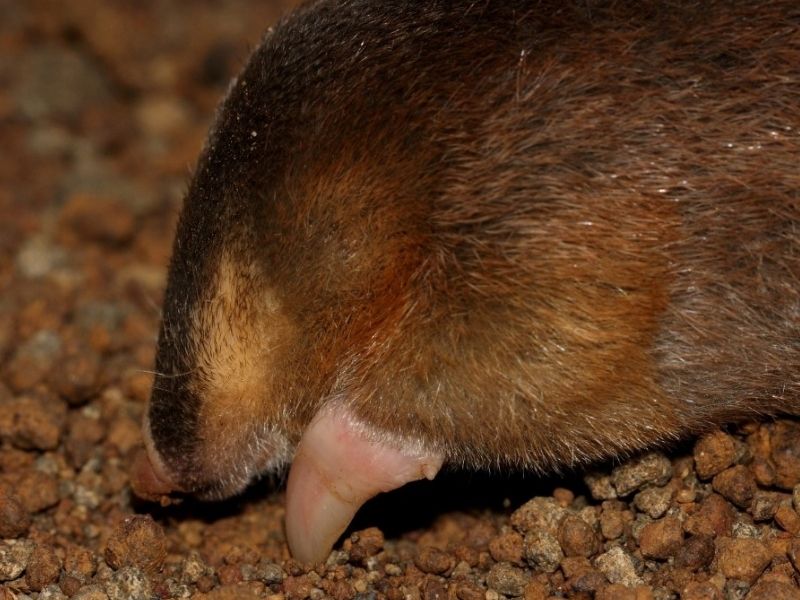
Highveld Golden Mole
Amblysomus septentrionalis

2025 Red list status

Regional Population Trend

Change compared
to 2016
No Change
Overview
Amblysomus septentrionalis – Roberts, 1913
ANIMALIA – CHORDATA – MAMMALIA – AFROSORICIDA – CHRYSOCHLORIDAE – Amblysomus – septentrionalis
Common Names: Highveld Golden Mole (English), Hoëveld Gouemol (Afrikaans), Highveld-Goldmull (German)
Synonyms: No Synonyms
Taxonomic Note:
Traditionally recognised as a subspecies of the Zulu Golden Mole (A. “iris” now incorporated into A. hottentotus). Bronner (1996) raised septentrionalis to a full species based on unique chromosomal and craniometric properties. No subspecies currently recognised (Bronner and Jenkins 2005), but orangensis from Parys/Heilbron district may qualify for subspecies status pending the availability of chromosomal and genetic data.
The phylogeographic analysis of Mynhardt et al. (2015) revealed the paraphyly of several subspecies previously attributed to Amblysomus “hottentotus”. Possibly, following Bronner (1996), specimens from at least Wakkerstroom could be referred to A. septentrionalis. Specimens of A. septentrionalis from Ngome Forest and Ermelo Dam do not cluster with each other relative to a population of A. robustus from Dullstroom (Mynhardt et al. 2015). A. robustus and A. septentrionalis are in any event closely related; the extent to which they comprise valid, distinct species must await further investigation.
Red List Status: NT – Near Threatened B2ab(ii,iii), (IUCN version 3.1)
Assessment Information
Assessors: Mynhardt, S.1 & da Silva, J.2
Reviewer: Asher, R.3
Contributor: Patel, T.1
Institutions: 1Endangered Wildlife Trust, 2South African National Biodiversity Institute, 3University of Cambridge
Previous Assessors: Rampartab, C.
Previous Reviewers: Bronner, G. & Taylor, A.
Assessment Rationale
The species is listed as Near Threatened as it is currently known from 12 localities, with an extent of occurrence of 58,652 km2 and an area of occupancy of 144 km2. Based on multivariate morphometrics predictions it is probably more widespread than current records indicate (Bronner 2000). Observed habitat degradation associated with mining for shallow coal deposits to fuel numerous power stations that occur in the preferred high-altitude grassland habitats of this species is an inferred major threat. Rehabilitation attempts at these sites have proved largely ineffective. These power stations form the backbone of South Africa’s electricity network, and disturbance is likely to increase as human populations grow and the demand for power increases. Farming and agro-forestry (exotic pine and eucalyptus plantations) have also transformed habitat, but less dramatically; this does not appear to pose a major threat. Research is currently underway to acquire data on distribution limits. Data is required to shed light on ecology, behaviour densities and reproduction. It almost qualifies as threatened under criterion B2ab(ii,iii).
Reasons for Change
Reason(s) for Change in Red List Category from the Previous Assessment: No change
Red List Index
Red List Index: No change
Recommended citation: Mynhardt S & da Silva JM. 2025. A conservation assessment of Amblysomus septentrionalis. In Patel T, Smith C, Roxburgh L, da Silva JM & Raimondo D, editors. The Red List of Mammals of South Africa, Eswatini and Lesotho. South African National Biodiversity Institute and Endangered Wildlife Trust, South Africa.
Regional Distribution and occurrence
Geographic Range
The species occurs in South Africa, ranging in the Mpumalanga Highveld from Wakkerstroom northwards to Ermelo and Barberton, and westwards through Standerton district to northeastern Free State (Heilbron/Parys) and possibly eastwards into northeastern Eswatini (Piggs Peak/Mbabane) based on equivocal morphometric identifications that await confirmation by genetic data. Moles from the Harrismith area are also provisionally attributed to this form. Distribution models currently being refined predict that geographic range also extends westwards and southwards into other parts of the northeastern Free State. Based on multivariate morphometric predictions, it is probably more widespread than current records indicate (Bronner 2000).
Number of locations: 12
Extent of occurrence (EOO): 58,652 km2
Area of occupancy (AOO): 144 km2
Elevation / Depth / Depth Zones
Elevation Lower Limit (in metres above sea level): (Not specified)
Elevation Upper Limit (in metres above sea level): (Not specified)
Depth Lower Limit (in metres below sea level): (Not specified)
Depth Upper Limit (in metres below sea level): (Not specified)
Depth Zone: (Not specified)
Map
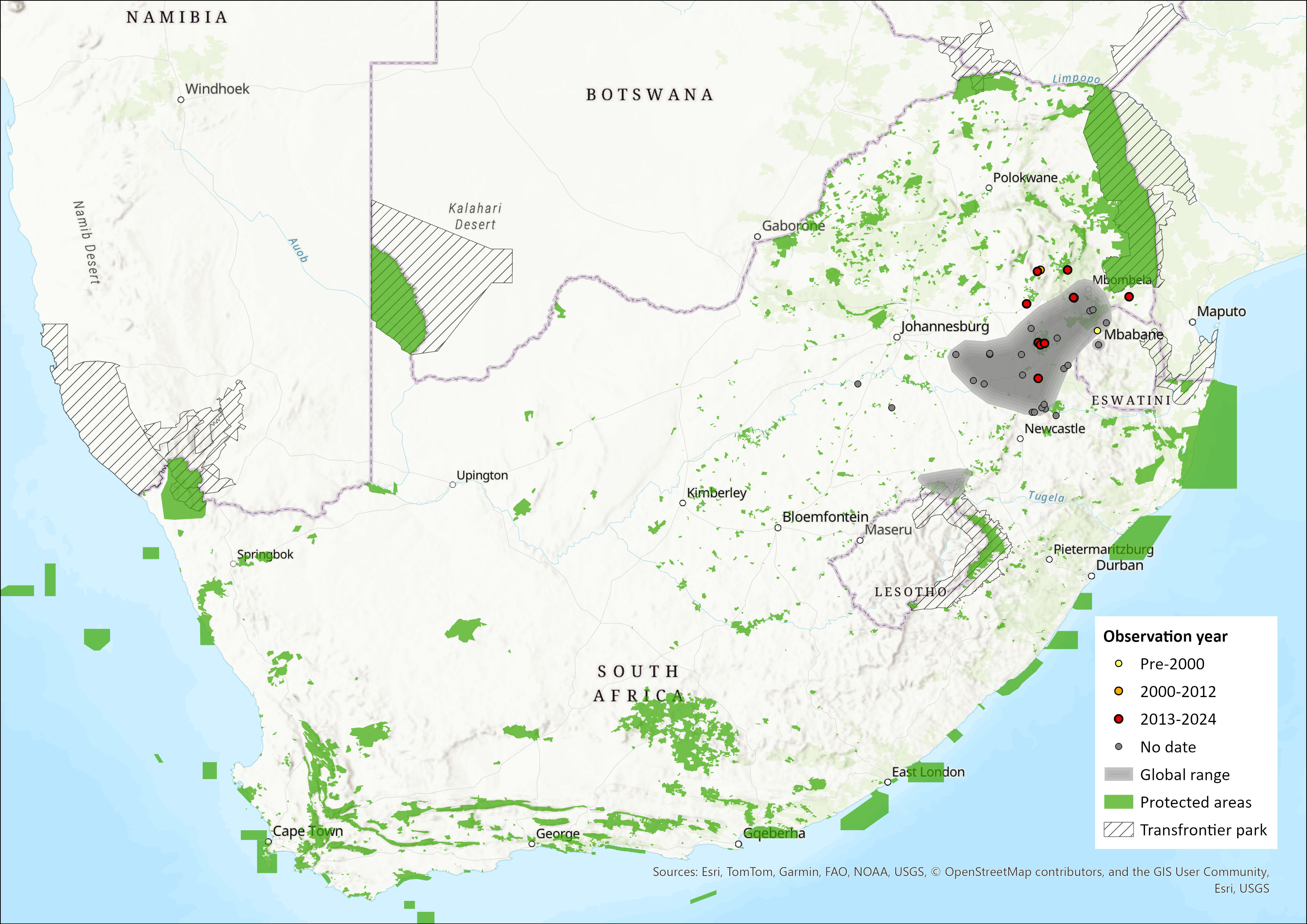
Figure 1. Distribution records for Highveld Golden Mole (Amblysomus septentrionalis) within the assessment region (South Africa, Eswatini and Lesotho). Note that distribution data is obtained from multiple sources and records have not all been individually verified.
Biogeographic Realms
Biogeographic Realm: Afrotropical
Occurrence
Countries of Occurrence
| Country | Presence | Origin | Formerly Bred | Seasonality |
| Eswatini | Presence Uncertain | Native | – | Resident |
| South Africa | Extant | Native | – | Resident |
| South Africa -> Free State | Extant | Native | – | Resident |
| South Africa -> Mpumalanga | Extant | Native | – | Resident |
Large Marine Ecosystems (LME) Occurrence
Large Marine Ecosystems: (Not specified)
FAO Area Occurrence
FAO Marine Areas: (Not specified)
Climate change
Although the potential impacts of climate change on this species have not been directly assessed, climate change is expected to impact most golden mole species. Since these subterranean animals are restricted to soft soils for burrowing, and have very low vagility, their ability to migrate or shift their distribution ranges in response to climate change is very limited. Climate change is likely to impact golden moles through changes in vegetation type, soil moisture and prey availability.
Population information
The species is locally common; trapping data suggest densities of 3 ha-1 at one locality in the Wakkerstroom district. Based on current estimates of area of occupancy (AOO), the global population is well over 10,000 individuals.
| Continuing decline in mature individuals? | Qualifier | Justification |
| Unknown | Inferred | – |
Current Population Trend: Unknown
Number of mature individuals (=population size): >10,000
Extreme fluctuations in the number of subpopulations: (Not specified)
Continuing decline in number of subpopulations: (Not specified)
All individuals in one subpopulation: (Not specified)
Number of mature individuals in largest subpopulation: Unknown
Number of Subpopulations: (Not specified)
Quantitative Analysis
Probability of extinction in the wild within 3 generations or 10 years, whichever is longer, maximum 100 years: (Not specified)
Probability of extinction in the wild within 5 generations or 20 years, whichever is longer, maximum 100 years: (Not specified)
Probability of extinction in the wild within 100 years: (Not specified)
Population genetics
While this species has been studied in a phylogenetic context (Mynhardt et al. 2015, 2020), no population genetic investigations have been undertaken, which could help uncover the population structure and diversity within the species complex this species has been found to fall into. It is anticipated that the 12 localities where it is found, comprise a single metapopulation.
Given that the species is thought to exceed 10,000 individuals in number, the effective population size for this metapopulation is thought to be between 1,000-3,000 individuals (based on a Nc/Ne conversion ratio of 0.1-0.3).
Habitats and ecology
Occurs in meadows and edges of marshes in high-altitude grasslands of Mpumalanga, possibly extending toward the Free State and Gauteng borders. Restricted to friable soils in valleys and on mountainsides, where individuals may co-exist with the Rough-haired Golden Mole, Chrysospalax villosus. Common in well-irrigated farmyards, gardens, golf courses, and present also in exotic plantations, though seemingly at lower densities. In the Wakkerstroom district it is found in thickets of Oldwood trees (Leucosidea sericea) on the banks of streams in valleys, but avoid scrubby vegetation in kloofs and along rocky ridges, where it is replaced by Sclater’s Golden Mole Chlorotalpa sclateri (Bronner 2013).
IUCN Habitats Classification Scheme
| Habitat | Season | Suitability | Major Importance? |
| 1.9. Forest -> Forest – Subtropical/Tropical Moist Montane | Resident | Suitable | No |
| 2.2. Savanna -> Savanna – Moist | Resident | Suitable | No |
| 3.4. Shrubland -> Shrubland – Temperate | Resident | Suitable | No |
| 4.4. Grassland -> Grassland – Temperate | Resident | Suitable | Yes |
| 4.5. Grassland -> Grassland – Subtropical/Tropical Dry | Resident | Suitable | Yes |
| 14.1. Artificial/Terrestrial -> Artificial/Terrestrial – Arable Land | Resident | Suitable | No |
| 14.2. Artificial/Terrestrial -> Artificial/Terrestrial – Pastureland | Resident | Suitable | No |
| 14.3. Artificial/Terrestrial -> Artificial/Terrestrial – Plantations | Resident | Marginal | – |
| 14.4. Artificial/Terrestrial -> Artificial/Terrestrial – Rural Gardens | Resident | Suitable | No |
| 14.5. Artificial/Terrestrial -> Artificial/Terrestrial – Urban Areas | Resident | Suitable | No |
| 16. Introduced vegetation | Resident | Marginal | – |
Life History
Generation Length: (Not specified)
Age at Maturity: Female or unspecified: (Not specified)
Age at Maturity: Male: (Not specified)
Size at Maturity: Female: 11-15
Size at Maturity: Male: 11-15
Longevity: (Not specified)
Average Reproductive Age: (Not specified)
Maximum Size (in cms): (Not specified)
Size at Birth (in cms): (Not specified)
Gestation Time: (Not specified)
Reproductive Periodicity: Breeding probably occurs throughout the years but with a peak in the wet summer months (Bronner 2013)
Average Annual Fecundity or Litter Size: (Not specified)
Natural Mortality: (Not specified)
Breeding Strategy
Does the species lay eggs? No
Does the species give birth to live young? Yes
Does the species exhibit parthenogenesis? No
Does the species have a free-living larval stage? No
Does the species require water for breeding? No
Movement Patterns
Movement Patterns: (Not specified)
Congregatory: (Not specified)
Systems
System: Terrestrial
General Use and Trade Information
General notes regarding trade and use of this species: This species is not known to be utilised or traded in any form.
Local Livelihood: (Not specified)
National Commercial Value: (Not specified)
International Commercial Value: (Not specified)
End Use: (Not specified)
Is there harvest from captive/cultivated sources of this species? (Not specified)
Harvest Trend Comments: (Not specified)
Threats
The major threat to this species is likely to be habitat alteration/degradation associated with mining of shallow coal deposits to fuel numerous power stations in the region that occur in the preferred high-altitude grassland habitats of this species, which is an inferred major threat. Rehabilitation attempts at these sites have proved largely ineffective. These power stations form the backbone of South Africa’s electricity network, and disturbance is likely to increase as human populations grow and the demand for power increases. Habitat alteration owing to agriculture could be a more minor threat, but this species thrives in such landscapes and thus is probably not severely impacted; predation by domestic pets, and persecution by gardeners and greenkeepers, could represent a more localized threat, and are inferred to be increasing along with settlement expansion.
Continuing decline in habitat: Yes. Declining in area and quality. Although it can survive in gardens and modified landscapes, its core grassland habitats are being lost to mining activities in the region. In Mpumalanga, 40% of the grassland vegetation types are listed as threatened and only 51% of the grasslands are still natural and previously not ploughed (Lötter et al. 2014). The Mpumalanga Tourism and Parks Agency (MTPA) mapped all development applications received at a cadastral scale over a 14-year period (2000–2014) and showed that greatest pressure for land-use change has come from prospecting applications (54.2% of the land surface area of Mpumalanga) and mining (24.5% of the land surface area). The province can anticipate much greater expansion in the mining sector than ever before (Lötter et al. 2014). Furthermore, rural and urban settlements have expanded by 7% and 11% respectively between 2000 and 2013 (GeoTerraImage 2015).
Conservation
Not recorded from any provincial or national nature reserves. Gelderblom et al. (1995) identified the southeastern Mpumalanga Highveld as a hotspot of chrysochlorid endemicity, and recommended that urgent action be taken to augment the national protected areas network in this region.
Recommendations for land managers and practitioners:
Field surveys to discover other subpopulations. Land managers should be incentivised to de-stock ranchlands to conserve grassland habitats, especially vlei areas, and to follow ecologically sensitive veld burning practices (using a mosaic spatial scheme so that refugia remain, from which re-colonisation of burned areas can take place).
Research priorities:
- Research needed to confirm distinctness from Amblysomus hottentotus meesteri, A. robustus and A. h. longiceps, and to determine distributional limits of these taxa.
- Surveys needed to determine distributional limits of these taxa, and discover areas of occurrence.
- Field studies to determine life history traits and ecological tolerances.
- Studies assessing the severity of threats, specifically the quantified impact from mining activities.
Encouraged citizen actions:
- Report sightings on virtual museum platforms (for example, iNaturalist and MammalMAP), especially outside protected areas.
- Deposit any dead specimens found in a state or provincial museum, together with information on the date and site where found.
- Create native vegetation gardens.
Bibliography
Afrotheria Specialist Group. 2014. Specialist Group website. Available at: http://www.afrotheria.net/index.php.
Bronner, G.N. 1995. Systematic revision of the golden mole genera Amblysomus, Chlorotalpa and Calcochloris (Insectivora: Chrysochloromorpha; Chrysochloridae). Ph.D. thesis, University of Natal (Durban), South Africa.
Bronner, G.N. 1996. Geographic patterns of morphometric variation in the Hottentot golden mole, Amblysomus hottentotus (Insectivora: Chrysochloridae): a multivariate analysis. Mammalia 60: 729–751.
Bronner, G.N. 2000. New species and subspecies of golden mole (Chrysochloridae: Amblysomus) from Mpumalanga, South Africa. Mammalia 64: 41-54.
Bronner, G.N. 2013. Amblysomus septentrionalis. In: J. Kingdon, D. Happold, T. Butynski, M. Hoffmann, M. Happold and J. Kalina (eds), Mammals of Africa, Volume I: Introductory Chapters and Afrotheria, pp. 232-233. Bloomsbury Publishing, London.
Bronner, G.N. and Jenkins, P.D. 2005. Order Afrosoricida. In: D.E. Wilson and D.M. Reeder (eds), Mammal Species of the World, pp. 70-81. The Johns Hopkins University Press, Baltimore, MD, USA.
Gelderblom, C.M., Bronner, G.N., Lombard, A.T., Taylor, P.J. and Benn, G.A. 1995. Patterns of distribution and the current protection status of the Chiroptera, Insectivora and Carnivora in South Africa. South African Journal of Zoology 30: 103–114.
GeoTerraImage. 2015. Quantifying settlement and built-up land use change in South Africa. Pretoria.
IUCN. 2015. The IUCN Red List of Threatened Species. Version 2015.2. Available at: www.iucnredlist.org. (Accessed: 23 June 2015).
Lötter, M.C., Cadman, M.J. and Lechmere-Oertel, R.G. 2014. Mpumalanga Biodiversity Sector Plan Handbook. MTPA. Nelspruit.
Mynhardt, S., Bennett, N.C. and Bloomer, P., 2020. New insights from RADseq data on differentiation in the Hottentot golden mole species complex from South Africa. Molecular phylogenetics and evolution, 143, p.106667.
Mynhardt, S., Maree, S., Pelser, I., Bennett, N.C., Bronner, G.N., Wilson, J.W. and Bloomer, P., 2015. Phylogeography of a morphologically cryptic golden mole assemblage from South-Eastern Africa. PLoS One, 10(12), p.e0144995.
Skinner, J.D. and Chimimba, C.T. (eds). 2005. The Mammals of the Southern African Subregion. Third edition. Cambridge University Press, United Kingdom, Cambridge.