
Gunning’s Golden Mole
Neamblysomus gunningi

2025 Red list status
Endangered

Regional Population Trend
Unknown

Change compared
to 2016
No Change
Overview
ANIMALIA – CHORDATA – MAMMALIA – AFROSORICIDA – CHRYSOCHLORIDAE – Neamblysomus – gunningi
Common Names: Gunning’s Golden Mole (English), Gunning se Gouemol (Afrikaans)
Synonyms: Chrysochloris gunningi Broom, 1908; Amblysomus gunningi (Broom, 1908)
Taxonomic Note:
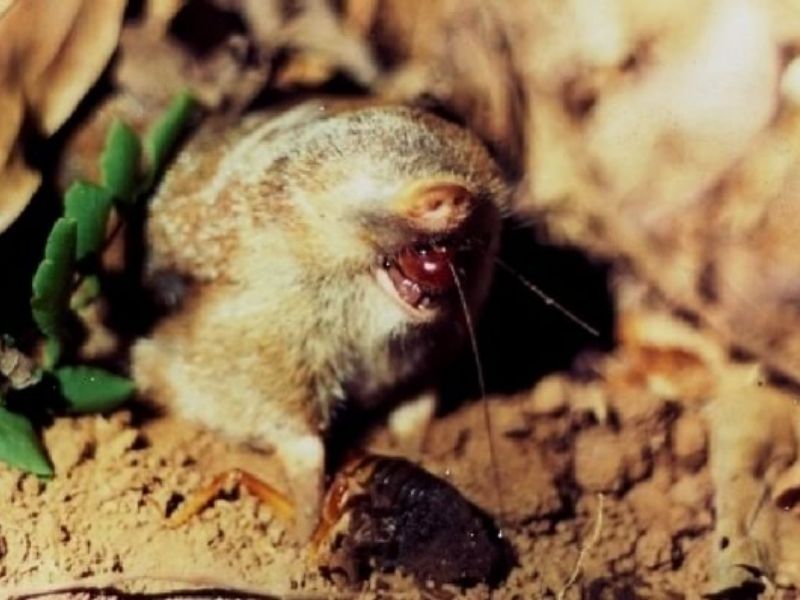
Included in Amblysomus by Simonetta (1968), Meester (1974), Petter (1981) and Meester et al. (1986). Bronner (1995) elevated it to the genus Neamblysomus and retained as such by Bronner and Jenkins (2005) and Bronner (2013). Externally this species resembles the Hottentot Golden Mole (Amblysomus hottentotus) and has been misidentified as such by some authors. There are no recognised subspecies.
Red List Status: EN – Endangered, B1ab(iii)+2ab(iii) (IUCN version 3.1)
Assessment Information
Assessor: Patel, T.1 & da Silva, J.2
Reviewer: Mynhardt, S.1
Institutions: 1Endangered Wildlife Trust, 2South African National Biodiversity Institute
Previous Assessor: Maree, S.
Previous Reviewers: Bronner, G., Bennett, N.C. & Taylor, A.
Previous Contributors: Child, M.F. & Relton, C.
Assessment Rationale
Known from only six sites which probably represent a single location, a restricted distributional range estimated at 1,327 km2 and the area of occupancy is estimated at 96 km2 from six known locations (using a 16 km2 grid area). The main threat to this fossorial species is the continuous decline in the quality and extent of its preferred natural habitats within low-lying and high-altitude indigenous Afromontane forests in the Grootbos-Magoebaskloof area (Northern Mistbelt Forests, Envirotek 2003; Wolkberg Afromontane Forest Belt, IBA_SA SA005) and adjoining montane grasslands. Commercial forestry operations and associated road infrastructure cause severe degradation and fragmentation of natural forests, and only small fragments of its habitat are protected in state-controlled forest reserves. However, protection measures on the ground are dubious and do not target management of this species. Increasing privatisation of some state forests brings the continued protection of this species’ habitat into doubt. Agriculture, rural and urban housing and tourism infrastructure development around Haenertsburg are additional but more localised causes of habitat destruction, fragmentation and loss. Therefore, the species is listed as Endangered under criterion B1ab(iii)+2ab(iii).
Reasons for Change
Reason(s) for Change in Red List Category from the Previous Assessment: No change
Red List Index
Red List Index: No change
Recommended citation: Patel T & da Silva JM. 2025. A conservation assessment of Neamblysomus gunningi. In Patel T, Smith C, Roxburgh L, da Silva JM & Raimondo D, editors. The Red List of Mammals of South Africa, Eswatini and Lesotho. South African National Biodiversity Institute and Endangered Wildlife Trust, South Africa.
Regional Distribution and occurrence
Geographic Range
Recorded only from six localities in the Grootbos-Magoebaskloof area (Woodbush-De Hoek) of the far Northern Eastern Escarpment (Drakensberg) between Haenertsburg, New Agatha and Tzaneen in Limpopo Province (South Africa). Three of the six confirmed localities fall within protected indigenous forest reserves (De Hoek, Woodbush and New Agatha). All of these records fall within the southern section of the Northern Mistbelt Forests (Envirotek 2003)/ Wolkberg Afromontane Forest Belt (IBA_SA – SA005).
Elevation / Depth / Depth Zones
Elevation Lower Limit (in metres above sea level): (Not specified)
Elevation Upper Limit (in metres above sea level): (Not specified)
Depth Lower Limit (in metres below sea level): (Not specified)
Depth Upper Limit (in metres below sea level): (Not specified)
Depth Zone: (Not specified)
Map
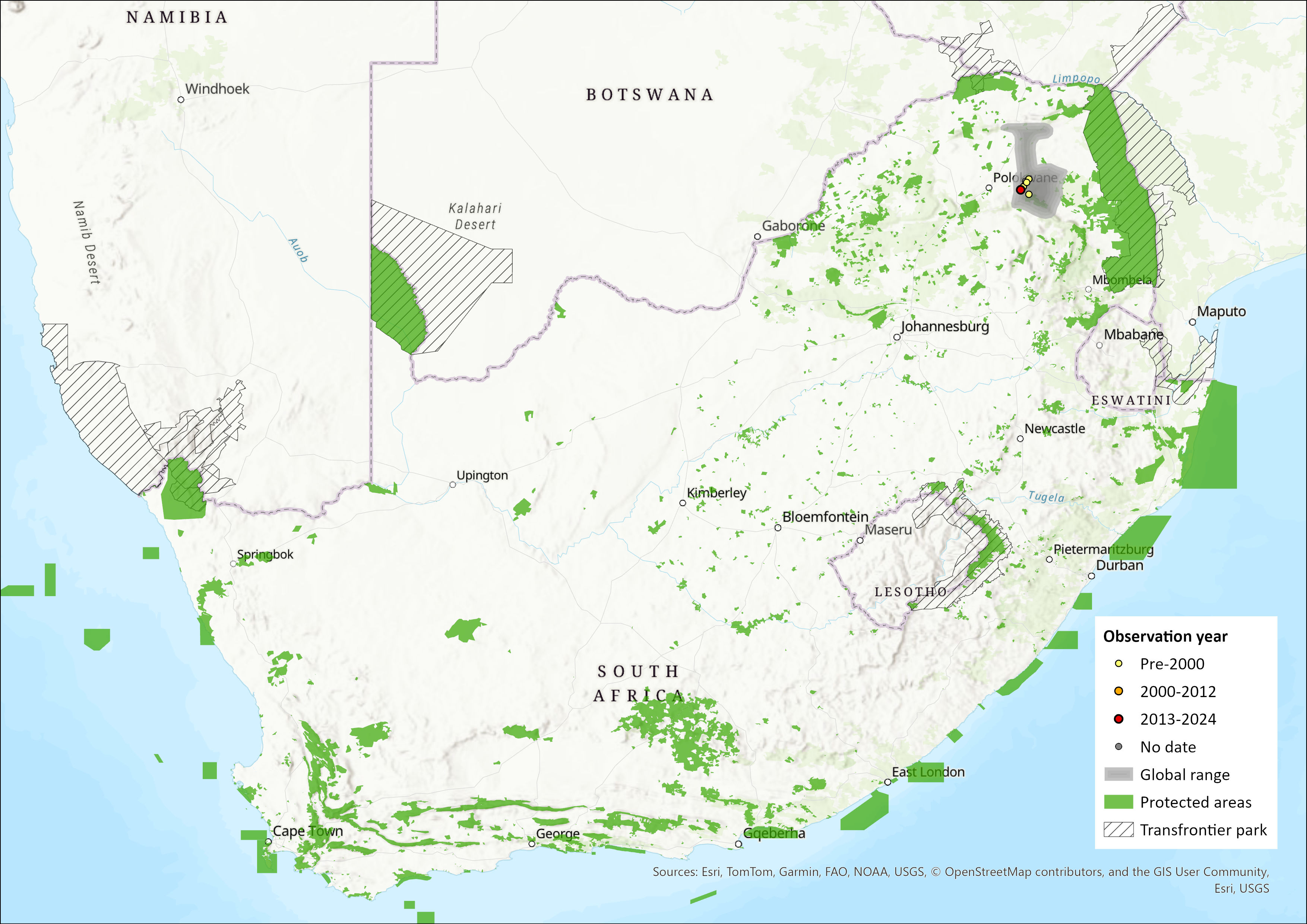 Figure 1. Distribution records for Gunning’s Golden Mole (Neamblysomus gunningi) within the assessment region (South Africa, Eswatini and Lesotho). Note that distribution data is obtained from multiple sources and records have not all been individually verified.
Biogeographic Realms
Biogeographic Realm: Afrotropical
Occurrence
Countries of Occurrence
| Country | Presence | Origin | Formerly Bred | Seasonality |
| South Africa | Extant | Native | – | Resident |
| South Africa -> Limpopo Province | Extant | Native | – | Resident |
Large Marine Ecosystems (LME) Occurrence
Large Marine Ecosystems: (Not specified)
FAO Area Occurrence
FAO Marine Areas: (Not specified)
Climate change
Although the potential impacts of climate change on this species have not been directly assessed, climate change is expected to impact most golden mole species. Since these subterranean animals are restricted to soft soils for burrowing, and have very low vagility, their ability to migrate or shift their distribution ranges in response to climate change is very limited. Climate change is likely to impact golden moles through changes in vegetation type, soil moisture and prey availability.
Population information
Very localised population, but locally common; most numerous in moist sandy loam soils associated with high altitude riverine forests near watercourses and ponds.
Population Information
| Extreme fluctuations in the number of subpopulations | Justification |
| No | – |
Current population trend: Unknown
Continuing decline in mature individuals: Unknown
All individuals in one subpopulation: Yes
Number of mature individuals in population: Unknown
Number of mature individuals in largest subpopulation: Unknown
Number of subpopulations: One
Severely fragmented: No
Quantitative Analysis
Probability of extinction in the wild within 3 generations or 10 years, whichever is longer, maximum 100 years: (Not specified)
Probability of extinction in the wild within 5 generations or 20 years, whichever is longer, maximum 100 years: (Not specified)
Probability of extinction in the wild within 100 years: (Not specified)
Population genetics
This species has not been studied in a population genetic context; however, given its very localised distribution it is expected to exist as a single population. Due to limited information on population sizes, the effective population size for the species/subpopulation cannot be quantified.
Habitats and ecology
Occurs in moist sandy loam soils along watercourses in low and high altitude moist Afromontane forests (Northern Mistbelt Forests, Envirotek 2003) and surrounding Northeastern Mountain Grassland of Limpopo Province (Savanna biome). Also occurs in pastoral and cultivated lands (livestock and tea farming) and young pine plantations, where it coexists with Common Mole-rats (Cryptomys hottentotus). It thrives in rural and urban gardens and uses stretches of suitable soil on road edges as movement corridors. Nocturnal foraging takes place in shallow subsurface tunnels; with increased activity after rain. Adults are solitary, except mothers with young. Little is known about the ecology of this species.
IUCN Habitats Classification Scheme
| Habitat | Season | Suitability | Major Importance? |
| 1.6. Forest -> Forest – Subtropical/Tropical Moist Lowland | Resident | Suitable | Yes |
| 1.9. Forest -> Forest – Subtropical/Tropical Moist Montane | Resident | Suitable | Yes |
| 3.6. Shrubland -> Shrubland – Subtropical/Tropical Moist | Resident | Suitable | No |
| 4.4. Grassland -> Grassland – Temperate | Resident | Suitable | Yes |
| 14.1. Artificial/Terrestrial -> Artificial/Terrestrial – Arable Land | Resident | Suitable | No |
| 14.2. Artificial/Terrestrial -> Artificial/Terrestrial – Pastureland | Resident | Suitable | No |
| 14.3. Artificial/Terrestrial -> Artificial/Terrestrial – Plantations | Resident | Marginal | – |
| 14.4. Artificial/Terrestrial -> Artificial/Terrestrial – Rural Gardens | Resident | Suitable | Yes |
| 14.5. Artificial/Terrestrial -> Artificial/Terrestrial – Urban Areas | Resident | Marginal | – |
| 16. Introduced vegetation | Resident | Marginal | – |
Life History
Generation Length: (Not specified)
Age at Maturity: Female or unspecified: (Not specified)
Age at Maturity: Male: (Not specified)
Size at Maturity (in cms): Female: 11-13
Size at Maturity (in cms): Male: 12-13
Longevity: (Not specified)
Average Reproductive Age: (Not specified)
Maximum Size (in cms): (Not specified)
Size at Birth (in cms): (Not specified)
Gestation Time: (Not specified)
Reproductive Periodicity: Seasonally polyoestrous, breeds in wet summer months (Bronner 2013)
Average Annual Fecundity or Litter Size: (Not specified)
Natural Mortality: (Not specified)
Breeding Strategy
Does the species lay eggs? No
Does the species give birth to live young? Yes
Does the species exhibit parthenogenesis? No
Does the species have a free-living larval stage? No
Does the species require water for breeding? No
Movement Patterns
Movement Patterns: (Not specified)
Congregatory: (Not specified)
Systems
System: Terrestrial
General Use and Trade Information
General notes regarding trade and use of this species: This species is not known to be traded or utilised in any form.
Local Livelihood: (Not specified)
National Commercial Value: (Not specified)
International Commercial Value: (Not specified)
End Use: (Not specified)
Is there harvest from captive/cultivated sources of this species? (Not specified)
Harvest Trend Comments: (Not specified)
Threats
In the former Transvaal Province (South Africa), a large geopolitical area now comprising the Gauteng, Limpopo, North-West and Mpumalanga provinces, this species was given the highest regional priority score for mammals (Freitag and van Jaarsveld 1997). Within its extent of occurrence, the distribution of populations is highly localised and naturally fragmented due to a preference for soft sandy loam soils along watercourses, especially in indigenous forests. Inferred major threats are severe habitat alteration and fragmentation of Afromontane forest and adjoining grasslands by commercial forestry operations and associated roads infrastructure. Although somewhat limited, expanding rural and urban housing, commercial and tourism infrastructure developments in the last five years have resulted in areas of suitable habitat being cleared or severely transformed. Minor threats include overgrazing of pastoral land along watercourses, predation by pets and persecution by gardeners in rural and urban settlements.
Habitat trend: Declining in area and quality. Ongoing deforestation and habitat degradation is inferred to be increasing along with expanding urban and rural settlements, which increased by 15% and 9% respectively between 2000 and 2013 in Limpopo Province (GeoTerraImage 2015).
Conservation
Protected in the De Hoek, New Agatha and Woodbush Forest Reserves. Research is needed to document most aspects of the natural history, ecology, evolutionary relationships, phylogeography and population genetics of this species. In the former Transvaal Province (South Africa), its was given the highest regional priority score for mammals (Freitag and van Jaarsveld 1997). The species is not receiving dedicated conservation attention at present.
Protected area expansion and biodiversity stewardship schemes are crucial interventions needed to conserve remaining habitat patches and connect subpopulations of this species. Additionally, stricter law enforcement for poaching and harvesting inside protected Forest Reserves should be established.
Recommendations for land managers and practitioners:
- Field surveys to discover other subpopulations and key sites for priority protection.
- A systematic monitoring scheme should be established to determine subpopulation trends within key protected areas.
- A Biodiversity Management Plan should be developed for this species.
- Incentivise landowners to de-stock to reduce overgrazing impacts.
Research priorities:
- Research needed to document most aspects of natural history, ecology, evolutionary relationships, phylogeography and population genetics of this species.
- Subpopulation trends and threat quantified impacts from agroforestry activities.
Encouraged citizen actions:
- Report sightings on virtual museum platforms (for example, iNaturalist and MammalMAP), especially outside protected areas.
- Deposit any dead specimens found in a state or provincial museum, together with information on the date and site where found.
- Create native-vegetation gardens.
Bibliography
Afrotheria Specialist Group. 2014. Specialist Group website. Available at: http://www.afrotheria.net/index.php.
Armstrong, A.J., Benn, G., Bowland, AE, Goodman, P.S., Johnson, D.N., Maddock, A.H. and Scott-Shaw, C.R. 1998. Plantation forestry in South Africa and its impact on biodiversity. The Southern African Forestry Journal 182: 59-65.
Bronner, G.N. 1995. Cytogenetic properties of nine species of golden moles (Insectivora: Chrysochloridae). Journal of Mammalogy 76: 957-971.
Bronner, G.N. 1995. Systematic revision of the golden mole genera Amblysomus, Chlorotalpa and Calcochloris (Insectivora: Chrysochloromorpha; Chrysochloridae). Ph.D. Thesis, University of Natal.
Bronner, G.N. 2013. Neamblysomus gunningi. In: J. Kingdon, D. Happold, T. Butynski, M. Hoffmann, M. Happold and J. Kalina (eds), Mammals of Africa, Volume I: Introductory Chapters and Afrotheria, pp. 239-240. Bloomsbury Publishing, London.
Bronner, G.N. and Jenkins, P.D. 2005. Order Afrosoricida. In: D.E. Wilson and D.M. Reeder (eds), Mammal Species of the World, pp. 70-81. The Johns Hopkins University Press, Baltimore, MD, USA.
Envirotek. 2003. Classification system for South African indigenous forests. Envirotek, CSIR, Pretoria.
Freitag, S. and van Jaarsveld, A.S. 1997. Relative occupancy, endemism, taxonomic distinctiveness and vulnerability: prioritising regional conservation actions. Biodiversity and Conservation 6: 211–232.
GeoTerraImage. 2015. Quantifying settlement and built-up land use change in South Africa. Pretoria.
IUCN. 2015. The IUCN Red List of Threatened Species. Version 2015.2. Available at: www.iucnredlist.org. (Accessed: 23 June 2015).
Isaac, N.J.B., Turvey, S.T., Collen, B., Waterman, C. and Baillie, J.E.M. 2007. Mammals on the EDGE: Conservation Priorities Based on Threat and Phylogeny. PLoS ONE 2(3): e296.
Meester, J. 1974. Family Chrysochloridae. Smithsonian Institution Press, Washington, DC, USA.
Meester, J.A.J., Rautenbach, I.L., Dippenaar, N.J. and Baker, C.M. 1986. Classification of Southern African Mammals. Monograph number 5. Transvaal Museum , Pretoria, South Africa.
Nicoll, M.E. and Rathbun, G.B. 1990. African Insectivora and elephant-shrews: An action plan for their conservation. IUCN/SSC Insectivore, Tree-Shrew and Elephant-Shrew Specialist Group. IUCN, Gland, Switzerland.
Petter, F. 1981. Remarques sur la systématique des Chrysochloridés. Mammalia 45: 49–53.
Rautenbach, I.L. 1978. The mammals of the Transvaal. Ph.D. Thesis, University of Natal.
Simonetta, A.M. 1968. A new golden mole from Somalia with an appendix on the taxonomy of the family Chrysochloridae (Mammalia, Insectivora). Monitore zoologici Italiano, Supplement 2: 27–55.
Smithers, R.H.N. 1986. South African Red Data Book – Terrestrial Mammals. South African National Scientific Programmes Report 125: 1–216.