
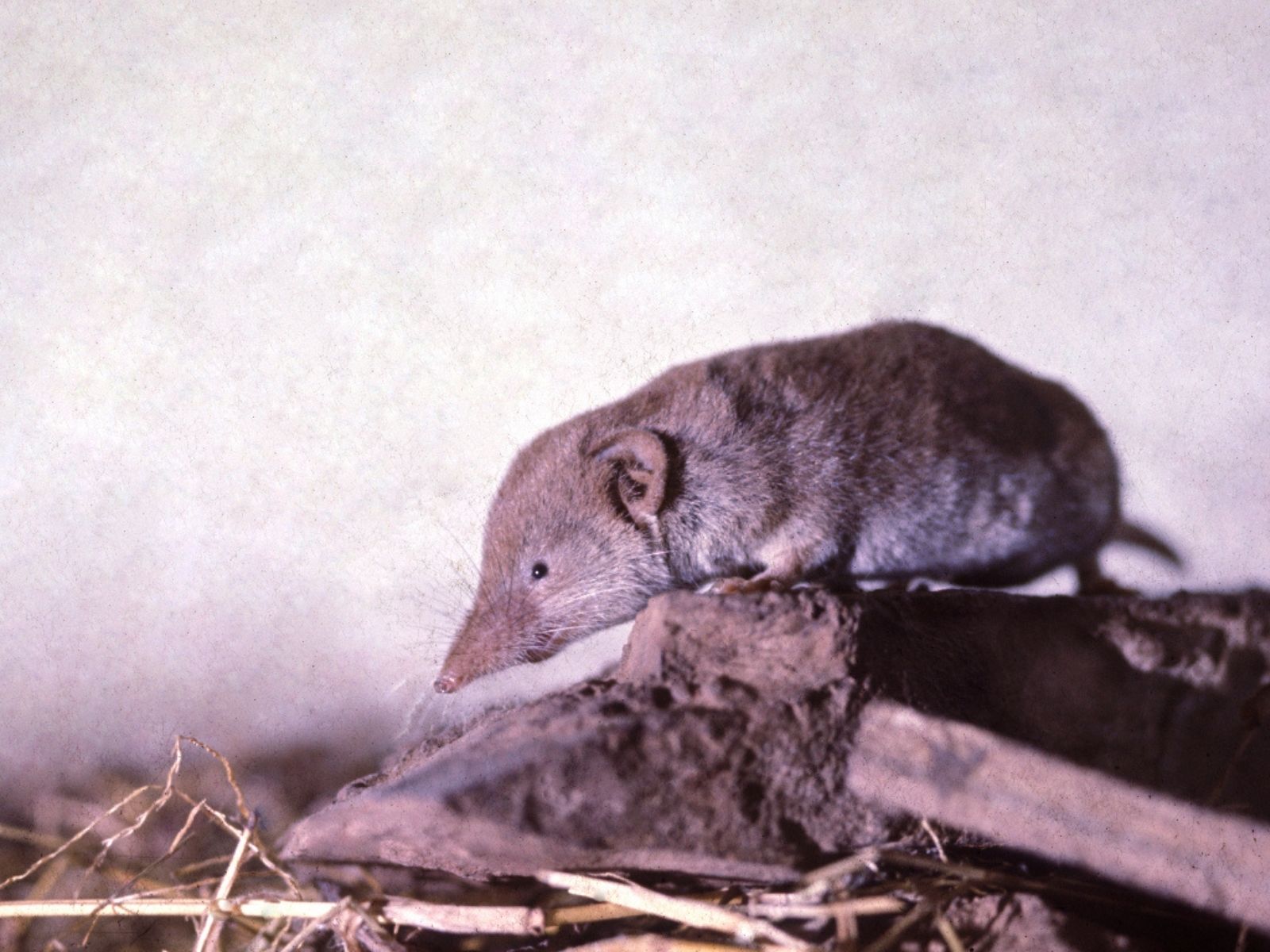
Greater Red Musk Shrew
Crocidura flavescens

2025 Red list status
Least Concern

Regional Population Trend
Declining

Change compared
to 2016
No Change
Overview
Crocidura flavescens – (I. Geoffroy, 1827)
ANIMALIA – CHORDATA – MAMMALIA – EULIPOTYPHLA – SORICIDAE – Crocidura – flavescens
Common Names: Greater Red Musk Shrew, Greater Musk Shrew (English), Groter Skeerbek (Afrikaans)
Synonyms: No Synonyms
Taxonomic notes: None
Red List Status: LC – Least Concern, (IUCN version 3.1)
Assessment Information
Assessors: Russo, I.M.1, da Silva, J. M.2
Reviewer: Erusan, R.3
Institutions: 1Cardiff University, 2South African National Biodiversity Institute, 3South African National Parks
Previous Assessors: Taylor, P., Baxter, R. & Monadjem, A.,
Previous Reviewers: Harvey, J. & Child, M.F.
Previous Contributors: Avery, M., MacFadyen, D., Avenant, N., Wilson, B. & Palmer, G.
Assessment Rationale
This species is near endemic with a wide distribution within the assessment region and occurs in multiple biomes and habitat types including transformed landscapes. Although it is suspected that moist grasslands will contract due to ongoing climate change, compounded by settlement expansion and overgrazing, this species is commensal with humans and is adaptable, able to live in disturbed areas and gardens. There are thus no major threats predicted to cause rapid decline, and this species is evaluated as Least Concern. Key interventions include protected area expansion of moist grassland habitats, as well as incentivising landowners to sustain natural vegetation around wetlands and to keep livestock or wildlife at ecological carrying capacity due to overgrazing.
Regional population effects: No rescue effects are possible as most of the population occurs within the assessment region
Reasons for Change
Reason(s) for Change in Red List Category from the Previous Assessment: No change
Red List Index
Red List Index: No change
Recommended citation: Russo IM da Silva JM. 2025. A conservation assessment of Crocidura flavescens. In Patel T, Smith C, Roxburgh L, da Silva JM & Raimondo D, editors. The Red List of Mammals of South Africa, Eswatini and Lesotho. South African National Biodiversity Institute and Endangered Wildlife Trust, South Africa.
Regional Distribution and occurrence
Geographic Range
This species occurs mainly in the higher rainfall regions of the assessment area in South Africa, Eswatini and Lesotho. The species occur on the coast as well as at altitudes of 2,300 m asl in the Drakensberg Mountains, KwaZulu-Natal Province (Rowe-Rowe and Meester 1982), Golden Gate National Park in the Free State Province, and at 1,800 m asl in the Amathole Mountains, Eastern Cape Province (R. Baxter unpubl. data). It has been reported to occur in the southern parts of Inhambane Province in Mozambique and from Port Nolloth, in the Northern Cape Province south along the West Coast (Skinner and Chimimba 2005). There are no records available to corroborate this. For example, only Crocidura cyanea was found in the Springbok area in the 1990s and records from this region need further confirmation (Avery and Avery 2011). The most northerly record in the Western Cape Province is from the Eland’s Bay area. While there are no records for Mozambique, it is possible that the species occurs in southern Mozambique but further field surveys are needed to confirm this. If the species is absent from Mozambique, the spccies will be endemic to the assessment region. Based on museum records, it occurs predominantly along the coast and interior of the Western Cape, Eastern Cape, and KwaZulu-Natal Provinces and inland in Lesotho, Eswatini and Mpumalanga. In Eswatini, it occurs in the Highveld region and marginally in the Middleveld region (Monadjem 1998). Although there is a single record from the North West Province, based on a putative specimen collected by Newbery (1996), it is presumably a misidentification (Power 2014).
Elevation / Depth / Depth Zones
Elevation Lower Limit (in metres above sea level): 0
Elevation Upper Limit (in metres above sea level): 1800
Depth Lower Limit (in metres below sea level): (Not specified)
Depth Upper Limit (in metres below sea level): (Not specified)
Depth Zone: (Not specified)
Map
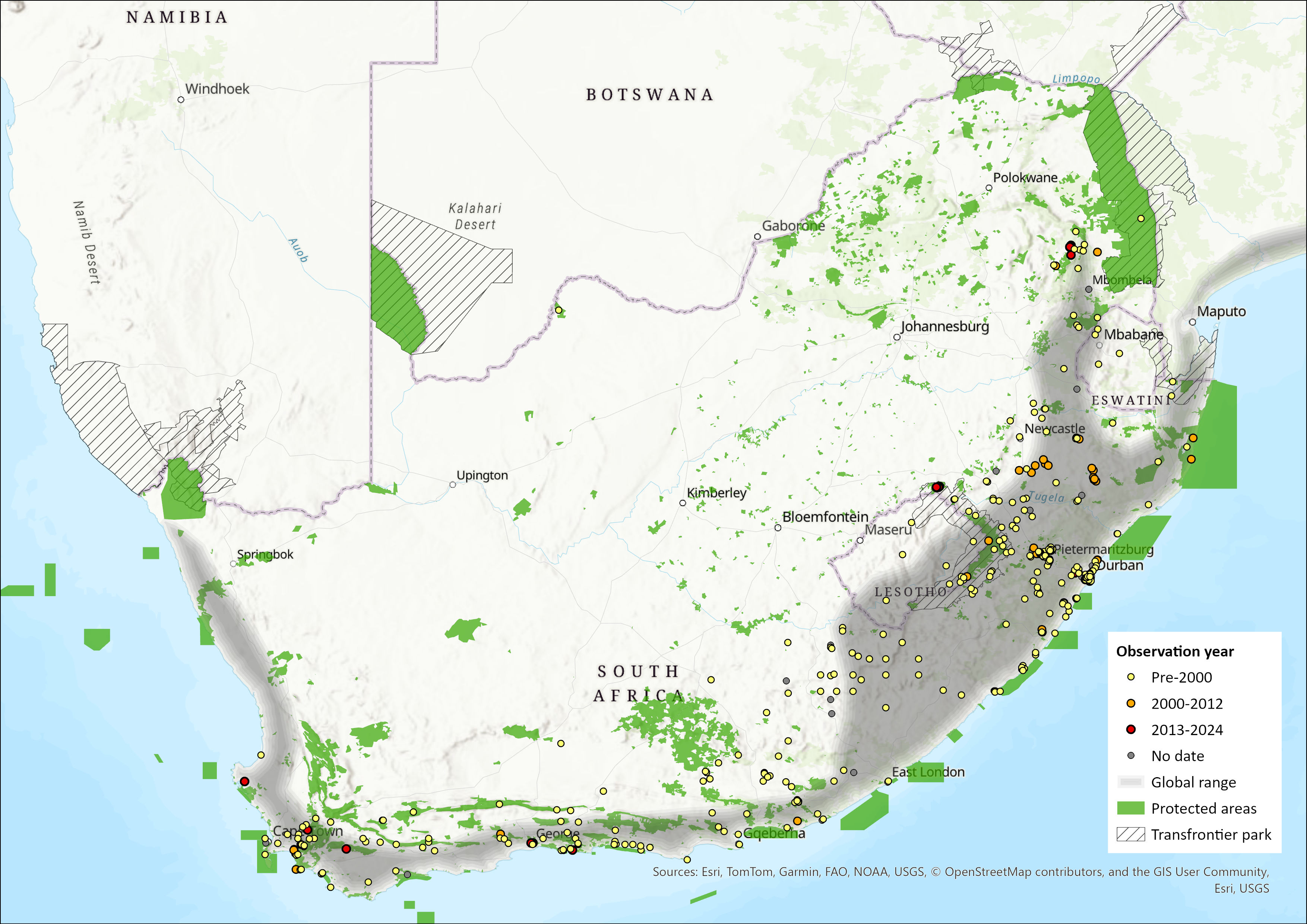
Figure 1. Distribution records for Greater Red Musk Shrew (Crocidura flavescens) within the assessment region (South Africa, Eswatini and Lesotho). Note that distribution data is obtained from multiple sources and records have not all been individually verified.
Biogeographic Realms
Biogeographic Realm: Afrotropical
Occurrence
Countries of Occurrence
| Country | Presence | Origin | Formerly Bred | Seasonality |
| Eswatini | Extant | Native | – | – |
| Lesotho | Extant | Native | – | – |
| Mozambique | Possibly Extant | Native | – | – |
| South Africa | Extant | Native | – | – |
Large Marine Ecosystems (LME) Occurrence
Large Marine Ecosystems: (Not specified)
FAO Area Occurrence
FAO Marine Areas: (Not specified)
Climate change
This species is widely distributed and common in gardens. However, it may be part of a suite of species that will display a general decline with grassland and fynbos contraction due to climate change (Taylor et al. 2016).
Population information
This species is relatively common in the coastal part of its range, although it was relatively infrequently caught in Dukuduku Forest, the northern KwaZulu-Natal Province (Perrin and Bodbijl 2001), with lower numbers being found at high altitudes. It can be very common in gardens and houses. The population may be declining due to the loss of moist grasslands. Healthy populations have been found in the Northern Drakensberg Grassland and Drakensberg Montane Shrubland biomes on slopes at higher altitudes.
Population Information
| Continuing decline in mature individuals? | Qualifier | Justification |
| Unknown | – | – |
Current population trend: Declining. Inferred from wetland habitat loss and degradation across its range.
Number of mature individuals in population: Unknown
Number of mature individuals in largest subpopulation: Unknown
Number of subpopulations: Unknown
Severely fragmented: No. Can occur in multiple habitats, including gardens and transformed landscapes.
Extreme fluctuations in the number of subpopulations: (Not specified)
Continuing decline in number of subpopulations: (Not specified)
All individuals in one subpopulation: (Not specified)
Quantitative Analysis
Probability of extinction in the wild within 3 generations or 10 years, whichever is longer, maximum 100 years: (Not specified)
Probability of extinction in the wild within 5 generations or 20 years, whichever is longer, maximum 100 years: (Not specified)
Probability of extinction in the wild within 100 years: (Not specified)
Population genetics
The karotype of this species in the assessment region has been examined (Maddalena et al. 1986), and so has its phylogenetic placement using mitochondrial and ddRAD data (Dianat et al. 2023). While not a comprehensive look at the population genetic structure within this species, various Dianat et al. (2023) did show that South African C. flaveescens has diverged from the Zambian population. It is possible distinct subpopulations exist within the assessment region, but this would require further investigation. Given the lack of population size estimates, the effective population size (Ne) for this species cannot be quantified.
Habitats and ecology
This species occurs mainly in moist grassland (montane, temperate and subtropical) but has a wide habitat tolerance and is found in fynbos, Afromontane and coastal forest, woodland and savannah, disturbed, built-up areas and gardens (Meester 1963, Taylor 1998). The species is commensal with humans and adapted to living in transformed habitats such as gardens. At Dukuduku Forest, KwaZulu-Natal Province, they were found in grassland and shrubland but absent from woody areas (Perrin and Bodbijl 2001). In Eswatini, the species predominantly inhabits moist, rank grasslands but may also occur in riverine thickets (Monadjem 1997). While the species prefer moist habitats, individuals have also been collected from sparse, recently burnt grasslands (Taylor 1998). The major determinants for habitat type appear to be proximity to water and adequate ground cover.
This is the largest shrew species in the assessment region, measuring 160 mm from tip to tail and weighing 30 g (Skinner and Chimimba 2005). It is solitary and tends to be aggressive (unlike Myosorex spp.) and has been observed to kill and eat a House Mouse (Mus musculus; Goulden and Meester 1978, Baxter and Meester 1982). While mainly insectivorous, it sometimes predates on vertebrates. It is predominantly nocturnal and crepuscular (Baxter et al. 1979), and undergoes spontaneous torpor to avoid expending energy on maintaining a constant body temperature through the coldest period of the night (Baxter 1996).
Ecosystem and cultural services: An important prey species for owls (e.g., Avery et al. 2005) and other mesocarnivores.
IUCN Habitats Classification Scheme
| Habitat | Season | Suitability | Major Importance? |
| 2.2. Savanna -> Savanna – Moist | – | Suitable | – |
| 4.4. Grassland -> Grassland – Temperate | – | Suitable | – |
| 14.4. Artificial/Terrestrial -> Artificial/Terrestrial – Rural Gardens | – | Suitable | – |
Life History
Generation Length: (Not specified)
Age at Maturity: Female or unspecified: (Not specified)
Age at Maturity: Male: (Not specified)
Size at Maturity (in cms): Female: (Not specified)
Size at Maturity (in cms): Male: (Not specified)
Longevity: (Not specified)
Average Reproductive Age: (Not specified)
Maximum Size (in cms): (Not specified)
Size at Birth (in cms): (Not specified)
Gestation Time: (Not specified)
Reproductive Periodicity: (Not specified)
Average Annual Fecundity or Litter Size: (Not specified)
Natural Mortality: (Not specified)
Does the species lay eggs? (Not specified)
Does the species give birth to live young: (Not specified)
Does the species exhibit parthenogenesis: (Not specified)
Does the species have a free-living larval stage? (Not specified)
Does the species require water for breeding? (Not specified)
Movement Patterns
Movement Patterns: (Not specified)
Congregatory: (Not specified)
Systems
System: Terrestrial
General Use and Trade Information
There is no known subsistence or commercial use of this species.
Local Livelihood: (Not specified)
National Commercial Value: (Not specified)
International Commercial Value: (Not specified)
End Use: (Not specified)
Is there harvest from captive/cultivated sources of this species? (Not specified)
Harvest Trend Comments: (Not specified)
Threats
There are no severe threats currently known to affect this species. The main threat to shrews in general is the loss or degradation of moist, productive areas such as wetlands and rank grasslands within suitable habitat. The two main drivers behind this are abstraction of surface water and draining of wetlands through industrial and residential expansion, and overgrazing of moist grasslands, which leads to the loss of ground cover and decreases small mammal diversity and abundance (Bowland and Perrin 1989, 1993). Overgrazing is particularly threatening for this species, as it relies on medium to tall vegetation cover. Suppression of natural ecosystem processes, such as severe fire, can also lead to habitat degradation through bush encroachment or loss of plant diversity through infestation of vegetation by alien invasives, and is suspected to be increasing with human settlement expansion. There are also clear overlaps and synergistic effects between these threats. We infer a continuing population decline based on loss of natural habitat. The species is also affected by mesopredators, it has been observed that shrews move higher up the slopes when jackals move into the area (R. Erusan, pers. Comm. 2025).
Conservation
This species occurs in several protected areas. The main intervention for this species is the protection and restoration of suitable habitat such as moist grassland and fynbos patches. Biodiversity stewardship schemes should be promoted to conserve such patches. Protecting these habitats may create dispersal corridors between patches. At the local scale, landowners and managers should be educated, encouraged and incentivised to conserve the habitats on which shrews and small mammals depend. Retaining ground cover is the most important management tool to increase small mammal diversity and abundance. This can be achieved through less grazing pressure (Bowland and Perrin 1989), or by maintaining buffer strips of natural vegetation around wetlands (Driver et al. 2012). Small mammal diversity and abundance is also higher in more complex or heterogeneous landscapes, where periodic burning is an important tool to achieve this (Bowland and Perrin 1993). Removing alien vegetation from watersheds, watercourses and wetlands is also an important intervention to improve flow and water quality, and thus habitat quality for shrews. Education and awareness campaigns should be employed to teach landowners and local communities about the importance of conserving wetlands and moist grasslands.
Recommendations for land managers and practitioners:
- Landowners and communities should be incentivised to stock livestock or wildlife at ecological carrying capacity to avoid overgrazing and to maintain a buffer of natural vegetation around wetlands.
- Enforce regulations on developments that potentially impact on the habitat integrity of grasslands and wetlands.
Research priorities:
- Additional field surveys are needed to clarify and confirm the habitat selection and distribution of this species.
- The effects of climate change on the distribution and abundance of this species should be modelled.
Encouraged citizen actions:
- Citizens are requested to submit any shrews killed by cats or drowned in pools to a museum or a provincial conservation authority for identification, thereby enhancing our knowledge of shrew distribution (carcasses can be placed in a ziplock bag and frozen with the locality recorded).
- Practice indigenous gardening to sustain small mammals.
Bibliography
Avery, D.M. and Avery, G. 2011. Micromammals in the Northern Cape Province of South Africa, past and present. African Natural History 7: 9-39.
Avery, D.M., Avery, G. and Palmer, N.G. 2005. Micromammalian distribution and abundance in the Western Cape Province, South Africa, as evidenced by Barn owls Tyto alba (Scopoli). Journal of Natural History 39: 2047–2071.
Baxter RM, Goulden EA, Meester J. 1979. The activity patterns of some southern African Crocidura in captivity. Acta Theriologica 24: 61-68.
Baxter RM, Meester J. 1982. The captive behaviour of the red musk shrew, Crocidura f. flavescens (I. Geoffroy, 1827) (Soricidae: Crocidurinae). Mammalia 46: 11-28.
Baxter RM. 1996. Evidence for spontaneous torpor in Crocidura flavescens. Acta Theriologica 41: 327-330.
Bowland, A.E. and Perrin, M.R. 1989. The effect of overgrazing on the small mammals in Umfolozi Game Reserve. Zeitschrift für Säugetierkunde 54: 251–260.
Bowland, J.M. and Perrin, M.E. 1993. Wetlands as reservoirs of small-mammal populations in the Natal Drakensberg. South African Journal of Wildlife Research 23: 39–43.
Driver, A., Sink, K.J., Nel, J.N., Holness, S., Van Niekerk, L., Daniels, F., Jonas, Z., Majiedt, P.A., Harris, L. and Maze, K. 2012. National Biodiversity Assessment 2011: An assessment of South Africa’s biodiversity and ecosystems. Synthesis Report. South African National Biodiversity Institute and Department of Environmental Affairs, Pretoria, South Africa.
Goulden EA, Meester J. 1978. Notes on the behaviour of Crocidura and Myosorex (Mammalia: Soricidae) in captivity. Mammalia 42: 197-208.
Meester, J. 1963. A systematic revision of the shrew genus Crocidura in Southern Africa. Transvaal Museum Memoir 13: 1-127.
Monadjem A. 1997. Habitat preferences and biomasses of small mammals in Swaziland. African Journal of Ecology 35: 64-72.
Monadjem A. 1998. The mammals of Swaziland. Conservation Trust of Swaziland and Big Games Parks, Mbabane, Swaziland.
Newbery CH. 1996. Inventory – report: Small Mammals: Molopo Nature Reserve. Ecological Support Services, North West Parks Board, Mafikeng, South Africa.
Perrin, M.R. and Bodbijl, T. 2001. Habitat selection and small mammal prey availability of the gaboon adder in Zululand (KwaZulu-Natal), South Africa. South African Journal of Wildlife Research 31: 115-126.
Power, R.J. 2014. The distribution and status of mammals in the North West Province. Department of Economic Development, Environment, Conservation & Tourism, North West Provincial Government, Mahikeng.
Rowe-Rowe DT, Meester J. 1982. Habitat preferences and abundance relations of small mammals in the Natal Drakensberg. South African Journal of Zoology 17: 202-209.
Skinner, J.D. and Chimimba, C.T. (eds). 2005. The Mammals of the Southern African Subregion. Cambridge University Press, United Kingdom, Cambridge.
Taylor, P. 1998. The Smaller Mammals of KwaZulu-Natal. University of Natal Press, Pietermaritzburg, South Africa.
Taylor, P.J., Nengovhela, A., Linden, J. and Baxter, R.M. 2016. Past, present, and future distribution of Afromontane rodents (Muridae: Otomys) reflect climate-change predicted biome changes. Mammalia 80: 359–375.