
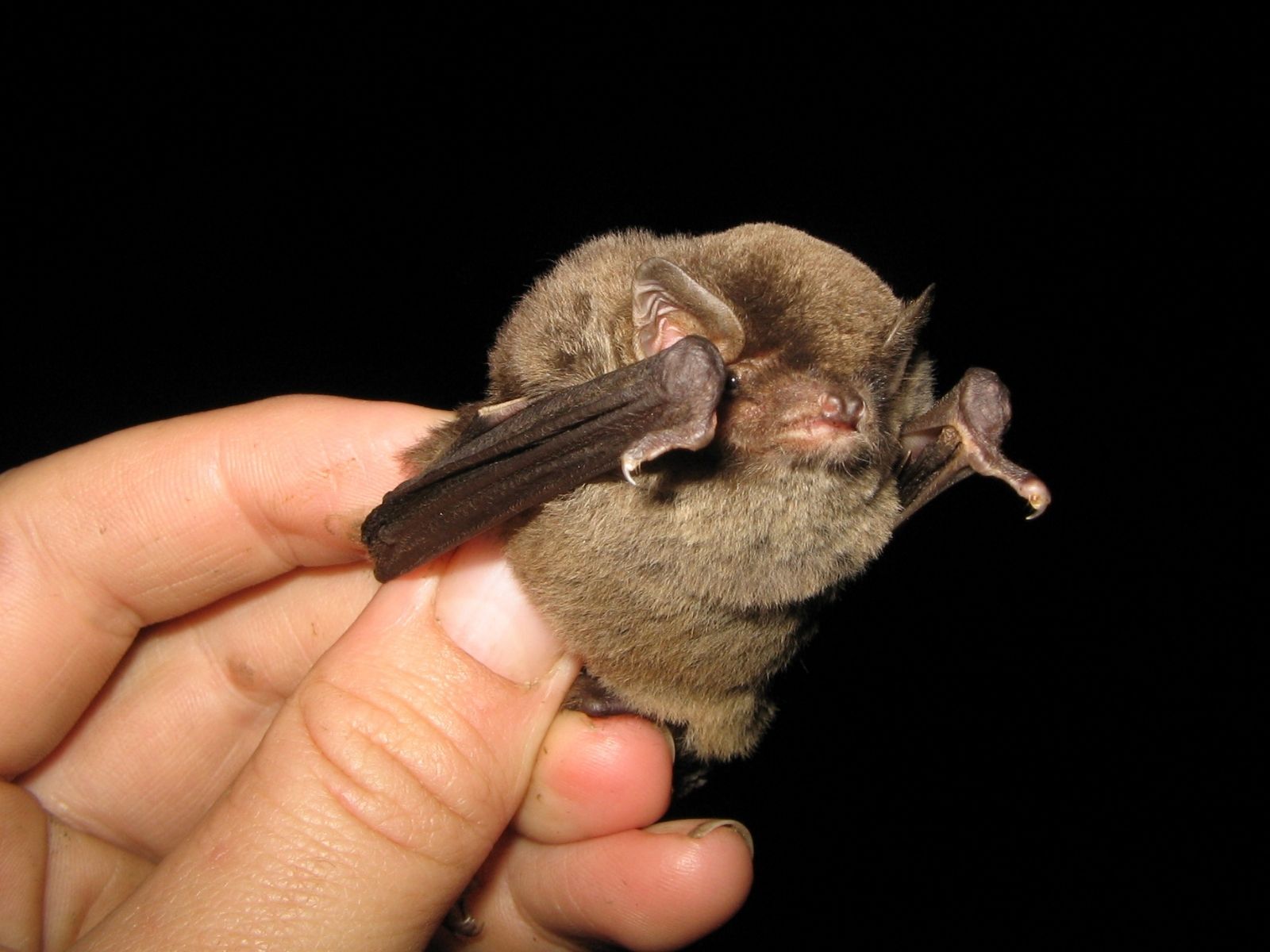
Greater Long-fingered bat
Miniopterus cf. inflatus

2025 Red list status
Near threatened

Regional Population Trend
Unknown

Change compared
to 2016
No Change
Overview
Miniopterus cf. inflatus – Monadjem, Shapiro, Richards, Karabulut, Crawley, Broman Nielsen,Hansen, Bohmann and Mourier, 2020
ANIMALIA – CHORDATA – MAMMALIA – CHIROPTERA – MINIOPTERIDAE – Miniopterus – inflatus
Common Names: Greater Long-fingered Bat (English), Groot Grotvlermuis (Afrikaans)
Synonyms: No Synonyms
Taxonomic Note:
South Africa
The currently recognized Miniopterus cf. inflatus may be a complex of morphologically similar species. Juste et al. (2007) recognise M. africanus from Kenya (also Eritrea and Tanzania (IUCN species 44859)) as distinct from M. cf. inflatus and Miniopterus from Zambia as a separate species. Molecular research may reveal M. cf. inflatus to be endemic or near endemic to the assessment region (A. Monadjem pers. comm. 2016). Molecular data suggest that this species’ closest relative in southern Africa is M. fraterculus (Miller-Butterworth et al. 2005).
Red List Status: NT – Near Threatened
Assessment Information
Assessors: Richardson, E.1 & da Silva, J.M.2
Reviewers: Richards, L.R.3
Institutions: 1Independent Consultant at Richardson & Peplow Environmental, 2South African National Biodiversity Institute, 3Durban Natural Science Museum
Previous Assessors and Reviewers: Richards, L.R., MacEwan, K., White, W., Cohen, L., Jacobs, D., Monadjem, A., Schoeman, C. & Taylor, P.
Previous Contributors: Roxburgh, L., Raimondo, D. & Child, M.F.
Assessment Rationale
This species occurs sparsely in eastern South Africa with an extent of occurrence of 64,799 km2. It is often sympatric at roost sites with other Miniopterus species yet occurs in low densities (typically only 5% the abundance of Miniopterus natalensis). It may thus be overlooked and occur more widely than thought.
As it occurs predominantly outside protected areas it may be experiencing declines due to loss of roost sites in caves and old mine tunnels, loss of foraging habitat due to conversion of natural areas for agriculture and urbanisation, deliberate closure of mines, and potentially mortalities from collisions with wind turbines. This species would qualify as Vulnerable C2a(i), but colonies may not be significantly fragmented as they have relatively high wing-loading and therefore assumed genetic continuity. As subpopulations typically comprise less than 50 individuals and this species is known from only five sites, there is an inferred minimum population size of 250 individuals. However, this could be an underestimate and field surveys are required to identify as yet undetected subpopulations. Total mature population size in the assessment region is unlikely to be more than 1,000 individuals and with only 5 known locations, the species also qualifies as Vulnerable D2. Additionally, since it is almost certainly a species complex and may thus be revealed to be a South African or southern African endemic, we do not know the true range of the species. As such, this species should be reassessed after further population data and taxonomic. Until the population is reassessed, we list this species as Near Threatened C2a(i) + D2.
Regional population effects: It has a relatively high wing-loading (Norberg and Rayner 1987) and thus dispersal is possible. However, it is sparsely distributed throughout its range and might be a regional endemic, so rescue effects are uncertain.
Red List Index
Red List Index: No change
Recommended citation: Richardson E & da Silva JM. 2025. A conservation assessment of Miniopterus cf. inflatus. In Patel T, Smith C, Roxburgh L, da Silva JM & Raimondo D, editors. The Red List of Mammals of South Africa, Eswatini and Lesotho. South African National Biodiversity Institute and Endangered Wildlife Trust, South Africa.
Regional Distribution and occurrence
Geographic Range
Owing to its similarity with Miniopterus natalensis this species may be overlooked in surveys, but only scattered records exist throughout its range. It is likely a species complex: Juste et al (2007) recognise the previous inflatus from East Africa as a separate species africanus, and a specimen from Zambia as a new species. Otherwise, it has been reported from Liberia and Guinea in West Africa; from Cameroon, Equatorial Guinea, Gabon, Central African Republic and the Democratic Republic of the Congo in Central Africa; and from Namibia, Zimbabwe and Mozambique in southern Africa (ACR 2015). It may have been overlooked in Angola (Monadjem et al. 2010).
Within the assessment region, there are clusters of records from the Eastern Cape, KwaZulu-Natal and Mpumalanga provinces (Monadjem et al. 2020). Its overall distribution is unclear due to confusion with M. natalensis. The current estimated extent of occurrence in the assessment region is 64,799 km2. Field surveys are needed to identify previously undetected localities and subpopulations.
Elevation / Depth / Depth Zones
Elevation Lower Limit (in metres above sea level): (Not specified)
Elevation Upper Limit (in metres above sea level): (Not specified)
Depth Lower Limit (in metres below sea level): (Not specified)
Depth Upper Limit (in metres below sea level): (Not specified)
Depth Zone: (Not specified)
Map
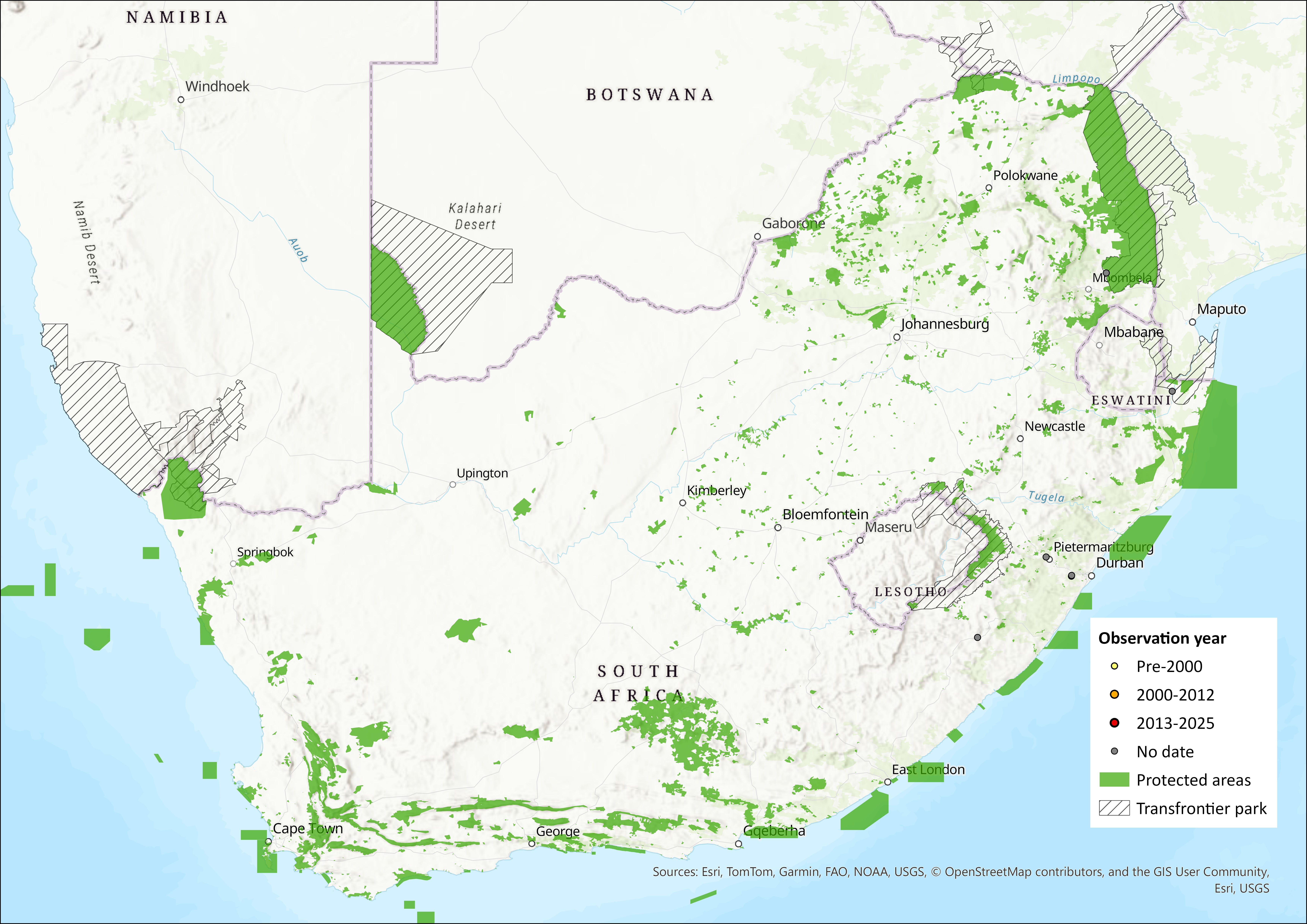 Figure 1. Distribution records for Greater Long-fingered Bat (Miniopterus cf. inflatus) within the assessment region (South Africa, Eswatini and Lesotho). Note that distribution data is obtained from multiple sources and records have not all been individually verified.
Biogeographic Realms
Biogeographic Realm: (Not specified)
Occurrence
Countries of Occurrence
|
Country |
Presence |
Origin |
Formerly Bred |
Seasonality |
|
Mozambique |
Extant |
Native |
– |
– |
|
Namibia |
Extant |
Native |
– |
– |
|
South Africa |
Extant |
Native |
– |
– |
|
Zimbabwe |
Extant |
Native |
– |
– |
Large Marine Ecosystems (LME) Occurrence
Large Marine Ecosystems: (Not specified)
FAO Area Occurrence
FAO Marine Areas: (Not specified)
Climate change
Pretorius et al. (2020) found that El Nino-induced drought conditions likely impacted resources and led to a reduction in activity and population size of Miniopterus natalensis. It is probable that this species is similarly vulnerable to this phenological mismatch and increasing droughts and stronger ENSO events will negatively affect the population size.
Population information
This is generally considered to be a locally rare species, although it can be common in some areas (Schlitter 2008). It is poorly represented in museums with only 24 specimens examined in Monadjem et al. (2010). Where it co-occurs with M. natalensis, it does so in very low numbers (Skinner and Chimimba 2005), possibly only 5% of the total as it occurs singly or in small groups of 4–6 individuals (W. White pers. obs. 2015). For example, in Namibia, Churchill et al. (1997) recorded a cluster of 50 individuals sharing a roost with c. 500 Rhinolophus fumigatus and over 200 Nycteris thebaica.
Current population trend:
Number of subpopulations: One
Continuing decline in mature individuals? (Not specified)
Extreme fluctuations in the number of subpopulations: (Not specified)
Continuing decline in number of subpopulations: (Not specified)
All individuals in one subpopulation: Assumed
Number of mature individuals in largest subpopulation: (Not specified)
Quantitative Analysis
Probability of extinction in the wild within 3 generations or 10 years, whichever is longer, maximum 100 years: (Not specified)
Probability of extinction in the wild within 5 generations or 20 years, whichever is longer, maximum 100 years: (Not specified)
Probability of extinction in the wild within 100 years: (Not specified)
Population genetics
No genetic study has been conducted on this species within the assessment region; however, it is assumed to form part of the genetic group linked to Mozambique (Monadjem et al. 2019). Within South Africa, it is currently known from five sites and hence one population is assumed within the assessment region. The genetic status of these individuals should be confirmed through a phylogenetic or population genomic study.
Habitats and ecology
It appears to be associated with moist savannah habitats (Monadjem et al. 2010). The availability of roosting sites (primarily caves) and food are probably more important habitat requirements than the type of vegetation (Skinner and Chimimba 2005). It may be a clutter-edge forager (Monadjem et al. 2010), but, since it has higher wing loading and aspect ratio than M. natalensis (Norberg and Rayner 1987, Jacobs 1999), this species probably spends most of its time in relatively open habitat. It congregates in small groups of up to 50 individuals (Churchill et al. 1997). All three Miniopterus species appear to use the same roosts in KwaZulu-Natal. While M. natalensis and M. fraterculus roost in large clumps of conspecifics, usually on the ceiling, M. cf. inflatus roosts individually or in small groups of 4–6 bats, frequently on the walls as well as the ceilings (W. White pers. obs. 2015). The Greater Long-fingered Bat is the largest of the three long-fingered bat species within the assessment region (Skinner and Chimimba 2005). There is no information on the diet of this species (Monadjem et al. 2010).
IUCN Habitats Classification Scheme
|
Habitat |
Season |
Suitability |
Major Importance? |
|
2.2. Savanna -> Savanna – Moist |
– |
Suitable |
– |
Life History
Generation Length: (Not specified)
Age at maturity: female or unspecified: (Not specified)
Age at Maturity: Male: (Not specified)
Size at Maturity (in cms): Female: (Not specified)
Size at Maturity (in cms): Male: (Not specified)
Longevity: (Not specified)
Average Reproductive Age: (Not specified)
Maximum Size (in cms): (Not specified)
Size at Birth (in cms): (Not specified)
Gestation Time: (Not specified)
Reproductive Periodicity: (Not specified)
Average Annual Fecundity or Litter Size: (Not specified)
Natural Mortality: (Not specified)
Does the species lay eggs? No
Does the species give birth to live young: Yes
Does the species exhibit parthenogenesis: No
Does the species have a free-living larval stage? No
Does the species require water for breeding? (Not specified)
Movement Patterns
Movement Patterns: (Not specified)
Congregatory: (Not specified)
Systems
System: Terrestrial
General Use and Trade Information
It is not known to be utilised or traded in any form.
Local Livelihood: (Not specified)
National Commercial Value: (Not specified)
International Commercial Value: (Not specified)
End Use: (Not specified)
Is there harvest from captive/cultivated sources of this species? (Not specified)
Harvest Trend Comments: (Not specified)
Threats
Extensive transformation of natural habitat, particularly in KwaZulu-Natal (Jewitt et al. 2015), is likely to be causing declines where the insect prey base is depleted as a result of loss of native vegetation or the use of pesticides. Its high wing loading and aspect ratio (Norberg and Rayner 1987) suggests that this bat is a fast flyer in relatively open spaces. Additionally, similar to its close relative M. natalensis, it is also likely to be migratory. These factors put this species at risk of being killed by wind farms both while foraging and commuting during migration.
Implementation of the Mine Closure Strategy of the South African Department of Mineral Resources and Energy (Government Notice 446, 21 May 2021) poses a serious threat to established colonies of this species in old mine tunnels, as does the reopening of old mines for development.
Conservation
This species occurs marginally in Kruger National Park (Mpumalanga Province). Regulations to limit disturbance of important roosting caves are important (Schlitter 2008). However, identifying key roosting sites is a prerequisite.
Research priorities:
- Molecular research to resolve the species complex is urgently needed.
Conservation priorities:
- Systematic monitoring to identify key roost sites and delimit geographical distribution more accurately.
- There is a need to identify and protect additional important roost sites (especially maternity caves) and to gain a better understanding of their migratory routes.
- The South Africa Department of Mineral Resources and Energy should engage with the South African Bat Assessment Association with regards to future closure of old mine tunnels in the country, so as to minimize the impact of this on cavity-roosting bat species.
- Closure of mines and caves should only be done using bat-compatible methods.
Encouraged citizen actions:
- Limit disturbance to roost sites.
- Deposit any dead specimens to the Durban Natural Science Museum or Ditsong Museum of Natural History
Bibliography
ACR. 2015. African Chiroptera Report 2015. Pretoria, South Africa.
Churchill, S., Draper, R. and Marais, E. 1997. Cave utilisation by Namibian bats: population, microclimate and roost selection. South African Journal of Wildlife Research 27: 44-50.
Driver, A., Sink, K.J., Nel, J.N., Holness, S., Van Niekerk, L., Daniels, F., Jonas, Z., Majiedt, P.A., Harris, L. and Maze, K. 2012. National Biodiversity Assessment 2011: An assessment of South Africa’s biodiversity and ecosystems. Synthesis Report. South African National Biodiversity Institute and Department of Environmental Affairs, Pretoria, South Africa.
Friedmann, Y. and Daly, B. 2004. Red Data Book of the Mammals of South Africa: A Conservation Assessment. Conservation Breeding Specialist Group (SSC/IUCN) and Endangered Wildlife Trust, Parkview, South Africa.
Jacobs DS. 1999. Intraspecific variation in wingspan and echolocation call flexibility might explain the use of different habitats by the insectivorous bat, Miniopterus schreibersii (Vespertilionidae: Miniopterinae). Acta Chiropterologica 1: 93–103.
Jewitt, D., Goodman, P.S., Erasmus, B.F.N., O’Connor, T.G. and Witkowski, E.T.F. 2015. Systematic land-cover change in KwaZulu-Natal, South Africa: Implications for biodiversity. South African Journal of Science 111: 1-9.
Juste, J., Ferrández, A., Fa, J. E., Masefield, W. and Ibáñez, C. 2007. Taxonomy of little bent-winged bats (Miniopterus, Miniopteridae) from the African islands of São Tomé, Grand Comoro and Madagascar, based on based on mtDNA. Acta Chiropterologica 9(1): 27-37.
Meester, J.A.J., Rautenbach, I.L., Dippenaar, N.J. and Baker, C.M. 1986. Classification of Southern African Mammals. Monograph number 5. Transvaal Museum, Pretoria, South Africa.
Miller-Butterworth CM, Eick G, Jacobs DS, Schoeman MC, Harley EH. 2005. Genetic and phenotypic differences between South African long-fingered bats, with a global Miniopterine phylogeny. Journal of Mammalogy 86: 1121–1135.
Monadjem, A., Taylor, P.J., Cotterill, F.P.D. and Schoeman M.C. 2010. Bats of Southern and Central Africa: a biogeographic and taxonomic synthesis. University of Witwatersrand Press, Johannesburg.
Norberg, U.M. and Rayner, J.M. 1987. Ecological morphology and flight in bats (Mammalia; Chiroptera): wing adaptations, flight performance, foraging strategy and echolocation. Philosophical Transactions of the Royal Society B: Biological Sciences 316: 335–427.
Pretorius, M., Broders, H., Seamark, E. and Keith, M. 2020. Climatic correlates of migrant Natal long-fingered bat (Miniopterus natalensis) phenology in north-eastern South Africa. Wildlife Research 47: 404-414.
Sanborn, C. C. 1936. Descriptions and records of African bats. Zoological Series of the Field Museum of Natural History 20(14): 107-114.
Schlitter, D. 2008. Miniopterus inflatus. The IUCN Red List of Threatened Species 2008: e.T13565A4170630.
Skinner, J.D. and Chimimba, C.T. (eds). 2005. The Mammals of the Southern African Subregion. Cambridge University Press, United Kingdom, Cambridge.