
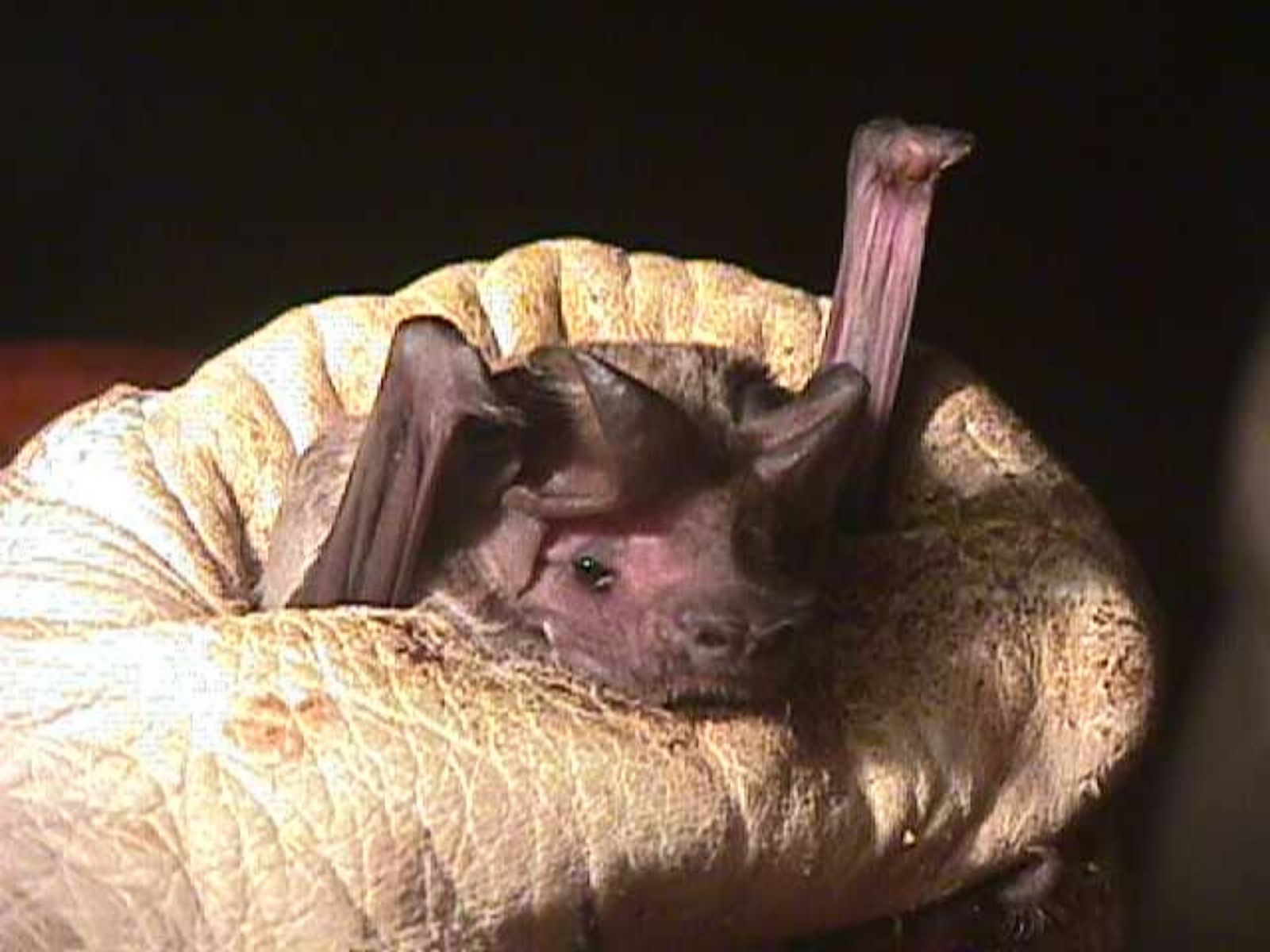
Giant Free-tailed Bat
Tadarida ventralis

2025 Red list status
Vulnerable

Regional Population Trend
Unknown

Change compared
to 2016
No Change
Overview
Tadarida ventralis – (Heuglin, 1861)
ANIMALIA – CHORDATA – MAMMALIA – CHIROPTERA – MOLOSSIDAE – Tadarida – ventralis
Common Names: Giant Free-tailed Bat, African Giant Free-tailed Bat, Giant African Free-tailed Bat, Giant Guano Bat, Giant African Guano Bat, Transvaal Free-tailed Bat (English), Transvaalse Losstertvlermuis (Afrikaans)
Synonyms: Nyctinomus (Dysopes) ventralis Dobson, 1876; Tadarida ventralis (Dobson, 1876) ssp. africana
Taxonomic Note:
South Africa
The Giant Free-tailed bat (Tadarida ventralis), originally described from Kérén, Eritrea, was reported in South Africa in 1876 as Nyctinomus africanus (Dobson, 1876), a name that is now seen as a junior synonym for T. ventralis (Heuglin, 1861). The locality of the type specimen for africanus in the Natural History Museum, London (BM 75.11.19.1), was listed imprecisely as “Transvaal”, hence the alternative common name of Transvaal Free-tailed Bat (Hayman & Hill 1971).
Red List Status: VU – Vulnerable, D2 (IUCN version 3.1)
Assessment Information
Assessors: Richards, L.R.1, & da Silva, J.M.2
Reviewer: Richardson, E.J.3
Institutions: 1Durban Natural Science Museum, 2South African National Biodiversity Institute, 3Independent Consultant at Richardson & Peplow Environmental
Previous Assessors and Reviewers: Taylor, P. & Richards, L.R., Bayliss, J., Cotterill, W. & Child, M.F.
Previous Contributors: Monadjem, A., Raimondo, D., Roxburgh, L. & Shoeman, C.
Assessment Rationale
Within the assessment region, this species is known from only two verified records in Limpopo Province. Its rediscovery in the western Soutpansberg Mountains in 2014 confirms its presence in the assessment region and adds a record to its sparse distribution in Zimbabwe, Mozambique and South Africa and northwards to Ethiopia. Its secluded roosts and high-flying habits means it is rarely collected by field surveys and suggests its distribution may be wider than currently known. Further studies are necessary to delimit distribution more accurately within the assessment region and this species should be reassessed once additional data are available. Although its roost sites are presumed to be granite precipices (unlikely to be transformed) and acoustic data suggest that the species is locally common, there is evidence to suggest continuing decline in habitat and habitat quality in the Soutpansberg; 20% of woodland cover was lost from 1990 to 2006 in the Soutpansberg Mountains region due to fuelwood extraction (Munyati and Kabanda, 2009). Thus, we infer a potential ongoing decline in population and, as it is severely range-restricted (known from only two locations) and recruitment from nearest subpopulation is unlikely (see below), we list as Vulnerable D2. Should future research reveal a connection between the continuing decline in relevant habitat or habitat quality variables and mature individuals/colonies, this species could qualify for Critically Endangered B1ab(ii,iii,iv,v)+B2ab(ii,iii,iv,v).
Regional population effects: Unknown. As it is an open-air forager, its dispersal capacity is assumed to be good. However, it has a disjunct distribution between the assessment region and the closest extra-regional subpopulation in Zimbabwe (Monadjem et al. 2020), and thus we assume no rescue effects are possible.
Reasons for Change
Reason(s) for Change in Red List Category from the Previous Assessment: No change
Red List Index
Red List Index: No change
Recommended citation: Richards LR & da Silva JM. 2025. A conservation assessment of Tadarida ventralis. In Patel T, Smith C, Roxburgh L, da Silva JM & Raimondo D, editors. The Red List of Mammals of South Africa, Eswatini and Lesotho. South African National Biodiversity Institute and Endangered Wildlife Trust, South Africa.
Regional Distribution and occurrence
Geographic Range
Tadarida ventralis is sparsely distributed in the northeast of southern Africa, known from four sites in Zimbabwe, two sites in central Mozambique, one site in southern Malawi, and one site in northeast Zambia (Monadjem et al. 2020). It is one of the most poorly collected bats in southern Africa with just six specimens (of nine southern African records) examined by Monadjem et al. (2020), although 37 specimens are known from Kenya (Cotterill 2001).
Within the assessment region, it was originally described from the Transvaal in 1876, but no exact locality was given, and no further specimens have been recorded in the former Transvaal since (Skinner and Chimimba 2005). Since 1876, despite extensive surveys in the former Transvaal Province (Rautenbach 1982), no further specimens of T. ventralis have been collected, leading to this species being regarded as a rare vagrant in South Africa (Monadjem et al. 2020). However, in January 2014 (138 years after its original discovery), following a massive rain storm, a male specimen of T. ventralis (DM 14680) was found dead on the ground outside the house of the manager of the Lajuma Research Centre located in the Luvhondo Private Nature Reserve in the western Soutpansberg (altitude 1,270 m). In 2018, a downed male specimen was collected from a farm along the R33, 30 km NW of Modimolle on the road to Vaalwater (DM15962). Both the 2014 and 2018 specimens were catalogued into the Durban Natural Science Museum Mammal Collection.
The species can be confused with other molossids (Taylor et al. 2015). For example, Cotterill (1996) identified two specimens from Zimbabwe while re-examining a collection of Tadarida fulminans. Thus, its distribution within the assessment region and the rest of southern Africa may be wider than reflected by the available data. Similarly, the call parameters of the species overlap with other medium- to large-sized molossids, rendering acoustic surveys of the species challenging (Linden et al. 2014; Parker and Bernard 2019). Further field surveys are needed to more accurately delimit its distribution within the assessment region. The species has an EOO of 48 km2 within the assessment region.
Elevation / Depth / Depth Zones
Elevation Lower Limit (in metres above sea level): (Not specified)
Elevation Upper Limit (in metres above sea level): (Not specified)
Depth Lower Limit (in metres below sea level): (Not specified)
Depth Upper Limit (in metres below sea level): (Not specified)
Depth Zone: (Not specified)
Map
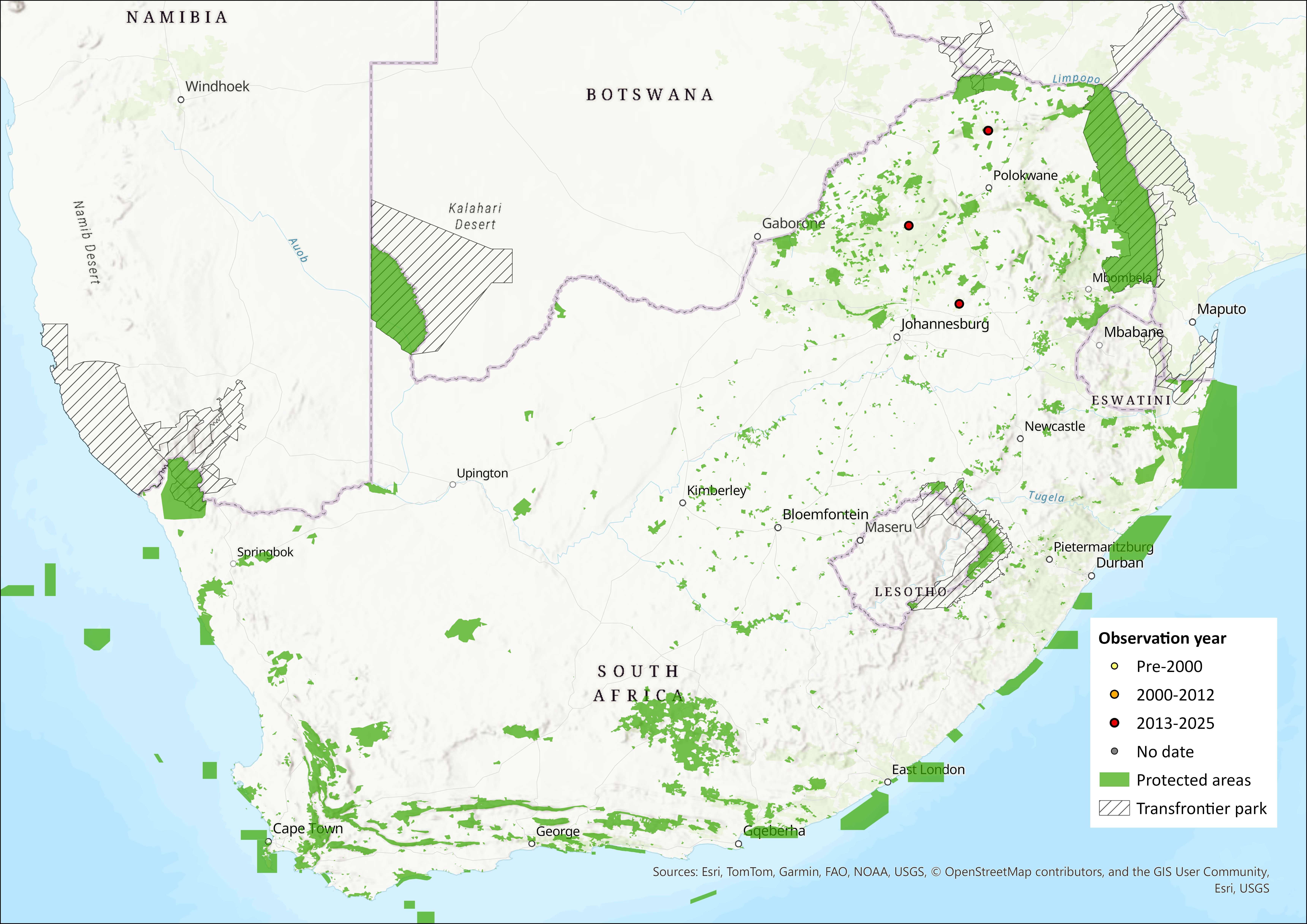 Figure 1. Distribution records for Giant Free-tailed Bat (Tadarida ventralis) within the assessment region (South Africa, Eswatini and Lesotho). Note that distribution data is obtained from multiple sources and records have not all been individually verified.
Biogeographic Realms
Biogeographic Realm: (Not specified)
Occurrence
Countries of Occurrence
| Country | Presence | Origin | Formerly Bred | Seasonality |
| Malawi | Extant | Native | ||
| Mozambique | Extant | Native | – | – |
| South Africa | Extant | Native | – | – |
| Zimbabwe | Extant | Native | – | – |
Large Marine Ecosystems (LME) Occurrence
Large Marine Ecosystems: (Not specified)
FAO Area Occurrence
FAO Marine Areas: (Not specified)
Climate change
Although the potential impacts of climate change on this species have not been directly assessed, climate change is expected to impact most golden mole species. Since these subterranean animals are restricted to soft soils for burrowing, and have very low vagility, their ability to migrate or shift their distribution ranges in response to climate change is very limited. Climate change is likely to impact golden moles through changes in vegetation type, soil moisture and prey availability.
Population information
While some African molossids, notably Mops condylurus, are locally abundant, others are rare and poorly known, such as Tadarida ventralis. Their inconspicuous roosts and high-flying habits make them challenging to locate and study (Monadjem et al. 2020). Most records are collected serendipitously, thus precluding any analysis of population size and trends. This situation is exemplified by the current assessment where, after an extensive acoustic and capture survey of bats in the Luvhondo Private Nature Reserve, no additional specimens were recorded (Linden et al. 2014). However, based on acoustic surveys and subsequent comparisons of echolocation frequencies, the species may well be locally common in the Soutpansberg Mountains (Taylor et al. 2015). Their choice of roosts in inaccessible cliff crevices and their high-flying behaviour makes conventional sampling through mist nets or harp traps difficult and may explain why they have not been recorded more often (Taylor et al. 2015).
Current population trend: Unknown
Continuing decline in mature individuals? Presumed
Number of subpopulations: One
Extreme fluctuations in the number of subpopulations: Unknown
Continuing decline in number of subpopulations: Unknown
All individuals in one subpopulation: Unknown
Number of mature individuals in largest subpopulation: Unknown
Quantitative Analysis
Probability of extinction in the wild within 3 generations or 10 years, whichever is longer, maximum 100 years: Unknown
Probability of extinction in the wild within 5 generations or 20 years, whichever is longer, maximum 100 years: Unknown
Probability of extinction in the wild within 100 years: Unknown
Population genetics
No population genetic study has been conducted on the species and data are insufficient to estimate the potential number of genetically distinct subpopulations (although there is at least one) and their size within the assessment region.
Habitats and ecology
The habitat of this species appears to be semi-arid savanna, associated with rocky hills and inselbergs (Cotterill 1996, 2001), but studies of actual roosting behaviour are a prerequisite for an accurate assessment of its habitat requirements. In Zimbabwe, a specimen has been collected from under a rock crevice about 20 m above ground level, a roost shared with T. fulminans and Chaerephon ansorgei (Monadjem et al. 2020). There is a single record of a specimen collected from the roof of a house, but this appears to be unusual behaviour in this species (Cotterill 1996). The distributions of large molossid bats (Tadarida fulminans, T. lobata, and T. ventralis) are closely associated with crevice roosts in granite precipices (Cotterill and Fergusson 1993, Cotterill 2001), and thus granite outcrops may be important habitat areas.
IUCN Habitats Classification Scheme
| Habitat | Season | Suitability | Major Importance? |
| 2.1. Savanna -> Savanna – Dry | – | Suitable | – |
| 6. Rocky areas (eg. inland cliffs, mountain peaks) | – | Suitable | – |
Life History
Generation Length: Unknown
Age at Maturity: Female or unspecified: Unknown, but likely 1 year old
Age at Maturity: Male: Unknown, but likely 1 year old
Size at Maturity (in cms): Female Not available
Size at Maturity (in cms): Male: Mean Forearm 6.52 cm (Taylor et al. 2015)
Longevity: Unknown
Average Reproductive Age: (Not specified)
Maximum Size (in cms): Forearm length = 6.55 cm, Mass = 55 0 g
Size at Birth (in cms): (Not specified)
Gestation Time: (Not specified)
Reproductive Periodicity: (Not specified)
Average Annual Fecundity or Litter Size: (Not specified)
Natural Mortality: (Not specified)
Does the species lay eggs? No
Does the species give birth to live young: Yes
Does the species exhibit parthenogenesis: No
Does the species have a free-living larval stage? No
Does the species require water for breeding? No
Movement Patterns
Movement Patterns: The roosting ecology of the species remain unknown and potential local migrations cannot be inferred.
Congregatory: Assumed to be congregatory.
Systems
System: Terrestrial
General Use and Trade Information
There is no evidence that this species is utilised in any way.
Local Livelihood: (Not specified)
National Commercial Value: (Not specified)
International Commercial Value: (Not specified)
End Use: (Not specified)
Is there harvest from captive/cultivated sources of this species? (Not specified)
Harvest Trend Comments: (Not specified)
Threats
The potential threats facing this species need further investigation and quantification. As they occupy inaccessible habitats in mountainous and rocky areas, we suspect there is no significant population decline. However, research into their resource and habitat requirements may disprove this. The lower altitude habitats of the Soutpansberg Mountains are most susceptible to human impacts leading to habitat degradation due to overgrazing, bush encroachment, cultivation and denudation of large trees for firewood collection (Linden et al. 2014). Such disturbances could have negative impacts on this species and should be monitored.
Conservation
The species is known to occur in the Luvhondo Private Nature Reserve and is thus at least partially protected. Further surveys are required to identify other areas in which it occurs to inform protected area expansion or biodiversity stewardship schemes. However, no direct interventions are possible currently until research has revealed basic data on its ecology and distribution.
Recommendations for land managers and practitioners: None
Research priorities:
- Capture and radio-tagging thus enabling the use of biotelemetric methods to locate daylight roosts.
- Field surveys to locate additional subpopulations.
- Habitat assessments of known roost sites to assess threat severity.
- Research into its foraging ecology to identify potential threats to key resources.
Encouraged citizen actions:
- Deposit any dead specimens with your local conservation agency or museum.
Bibliography
Cotterill, F.P.D. and Fergusson, R.A. 1993. Capturing free-tailed bats (Chiroptera: Molossidae): the description of a new trapping device. Journal of Zoology 231: 645–651.
Cotterill, F.P.D. 2001. Further notes on large Afrotropical free-tailed bats of the genus Tadarida (Molossidae: Mammalia). Arnoldia Zimbabwe 10: 199–210.
Cotterill, F.P.D. 1996. New distribution records of insectivorous bats of the families Nycteridae, Rhinolophidae and Vespertilionidae (Microchiroptera: Mammalia) in Zimbabwe. Arnoldia Zimbabwe 10(8): 71-89.
Gaona, F.P., Delabye, S., Potocky, P., Govorov, V., Cuda, J., Foxcroft, L.C., Garlacz, R., Hejda, M., MacFadyen, S,. Pyrcz, T, and Pyskova, K. 2024. Climate-driven vegetation characteristics shape phytophagous and carnivorous insect diversity in South African savannahs. bioRxiv. 2024:2024-07.
GeoTerraImage. 2015. Quantifying settlement and built-up land use change in South Africa. Pretoria.
Hayman, R.W. and Hill, J.E. 1971. Order Chiroptera. In: J. Meester and H.W. Setzer (eds), The Mammals of Africa: An Identification Manual, pp. 73. Smithsonian Institution Press, Washington, D.C., USA.
Heuglin, T. von. 1862. Beiträge zur Fauna der Säugethiere N. O. Afrikas mit Tafel. Nova Acta Academiae Caesarea Leopoldino-Carolinae Naturae Curiosorum, 29(8), 11.
Linden, V.M., Weier, S.M., Gaigher, I., Kuipers, H.J., Weterings, M.J. and Taylor, P.J. 2014. Changes of bat activity, species richness, diversity and community composition over an altitudinal gradient in the Soutpansberg range, South Africa. Acta Chiropterologica 16: 27–40.
Monadjem, A., Taylor, P.J., Cotterill, F.P.D. and Schoeman M.C. 2020. Bats of Southern and Central Africa: a biogeographic and taxonomic synthesis. 2nd Edition. University of Witwatersrand Press, Johannesburg.
Munyati, C. and Kabanda, T.A. 2009. Using multitemporal Landsat TM imagery to establish land use pressure induced trends in forest and woodland cover in sections of the Soutpansberg Mountains of Venda region, Limpopo Province, South Africa. Regional Environmental Change 9: 41–56.
Rautenbach, I. L. 1982. Mammals of the Transvaal. Ecoplan monograph, N.S. Supplemento 1: 111-211.
Skinner, J.D. and Chimimba, C.T. (eds). 2005. The Mammals of the Southern African Subregion. Cambridge University Press, United Kingdom, Cambridge.
Taylor, P.J., Richards, L.R., Bayliss, J. and Cotterill, F.P.D. 2015. Rediscovery of the Transvaal free-tailed bat (Tadarida ventralis africana) in South Africa, with an additional record of the Malagasy free-tailed bat (T. fulminans) from northern Mozambique. Durban Natural Science Museum Novitates 38: 50 – 55.