
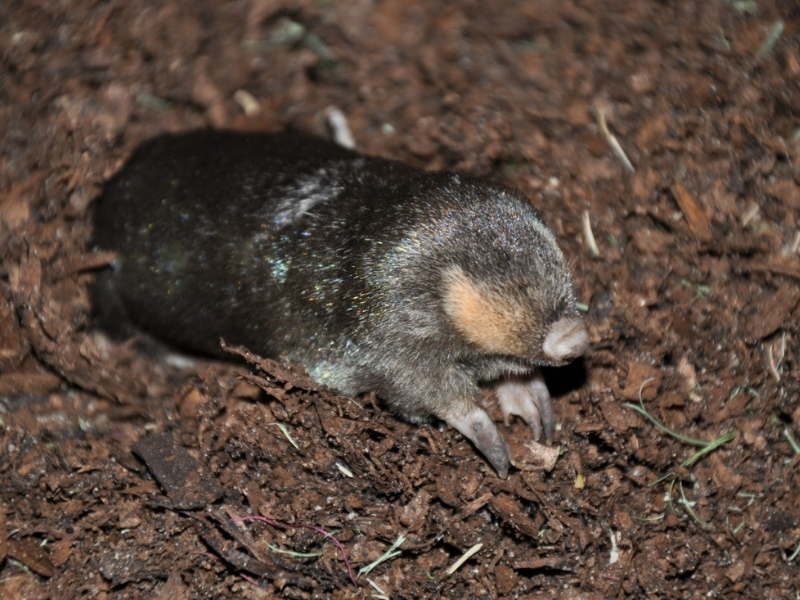
Fynbos Golden Mole
Amblysomus corriae

2025 Red list status
Near threatened

Regional Population Trend
Unknown

Change compared
to 2016
No Change
Overview
Amblysomus corriae – Thomas, 1905
ANIMALIA – CHORDATA – MAMMALIA – AFROSORICIDA – CHRYSOCHLORIDAE – Amblysomus – corriae
Common Names: Fynbos Golden Mole (English), Fynbos Gouemol (Afrikaans), Fynbos-Goldmull (German)
Synonyms: No Synonyms
Taxonomic Note:
Includes populations previously treated as a subspecies of Amblysomus iris (A. i. corriae), as well as a subspecies of A. hottentotus (A. h. devilliersi), see Meester et al. (1986: 23). Bronner (1996) showed that iris represents only a subspecies of A. hottentotus, and elevated corriae to species rank to include devilliersi. Includes two subspecies: A. c. corriae and A. c. devilliersi (Bronner 1995, 2013).
Red List Status: NT – Near Threatened B2b(iii), (IUCN version 3.1)
Assessment Information
Assessors: Mynhardt, S.1 & da Silva, J.2
Reviewer: Asher, R.3
Institutions: 1Endangered Wildlife Trust, 2South African National Biodiversity Institute, 3University of Cambridge
Previous Assessors: Mynhardt, S. & Bronner, G.
Previous Reviewer: Taylor, A.
Assessment Rationale
The Fynbos Golden Mole is an endemic species dependent on moist, soft soils in the Western and Eastern Cape. Although their extent of occurrence is over 20,000 km², they have only been confirmed at 16 locations, with an area of occupancy estimated at less than 500 km² (assuming a grid cell area of 16 km²). The population is not, however, considered severely fragmented, as it can survive successfully in anthropogenically altered habitats, such as residential gardens and agricultural areas. Although populations are expected to be declining in some locations, no significant overall population fluctuations are projected. Given this restricted range, as well as widespread habitat alteration, loss and degradation, we list A. corriae as Near Threatened B2b(iii).
Reasons for Change
Reason(s) for Change in Red List Category from the Previous Assessment: No change
Red List Index
Red List Index: No change
Recommended citation: Mynhardt S & da Silva JM. 2025. A conservation assessment of Amblysomus corriae. In Patel T, Smith C, Roxburgh L, da Silva JM & Raimondo D, editors. The Red List of Mammals of South Africa, Eswatini and Lesotho. South African National Biodiversity Institute and Endangered Wildlife Trust, South Africa.
Regional Distribution and occurrence
Geographic Range
This species is endemic to South Africa. It is found in the Western Cape Province, from Groot Winterhoek Wilderness Area (near Porterville) in the north, southeastwards along the southern Cape mountains to Hawequas Forest and Limietberg Mountains (near Worcester), and then westwards through Paarl and Stellenbosch to the coastal plain and slopes of the Langeberg mountains in the Riversdale district, then northeastwards along the coastal plain and slopes of the Outeniqua, Kouga and Baviaanskloof mountain ranges from the vicinity of George to Humansdorp (Eastern Cape). In the southern parts of the Western Cape it appears to be confined to higher-altitude, montane fynbos habitats. They coexist with the Cape Golden Mole (Chrysochloris asiatica) in Stellenbosch and Paarl, but are absent from the Cape Peninsula, where the Cape Golden Mole is common (Bronner 2013). Amblysomus c. corriae extends from George (Western Cape) eastwards to Humansdorp (Eastern Cape), while A. c. devilliersi is restricted to the Western Cape, with a range expanding from Worcester to Stellenbosch (Skinner and Chimimba 2005).
Number of locations: 16
Elevation / Depth / Depth Zones
Elevation Lower Limit (in metres above sea level): (Not specified)
Elevation Upper Limit (in metres above sea level): (Not specified)
Depth Lower Limit (in metres below sea level): (Not specified)
Depth Upper Limit (in metres below sea level): (Not specified)
Depth Zone: (Not specified)
MAP
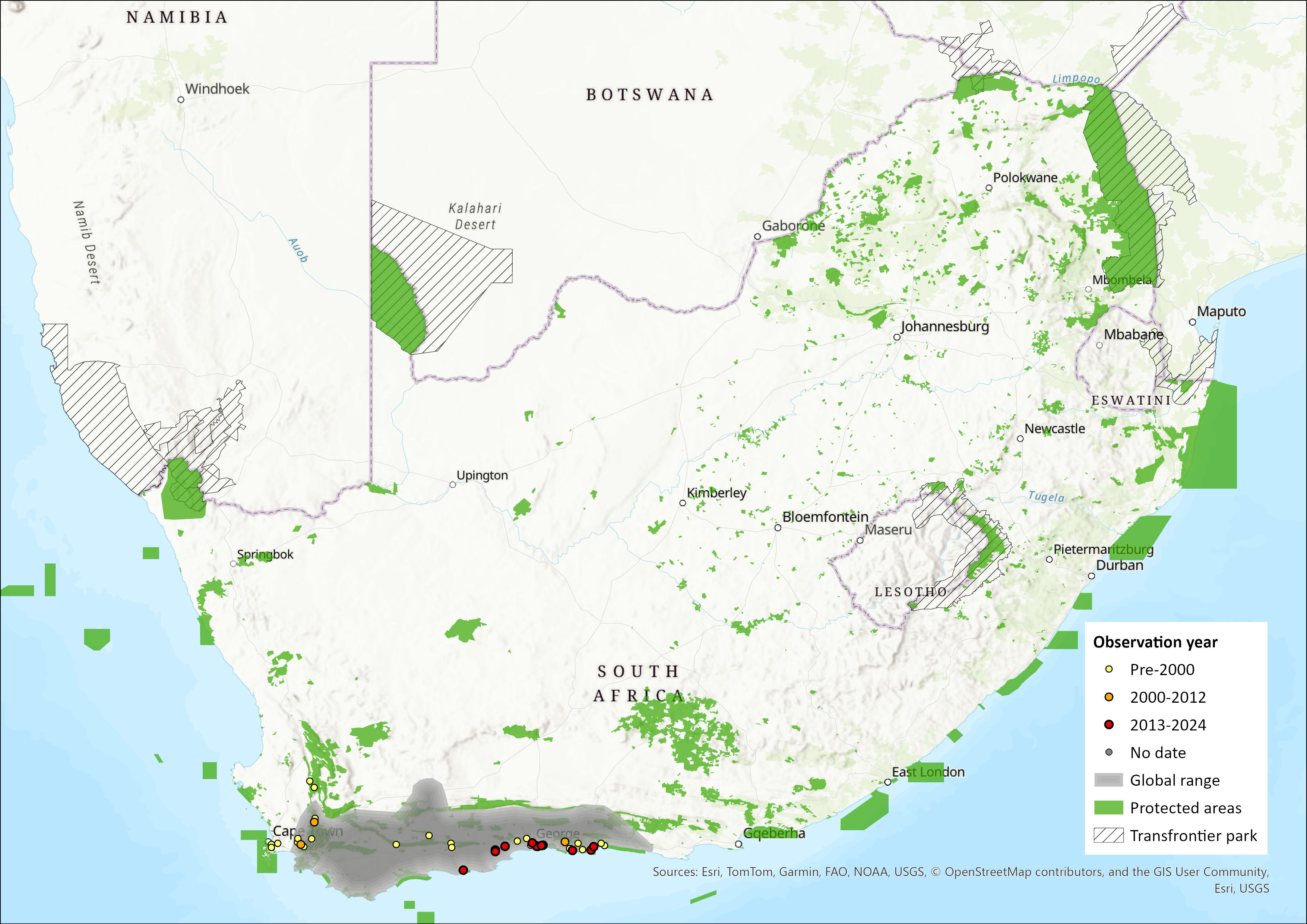 Figure 1. Distribution records for Fynbos Golden Mole (Amblysomus corriae) within the assessment region (South Africa, Eswatini and Lesotho). Note that distribution data is obtained from multiple sources and records have not all been individually verified.
Biogeographic Realms
Biogeographic Realm: Afrotropical
Occurrence
Countries of Occurrence
| Country | Presence | Origin | Formerly Bred | Seasonality |
| South Africa | Extant | Native | – | Resident |
| South Africa -> Eastern Cape Province | Extant | Native | – | Resident |
| South Africa -> Western Cape | Extant | Native | – | Resident |
Large Marine Ecosystems (LME) Occurrence
Large Marine Ecosystems: (Not specified)
FAO Area Occurrence
FAO Marine Areas: (Not specified)
Climate change
The change in potential species distribution of the Fynbos Golden Mole under predicted future climate change scenarios has been modelled. Species distribution models (SDMs), also known as Ecological Niche Models, were applied to explore potential impacts of climate change on the species distribution by utilising associations between environmental variables and known species occurrence records to identify climatic and environmental conditions within which populations may be maintained.
A list of potential environmental predictors were selected utilising knowledge of the species’ ecology, data availability, and recommendations from the IUCN guidelines. After filtering these, the final list of non-correlated variables considered for the Species Distribution Modelling were: BIOCLIM_03, BIOCLIM_06, BIOCLIM15, BIOCLIM_19, Soil Coarse Fragments, Soil Organic Carbon Content, Silt Content, Forest Vegetation, Montane Fynbos Vegetation, and Plain Fynbos Vegetation.
The predicted changes in distribution under three GCMs and two SSPs for the time period 2011-2040 were found to be relatively small, with an area change of between –8% and +0.6% and between 92% and 98% overlap between the existing and projected distributions. (Cowan 2025)
Population information
Common throughout its range but restricted to friable soils supporting a dense invertebrate fauna; less common in rocky mountainous habitats, where its occurrence is seemingly restricted to patches of friable soils.
Population Information
Current population trend: Unknown
Continuing decline in mature individuals? Unknown
Number of mature individuals in population: Unknown
Extreme fluctuations in the number of subpopulations: (Not specified)
Continuing decline in number of subpopulations: (Not specified)
All individuals in one subpopulation: No
Number of mature individuals in largest subpopulation: Unknown
Number of Subpopulations: Unknown
Severely fragmented: No, can exist in modified and agricultural landscapes.
Quantitative Analysis
Probability of extinction in the wild within 3 generations or 10 years, whichever is longer, maximum 100 years: (Not specified)
Probability of extinction in the wild within 5 generations or 20 years, whichever is longer, maximum 100 years: (Not specified)
Probability of extinction in the wild within 100 years: (Not specified)
Population genetics
While phylogenetic investigations have incorporated A. corriae (e.g., Mynhardt et al. 2015), no population genetic studies have been undertaken on this species. Assuming the subspecific designations have a molecular basis, it is believed they each comprise single subpopulations; however, this will need to be confirmed ideally using finescale nuclear markers.
While the species is considered common throughout its range, no estimates of population size exist and therefore it is not possible to provide estimates of effective population size.
Habitats and ecology
The Fynbos Golden Mole is limited to sandy soils and soft loams associated with fynbos, afromontane forest, moist savannah (southern Cape coast) and renosterveld habitats of the south-west Cape. Additionally, this species is frequently found in anthropogenically modified habitats, such as gardens, nurseries, golf courses, livestock enclosures and exotic plantations (Skinner and Chimimba 2005), although at lower densities in the latter (Bronner 2013). In the vicinity of Stellenbosch, it coexists with the Cape Golden Mole, Chrysochloris asiatica, but prefers wetter and richer soils in comparison (Broom 1907). Additionally, along the southern coast, they survive in sympatry with Duthie’s Golden Mole, Chlorotalpa duthieae, but seem to differ somewhat in their microhabitat preference. A. corriae favours the edge of the forest and adjoining fynbos, while C. duthieae prefers deeper areas of forest.
Amblysomus corriae feeds on invertebrates, predominantly earthworms and insects in the wild (Skinner and Chimimba 2005), but have been known to consume a range of food types while in captivity (G.N. Bronner unpubl. data). The subspecies, A. c. corriae and A. c. devilliersi are somewhat identifiable based on pelage colour; with grey-black and reddish-back/brown dorsal colourations respectively. Males are slightly larger in size compared to females; however, the cranial measurements between sexes do not differ significantly (Bronner 1995, 1996).
IUCN Habitats Classification Scheme
| Habitat | Season | Suitability | Major Importance? |
| 1.5. Forest -> Forest – Subtropical/Tropical Dry | – | Suitable | No |
| 1.6. Forest -> Forest – Subtropical/Tropical Moist Lowland | – | Suitable | Yes |
| 1.9. Forest -> Forest – Subtropical/Tropical Moist Montane | – | Suitable | Yes |
| 2.2. Savanna -> Savanna – Moist | – | Marginal | – |
| 3.4. Shrubland -> Shrubland – Temperate | – | Suitable | Yes |
| 3.8. Shrubland -> Shrubland – Mediterranean-type Shrubby Vegetation | – | Suitable | Yes |
| 4.4. Grassland -> Grassland – Temperate | – | Suitable | Yes |
| 4.5. Grassland -> Grassland – Subtropical/Tropical Dry | – | Suitable | No |
| 14.1. Artificial/Terrestrial -> Artificial/Terrestrial – Arable Land | – | Marginal | – |
| 14.2. Artificial/Terrestrial -> Artificial/Terrestrial – Pastureland | – | Suitable | No |
| 14.3. Artificial/Terrestrial -> Artificial/Terrestrial – Plantations | – | Marginal | – |
| 14.4. Artificial/Terrestrial -> Artificial/Terrestrial – Rural Gardens | – | Suitable | No |
| 14.5. Artificial/Terrestrial -> Artificial/Terrestrial – Urban Areas | – | Marginal | – |
| 16. Introduced vegetation | – | Marginal | – |
Life History
Generation Length: (Not specified)
Age at maturity: female or unspecified: (Not specified)
Age at Maturity: Male: (Not specified)
Size at Maturity (in cms): Female: 11-13
Size at Maturity (in cms): Male: 11-13
Longevity: (Not specified)
Average Reproductive Age: (Not specified)
Maximum Size (in cms): (Not specified)
Size at Birth (in cms): (Not specified)
Gestation Time: (Not specified)
Reproductive Periodicity: Aseasonally polyoestrus
Average Annual Fecundity or Litter Size: (Not specified)
Natural Mortality: (Not specified)
Breeding Strategy
Does the species lay eggs? No
Does the species give birth to live young? Yes
Does the species exhibit parthenogenesis? No
Does the species have a free-living larval stage? No
Does the species require water for breeding? No
Movement Patterns
Movement Patterns: (Not specified)
Congregatory: (Not specified)
Systems
System: Terrestrial
General Use and Trade Information
General notes regarding trade and use of this species: (Not specified)
Local Livelihood: (Not specified)
National Commercial Value: (Not specified)
International Commercial Value: (Not specified)
End Use: (Not specified)
Is there harvest from captive/cultivated sources of this species? (Not specified)
Harvest Trend Comments: (Not specified)
Threats
Widespread habitat alteration, degradation and loss has occurred historically throughout the range of this species, as a result of agriculture, forestry and urbanisation, but it appears to adapt well to transformed habitats providing that the intensity of disturbance is not too severe. Current threats are habitat alteration, degradation and loss in preferred habitat areas along the southeastern coast of Western Cape owing to tourism developments and increasingly intensive agricultural practices, and climate change, which could lead to a decline in suitable habitat at some locations, and the fragmentation of some subpopulations. More localised threats include poisoning and persecution by gardeners, greenkeepers, nurserymen and specialised (small-scale) agricultural concerns; and predation by domestic dogs and cats.
Continuing decline in habitat: Yes. Declining in area and quality. In the Western Cape Province, Pence (2014) calculated that between 2006 and 2011, 536 km2 of land was converted to agriculture (107 km2 / year, which equates to 0.08% of the surface area of the province / year). Similarly, urban areas have expanded by 8.6% between 2000 and 2013 (GeoTerraImage 2015). The impact of invasive alien plants on natural habitats in the Western Cape may also be worsening. Invasive alien plants displace native species, significantly altering not only habitat composition and structure, but fire and moisture regimes, to the detriment of indigenous flora and fauna. Van Wilgen et al. (2012) estimate that spread rates (~10% / year) are currently exceeding clearing rates.
Conservation
Although no specific conservation interventions are deemed necessary for this species, Fynbos Golden Moles are likely to benefit from the expansion of protected areas, as well as biodiversity stewardship schemes. A. c. corriae occurs in protected areas, including Garden Route National Park (incorporating the Wilderness National Park, Tsitsikamma National Park), Diepwalle Forest Reserve, Keurboomsrivier Nature Reserve, Kluitjieskraal Nature Reserve, Ruitersbos State Forest, Saasveld State Forest and the Bergplaas Nature Reserve. A. c. devilliersi recorded from the Jonkershoek Conservation Area (Stellenbosch), Grootwinterhoek Wilderness Area (Porterville), Limietberg Nature Reserve, Limietberg Nature Reserve and Hawequas State Forest (Worcester) and the Boosmansbos Wilderness Area (Swellendam), Grootvadersbosch Forest Reserve (Heidelberg) and Garcia State Forest (Riversdale). It probably occurs more widely in other conservation areas proclaimed for the preservation of fynbos.
Recommendations for land managers and practitioners:
- Reduce stocking rates and use correct fire regime.
Research priorities:
- Field studies to determine life history traits and ecological tolerances of this species.
- Studies on the population size, trends and distribution.
- The assessment of specific threats to this species and the associated severity.
Encouraged citizen actions:
- Report sightings on virtual museum platforms (for example, iNaturalist and MammalMAP), especially outside protected areas.
- Deposit any dead specimens found in a state or provincial museum, together with information on the date and site where found.
- Create indigenous vegetation gardens.
Bibliography
Afrotheria Specialist Group. 2014. Specialist Group website. Available at: http://www.afrotheria.net/index.php.
Bronner, G.N. 1995. Systematic revision of the golden mole genera Amblysomus, Chlorotalpa and Calcochloris (Insectivora: Chrysochloromorpha; Chrysochloridae). Ph.D. Thesis, University of Natal.
Bronner, G.N. 1996. Geographic patterns of morphometric variation in the Hottentot golden mole, Amblysomus hottentotus (Insectivora: Chrysochloridae): a multivariate analysis. Mammalia 60: 729–751.
Bronner, G.N. 2013. Amblysomus corriae. In: J. Kingdon, D. Happold, T. Butynski, M. Hoffmann, M. Happold and J. Kalina (eds), Mammals of Africa, Volume I: Introductory Chapters and Afrotheria, pp. 226-227. Bloomsbury , London.
Bronner, G.N. and Jenkins, P.D. 2005. Order Afrosoricida. In: D.E. Wilson and D.M. Reeder (eds), Mammal Species of the World, pp. 70-81. The Johns Hopkins University Press, Baltimore, MD, USA.
Broom, R. 1907. A contribution to the knowledge of the Cape golden moles. Transactions of the South African Philosophical Society 18: 283–311.
Cowan, O.S. 2025. Modelling the change in potential species distribution of Fynbos Golden Mole (Amblysomus corriae) under predicted future climate change scenarios. Technical Report, Endangered Wildlife Trust.
GeoTerraImage. 2015. Quantifying settlement and built-up land use change in South Africa. Pretoria.
IUCN. 2015. The IUCN Red List of Threatened Species. Version 2015.2. Available at: www.iucnredlist.org. (Accessed: 23 June 2015).
Meester, J.A.J., Rautenbach, I.L., Dippenaar, N.J. and Baker, C.M. 1986. Classification of Southern African Mammals. Monograph number 5. Transvaal Museum , Pretoria, South Africa.
Pence, G.Q.K. 2014. Western Cape Biodiversity Framework 2014 status update: Critical Biodiversity Areas of the Western Cape. CapeNature, Cape Town.
Rouget, M., Richardson, D.M., Cowling, R.M., Lloyd, J.W. and Lombard, A.T. 2003. Current patterns of habitat transformation and future threats to biodiversity in terrestrial ecosystems of the Cape Floristic Region, South Africa. Biological Conservation 112: 63-85.
Skinner, J.D. and Chimimba, C.T. (eds). 2005. The Mammals of the Southern African Subregion. Third edition. Cambridge University Press, United Kingdom, Cambridge.
Taylor WA, Mynhardt S, Maree S (2018). Family Chrysochloridae. In: Handbook of the Mammals of the World – Volume 8 Insectivores, Sloths and Colugos. DE Wilson & RA Mittermeier (eds). Lynx Edicions. ISBN-13: 978-84-16728-08-4.
van Wilgen, B.W., Forsyth, G.G., Le Maitre, D.C., Wannenburgh, A., Kotzé, J.D.F., van den Berg, E. and Henderson, L. 2012. An assessment of the effectiveness of a large, national-scale invasive alien plant control strategy in South Africa. Biological Conservation 148: 28-38.