
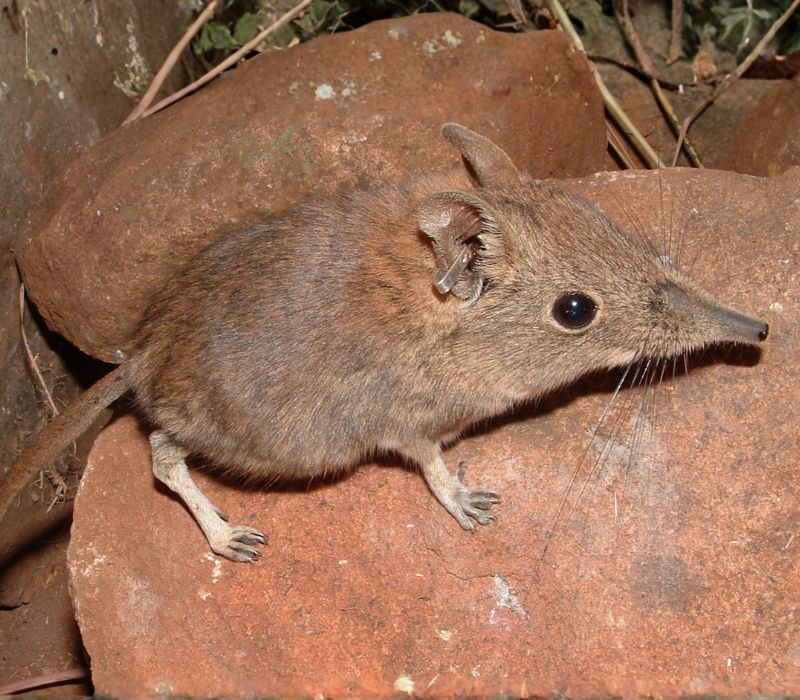
Eastern Rock Sengi
Elephantulus myurus

2025 Red list status
Least Concern

Regional Population Trend
Unknown

Change compared
to 2016
No Change
Overview
Elephantulus myurus – Thomas & Schwann, 1906
ANIMALIA – CHORDATA – MAMMALIA – MACROSCELIDEA – MACROSCELIDIDAE – Elephantulus – myurus
Common Names: Eastern Rock Sengi, Eastern Rock Elephant-shrew (English), Klip Klaasneus (Afrikaans)
Synonyms: No Synonyms
For general biological information on all sengi species, consult: Species accounts: Order Macroscelidea, in: Perrin, M. & Rathbun, G. B. 2013. Mammals of Africa, Volume I (Ed. by Kingdon, J., Happold, D., Hoffmann, M., Butynski, T., Happold, M. & Kalina, J.), pp. 261-278. London: Bloombury; Order Macroscelidea, in: Rathbun, G. B., (subeditor). 2005. The Mammals of the Southern African Subregion, 3rd edition (Ed. by Skinner, J. D. & Chimimba, C. T.), pp. 22-34. Cape Town, South Africa: Cambridge University Press; Species accounts, in: Rathbun, G. B. 2013. Mammals of Africa, Volume I (Ed. by Kingdon, J., Happold, D., Hoffmann, M., Butynski, T., Happold, M. & Kalina, J.), pp. 279-287. London: Bloomsbury. Order MACROSCELIDEA, in: Heritage, S. 2018. Handbook of the Mammals of the World, Volume 8. Insectivores, Sloths and Colugos (D.E. Wilson and R.A. Mittermeier, eds), Lynx Edicions, Barcelona, Spain. For current and more technical information, search the on-line bibliography at www.sengis.org.
Taxonomic Note:
In the past, the single family was included in the order Insectivora, but now the family is in the monophyletic order Macroscelidea and the superorder Afrotheria. Currently, there are 20 living species recognised in six genera. The soft-furred sengis or elephant-shrews include five genera: Petrodromus and Petrosaltator are monospecific, Macroscelides has three species, Galegeeska has two species and Elephantulus contains 8 species. The five species of giant sengis belong to the genus Rhynchocyon. The common name “sengi” is being used in place of elephant-shrew by many biologists to try and disassociate the Macroscelidea from the true shrews (family Soricidae) in the order Eulipotyphla.
See the IUCN SSC Afrotheria Specialist Group web site and www.sengis.org for additional information.
| Red List Status |
| LC – Least Concern, (IUCN version 3.1) |
Assessment Information
Assessor: Roxburgh, L.1
Reviewer: Schradin, C.2
Contributor: da Silva, J. M.3
Institutions: 1Endangered Wildlife Trust, 2Institut pluridisciplinaire Hubert Curien, 3South African National Biodiversity Institute
Previous Assessors: Rathbun, G.B. & Smit-Robinson, H.
Previous Reviewers: Taylor, A.
Previous Contributors: Page-Nicholson, S. & Child, M.F.
Assessment Rationale
This species occupies habitats that are dominated by large rocks and boulders that are not particularly suitable for any intense human activities with the possible exception of grazing, especially by goats. There is no indication that this species or the habitats it uses face any major threats, though there has been no documented range contraction in the assessment region. Therefore, the species remains Least Concern.
Regional population effects: Continuous distribution with rest of African range.
Reasons for Change
Reason(s) for Change in Red List Category from the Previous Assessment: No change
Red List Index
Red List Index: No change
Recommended citation: Roxburgh L. 2025. A conservation assessment of Elephantulus myurus. In Patel T, Smith C, Roxburgh L, da Silva JM & Raimondo D, editors. The Red List of Mammals of South Africa, Eswatini and Lesotho. South African National Biodiversity Institute and Endangered Wildlife Trust, South Africa.
Regional Distribution and occurrence
Geographic Range
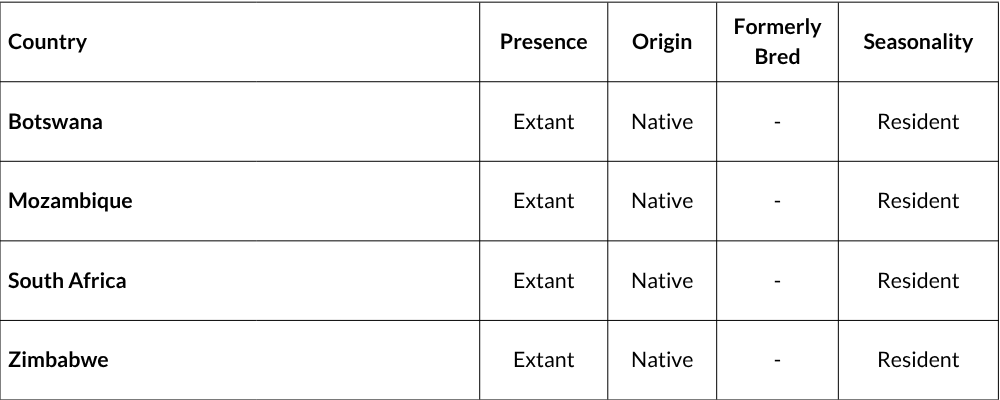
Recorded from the eastern areas of South Africa north into Zimbabwe and eastern Botswana and western Mozambique (Corbet & Hanks 1968; Skinner & Chimimba 2005). Within the assessment region, it occurs across the central to northern parts of the country in all provinces except the Western Cape. The Eastern Rock Sengi is absent from Lesotho and Eswatini. In South Africa, it is widely distributed in Limpopo, Gauteng, Free State and Mpumalanga (Skinner & Chimimba 2005). In the Free State Province, it was regularly seen in rocky outcrops in Tussen-die-Riviere Nature Reserve (Watson 2006). In the North West Province, it was captured in rocky habitats in the eastern parts of the province, and was abundant in the Magaliesberg (Power 2014). This species also occurs in the eastern regions of the Northern Cape and in areas of the Eastern Cape (Skinner & Chimimba 2005). It is also present in the mountainous areas of north-western KwaZulu-Natal. The species was also more recently sampled in Tswalu Kalahari Reserve (Webster 2017, D. MacFadyen, pers. comm.), which is a significant westward extension of its range. This is thought to be an isolated population, based on genetic analyses (Webster, 2017), but further sampling would be needed to confirm this.
Elevation / Depth / Depth Zones
Elevation Lower Limit (in metres above sea level): (Not specified)
Elevation Upper Limit (in metres above sea level): (Not specified)
Depth Lower Limit (in metres below sea level): (Not specified)
Depth Upper Limit (in metres below sea level): (Not specified)
Depth Zone: (Not specified)
Biogeographic Realms
Biogeographic Realm: Afrotropical
Map
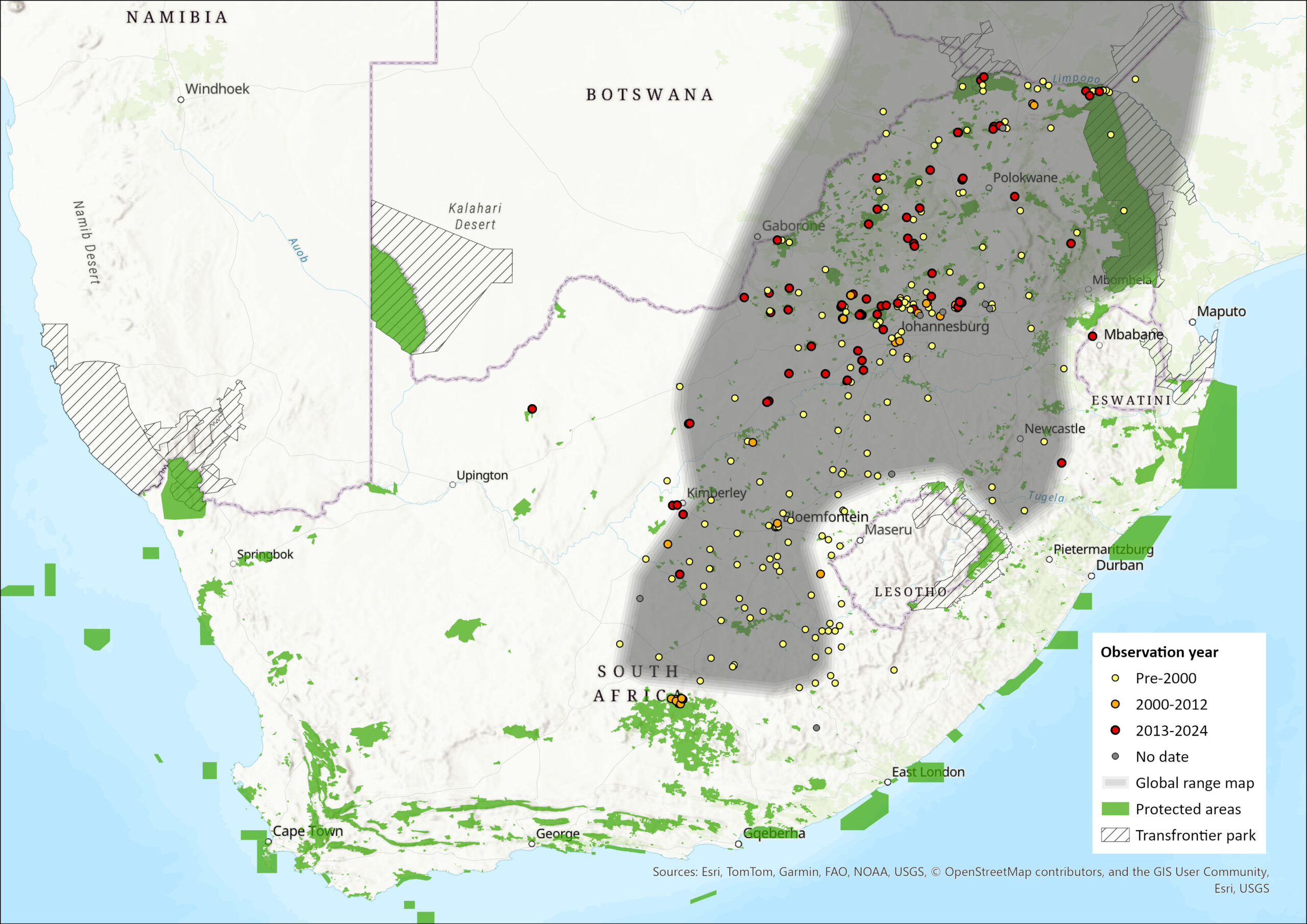
Figure 1. Distribution records for Eastern Rock Sengi (Elephantulus myurus) within the assessment region (South Africa, Eswatini and Lesotho). Note that distribution data is obtained from multiple sources and records have not all been individually verified.
Countries of Occurrence
Large Marine Ecosystems (LME) Occurrence
Large Marine Ecosystems: (Not specified)
FAO Area Occurrence
FAO Marine Areas: (Not specified
Climate change
This is a relatively widespread species across the grassland and savanna biomes and parts of the Nama Karoo. Its use of rocky outcrops and crevices for shelter and its habit of keeping in the shade might help to minimize some of the effects of climate extremes. However, bird species from hot arid environments have been found to be more vulnerable to heat waves than species from milder climates, maybe because they are already living close to their maximum heat tolerance (Levillain 2025). Whether in the case of sengis their adaptation to hot environments makes them more resilient against further heat waves, or whether they are already living in a habitat close to their heat tolerance, is so far unknown. Its preference for bush and tree cover suggests that it will benefit from bush encroachment due to climate change. Daily torpor and passive heating via basking allows it to save energy (Mzilikazi & Lovegrove 2005), but whether this will confer any benefits in the face of increased temperatures is not known.
Population information
This species is locally common throughout its range in the assessment region and can be the most abundant of all Elephantulus species in South Africa. The population fluctuates naturally, due to climatic factors (rainfall). While Ribble and Perrin (2005) report 2.5 individuals/ ha, Hoffmann et al. (2020) report only about 0.3 individuals/ha. It is usually pair-living and pairs occupy large exclusive home ranges, though solitary individuals are also common (Ribble and Perrin, 2005). Mate guarding is common in this species (Ribble and Perrin 2005). Home range sizes were estimated to be 0.675 + 0.07ha for males and 0.498 + 0.06ha for females in the Goro Nature Reserve in Limpopo (Hoffmann et al 2020) and 0.398 + 0.0625 for males and 0.2011 + 0.013 ha for females, with some overlap between male territories, in a study in Weenen Nature Reserve, KwaZulu-Natal Province.
Population Information
Continuing decline in mature individuals? No
Extreme fluctuations in the number of subpopulations: (Not specified)
Continuing decline in number of subpopulations: (Not specified)
All individuals in one subpopulation: (Not specified)
Number of mature individuals in largest subpopulation: (Not specified)
Number of Subpopulations: (Not specified)
Quantitative Analysis
Probability of extinction in the wild within 3 generations or 10 years, whichever is longer, maximum 100 years: (Not specified)
Probability of extinction in the wild within 5 generations or 20 years, whichever is longer, maximum 100 years: (Not specified)
Probability of extinction in the wild within 100 years: (Not specified)
Population genetics
Webster (2017) conducted a population genetic study on this species incorporating both mtDNA and microsatellite data. A structure analysis identified three geographically meaningful genetic clusters: a northern group (Goro & Lephalale), a western group (Tswalu) and a south-central group (Ezemvelo, Tussen-die-Riviere nature reserves & Potfontein). Due to insufficient information on area of occurrence, it is not possible to quantify population size and subsequently approximate effective population size (Ne) for each genetic subpopulation.
Habitats and ecology
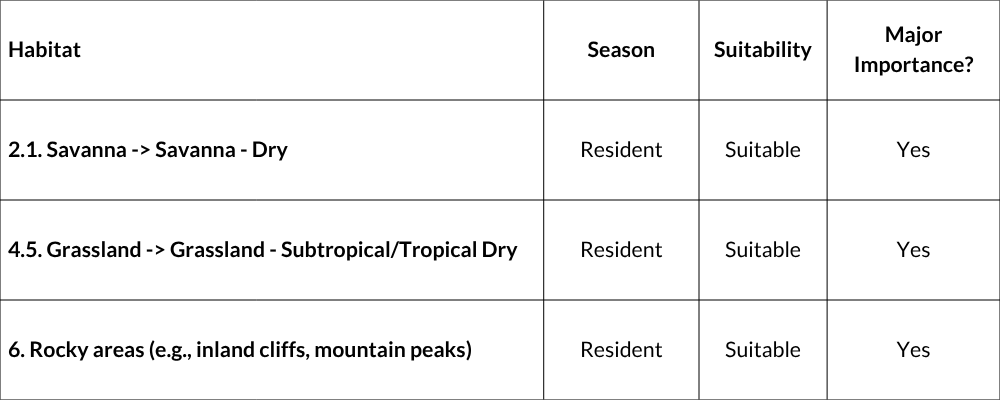
As its name suggests, this species prefers habitat with rocky outcrops or koppies (hills) that provide sufficient cracks and holes for shelter and nesting sites (Corbet & Hanks 1968; Rathbun 2005). For example, at Rolfontein Nature Reserve, Northern Cape Province, only one of 34 specimens was caught in an open vegetation community, and this was also on a trap-line that passed near a small pile of rocks (Jooste & Palmer 1982). The species prefers parts of rocky habitats with over-hanging ledges or vegetation that provides cover from aerial predators (Skinner & Chimimba 2005). Key vegetation types for this species include the Nama Karoo, Grassland and Savanna Biomes.
Ecosystem and cultural services: Sengi species are thought to be included in San art and are therefore subject to local folklore.
IUCN Habitats Classification Scheme
Life History
Generation Length: (Not specified)
Age at maturity: female or unspecified: 6 weeks
Age at Maturity: Male: (Not specified)
Size at Maturity (in cms): 26.3 (males and females)
Longevity: (Not specified)
Average Reproductive Age: (Not specified)
Maximum Size (in cms): (Not specified)
Size at Birth (in cms): (Not specified)
Gestation Time: 8 weeks
Reproductive Periodicity: (Not specified)
Average Annual Fecundity or Litter Size: (Not specified)
Natural Mortality: (Not specified)
Breeding Strategy
Does the species lay eggs? No
Does the species give birth to live young? Yes
Does the species exhibit parthenogenesis? No
Does the species have a free-living larval stage? No
Does the species require water for breeding? No
Movement Patterns
Movement Patterns: (Not specified)
Congregatory: (Not specified)
Systems
System: Terrestrial
General Use and Trade Information
There is no evidence that this species is used for local or international trade.
Local Livelihood: (Not specified)
National Commercial Value: (Not specified)
International Commercial Value: (Not specified)
End Use: (Not specified)
Is there harvest from captive/cultivated sources of this species? (Not specified)
Harvest Trend Comments: (Not specified)
Threats
There are no major threats to the species. However, overgrazing from livestock and wildlife ranching may cause local declines through the loss of ground cover. Mining activities, especially coal mining, can contribute to habitat loss. The species occurs in the Grassland Biome, South Africa’s least protected and most exploited biome through mineral extraction, agricultural crop farming and urban expansion.
Conservation
This species occurs in many protected areas across its range. Although no specific interventions are necessary at present, we suspect that destocking on agricultural and ranchlands would benefit the species. Key protected areas for the species include Mapungubwe National Park, Kruger National Park and Golden Gate National Park.
Recommendations for land managers and practitioners:
- Expansion of the protected area network.
- Land managers should stock cattle or game at ecological levels.
Research priorities:
- Determine density estimates and range sizes across the species’ distribution in South Africa.
Encouraged citizen actions:
- Citizens are encouraged to report sightings on virtual museum platforms (for example, iNaturalist and MammalMAP) with photographic confirmation.
Bibliography
Corbet, G.B. and Hanks, J. 1968. A revision of the elephant-shrews, family Macroscelididae. Bulletin of the British Museum of Natural History (Zoology) 16: 1-111.
Heritage, S. 2018. Order MACROSCELIDEA. In Handbook of the Mammals of the World, Volume 8. Insectivores, Sloths and Colugos (D.E. Wilson and R.A. Mittermeier, eds), Lynx Edicions, Barcelona, Spain.
Hoffmann, S., N. C. Bennett, B. Jansen van Vuuren & H. Lutermann. 2020. Space use and the evolution of social monogamy in eastern rock sengis. Ethology, 126, 393.
Jooste JF, Palmer NG. 1982. The distribution and habitat preference of some small mammals in the Rolfontein Nature Reserve. South African Journal of Wildlife Research 12: 26-35.
Levillain, A. 2025. Influence of high temperatures on avian species: from physiological responses to ecological consequences. PhD thesis, University of Strasbourg, France.
Mzilikazi, N. & B. G. Lovegrove .2005. Daily torpor during the active phase in free-ranging rock elephant shrews (Elephantulus myurus). Journal of Zoology, 267, 103.
Power, R.J. 2014. The distribution and status of mammals in the North West Province. Department of Economic Development, Environment, Conservation & Tourism, North West Provincial Government, Mahikeng.
Rathbun, G.B. (subeditor). 2005. Macroscelidea. In: J.D. Skinner and C.T. Chimimba (eds), The Mammals of the Southern African Subregion, 3rd edition, pp. 22-34. Cambridge University Press, Cambridge, UK.
Ribble, D. & Perrin, M. 2005. Social organization of the Eastern Rock Elephant-shrew (Elephantulus myurus): The evidence for mate guarding. Belgian Journal of Zoology. 135(Suppl.): 167-173.
Skinner, J.D. and Chimimba, C.T. (eds). 2005. The Mammals of the Southern African Subregion. Cambridge University Press, United Kingdom, Cambridge.
Watson JP. 2006. Check list of the mammals of Tussen-die-Riviere Provincial Nature Reserve, Free State Province, South Africa. Koedoe 49: 111-117.
Webster, H.J. 2017. Phylogeography of the eastern rock elephant shrew, Elephantulus myurus. University of Johannesburg.