
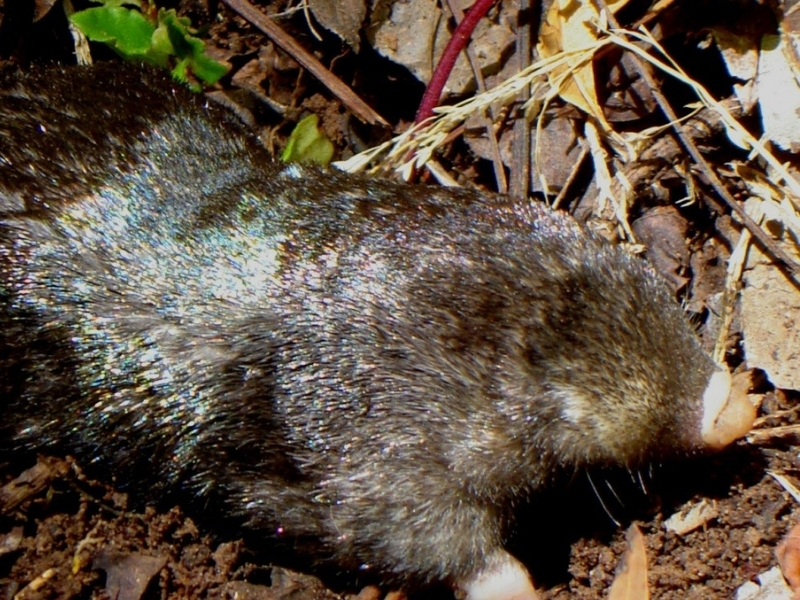
Duthie’s Golden Mole
Chlorotalpa duthieae

2025 Red list status
Vulnerable

Regional Population Trend
Unknown

Change compared
to 2016
No Change
Overview
Chlorotalpa duthieae – (Broom, 1907)
ANIMALIA – CHORDATA – MAMMALIA – AFROSORICIDA – CHRYSOCHLORIDAE – Chlorotalpa – duthieae
Common Names: Duthie’s Golden Mole (English), Duthie se Gouemol, Duthie se Kruipmol (Afrikaans), Duthie-Goldmull (German)
Synonyms: Chrysochloris duthieae Broom, 1907
Taxonomic Note:
Included in Amblysomus by Ellerman et al. (1953) and by Petter (1981). Meester (1974) and Meester et al. (1986) included leucorhina (here referred to Huetia) and arendsi (here treated as Carpitalpa) in this genus. Revised by Bronner (1995).
Some authors (Ellerman et al. 1953, Simonetta 1968) treated this taxon as only a subspecies of C. sclateri, but consistent differences in fur colour and chromosomal properties, and their preference for quite dissimilar ecotypes, indicate that they are distinct species (Bronner 1995). A recent phylogenetic analysis supports distinction between these species based on subtle morphological differences (the position of foramen ovale relative to the sphenorbital fissure) and nuclear GHR gene sequences (Asher et al. 2010). Geographic variation is not sufficiently marked to warrant recognition of subspecies (Bronner and Jenkins 2005, Bronner 2013).
Red List Status: VU – Vulnerable, B1ab(iii)+2ab(iii) (IUCN version 3.1)
Assessment Information
Assessors: Patel, T.1 & da Silva, J.2
Reviewer: Mynhardt, S.1
Institutions: 1Endangered Wildlife Trust, 2South African National Biodiversity Institute
Previous Assessor: Bronner, G.
Previous Reviewers: Bennett, N.C. & Taylor, A.
Assessment Rationale
The species is known from only nine locations in southern Cape Afrotemperate Forests, clustered in two subpopulations: an eastern subpopulation in the suburban parts of Port Elizabeth (three locations); and a western subpopulation in the indigenous coastal forest belt from Wilderness to Tsitsikamma (six locations). Gene flow between these two subpopulations seems unlikely owing to intervening drier strandveld habitats. Although the observed area of occupancy (AOO) is 96 km2 (using the IUCN 2 x 2 km method), satisfying one of the criteria for Endangered status, the estimated extent of occurrence (EOO) is 10,821 km2. Given that this species tolerates mild habitat alteration, is common in suburban gardens and pasturelands adjoining natural forests and is likely to occur more widely than current records indicate, extent of occurrence is the preferred range proxy.
This taxon is not deemed severely fragmented as the (presumably isolated) eastern subpopulation occupies less than 50% of the observed or inferred AOO. About 60% of the forests in which the western subpopulation occurs are conserved within nature reserves (notably ca 40,000 ha controlled by the South African National Parks agency) and areas managed for sustainable exploitation (Envirotek 2003), and are thus buffered from habitat alteration, which is inferred to be the main threat to this species. However, the extent and quality of their preferred forest habitats at some locations outside protected areas, are clearly being impacted by housing and tourism developments that are expanding along the entire coastline of this subpopulation. None of the eastern subpopulation locations are currently formally protected, and both the number of locations and the quality and extent of habitat are likely to decline as the city of Port Elizabeth (i.e. Nelson Mandela Bay Metro) continues to expand rapidly. Given the EOO and AOO of this species, occurrence in only two subpopulations, and the threats that could lead to habitat alteration in both, Vulnerable status is confirmed under criteria B1ab(iii) and B2ab(iii).
Reasons for Change
Reason(s) for Change in Red List Category from the Previous Assessment: No change
Red List Index
Red List Index: No change
Recommended citation: Patel T & da Silva JM. 2025. A conservation assessment of Chlorotalpa duthieae. In Patel T, Smith C, Roxburgh L, da Silva JM & Raimondo D, editors. The Red List of Mammals of South Africa, Eswatini and Lesotho. South African National Biodiversity Institute and Endangered Wildlife Trust, South Africa.
Regional Distribution and occurrence
Geographic Range
This species is endemic to South Africa. It occurs in a narrow coastal band 275 km long from Wilderness through Kynsna, Nature’s Valley and Plettenberg Bay (Western Cape), northwards through the Tsitsikamma forests perhaps as far of the Storm River mouth, and to the Walmer and Baakens Vlei districts of Port Elizabeth (Eastern Cape).
Elevation / Depth / Depth Zones
Elevation Lower Limit (in metres above sea level): (Not specified)
Elevation Upper Limit (in metres above sea level): (Not specified)
Depth Lower Limit (in metres below sea level): (Not specified)
Depth Upper Limit (in metres below sea level): (Not specified)
Depth Zone: (Not specified)
MAP
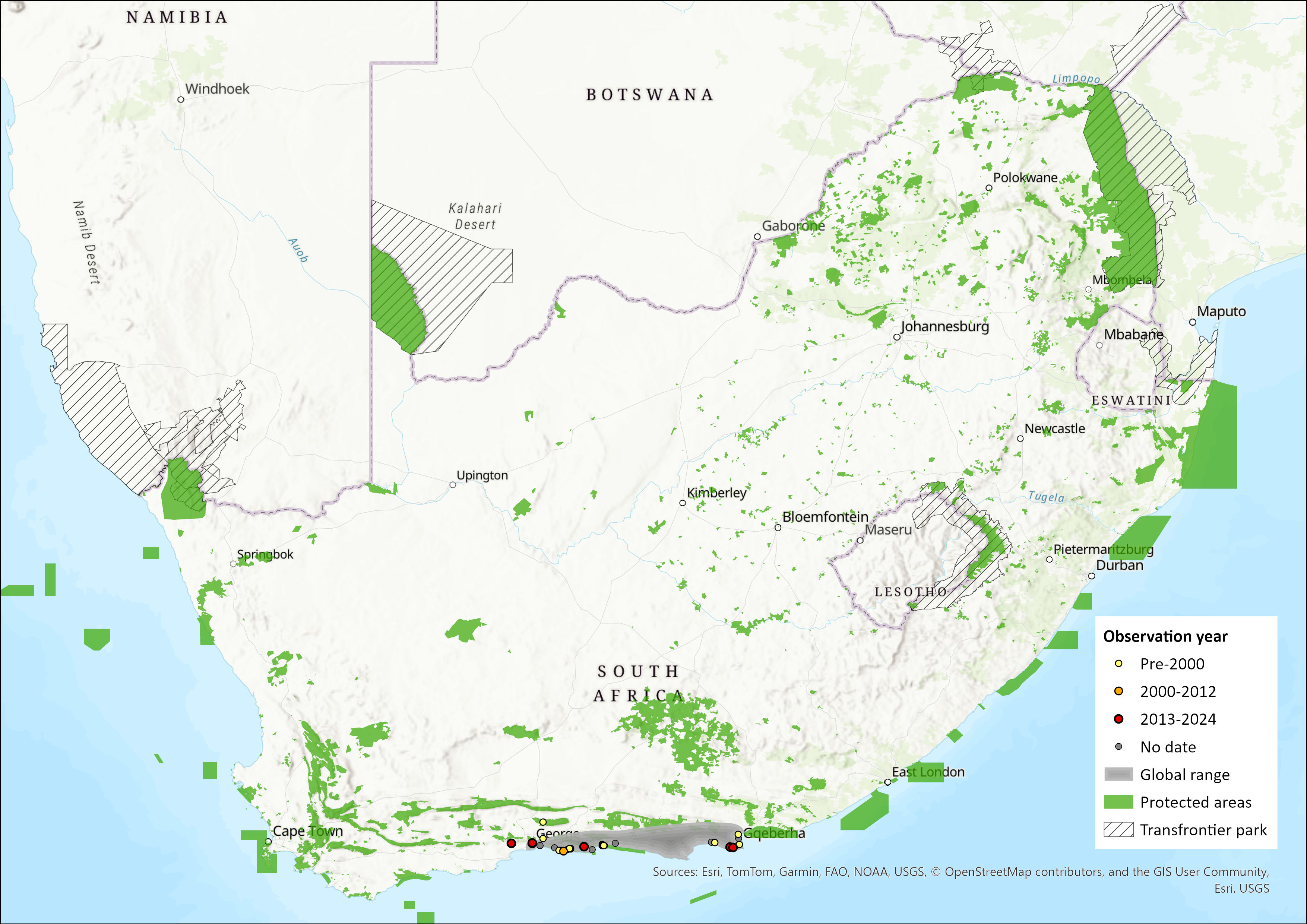 Figure 1. Distribution records for Duthie’s Golden Mole (Chrysochloris duthieae) within the assessment region (South Africa, Eswatini and Lesotho). Note that distribution data is obtained from multiple sources and records have not all been individually verified.
Biogeographic Realms
Biogeographic Realm: Afrotropical
Occurrence
Countries of Occurrence
| Country | Presence | Origin | Formerly Bred | Seasonality |
| South Africa | Extant | Native | – | Resident |
| South Africa -> Eastern Cape Province | Extant | Native | – | Resident |
| South Africa -> Western Cape | Extant | Native | – | Resident |
Large Marine Ecosystems (LME) Occurrence
Large Marine Ecosystems: (Not specified)
FAO Area Occurrence
FAO Marine Areas: (Not specified)
Climate change
Although the potential impacts of climate change on this species have not been directly assessed, climate change is expected to impact most golden mole species. Since these subterranean animals are restricted to soft soils for burrowing, and have very low vagility, their ability to migrate or shift their distribution ranges in response to climate change is very limited. Climate change is likely to impact golden moles through changes in vegetation type, soil moisture and prey availability, and coastal species additionally through reduced available habitat in developed/developing areas, as rising sea levels reduce the area of undeveloped coastal dune habitats between the coast and its associated developments.
Population information
The species is locally common in coastal and scarp Southern Cape Afrotemperate forest habitats, and adjacent pasturelands, cultivated lands and gardens, but no quantitative data are available.
Population Information
Current population trend: Unknown
Continuing decline in mature individuals: Unknown
Number of mature individuals in population: Unknown
Number of mature individuals in largest subpopulation: Unknown
Extreme fluctuations in the number of subpopulations: (Not specified)
Continuing decline in number of subpopulations: (Not specified)
All individuals in one subpopulation: (Not specified)
Number of Subpopulations: 2
Severely fragmented: No
Quantitative Analysis
Probability of extinction in the wild within 3 generations or 10 years, whichever is longer, maximum 100 years: (Not specified)
Probability of extinction in the wild within 5 generations or 20 years, whichever is longer, maximum 100 years: (Not specified)
Probability of extinction in the wild within 100 years: (Not specified)
Population genetics
No population genetic study has been undertaken on this species; however, the species is thought to exist as two subpopulations: an eastern subpopulation in the suburban parts of Port Elizabeth (three locations); and a western subpopulation in the indigenous coastal forest belt from Wilderness to Tsitsikamma (six locations). Gene flow between these two subpopulations seems unlikely owing to intervening drier strandveld habitats.
Given that the species is locally common within both subpopulations, it is expected that the effective population sizes of each are sufficiently large to maintain genetic diversity (e.g., Ne > 500); however, this would need to be verified through a genetic examination of the species.
Habitats and ecology
Duthie’s Golden Mole is restricted to alluvial sands and sandy loams in the southern Cape Afrotemperate forests (especially coastal platform and scarp forest patches) in the Fynbos and Moist Savannah biomes. It coexists with Amblysomus corriae in parts of their range, but trapping data suggest that A. corriae prefers fynbos and forest fringes, while Chlorotalpa duthieae favours deeper forest. This species thrives in cultivated areas and gardens and up to 4 individuals / hectare have been trapped on the same night, suggesting that population densities are relatively high in areas of suitable habitat. They construct shallow subsurface foraging tunnels that radiate outwards from under the roots of trees, and are predominantly active at night (Bronner 2013). Adults are solitary, and very little is known about the reproduction of this species, but it is thought to take place predominantly during the wet summer season (G.N. Bronner unpubl. data).
IUCN Habitats Classification Scheme
| Habitat | Season | Suitability | Major Importance? |
| 1.6. Forest -> Forest – Subtropical/Tropical Moist Lowland | Resident | Suitable | Yes |
| 2.2. Savanna -> Savanna – Moist | Resident | Marginal | – |
| 4.4. Grassland -> Grassland – Temperate | Resident | Marginal | – |
| 14.1. Artificial/Terrestrial -> Artificial/Terrestrial – Arable Land | Resident | Suitable | No |
| 14.2. Artificial/Terrestrial -> Artificial/Terrestrial – Pastureland | Resident | Suitable | No |
| 14.3. Artificial/Terrestrial -> Artificial/Terrestrial – Plantations | Resident | Marginal | – |
| 14.4. Artificial/Terrestrial -> Artificial/Terrestrial – Rural Gardens | Resident | Suitable | No |
| 14.5. Artificial/Terrestrial -> Artificial/Terrestrial – Urban Areas | Resident | Suitable | No |
| 16. Introduced vegetation | Resident | Marginal | – |
Life History
Generation Length: (Not specified)
Age at Maturity: Female or unspecified: (Not specified)
Age at Maturity: Male: (Not specified)
Size at Maturity (in cms): Female: 9 – 13
Size at Maturity (in cms): Male: 9-13
Longevity: (Not specified)
Average Reproductive Age: (Not specified)
Maximum Size (in cms): (Not specified)
Size at Birth (in cms): (Not specified)
Gestation Time: (Not specified)
Reproductive Periodicity: (Not specified)
Average Annual Fecundity or Litter Size: Litter size 2
Natural Mortality: (Not specified)
Breeding Strategy
Does the species lay eggs? No
Does the species give birth to live young? Yes
Does the species exhibit parthenogenesis? No
Does the species have a free-living larval stage? No
Does the species require water for breeding? No
Movement Patterns
Movement Patterns: (Not specified)
Congregatory: (Not specified)
Systems
System: Terrestrial
General Use and Trade Information
General notes regarding trade and use of this species: (Not specified)
Local Livelihood: (Not specified)
National Commercial Value: (Not specified)
International Commercial Value: (Not specified)
End Use: (Not specified)
Is there harvest from captive/cultivated sources of this species? (Not specified)
Harvest Trend Comments: (Not specified)
Threats
The most important threats are habitat alteration and fragmentation owing to extensive (and intensive) development of coastal tourism resorts that could degrade habitats and lead to population fragmentation, and increased urbanisation in the vicinity of cities (especially Port Elizabeth and Knysna). Localised minor threats include replacement of indigenous forest by plantations, timber harvesting (even in protected natural forests), predation by domestic pets in vicinity of human habitations, and persecution by gardeners.
Continuing decline in area, extent and/or quality of habitat: Yes. Declining in area and quality. Urban settlements have expanded by 6% between 2000 and 2013 in the Eastern Cape (GeoTerraImage 2015). Overall, 2% of the natural area of the Eastern Cape Province was lost between 2007 and 2015 at the rate of 0.24% per year (Berliner & Desmet 2007). Based on the analysis of the proposals, mining applications and municipal development, it is estimated that over 2 million hectares may be lost between 2015 and 2045. The proposals include Strategic Infrastructure Projects, wild coast N2 toll highway, mining, dam constructions and also future developments around rural and urban areas. Thus, there is a continuing decline in habitat across the province.
Conservation
Duthie’s Golden Mole is protected within the Garden Route National Park (including Tsitsikamma National Park, Wilderness National Park and Keurboomsriver Nature Reserve), as well as numerous forest reserves managed by either the Department of Agriculture, Water Affairs and Forestry, or local authorities. It also thrives in cultivated areas and gardens (particularly in the Walmer district of Port Elizabeth), suggesting that it is not at risk if human activities result in only mild habitat transformation. Protected area expansion through land-acquisition and stewardship are mechanisms that are employed to protect threatened ecosystems in the Eastern Cape and these mechanisms will be used to minimise habitat loss in the future. Plans are in place to double the protected area to over 1 million hectares over the next decade or so (Skowno et al. 2012).
Recommendations for land managers and practitioners:
Field surveys to discover other subpopulations, especially within current conservation areas.
Research priorities:
- Studies assessing subpopulation trends and the severity of threats, particularly the quantified impact of urban expansion.
- Potential for protected area expansion and biodiversity stewardship schemes to connect habitat patches.
- Field studies to determine life history traits and ecological tolerances.
- Surveys needed to determine subpopulation size, trend and distribution.
Encouraged citizen actions:
- Report sightings on virtual museum platforms (for example, iNaturalist and MammalMAP), especially outside protected areas.
- Deposit any dead specimens found in a state or provincial museum, together with information on the date and site where found.
Bibliography
Afrotheria Specialist Group. 2014. Specialist Group website. Available at: http://www.afrotheria.net/index.php.
Asher, R.J., Maree, S., Bronner, G., Bennett, N.C., Bloomer, P., Czechowski, P., Meyer, M. and Hofreiter, M. 2010. A phylogenetic estimate for golden moles (Mammalia, Afrotheria, Chrysochloridae). BMC Evolutionary Biology 10: 69 (doi:10.1186/1471-2148-10-69).
Berliner, D. and Desmet, P. 2007. Eastern Cape Biodiversity Conservation Plan: Technical Report. Department of Water Affairs and Forestry, Pretoria, South Africa.
Bronner, G.N. 1995. Systematic revision of the golden mole genera Amblysomus, Chlorotalpa and Calcochloris (Insectivora: Chrysochloromorpha; Chrysochloridae). Ph.D. Thesis, University of Natal.
Bronner, G.N. 2013. Chlorotalpa duthieae. In: J. Kingdon, D. Happold, T. Butynski, M. Hoffmann, M. Happold and J. Kalina (eds), Mammals of Africa, Volume I: Introductory Chapters and Afrotheria, pp. 239-240. Bloomsbury Publishing, London.
Bronner, G.N. and Jenkins, P.D. 2005. Order Afrosoricida. In: D.E. Wilson and D.M. Reeder (eds), Mammal Species of the World, pp. 70-81. The Johns Hopkins University Press, Baltimore, MD, USA.
Ellerman, J.R., Morrison-Scott, T.C.S. and Hayman, R.W. 1953. Southern African Mammals 1758 to 1951: A Reclassification. British Museum (Natural History), London, UK.
Envirotek. 2003. Classification system for South African indigenous forests. Envirotek, CSIR, Pretoria.
IUCN. 2015. The IUCN Red List of Threatened Species. Version 2015.2. Available at: www.iucnredlist.org. (Accessed: 23 June 2015).
GeoTerraImage. 2015. Quantifying settlement and built-up land use change in South Africa. Pretoria.
Meester, J. 1974. Family Chrysochloridae. Smithsonian Institution Press, Washington, DC, USA.
Meester, J.A.J., Rautenbach, I.L., Dippenaar, N.J. and Baker, C.M. 1986. Classification of Southern African Mammals. Monograph number 5. Transvaal Museum , Pretoria, South Africa.
Nicoll, M.E. and Rathbun, G.B. 1990. African Insectivora and elephant-shrews: An action plan for their conservation. IUCN/SSC Insectivore, Tree-Shrew and Elephant-Shrew Specialist Group. IUCN, Gland, Switzerland.
Petter, F. 1981. Remarques sur la systématique des Chrysochloridés. Mammalia 45: 49–53.
Simonetta, A.M. 1968. A new golden mole from Somalia with an appendix on the taxonomy of the family Chrysochloridae (Mammalia, Insectivora). Monitore zoologici Italiano, Supplement 2: 27–55.
Skowno, A., Holness, S., Jackelman, J. and Desmet, P. 2012. Eastern Cape Protected Area Expansion Strategy (ECPAES).