
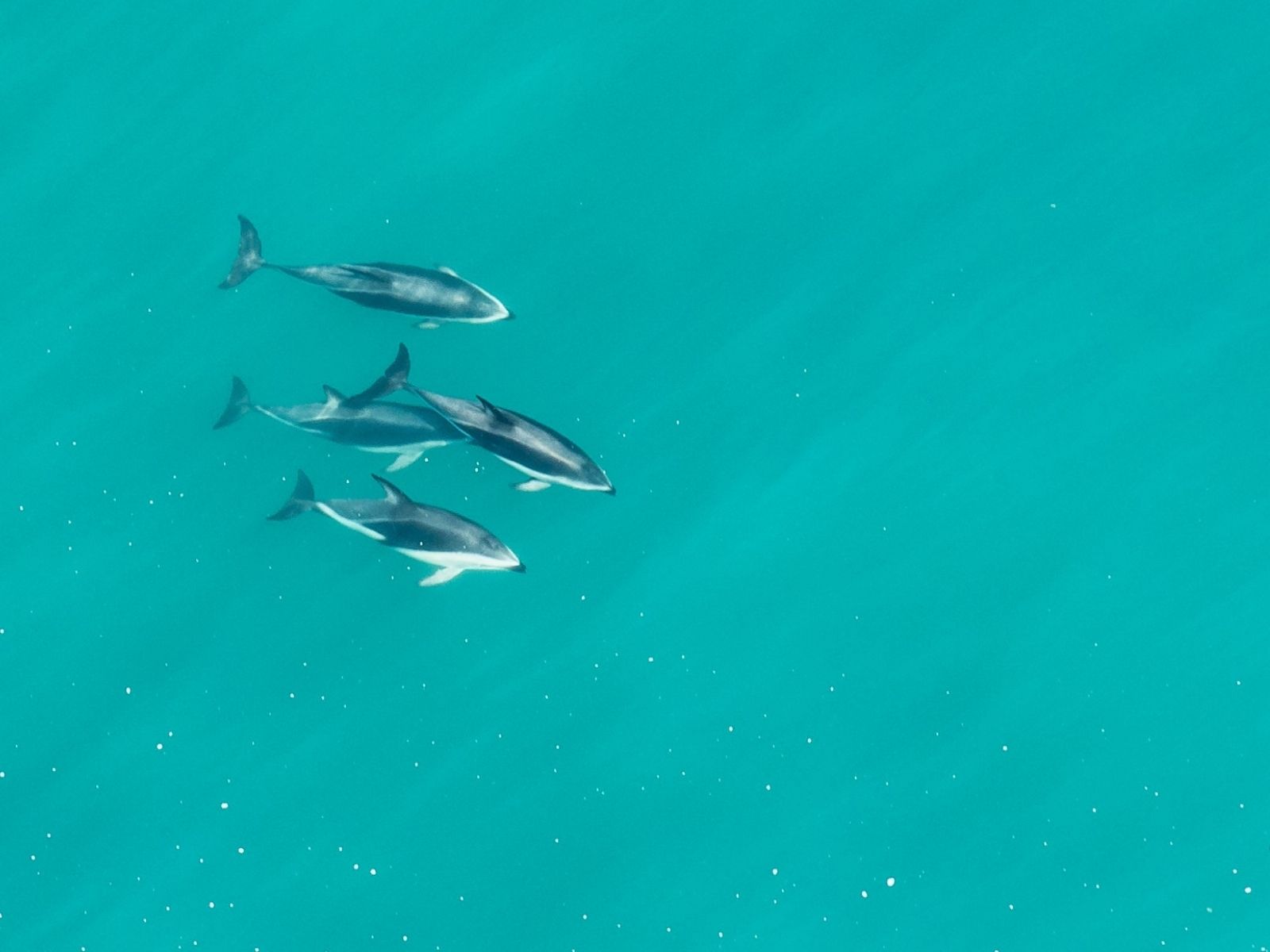
Dusky Dolphin
Sagmatias obscurus

2025 Red list status
Least Concern

Regional Population Trend
Unknown

Change compared
to 2016
No Change
Overview
Sagmatias obscurus – (Gray, 1828)
ANIMALIA – CHORDATA – MAMMALIA – ARTIODACTYLA – DELPHINIDAE – Sagmatias – obscurus
Common Names: Dusky Dolphin (English), Vaaldolfyn (Afrikaans), Delfín Obscuro (Spanish; Castilian), Lagénorhynque Sombre (French)
Synonyms: No Synonyms
Taxonomic Note:
A recent taxonomic revision of the genus Laegenorhynchus that incorporated multiple lines of evidence (morphology, genetics, historical biogeography, acoustics and phylogenetics) consistently reported that the six species currently assigned to Lagenorhynchus do not form a monophyletic group (Vollmer et al. 2019). While Lagenorhynchus albirostris has been retained, the remaining five species have been reassigned to existing generic names, namely Leucopleurus acutus, Sagmatias australis, Sagmatias cruciger, Sagmatias obliquidens, and Sagmatias obscurus.
Four subspecies of Dusky Dolphin (Sagmatias obscurus) are currently recognised by the Society for Marine Mammalogy’s Committee on Taxonomy (2018): African Dusky Dolphin L. o. obscurus off southern Africa, Fitzroy’s Dolphin L. o. fitzroyi off eastern South America, Peruvian/Chilean Dusky Dolphin L. o. posidonia off western South America, and the New Zealand Dusky Dolphin (un-named) off New Zealand (Perrin 2002). The populations cantered in New Zealand, the west coast of South America, and southwestern Africa are genetically and morphologically distinct (Harlin-Cognato et al. 2007, Cassens et al. 2003, Würsig et al. 1997, Van Waerebeek 1993a, b). There is a hiatus in distribution spanning about 1,000 km along the Chilean coast (Van Waerebeek, 1994), and the animals off Patagonia in Argentina are smaller than those off northern Chile and Peru (Van Waerebeek, 1993b), suggesting that there may be separate subspecies in western and eastern South America (Van Waerebeek, 1993a, b).
Dusky Dolphins also occur around some oceanic island groups (e.g., Tristan da Cunha, Prince Edward, Amsterdam, and St. Paul Islands). The subspecies affinities of these groups are uncertain.
Red List Status: LC – Least Concern, (IUCN version 3.1)
Assessment Information
Assessors: Nadin C. E.1 & da Silva, J. M.2
Reviewer: Purdon, J.3,4
Institutions: 1Sea Search Research and Conservation, 2South African National Biodiversity Institute, 3TUT Nature Conservation, 4The Whale Unit, University of Pretoria
Previous Assessors: Elwen, S. & Plön, S.
Previous Reviewer: Relton, C.
Previous Contributors: Atkins, S., Findlay, K., Meyer, M. & Oosthuizen, H.
Assessment Rationale
Large schools and frequent sightings of Dusky Dolphins in both the northern (Namibia) and southern (South Africa) Benguela suggest high abundance and more than 10,000 mature individuals. No major threats were identified, although an emerging threat of mid-water trawling requires monitoring. This species is thus listed as Least Concern. However, as more data is acquired about taxonomy, distribution, subpopulation size and trends, and the levels of bycatch, this species may require reassessment.
Regional population effects: There appears to be a gap in distribution of Dusky Dolphins along the continental shelf around the South Africa–Namibia border that is associated with the Lüderitz Upwelling Cell and Orange River Cone (Best 2007). This hiatus suggests that isolation of animals in South Africa and Namibia may occur.
Reasons for Change
Reason(s) for Change in Red List Category from the Previous Assessment: No change
Red List Index
Red List Index: No change
Recommended citations: Nadin CE & da Silva JM. 2025. A conservation assessment of Sagmatias obscurus. In Patel T, Smith C, Roxburgh L, da Silva JM & Raimondo D, editors. The Red List of Mammals of South Africa, Eswatini and Lesotho. South African National Biodiversity Institute and Endangered Wildlife Trust, South Africa.
Regional Distribution and occurrence
Geographic Range
Across the Southern Hemisphere, Dusky Dolphins are widespread but occur in disjunct subpopulations off the coast of South America, the west coast of southern Africa, and New Zealand, with occasional sightings from subantarctic Islands around Australia (Brownell & Cipriano 1999; Best 2007). They have also been recorded from around the Prince Edward Islands, Gough Island, the Falkland Islands and Amsterdam Island (Van Warebeek et al. 1995).
In the region of assessment, they occur in cool temperate waters on the continental shelf from western False Bay to the Orange River. This species is considered a year- round resident of the west coast of southern Africa, and is located most commonly over the continental shelf, in shallow waters between 0–50 m, but occasionally occurs over the shelf edge (Findlay et al. 1992).
Elevation / Depth / Depth Zones
Elevation Lower Limit (in metres above sea level): (Not specified)
Elevation Upper Limit (in metres above sea level): (Not specified)
Depth Lower Limit (in metres below sea level): (Not specified)
Depth Upper Limit (in metres below sea level): (Not specified)
Depth Zone: (Not specified)
Map
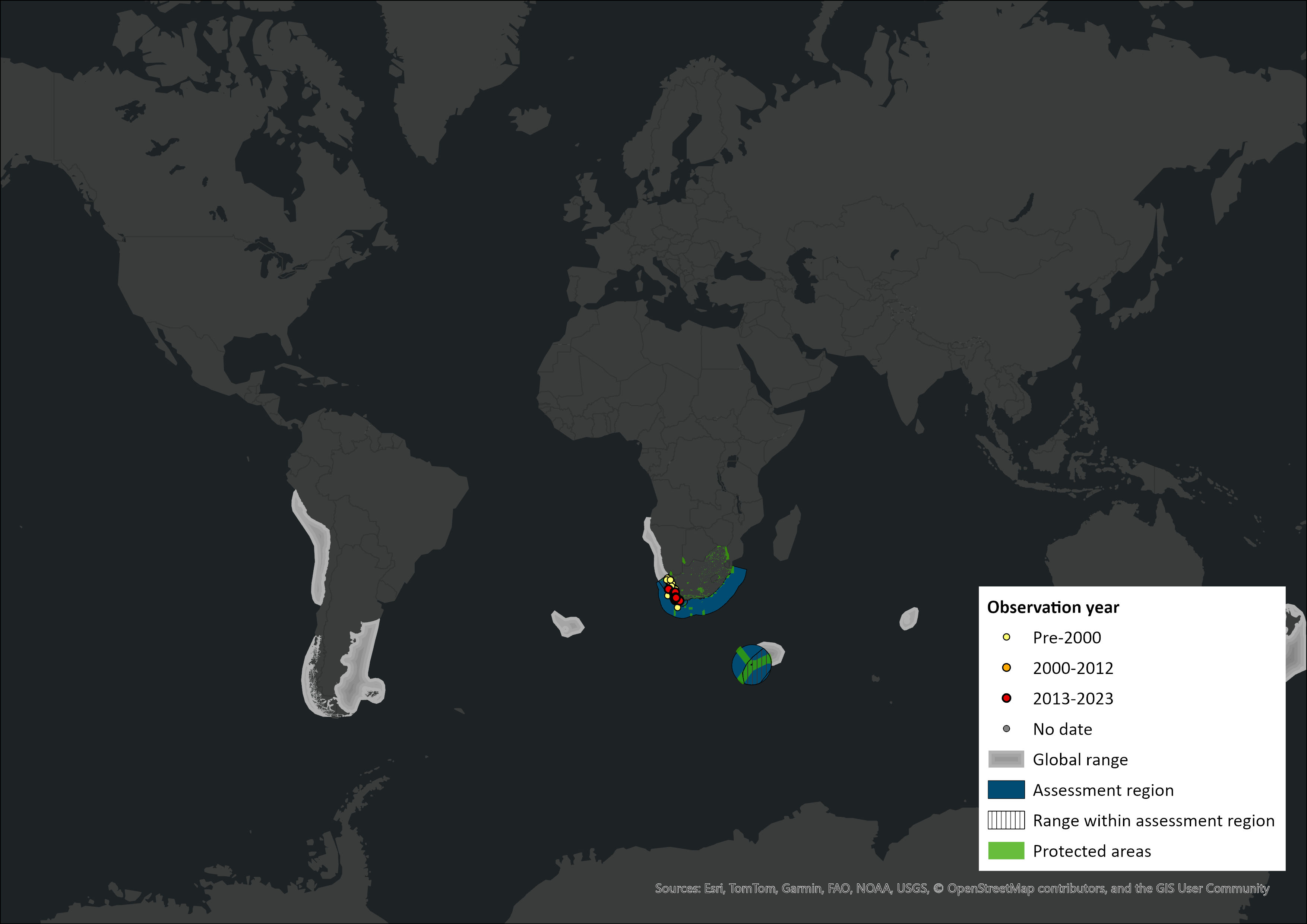 Figure 1. Distribution records for Dusky Dolphin (Sagmatias obscurus) within the assessment region (South Africa, Eswatini and Lesotho). Note that distribution data is obtained from multiple sources and records have not all been individually verified.
Biogeographic Realms
Biogeographic Realm: Afrotropical, Australasian, Neotropical, Oceanian
Occurrence
Countries of Occurrence
| Country | Presence | Origin | Formerly Bred | Seasonality |
| Argentina | Extant | Native | – | – |
| Australia | Extant | Native | – | – |
| Chile | Extant | Native | – | – |
| Falkland Islands (Malvinas) | Extant | Native | – | – |
| French Southern Territories | Extant | Native | – | – |
| French Southern Territories -> Amsterdam-St. Paul Is. | Extant | Native | – | – |
| Namibia | Extant | Native | – | – |
| New Zealand | Extant | Native | – | – |
| Peru | Extant | Native | – | – |
| Saint Helena, Ascension and Tristan da Cunha | Extant | Native | – | Resident |
| Saint Helena, Ascension and Tristan da Cunha -> Tristan da Cunha | Extant | Native | – | – |
| South Africa | Extant | Native | – | – |
| South Africa -> Marion-Prince Edward Is. | Extant | Native | – | – |
| South Africa -> Northern Cape Province | Extant | Native | – | – |
| South Africa -> Western Cape | Extant | Native | – | – |
Large Marine Ecosystems (LME) Occurrence
Large Marine Ecosystems: (Not specified)
FAO Area Occurrence
| Presence | Origin | Formerly Bred | Seasonality | |
| 41. Atlantic – southwest | Extant | Native | – | – |
| 47. Atlantic – southeast | Extant | Native | – | – |
| 81. Pacific – southwest | Extant | Native | – | – |
| 87. Pacific – southeast | Extant | Native | – | – |
Climate change
Sea surface temperature and chlorophyll a (chl a) levels are key predictor variables of the Dusky Dolphin’s range and distribution within this assessment region, with the species requiring sea surface temperatures (SSTs) between 14 and 17°C and chl a concentrations >1 mg/m3 (Purdon et al. 2020). Sea temperature rises in the Southern Hemisphere, from cooler to more temperate, have the potential to reduce the range of suitable habitat for this cool water limited species and decrease the range of Dusky Dolphins in this assessment region (Learmonth et al. 2006; MacLeod 2009; Laubscher 2018). Chl a concentrations, however, have been reported to range between 0.06–10.9 mg/m3, with highest median concentrations in the Benguela (Sweijd & Smit, 2020), appearing suitable for Dusky Dolphins.
The negative impacts of unusually warm waters and low in Chl a concentration on Dusky Dolphins in the cold-water Benguela system are likely indirect and a result of negative impacts on the spawning success of fish, resulting in a reduction in prey abundance and availability (Shannon et al. 1992). In regions of the Benguela that have warmed off the coast of Namibia, fish species have shown differing responses, with approximately half of the species shifting polewards and the rest shifting towards the equator (Poloczanska et al. 2016).
Previous studies identified nutritional stress, from poorly calcified teeth, in pregnant and lactating female dusky dolphins during an El Niño event in Peru between 1982 and 1983, in which stock of the primary prey source of Dusky Dolphins, the Peruvian anchovy, collapsed (Manzanilla 1989). Thus, displaying how extreme temperature events can negatively affect this species indirectly through adverse impacts on prey species abundance and availability.
Until approval of the new Namaqua Fossil Forest and Robben Island Marine Protect Areas (MPAs) the only protection Dusky Dolphins received was in various small coastal MPAs. These newly approved MPAs have increased the percentage protection of Dusky Dolphins from 0.6 – 3%, which is still very limited.
Population
Although direct abundance estimates exist, sighting rates produced during coastal surveys directed at Heaviside’s dolphins show regular occurrence of large groups throughout the southern Benguela, with up to 0.9 groups / km searched seen in St Helena Bay (Elwen et al. 2010). Although not seen as frequently close to shore in Namibia, Dusky Dolphins are amongst the most frequently encountered species on the Namibian continental shelf and are commonly spotted off South Africa’s west coast (Simon Elwen, Namibian Dolphin Project, unpubl. data). Dusky Dolphins are known to gather in schools of up to 800 (Findlay et al. 1992; Best 2007). The high sighting rate and large group sizes suggest a population of over 10,000 mature individuals.
It remains uncertain whether the groups around oceanic islands, for example, those around the Prince Edward Islands, are discrete or regularly mix with animals in other areas (Brownell & Cipriano 1999). Model-based estimates of generation time are 16.4 years (Taylor et al. 2007).
Current population trend: Unknown
Continuing decline in mature individuals: Unknown
Number of mature individuals in population: Estimated at over 10,000 individuals
Number of mature individuals in largest subpopulation: Unknown
Number of subpopulations: Unknown
Severely fragmented: No
Extreme fluctuations in the number of subpopulations: (Not specified)
Continuing decline in number of subpopulations: (Not specified)
All individuals in one subpopulation: (Not specified)
Quantitative Analysis
Probability of extinction in the wild within 3 generations or 10 years, whichever is longer, maximum 100 years: (Not specified)
Probability of extinction in the wild within 5 generations or 20 years, whichever is longer, maximum 100 years: (Not specified)
Probability of extinction in the wild within 100 years: (Not specified)
Population Genetics
A study by Harlin et al. (2007) found a strong association between prey availability/abundance and the phylogeography of the Dusky Dolphin, with timing of oceanic change coincident with the dates of important events in the history of dolphin populations. The evidence supports the species’ wide distribution and contact between geographic regions. These findings support those by Cassens et al. (2003) which found no pronounced genetic differentiation across the Atlantic. Consequently, Dusky Dolphins within the assessment region are believed to form part of a single population, with connectivity present between the eastern and western Atlantic.
Measure of effective population size have not been quantified, but based on surveys and sightings, the number of L. obscurus within the assessment region is projected at over 10,000 mature individuals (see population section). Assuming an Ne/Nc conversion ratio of 0.1-0.3, the Ne for the region is estimated at over 1,000 individuals; well above the Ne 500 threshold. More recent abundance estimates of Dusky Dolphins in the northern Benguela, from data collected between 2012 – 2014, documented an average baseline density of 3,493 individuals (CV = 26.2%, 95% CI = 2015-6052) (Martin et al. 2020). These estimates may prove very useful if two sub-populations of Dusky Dolphins exist between the northern and southern Benguela.
Habitats and ecology
The Dusky Dolphin is a resident coastal species, most commonly located over the continental slope and shelf (Jefferson et al. 1993; Aguayo et al. 1998). Along the west coast of southern Africa, its distribution is associated with the continental shelf and cool waters of the Benguela Current. Research indicates that they favour sea surface temperatures between 10°C and 18°C (Brownell & Cipriano 1999). They use a wide range of habitats within the Benguela Current depending partly on age and reproductive status, from extreme nearshore to shelf edge, with corresponding flexibility in prey usage. Dusky Dolphins usually rest and socialise in shallow waters, but utilise deeper marine habitats when feeding (Wursig & Wursig 1980).
Dusky Dolphins take a wide variety of prey, mainly Piscine and Cephalopods. Food remains from 36 dolphins from South Africa included Horse Mackerel Trachurus p. (34.7% by mass), Hake Merluccius sp. (22.9%) and Lantern Fish Lampanyctus sp. (12.8%) with Sardine (Sardina pilchardus), Arrow Squid (Nototodarus sloanii) and Chokka Squid (Loligo reynaudii) also taken occasionally (Best & Meÿer 2010). Stomach contents tend to either consist of prey associated with the epipelagic zone (surface schooling fish such as Sardine, Anchovy (Engraulidae sp.) and Horse Mackerel or even such nearshore inhabitants as Mullet, Liza richardsoni) or mesopelagic prey (those associated with the deep scattering layer such as myctophids, Lampanyctys and Diaphus or Hatchet Fish Maurolicus), suggesting that Dusky Dolphins use at least two foraging strategies.
Group sizes within South Africa have been recorded from 2 to 800 (mean 35.3, Best 2007), although the vast majority of groups encountered consist of fewer than 20 individuals (Best & Meÿer 2010). The species is known to form nursery groups consisting entirely of mother-calf pairs. These nursery groups are most common in late summer with peak occurrence of 38% in February (Best & Meÿer 2010), coinciding with a birth season in January to early February, estimated from the reproductive status of dead females and stranded neonates (Best & Meÿer 2010). Calf size at birth has been recorded at approximately 0.86 m, and strandings data revealed highest calf percentage in January and February (Skinner & Chimimba 2005).
Ecosystem and cultural services: This species is a flagship species for conservation and ecotourism on the west coast of South Africa.
IUCN Habitats Classification Scheme
| Habitat | Season | Suitability | Major Importance? |
| 9.1. Marine Neritic -> Marine Neritic – Pelagic | – | Suitable | Yes |
Life History
Generation Length: (Not specified)
Age at Maturity: Female or unspecified: (Not specified)
Age at Maturity: Male: (Not specified)
Size at Maturity (in cms): Female: (Not specified)
Size at Maturity (in cms): Male: (Not specified)
Longevity: (Not specified)
Average Reproductive Age: (Not specified)
Maximum Size (in cms): (Not specified)
Size at Birth (in cms): (Not specified)
Gestation Time: (Not specified)
Reproductive Periodicity: (Not specified)
Average Annual Fecundity or Litter Size: (Not specified)
Natural Mortality: (Not specified)
Does the species lay eggs? (Not specified)
Does the species give birth to live young: (Not specified)
Does the species exhibit parthenogenesis: (Not specified)
Does the species have a free-living larval stage? (Not specified)
Does the species require water for breeding? (Not specified)
Movement Patterns
Movement Patterns: (Not specified)
Congregatory: (Not specified)
Systems
System: Marine
General Use and Trade Information
There is no known trade in this species within the region under consideration.
| Subsistence: | Rationale: | Local Commercial: | Further detail including information on economic value if available: |
| Yes | – | – | – |
National Commercial Value: Yes
International Commercial Value: No
| End Use | Subsistence | National | International | Other (please specify) |
| 1. Food – human | true | true | – | – |
Is there harvest from captive/cultivated sources of this species? (Not specified)
Harvest Trend Comments: (Not specified)
Threats
This species may be susceptible to both offshore and inshore threats. Globally, Dusky Dolphins are threatened by entanglement in gillnets, particularly in mid-water trawls. In the assessment region, they are caught in midwater trawls, purse-seines and set nets but these are considered a minor threat and mortality numbers are unknown. However, there is an emerging threat related to the mid-water trawling fisheries in the southern Benguela. Both fishermen and cetaceans are drawn to areas of high prey density, and trawling fishing boats often make hunting easier for cetaceans. However, with the benefits of increased feeding success comes the additional risk of entanglement. Trawl fisheries not only influence target species and their immediate predators, but also the rest of the food web. For example, trawl fisheries may directly target Hake (Merluccius spp.), which is a predator of Anchovy, also a common prey item of Dusky Dolphins. Six Dusky Dolphins were reported to have died as a result of bycatch in gillnets during one year between 1986 and 1998 (Best & Meÿer 2010).
A recent collapse (mid-2000s) in South Africa’s Sardine stocks due to overexploitation may threaten prey availability for Dusky Dolphins (Coetzee et al. 2008) and is expected to have resulted in a diet change for this species. Additionally, harmful algal blooms caused by dinoflagellates may be increasing in frequency and severity in the southern Benguela current as a result of climate change (Van der Lingen et al. 2015). This was found to have an indirect effect on the condition of Sardine, a top prey item for this species (Van der Lingen et al. 2015).
Current habitat trend: Water temperatures along the west coast have become cooler over the past 20–30 years (Mead et al. 2013), where simultaneously oxygen concentrations have decreased (Moloney et al. 2013). The specific effects of these patterns on Dusky Dolphin distribution, either directly or indirectly through resource shifts, have not been documented and should be monitored.
Conservation
The species is listed in Appendix II of the Conventional on International Trade in Endangered Species of Wild Fauna and Flora (CITES) and Marine Living Resources Act (No. 18 of 1998). Within the assessment region, this species’ distribution falls within the West Coast National Park MPA. Recent bycatch in gillnets occurs at an unknown level and needs to be investigated. An investigation resolving population structure is required. Taxonomy requires clarification.
No direct research is occurring on Dusky Dolphins in South Africa, other than ongoing recording and dissection of stranded animals attended to by Department of Environmental Affairs (DEA) and the University of Pretoria MRI/South African Museum team. Abundance, habitat use and acoustic behaviour is currently under study in Namibia through the work of the Namibian Dolphin Project (Elwen and colleagues).
Recommendations for managers and practitioners:
- Fisheries bycatch occurs at levels that are suspected to be low. The level of bycatch should be clarified and the emerging threat with respect to the midwater trawl sector should be monitored.
Research priorities:
- More research is required focusing on the distribution of Dusky Dolphins and possible existence of population structure between South Africa and Namibia (see below).
- Bycatch in commercial fisheries is not well quantified and current estimates are needed, especially for the purse-seine industry in both South Africa and Namibia and the mid-water trawl industry.
- Taxonomy requires clarification at a global level.
- Estimate of total population size would be useful to allow a better understanding of the role of Dusky Dolphins as top predators in fisheries models.
- Research priorities include distribution clarification, and subpopulation abundance and trends. It is necessary to better understand the apparent hiatus in distribution around the Orange River mouth and establish whether the South African and Namibian stocks are separate; there is particular need to gather genetic data from the Namibian animals.
Encouraged citizen actions:
- Use information dispensed by the South African Sustainable Seafood Initiative to make good choices when buying fish in shops and restaurants, e.g. FishMS 0794998795.
- Save electricity and fuel to mitigate CO2 emissions and hence rate of climate change.
- Buy local products that have not been internationally shipped.
- Reduce boat speed in harbours.
- Report sightings on virtual museum platforms (for example, iNaturalist and MammalMAP) to help with mapping geographical distribution.
Bibliography
Aguayo, A., Bernal, R., Olavarria, C., Vallejos, V. and Hucke, R. 1998. Observaciones de cetáceos realizadas entre Valparaíso e Isla de Pascua, Chile, durante los inviernos de 1993, 1994 y 1995. Revista de Biologia Marina y Oceanografia 33(1): 101-123.
Best P., and Meÿer, M.A. 2010. Neglected but not forgotten – Southern Africa’s Dusky Dolphins. In: Wursig B,Wursig M (ed.), Dusky dolphins: Master Acrobats off Different Shores, pp. 291-312. Academic Press, San Diego, CA, USA.
Best, P.B. 2007. Whales and Dolphins of the Southern African Subregion. Cambridge University Press, Cape Town, South Africa.
Brownell Jr., R. L. and Cipriano, F. 1999. Dusky dolphin Lagenorhynchus obscurus (Gray, 1828). In: S. H. Ridgway and R. Harrison (eds), Handbook of marine mammals, Vol. 6: The second book of dolphins and the porpoises, pp. 85-104. Academic Press, San Diego, USA.
Cipriano, F., and Webber, M. 2010. Dusky Dolphin life history and demography. In: Wursig, B., and Wursig, M. (eds), Dusky Dolphins: Master Acrobats off Different Shores, pp. 21-48. Academic Press, San Diego, CA, USA.
Coetzee, J.C., Van der Lingen, C.D., Hutchings, L. and Fairweather, T.P. 2008. Has the fishery contributed to a major shift in the distribution of South African sardine? ICES Journal of Marine Science: Journal du Conseil 65(9): 1676-1688.
Elwen, S.H., Thornton, M., Reeb, D., and Best, P.B. 2010. Near-shore distribution of Heaviside’s (Cephalorhynchus heavisidii) and Dusky Dolphins (Lagenorhynchus obscurus) at the southern limit of their range in South Africa. African Zoology 45: 78-91.
Findlay KP, Best PB, Ross GJB, Cockcroft VG. 1992. The distribution of small odontocete cetaceans off the coasts of South Africa and Namibia. South African Journal of Marine Science 12: 237-270.
Harlin-Cognato AD. 2010. The Dusky Dolphins place in the delphinids family tree. In: Wursig B,Wursig M (ed.), Dusky Dolphins: Master Acrobats off Different Shores, pp. 1-20. Academic Press, San Diego, CA, USA.
Harlin-Cognato, A.D., Markowitz, T., Würsig. B., and Honeycutt, R,L. 2007. Multi-locus phylogeography of the Dusky Dolphin (Lagenorhynchus obscurus): passive dispersal via the west-wind drift or response to prey species and climate change? BMC Evolutionary Biology 7: 131.
IUCN (International Union for Conservation of Nature). 2008. Lagenorhynchus obscurus. The IUCN Red List of Threatened Species. Version 3.1. Available at: http://www.iucnredlist.org. Downloaded on 21 February 2016.
Jefferson, T. A., Leatherwood, S. and Webber, M. A. 1993. Marine Mammals of the World: FAO Species Identification Guide. United Nation Environment Programme and Food and Agricultural Organization of the UN.
Laubscher, M., 2018. Mapping cetacean distribution in the Western Cape to explore potential range shifts in light of climate change. University of Pretoria, South Africa.
LeDuc, R.G., Perrin, W.F. and Dizon, A.E. 1999. Phylogenetic relationships among the delphinid cetaceans based on full cytochrome b sequences. Marine Mammal Science 15: 619-648.
MacLeod, C.D.C. 2009. Global climate change, range changes and potential implications for the conservation of marine cetaceans: A review and synthesis. Endangered Species Research 7, 125–136.
Manzanilla, S.R. 1989. The 1982–1983 El Nino event recorded in dentinal growth layers in teeth of Peruvian dusky dolphins (Lagenorhynchus obscurus). Canadian Journal of Zoology 67, 2120–2125.
Martin, M.J., Gridley, T., Roux, J.P. & Elwen, S.H., 2020. First abundance estimates of Heaviside’s (Cephalorhynchus heavisidii) and dusky (Lagenorhynchus obscurus) dolphins off Namibia using a novel visual and acoustic line transect survey. Frontiers in Marine Science, 7, p.555659.
May-Collado, L., and Agnarsson, I. 2006. Cytochrome b and Bayesian inference of whale phylogeny. May-Collado, L., and Agnarsson, I. 38: 344-354.
Moloney, C.L., Fennessey, S.T., Gibbons, M.J., Roychoudhury, A., Shillington, F.A. von der Heyden, B.P. and Watermeyer, K. 2013. Reviewing evidence of marine ecosystem change off South Africa. African Journal of Marine Science 35(3): 427-448.
Perrin, W. F. 2002. Geographic variation. In: W. F. Perrin, B. Wursig and J. G. M. Thewissen (eds), Encyclopedia of Marine Mammals, pp. 510-516. Academic Press.
Poloczanska, E.S., Burrows, M.T., Brown, C.J., García Molinos, J., Halpern, B.S., Hoegh-Guldberg, O., Kappel, C.V., Moore, P.J., Richardson, A.J., Schoeman, D.S. & Sydeman, W.J., 2016. Responses of marine organisms to climate change across oceans. Frontiers in Marine Science, 3, p.62.
Purdon, J., Shabangu, F., Pienaar, M., Somers, M.J. and Findlay, K.P., 2020. South Africa’s newly approved marine protected areas have increased the protected modelled habitat of nine odontocete species. Marine Ecology Progress Series, 633, pp.1-21.
Sekiguchi, K., Klages, N.T.W. and Best, P.B. 1992. Comparative analysis of the diets of smaller odontocete cetaceans along the coast of southern Africa. South African Journal of Marine Science 12: 843-861.
Skinner, J.D. and Chimimba, C.T. (eds). 2005. The Mammals of the Southern African Subregion. Cambridge University Press, United Kingdom, Cambridge.
Sweijd, N.A. & Smit, A.J., 2020. Trends in sea surface temperature and chlorophyll-a in the seven African Large Marine Ecosystems. Environmental Development, 36, p.100585.
Taylor, B.L., Chivers, S.J., Larese, J. and Perrin, W.F. 2007. Generation length and percent mature estimates for IUCN assessments of cetaceans. NOAA, Southwest Fisheries Science Center Administrative Report LJ-07-01. La Jolla, California.
Van Waerebeek, K. 1993. External features of the dusky dolphin Lagenorhynchus obscurus (Gray, 1828) from Peruvian waters. Estudios Oceanologicos 12: 37-53.
Van Waerebeek, K. 1993. Geographic variation and sexual dimorphism in the skull of the dusky dolphin, Lagenorhynchus obscurus (Gray, 1828). Fishery Bulletin 91: 754-774.
Van Waerebeek, K., van Bree, P. J. H. and Best, P. B. 1995. On the identity of Predelphinus petersii Lutken, 1889 and records of dusky dolphin Lagenorhynchus obscurus (Gray, 1828) from the southern Indian and Atlantic oceans. South African Journal of Marine Science 16: 25-35.
Vaughn RL, Shelton DE, Timm LL, Watson LA, Würsig B. 2007. Dusky Dolphin (Lagenorhynchus obscurus) feeding tactics and multi-species associations. New Zealand Journal of Marine and Freshwater Research 41: 391-400.
Wursig B, Wursig M. 1980. Behavior and ecology of the Dusky Dolphin, Lagenorhynchus obscurus, in the South Atlantic. Fish. Bull 77: 871-890.
van der Lingen CD, Hutchings L, Lamont T, Pitcher GC. 2015. Climate change, dinoflagellate blooms and sardine in the southern Benguela Current Large Marine Ecosystem. Environmental Development DOI:10.1016/j.envdev.2015.09.004.