
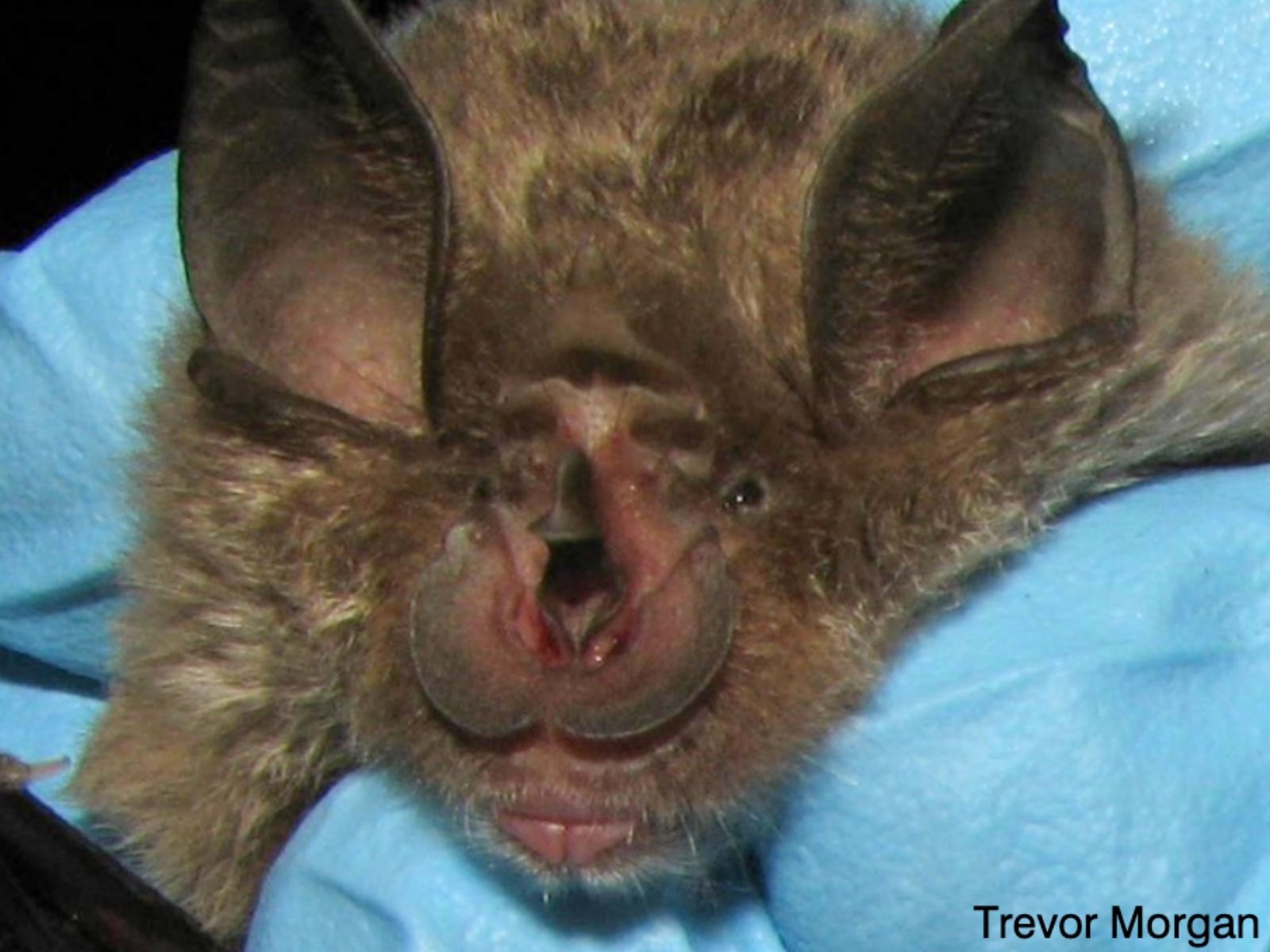
Darling’s Horseshoe Bat
Rhinolophus darlingi

2025 Red list status
Least Concern

Regional Population Trend
Stable

Change compared
to 2016
No Change
Overview
Rhinolophus darlingi – K. Andersen, 1905
ANIMALIA – CHORDATA – MAMMALIA – CHIROPTERA – RHINOLOPHIDAE – Rhinolophus – darlingi
Common Names: Darling’s Horseshoe Bat (English), Darling se saalneusvlermuis, Darling-saalneusvlermuis (Afrikaans).
Synonyms: barbertonensis
This is a new concept for this species following the split of R. damarensis from it.
Jacobs et al. (2013) present genetic evidence that Rhinolophus darlingi (sensu lato) is polyphyletic, comprising two cryptic species corresponding to the western populations that occur in arid habitats and the populations occurring in central and eastern southern Africa. Specifically, R. damarensis occurs in Angola, Namibia, and northwestern South Africa; while R. darlingii occurs in eastern South Africa, Mozambique, Eswatini, Zimbabwe, Botswana, Zambia and Malawi. The taxonomic status of the population in Nigeria is unclear (Cotterill & Happold 2013).
Red List Status: LC – Least Concern (IUCN version 3.1)
Assessment Information
Assessors: Taylor, P.1 & da Silva. J.M.2
Reviewers: Howard, A.1 & Bastian, A.3
Institutions: 1University of the Free State, 2South African National Biodiversity Institute, 3University of KwaZulu-Natal
Previous Assessors and Reviewers: Jacobs, D., Taylor, P., Cohen, L., MacEwan, K., Richards, L, Schoeman, C., Sethusa, T. & Monadjem, A.
Previous Contributors: Child, M.F. & Raimondo, D.
Assessment Rationale
This species is widely distributed in the Savannah Biome of the assessment region, occurs in multiple protected areas (including Great Limpopo Transfrontier Park) and there are no major identified threats that could cause widespread population decline. Savannah habitats in the assessment region are well protected. Disturbance to roosting sites may cause local declines but there is no evidence for continuing decline. Thus, we list this species as Least Concern.
Regional population effects: Habitat is connected across transfrontier parks, and the species has low to intermediate wing loading (Norberg & Rayner 1987), so dispersal, and thus rescue effects, are presumed to be limited, but possible.
Reasons for Change
Reason(s) for Change in Red List Category from the Previous Assessment: No change
Red List Index
Red List Index: No change
Recommended citation: Taylor P & da Silva JM. 2025. A conservation assessment of Rhinolophus darlingi. In Patel T, Smith C, Roxburgh L, da Silva JM & Raimondo D, editors. The Red List of Mammals of South Africa, Eswatini and Lesotho. South African National Biodiversity Institute and Endangered Wildlife Trust, South Africa.
Regional Distribution and occurrence
Geographic Range
Distributed in southern Africa from northern KwaZulu-Natal through Eswatini, and northeastern South Africa to Zimbabwe, northern Botswana, the extreme southeast Zambia and southern Malawi (Monadjem et al. 2020). The species has not been reliably reported outside southern Africa Jacobs et al. 2013; Monadjem et al. 2020; Monadjem et al. 2024). In the assessment region the species is known from the Limpopo, Mpumalanga, Gauteng, North West, and KwaZulu-Natal provinces of South Africa; as well as the lowveld and Lubombo regions of Eswatini. It is unclear if the species is present in Lesotho (Monadjem et al. 2020; 2024; ACR 2015). The current estimated extent of occurrence is 307,291 km2.
Elevation / Depth / Depth Zones
Elevation Lower Limit (in metres above sea level): 416 m asl (Monadjem et al. 2024)
Elevation Upper Limit (in metres above sea level): 1,414m asl (Monadjem et al. 2024)
Depth Lower Limit (in metres below sea level): (Not specified)
Depth Upper Limit (in metres below sea level): (Not specified)
Depth Zone: (Not specified)
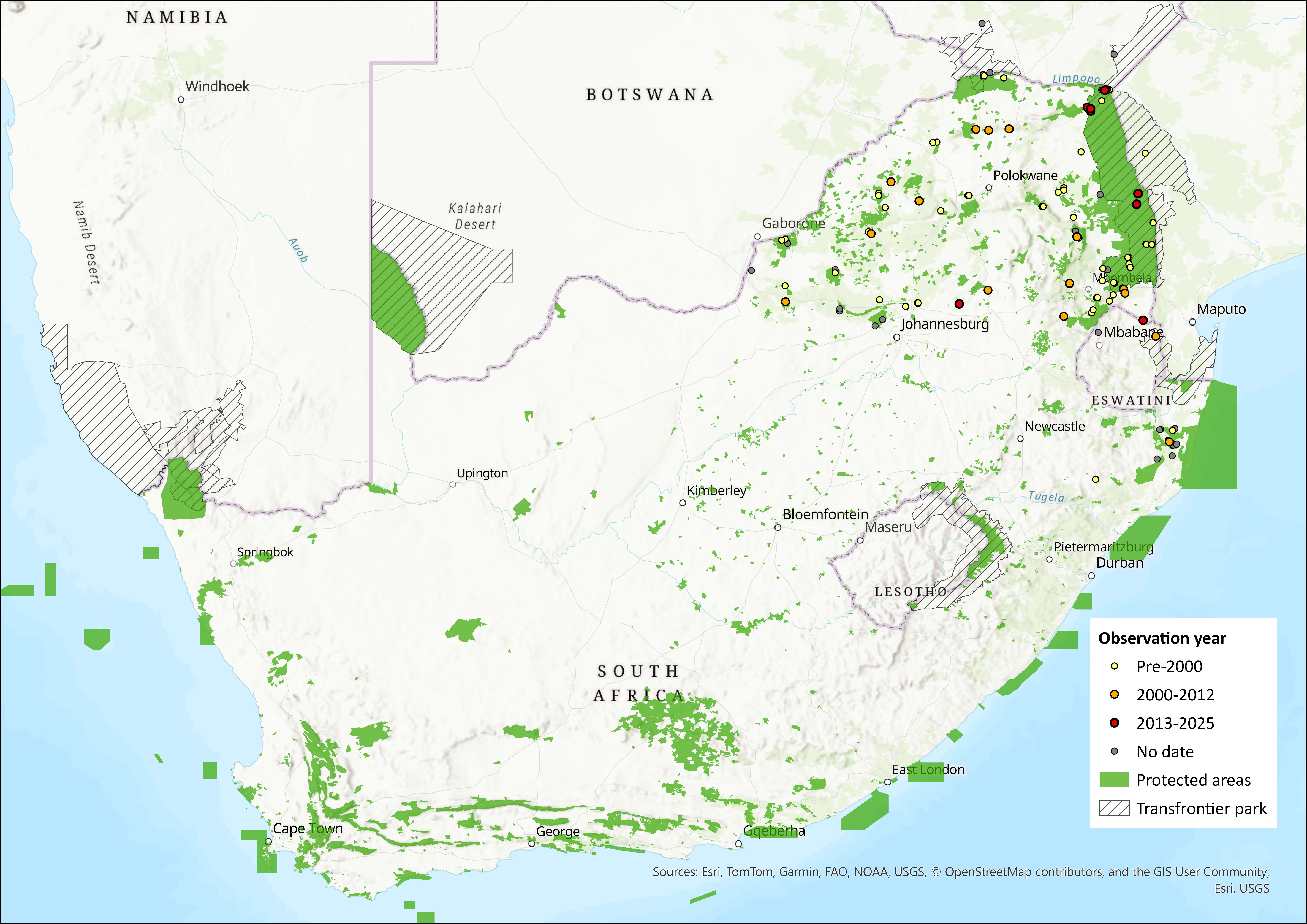 Figure 1. Distribution records for Darling’s Horseshoe Bat (Rhinolophus darlingi) within the assessment region (South Africa, Eswatini and Lesotho). Note that distribution data is obtained from multiple sources and records have not all been individually verified.
Biogeographic Realms
Biogeographic Realm: Afrotropical
Occurrence
Countries of Occurrence
| Country | Presence | Origin | Formerly Bred | Seasonality |
| Angola | Extant | Native | – | |
| Botswana | Extant | Native | – | Resident |
| Eswatini | Extant | Native | – | Resident |
| Lesotho | Presence Uncertain | Native | – | – |
| Malawi | Extant | Native | – | Resident |
| Mozambique | Extant | Native | – | Resident |
| South Africa | Extant | Native | – | Resident |
| Tanzania | Extant | Native | – | |
| Zambia | Extant | Native | – | Resident |
| Zimbabwe | Extant | Native | – | Resident |
Large Marine Ecosystems (LME) Occurrence
Large Marine Ecosystems: (Not specified)
FAO Area Occurrence
FAO Marine Areas: (Not specified)
Climate change
Possibly because of the buffering effect of the eastern Great Escarpment, climate models do not predict a significant range reduction of this species by 2070 (Taylor et al. 2024) for southern Africa. Furthermore, there are unknown effects of climate change on this species physiology.
Population Information
Locally common in the vicinity of day roosts in South Africa and Zimbabwe (Cotterill & Happold 2013). Darling’s Horseshoe Bat is usually found in small numbers. For example, a group of c. 20 individuals is reported from KwaZulu-Natal (Taylor 1998); and groups of 2–15 were recorded by Rautenbach (1982). However, they can be represented by a maximum of about a hundred bats in a colony (Skinner & Chimimba 2005). Additionally, this species is well represented in museums, with 320 specimens examined in Monadjem et al. (2020). However, the total mature population is inferred to be a little less than 10,000 individuals in the assessment region.
Current population trend: Stable
Continuing decline in mature individuals? (Not specified)
Number of subpopulations: Unknown
Extreme fluctuations in the number of subpopulations: (Not specified)
Continuing decline in number of subpopulations: (Not specified)
All individuals in one subpopulation: (Not specified)
Number of mature individuals in largest subpopulation: 100
Quantitative Analysis
Probability of extinction in the wild within 3 generations or 10 years, whichever is longer, maximum 100 years: (Not specified)
Probability of extinction in the wild within 5 generations or 20 years, whichever is longer, maximum 100 years: (Not specified)
Probability of extinction in the wild within 100 years: (Not specified)
Population Genetics
Several phylogenetic studies have been undertaken incorporating R. darlingi (Jacobs et al. 2013; Demos et al. 2019; Taylor et al. 2024; Benda et al. 2024), with individuals from South Africa, Zimbabwe and Eswatini seemingly forming a single metapopulation (Jacobs et al. 2013). While climatic niche modelling confirms suitable and connected niche availability to support genetic connectivity within this area dating back to the Last Glacial Maxima (Taylor et al. 2024), future projections indicate the possible disjunction between northern and eastern colonies which appears to align with an area associated with phylogeographic breaks in other bat species. A population genetic study analysing the contemporary population genetic structure, gene flow and diversity within this species is highly recommended to establish baselines for the species, from which to compare future genetic monitoring (proposed at 10-15 year intervals).
Based on the current population size estimate of < 10 000, the effective population size is estimated between 1000-3000 individuals (above the Ne 500 threshold); however, these estimates should be confirmed through a comprehensive population genomic study.
Habitats and ecology
Occurs in mesic woodland savannahs where suitable day-roosts are present (Cotterill & Happold 2013). In the southern part of its range, it is particularly associated with broken, rocky terrain where they roost in caves or in cavities in piles of boulders (Skinner & Chimimba 2005). It also roosts in mine audits, where it may form medium-sized colonies of c. 100 individuals, as well as culverts (Monadjem 1998), large hollow trees and disused buildings (Cotterill & Happold 2013). It hangs freely from ceilings (Rautenbach 1982). It is a clutter forager with Lepidoptera and Coleoptera comprising the bulk of its diet (Schoeman 2006).
Ecosystem and cultural services: As this species is insectivorous, it may contribute to controlling insect populations that damage crops (Boyles et al. 2011; Kunz et al. 2011). Ensuring a healthy population of insectivorous bats can thus decrease the need for pesticides. However, Rhinolophus as a clutter forager is often one of the first bat foraging guilds to disappear from disturbed habitats and farms.
IUCN Habitats Classification Scheme
| Habitat | Season | Suitability | Major Importance? |
| 2.1. Savanna -> Savanna – Dry | – | Suitable | – |
| 2.2. Savanna -> Savanna – Moist | – | Suitable | – |
| 4.4. Grassland -> Grassland – Temperate | – | Suitable | – |
| 7.1. Caves and Subterranean Habitats (non-aquatic) -> Caves and Subterranean Habitats (non-aquatic) – Caves | – | Suitable | – |
| 7.2. Caves and Subterranean Habitats (non-aquatic) -> Caves and Subterranean Habitats (non-aquatic) – Other Subterranean Habitats | – | Suitable | – |
Life History
Generation Length: (Not specified)
Age at Maturity: Female or unspecified: (Not specified)
Age at Maturity: Male: (Not specified)
Size at Maturity (in cms): Female: (Not specified)
Size at Maturity (in cms): Male: (Not specified)
Longevity: (Not specified)
Average Reproductive Age: (Not specified)
Maximum Size (in cms): (Not specified)
Size at Birth (in cms): (Not specified)
Gestation Time: (Not specified)
Reproductive Periodicity: (Not specified)
Average Annual Fecundity or Litter Size: (Not specified)
Natural Mortality: (Not specified)
Breeding Strategy
| Does the species lay eggs? |
| No |
| Does the species give birth to live young |
| Yes |
| Does the species exhibit parthenogenesis |
| No |
| Does the species have a free-living larval stage? |
| No |
| Does the species require water for breeding? |
| No |
Movement Patterns
Movement Patterns: (Not specified)
Congregatory: (Not specified)
Systems
System: Terrestrial
General Use and Trade Information
Not known to be traded or utilised in any form.
Local Livelihood: (Not specified)
National Commercial Value: (Not specified)
International Commercial Value: (Not specified)
End Use: (Not specified)
Is there harvest from captive/cultivated sources of this species? (Not specified)
Harvest Trend Comments: (Not specified)
Threats
There appear to be no major threats to this species as a whole (ACR 2024). Roost disturbance may cause local declines, but this remains to be documented. Indirect poisoning resulting from the use of insecticides, pesticides and similar chemicals may occur. In addition, use of such insecticides and pesticides may decrease the natural prey base of Lepidoptera and Coleoptera.
Conservation
This species is present in many protected areas, including Kruger National Park. No direct conservation interventions are currently needed for the species. However, it would benefit from holistic land management techniques that reduce the need for pesticides, as well as identification and protection of key roost sites to limit disturbance.
Recommendations for land managers and practitioners:
- Identify and protect important roost sites for this species.
- Reduce pesticide use in agricultural landscapes.
Research priorities:
- Further taxonomic research is required to delimit distribution more accurately, especially for populations recorded outside of southern Africa.
- Systematic surveys to identify further colonies and assess population size and trend.
Encouraged citizen actions:
- Minimise disturbance to caves when visiting.
- As this species occurs in urban and rural areas, citizens can report sightings on virtual museum platforms (for example, iNaturalist and MammalMAP).
Bibliography
ACR. 2024. African Chiroptera Report 2024. Pretoria, South Africa.
Boyles, J.G., Cryan, P.M., McCracken, G.F. and Kunz, T.H. 2011. Economic importance of bats in agriculture. Science 332: 41–42.
Cotterill, F.P.D. and Happold, M. 2013. Rhinolophus darlingi Darling’s Horseshoe Bat. Pages 318–320 in Happold M, Happold DCD, editors. Mammals of Africa. Volume IV: Hedgehogs, Shrews and Bats. Bloomsbury Publishing, London, UK.
Driver, A., Sink, K.J., Nel, J.N., Holness, S., van Niekerk, L., Daniels, F., Jonas, Z., Majiedt, P.A., Harris, L. and Maze, K. 2012. National Biodiversity Assessment 2011: An Assessment of South Africa’s Biodiversity and Ecosystems. Synthesis Report. South African National Biodiversity Institute and Department of Environmental Affairs, Pretoria, South Africa.
Jacobs, D.S., Babiker, H., Bastian, A., Kearney, T., van Eeden, R. and Bishop, J.M. 2013. Phenotypic convergence in genetically distinct lineages of a Rhinolophus species complex (Mammalia, Chiroptera). PloS one 8: e82614.
Kunz, T.H., Braun de Torrez, E., Bauer, D., Lobova, T. and Fleming, T.H. 2011. Ecosystem services provided by bats. Annals of the New York Academy of Sciences 1223: 1–38.
Monadjem, A. 1998. The mammals of Swaziland. Conservation Trust of Swaziland and Big Games Parks, Mbabane, Swaziland.
Monadjem, A., Taylor, P.J., Cotterill, F.P.D. and Schoeman, M.C. 2020. Bats of Southern and Central Africa: A Biogeographic and Taxonomic Synthesis. University of the Witwatersrand Press, Johannesburg, South Africa.
Monadjem, A., Montauban, C., Webala, P. W., Laverty, T. M., Bakwo-Fils, E.M., Torrent, L., Tanshi, I., Kane, A., Rutrough, A. L.,Waldien, D. & Taylor, P. J. 2024. African bat database: curated data of occurrences, distributions and conservation metrics for sub-Saharan bats. Scientific Data 11, 1309 (2024). https://doi.org/10.1038/s41597-024-04170-7.
Norberg, U.M. and Rayner, J.M. 1987. Ecological morphology and flight in bats (Mammalia; Chiroptera): wing adaptations, flight performance, foraging strategy and echolocation. Philosophical Transactions of the Royal Society B: Biological Sciences 316: 335–427.
Rautenbach, I.L. 1982. Mammals of the Transvaal. No. 1, Ecoplan Monograph, Pretoria, South Africa.
Schoeman, M.C. 2006. The relative influence of competition and coevolution on the community structure of insectivorous bats in southern Africa. Ph.D. Thesis. University of Cape Town.
Skinner, J.D. and Chimimba, C.T. (eds). 2005. The Mammals of the Southern African Subregion. Cambridge University Press, United Kingdom, Cambridge.
Taylor, P. J., Kearney, T. C., Clark, V. R., Howard, A., Mdluli, M. V., Markotter, W. Geldenhuys, M., Richards, L. R., Rakotoarivelo, A. R., Watson, J., Balona, J., and Monadjem, A. 2024. Southern Africa’s Great Escarpment as an amphitheater of climate-driven diversification and a buffer against future climate change in bats, Global Change Biology, 30: e17344, https://doi.org/10.1111/gcb.17344