
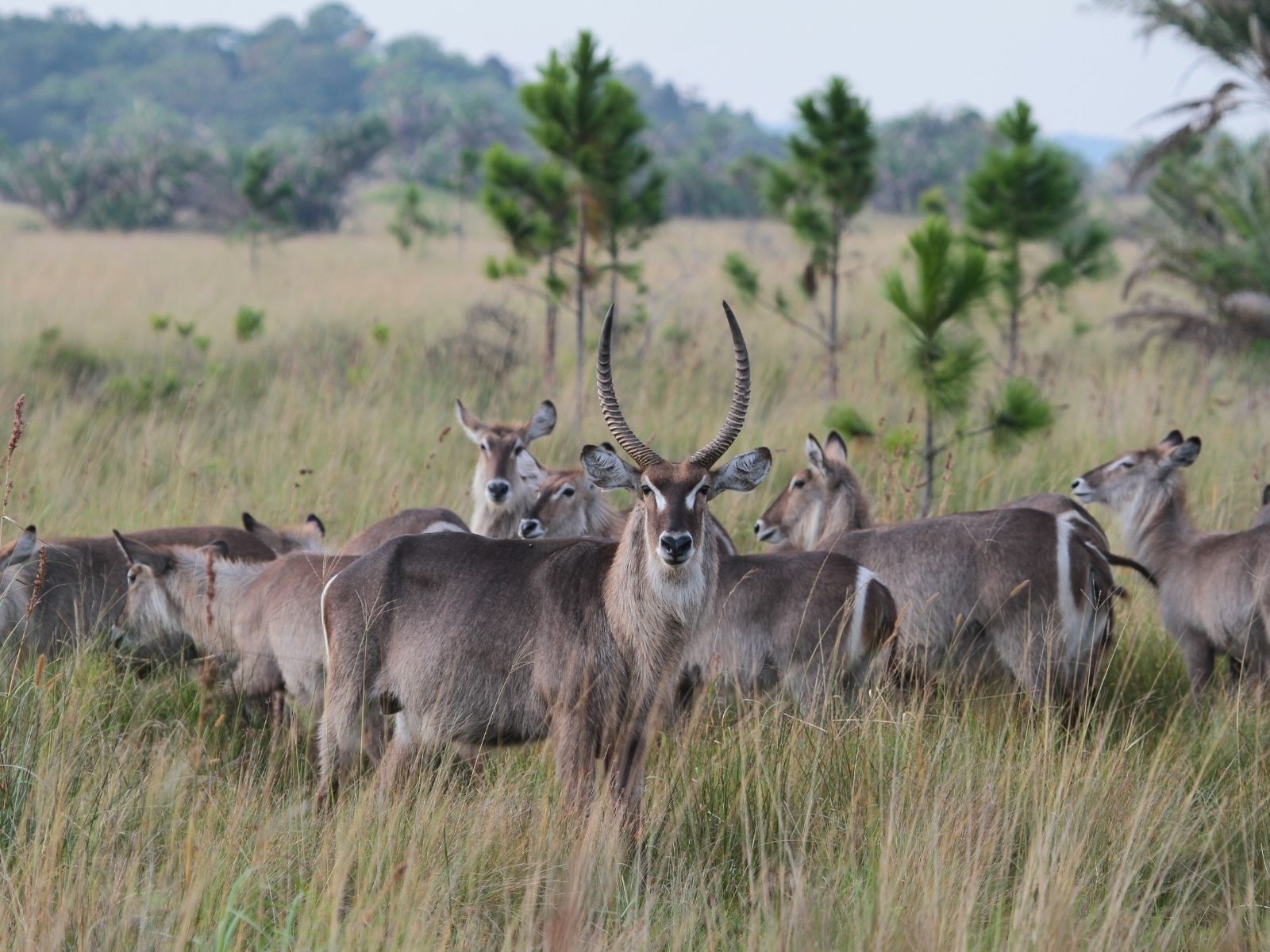
Common Waterbuck
Kobus ellipsiprymnus ellipsiprymnus

2025 Red list status
Least Concern

Regional Population Trend
Stable
change compared
to 2016
No Change
Overview
Kobus ellipsiprymnus ellipsiprymnus – (Ogilbyi, 1833)
ANIMALIA – CHORDATA – MAMMALIA – ARTIODACTYLA – BOVIDAE – Kobus – ellipsiprymnus
Common Names: Common Waterbuck (English), Waterbok, Kringgat (Afrikaans), Isidumuka (Ndebele), Phitlwa, Tomoga, Tumuga, Sekwêlê, Kwêlêkwêlê (Sepedi), Phitlwa (Sesotho), Letimoga, Motumoga, Tumoga (Setswana), Phiva, Isiphiva, Liphiva (Swati), Mhitlwa, Phiva (Tsonga), Phidwa, Phi, Dwa, Ngwelengwele (Venda), Isiphiva, Iphiva (Zulu), Cobe onctueux (French), Wasserbock (German)
Synonyms: No Synonyms
Taxonomic Status: Sub-species
Taxonomic Note:
Although previously regarded as separate species, the Defassa Waterbuck and the Common Waterbuck are now listed as the subspecies Kobus ellipsiprymnus defassa and K. e. ellipsiprymnus, respectively. These subspecies can be distinguished by differences in coat colouration, rump patterns, genetics (Lorenzen et al. 2006) and geographic range. Their distributions overlap somewhat in East Africa, where genetically intermediate populations exist, suggesting a high degree of hybridisation in the Nairobi National Park population in Kenya (Lorenzen et al. 2006).
| Red List Status |
| LC – Least Concern, (IUCN version 3.1) |
Assessment Information
Assessors: Patel, T.1 & da Silva, J.2
Reviewer: Anderson, J.3, 4
Institutions: 1Endangered Wildlife Trust, 2South African National Biodiversity Institute, 3International Conservation Services, 4IUCN SSC Antelope Specialist Group
Previous Assessors and Reviewers: Parrini, F. & Relton, C.
Previous Contributors: Child, M.F. & IUCN SSC Antelope Specialist Group
Assessment Rationale
This subspecies is widespread and common throughout the assessment region. For example, there was an estimated 3,763–8,907 individuals (2012 count) in Kruger National Park (KNP) alone. Within the natural range, the mature population size (assuming a 70% mature population structure) was estimated to be at least 14,392–17,993 animals on 386 protected areas and ranches (counts between 2012 and 2015). The population is thought to be stable or increasing through reintroduction across its range (and outside of its natural range) on private lands. While globally the subspecies is thought to be declining slowly, there are no major identified threats that could cause range-wide decline or any evidence for decline within the assessment region. Thus, we retain the Least Concern listing. A significant threat to the species is the loss of suitable habitat due to encroachment of woody plants caused by over-utilization by other herbivores and high tick burdens. Potential local threats, including bushmeat poaching and hybridisation with exotic subspecies through unregulated translocation, should be quantified. Additionally, increasing spells of drought due to climate change represent an emerging threat to this subspecies as stochastic population models predict that Waterbuck will be one of the species at highest risk from future increase in drought periods. Such threats should all be monitored.
Regional population effects: Dispersal through the transfrontier parks, such as the Greater Mapungubwe Transfrontier Conservation Area and the Greater Kruger Transfrontier Park is suspected. Anecdotal evidence suggests that this species evades fence boundaries by dispersing along waterways.
Reasons for Change
Reason(s) for Change in Red List Category from the Previous Assessment: No change
Red List Index
Red List Index: No change
Recommended citation: Patel T & da Silva JM. 2025. A conservation assessment of Kobus ellipsiprymnus ellipsiprymnus. In Patel T, Smith C, Roxburgh L, da Silva JM & Raimondo D, editors. The Red List of Mammals of South Africa, Eswatini and Lesotho. South African National Biodiversity Institute and Endangered Wildlife Trust, South Africa.
Regional Distribution and occurrence
Geographic Range
The former range of this species expanded across much of sub-Saharan Africa; however, overexploitation led to large-scale range contraction and restriction to protected areas and areas with extremely low human density (IUCN SSC Antelope Specialist Group 2016).
Kobus e. defassa has a much broader distribution compared to that of K. e. ellipsiprymnus, occurring across much of central and eastern Africa, extending somewhat into western Africa to Senegal (although they are now extinct in The Gambia) (Spinage 2013). The Waterbuck extends from East Africa, where its range overlaps with that of the Defassa Waterbuck, through Mozambique, Zambia, Zimbabwe, Botswana, Namibia and into South Africa (Skinner & Chimimba 2005). In Namibia, this species was previously restricted to the Caprivi Strip, but has been more recently introduced onto private lands in the north of the country (Skinner & Chimimba 2005). Significant range contraction occurred historically in Zimbabwe and due to the civil war in Mozambique, but recent reintroduced into parts of their former range have taken place (Skinner & Chimimba 2005).
Within the assessment region, the Waterbuck was previously restricted to the savannah woodlands of northeastern South Africa, with the range extending westwards along the Limpopo River, and reaching its southern limit around Hluhluwe-iMfolozi Park in KwaZulu-Natal. However, recent introductions onto protected areas and private lands outside of their native range, as well as reintroductions throughout their former range, have occurred across a number of provinces in South Africa. For example, while it occurred historically in the northern bushveld areas of North West Province (Rautenbach 1982) (in which it has been reintroduced), it has been introduced in other areas of the province where a number of escapees from ranches have created free-roaming subpopulations (Buijs 2010; Power 2014). In Eswatini, their native range was limited to the northeast of the country, however they have been introduced onto reserves in the middleveld and lowveld regions of Eswatini (Skinner & Chimimba 2005).
Elevation / Depth / Depth Zones
Elevation Lower Limit (in metres above sea level): (Not specified)
Elevation Upper Limit (in metres above sea level): (Not specified)
Depth Lower Limit (in metres below sea level): (Not specified)
Depth Upper Limit (in metres below sea level): (Not specified)
Depth Zone: (Not specified)
Biogeographic Realms
Biogeographic Realm: Afrotropical
Map
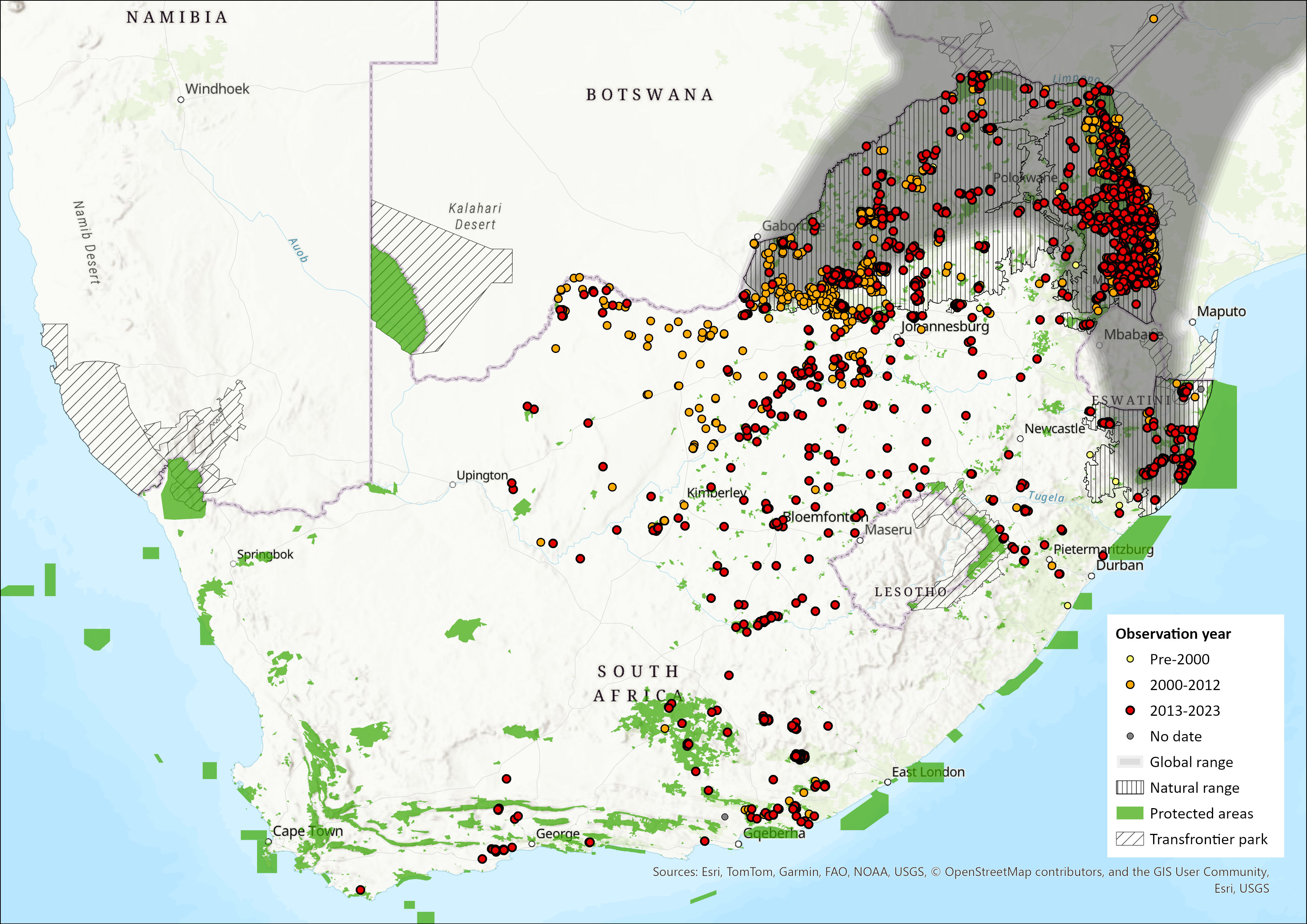
Figure 1. Distribution records for Common Waterbuck (Kobus ellipsiprymnus ellipsiprymnus) within the assessment region (South Africa, Eswatini and Lesotho). Note that distribution data is obtained from multiple sources and records have not all been individually verified.
Countries of Occurrence
| Country | Presence | Origin | Formerly Bred | Seasonality |
| Angola | Extant | Native | – | – |
| Benin | Extant | Native | – | – |
| Botswana | Extant | Native | – | – |
| Burkina Faso | Extant | Native | – | – |
| Burundi | Extant | Native | – | – |
| Cameroon | Extant | Native | – | – |
| Central African Republic | Extant | Native | – | – |
| Chad | Extant | Native | – | – |
| Congo | Extant | Native | – | – |
| Congo, The Democratic Republic of the | Extant | Native | – | – |
| Côte d’Ivoire | Extant | Native | – | – |
| Eritrea | Extant | Native | – | – |
| Eswatini | Extant | Native | – | – |
| Ethiopia | Extant | Native | – | – |
| Gabon | Extant | Native | – | – |
| Gambia | Possibly Extinct | Vagrant | – | – |
| Ghana | Extant | Native | – | – |
| Guinea | Extant | Native | – | – |
| Guinea-Bissau | Extant | Native | – | – |
| Kenya | Extant | Native | – | – |
| Malawi | Extant | Native | – | – |
| Mali | Extant | Native | – | – |
| Mozambique | Extant | Native | – | – |
| Namibia | Extant | Native | – | – |
| Niger | Extant | Native | – | – |
| Nigeria | Extant | Native | – | – |
| Rwanda | Extant | Native | – | – |
| Senegal | Extant | Native | – | – |
| Sierra Leone | Extant | Native | – | – |
| Somalia | Extant | Native | – | – |
| South Africa | Extant | Native | – | – |
| Sudan | Extant | Native | – | – |
| Tanzania, United Republic of | Extant | Native | – | – |
| Togo | Extant | Native | – | – |
| Uganda | Extant | Native | – | – |
| Zambia | Extant | Native | – | – |
| Zimbabwe | Extant | Native | – | – |
Large Marine Ecosystems (LME) Occurrence
Large Marine Ecosystems: (Not specified)
FAO Area Occurrence
FAO Marine Areas: (Not specified)
Climate change
Increasing spells of drought due to climate change represent an emerging threat to this subspecies as stochastic population models predict that Waterbuck will be one of the species at highest risk from future increase in drought periods through a change in habitat quality and forage availability, which results in local declines.
Population information
A global population of approximately 200,000 Waterbuck has been estimated, comprising about 95,000 Defassa Waterbuck and 105,000 Waterbuck (East 1999). No recent global population estimate is available (IUCN SSC Antelope Specialist Group 2016). Within the assessment region, recent data captured from provinces were not robust enough to update the population numbers from the 2016 assessment. There is no evidence to suggest a change in population size that would affect the conservation status of this species at present.
There were estimated (using distance sampling; 2012 count) 3,763–8,907 animals in KNP alone (Ferreira et al. 2013). Across the country, there are estimated to be 29,163–38,070 animals on 607 protected areas and ranches (counts between 2012 and 2015), but this includes a number of extra-limital subpopulations. Within the natural range alone, there are estimated to be 20,560–25,704 animals on 386 protected areas and ranches (counts between 2012 and 2015), which corresponds to 14,392–17,993 mature animals using a 70% mature population structure. Within formally protected areas alone inside the natural range, there are an estimated 7,497–12,623 animals (counts between 2012 and 2015; 33 protected areas), which corresponds to 5,236–8,836 mature animals. These may well be underestimates as not all counts for all protected areas are available and some areas are under-counted. However, we infer that there are over 10,000 mature individuals throughout the natural range in total.
Generation length is calculated as 7.1 years, yielding a three generation window of c. 21 years (1994–2015). Over this period, the population was inferred to be stable or increasing in formally protected areas. For example, on Botsalano Game Reserve, Borakalalo Nature Reserve, Kgaswane Mountain Reserve and Pilanesberg National Park in North West province, groups have been stable since 1999 (Nel 2015); and KwaZulu-Natal protected areas are also largely stable or increasing (Ezemvelo KZN Wildlife unpubl. data) with the largest population, around 450 individuals, in iSimangaliso Wetland Park. However, there are local declines in some areas. For example, in Hluhluwe-Imfolozi Park, the population declined from 1400 in 1971 to about 120 in 2016 (Cromsigt et al 2017), in Mafikeng Nature Reserve, North West, declines were observed from 125 in 1999 to 67 in 2015 (Nel 2015). On Free State provincial protected areas (extra-limital), the population increased from 50 in 2004 to 388 in 2014 at an average annual growth rate of 44% (E. Schulze unpubl. data). Groups of animals on private land are also suspected to be stable. Globally, the subspecies is suspected to be declining (IUCN SSC Antelope Specialist Group 2016).
Within favourable habitats, populations of Waterbuck can reach relatively high densities, for example in Lake Nakuru National Park, Kenya, densities of more than 10 individuals / km² were recorded (East 1999). However, in other areas, aerial surveys produced density estimates of 0.05–0.15 individuals / km², and higher estimates of 0.2–0.9 individuals / km² have been documented in certain habitats (East 1999). Ground surveys in areas where Waterbuck are particularly common produced density estimates of 0.4–1.5 individuals / km². In favourable habitat, although this species may be locally abundant, Waterbuck do not constitute a large proportion of the antelope community in general, due to their strict water requirements (Melton 1997).
Population Information
|
Continuing decline in mature individuals? |
Qualifier |
Justification |
|
No |
– |
– |
Current population trend: Stable
Extreme fluctuations in the number of subpopulations: (Not specified)
Continuing decline in number of subpopulations: (Not specified)
All individuals in one subpopulation: No
Number of mature individuals in largest subpopulation: Probably about 2,500-6,000 in Kruger National Park.
Severely fragmented: No. While most subpopulations occur in fenced reserves or ranches, this subspecies can use waterways to disperse.
Quantitative Analysis
Probability of extinction in the wild within 3 generations or 10 years, whichever is longer, maximum 100 years: (Not specified)
Probability of extinction in the wild within 5 generations or 20 years, whichever is longer, maximum 100 years: (Not specified)
Probability of extinction in the wild within 100 years: (Not specified)
Population genetics
Two subspecies are recognised of K. ellipsiprymnus: the Common (K. e. ellipsiprymnus) and Defassa (K. e. defassa) Waterbuck (Spinage 1982; Birungi and Arctander 2001; Lorenzen et al. 2006); however, due to their phenotypic and karyotypic differences, some recommend their elevation to full species level (Kingswood et al. 1998; Groves and Grubb 2011). While hybridisation can occur at contact zones between subspecies, this has only been found to occur in a few isolated along a narrow hybridisation zone (e.g., in Kenya). Overall, the two subspecies are deemed to be separate allopatrically diverging evolutionary lineages (Lorenzen et al. 2006).
While a population genomic study has been conducted on the species and identified high levels of genetic diversity within both subspecies (Wang et al. 2024; albeit no samples from the assessment region were included); a fine-scale investigation looking at structure within K. e. ellipsiprymnus has not been undertaken. However, given that large-horned bulls are translocated between wildlife ranchers to improve trophy quality in the herds (Turnbull-Kemp pers. comm.), it is possible the subspecies exists as a metapopulation within and outside the assessment region. Based on population estimates noted in the Population section, greater than
14,000 mature individuals make up this metapopulation. The effective population size can therefore be loosely inferred after applying a Ne/Nc conversion ratio of 0.1-0.3, yielding a Ne of at least 1,400-4,200 individuals.
Habitats and ecology
As their name indicates, this species is restricted to well-watered habitats, having remarkably high water requirements (Taylor et al. 1969). Preferring dense woody vegetation of savannah woodlands and forest-savannah mosaics (Melton 1997; East 1999), Waterbuck are commonly associated with floodplain and vlei regions (Skinner & Chimimba 2005). Along the Zambezi River, they are often found along the rocky hills in the vicinity of the river (Skinner & Chimimba 2005), and in Ethiopia they have been recorded up to 2,100 m asl (Yalden et al. 1996). Although dependent on water, they are not as aquatic as the Lechwe, Kobus leche, but also not as independent as the Kob, Kobus kob (Spinage 2013). The Waterbuck persist in drier regimes than the Defassa Waterbuck (Spinage 2013).
Waterbuck are classified as grazers, with a more diversified diet in the wet season and a less diversified diet at the end of the dry season. Waterbuck have been observed to occasionally include browse material (up to 35% of the diet in the Defassa Waterbuck in Benin) in their diet during the dry season (Kassa et al. 2008). They have been observed supplementing their diet with Umbrella Thorn, Vachellia (previously Acacia) tortilis, as well as Marula, Sclerocarya birrea, fruits. Hoffmann (1973) described Waterbuck as efficient in fibre digestion, and thus roughage feeders. In Hluhluwe-iMfolozi Park (previously Umfolozi Game Reserve), Melton (1978) found that, due to restricted forage in the dry season, Waterbuck were out-competed by Nyala, Tragelaphus angasii, and Impala, Aepyceros melampus. This, in combination with bush encroachment and high tick infestation, resulted in significant Waterbuck calf mortality during the 1970s. However, following the reduction of other antelope during a management response to drought conditions in the 1980s, Waterbuck populations began to stabilise (Melton 1997). However, the population later declined further (Cromsigt et al 2017).
Waterbuck are gregarious, forming herds of usually less than 10 individuals comprising of either bachelor males, or females and young (Melton 1997). Solitary territorial males will defend territories of up to about 2 km² of prime habitat in close vicinity to water, and female herds commonly form home ranges that encompass several territorial males (Melton 1997). Waterbuck breed throughout the year, although calves in the KNP and Hluhluwe-iMfolozi Park are most commonly born between October and March (Pienaar 1963; Fairall 1968; Melton 1983). The gestation period of Waterbuck is approximately 280 days (Spinage 1982), and during parturition the female will leave the herd to give birth to one or, very occasionally, two calves (Skinner & Chimimba 2005). For the first 3–4 weeks of their lives, the calf is hidden from predators in tall grass or underbush, where the mother returns frequently to feed and clean her calf (Skinner & Chimimba 2005). Calves are weaned after approximately 276 days (Spinage 1982).
Ecosystem and cultural services: Although historical records proposed that Waterbuck were unfavourable prey for both predators and humans alike, due to their musky smell, this statement is considered erroneous, as Waterbuck are commonly preyed upon by both (Melton 1997). In Mpumalanga and KwaZulu-Natal, 60–80% of Waterbuck predation events were attributed to Lions, Panthera leo, however, this species is also a valuable prey species for Spotted Hyena (Crocuta crocuta), Leopard (Panthera pardus), Cheetah (Acinonyx jabatus) and Nile Crocodile (Crocodylus niloticus) (Melton 1997).
IUCN Habitats Classification Scheme
| Habitat | Season | Suitability | Major Importance? |
| 1.5. Forest -> Forest – Subtropical/Tropical Dry | – | Suitable | – |
| 2.1. Savanna -> Savanna – Dry | – | Suitable | – |
| 3.5. Shrubland -> Shrubland – Subtropical/Tropical Dry | – | Suitable | – |
| 4.5. Grassland -> Grassland – Subtropical/Tropical Dry | – | Suitable | – |
Life History
Generation Length: (Not specified)
Age at maturity: female or unspecified: Females have their first calf at three years of age in Southern Africa
Age at Maturity: Male: Probably physiologically by 2 years but socially only when territorial
Size at Maturity (in cms): Female: Shoulder height 1220 cm, weight up to 210 kg.
Size at Maturity (in cms): Male: Shoulder height 1290 cm, weight up to 290 kg
Longevity: up to 18 years in the wild (Kingdon and Hoffman 2013)
Average Reproductive Age: Females may conceive first at 20 months and are reproductively active for 10 years of age (Kingdon and Hoffman 2013)
Maximum horn Size (in cms): 100 cms
Size at Birth (in cms): average 13.5 kg
Gestation Time: 40 weeks
Reproductive Periodicity: Most calves in the regions a born in late summer
Average Annual Fecundity or Litter Size: one calf per year
Natural Mortality: (Not specified)
Breeding Strategy
Does the species lay eggs? No
Does the species give birth to live young? Yes
Does the species exhibit parthenogenesis? No
Does the species have a free-living larval stage? No
Does the species require water for breeding? No
Movement Patterns
Movement Patterns:(Not specified)
Congregatory: (Not specified)
Systems
System: Terrestrial, Freshwater (=Inland waters)
General Use and Trade Information
Waterbuck are used for food, trophy hunting and live animal sales. The proportion of animals from wild populations and from private ranches is unknown. Trophy hunting, if well controlled, will pose no threat to the species. The live trade will increase its area of occupancy as it is relocated to private reserves.
|
Subsistence: |
Rationale: |
Local Commercial: |
Further detail including information on economic value if available: |
|
Yes |
Bushmeat |
Yes |
Meat, trophies and live animal sales |
National Commercial Value: Yes
International Commercial Value: Yes
|
End Use |
Subsistence |
National |
International |
Other (please specify) |
|
1. Food – human |
true |
true |
– |
– |
|
15. Sport hunting/specimen collecting |
– |
true |
true |
– |
Is there harvest from captive/cultivated sources of this species? Yes
Harvest Trend Comments: Meat, trophies and live animal sales Live sales in South Africa are strong and the species’ value is good. This is largely supported by trophy hunting and the wildlife ranching industry. The demand for trophy animals for hunting remains strong.
Threats
Globally, Waterbuck have been eliminated throughout much of their range from hunting (Spinage 2013) and are thought to be declining (especially Defassa Waterbuck) at a slow but significant rate (IUCN SSC Antelope Specialist Group 2016). However, within the assessment region, this subspecies is well protected. Waterbuck are prevalent on many private farms and tend to be increasing in many areas. There are local declines with drought impacts, which result in a change in habitat quality and forage availability and may be exacerbated by climate change in the future. Possibly the greatest threat is woody plant encroachment brought about by over-utilisation by other herbivores and possibly the lack of fire. This impacts negatively on Waterbuck calf survival, and this can be exacerbated by high tick burdens. Waterbuck are susceptible to poaching due to their sedentary nature and association with agricultural lands and several population declines, some of them severe, have been documented in other parts of its range (IUCN SSC Antelope Specialist Group 2016). Within the assessment region, bushmeat hunting, often with domestic dogs (Canis familiaris), along protected area boundaries may also cause local declines. For example, it is very heavily impacted by poaching in Borakalalo Nature Reserve, North West (Nel 2015). If the progressive decline in the standards of custodianship of state-owned protected areas described in Patel et al. (2023) is not reversed, the losses to poaching will become the most important threat factor.
Conservation
The majority of the population lives in protected areas within the assessment region. Important subpopulations of Waterbuck occur in KNP and iSimangaliso Wetland Park, and there are also extensive numbers on private land (East 1999). As the effects of drought associated with climate change are unpredictable and not controllable, no specific interventions are necessary for this subspecies at present. However, protected area expansion, especially transfrontier protected areas, will benefit Waterbuck in the assessment region by facilitating dispersal and thus allowing for adaptation to climate change. Biodiversity stewardship schemes that protect wetlands and associated vegetation will also conserve key resource areas needed by this subspecies. However, the progressive decline in the standards of management in Provincial Protected Areas is a cause for serious concern for their future (Patel et al. 2023).
Recommendations for land managers and practitioners:
- This species requires ongoing monitoring and possible improvement of assessments on private land to provide better indication of population trends.
- Extra-limital subpopulations in formally protected areas should be removed, such as in Molopo Nature Reserve, North West (Power 2014).
Research priorities:
- Basic ecological research is needed, as most of the existing literature are studies done during the 1960s to 1980s on Defassa Waterbuck, thus detailed information on the Waterbuck is lacking.
- Studies quantifying the severity of putative threats to enable conservation planning.
Encouraged citizen actions:
- Landowners should create conservancies for this species and engage local stakeholders to create sustainable, wildlife-based rural economies.
- Report sightings on virtual museum platforms (for example, iNaturalist and MammalMAP), especially of free-roaming herds outside protected areas and private lands.
Bibliography
Birungi, J. & Arctander, P. Molecular systematics and phylogeny of the Reduncini (Artiodactyla: Bovidae) inferred from the analysis of mitochondrial cytochrome b gene 760 sequences. Journal of Mammalian Evolution 8, 125-47 (2001).
Buijs, D. 2010. Aerial survey of wildlife and domestic stock on tribal land in North West Province 2010. DACERD, Mmabatho.
Cromsigt.J.P.M, S. Archubald & N. Owen-Smith. 2017. Conserving Africa’s Mega-Diversity in the Anthropocene. Cambridge University Press. 406 pp.
Duncan C, Chauvenet AL, McRae LM, Pettorelli N. 2012. Predicting the future impact of droughts on ungulate populations in arid and semi-arid environments. PloS One 7: e51490.
East, R. (compiler). 1999. African Antelope Database 1998. IUCN, Gland, Switzerland and Cambridge, UK.
Fairall N. 1968. The reproductive seasons of some mammals in the Kruger National Park. Zoologica Africana 3: 189-210.
Ferreira S, Gaylard, A, Greaver, C, Hayes, J, Cowell C, Ellis G. 2013. Animal abundances in Parks 2012/2013. Scientific Services, SANParks, Skukuza, South Africa.
Groves, C. & Grubb, P. Ungulate taxonomy. (JHU Press, 2011).
Hoffmann R.R. 1973. The ruminant stomach : stomach structure and feeding habits of East African game ruminants. East African Monographs in Biology. East African Literature Bureau, Nairobi.
IUCN SSC Antelope Specialist Group. 2016. Kobus ellipsiprymnus. The IUCN Red List of Threatened Species 2016: e.T11035A50189324.
Kingswood, SC., Kumamoto, AT., Charter, SJ., Aman, RA & Ryder, OA. 1998. Brief communication. Centric fusion polymorphisms in waterbuck (Kobus ellipsiprymnus), Journal of Heredity, Volume 89, Issue 1, Pages 96–100, https://doi.org/10.1093/jhered/89.1.96
Kassa B, Libois R, Sinsin B. 2008. Diet and food preference of the waterbuck (Kobus ellipsiprymnus defassa) in the Pendjari National Park, Benin. African Journal of Ecology 46: 303-310.
Kingdon. J & M.Hoffman 2013. MAMMALS OF AFRICA. Vol VI: PIGS, HIPPOPOTAMUS, CHEVROTAIN, GIRAFFES, DEER AND BOVIDS. Bloomsbury, London. 704 pp.
Lorenzen, E.D., Simonsen, B.T., Kat, P.W., Arctander, P. and Siegismund, H.R. 2006. Hybridization between subspecies of waterbuck (Kobus ellipsiprymnus) in zones of overlap with limited introgression. Molecular Ecology 15: 3787-3799.
Melton DA. 1978. Ecology of waterbuck Kobus ellipsiprymnus (Ogilby, 1833) in the Umfolozi Game Reserve. D.Sc. Thesis. University of Pretoria, Pretoria, South Africa.
Melton DA. 1983. Population dynamics of waterbuck (Kobus ellipsiprymnus) in the Umfolozi Game Reserve. African Journal of Ecology 21: 77-91.
Melton DA. 1997. Waterbuck Kobus ellipsiprymnus. In: G. Mills and L. Hes (eds), The complete book of southern African mammals, pp. 290-291. Struik Publishers, Cape Town, South Africa.
Nel, P. 2015. Population estimates for large herbivores and predators in protected areas in the North West Parks Board November 2015. North West Parks Board.
Patel, T., Cowan, C., Little, I., Friedmann, Y. & Andy Blackmore. 2023. The State of Provincial Reserves in South Africa, Challenges and Recommendations. https://ewt.org/wp-content/uploads/2023/04/Provincial-Reserve-Management-Report-2023-FINAL-Print.pdf
Pienaar U deV. 1963. The large mammals of the Kruger National Park – their distribution and present day status. Koedoe 6: 1-37.
Power, R.J. 2014. The distribution and status of mammals in the North West Province. Department of Economic Development, Environment, Conservation & Tourism, North West Provincial Government, Mahikeng.
Rautenbach, I. L. 1982. Mammals of the Transvaal. Ecoplan monograph, N.S. Supplemento 1: 111-211.
Skinner, J.D. and Chimimba, C.T. (eds). 2005. The Mammals of the Southern African Subregion. Cambridge University Press, United Kingdom, Cambridge.
Spinage CA. 1982. A territorial antelope: the Uganda Waterbuck. Academic Press, London, UK.
Spinage, C.A. 2013. Kobus ellipsiprymnus Waterbuck. In: J. Kingdon & M. Hoffmann (ed.), The Mammals of Africa. VI. Pigs, Hippopotamuses, Chevrotain, Giraffes, Deer, and Bovids, pp. 461-468. Bloomsbury Publishing, London, UK.
Taylor CR, Spinage CA, Lyman CP. 1969. Water relations of the waterbuck, an East African antelope. American Journal of Physiology–Legacy Content 217: 630-634.
Yalden, D.W., Largen, M.J., Kock, D. and Hillman, J.C. 1996. Catalogue of the mammals of Ethiopia and Eritrea. 7. Revised checklist, zoogeography and conservation. Tropical Zoology 9: 73-164.