
Common Warthog
Phacochoerus africanus

2025 Red list status
Least Concern

Regional Population Trend
Increasing

change compared
to 2016
No Change
Overview
Phacochoerus africanus – (Gmelin, 1788)
ANIMALIA – CHORDATA – MAMMALIA – ARTIODACTYLA – SUIDAE – Phacochoerus – africanus
Common Names: Common Warthog, Eritrean Warthog, Warthog (English), Vlakvark (Afrikaans), Ngulubi (Ndebele), Kolobê (Sepedi, Setswana), Kolobe (Sotho), Mzanxi, Inyamatane (Swati), Ngulube (Tsonga), Ndlovudalana (Zulu), Phacochère Commun (French), Warzenschwein (German)
Synonyms: No Synonyms
Taxonomic Note:
During the 18th and 19th centuries two species of warthog were recognised: Phacochoerus aethiopicus (Pallas 1766) from the Cape Province of South Africa and Phacochoerus africanus (Gmelin 1788) from West Africa. In the early 20th century, mammalian taxonomists lumped the two species under P. aethiopicus. Palaeontologists, however, continued to recognise two distinct species based on the absence of incisors in P. aethiopicus and differences between the two species in the structure of the third molar. The Cape Warthog (P. aethiopicus aethiopicus) was extinct by the 1870s, but it was not until the rediscovery of the Somali Warthog (P. aethiopicus delamerei) in the horn of Africa (Grubb 2013) that the 20th century confusion over the classification of the two species of warthog was resolved. The history of the classification of warthogs is fully described by Grubb and D’Huart (2010). All southern African forms are referred to P. africanus.
Red List Status: LC Least Concern
Assessment Information
Assessor: Russo, I.M.1
Reviewer: Patel, T.2
Institutions: 1Cardiff University, 2Endangered Wildlife Trust
Previous Assessors: Swanepoel, M. & Schulze, E.
Previous Reviewers: Cumming, D. & Child, M.F.
Previous Contributor: Somers, M.J.
Assessment Rationale
Listed as Least Concern as the species is relatively widespread within the assessment region, they are abundant, and there are no major threats believed to be resulting in a significant population decline. From available game count data from formally protected areas, private nature reserves and game farms, there were an estimated 22,252 observed Common Warthogs within the assessment region at the time of the previous assessment. There is also evidence that the species is expanding its distribution in South Africa, both naturally and through introductions.
Regional population effects: The Common Warthog is widespread across sub-Saharan Africa from West Africa eastwards to Ethiopia and southwards through East Africa and southern Africa to South Africa There may be some dispersal across national boundaries and between neighbouring populations in Botswana, Zimbabwe, Mozambique, South Africa and Eswatini.
Reasons for Change
Reason(s) for Change in Red List Category from the Previous Assessment: No change
Red List Index
Red List Index: No change
Recommended citation: Russo IM. 2025. A conservation assessment of Phacochoerus africanus. In Patel T, Smith C, Roxburgh L, da Silva JM & Raimondo D, editors. The Red List of Mammals of South Africa, Eswatini and Lesotho. South African National Biodiversity Institute and Endangered Wildlife Trust, South Africa.
Regional Distribution and occurrence
Geographic Range
Within southern Africa, they occur in northeastern Namibia, and extensively in Botswana, Zimbabwe, Mozambique and South Africa. Within the assessment region, the species naturally occurs in the northern and eastern parts of the country from Limpopo Province to the Northern Cape. They occur throughout Mpumalanga, Limpopo and North West Provinces and marginally in Northern Cape Province, including Kgalagadi Transfrontier Park, and in the north-eastern areas of KwaZulu-Natal (Skinner & Chimimba 2005). Six isolated introduced subpopulations occur in southern KwaZulu-Natal (www.kznwildlife.com).
The Common Warthog has often been referred to as P.aethiopicus, but this is the binomial for the Cape Warthog that became extinct before 1870 (Skead 2011). Phacocoerus africanus has been introduced into the former range of P. aethiopicus aethiopicus, including Eastern Cape, Free State and Northern Cape Provinces. Boshoff and Kerley (2013) concluded that the Orange River probably represented the northern boundary between the Cape and Common Warthog (where all records south probably refer to the Cape Warthog), while the Tugela River was the southerly limit for the species and records south of 30°S and between 27° and 30°E refer to Cape Warthog. The first extra-limital introductions were made in 1960s and 1970s. An unknown number of Common Warthogs sourced from the Hluhluwe-iMfolozi Park (KwaZulu-Natal), were introduced into Golden Gate Highlands National Park (GGHNP), Free State Province, between 1963 and 1968 (Penzhorn 1971). Another group of warthogs (N = 20) also sourced from Hluhluwe-iMfolozi were introduced into the Andries Vosloo Kudu Nature Reserve (AVKNR) (which now forms part of the Great Fish River Nature Reserve) in the Eastern Cape Province between 1976 and 1977 (Somers 1992a). In 1984, three warthogs were translocated from the AVKNR to the Rolfontein Nature Reserve (RNR) in the Northern Cape Province (unpubl. reserve records). They have also been reintroduced to areas of KwaZulu-Natal and Eastern Cape Provinces (Skinner & Chimimba 2005). It is unclear how widely they have been introduced into the Northern and Western Cape Provinces.
The species has been reintroduced into game reserves in Eswatini (Monadjem 1998), and likely occurs in low densities along the Caledon River in Lesotho, where their historical occurrence is documented in Boshoff and Kerley (2013), and they have been observed in the vicinity of the Caledon River in the Wepener area since 2013 (E. Schulze pers. obs.).
Warthogs are generally not contained within the borders of a property by standard wire or wire-mesh fencing and can be considered a “free-roaming” species in South Africa. Their home ranges may stretch across several fenced properties which includes crop, livestock and game farms, and private or public nature reserves (M. Swanepoel unpubl. data). This has enabled them to disperse and expand their distribution from the initial introduction points in the Eastern Cape and arid Karoo. It is expected that their dispersal and range expansion will continue into areas that meet their habitat requirements. This would include large parts of central and eastern South Africa, with the very arid west coast and the fynbos regions possibly the only exceptions. Since these free-roaming animals are subjected to hunting on private farms and reserves, formally protected areas, where no hunting takes place, might harbour core populations.
Elevation / Depth / Depth Zones
Elevation Lower Limit (in metres above sea level): 0
Elevation Upper Limit (in metres above sea level): 3500
Depth Lower Limit (in metres below sea level): (Not specified)
Depth Upper Limit (in metres below sea level): (Not specified)
Depth Zone: (Not specified)
Biogeographic Realms
Biogeographic Realm: Afrotropical
Map
Click on map to view/enlarge
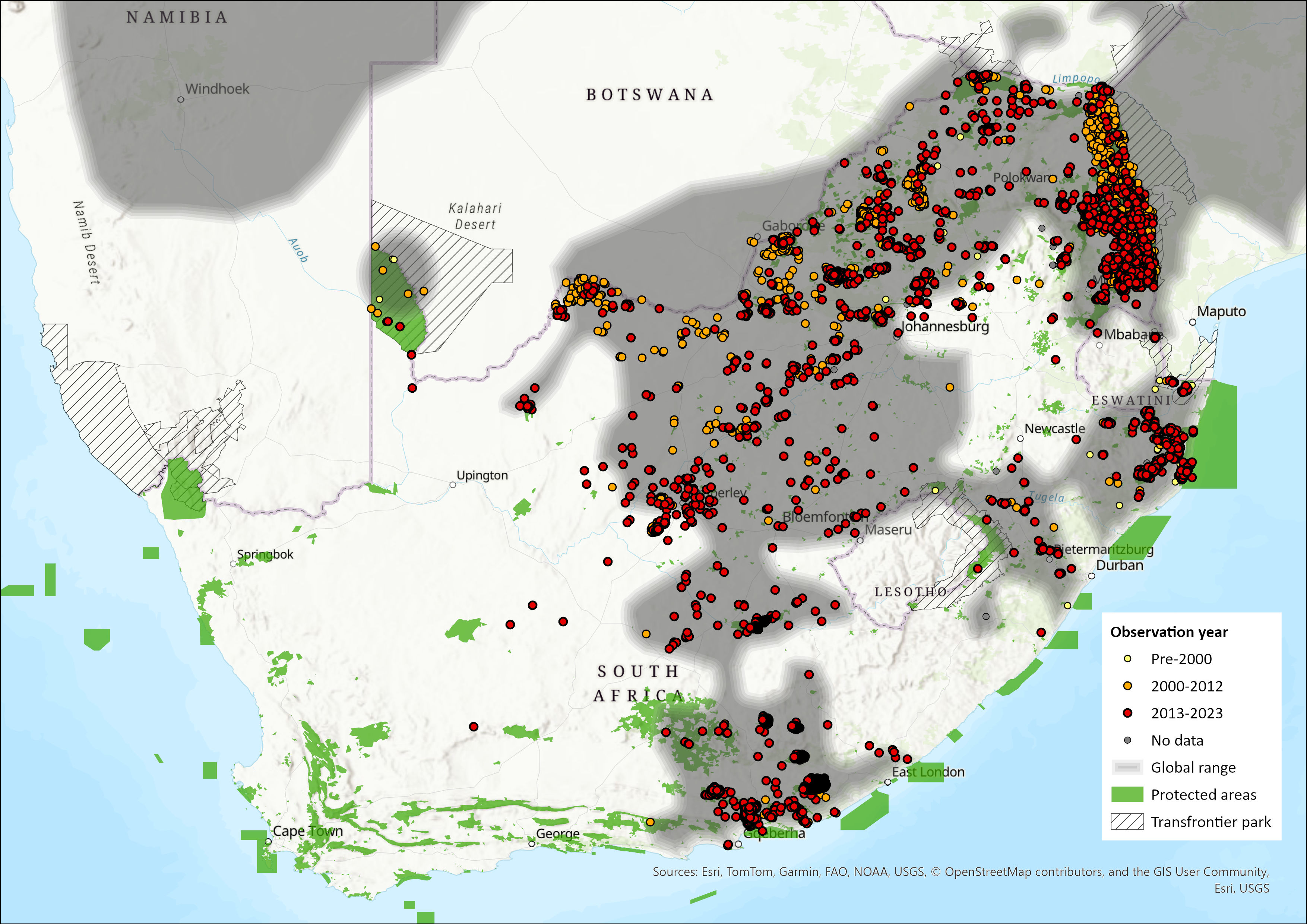
Figure 1. Distribution records for Common Warthog (Phacochoerus africanus) within the assessment region (South Africa, Eswatini and Lesotho). Note that distribution data is obtained from multiple sources and records have not all been individually verified.
Countries of Occurrence
| Country | Presence | Origin | Formerly Bred | Seasonality |
| Angola | Extant | Native | – | – |
| Benin | Extant | Native | – | – |
| Botswana | Extant | Native | – | – |
| Burkina Faso | Extant | Native | – | – |
| Burundi | Extant | Native | – | – |
| Cameroon | Extant | Native | – | – |
| Central African Republic | Extant | Native | – | – |
| Chad | Extant | Native | – | – |
| Congo | Extant | Native | – | – |
| Congo, The Democratic Republic of the | Extant | Native | – | – |
| Côte d’Ivoire | Extant | Native | – | – |
| Djibouti | Extant | Native | – | – |
| Eritrea | Extant | Native | – | – |
| Eswatini | Extant | Reintroduced | – | – |
| Ethiopia | Extant | Native | – | – |
| Gabon | Extant | Native | – | – |
| Gambia | Extant | Native | – | – |
| Ghana | Extant | Native | – | – |
| Guinea | Extant | Native | – | – |
| Guinea-Bissau | Extant | Native | – | – |
| Kenya | Extant | Native | – | – |
| Lesotho | Possibly Extant | Native | – | – |
| Liberia | Extant | Native | – | – |
| Malawi | Extant | Native | – | – |
| Mali | Extant | Native | – | – |
| Mauritania | Extant | Native | – | – |
| Mozambique | Extant | Native | – | – |
| Namibia | Extant | Native | – | – |
| Niger | Possibly Extinct | Native | – | – |
| Nigeria | Extant | Native | – | – |
| Rwanda | Extant | Native | – | – |
| Senegal | Extant | Native | – | – |
| Sierra Leone | Extant | Native | – | – |
| South Africa | Extant | Native | – | – |
| South Africa -> Eastern Cape Province | Extant | Introduced | – | – |
| South Africa -> Free State | Extant | Native | – | – |
| South Africa -> Gauteng | Extant | Native | – | – |
| South Africa -> Limpopo Province | Extant | Native | – | – |
| South Africa -> Mpumalanga | Extant | Native | – | – |
| South Africa -> North-West Province | Extant | Native | – | – |
| South Africa -> Northern Cape Province | Extant | Native | – | – |
| South Africa -> Western Cape | Extant | Introduced | – | – |
| Sudan | Extant | Native | – | – |
| Tanzania, United Republic of | Extant | Native | – | – |
| Togo | Extant | Native | – | – |
| Uganda | Extant | Native | – | – |
| Zambia | Extant | Native | – | – |
| Zimbabwe | Extant | Native | – | – |
Large Marine Ecosystems (LME) Occurrence
Large Marine Ecosystems: (Not specified)
FAO Area Occurrence
FAO Marine Areas: (Not specified)
Climate change
Climate change may become an emerging threat if it alters surface water distribution, thereby degrading habitat suitability for the species. For example, Ogutu et al. (2011) found warthogs to be influenced by rainfall patterns. The species is susceptible to drought, which may result in localised extinctions (Somers 1997), or localised population fluctuations.
Population information
The overall number of Common Warthog in Angola, Zambia, Tanzania and southwards was estimated at about 250,000 (Cumming 1999). Typical densities range from 1–10 individuals / km² in protected areas (Hunter 1998; Caro 2005; Cumming 2013). Densities in the iMfolozi Game Reserve, KwaZulu-Natal Province, ranged between 26.0 individuals / km² in 2006 and 22.8 individuals / km² in 2007 (White 2010). Within Kruger National Park alone, population size was estimated at between 2,000 and 5,000 individuals in 2012, or about 0.25 warthogs / km² (Ferreira et al. 2013). Overall, using composite data from 147 formally protected areas, private protected areas and game farms within the assessment region, the minimum observed population size for the species in 2013 was 22,252 individuals. In a typical sounder (a group of warthogs), the adults represent roughly 40%, but composition changes seasonally (Somers et al. 1995). Thus, there were estimated to be at least 8,900 mature individuals, which is very likely to be a significant underestimate.
Annual growth rates vary but can be as high as 40–45% under favourable conditions (for example, absence from predators, access to water and burrows, sufficient fodder), such as when introduced to a protected area without predators (Somers 1992a; Somers & Penzhorn 1992), but higher rates have been recorded. For example, in the 15 years since 43 warthog were introduced in Tussen die Riviere Nature Reserve in the Free State Province (protected area, no large predators), the population grew by an average of 62.6% per year, and highest growth rates (between 83% and 106% were recorded 8–11 years after introduction; E. Schulze unpubl. data).
Subpopulations are widespread across South Africa in national and provincial parks, private game reserves and wildlife ranches. Through the expansion of game ranching across South Africa, coupled with potentially high reproductive rates and potentially increasing dispersal events, the national population is likely to be increasing.
Population Information
| Continuing decline in mature individuals? | Qualifier | Justification |
| No | – | – |
Current population trend: Increasing due to their prevalence on private lands and their high potential growth rates.
Extreme fluctuations in the number of subpopulations: (Not specified)
Continuing decline in number of subpopulations: (Not specified)
All individuals in one subpopulation: (Not specified)
Number of mature individuals in population: At least 8,900.
Number of mature individuals in largest subpopulation: Between 2,000 and 5,000 individuals in Kruger National Park.
Number of Subpopulations: Unknown
Severely fragmented: No. Although they exist in fenced properties, they are able to disperse between properties.
Quantitative Analysis
Probability of extinction in the wild within 3 generations or 10 years, whichever is longer, maximum 100 years: (Not specified)
Probability of extinction in the wild within 5 generations or 20 years, whichever is longer, maximum 100 years: (Not specified)
Probability of extinction in the wild within 100 years: (Not specified)
Population genetics
Desert (Phacochoerus aethiopicus) and Common (P. africanus) Warthog have been considered a single species, but more recently molecular evidence has suggested that these Warthogs diverged at least 4.4 MYA (million years ago; Randi et al. 2002) and should be regarded as two separate species. In contrast, whole genome data have shown that the two species diverged much later than previously estimated (400,000-1,700,00 years ago; Garcia-Erill et al. 2022). Three Common Warthog refugia (western, eastern and southern Africa) have been identified in a study using microsatellite and mtDNA markers (Muwanika et al. 2003); yet four subspecies of Common Warthog are recognised: Phacochoerus aethiopicus africanus (western Africa), P. a. aeliani (eastern Africa), P. a. massaicus (central Africa) and P. a. sundevallii (southern Africa; Grubb 2005). To date, no study has included samples from the assessment region and the species remains understudied from a population genetics perspective.
The number of mature individuals has been estimated at least at 8,900 for the assessment region (see “Population” section). Using the Nc:Ne (effective population size) ratio of 0.1-0.3, the Ne is at least 890-2,670 individuals which are above the recommended number of 500 individuals per population to ensure long-term survival of the species, especially considering the metapopulation within the assessment region is likely extended to neighbouring countries.
Habitats and ecology
They inhabit moist and dry African savannah grasslands, open bushlands and woodlands (Cumming 2013), with varied climatic conditions across the continent, from the desert-like conditions of the Sahel zone (southern parts of Niger, Chad and Sudan) to temperate, subtropical and tropical conditions of East Africa (Kenya and Tanzania). Within the assessment region, it occupies a wide range of habitat, especially open woodland, shrubland, short grassland and floodplains (Skinner & Chimimba 2005). Its natural distribution corresponds with the Savannah biome, which is demarcated by altitudes from sea level to 2000 m, annual rainfall averages from 235–1,000 mm, diverse soil types and a temperate to tropical climate. It has been introduced to areas where the main vegetation types are primarily grassland, thicket and Nama Karoo. Although it usually occurs within range of perennial surface water, it may be the least water-dependent of all the suids and possibly obtains the majority of its required moisture from the food it consumes (Harris & Cerling 2002). Despite this, they readily drink and wallow when water is available. However, the evidence that warthog may be independent of water is anecdotal and based on occasional sightings where observers assumed surface water was not available. Warthogs will go down burrows to reach water below the surface in apparently waterless areas (D. Cumming pers. obs. 1968).
Common Warthogs have potentially high reproductive rates, combined with a polyandrous mating system, and males actively compete for mating opportunities and not habitat. They typically reach sexual maturity around 18–24 months, but juvenile females less than 12 months of age have been found pregnant (Somers 1992a). They can reproduce aseasonally in high rainfall regions where resources are plentiful but have distinct farrowing peaks in October and April in regions with a marked dry and wet season, such as South Africa. Litter sizes are usually between one and four but as many as eight have been recorded (Child et al. 1968). Average litter sizes that have been recorded are 3.7 (Child et al. 1968), 2.6 (Boshe 1981), 3.3 (Mason 1982) and 4 (Somers & Penzhorn 1992). Adoption may occur when a female with young is lost to predation or disease and another closely related lactating female within the sounder raises the young as her own (Plesner-Jensen et al. 1999). Both sexes are considered strongly philopatric with sounders belonging to clans of related individuals within a population (Cumming 1975; Muwanika et al. 2007; White & Cameron 2009). They are non-territorial and non-migratory animals who have large home ranges in their native habitat.
Ecosystem and cultural services: Common Warthogs are considered a pioneer species as they are one of the first species to inhabit and utilise previously disturbed habitats, potentially promoting nutrient turnover in soils and grasses and assisting in their restoration (Treydte et al. 2006a, 2006b). They have economical potential as a profitable species in terms of recreational and trophy hunting, eco-tourism and meat production. Considered a popular bushmeat species, they are hunted and utilised by local communities for subsistence and readily exterminated locally by hunting with domestic dogs. Local markets also trade in warthog ivory, obtained from the large canines (formal term for tusks in this family).
IUCN Habitats Classification Scheme
| Habitat | Season | Suitability | Major Importance? |
| 1.5. Forest -> Forest – Subtropical/Tropical Dry | – | Suitable | – |
| 2.1. Savanna -> Savanna – Dry | – | Suitable | – |
| 2.2. Savanna -> Savanna – Moist | – | Suitable | – |
| 4.5. Grassland -> Grassland – Subtropical/Tropical Dry | – | Suitable | – |
| 14.4. Artificial/Terrestrial -> Artificial/Terrestrial – Rural Gardens | – | Marginal | – |
Systems
System: Terrestrial
General Use and Trade Information
Common Warthogs have an economic value as a game animal hunted for trophy value and meat provision. International trade is for trophy hunting only – there are no live animals or animal meat traded through concern over the spread of African swine fever. Nationally, however, Common Warthogs are used for local subsistence, commercial meat provision, trophy and recreational hunting, and live animal auctions. Utilisation is unlikely to affect the population. However, the bushmeat trade is increasing rapidly, and in some areas, reserves close to human settlements have been stripped almost clean of wildlife. Warthogs are actively targeted in these hunts as they are easily killed (E. Schulze unpubl. data).
Research on the animal was previously directed towards identifying disease risks (Penrith 2009), ecological and biological aspects of introduced populations (Nyafu 2009; Mgqatsa 2010), avenues for management and utilisation of extra-limital populations, and aspects relating to the value of meat (Swanepoel et al. 2014). Additionally, the warthog’s potential for parasite transmission is being considered, specifically with regards to African Swine Fever and Bovine Tuberculosis (BTB; Renwick et al. 2007).
Wildlife ranching has extended the range of this species, and free-roaming subpopulations are expected to expand their distribution in South Africa where there is suitable habitat. They have been actively translocated from their native range to reserves and wildlife ranches across South Africa and high reproductive rates have allowed the species to establish and disperse to wildlife, livestock and crop farms. They are sometimes considered damage-causing animals when responsible for crop raiding or causing damage to fences. Damaged fences may allow previously excluded predators to gain access to vulnerable livestock and game animals. In some agricultural regions they are heavily persecuted by humans for loss reprisal. There are no domesticated Common Warthog subpopulations, but they are sometimes kept as pets.
As part of management efforts, the extensively distributed extra-limital subpopulations should rather be controlled and perhaps utilised to create rural and commercial meat production systems for local markets. Warthogs have a favourable carcass yield and can be utilised for commercial game meat production (Somers 1992b; Swanepoel et al. 2014). Assigning a monetary value to the species to establish and implement incentives for sustained management and utilisation strategies could further incentivise the shift from livestock agriculture to wildlife ranching.
| Subsistence: | Rationale: | Local Commercial: | Further detail including information on economic value if available: |
| Yes | Meat provision | Yes | Trophy hunting and live game sales |
National Commercial Value: Yes
International Commercial Value: No
| End Use | Subsistence | National | International | Other (please specify) |
| 1. Food – human | true | true | – | – |
Is there harvest from captive/cultivated sources of this species? Yes
Harvest Trend Comments: Game meat and trophy hunting. Not domesticated
Threats
There are currently no major threats to this species. It is widespread and tolerant, and shows remarkable resilience. Populations quickly recover due to their high reproductive rates and large litter sizes (Mason 1990; Somers & Penzhorn 1992). However, the species is susceptible to drought and overhunting or persecution, which may result in localised extinctions (Somers 1997), or localised population fluctuations.
Current habitat trend: Common Warthogs have a wide habitat tolerance in the region. They are primarily grazers and can successfully co-occur with livestock and game species through resource partitioning. On farmlands they have access to food, permanent water sources, and burrows, as the species responsible for digging burrows, such as Aardvark (Orycteropus afer) and Porcupine (Hystrix africaustralis) are distributed across South Africa. Farmlands encompass large areas of the total surface area of the provinces where warthogs occur; Limpopo (88.2%), Mpumalanga (60.9%), KwaZulu-Natal (71.4%), North West (85.1%), Eastern Cape (86.8%), Free State (90.9%) and Northern Cape (81.3%) (DAFF 2013). Thus, the habitat for Common Warthogs is stable.
Conservation
The Common Warthog is present in numerous protected areas, wildlife ranches and agricultural lands across its extensive range within the assessment region. The most important protected areas in their native range include Kruger National Park, Mapungubwe National Park and Marakele National Park in Limpopo Province; Madikwe Game Reserve and Pilanesberg National Park in North West Province; and Hluhluwe-iMfolozi Park and Ndumu Game Reserves in KwaZulu-Natal Province. In their introduced range, key protected areas include the Addo Elephant National Park and Mountain Zebra National Park in the Eastern Cape Province, Golden Gate Highlands National Park and Tussen die Rivere Nature Reserve in the Free State Province, and Mokala National Park in the Northern Cape Province.
Its sustainable use should be continued and enhanced by more formal structures to promote the Common Warthog as an alternative meat source for local communities and commercial markets, which may potentially reduce illegal bushmeat hunting. Conservancy formation will help to create stable and resilient subpopulations of this species that can be used commercially, while increasing management and research efforts should be directed to control extra-limital populations. Landowners should be made aware of alternative interventions to reduce fence and crop damage. For example, the use of swing-gates in game fencing has been shown to reduce the damage caused by warthogs burrowing under fences (Schumann et al. 2006). Similarly, Weise et al. (2014) trialled the use of discarded car tyres as wildlife passageways along the border of a Namibian wildlife ranch to reduce Common Warthog damage, which halved the number of holes needing to be repaired along the fence.
Recommendations for land managers and practitioners: The primary management recommendation is to manage the Common Warthog harvest sustainably. This is a key species to galvanise sustainable wildlife-based economies. More incentives and infrastructure should be put in place to ensure this species is used as a low-carbon, local source of protein to stimulate local economies to encourage game meat consumption and enhance national food security (Swanepoel et al. 2014). To do this, it is necessary to monitor subpopulations and their distribution across seasons, as this would directly influence the degree of harvesting pressure applied to a subpopulation. The best times to monitor subpopulations are during summer and spring, early morning, midday and late afternoon, as these are the times they are most visible (M. Swanepoel, unpubl. data). Secondly, accredited field abattoirs, which can inspect and process carcasses for commercial markets, must be established. Increasing the hunting pressure on cohorts such as piglets and yearlings would possibly simulate natural mortality and population regulation. This has been suggested for feral pig subpopulations, with the added emphasis on removing yearling sows (Gaillard et al. 2000; Gamelon et al. 2012).
Research priorities:
- There is uncertainty regarding the exact distribution of extra-limital subpopulations across central South Africa and the extent of translocations resulting in the spread of P. africanus into the former range of P. aethiopicus where it may be regarded as an invasive species (Skead 2007, 2011). However, this might not affect the current listing. Further research should nevertheless seek to delimit the extent of their current distribution and natural range expansions.
- Similarly, research into the ecological and biological factors contributing to the success of the Common Warthog as an introduced species, and their impact in these areas, should be undertaken. For example, understanding whether small livestock farms are shifting to large livestock or mixed farming practices following the introduction of the Common Warthog in the Northern Cape and Free State Provinces. This also includes documenting the internal parasites of extra-limital subpopulations with reference to native subpopulations.
- Determine the risk of Common Warthogs acting as long-term hosts and vectors of potentially harmful livestock and game animal diseases (for example, African Swine Fever).
- Methods of artificially simulating natural mortality patterns in Common Warthog subpopulations as management tool should be developed.
- Further research is needed on practical methods to mitigate the negative ecological and economic impacts caused by Common Warthogs.
Encouraged citizen actions:
- Consume Common Warthog meat and products to stimulate wildlife-based economies.
- Similarly, landowners should manage extra-limital warthog subpopulations commercially for local food consumption.
- Report sightings on virtual museum platforms (for example, iNaturalist and MammalMAP) to establish the extent of extra-limital distribution within the assessment region.
Bibliography
Boshe JI. 1981. Reproductive ecology of the warthog Phacochoerus aethiopicus and its significance for management in the eastern Selous Game Reserve, Tanzania. Biological Conservation 20: 37-44.
Boshoff AF, Kerley GIH. 2013. Historical Incidence of the Larger Mammals in the Free State Province (South Africa) and Lesotho. Centre for African Conservation Ecology, Nelson Mandela Metropolitan University, Port Elizabeth, South Africa.
Caro TM. 2005. Behavioural indicators of exploitation. Ethology Ecology & Evolution 17: 189-194.
Child G, Roth HH, Kerr M. 1968. Reproduction and recruitment patterns in warthog (Phacochoerus aethiopicus) populations. Mammalia 32: 6-29.
Cumming, D. H. M. 1999. Study on the development of Transboundary Natural Resource Management Areas in Southern Africa – Environmental Context. Natural Resources, Land Use, and Conservation. Biodiversity Support Program. Washington, DC, USA.
Cumming, D.H.M. 1975. A Field Study of the Ecology and Behaviour of Warthog. . National Museums& Monuments of Rhodesia, Salisbury.
Cumming, D.H.M. 2013. Phacochoerus africanus Common warthog. In: J.S. Kingdon and M. Hoffmann (eds), The Mammals of Africa, pp. 54-60. Bloomsbury, London.
DAFF. 2013. Abstract of Agricultural Statistics 2013. Department of Agriculture, Forestry and Fisheries, Pretoria, South Africa.
Ferreira S, Gaylard, A, Greaver, C, Hayes, J, Cowell C, Ellis G. 2013. Summary Report: Animal abundances in Parks 2012/2013. Scientific Services, SANParks, Skukuza, South Africa.
Gaillard J-M, Festa-Bianchet M, Yoccoz NG, Loison A, Toïgo C. 2000. Temporal variation in fitness components and population dynamics of large herbivores. Annual Review of Ecology and Systematics 31: 367-393.
Gamelon M, Gaillard J-M, Servanty S, Gimenez O, Toïgo C, Baubet E, Klein F, Lebreton J-D. 2012. Making use of harvest information to examine alternative management scenarios: a body weight-structured model for wild boar. Journal of Applied Ecology 49: 833-841.
Garcia-Erill G, Jørgensen, CHF, Muwanika VB, Wang X et al. 2022. Warthog genomes resolve and evolutionary conundrum and reveal introgression of disease resistance genes. Molecular Biology and Evolution 39(7): msac134.
Grubb P. 2005. Order Artiodactyla. In: Wilson DE, Reeder DAM. editor. Mammal species of the world: a taxonomic and geographic reference. Vol 1. Batlimore (MD). The John Hopkins University Press. p. 637-722.
Grubb, P. and d’Huart, J.P. 2010. Rediscovery of the Cape Warthog Phacochoerus aethiopicus: a Review. Journal of East African Natural History 99(2): 77-102.
Grubb. 2013. Genus Phacochoerus Warthogs. In: Kingdon JS, Hoffmann M (ed.), Mammals of Africa. Volume VI: Pigs, Hippopotamuses, Chevrotain, Giraffes, Deer and Bovids, pp. 50. Bloomsbury Publishing, London, UK.
Harris JM, Cerling TE. 2002. Dietary adaptations of extant and Neogene African suids. Journal of Zoology 256: 45-54.
Hunter, LTB. 1998. The behavioural ecology of reintroduced lions and cheetahs in the Phinda Resource Reserve, Kwazulu-Natal, South Africa. Ph.D. dissertation, University of Pretoria.
Mason DR. 1982. Studies on the biology and ecology of the warthog Phacochoerus aethiopicus sundevalli Lonnberg, 1908 in Zululand. D.Sc. Thesis. University of Pretoria, Pretoria, South Africa.
Mason DR. 1990. Juvenile survival and population structure of blue wildebeest and warthogs in the Central Region of the Kruger National Park during the mid-summer drought of 1988/89. Koedoe 33: 29-45.
Mgqatsa N. 2010. Diet and population trends of warthog in the Addo Elephant National Park. M.Sc. Thesis. Nelson Mandela Metropolitan University, Port Elizabeth, South Africa.
Monadjem A. 1998. The mammals of Swaziland. Conservation Trust of Swaziland and Big Games Parks, Mbabane, Swaziland.
Muwanika VB, Nyakaana S, Siegismund HR and Arctander P. 2003. Phylogeography and population structure of the common warthog (Phacochoerus africanus) inferred from variation in mitochondrial DNA sequences and microsatellite loci. Heredity 91:361-372.
Muwanika VB, Nyakaana S, Siegismund HR, Arctander P. 2007. Population genetic structure of the common warthog (Phacochoerus africanus) in Uganda: evidence for a strong philopatry among warthogs and social structure breakdown in a disturbed population. African Journal of Ecology 45: 22-30.
Nyafu, K. 2009. Warthog as an introduced species in the Eastern Cape. . MSc., Nelson Mandela Metropolitan University.
Ogutu JO, Piepho HP, Dublin HT, Bhola N, Reid RS. 2008. Rainfall influences on ungulate population abundance in the Mara-Serengeti ecosystem. Journal of Animal Ecology 77: 814-829.
Ogutu, J.O., Owen‐Smith, N., Piepho, H.P. and Said, M.Y. 2011. Continuing wildlife population declines and range contraction in the Mara region of Kenya during 1977–2009. Journal of Zoology 285: 99-109.
Penrith M-L. 2009. African swine fever: transboundary diseases. Onderstepoort Journal of Veterinary Research 76: 91-95.
Penzhorn BL. 1971. A summary of the re-introduction of ungulates into South African National Parks (to 31st Dec, 1970). Koedoe 14: 145-159.
Plesner-Jensen S, Siefert L, Okori JJL, Clutton-Brock TH. 1999. Age-related participation in allosuckling by nursing warthogs (Phacochoerus africanus). Journal of Zoology 248: 443-449.
Randi E, D’Huart J-P, Lucchini V and Aman R. 2002. Evidence of two genetically deeply divergent species of warthog, Phacochoerus africanus and P. aethiopicus (Artiodactyla: Suiformes) in East Africa. Mammalian Biology 67: 91-96.
Renwick AR, White PCL, Bengis RG. 2007. Bovine tuberculosis in southern African wildlife: a multi-species host–pathogen system. Epidemiology and Infection 135: 529-540.
Schumann M, Schumann B, Dickman A, Watson LH, Marker L. 2006. Assessing the use of swing gates in game fences as a potential non-lethal predator exclusion technique. South African Journal of Wildlife Research 36: 173-181.
Skead, C.J. 2007. Historical Incidence of the Larger Land Mammals in the broader Eastern Cape, Second Edition.In: Boshoff AF, Kerley GIH, Lloyd PH (ed.), Port Elizabeth: Centre for African Conservation Ecology, Nelson Mandela Metropolitan University.
Skead, C.J. 2011. Historical incidence of the larger land mammals in the broader Western and Northern Cape provinces.In: Boshoff A.F., Kerley G.I.H, Lloyd P. (ed.), Centre for African Conservation Ecology, Nelson Mandela Metropolitan University, Port Elizabeth.
Skinner, J.D. and Chimimba, C.T. (eds). 2005. The Mammals of the Southern African Subregion. Cambridge University Press, United Kingdom, Cambridge.
Somers MJ, Penzhorn BL. 1992. Reproduction in a reintroduced warthog population in the eastern Cape Province. South African Journal of Wildlife Research 22: 57-60.
Somers MJ, Rasa OAE, Penzhorn BL. 1995. Group structure and social behaviour of warthogs Phacochoerus aethiopicus. Acta Theriologica 40: 257-281.
Somers MJ. 1992a. The implications of social structure for the conservation and control of a warthog Phacochoerus aethiopicus population in the Andries Vosloo Kudu Reserve, Eastern Cape Province. M.Sc. Thesis. University of Pretoria, Pretoria, South Africa.
Somers MJ. 1992b. Warthog carcass yields in the Andries Vosloo Kudu Reserve. Pelea 11: 61-62.
Somers, M.J. 1997. The sustainability of harvesting a warthog population: assessment of management options using simulation modelling. . South African Journal of Wildlife Research 27: 37-43.
Swanepoel M, Leslie AJ, Hoffman LC. 2014. The influence of season and sex on the carcass yield of common warthog (Phacochoerus africanus). South African Journal of Wildlife Research 44: 179-188.
Treydte AC, Bernasconi SM, Kreuzer M, Edwards PJ. 2006a. Diet preferences of the common warthog on nutrient-enriched former cattle grounds on a coastal savanna in Tanzania. Journal of Mammalogy 87: 889-898.
Treydte AC, Halsdorf SA, Weber E, Edwards PJ. 2006b. Habitat use of warthogs on a former cattle ranch in Tanzania. Journal of Wildlife Management 70: 1285-1292.
Weise FJ, Wessels Q, Munro S, Solberg M. 2014. Using artificial passageways to facilitate the movement of wildlife on Namibian farmland. South African Journal of Wildlife Research 44: 161-166.
White AM, Cameron EZ. 2009. Communal nesting is unrelated to burrow availability in the common warthog. Animal Behaviour 77: 87-94.
White AM. 2010. A pigheaded compromise: do competition and predation explain variation in warthog group size? Behavioral Ecology 21: 485-492.