
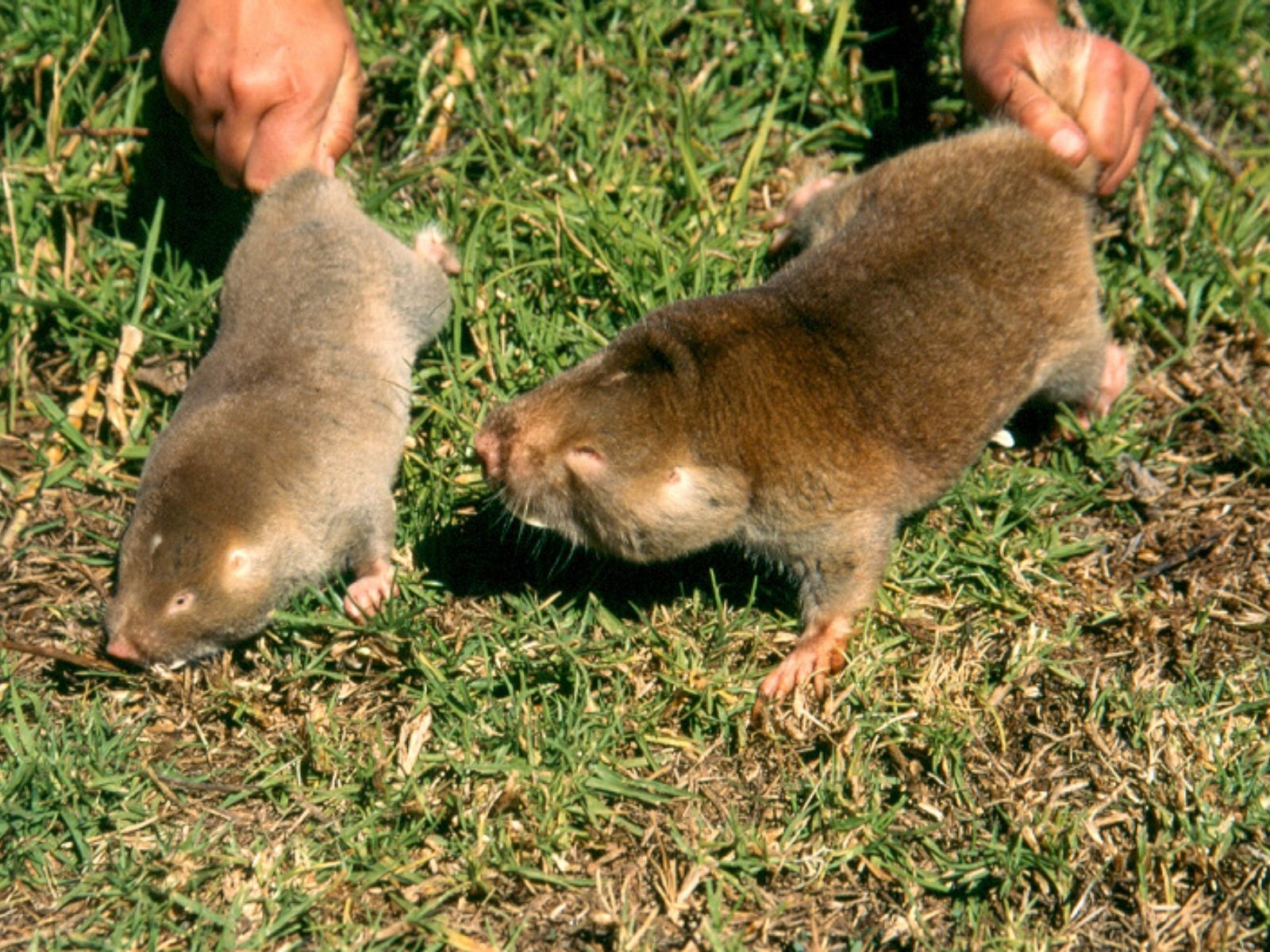
Cape Dune Mole-rat
Bathyergus suillus

2025 Red list status
Least Concern

Regional Population Trend
Stable

Change compared
to 2016
No Change
Overview
Bathyergus suillus – (Schreber, 1782)
ANIMALIA – CHORDATA – MAMMALIA – RODENTIA – BATHYERGIDAE – Bathyergus – suillus
Common Names: Cape Dune Mole Rat, Cape Dune Blesmol (English), Kaapse Duinmol (Afrikaans), Kap-Strandgräber (German)
Synonyms: Bathyergus africana (Lamarck, 1796); Bathyergus maritimus (Gmelin, 1788); Bathyergus suillus ssp. intermedius Roberts, 1926
Taxonomic Note: Earlier evidence uncovered Bathyergus suillus to be paraphyletic with regards to its sister species, B. janetta Visser et al. (2014). This has recently been validated by Sumbera et al (2024); however, the molecular markers used were likely not able to detect recent divergence. Given the strong morphological differences between the two, B. janetta is being maintained as a separate species.
Red List Status: LC – Least Concern, (IUCN version 3.1)
Assessment Information
Assessors: Bennett, N.1 & da Silva, J.2
Reviewer: Patel, T.3
Institutions: 1University of Pretoria, South Africa,2South African National Biodiversity Institute,3Endangered Wildlife Trust
Previous Assessors & Reviewers: N.C. Bennett., Visser, J., Maree, S. & Jarvis, J.
Previous Contributors: Wilson, B., Palmer, G., MacFadyen, D., Avery, M., Child, M.F., Relton, C., Avenant, N., Baxter, R., Monadjem, A. & Taylor, P.
Assessment Rationale
Although it has a limited distribution, the Cape Dune Mole-rat is listed as Least Concern because it is common within its distributional range and survives successfully within environments modified by humans, such as agricultural areas. In some areas they are considered locally abundant and even a pest. There are no major threats to this species.
Reasons for Change
Reason(s) for Change in Red List Category from the Previous Assessment: No Change
Red List Index
Red List Index: No change
Recommended citation: Bennett N & da Silva JM. 2025. A conservation assessment of Bathyergus suillus. In Patel T, Smith C, Roxburgh L, da Silva JM & Raimondo D, editors. The Red List of Mammals of South Africa, Eswatini and Lesotho. South African National Biodiversity Institute and Endangered Wildlife Trust, South Africa.
Regional Distribution and occurrence
Geographic Range
Endemic to South Africa, this species ranges along the coast of the Western Cape from Knysna to Lamberts Bay and Klawer. Additionally, this species is present in the Northern Cape near Groenrivier, having been recorded from Rondawel (Monadjem et al. 2015), where it occurs sympatrically with B. janetta (Faulkes et al. 2004). Its range extends inland approximately 80 km from South Africa’s western coastline. Generally, this species occurs at altitudes below 300 m above sea level, and its range is discontinuous along South Africa’s west coast, fragmented by mountains and rivers (Visser et al. 2014).
Elevation / Depth / Depth Zones
Elevation Lower Limit (in metres above sea level): (Not specified)
Elevation Upper Limit (in metres above sea level): 300
Depth Lower Limit (in metres below sea level): (Not specified)
Depth Upper Limit (in metres below sea level): (Not specified)
Depth Zone: (Not specified)
Map
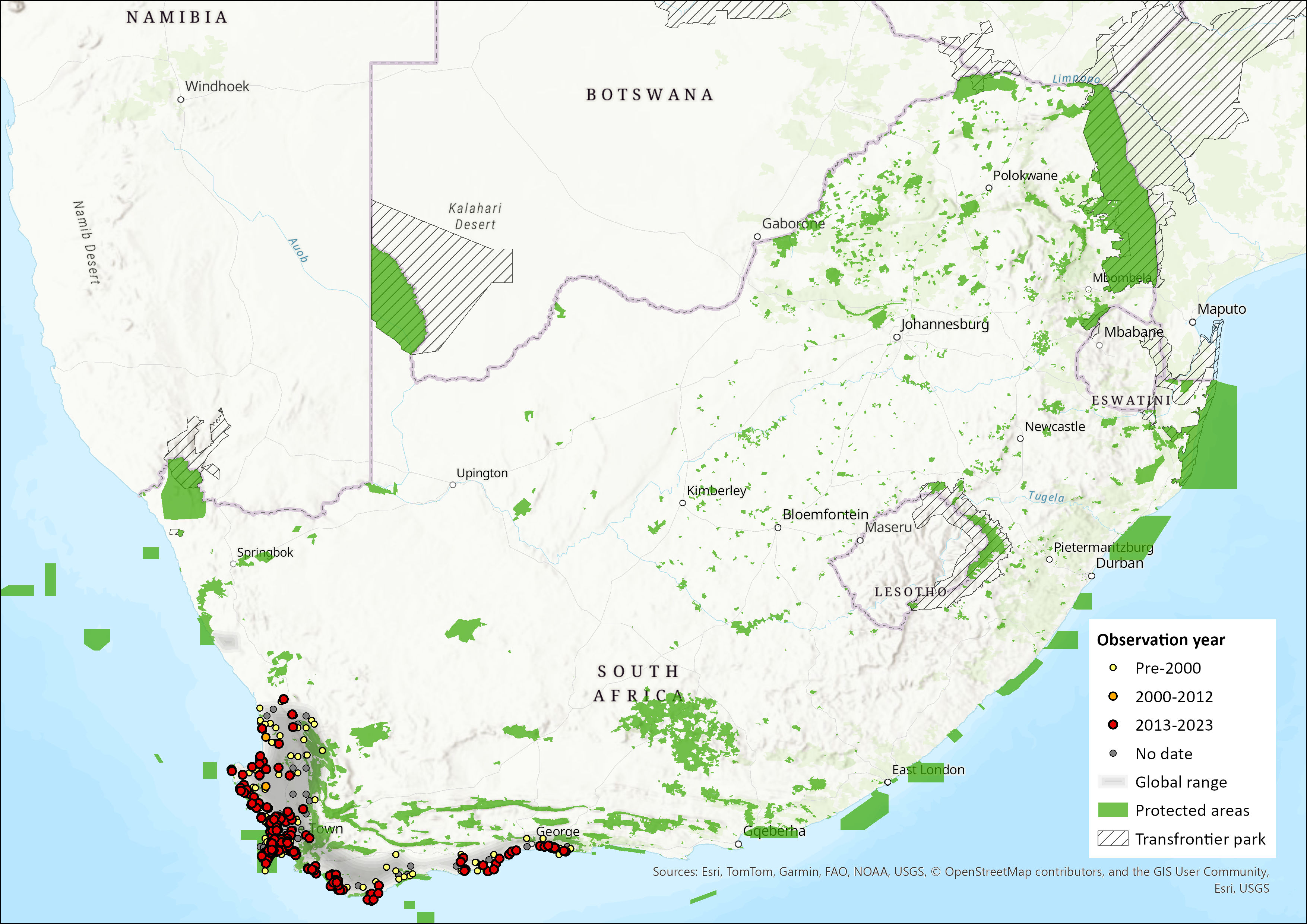
Figure 1. Distribution records for Cape Dune Mole Rat (Bathyergus suillus) within the assessment region (South Africa, Eswatini and Lesotho). Note that distribution data is obtained from multiple sources and records have not all been individually verified.
Biogeographic Realms
Biogeographic Realm: Afrotropical
Occurrence
Countries of Occurrence
| Country | Presence | Origin | Formerly Bred | Seasonality |
| South Africa | Extant | Native | – | – |
| South Africa -> Northern Cape Province | Extant | Native | – | – |
| South Africa -> Western Cape | Extant | Native | – | – |
Large Marine Ecosystems (LME) Occurrence
Large Marine Ecosystems: (Not specified)
FAO Area Occurrence
FAO Marine Areas: (Not specified)
Climate change
Climate change is unlikely to have an impact on this species as geology and drainage evolution has a larger influence on its distribution than does climate.
Population Information
Visser et al. (2014) found three major lineages across the species’ distribution with the sister species, B. janetta, regarded as paraphyletic with respect to this species. These lineages pertain to the West Coast, Struisbaai and Sedgefield areas, evidently separated by the Hottentots Holland Mountains and the Breede River, which act as phylogeographic disruptors. Importantly, however, every studied population (10 in total) was genetically unique in both their mitochondrial and nuclear DNA. It therefore seems that populations greater than 30 km apart may be considered as subpopulations due to a lack of gene-flow between them. Additionally, Visser et al. (2014) also found populations to be demographically stable or even expanding, with limited evidence of inbreeding. Within grassland habitats, population densities of this species have been recorded to reach over 300/ha (J.U.M. Jarvis unpubl. data).
Population Information
Continuing decline in mature individuals? No
Extreme fluctuations in the number of subpopulations: No
Continuing decline in number of subpopulations: No
All individuals in one subpopulation: No
Number of mature individuals in largest subpopulation: No
Number of Subpopulations: Many
Quantitative Analysis
Probability of extinction in the wild within 3 generations or 10 years, whichever is longer, maximum 100 years: No
Probability of extinction in the wild within 5 generations or 20 years, whichever is longer, maximum 100 years: No
Probability of extinction in the wild within 100 years: Possibly
Population Genetics
Using both mitochondrial DNA and microsatelite markers, Visser et al. (2014) investigated the population genetic structure within B. suillus and found eight well defined genetic subpopulations, corresponding to geographic barriers such as rivers and mountains dissecting their distributions.
No subpopulations are thought to have gone extinct, with most actually showing signs of expansion. Based on this information, the Convention of Biological Diversity’s Global Biodiversity Framework’s complementary indicator – the proportion of populations maintained- is calculated at 1.0 (8/8 subpopulations maintained). Given their stable or increasing status, it is likely that each have a healthy and stable effective population size (i.e., Ne> 500), which would equate to at least 5,000 mature individuals per subpopulation. Actual estimates of Ne may be acquired by reanalysing the dataset of Visser et al. (2014).
Habitats and ecology
Cape Dune Mole-rats are subterranean and occur in loose sandy and loamy soils along South Africa’s south and west coast, and alluvial sandy soils in riverine habitats. This species is one of few mammals considered endemic to the Cape Floristic region of south-western Africa (Visser et al. 2014), and along with Georychus capensis, has a clear preference for Fynbos vegetation (Mugo et al. 1995). Cape Dune Mole-rats are most commonly associated with sandveld habitats (Bennett and Faulkes 2000), and adapt successfully to landscapes transformed by humans, such as wheat fields, other agricultural areas and road verges. This species is often regarded as a pest on sporting areas (golf courses, bowling greens and tennis courts), and on wheat farms, where their mounds cause damage to reaping machine blades. It also undermines roads and chews through cables and irrigation pipes.
Cape Dune Mole-rats are generally solitary with individual burrows. They are seasonal breeders and produce between one and six young per litter (Hart et al. 2006). They consume underground roots and bulbs, as well as grasses and green forbs from above ground (Davies and Jarvis 1986). Independent from water, they are able to meet moisture requirements from food. It has a generation length of two years.
Similar to other Mole-rats (Cryptomys hottentotus and Georychus capensis), the Cape Dune Mole-rat is an important eco-engineer and plays a role in modifying soil properties and increasing the humic content of the sands in which it occurs (Hagenah and Bennett 2013). Burrowing activities by mole-rats may also enhance infiltration and the water holding capacity of soil (Hagenah and Bennett 2013).
IUCN Habitats Classification Scheme
| Habitat | Season | Suitability | Major Importance? |
| 8.2. Desert -> Desert – Temperate | – | Marginal | – |
| 14.1. Artificial/Terrestrial -> Artificial/Terrestrial – Arable Land | – | Suitable | – |
Life History
| Generation Length | Justification | Data Quality |
| 2 | – | good |
Age at Maturity: Female or unspecified: 2 years
Age at Maturity: Male: 1.5 years
Size at Maturity (in cms): Female: 30cm, 735g
Size at Maturity (in cms): Male: 31cm, 955g
Longevity: 8 years
Average Reproductive Age: 2 years
Maximum Size (in cms): 2kg
Size at Birth (in cms): 27-52g
Gestation Time: 50 days
Reproductive Periodicity: two litters per annum
Average Annual Fecundity or Litter Size: 3 (1-6)
Natural Mortality: Mole-snakes, jackals
Does the species lay eggs? No
Does the species give birth to live young: Yes
Does the species exhibit parthenogenesis: No
Does the species have a free-living larval stage? No
Does the species require water for breeding? No
Movement Patterns
Movement Patterns: overground dispersal
Congregatory: (Not specified)
Systems
System: Terrestrial
General Use and Trade Information
Cape Dune Mole-rats are utilised local communities as an additional source of protein, where the meat is considered a delicacy (Skinner and Chimimba 2005). For example, De Graaff (1981) recorded that four or five were caught weekly by some families, this being their only source of protein apart from fish.
|
Subsistence: |
Rationale: |
Local Commercial: |
Further detail including information on economic value if available: |
|
Yes |
– |
– |
– |
National Commercial Value: No
International Commercial Value: No
|
End Use |
Subsistence |
National |
International |
Other (please specify) |
|
1. Food – human |
– |
– |
– |
– |
Is there harvest from captive/cultivated sources of this species? for food
Harvest Trend Comments: n/a
Threats
The main threat to this species is habitat destruction due to the expansion of and human settlements and intensive agricultural production (sensu Rouget et al. 2003). While intensive agricultural production may reduce available habitat they can exist in agricultural landscapes, sometimes in high numbers if the area remains unworked for a couple of years. For example, all animals sampled in Visser et al. (2014) study were from agricultural areas that displayed no inbreeding and had demographically stable populations. Additionally, they are commonly killed on roads while dispersing above ground. Males sometimes range longer distances than usual in search of a mate, and mole-rats are also forced above ground when seasonal flooding takes place. In some parts of its range this species is classified as a pest, resulting in pest control procedures.
Conservation
This species occurs within several protected areas in the Western Cape, including Table Mountain National Park, Cederberg Wilderness Area and De Hoop Nature Reserve. No interventions are necessary at present but protected area expansion to protect genetically divergent populations would benefit this species.
Recommendations for land managers and practitioners: Population monitoring, including recordings of roadkill incidents.
Research priorities: A taxonomic revision of the genus Bathyergus is necessary, given the findings of Visser et al. (2014); long-term monitoring of the population to assess the severity of putative threats; identification of core conservation areas for this species. Recent research by Sumbera et al (2024) suggests Bathyergus may comprise of 1, 2 or even 4 species.
Encouraged citizen actions: Report sightings on virtual museum platforms (for example, iNaturalist and MammalMAP), especially outside protected areas.
Bibliography
Bennett, N.C. and Faulkes, C.G. 2000. African Mole-rats: Ecology and Eusociality. Cambridge University Press, Cambridge, UK.
Bennett, N.C. Faulkes, C.G., Hart, L. & Jarvis, J.U.M. (2009). The Cape mole-rat, Bathyergus suillus. Mammalian Species 828: 1-7.
Davies, K.C. and Jarvis, J.U. 1986. The burrow systems and burrowing dynamics of the mole-rats Bathyergus suillus and Cryptomys hottentotus in the fynbos of the south-western Cape, South Africa. Journal of Zoology 209: 125-147.
Faulkes, C.G., Verheyen, E., Verheyen, W., Jarvis, J.U.M. and Bennett, N.C. 2004. Phylogeographical patterns of genetic divergence and speciation in African mole-rats (Family: Bathyergidae). Molecular Ecology 13(3): 613-629.
Hagenah, N. and Bennett, N.C. 2013. Mole rats act as ecosystem engineers within a biodiversity hotspot, the Cape Fynbos. Journal of Zoology 289: 19-26.
Hart, L., O’Riain, M.J., Jarvis, J.U.M. and Bennett, N.C. 2006. Is the Cape dune mole-rat, Bathyergus suillus (Rodentia: Bathyergidae), a seasonal or aseasonal breeder? Journal of Mammalogy 87: 1078-1085.
IUCN. 2017. The IUCN Red List of Threatened Species. Version 2017-2. Available at: www.iucnredlist.org. (Accessed: 14 September 2017).
Monadjem, A., Taylor, P.J., Denys, C. and Cotterill, F.P.D. 2015. Rodents of Sub-Saharan Africa – a biogeographic and taxonomic synthesis. De Gruyter, Berlin/Munich/Boston.
Mugo, D.N., Lombard, A.T., Bronner, G.N. and Gelderblom, C.M. 1995. Distribution and protection of endemic or threatened rodents, lagomorphs and macrosceledids in South Africa. Journal of Zoology 30: 115-126.
Rouget, M., Richardson, D.M., Cowling, R.M., Lloyd, J.W. and Lombard, A.T. 2003. Current patterns of habtiat transformation and future threats to biodiversity in terrestrial ecosystems of the Cape Floristic Region, South Africa. Biological Conservation 112: 63-85.
Skead, C.J. 2011. Historical incidence of the larger land mammals in the broader Western and Northern Cape provinces.In: Boshoff A.F., Kerley G.I.H, Lloyd P. (ed.), Centre for African Conservation Ecology, Nelson Mandela Metropolitan University, Port Elizabeth.
Sumbera, R., Uhrova, M., Montoya_Sanhuesa, G., Btyjova, A., Bennett, N.C. & Mikula, O. (2024). Genetic and species diversity of the largest African mole-rat genus, Bathyergus. One, two or four soecies. Molecular Phylogenetics and Evolution 108157.
Skinner, J.D. and Chimimba, C.T. (eds). 2005. The Mammals of the Southern African Subregion. Cambridge University Press, United Kingdom, Cambridge.
Visser, J.H., Bennett, N.C. and van Vuuren, B.J. 2014. Local and regional scale genetic variation in the Cape dune mole-rat, Bathyergus suillus. PloS one 9(9).
de Graaff, G. 1981. The Rodents of Southern Africa: Notes on their Identification, Distribution, Ecology, and Taxonomy. Butterworths, Durban, Pretoria, South Africa.