
Butterfly Bat
Glauconycteris variegata

2025 Red list status
Least Concern

Regional Population Trend
Stable

Change compared
to 2016
No Change
Overview
Glauconycteris variegata – (Tomes, 1861)
ANIMALIA – CHORDATA – MAMMALIA – CHIROPTERA – VESPERTILIONIDAE – Glauconycteris – variegata
Common Names: Butterfly Bat, Leaf-winged Bat, Variegated Butterfly Bat (English), Vlindervlermuis (Afrikaans)
Synonyms: Chalinolobus variegatus (Tomes, 1861), Scotophilus variegatus Tomes, 1861
Taxonomic Note:
Two subspecies are currently recognised, but their validity remains uncertain (Happold 2013): Glauconycteris variegata phalaena from Sudan and Somalia, and G. v. variegata, which is distributed through the rest of the species range; including the assessment region (Skinner & Chimimba 2005). Glauconycteris machadoi is sometimes considered a melanistic subspecies of G. variegata (Monadjem et al. 2020), but is considered a distinct species by Happold (2013).
Red List Status: LC – Least Concern, (IUCN version 3.1)
Assessment Information
Assessors: Richards L.R.1 & da Silva, J.M.2
Reviewer: Smith, C.3
Institutions: 1Durban Natural Science Museum, 2South African National Biodiversity Institute, 3Endangered Wildlife Trust
Previous Assessors and Reviewers: Schoeman, C., Taylor, P., White, W., Cohen, L., Jacobs, D., MacEwan, K., Richards, L, Sethusa, T. & Monadjem, A.
Previous Contributors: Roxburgh, L., Raimondo, D., Page-Nicholson, S. & Child, M.F.
Assessment Rationale
The Variegated Butterfly Bat is a widely, yet sparsely distributed species across the continent, occurring in the northeastern areas of the assessment region with an estimated extent of occurrence of 127,508 km2. It occurs in many protected areas, including the iSimangaliso Wetland Park, Kruger National Park, Great Limpopo Transfrontier Park and the Lubombo Transfrontier Conservation and Resource Area, and thus most of its habitats appear connected across regions. Therefore, the status of Least Concern is retained. While agricultural transformation and logging for fuelwood remain as threats, it is uncertain whether this is causing a net population decline as the species can also occupy human modified landscapes. It is a rare species, roosting in low numbers. Thus, we suspect there are fewer than 10,000 mature individuals, and may well be fewer than 1,000 mature individuals within the assessment range. It may be underrepresented in recent acoustic surveys as the species echolocation call parameters overlap with several vespertilionid clutter-edge species (Monadjem et al. 2020). Systematic monitoring and research are urgently needed to determine population size and trend of this species, as it may qualify for a more threatened listing. Once more data are available, reassessment will be required. Primary interventions include protected area expansion and connection of riverine forest and woodland habitats through both continued transfrontier initiatives and stewardship or conservancy proclamations.
Regional population effects: As this species is present in the northeastern section of the assessment region as well as in southern Mozambique and in Zimbabwe, the population is suspected to be continuous across country borders. However, it has intermediate wing loading (Happold 2013), and thus significant rescue effects may be limited.
Reasons for Change
Reason(s) for Change in Red List Category from the Previous Assessment: No change
Red List Index
Red List Index: No change
Recommended citation: Richards LR & da Silva JM. 2025. A conservation assessment of Glauconycteris variegata. In Patel T, Smith C, Roxburgh L, da Silva JM & Raimondo D, editors. The Red List of Mammals of South Africa, Eswatini and Lesotho. South African National Biodiversity Institute and Endangered Wildlife Trust, South Africa.
Regional Distribution and occurrence
Geographic Range
This species is widely, but patchily, recorded throughout much of sub-Saharan Africa. It ranges from Senegal and Gambia in West Africa, through Central Africa to Ethiopia and Somalia in the east; from there it ranges south through East Africa and southern Africa, being recorded as far south as northeastern South Africa (ACR 2015). Within the assessment region, it occurs from the KwaZulu-Natal coast, north through southern Mozambique, extreme northeastern South Africa to Zimbabwe, northern Botswana and Namibia, Zambia, southern Malawi, southern Democratic Republic of the Congo (DRC), and from isolated sites in Angola (Skinner & Chimimba 2005; Monadjem et al. 2020).
Elevation / Depth / Depth Zones
Elevation Lower Limit (in metres above sea level): (Not specified)
Elevation Upper Limit (in metres above sea level): (Not specified)
Depth Lower Limit (in metres below sea level): N/A
Depth Upper Limit (in metres below sea level): N/A
Depth Zone: N/A
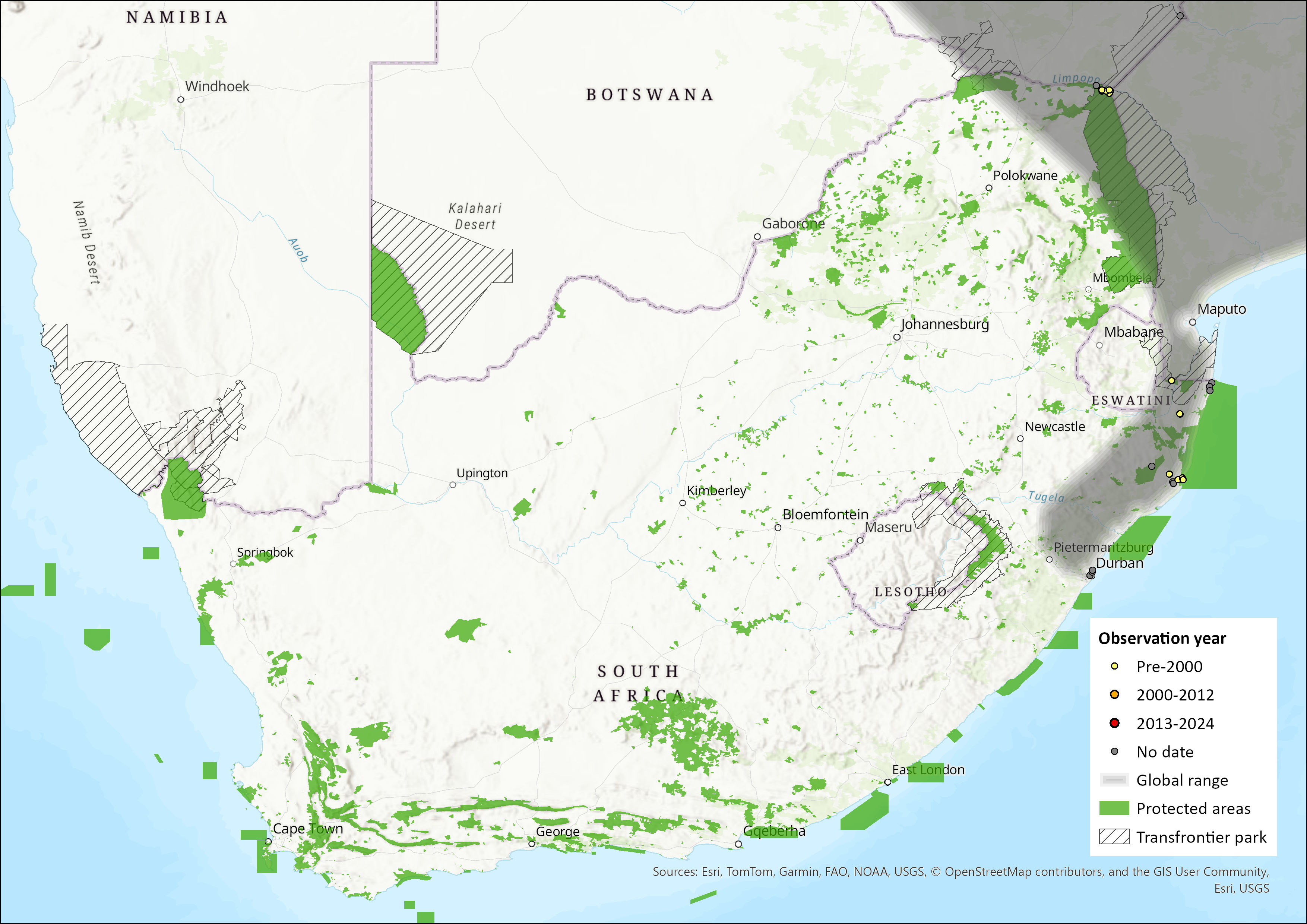 Figure 1. Distribution records for Butterfly Bat (Glauconycteris variegata) within the assessment region (South Africa, Eswatini and Lesotho). Note that distribution data is obtained from multiple sources and records have not all been individually verified.
Biogeographic Realms
Biogeographic Realm: Afrotropical
Occurrence
Countries of Occurrence
| Country | Presence | Origin | Formerly Bred | Seasonality |
| Angola | Extant | Native | – | – |
| Benin | Extant | Native | – | – |
| Botswana | Extant | Native | – | – |
| Burundi | Extant | Native | ||
| Cameroon | Extant | Native | – | – |
| Central African Republic | Extant | Native | – | – |
| Chad | Extant | Native | – | – |
| Congo | Extant | Native | – | – |
| Congo, The Democratic Republic of the | Extant | Native | – | – |
| Cote d’Ivoire | Extant | Native | – | – |
| Eswatini | Extant | Native | – | – |
| Ethiopia | Extant | Native | – | – |
| Gabon | Extant | Native | – | – |
| Gambia | Extant | Native | – | – |
| Ghana | Extant | Native | – | – |
| Guinea | Extant | Native | ||
| Kenya | Extant | Native | – | – |
| Malawi | Extant | Native | – | – |
| Mozambique | Extant | Native | – | – |
| Namibia | Extant | Native | – | – |
| Nigeria | Extant | Native | – | – |
| Rwanda | Extant | Native | – | – |
| Senegal | Extant | Native | – | – |
| Somalia | Extant | Native | – | – |
| South Africa | Extant | Native | – | – |
| South Sudan | Extant | Native | ||
| Sudan | Extant | Native | – | – |
| Tanzania, United Republic of | Extant | Native | – | – |
| Togo | Extant | Native | – | – |
| Uganda | Extant | Native | – | – |
| Zambia | Extant | Native | – | – |
| Zimbabwe | Extant | Native | – | – |
Large Marine Ecosystems (LME) Occurrence
Large Marine Ecosystems: (Not specified)
FAO Area Occurrence
FAO Marine Areas: (Not specified)
Climate change
To date, no studies have explored the potential impacts of climate change on the species distribution, ecology or physiology. The species it is often associated with riparian areas in coastal forest, savanna, or open woodland habitats (Monadjem et al. 2020). Increases in mean temperature and interannual precipitation variability, linked to climate change, are likely to negatively impact riparian areas (Capon et al. 2013) and associated invertebrate communities (Gaona et al. 2025), which in turn can potentially affect the species.
Population Information
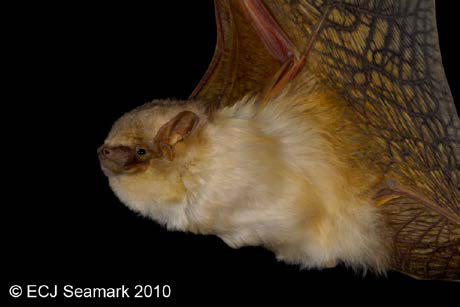
This species is considered rare throughout its range, but it may also be under-sampled as it is difficult to record due to its reticulated wings resembling dead leaves, rendering roosting bats well camouflaged (Happold 2013). It is therefore difficult to estimate the population size within the assessment region but may be locally common in some areas. It is not well represented in museums, with over 40 specimens examined in Monadjem et al. (2020). As it roosts in foliage (often hidden among leaves or palm fronds), it does not form large colonies, usually singly or in pairs (Monadjem et al. 2020), and always fewer than 10 individuals (Rambaldini 2010). As such, there are suspected to be less than 10,000 individuals in total across its range, and possibly fewer than 1,000 mature individuals within the assessment region. Further data on density, colony size and occupancy are needed to evaluate this assumption.
Current population trend: Presumed to be stable
Continuing decline in mature individuals? Unknown
Number of mature individuals in population: <10,000
Number of mature individuals in largest subpopulation: <10,000
Continuing decline in number of subpopulations: Unknown
Number of subpopulations: One, with 10-20 colonies
All individuals in one subpopulation: Presumed
Extreme fluctuations in the number of subpopulations: Unknown
Severely fragmented: No
Quantitative Analysis
Probability of extinction in the wild within 3 generations or 10 years, whichever is longer, maximum 100 years: (Not specified)
Probability of extinction in the wild within 5 generations or 20 years, whichever is longer, maximum 100 years: (Not specified)
Probability of extinction in the wild within 100 years: (Not specified)
Population Genetics
Glauconycteris variegata within the assessment region has been studied in a phylogenetic context (Hassanin et al. 2017), and based on mitochondrial data from three gene regions, South African animals appear to cluster with other southern Africa specimens. The dataset however, only included animals from one locality (Kruger National Park); therefore, the existence of connectivity between the northern and eastern stretches of South Africa could not be confirmed. Given the intermediate wing loading of the species (Happold 2013), it is possible distinct genetic clusters exist within the assessment region; but this will need confirmation using more fine scale molecular techniques. Currently, evidence suggests at least a single metapopulation.
While actual effective population size (Ne) estimates are not available, it is believed that fewer than 1,000 individuals exist within the assessment region as a whole. Assuming an Ne/Nc conversion ratio between 0.1-0.3, the inferred Ne of this metapopulation is less than 300 individuals, which is below the Ne 500 threshold for a stable and genetically healthy population. Given that the species is likely connected to neighbouring countries, this could be an underestimate but warrants further investigation using molecular techniques to verify its status.
Habitats and ecology
This species is associated with open savannah woodland, open bushland and riverine woodland or coastal forest within the assessment region (Skinner & Chimimba 2005; Monadjem et al. 2020; Happold 2013). It is generally absent from areas of closed forest. However, Rautenbach (1982) captured this species in dense riparian forest in Pafuri, Kruger National Park. It has also been recorded over streams and pools (Happold 2013), and one individual was mist-netted in a picnic ground within dense forest in KwaZulu-Natal (Taylor 1998). It can occur in semi-disturbed or modified habitats. Roosting colonies, containing single individuals or a few pairs, have been found in thatched roofs of abandoned huts and among dense vegetation (Allen 1917; Rautenbach et al. 1979; Ansell & Dowsett 1988; Taylor 1998). In Zimbabwe, Obrist et al. (1989) recorded a group of eight individuals roosting within the foliage of a Natal Mahogany (Trichilia emetica). They have also been found in Lychee (Litchi chinensis) trees (Pienaar et al. 1987) and on a low branch of a Mango (Mangifera indica) tree (McLellan 1986). It is a clutter-edge forager and its diet mainly comprises Lepidoptera species (Monadjem et al. 2020; Happold 2013).
Ecosystem and cultural services: As this species is insectivorous, it may contribute to controlling insect populations that damage crops (Boyles et al. 2011; Kunz et al. 2011). Ensuring a healthy population of insectivorous bats can thus decrease the need for pesticides.
IUCN Habitats Classification Scheme
| Habitat | Season | Suitability | Major Importance? |
| 1.6. Forest -> Forest – Subtropical/Tropical Moist Lowland | – | Unknown | – |
| 2.1. Savanna -> Savanna – Dry | – | Suitable | – |
| 2.2. Savanna -> Savanna – Moist | – | Suitable | – |
| 3.6. Shrubland -> Shrubland – Subtropical/Tropical Moist | – | Suitable | – |
| 14.4. Artificial/Terrestrial -> Artificial/Terrestrial – Rural Gardens | – | Unknown | – |
Life History
Generation Length: Unknown
Age at Maturity: Female or unspecified: Unknown
Age at Maturity: Male: Unknown
Size at Maturity (in cms): Female: Mean forearm length = 4.42 ±0.11 cm; mean total length = 10.40 ±0.74 cm (Monadjem et al. 2020)
Size at Maturity (in cms): Male: Mean forearm length = 4.37 ±0.14 cm; mean total length (Monadjem et al. 2020)
Longevity: Unknown
Average Reproductive Age: (Not specified)
Maximum Size (in cms): (Not specified)
Size at Birth (in cms): (Not specified)
Gestation Time: (Not specified)
Reproductive Periodicity: Anciaux de Faveaux (1970) in Rambaldini (2010: 255) indicates that this species is monoestrus, but that the seasonal reproductive cycle can change across its range. Pregnant females have been encountered in August (Smithers and Wilson 1979) and November (Orbrist 1989) in Zimbabwe.
Average Annual Fecundity or Litter Size: reported to carry a single young (Obrist et al. 1989)
Natural Mortality: Unknown
Breeding Strategy
| Does the species lay eggs? |
| No |
| Does the species give birth to live young |
| Yes |
| Does the species exhibit parthenogenesis |
| No |
| Does the species have a free-living larval stage? |
| No |
| Does the species require water for breeding? |
| No |
Movement Patterns
Movement Patterns: Unknown
Congregatory: Colonies of this species are small, and there are believed to be less than 10,000 individuals in total (Monadjem et al. 2017). Happold and Happold (2023: 136) mention that these bats were found roosting singly, in pairs or in groups of three to 12 individuals.
Systems
System: Terrestrial
General Use and Trade Information
Not known to be traded or utilised in any form.
Local Livelihood: N/A
National Commercial Value: Glauconycteris variegata eats airborne prey, primarily soft-bodied insects such as moths (see Kingdon 1974; Fenton et al. 1977). Where they occur near agro-ecosystems they may afford farmers natural pest control.
International Commercial Value: N/A
End Use: N/A
Is there harvest from captive/cultivated sources of this species? Not to our knowledge
Harvest Trend Comments: N/A
Threats
There are no significant overall threats to this taxon, and it occurs across several large, protected areas. The species can also utilise semi-disturbed vegetation and human structures for roosting. However, there is ongoing habitat loss from agricultural transformation, especially in KwaZulu-Natal (Jewitt et al. 2015), which may cause population declines. Selective logging of trees for fuelwood and charcoal production may also cause local declines. Removal of the commercial pine forests from the iSimangaliso Wetland Parks is also suspected to have adversely affected the local subpopulation in the area. More research must be done to quantify the severity of local threats to the species. The species is categorised as “medium-high risk species” in terms of its wind turbine collision potential (MacEwan et al. 2020), however wind turbines do not appear to pose a significant threat to the species at present.
Habitat trend: Stable overall with suspected local declines. While savannah woodland in the assessment region is generally well protected (Driver et al. 2012), KwaZulu-Natal forests and moist woodlands are under pressure in some areas. An average of 1.2% natural habitat is transformed per annum since 1994 in KwaZulu-Natal, primarily due to agriculture, timber plantations, human settlements and industry and mines (Jewitt et al. 2015).
Conservation
The Variegated Butterfly Bat occurs in protected areas such as in the Kruger National Park, Ndumo Game Reserve, Hluhluwe-iMfolozi Game Reserve and the iSimangaliso Wetland Park. No direct interventions can be put in place until more data on population size and trends, as well as local threat severity, is produced. However, the species would benefit from further protected area expansion, such as the planned link from Maputaland to the Lubombo Transfrontier Conservation Area (Smith et al. 2008). Identification and protection of key roost sites is also necessary.
Recommendations for land managers and practitioners:
- Report discoveries of new roost sites.
- Protection and expansion of riparian habitats and transfrontier conservation areas in the eastern parts of the assessment region.
Research priorities:
- Further field surveys to discover new roost sites to inform protected area expansion.
- Monitoring of known colonies to establish population size and trend.
- Bolstering species reference call libraries to enhance acoustic monitoring.
- Quantification of severity of local threats.
Encouraged citizen actions:
- Citizens can assist the conservation of the species by reporting sightings on virtual museum platforms (for example, iNaturalist and MammalMAP), especially outside protected areas.
Bibliography
ACR. 2015. African Chiroptera Report 2015. Pretoria, South Africa.
Allen JA. 1917. The American Museum Congo Expedition collection of bats. Bulletin of the American Museum of Natural History 37: 405–478.
Ansell, W.F.H. and Dowsett, R.J. 1988. Mammals of Malawi – an Annotated Checklist and Atlas. The Trendrine Press, Zennor, St Ives, Cornwall, UK.
Boyles JG, Cryan PM, McCracken GF, Kunz TH. 2011. Economic importance of bats in agriculture. Science 332: 41–42.
Capon, S.J., Chambers, L.E., Mac Nally, R., Naiman, R.J., Davies, P., Marshall, N., Pittock, J., Reid, M., Capon, T., Douglas, M. and Catford, J., 2013. Riparian ecosystems in the 21st century: hotspots for climate change adaptation?. Ecosystems, 16, pp.359-381.
Driver A, Sink KJ, Nel JN, Holness S, van Niekerk L, Daniels F, Jonas Z, Majiedt PA, Harris L, Maze K. 2012. National Biodiversity Assessment 2011: An Assessment of South Africa’s Biodiversity and Ecosystems. Synthesis Report. South African National Biodiversity Institute and Department of Environmental Affairs, Pretoria, South Africa.
Fenton, M.B., Boyle, N.H., Harrison, T.M. and Oxley, D.J., 1977. Activity patterns, habitat use, and prey selection by some African insectivorous bats. Biotropica, pp.73-85.
Gaona, F.P., Delabye, S., Potocký, P., Govorov, V., Čuda, J., Foxcroft, L.C., Garlacz, R., Hejda, M., MacFadyen, S., Pyrcz, T. and Pyšková, K., 2025. Climate‐driven vegetation characteristics shape phytophagous and carnivorous insect diversity in South African savannahs. Journal of Biogeography, 52(4), p.e15076.
Happold M. 2013. Glauconycteris variegata Variegated Butterfly Bat. Pages 576–578 in Happold M, Happold DCD, editors. Mammals of Africa. Volume IV: Hedgehogs, Shrews and Bats. Bloomsbury Publishing, London, UK.
Hassanin, A., Colombo, R., Gembu, G.C., Merle, M., Tu, V.T., Görföl, T., Akawa, P.M., Csorba, G., Kearney, T., Monadjem, A. and Ing, R.K., 2018. Multilocus phylogeny and species delimitation within the genus Glauconycteris (Chiroptera, Vespertilionidae), with the description of a new bat species from the Tshopo Province of the Democratic Republic of the Congo. Journal of Zoological Systematics and Evolutionary Research, 56(1), pp.1-22.
Jewitt D, Goodman PS, Erasmus BFN, O’Connor TG, Witkowski ETF. 2015. Systematic land-cover change in KwaZulu-Natal, South Africa: implications for biodiversity. South African Journal of Science 111: 1–9.
Kingdon, J., 1988. East African mammals: an atlas of evolution in Africa, volume 3, Part A: Carnivores (Vol. 3). University of Chicago press.
Kunz TH, Braun de Torrez E, Bauer D, Lobova T, Fleming TH. 2011. Ecosystem services provided by bats. Annals of the New York Academy of Sciences 1223: 1–38.
McLellan LJ. 1986. Notes on bats of Sudan. American Museum Novitates 2839: 1–12.
Monadjem, A., Taylor, P.J., Jacobs, D. & Cotterill, F.P.D. 2017. Glauconycteris variegata. The IUCN Red List of Threatened Species 2017: e.T44800A22069727. https://dx.doi.org/10.2305/IUCN.UK.2017-2.RLTS.T44800A22069727.en. Accessed on 06 July 2025.
Monadjem, A., Taylor, P.J., Cotterill, F.P.D. and Schoeman M.C. 2020. Bats of Southern and Central Africa: a biogeographic and taxonomic synthesis, Second Edition. University of Witwatersrand Press, Johannesburg.
Obrist M, Aldridge HDJN, Fenton MB. 1989. Roosting and echolocation behavior of the African bat, Chalinolobus variegatus. Journal of Mammalogy 70: 828–833.
Pienaar U de V, Joubert SCJ, Hall-Martin A, de Graaff G, Rautenbach IL. 1987. Field Guide to the Mammals of the Kruger National Park. Struik, Cape Town, South Africa.
Rambaldini DA. 2010. Glauconycteris variegata (Chiroptera: Vespertilionidae). Mammalian Species 42: 251–258.
Rautenbach IL, Pienaar U de V, de Graaff G. 1979. Records of seven small mammal species recorded for the first time from the Kruger National Park. Koedoe 22: 81–87.
Rautenbach IL. 1982. Mammals of the Transvaal. No. 1, Ecoplan Monograph, Pretoria, South Africa.
Skinner, J.D. and Chimimba, C.T. (eds). 2005. The Mammals of the Southern African Subregion. Cambridge University Press, United Kingdom, Cambridge.
Smith RJ et al. 2008. Maputaland centre of endemism using biodiversity, economic and threat data. Biological Conservation 141: 2127–2138.
Smithers, R. H. N. and V. J. Wilson (1979). Checklist and atlas of the mammals of Zimbabwe Rhodesia. Musem Memoir, Salisbury, 9: 193 pp.
Taylor, P.J. 1998. The Smaller Mammals of KwaZulu-Natal. University of Natal Press, Pietermaritzburg, South Africa.